Lab Inventory Management for Research Institutions: What to Consider Before You Buy
Comparing lab inventory management platforms for research? Learn what to check for cold storage tracking, barcode scanning, sample records, migration, and institutional fit.

Download Whitepaper
TL;DR
Before buying lab inventory management software, research institutions should decide what they need to track, then test each platform on storage mapping, barcode scanning, sample records, data migration, multi-site permissions, pricing, and hosting.
- Track what matters.
Irreplaceable samples such as cell lines, tissue, and patient-derived DNA need location, lineage, and custody records, while consumables like tubes and well plates need stock visibility and reorder triggers. Most institutions need both, so decide which matters more before comparing a research LIMS (Laboratory Information Management System) with a quality control one.
- Storage and scanning.
Check that the platform mirrors your real freezer, shelf, rack, box, and position hierarchy, and that researchers can scan barcodes from a mobile app at the freezer or bench. Terminus Bio cut per-sample data entry from about two minutes to ten seconds, roughly a 92% reduction, using barcode automation with SciSure.
- Flexible sample records.
Cell lines, DNA samples, and chemicals each need different fields, such as passage numbers, concentration values, expiration dates, and Safety Data Sheets. Look for configurable sample types, validation rules, and parent-child lineage for aliquots, plus low-stock and expiration reminders that lab staff can set up without paid custom development.
- Migration and shared access.
Years of spreadsheet records often arrive with gaps, including samples assigned to researchers who have left. Ask what cleanup and validation help the vendor provides, pilot on one freezer, and test permissions across groups and sites. At Fraunhofer Institute for Cell Therapy and Immunology IZI, SciSure helped seven departments organize records previously kept in paper notebooks.
- Pricing and hosting.
Platforms may charge per user, storage unit, or sample count, and migration support can be billed separately, so ask what the base price includes. Bring IT and procurement in early to confirm hosting (public cloud, private cloud, or on-premises), data location, interface languages, and the contracting entity. SciSure supports data centers in Germany.
Ready to see SciSure in action?
No commitment · Free consultation
I've had enough conversations with scientists to know how this usually goes. A postdoc or lab manager gets tired of hunting through a freezer for a mislabeled tube, someone says, “We should really get a proper inventory system,” and a grant or manuscript deadline pushes it down the list again.
The costs accumulate over time: 20 minutes searching for a vial, a duplicate order because nobody knows what's in stock, or an experiment delayed by a missing reagent. Meanwhile, researchers rely on spreadsheets last updated by someone who left months ago.
Occasionally, the consequences are much larger. In 2024, a freezer failure at Karolinska Institutet destroyed research and biobank samples accumulated over decades, many described as irreplaceable. The investigation identified organizational gaps, including unclear responsibility for freezer monitoring and escalation.
Lab inventory software belongs alongside clear ownership and monitoring procedures. Your team needs to know where materials are stored, who is responsible for them, and who can act when something goes wrong.
For more on the everyday impact, our breakdown of the cost of manual lab data entry explores the time and material losses that labs rarely measure.
Start with what your lab needs to track
Irreplaceable research samples and replenishable supplies need different kinds of tracking. A cell line, tissue sample, or patient-derived DNA aliquot requires accurate location, lineage, and custody records. PCR tubes, well plates and other consumables need stock visibility and reorder triggers.
Most institutions need both. Shared stocks should be distinguishable from materials reserved for individual researchers, so teams can avoid duplicate orders and plan experiments around what's available. Storage requirements also vary, from freezers and liquid nitrogen tanks to animal cages and greenhouses or chemicals kept at room temperature.
If irreplaceable samples are your main concern, make sample tracking and storage management central to your evaluation.
A tool that handles purchasing well may still struggle with complex freezer layouts or sample relationships.
The same applies when comparing research systems with quality control or manufacturing LIMS. R&D teams need flexibility as sample types and experiments evolve. Our comparison of R&D LIMS versus QC LIMS explains how those requirements differ.
What to look for when comparing lab inventory platforms
1. Visual storage mapping and barcode scanning
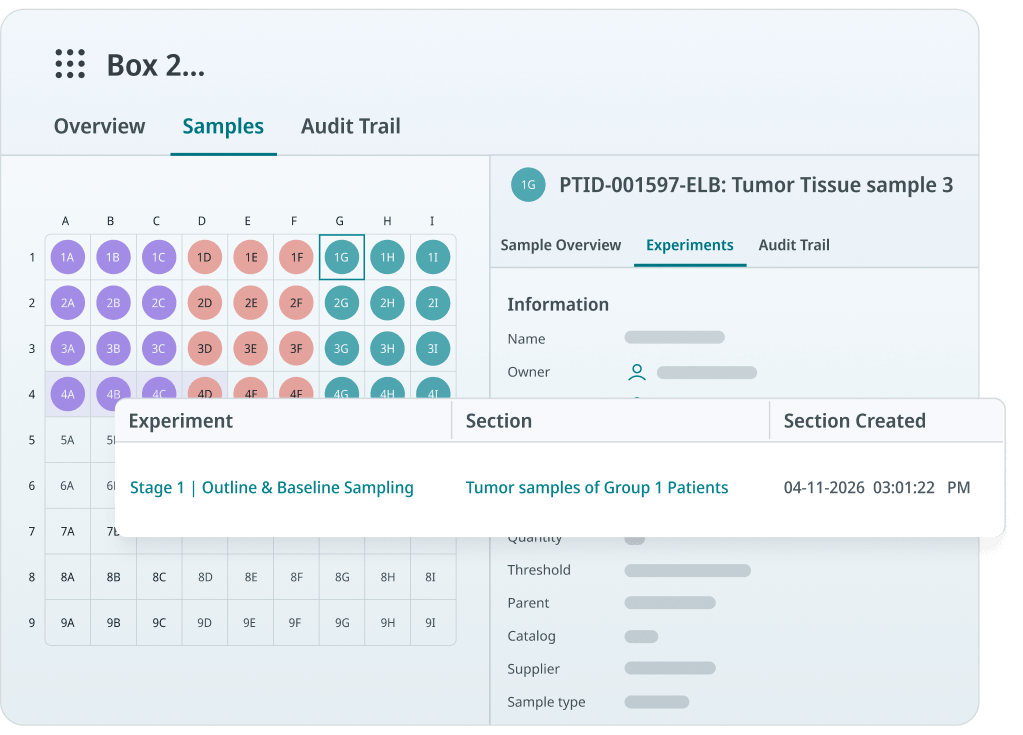
A researcher should be able to find the exact freezer, shelf, rack, box, and position holding a sample. Test whether the platform can reproduce your actual storage hierarchy, including compartment types, grid dimensions, and position numbering.
SciSure combines searchable tabular records with visual tools for moving samples, finding empty locations, and checking storage capacity. Reusable templates let teams add storage units without rebuilding the same structure each time.
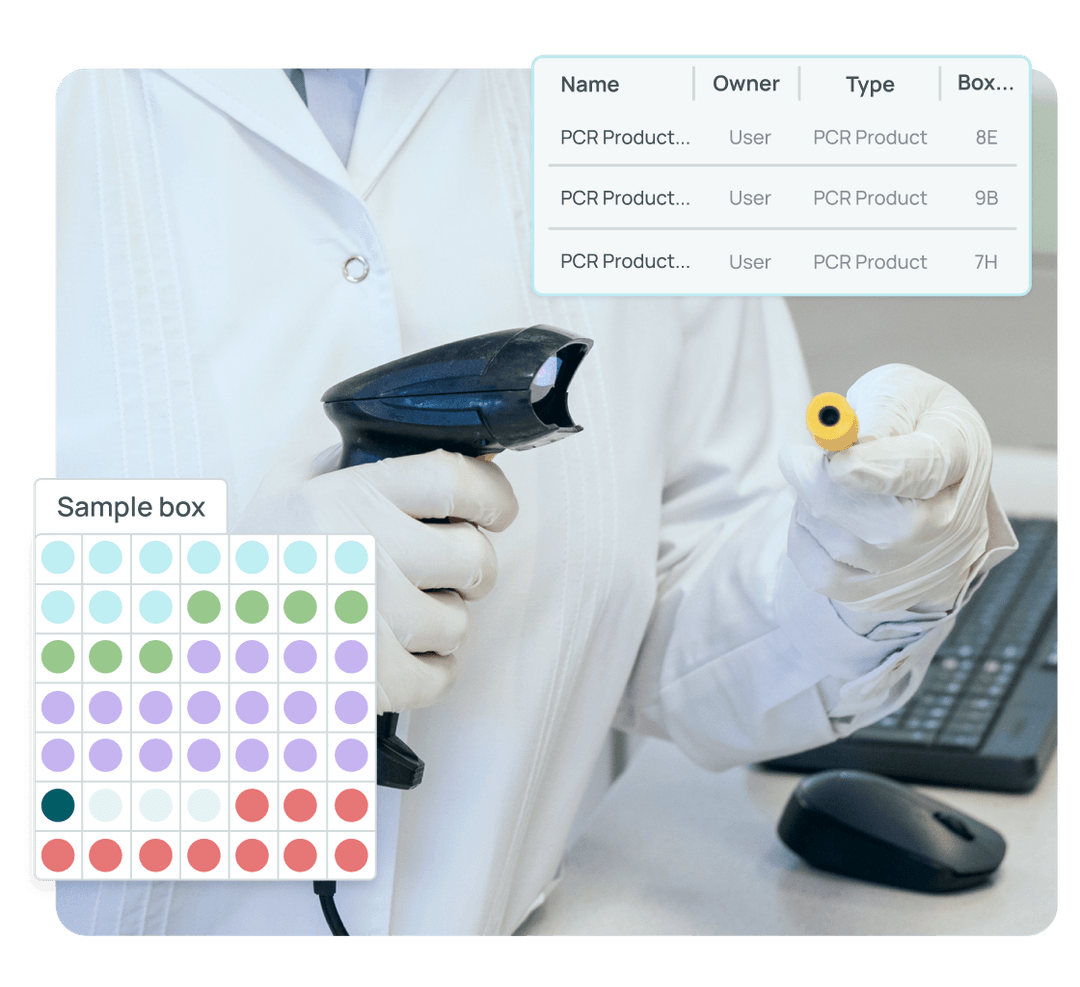
Accurate locations also depend on how easily researchers can record changes. Someone handling samples that could thaw quickly needs to scan and update them where they are working. If logging a move means returning to a desktop later, records can fall behind the physical inventory.
Look for mobile barcode scanning that supports check-in, check-out, and location or quantity updates at the point of use. Check whether scanning a storage unit or compartment shows its contents, as well as whether individual sample barcodes work. With SciSure, teams can also configure automatically numbered sample IDs using a prefix-number-suffix format.
Terminus Bio, a plant biotechnology company managing thousands of cell line samples, reduced per-sample data entry from around two minutes to ten seconds after adopting barcode automation with SciSure. That's roughly a 92 percent reduction, making routine updates much easier to fit into research work.
Ask vendors:
- Can we map our actual storage layouts and reuse them as templates?
- Can researchers scan samples and compartments through a mobile app?
- Can they update locations, quantities, and check-out records while at the freezer or bench?
2. Flexible sample records and useful automation
Research samples need different information. Cell lines may require passage numbers and mycoplasma testing records. DNA samples need concentration, sequence, and purity values. Chemicals need expiration dates, CAS numbers, and Safety Data Sheets.
Look for custom sample types or item categories with configurable fields, required entries, and validation rules. Parent-child relationships should make it easy to trace aliquots and processed samples back to their source. You should be able to answer, “Where did this sample come from, and what was made from it?” without reconstructing the history manually.
Ask how these records can change as your research develops. A system that requires paid custom development for every new workflow can become difficult to maintain and expensive.
Automation should likewise reduce the routine work around those records. Useful examples include low-stock order reminders, expiration notifications, and tasks assigned to the right person after a sample event. Test how easily lab staff can configure these workflows and where IT or vendor support is required.

Ask vendors:
- Can we define different sample types, required fields, and validation rules?
- Can we track sample lineage and relationships between aliquots?
- Which events can trigger reminders or tasks, and can lab staff configure them?
3. Migration support and clear sample ownership
Most institutions are bringing years of records from spreadsheets, shared drives, or an older system. Some collections have incomplete descriptions, inconsistent locations, or samples assigned to researchers who have left.
Ask how the vendor helps your team prepare and validate that data. Receiving an import template is very different from working with an implementation team that helps resolve formatting and ownership gaps before the import. SciSure's Customer Success team supports institutions through migration and data import as part of the implementation process.
Ownership deserves particular attention in university labs and shared facilities, where students, postdocs, and staff regularly move on. A sample should retain its historical context while having a current person responsible for it. With SciSure, labs can retain the original creator on the sample record and reassign active ownership to a current researcher, lab manager, or PI. This helps bring inherited freezer collections into a usable inventory without losing who created the samples.
Start with a pilot on one freezer or safety cabinet. It gives your team a manageable way to check location accuracy, identify missing fields, and confirm that imported records work in daily use before adding the full collection. Data cleanup and ownership verification may take longer than the import itself, so include both in the rollout plan.
If you're comparing vendors, check out our comparison of the best lab management software ranked by what keeps running after a lab manager or safety contact leaves.
Ask vendors:
- What support do you provide during the data cleanup, formatting, and validation phase?
- Do you have experience with data migration projects from previous solutions?
- How do we reassign responsibility and access when someone leaves while preserving traceability?
4. Support for multiple groups and sites
Institutions with several labs or departments need shared visibility and clear permissions. Central administrators may need oversight across the organization, while individual groups need control over their sample types and storage workflows.
Test those arrangements using a realistic example: a few storage units shared by several small teams or a biobank serving multiple departments. Confirm who can view, edit, move, or take responsibility for materials.
At Fraunhofer Institute for Cell Therapy and Immunology IZI in Germany, SciSure helped a seven-department team organize experiments and records previously kept in paper notebooks. By identifying the sample used across failed experiments, the team was also able to detect contamination more easily.
"SciSure helps us save time by enabling us to share our protocols with colleagues easily. It also takes care of our sample management. This reduces the time spent writing down experiments, as samples can be easily linked. It is no longer necessary to annotate sample information (e.g., batch numbers) for each sample used in each experiment."
- Sabrina Rau, Scientist and Scientific Coordinator, Fraunhofer Institute
Ask vendors:
- Can administrators oversee several groups or sites while enforcing different permissions for different departments, people, or locations?
- Can each group maintain its own sample types and storage workflows?
- How can teams share sample information and connect it to experiment records?
5. Pricing and implementation costs
Compare the cost of meeting your actual requirements. Platforms may charge per user, storage unit, or sample count, and data import or migration support may be included or billed separately. A low starting price can become less attractive when essential functionality requires an add-on or higher tier.
Use the workflows above to build a consistent pricing request. Include the researchers and administrators who need access, your current inventory volume, and expected growth. Ask the vendor to identify which parts of the proposed setup require separate purchases or services.
If you're considering a free platform, our guide to choosing between a free or paid LIMS explores where capability limits can affect different labs. Smaller teams may find a free option sufficient, but storage configuration, custom sample types, or migration support can become constraints as requirements grow.
Ask vendors:
- What is included in the base price, and what requires an add-on or higher tier?
- What do implementation and migration support cost?
- How will pricing change as users, storage units, or sample volumes increase?
6. Hosting, language support, and local contracting
Bring IT and procurement into the evaluation early. Hosting location, language support, and the vendor's contracting entity can affect whether a platform fits institutional requirements, even when the research features look suitable. Confirm which deployment options the vendor offers: public cloud, private cloud, or on-premises hosting. For cloud deployments, establish where your data will be stored. With on-premises hosting, the system runs on your institution's own servers.
SciSure supports data centers based in Germany. If keeping research data within German borders is a procurement requirement, confirm the location for your proposed deployment in writing before signing.
Language support should cover daily use as well as training and support. Alongside English, SciSure offers localized interfaces in German and French. Ask vendors to distinguish interface availability from the languages available for onboarding and ongoing assistance.
Also confirm which legal entity will contract with your institution. SciSure has legal entities in the Netherlands, Germany, and the US. The relevant entity can matter for invoicing and supplier requirements, particularly at publicly funded institutions.
Ask vendors:
- Which hosting options are available, and where will our data reside?
- Which languages are supported for the interface, training, and customer support?
- Which legal entity will handle our contract and invoicing?
Map your priorities before building a shortlist
Before booking demos, write down what your lab stands to lose: irreplaceable materials if sample tracking fails, research time if supplies run out, or confidence in records if migration leaves gaps. Use those priorities to decide which workflows every shortlisted vendor must demonstrate.
SciSure's LIMS capabilities focus on research sample tracking and storage management for materials such as cell lines, tissue, DNA, proteins, consumables and chemical compounds. Visual storage mapping, configurable sample types, mobile barcode scanning, sample-related automation, and guided implementation address the practical needs outlined above.
If your freezers contain samples nobody can fully account for, or your spreadsheet has become something people are afraid to touch, get in touch with the SciSure team to share your challenges with us. Together, we can look at your current setup and explore practical ways to improve how your lab manages samples and inventory.
For a broader comparison, our guide to the best sample management and tracking software reviews options across different use cases.
Frequently asked questions
What should research institutions prioritize in a lab inventory system?
Start with the materials you track. Irreplaceable research samples need accurate storage locations, flexible sample records, and lineage tracking. Replenishable supplies need stock visibility and reorder workflows. Test the platform against where your lab needs them.
How long does data transfer from spreadsheets take?
Timing depends on sample volume, the number of source files, and the quality of existing records. Cleanup and ownership checks often take longer than importing the data. A pilot on one freezer helps establish a realistic timeline before a full rollout.
Does SciSure work for universities as well as biotech and pharma?
Yes. SciSure's sample tracking and migration support apply to university core facilities, biotech R&D teams, and pharma research organizations managing valuable samples and inherited inventory records.
Keep reading
- ELN and LIMS for CROs: What to Check Before You Invest
- Best Practices for Lab Inventory Management
- Benchling Alternatives for R&D Teams in 2026: Setup, Migration and Sample Workflows
- How to Build, Manage, and Analyze Your Plasmid Library
- 7 Critical Features To Look For In A Sample Management Platform
- Lab Sample Management: A Complete Guide for Enterprise & Smaller Labs

Read more of our blogs about modern lab management
Discover the latest in lab operations, from sample management to AI innovations, designed to enhance efficiency and drive scientific breakthroughs.