Best Sample Management and Tracking Software For Labs: 5 Platforms for Research Groups and Enterprise Organizations
Five sample management and tracking software platforms compared by lab workflow, scientific context, inventory scope, traceability, integrations, and operational fit.
Download Whitepaper
TL;DR
In this shortlist, SciSure is the strongest fit when sample tracking and traceability are central, connected within one operational platform to experimental records, and relevant to both individual research groups to multidisciplinary departments across multi-site institutions.
- Sample-centric connected lab operations.
SciSure combines configurable sample types, storage, barcodes, lineage, experiments, protocols, inventory, equipment, orders, permissions, audit history, integrations, and disposal. An individual lab can use these capabilities to bring structure to its daily work, while larger organizations can extend the same operating model across teams, disciplines, and locations.
- Research and safety coverage.
SciSure is also the only platform in this shortlist that pairs research and sample-management modules with dedicated EHS capabilities. Relevant modules can cover chemical inventory and safety data sheet management, biosafety, inspections, training, hazardous waste, and regulatory reporting.
- Specialized R&D workflows.
Benchling fits teams whose samples are closely connected to DNA, RNA, proteins, plasmids, cell lines, constructs, and registered biological entities. Labguru fits research teams seeking an integrated electronic laboratory notebook, inventory, equipment, labeling, and project-management workspace. Labguru and Mosaic (a complementary sample-centric platform) are available separately or as a combined offering, so make sure to confirm which products and connections are included.
- Defined testing workflows.
QBench fits testing and service laboratories that manage samples from order and receipt through testing, quality control, reporting, customer communication, and billing. LabVantage fits laboratories that prioritize embedded standard operating procedure execution within LIMS processes.
- Confirm fit at your scale.
Test each platform using your actual sample types, workflows, storage structures, roles, integrations, and exception paths. If you’re planning a broader rollout, add departments, sites, governance, deployment, migration, validation, and long-term administration to the evaluation.
The best sample management software depends on what your lab needs to control and how far the system must scale. This guide can help you figure out what to look out for, questions to ask your vendor, and how SciSure compares.
Ready to see SciSure in action?
No commitment · Free consultation
What should sample management and tracking software help your lab do?
The best sample management and tracking software identifies every sample, shows its current location, preserves its history, and connects it to the scientific and operational work around it. It should fit the way your organization creates, labels, stores, moves, uses, and retires samples.
For an enterprise or institution-wide implementation, the system also needs to work across different scientific disciplines, laboratory groups, departments, facilities, and sites. Your organization may need to support biological specimens, cell lines, chemicals, compounds, formulations, environmental samples, clinical materials, reagents, consumables, and equipment within a coordinated operating environment.
For an individual laboratory group, the system should fit daily work without imposing unnecessary administrative complexity. As the implementation grows, it should also support different scientific disciplines, laboratory groups, departments, facilities, and sites within a coordinated operating environment.
Why all labs should consider safety alongside research
Research samples can also carry operational and safety requirements. Scientists need to document how materials were created and used. Lab operations teams need to manage storage, inventory, equipment, ordering, and lifecycle events. Safety professionals may need to oversee hazards, safety data sheets, training, inspections, waste, and disposal requirements.
Based on the public product scope reviewed, SciSure is the only platform in this five-product comparison that combines:
- Electronic laboratory notebook, LIMS, sample and inventory management, protocols, equipment, supplies, ordering, and research workflows,
- Dedicated EHS capabilities for chemical inventory and safety data sheet management, biosafety, inspections, training, hazardous waste, and regulatory reporting.
This combination can matter at any scale and becomes increasingly valuable as more teams share the same laboratory environment. Scientists need experimental context, lab operations teams need physical and operational control, administrators need governance and reporting, and safety professionals need visibility into applicable hazards and requirements.
How we compared these sample management platforms
SciSure publishes this comparative guide and is one of the platforms covered below. We reviewed publicly available product information and relevant customer stories as of August 2026. We also picked these five platforms because they represent distinct operating models:
- Enterprise and institution-wide connected sample operations
- Biology-aware research and related physical inventory
- Integrated research-team lab management
- Configurable sample-to-report testing workflows
- Embedded SOP execution within LIMS processes
The best-fit labels below reflect each platform’s public positioning and the product scope reviewed. Your own proof of concept should determine the final fit.
The best sample management and tracking software for labs in 2026
SciSure: Best for end-to-end sample tracking that scales with your lab
Best for: Universities, individual research groups, research institutions, biotech, and biopharma organizations that need to coordinate samples, experiments, inventory, equipment, lab operations, and relevant safety programs across multiple teams or locations.
SciSure’s enterprise position begins with sample management, its differentiation also beginning with the sample record, not the size of the organization using it. Each sample can carry its scientific and operational context, including its source or parents, storage location, barcode, lineage, experiment history, custodian, associated materials, remaining quantity, permissions, and lifecycle status.
SciSure LIMS brings these records together so your teams can trace what a sample is, where it has been, how it was used, and what happened to it. Configurable sample types allow different scientific groups to model the materials and metadata their work requires while operating within a broader organizational framework.
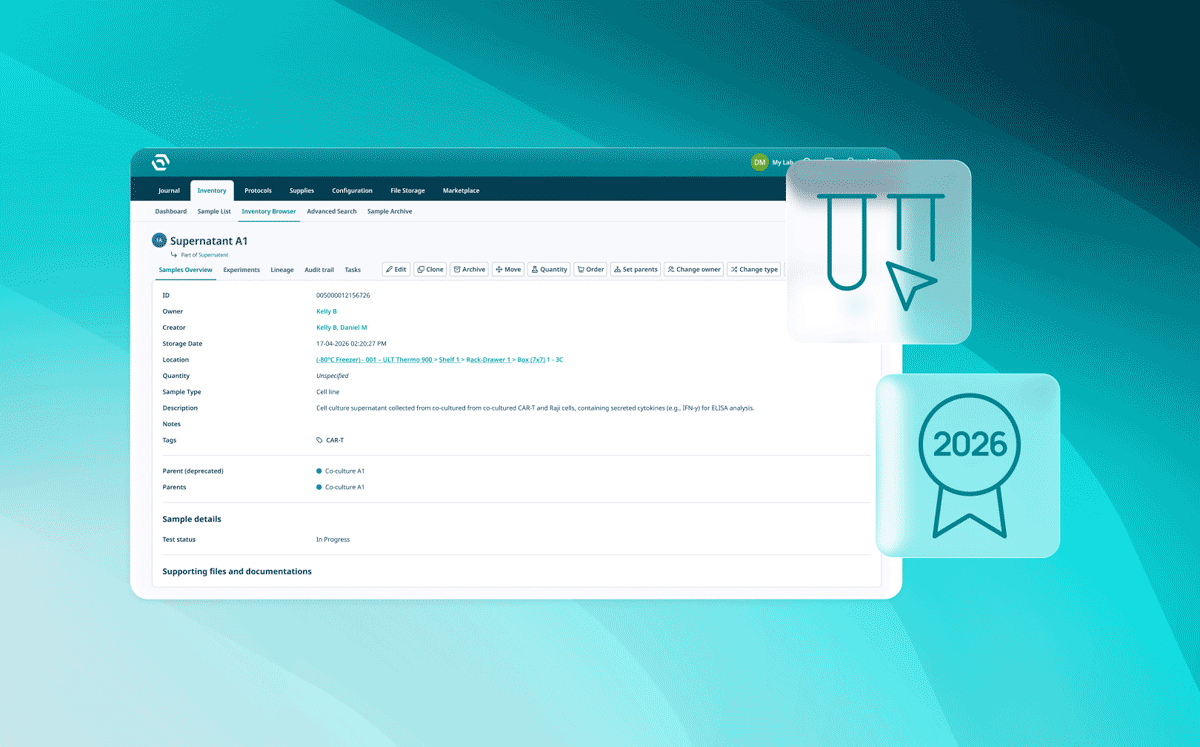
Sample management and tracking with SciSure LIMS
Here’s a non-exhaustive list of what you can expect after implementing SciSure LIMS and its research-relevant features:
These capabilities are useful whether one laboratory group is replacing spreadsheets or an institution is coordinating work across departments and sites. A team can begin with the sample workflows it needs today and extend the same environment into shared equipment, integrations, governance, alternative deployment models, and relevant safety functions as its requirements grow.
SciSure Health & Safety
Besides sample management, inventory, LIMS, research documentation, equipment, supplies, ordering, and lab operations, SciSure also includes dedicated EHS capabilities included in your selected package and hosting model. These capabilities can cover:
- Chemical hazard information and container-level tracking
- Laboratory inspections
- Hazardous-waste processes
- Safety-relevant equipment and oversight activities
The value comes from coordinating responsibilities across the organization. Scientists can connect samples with experiments and results. Lab operations teams can manage storage, inventory, equipment, and supplies. Administrators can oversee roles, configuration, and integrations. Safety professionals can manage the hazards, training, inspections, and disposal requirements that apply to laboratory work.
The labs succeeding with SciSure
These examples show SciSure supporting sample-centric work in different operating contexts, from research groups and specialized biotech workflows to high-throughput institutional testing.
Lund University
With SciSure implemented, Swedish Lund University’s Department of Translational Medicine reported reducing the time needed to find a sample from as much as one hour to less than one minute. The teams evaluated more than ten alternatives, and their sample-management implementation took a few days.
Terminus Bio
Atlanta, Georgia-based Terminus Bio reported reducing data entry for subcultured cell lines from two minutes to ten seconds per sample, or about a 92% reduction, using SciSure’s configurable barcode workflow. It also reported reducing data-management time by more than 90%.
Boston University
Boston University’s clinical testing laboratory processed more than 9,000 samples per day at peak. SciSure APIs connected the workflow with testing robots and two electronic medical record systems.
Put SciSure LIMS to the Test
The best way to evaluate SciSure is to see it handle the work your lab actually does. Ask your SciSure implementation specialist to configure at least two representative sample types using your metadata, terminology, and storage model. If you’re evaluating a multi-team or multi-site rollout, choose sample types from different disciplines, groups, or locations.
Then follow those samples through a complete workflow: model at least two real sample types and follow them through creation, lineage, storage, barcode-driven actions, experimental use, movement, permissions, inventory effects, and disposal.
If safety is part of your organization’s scope, bring that into the demonstration too. Choose a realistic scenario involving chemical or safety data sheet information, biological hazards, training requirements, inspections, hazardous waste, or disposal. Before the demo ends, confirm which SciSure modules, integrations, and connections are included in the proposed package.
Benchling: Built for biology-aware R&D and related sample inventory
Built for: Biotech and biopharma R&D teams whose work centers on DNA, RNA, proteins, cell lines, plasmids, constructs, and other registered biological entities.
Benchling Bioresearch is primarily a biology-aware R&D environment for experimental data, biomolecule design, sequence work, and registered biological entities. Its Registry and Notebook provide the foundation, with supporting sample-management and inventory capabilities that connect physical materials to biological records and experiments.
Within this biology-centered model, your team can represent samples, containers, consumables, equipment, and storage locations; associate physical materials with registered entities; preserve relevant lineage; and link inventory records to Notebook activity. The operational depth of these capabilities varies by workflow, so make sure to test them directly.
How SciSure compares to Benchling for sample and inventory management
Benchling’s sample-management and inventory scope is narrower than SciSure’s enterprise LIMS and inventory coverage. SciSure supports configurable biological and non-biological sample types, deeper storage and lifecycle workflows, barcode automation, inventory, equipment, supplies, ordering, permissions, audit history, and multidisciplinary operations across teams and sites.
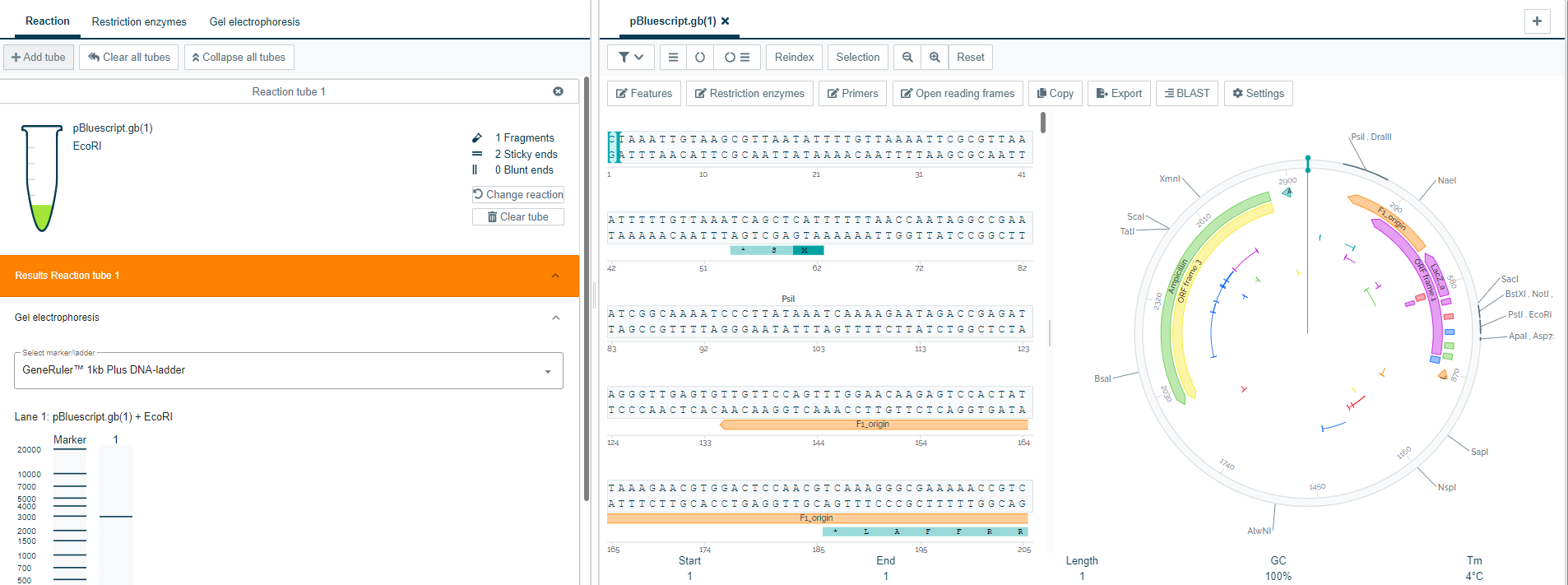
SciSure also supports molecular biology workflows through configurable records, and integrations. Its CloneAssist beta add-on adds DNA and RNA sequence analysis, annotation, plasmid visualization, restriction-enzyme analysis, gel simulation, and sequence import and export within experiments. Make sure to evaluate the molecular tools and the complete operational sample lifecycle separately.
For a deeper dive, check out our guide to the best Benchling alternatives in 2026.
Labguru: Built for ELN-centered lab workflows, complemented by Mosaic for sample management
Built for: R&D teams that prioritize experiment documentation and project coordination alongside integrated inventory, equipment, labeling, automation, and reporting.
Labguru organizes day-to-day research through experiment documentation, inventory management, equipment management, labelling, automation, reporting, and project coordination. Its inventory capabilities support configurable records, labels, shopping lists, stock management, and reporting. Equipment features address scheduling, usage, and maintenance, while the electronic laboratory notebook and project tools connect laboratory materials with experiments and research activities.
Cenevo also offers Mosaic, a separate but complementary sample-management platform. Mosaic is designed for sample-intensive operations involving large material collections, end-to-end lifecycle tracking, request and fulfillment workflows, container- and box-level positioning, barcode-driven handling, automated stores, liquid handlers, scanners, and other laboratory systems.
Cenevo positions the two products around complementary strengths: Labguru provides experiment-centric ELN, LIMS, inventory, registration, and research-data management, while Mosaic provides sample-centric operations, orchestration, and automation. They can be implemented independently or as a combined solution, depending on the laboratory’s requirements.
How SciSure compares to Labguru and Mosaic for sample and inventory management
SciSure remains the stronger recommendation when your organization wants detailed sample tracking integrated directly with ELN, protocols, inventory, equipment, supplies, ordering, audit history, integrations, and disposal workflows. The same SciSure environment can support an individual laboratory group and expand across departments or sites. Relevant SciSure modules can also connect research and sample operations with chemical inventory, safety data sheets, biosafety, inspections, training, hazardous waste, and regulatory reporting.
Labguru and SciSure overlap substantially across ELN, inventory, storage, equipment, labeling, purchasing support, permissions, reporting, and sample-to-experiment connections. With Mosaic included as a separate product, you can combine Labguru’s experiment-centric environment with dedicated sample lifecycle management, request fulfillment, barcode-driven operations, and laboratory automation.
Cenevo states that Mosaic and Labguru can be purchased and implemented standalone or combined, depending on customer requirements. Mosaic is not a standard Labguru feature, so don’t assume it to be included in a Labguru package.
QBench: Built for configurable sample-to-report workflows in testing labs
Built for: Testing and service laboratories that need to manage customer orders, sample intake, testing, quality control, results, reports, inventory, and billing in a configurable cloud LIMS.
QBench organizes work around the progression from order and sample receipt through testing, review, reporting, and billing. Your team can track the status of orders, samples, tests, and pending work; add custom fields and identifiers; automate workflow actions; synchronize instrument data; and monitor turnaround times and other laboratory metrics.
Its wider operating model includes electronic worksheets, batch processing, quality-control data, report and Certificate of Analysis generation, customer portals, inventory management, quality management, and invoicing. This makes QBench relevant when your laboratory processes samples for internal or external customers and needs operational and commercial records to move through a defined sample-to-report workflow.
QBench’s centre of gravity is structured testing execution. Make sure to evaluate physical storage, sample lineage, inventory controls, equipment workflows, permissions, integrations, exception handling, and administration alongside its order, testing, reporting, and billing capabilities.
How SciSure compares to QBench for sample and inventory management
QBench’s sample and inventory capabilities are narrower than SciSure’s enterprise LIMS and inventory coverage. SciSure supports configurable sample records, storage hierarchies, barcodes, lineage, parent-child relationships, experimental context, inventory, equipment, supplies, ordering, permissions, audit history, and lifecycle management across scientific disciplines, teams, and sites.
SciSure also supports configurable workflows, instrument and system integrations, reporting, high-throughput sample operations, and connections between samples, experiments, protocols, results, reagents, and equipment. Relevant EHS modules can add chemical inventory, safety data sheets, biosafety, inspections, training, hazardous waste, and regulatory reporting to the broader platform environment.
LabVantage: Built for embedded SOP execution within LIMS processes
Built for: Laboratories that need technicians to follow controlled standard operating procedures as part of sample testing and LIMS workflows.
LabVantage combines LIMS sample and test records with an integrated Laboratory Execution System. The defining fit in this comparison is its ability to embed SOP execution within LIMS processes.
Electronic worksheets and workflow templates can guide technicians through required procedure steps. These workflows can prompt users to confirm instrument calibration, reagent status, sample quantity, environmental conditions, and other controls before work proceeds.
The execution layer can log and time-stamp procedure activities, capture required data, route completed worksheets for review, and support approvals and electronic signatures.
This matters when your laboratory needs to preserve evidence that each sample was tested according to the approved procedure using suitable instruments, reagents, and conditions.
Your evaluation should focus on how LabVantage connects the sample record, testing workflow, SOP instructions, required data, exceptions, and approvals. Also examine the implementation and validation effort required to configure, maintain, and update those controlled procedures.
How SciSure compares to LabVantage for sample and inventory management
LabVantage’s position in this comparison centres on embedding SOP steps within LIMS testing processes, while SciSure’s position covers the wider enterprise sample environment. This includes research documentation, sample and inventory management, laboratory operations, equipment, protocols, and relevant safety modules.
SciSure also supports version-controlled protocols and executable procedures that can you can connect to experiments, samples, reagents, results, and audit history. Its enterprise scope extends across configurable biological and non-biological sample types, storage hierarchies, barcode automation, lineage, inventory, equipment, supplies, ordering, integrations, permissions, and multidisciplinary operations across teams and sites.
How to choose the right sample management and tracking system for your lab
FAQs
What is the best sample management and tracking software for enterprise and multidisciplinary labs?
SciSure is the strongest fit in this five-platform comparison when your organization needs connected sample operations across scientific disciplines, laboratory groups, departments, facilities, or sites. It combines configurable sample records, storage, lineage, barcodes, experiment links, protocols, inventory, equipment, supplies, orders, permissions, audit history, integrations, and deployment options.
Relevant SciSure EHS modules can extend that environment across chemical inventory and safety data sheet management, biosafety, inspections, training, hazardous waste, and regulatory reporting when included in your selected package and hosting model.
Why does connecting sample management with EHS matter?
Research materials can carry scientific, operational, and safety requirements throughout their lifecycle. Scientists need experiment and lineage context. Lab operations teams need storage, inventory, equipment, and ordering information. Safety teams may need hazard, safety data sheet, training, inspection, and disposal records.
A broader platform can help these teams coordinate their responsibilities while maintaining the records and permissions relevant to each function.
What is the difference between sample tracking software and a LIMS?
Sample tracking software may focus mainly on identity, location, quantity, status, and history. A LIMS usually adds structured workflows, data relationships, chain of custody, permissions, reporting, integrations, testing processes, and broader laboratory operations.
For enterprise use, also evaluate organizational structure, administration, deployment, integrations, security, validation, migration, and cross-site governance.
Can sample management software replace spreadsheets?
Yes, in the case that it gives your organization a configurable data model, structured storage hierarchy, reliable identifiers, barcode workflows, permissions, history, search, and usable import and export. Before migration, clean duplicate identifiers, inconsistent names, missing locations, and obsolete records so the new system begins with reliable data.
For a multi-team rollout, establish ownership for naming conventions, sample types, metadata, storage records, and data-quality rules before migration begins.
What should your organization test before choosing a platform?
Test sample creation, barcode assignment, storage, movement, lineage, experimental use or testing, inventory consumption, equipment context, permissions, audit history, search, disposal, and export. Use your own sample types and include an exception path. Also confirm integration, migration, hosting, validation, implementation, configuration, training, administration, and support responsibilities.
For an enterprise rollout, include multiple disciplines, groups, roles, facilities, or sites in the proof of concept (PoC).
Which sample tracking and inventory management platforms fit contract research organizations?
While the right fit depends on your CRO’s service model, SciSure suits multidisciplinary organizations that need connected sample lifecycles, experiments, inventory, equipment, permissions, audit history, integrations, and operations across teams or sites. QBench is worth evaluating when structured order-to-report testing workflows are central, while LabVantage is relevant when embedded SOP execution is the main requirement. Test each platform using your actual intake, testing, review, reporting, retention, and disposal workflows.
Which sample and inventory management software suits large biopharma laboratories?
SciSure is designed for mid-to-large biopharma organizations that need enterprise LIMS and inventory coverage across biological and non-biological samples, storage hierarchies, barcodes, lineage, experiments, equipment, supplies, ordering, governance, and multiple teams or sites. Relevant SciSure EHS modules can also connect chemical inventory, SDS management, biosafety, inspections, training, hazardous waste, and regulatory reporting with the wider laboratory environment.
What sample and inventory management software fits biotech R&D labs?
SciSure fits biotech R&D labs that need to connect samples, experiments, protocols, inventory, equipment, and wider laboratory operations. Benchling may enter the shortlist when native biomolecule design, sequence work, and registered biological entities are the primary requirements, although its supporting sample-management and inventory scope is narrower than SciSure’s enterprise LIMS coverage.
Is SciSure sample and inventory management suitable for large university laboratories?
Yes. SciSure supports multidisciplinary sample types, shared facilities, configurable storage, barcodes, lineage, experiments, inventory, equipment, permissions, audit history, and governance across departments and sites. Universities can also include relevant EHS modules for chemical inventory and SDS management, biosafety, inspections, training, hazardous waste, and regulatory reporting, subject to the selected package and hosting model.
Choose an enterprise platform that keeps every sample useful
A sample is valuable because of the context your organization can trust around it: identity, location, lineage, experimental use, testing history, inventory context, permissions, and the operational conditions that shape the work.
Benchling, Labguru, Mosaic, QBench, and LabVantage emphasize different aspects of laboratory work. Labguru centers on experiment documentation and integrated research management, while Mosaic extends Cenevo’s offering into sample operations, request fulfillment, and laboratory automation. QBench centers on sample-to-report testing, and LabVantage emphasizes embedded SOP execution within LIMS processes.
SciSure is our strongest recommendation when sample tracking must remain directly connected with experiments, protocols, inventory, equipment, supplies, ordering, integrations, disposal, and relevant safety operations. It fits an individual laboratory group while providing a path to broader multidisciplinary, multi-team, and multi-site use.
Talk to a SciSure specialist and bring your real sample workflows, organizational structure, integration requirements, and deployment needs to the conversation. The most useful demonstration is built around your laboratories, your teams, and the decisions your organization needs to make.
Read More:
.png)
Read more of our blogs about modern lab management
Discover the latest in lab operations, from sample management to AI innovations, designed to enhance efficiency and drive scientific breakthroughs.