7 Critical Features To Look For In A Sample Management Platform
Discover 7 key features every sample management platform needs, from real-time tracking and audit trails to lineage mapping, compliance readiness, and ELN integration for scaling research organizations.
Download Whitepaper
TL;DR
A sample management platform should go beyond basic inventory tracking to deliver real-time traceability, automated audit trails, lineage mapping, and compliance-ready workflows that scale across biological and chemical R&D labs.
- Traceability and audit trails.
The platform must pinpoint the exact storage location of every sample and maintain a chronological record of all collection, handling, analysis, and disposal activities. Every interaction should be timestamped and traceable to a specific user without manual logging.
- Status updates and specialized data.
Samples need real-time status tracking as they move through contamination checks, passage counts, or QC workflows. The platform should handle specialized data types like SMILES chemical notation, GenBank plasmid rendering, and domain-specific metadata without requiring separate tools.
- Lineage, compliance, and integration.
Whether you're tracking chemical derivatives or parent-child biospecimen relationships, the system should map lineage across the whole collection rather than one record at a time. It should support GLP and GxP workflows through signatures, versioning, and access control, and connect sample records to the experiments that used them. This 2023 guide was updated in 2026 with current evaluation criteria and new customer examples.
This post was originally written in 2023 but updated in 2026 to reflect SciSure's updated sample management features, hosting options, and new customer proof from Euroimmun US, Boston College, Arctic Therapeutics, and Lund University.
Ready to see SciSure in action?
No commitment · Free consultation
A sample management platform is a digital system that enables research organizations to track, organize, store, and retrieve biological and chemical samples across their entire lifecycle, from collection and labeling through experimental use, storage, and disposal.
Across biological and chemical R&D labs, "sample management" can mean very different things. A "sample" could be a live mouse within a large colony, a cell line in a cryotube on its 20th passage, a newly synthesized chemical compound, or a recently constructed plasmid. "Management" is equally broad: it can refer to what type of biospecimen or chemical a sample is, where it's stored, who used it last, how much remains, or how it relates to other samples in the collection.
For a single lab, managing this information in spreadsheets might feel workable. But for research organizations operating across multiple sites, departments, and regulatory jurisdictions, the stakes are different. Inconsistent sample data doesn't just slow down one scientist; it creates compounding risk across the entire operation, from failed audits and IP exposure to reproducibility gaps that undermine regulatory submissions.
To manage this complexity reliably, organizations need more than basic inventory lists. They need a sample management platform purpose-built for the scale, regulatory demands, and cross-functional workflows of modern research.
Why your choice of sample management platform matters as you scale
Most labs turn to a Laboratory Information Management System (LIMS) or a broader digital lab platform to handle the complexity of a growing lab. These solutions go by different names: LIMS, Digital Sample Management (DSM) platforms, or integrated Scientific Management Platforms. But regardless of terminology, the core question is the same: does the platform have the capabilities your organization actually needs to manage samples effectively at scale?
This guide breaks down seven essential features to look for in a sample management platform, why each one matters for day-to-day research and long-term organizational scalability, and how to avoid the common mistakes labs make when choosing a solution. For a deeper look at how to build a scalable strategy around these capabilities, see our guide on how to build a scalable sample management strategy.
7 features to look for in a sample management platform
1. Real-time sample traceability
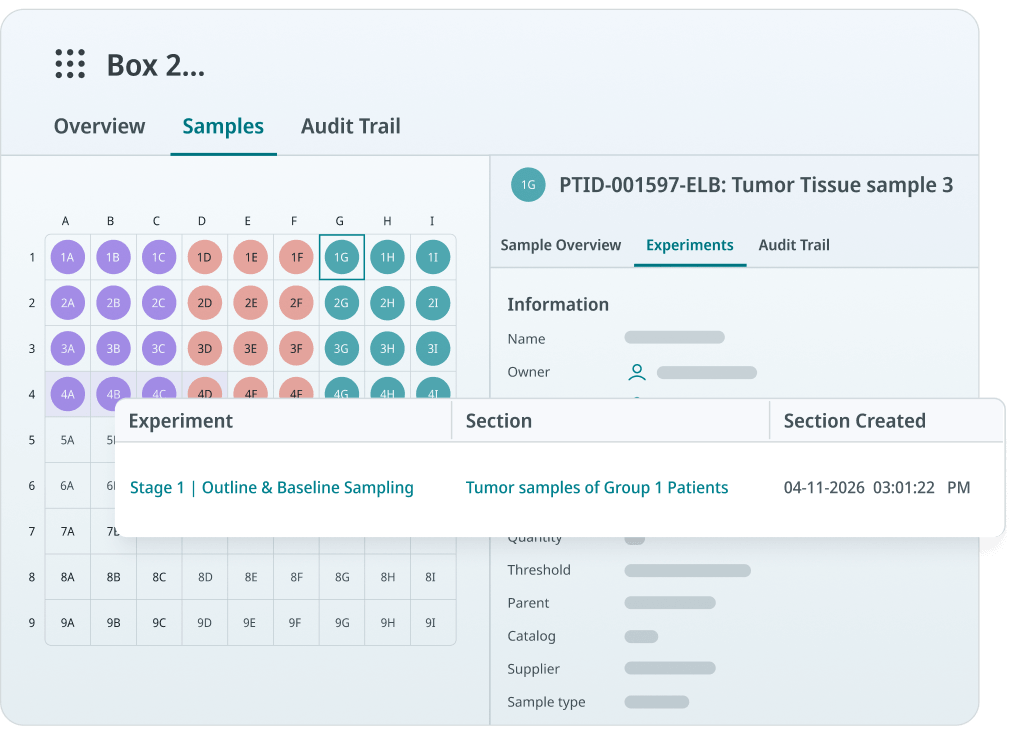
Sample tracking is the most fundamental requirement of any sample management platform. Every researcher in the lab should be able to locate the exact position of any sample at any time, without asking a colleague or checking a separate spreadsheet.
This means the platform should support:
- Hierarchical storage mapping.
Model a freezer the way it physically exists (room, unit, shelf, rack, box, position) and reuse that structure as a template when the next freezer arrives, rather than rebuilding it by hand - Barcode and mobile scanning.
Scan a box or a position from a phone at the bench, not just from a desktop across the room - Free-position search.
Ask the system where there is space, instead of opening freezer doors to find out - Multi-site visibility.
One view across buildings, so two teams don't quietly maintain the same cell line twice
Traceability becomes especially important when multiple researchers and technicians rely on or regularly use the same samples. Without a real-time, searchable record of where every sample lives, labs lose time, create duplicates, and risk using degraded or mislabeled material.
At an organizational level, the cost compounds. When sample retrieval is slow or unreliable, freezer doors stay open longer, freeze-thaw cycles increase, and teams across departments waste time searching instead of researching.
Euroimmun US experienced this firsthand: before centralizing sample management, their teams relied on spreadsheets and staff memory, leading to inconsistent sample status across departments. After implementing SciSure's unified platform, they streamlined retrieval across Scientific Affairs, Quality Control, Sales, and Technical Operations, reducing energy draw from cold storage and eliminating cross-departmental misalignment.
2. Comprehensive audit trails
An audit trail provides a chronological record of all sample collection, handling, storage, analysis, and disposal activities. Think of it as the complete history of a sample's who, what, when, where, why, and how. A strong audit trail should capture:
- Every change to sample metadata, status, or location
- The identity of the person who made each change, with a timestamp
- Any deviations from standard operating procedures
- Records of access, transfers, and experimental use
Audit trails are essential for ensuring data integrity and traceability. They allow labs to identify potential errors in sample handling, reconstruct the history of any sample on demand, and provide the documentation required for regulatory audits.
When sitting across your vendor, make sure to ask a more specific question than "Do you have audit trails?" Rather, you should ask which record types are covered. Coverage is rarely uniform across a platform: sample records, experiments, and storage moves are usually logged in detail, while newer or add-on features sometimes aren't. That gap matters when the record a regulator asks about is the one sitting in the uncovered feature. Get the answer in writing during evaluation rather than discovering it during an audit.
For enterprise organizations, the risk extends beyond individual labs. When audit trail quality varies across sites or departments, the entire organization inherits the compliance exposure of its weakest link. A platform that generates consistent, automatic audit trails across every location ensures that leadership can confidently represent the organization's data integrity posture to regulators, partners, and investors.
3. Dynamic sample status updates
Samples move through workflows, change states, and require frequent updates as experiments progress. A sample management platform must support rapid, easy status tracking so that the digital record always reflects the physical reality. Common examples include:
- Updating a sample's QC status after a contamination check (e.g., "contamination: pass")
- Logging a freeze-thaw event that affects sample integrity
- Recording partial consumption or aliquoting
- Flagging a sample as exhausted, expired, or retired
Because status updates happen frequently throughout the day, the platform should make this action as frictionless as possible. If updating a sample's status takes more than a few seconds or requires navigating multiple screens, researchers will stop doing it, and the system loses its value.
The better question is how much of this the platform can do without a person. A quantity threshold that emails the owner when stock drops. An expiration date that produces a reminder rather than a surprise. A rule that fires when a field changes and updates a record or notifies a team.
With SciSure, teams can build these as trigger-and-action rules, and bulk updates handle the cases where a whole batch changes at once. Every status update a system handles on its own is one that can't be skipped on a busy Friday.
4. Biology- and chemistry-specific capabilities
Not all sample management platforms are created equal. Some solutions offer only basic list-based data management, which works for simple inventory tracking but falls short when labs need to store and work with specialized scientific data. Consider what happens when your lab needs to:
- Store SMILES (Simplified Molecular-Input Line-Entry System) chemical notation strings for synthesized compounds
- Render a plasmid map from GenBank or manage sequence data
- Track cell line passage history with associated viability and morphology data
- Manage compound libraries with associated assay results and property profiles
Buying four or five separate tools to cover these needs is common, and each one is a defensible decision on its own. The cost shows up later, in reconciling data between systems and in the licences, onboarding, and maintenance that multiply with every new team. Total cost of ownership should account for the overhead of running disconnected systems in parallel, not just the platform fee. The result is fragmented data, duplicated effort, and increased risk of errors when information needs to be reconciled across systems.
For more on this challenge, check out SciSure's article "The digital lab: in search of leaner, greener operations" in Nature.
For decision-makers evaluating platforms at an organizational level, this fragmentation also means multiplied license costs, separate onboarding processes for each tool, and ongoing maintenance overhead that scales with every new lab or team added. Total cost of ownership should account not just for the platform fee, but for the hidden costs of running disconnected systems in parallel.
The right sample management platform should handle domain-specific data types natively, so scientists can work within a single tool rather than exporting and importing between disconnected systems.
5. Sample lineage and relationship tracking
Whether you're tracking chemical derivatives, aliquot chains, or the parent-child relationships of biological specimens, your platform must be able to map and display sample lineages across the entire collection.
Lineage tracking answers critical questions like:
- Where did this sample originate?
- What derivatives or aliquots have been created from it?
- How has it been consumed or transformed across experiments?
- Which experimental results are linked to this specific sample or its parent?
This capability becomes particularly important for labs involved in biobanking, drug discovery, or any workflow where provenance directly affects the scientific and regulatory value of results. Without lineage tracking, reproducing findings or validating the history of a sample becomes a manual, error-prone process.
Food Brewer AG, a Swiss cultivated food company scaling plant cell culture production, illustrates why this matters at an organizational level. Their team tracks proprietary plant cell cultures across multiple scale-up stages, from tissue selection through 2,500-liter bioreactors, with full lineage connecting every production stage to its origin material.
By implementing end-to-end traceability with barcoding and custom automation through SciSure's SDK, Food Brewer achieved a 60% productivity increase in R&D and 40% in upstream processing, while building the regulatory and IP documentation needed for commercial scale.
Lineage is easy to assume and easy to get wrong. Some platforms record a parent field and call it lineage, which tells you where a sample came from but not what came out of it. Ask to see a full chain rendered in a demo, several generations deep, using a sample that has been aliquoted and consumed. Ask whether it is core functionality or an add-on.
6. Compliance and regulatory readiness
For labs operating under GLP (Good Laboratory Practice) or GxP frameworks, a sample management platform must actively support the documentation, traceability, and access control requirements that regulators expect. Key compliance capabilities to evaluate include:
- Audit trails and locked records that support GxP and 21 CFR Part 11 workflows through timestamps, electronic signatures, witness signing, and version history. Software supports compliant use; the validation, SOPs, training, and change control stay with your organisation
- Role-based access controls that restrict who can view, edit, move, or dispose of samples based on their scientific responsibility
- Data integrity protections including version control, change logging, and prevention of unauthorized modifications
- Regulatory reporting support for generating compliance documentation on demand rather than scrambling during audit season
Compliance issues arise because the systems used to manage those samples don't capture enough context, control, or traceability to satisfy regulatory scrutiny. Choosing a platform with compliance built in from the start eliminates the need for manual workarounds that introduce risk as the organization scales.
This is especially relevant for organizations operating across regulatory jurisdictions. A lab in the EU may need to satisfy GDPR and GLP requirements, while a US-based counterpart operates under FDA oversight. The platform must enforce consistent compliance standards without requiring site-by-site customization.
Arctic Therapeutics, an ISO 15189 certified biotech in Iceland, centralized their sample management, inventory, equipment tracking, and quality documentation in a single platform with SciSure. Both strengthening compliance while saving approximately two hours per week on registration and inventory processes alone.
7. Integration with ELN and the broader lab ecosystem
A sample management platform that operates in isolation from the rest of the lab's digital infrastructure creates the same silos it was supposed to eliminate. The most effective platforms connect sample data directly to experimental workflows, protocols, and research documentation.
Look for a platform that supports:
- Native ELN integration, so sample records are linked directly to the experiments that use them, preserving full experimental context
- Instrument connectivity, so that automated data capture from lab instruments to reduce manual transcription
- API and SDK access for labs that need custom integrations with internal systems, automation pipelines, or third-party tools
- A marketplace of add-ons, pre-built integrations for barcode scanners, scheduling tools, and specialized workflows
- Hosting that matches your governance: public cloud, private cloud, on-premise, or a hybrid setup where large files stay on your own server. Ask this early; it constrains everything else.
When sample management is connected to ELN and inventory in a single platform, scientists gain a complete picture of their work without switching between disconnected tools. This is the approach behind SciSure's Scientific Management Platform (SMP), which unifies sample tracking, experimental documentation, and inventory management into one connected environment, eliminating the fragmentation that slows research and introduces risk.
How to evaluate a sample management platform
Beyond individual features, consider these practical questions when evaluating any platform:
- Does it reduce your workload or add to it?
If the platform creates more administrative steps than it eliminates, adoption will suffer and data quality will decline. - Can it scale with your organization?
The platform should support multiple sites, growing sample volumes, new sample types, and additional departments without requiring a redesign or separate instances. - Is it built for scientists?
The interface should be intuitive enough that researchers actually use it daily, not just during audits. Low adoption is the fastest way to undermine a platform investment. - Does it unify or fragment your data?
The best platforms combine sample management, ELN, inventory, and compliance into a single connected system rather than requiring you to maintain multiple disconnected tools. - What is the true total cost of ownership?
Consider not just the license fee, but onboarding time, training across teams, integration maintenance, and the hidden cost of running parallel systems if the platform doesn't cover all your needs. - Does it support change management?
For enterprise deployments, phased rollout capabilities, structured onboarding, and the ability to start with core functionality and expand over time are essential for sustainable adoption across the organization.
The best sample management platforms have all of these features embedded into a single, customizable system. If a platform cannot combine these capabilities into an easy-to-use interface, or if it creates more work than it eliminates, it may not be the right solution for your organization.
FAQs: Evaluating sample management platforms
What is a sample management platform?
A sample management platform is a digital system for tracking biological and chemical samples across their lifecycle, from registration and storage through experimental use and disposal. Most labs meet the same capability set under the name LIMS, digital sample management, or an inventory module inside a broader research platform.
How does SciSure compare to Labguru and other sample management platforms?
Labguru and SciSure Research both combine an electronic lab notebook and a LIMS in one system, so experiments and samples share a record. Traditional LIMS vendors are built for QA/QC testing, where fixed sample lifecycles are the point, while lightweight inventory tools track storage without touching experimental records. If you're comparing vendors, c
For example, SciSure sells a separate EHS module covering chemical inventory, SDS, inspections, and training). SciSure also supports public cloud, private cloud, on-premises, and hybrid while most research platforms are cloud only.
What is the difference between a LIMS and a sample management platform?
Traditional LIMS platforms were built for QA/QC and high-throughput testing, so they enforce fixed sample lifecycles and predefined workflows. Research labs usually need the opposite: configurable sample types, evolving metadata, and lineage that adapts as the science changes. The label matters less than whether the workflow model fits how your lab actually runs.
Do I need a sample management platform if we already use spreadsheets?
Spreadsheets hold up in a single lab with one person maintaining them. They start failing when a second team needs the same data, when someone asks who moved a sample and when, or when an auditor asks for a history you can't reconstruct.
How long does implementing a sample management platform take?
This depends far more on data cleanup than on software. Storage structures, sample types, naming conventions, and ownership records should be agreed before migration, because fixing them afterwards means touching every record twice.
See how SciSure Research brings sample tracking, lineage, and experiment documentation into one system, built to scale across teams, sites, and regulatory requirements. Book a walkthrough and we'll run it against your own workflows rather than a demo dataset.
Read More:

Read more of our blogs about modern lab management
Discover the latest in lab operations, from sample management to AI innovations, designed to enhance efficiency and drive scientific breakthroughs.