The Difference Between a LIS and LIMS & Why It Matters
Learn the difference between an LIS and an LIMS and how to figure out which platform best suits your lab's needs.
Download Whitepaper
TL;DR
An LIS is patient-centric and built for clinical diagnostics; a LIMS is sample-centric and built for research, biotech, biobanking and analytical labs.
- Patient vs sample.
An LIS tracks a person, a test order, and a result delivered to a provider or patient. A LIMS tracks a specimen and everything that happens to it afterward, including storage, lineage, re-testing, and the metadata attached along the way.
- The line is softer than it looks.
Biobanks, clinical trial sample handling and veterinary diagnostics all resemble clinical work but almost always run on a LIMS. Boston University went further, building its Clinical Testing Laboratory on SciSure's ELN and API, integrating two university EMR systems and testing robots, and processing over 9,000 samples a day at peak.
- Different regulatory homes.
LIS platforms answer to HIPAA, CLIA and CAP. LIMS platforms answer to ISO/IEC 17025, GLP, GMP and FDA 21 CFR Part 11. ISO 15189, the standard for medical laboratories, sits across both: Arctic Therapeutics runs a certified ISO 15189 lab in Iceland on SciSure, saving roughly two hours weekly.
- The cost lands on your samples.
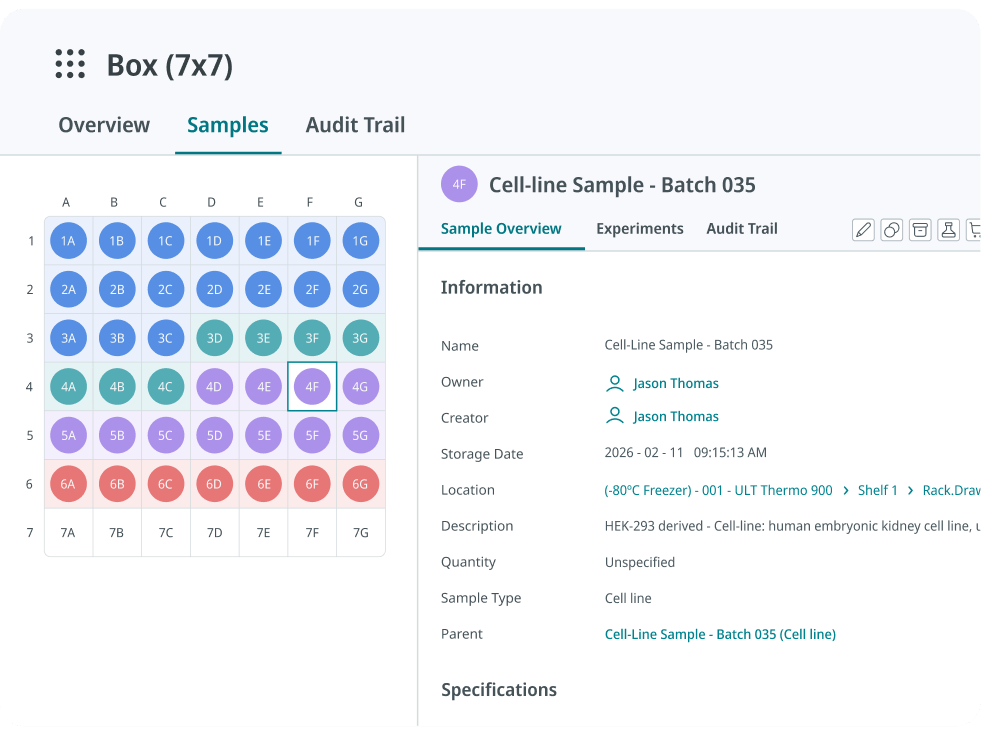
Poor sample management degrades material, not just schedules. After implementing SciSure, Euroimmun US cut wrong-sample retrievals, unnecessary freeze-thaw cycles and cold-storage energy draw after leaving spreadsheets, Lund University reduced sample lookup from an hour to under a minute, while the University of Pittsburgh reported a 50% time saving on sample tracking.
- Where SciSure fits.
SciSure provides LIMS and ELN capabilities in one application for research, biotech, biobanking and academic labs. It is not a clinical LIS and does not handle patient billing, provider portals, or routine result delivery. If diagnostics is your core business, a dedicated LIS is the right buy.
Originally published in 2025, this 2026 update adds expanded regulatory details and new customer proof relevant to SciSure's sample management capabilities.
Ready to see SciSure in action?
No commitment · Free consultation
You're in the lab and know you must move beyond paper, pencil, and Excel spreadsheets toward digitalization. Your colleagues have told you good things about managing workflows and documentation with Digital Lab Platforms.
But investigating digital lab platforms can be confusing, as there is an alphabet soup of different platforms and respective acronyms (an ELN vs. LIMS, for instance), features, and use cases.
If you’re in the clinical diagnostic space, you’ve probably heard of or used an LIS (or Laboratory Information System). However, if you’re in academia, biotech, or R&D, you may have heard the term LIMS (or Laboratory Information Management System).
They sound so similar that you may wonder if these are just two different ways to say the same thing. In the following blog, we review the difference between an LIS and a LIMS and how you know which platform suits your lab.
The short version: an LIS is patient-centric, while a LIMS is sample-centric. If your records are organized around a person and a diagnosis, you want an LIS. If they're organized around a specimen and everything that happens to it over the following months or years, you want a LIMS.
LIS vs LIMS: An overview
LIS and LIMS are not the same thing; contrary to popular belief, the difference can be quite stark.
What is an LIS?
A Laboratory Information System (LIS) is software designed to manage clinical laboratory operations, including sample tracking, test ordering, result reporting, and quality control. It enhances efficiency, data accuracy, and compliance with regulatory standards. Hospital laboratories may have the option to integrate this with their electronic health records (EHR) to have results directly imported into patient records.
What is a LIMS?
A Laboratory Information Management System, or LIMS software, is software designed to manage laboratory operations, including sample tracking, data management, workflow automation, and regulatory compliance. By streamlining processes and integrating with other systems, it enhances efficiency and accuracy in clinical and research laboratories. An electronic lab notebook enables researchers to record, organize, and share experimental data electronically, improving collaboration, accessibility, and traceability in one place.
The function of an LIS vs. a LIMS
The main function of an LIS is to provide the appropriate productivity tools to ensure that an external third party (e.g., a patient or health care provider) receives accurate test results quickly. While a LIS is typically used by personnel in a diagnostic lab, it is intended to be primarily an external, "patient-" or "provider-facing" platform.
Conversely, the primary function of a LIMS is to provide a centralized representation of a lab (including the samples, reagents, supplies, and equipment) and the data generated from specific samples and equipment. It's an internal, "personnel-facing" platform that can be used across any lab that is managing samples in a wide array of industries.
Does your lab need a LIS? Or a LIMS?
Has your reading made you think you need more clarification, or might even need both an LIS and a LIMS in your lab? You may even need to better define your own lab’s goals and priorities.
.jpg)
Where LIS & LIMS overlap
Biobanks, clinical trial sample handling, and veterinary diagnostics all involve subject data, test results, and something that looks a lot like a clinical interpretation. It's a reasonable assumption that they need an LIS, but they almost never do. These run on a LIMS, because the thing being tracked is the specimen rather than the episode of care. A biobanked sample might sit in a freezer for six years and then get re-tested with an assay that didn't exist when it was collected. An LIS has no reason to model that.
Then there are the cases that break the rule outright.
With SciSure, Boston University built an in-house COVID-19 testing lab in the fall of 2020. It was called the BU Clinical Testing Laboratory, and it did what a clinical lab does: it took test orders from two separate university EMR systems, one for students and one for employees, and sent results back to both. It ran testing robots. It was set up to process over 5,000 samples a day with next-day results, and at peak it handled more than 9,000.
That's an LIS job description. They built it on SciSure's ELN and API.
.jpg)
The reason wasn't about the category label; BU's binding constraint was integration. They needed software that could reliably talk to the robots and to both EMRs, and the APIs were the reason SciSure was chosen over the other applications they looked at. The lab was running two months after implementation.
I'm not telling you to skip the LIS. BU had an unusual set of constraints and a hard deadline. If you're running high-volume routine diagnostics with provider portals and billing attached, a dedicated LIS is still the right buy and I'd say so on a call. But the category boundary is a lot softer than most buyer guides admit, and if you've been told your workflow disqualifies you from one side or the other, it's worth checking that against what you actually need the software to do.
The standards LIS & LIMS systems answer to
An LIS answers to healthcare regulation: HIPAA for patient privacy, CLIA for clinical testing quality, CAP accreditation if the lab is going for it. The compliance conversation is about protecting patient data and defending a diagnostic result. A LIMS answers to a wider spread depending on the industry: ISO/IEC 17025 for testing and calibration competence, GLP and GMP in pharma and manufacturing, and FDA 21 CFR Part 11 wherever electronic records and signatures need to hold up. The conversation is about proving what happened to a sample, who touched it, and when.
Arctic Therapeutics runs an ISO 15189 certified lab in Akureyri, Iceland, with clinical trial operations out of Reykjavík and about ten specialists working across regulated research and clinical workflows. Before SciSure they had experiment documentation with no standard format, inventory spread across spreadsheets and paper, and equipment logs kept separately. Samples and reagents weren't QR coded at all.
Now sample tracking, inventory, equipment calibration schedules, and CoA and SDS documentation for reagents sit in one system. Controlled access, signing, and record locking support the documentation side of ISO 15189. Their lab director puts the time saving at around two hours a week on registration and inventory alone.
Keep in mind that no software makes a lab compliant on its own. SciSure can support Part 11 and ISO 15189 style workflows through signatures, timestamps, locked records, versioning, and audit trails. You still own validation, SOPs, training, and change control.
Does your lab need a LIS or a LIMS?
For a deeper look at how the two compare feature by feature, and how they can work alongside each other, read our whitepaper: Demystifying the LIS and LIMS.
Frequently Asked Questions
What is the main difference between an LIS and a LIMS?
An LIS is patient-centric and used in clinical and hospital labs to manage diagnostic testing, results, and patient records. A LIMS is sample-centric and used across research, biotech, biobanking, environmental and manufacturing labs to manage samples, workflows, and long-term data.
Can a lab use both an LIS and a LIMS?
Yes. Organizations running both patient diagnostics and research or quality testing often operate both, sometimes connected so data flows between them. Whether that's worth the integration work depends on how much of your workload is genuinely clinical.
Does a biobank need an LIS or a LIMS?
A LIMS. Biobanking involves long-term storage, lineage tracking, and re-testing years after collection. An LIS is built around a completed episode of testing, not an indefinitely stored specimen.
Can a clinical testing lab run on a LIMS instead of an LIS?
Sometimes. Boston University built an in-house COVID-19 testing lab on SciSure's ELN and API, integrating with testing robots and two university EMR systems, and processed over 9,000 samples a day at peak. It worked because the lab's hardest requirement was integration rather than clinical billing and reporting. For routine diagnostics with provider portals and billing, a dedicated LIS remains the better fit.
Which regulations apply to each system?
LIS platforms are typically built around HIPAA, CLIA and CAP. LIMS platforms cover a broader set including ISO/IEC 17025, GLP, GMP and FDA 21 CFR Part 11. ISO 15189, the standard for medical laboratories, sits across both and is supported by labs running on either.
Is SciSure an LIS or a LIMS?
SciSure provides LIMS and ELN capabilities in one application for research, biotech, biobanking and academic labs. It is not a clinical LIS and does not handle patient billing, provider portals, or routine clinical result delivery.
Figured out the system you need or still need some support? Talk to a SciSure specialist about your samples, systems, and reporting obligations. You'll get an honest read on whether SciSure fits, and where a different tool would serve you better.
Read More:

Read more of our blogs about modern lab management
Discover the latest in lab operations, from sample management to AI innovations, designed to enhance efficiency and drive scientific breakthroughs.