Benefits of LIMS for R&D Labs | SciSure

Explore the key benefits of LIMS for research labs, from sample traceability and workflow automation to audit readiness and reproducible science.
May 29, 2026
()
min read
A laboratory

Download Whitepaper

By submitting this form, you agree with our Privacy Policy.
Thank you! Download the file by clicking below:
Download
Oops! Something went wrong while submitting the form.

Table of Contents

Thank you! Your submission has been received!
Oops! Something went wrong while submitting the form.

Table of Contents

TL;DR

  • A LIMS designed for the R&D sector structures sample data, traceability, and compliance records in one searchable system.
  • Research labs gain immediate visibility into sample status, lineage, and inventory without relying on manual logs or spreadsheets.
  • Audit readiness improves when compliance documentation is maintained as part of daily workflows rather than assembled before each inspection.
  • Connecting LIMS with an ELN gives scientists full context across experiments and sample records in one place.

Introduction

Research labs that rely on spreadsheets, paper logs, or disconnected point solutions eventually reach a point where the system breaks down. Sample status becomes unclear, inventory records fall out of sync, and reproducing a previous experiment requires hunting through multiple sources that may not agree with each other. Understanding the importance of a laboratory information management system in this context goes beyond feature comparisons. 

A Laboratory Information Management System (LIMS) addresses these problems by changing how sample data is captured, tracked, and maintained across the lab. This article focuses on the benefits of LIMS, what specifically changes in an R&D environment when that structure is in place, and why the design of the LIMS itself determines how much of that value a lab can actually realize.

What is a LIMS and what does it actually manage? 

A Laboratory Information Management System (LIMS) is a software platform that manages the data generated by laboratory samples, workflows, and operations. At its core, a LIMS tracks samples across their full lifecycle — registration, storage, transfer, and disposal — through configurable metadata, check-out/check-in, sample dispatch, lineage, and Barcode Automation. At the same time, it maintains the associated status records and audit trails that give labs confidence in their data.

The benefits of a LIMS system extend beyond sample storage. A well-designed system handles inventory, equipment records, workflow configuration, and the data relationships between them. When evaluating LIMS software for an R&D environment, it is worth understanding that a LIMS designed for the R&D sector operates differently from a clinical or QA/QC-focused system. Clinical and manufacturing LIMS tend to be built around rigid, predefined testing pipelines, while an R&D-focused LIMS is designed to support flexible, iterative workflows where sample types, metadata requirements, and experimental parameters change frequently. 

The core benefits of LIMS for research labs

The advantages of a laboratory information management system in an R&D context go beyond basic sample tracking, making the choice of system a consequential infrastructure decision.

Sample traceability across the lifecycle

Without a reliable system in place, sample management depends on manual records, shared spreadsheets, and institutional memory. Samples get misplaced, their status becomes ambiguous, and when a scientist needs to trace a sample back through its history, the records required are often incomplete or inconsistent. In regulated environments, those gaps create compliance risk that is difficult to explain during an inspection.

A LIMS captures each sample at the point of registration and maintains a continuous, configurable record through every stage of its lifecycle. Check-out/check-in and sample dispatch with accept/deny functionality give labs visibility into where samples are and who is accountable for them. Barcode Automation and QR code integration allow lab teams to update sample status and location in real time, reducing the data entry errors common in paper-based systems. Lineage tracking maintains the relationship between parent and child samples across derivations, aliquots, and transfers, which is particularly valuable where sample histories need to be traceable for both scientific and regulatory purposes. 

The University of Pittsburgh reported a 50% improvement in sample tracking efficiency after implementing systematic sample management, a result that reflects how much time is lost when labs rely on manual processes to maintain that visibility.

Reducing manual entry with triggers and automation

Labs running on paper records or Excel spend a disproportionate amount of time on data entry, status updates, and manual notifications. These tasks add administrative load without contributing to the scientific work itself, and transcription errors introduced during manual data transfer between instruments, notebooks, and reporting systems can affect the integrity of results without being immediately obvious.

A LIMS reduces this burden by capturing data closer to the point of generation and connecting it to the relevant sample and experiment records. Instrument data can be associated directly with the samples being analyzed, cutting out the manual steps between data generation and record keeping. Triggers & Automations allow labs to configure notifications, status changes, and task creation based on defined conditions, so that routine follow-up actions happen consistently without requiring manual intervention each time. This is particularly useful for test scheduling, expiration monitoring, and cross-team handoffs where delays caused by missed notifications have real consequences for lab throughput.

The cumulative effect across multiple workflows is significant. Food Brewer AG reported a 60% increase in R&D productivity after moving away from manual processes, reflecting the time and focus that teams recover when routine administrative tasks are handled systematically.

Audit readiness and compliance documentation

Inspection preparation is one of the most resource-intensive activities in a regulated research lab, and the difficulty is rarely a lack of underlying data. It is a lack of organization around it. When records are maintained across paper binders, email threads, and point solutions, assembling the documentation required for an audit means locating, cross-referencing, and reformatting records that were never designed to be retrieved together. That process is slow and typically falls on a small number of people who know where everything is kept.

A LIMS generates audit logs automatically as users interact with samples, workflows, and inventory, creating a timestamped record of activity without requiring a separate documentation effort. For R&D labs operating under FDA 21 CFR Part 11, GxP requirements, or ISO 27001, the evidence required to demonstrate compliance is maintained as part of daily operations rather than assembled ahead of each inspection. Compliance is embedded into how the lab works day to day, not treated as a periodic reporting exercise.

The operational impact is direct. Arctic Therapeutics achieved ISO 15189 accreditation and reported saving two hours per week on compliance documentation after moving to this approach, time that had previously been spent on manual preparation tasks the system now handles automatically.

Reproducibility and structured research records

Reproducibility problems in research are often framed as a question of scientific rigor, but the root cause is frequently administrative. When experiment records are kept in paper notebooks, Word documents, or spreadsheets, the information captured varies by individual. Protocol versions go unrecorded. Sample references are inconsistent. When a scientist leaves a project, the knowledge embedded in those records often becomes inaccessible.

A LIMS captures sample-related work in a consistent, searchable, version-controlled format. Configurable metadata schemas and standardized data entry mean records are comparable across experiments, teams, and time periods. Version control ensures changes are tracked and attributable, and search functionality allows relevant historical data to be retrieved without relying on whoever originally created the record. For R&D organizations where the long-term value of research data depends on its usability across teams and time, this consistency is one of the most consequential advantages a LIMS delivers.

Inventory and resource visibility

Sample management and inventory management are closely connected, but many labs track them separately or not systematically at all. Reagents run out without warning. Consumables expire before they are used. The result is unplanned disruption to experiments, unnecessary reordering, and spending that is difficult to account for.

A LIMS extends systematic tracking to reagents, consumables, and equipment alongside sample records. Stock levels are visible in real time, and threshold-based alerts through Triggers & Automations notify the relevant people when items need reordering. The Supplies & Ordering module supports procurement workflows directly within the system, and expiration tracking reduces waste by making it clear which materials are approaching the end of their usable life.

Scalability across sites and teams

The processes that work for a single lab team frequently break down as an organization grows. Shared spreadsheets become difficult to maintain consistently across groups. Local conventions for sample naming, metadata entry, and record keeping diverge between sites. When leadership needs visibility into research activity or inventory status across multiple locations, consolidating that information requires manual effort that scales poorly.

A LIMS provides a configurable infrastructure that accommodates multiple sites, teams, and user roles within a single system. Role-based access controls allow organizations to define precisely what each user or group can view, edit, and approve, maintaining data integrity as the number of users increases. Multi-site configuration means each location can operate according to its own workflows while contributing to a shared data environment that supports centralized oversight. For research organizations managing labs across different regulatory jurisdictions or planning to expand, this flexibility reduces the operational risk that typically accompanies growth.

SciSure LIMS
Structured sample tracking, without the spreadsheets
SciSure Research gives R&D labs configurable sample tracking, lineage, and audit-ready records in one place.
Request a demo

Why a LIMS designed for R&D is different

The category of LIMS covers a wide range of products, and the differences between them are not always apparent from feature lists alone.

Clinical and manufacturing LIMS are typically designed for high-volume, predefined testing pipelines. The assumption embedded in those systems is that sample types, test panels, and reporting formats are largely fixed. That design works well for its intended context but does not translate well to R&D environments, where experimental parameters change frequently and workflows evolve alongside research questions.

A LIMS designed for the R&D sector operates on a different set of assumptions. Sample types and metadata schemas are configurable. Workflows can be adapted as research evolves. The system sits alongside protocols, experiments, equipment records, inventory, and compliance documentation, and the advantages of a LIMS in an R&D context depend in part on how well it connects to those adjacent areas. The laboratory information system benefits that matter most to R&D teams depend on a system that was designed for those requirements from the outset.

How LIMS and ELN work together

When a LIMS and an ELN operate as separate tools, experiments are documented in one system, sample data is managed in another, and there is no native link between the two. A scientist documenting an experiment needs to manually reference the samples involved, cross-checking records across systems that were never designed to communicate with each other.

A LIMS that connects workflows with an electronic lab notebook addresses this directly. Experiments can reference samples in context, so scientists have visibility into sample status, metadata, and lineage without switching between disconnected records. Samples link to the results generated from them, and those results sit within the experiment records where they belong. For R&D labs where reproducibility and traceability depend on following a clear line from experimental design through to results, the connection between LIMS and ELN is what makes the records produced by each system fully usable.

Signs your lab needs a LIMS (or a better one)

Not every lab problem points to a LIMS gap, but several specific patterns tend to indicate that the current system is creating more friction than it resolves. Understanding the advantages of a LIMS system starts with recognizing where existing processes are falling short.
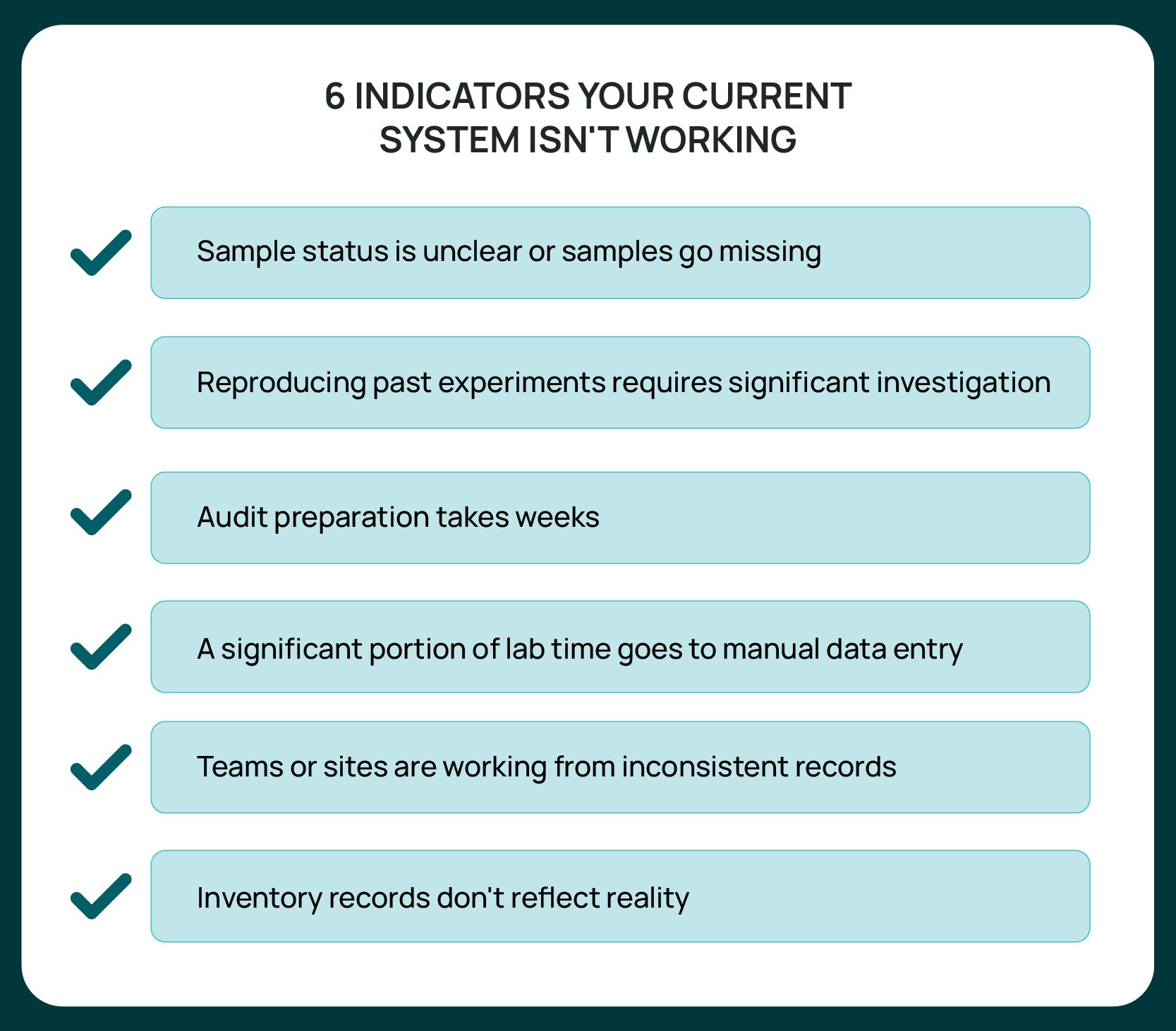
6 indicators your current system isn't working

Samples are getting lost or their status is unclear. If lab teams regularly spend time locating samples, reconciling conflicting location records, or discovering that a sample was consumed or disposed of without that being recorded, the tracking system is not doing its job. Sample loss and status ambiguity are among the most direct indicators that traceability has broken down.

Reproducing previous experiments requires significant investigation. When re-running an experiment means tracking down the scientist who originally ran it, or piecing together records from multiple sources that do not fully agree, the documentation system is not capturing enough context. Reproducibility problems that stem from record-keeping gaps are a reliable signal that the current approach is insufficient.

Audit preparation takes weeks. If the process of preparing for an inspection requires manually locating, formatting, and cross-referencing records that should already be accessible in a consistent format, the compliance documentation process is reactive rather than embedded in daily operations.

A significant portion of lab time goes to data entry and status updates. Manual transcription between instruments, notebooks, and reporting systems is not just inefficient. It introduces errors that are difficult to detect and correct after the fact. If lab teams are spending meaningful time on this kind of administrative work, that is time not spent on analysis.

Different teams or sites are working from inconsistent records. When sample naming conventions, metadata fields, and workflow steps vary between groups, cross-team collaboration becomes unreliable. Inconsistency at this level also makes it difficult for leadership to get an accurate picture of lab activity across the organization.

Inventory records do not reflect reality. If reagents run out unexpectedly, consumables expire unused, or procurement decisions are made based on estimates rather than current stock data, inventory visibility is insufficient. This is a common problem in labs where sample and inventory tracking are handled separately.

Any one of these patterns can be managed individually for a period of time. When several appear together, they typically indicate a systemic gap in how laboratory data is being captured and maintained.

What to look for when evaluating LIMS software 

Selecting a LIMS is a long-term infrastructure decision, and the criteria that matter most depend on the specific context of the lab. That said, several evaluation points apply broadly to R&D environments regardless of size or discipline.

R&D-specific configuration. Verify that the system can be configured to match how the lab actually works, and ask vendors specifically how it handles changes to sample types or workflow steps after initial setup.

ELN integration capability. A LIMS with no integration path to an electronic lab notebook will leave that gap in place. Look for native integration or well-documented API connectivity between the two systems.

Sample traceability depth. The system should be able to answer questions about where a sample came from, what happened to it, and what experiments it was associated with.

Compliance certifications. Verify certifications directly rather than taking general compliance claims at face value. Some platforms, including SciSure , carry ISO 27001 and HIPAA certifications in addition to FDA 21 CFR Part 11, GxP, and SOC 2 Type II.

API and integration ecosystem. Evaluate the depth of the API, the availability of SDKs, and whether the vendor maintains an active integration ecosystem or marketplace.

Role-based access controls. Evaluate how granular the access control system is and whether it can accommodate the organizational structure of the lab.

Scalability for multi-site environments. Evaluate how the system handles cross-site visibility, centralized administration, and consistency of records across locations.

Taken together, these criteria help distinguish a system that will deliver the full benefits of using a LIMS over time from one that solves immediate pain points but creates new constraints as the lab grows.

SciSure LIMS
See how SciSure Research holds up against these criteria
Built for R&D environments, with open APIs, configurable workflows, and certifications including FDA 21 CFR Part 11 and SOC 2 Type II.
Request a demo

The real value of LIMS starts with structured data 

The difference between a lab running on fragmented records and one running on well-maintained, connected data compounds over time. Decisions improve when the underlying information is reliable. Audits become less disruptive when records reflect what actually happened. Research moves faster when previous work is accessible and verifiable.

If your lab is evaluating whether a more structured approach to research data management would address the gaps you are working around, SciSure is worth a closer look.

SciSure LIMS
Not sure where to start?
If you're evaluating LIMS options for your lab, a specialist can help you work through what matters most for your environment.
Talk to a specialist

FAQ

What is a LIMS system used for?

A Laboratory Information Management System (LIMS) manages the data associated with laboratory samples, workflows, inventory, and equipment. In an R&D context, this includes registering and tracking samples across their lifecycle, maintaining configurable metadata, managing reagents and consumables, and keeping the records that regulated research environments require.

What are the advantages of a LIMS for research labs?

The main benefits for research labs include improved sample traceability, more reliable reproducibility, reduced manual data entry, stronger audit readiness, and better visibility into inventory and resource usage. These benefits are most pronounced when the system fits the lab's actual workflows. Platforms like SciSure are designed specifically for R&D environments, which affects how these benefits are realized in practice.

What is the difference between a LIMS and an ELN?

A LIMS manages sample data, inventory, and operational records. An electronic lab notebook documents experiments, protocols, and results. When the two operate independently, there is no native link between experiment records and the sample data they reference. SciSure LIMS Research connects workflows between both, so experiments reference samples directly and records are visible in context.

How does a LIMS improve compliance and audit readiness?

A LIMS maintains timestamped, attributable records of laboratory activity as part of normal operations. Audit logs are generated automatically, access controls define who can modify records, and data integrity requirements are enforced at the system level. SciSure LIMS supports FDA 21 CFR Part 11, GxP, and SOC 2 Type II, alongside ISO 27001 and HIPAA, depending on the lab's regulatory context.

What should I look for when choosing a LIMS?

The criteria covered in the “What to look for when evaluating LIMS software” section above apply here. If you want a quick shortlist of red flags to watch for: rigid workflows that cannot be reconfigured post-deployment, no native or documented ELN integration, vague compliance claims without certifiable evidence, and limited API access that locks you into the vendor’s ecosystem. SciSure LIMS is worth evaluating against those criteria if you are looking for a system designed specifically for research environments.

Can a LIMS integrate with lab instruments and other software?

Integration capability varies significantly between platforms. Look for open APIs, available SDKs, and an active ecosystem of supported connections. SciSure LIMS provides open APIs, SDKs, and a Marketplace of add-ons that allow labs to connect instruments, extend platform functionality, and push data between systems via API, SDK, webhooks, and Marketplace add-ons.

Ready to see SciSure in action?

Get a personalized demo and see how SciSure fits your lab's workflows.
Request demo

No commitment · Free consultation

Introduction

Research labs that rely on spreadsheets, paper logs, or disconnected point solutions eventually reach a point where the system breaks down. Sample status becomes unclear, inventory records fall out of sync, and reproducing a previous experiment requires hunting through multiple sources that may not agree with each other. Understanding the importance of a laboratory information management system in this context goes beyond feature comparisons. 

A Laboratory Information Management System (LIMS) addresses these problems by changing how sample data is captured, tracked, and maintained across the lab. This article focuses on the benefits of LIMS, what specifically changes in an R&D environment when that structure is in place, and why the design of the LIMS itself determines how much of that value a lab can actually realize.

What is a LIMS and what does it actually manage? 

A Laboratory Information Management System (LIMS) is a software platform that manages the data generated by laboratory samples, workflows, and operations. At its core, a LIMS tracks samples across their full lifecycle — registration, storage, transfer, and disposal — through configurable metadata, check-out/check-in, sample dispatch, lineage, and Barcode Automation. At the same time, it maintains the associated status records and audit trails that give labs confidence in their data.

The benefits of a LIMS system extend beyond sample storage. A well-designed system handles inventory, equipment records, workflow configuration, and the data relationships between them. When evaluating LIMS software for an R&D environment, it is worth understanding that a LIMS designed for the R&D sector operates differently from a clinical or QA/QC-focused system. Clinical and manufacturing LIMS tend to be built around rigid, predefined testing pipelines, while an R&D-focused LIMS is designed to support flexible, iterative workflows where sample types, metadata requirements, and experimental parameters change frequently. 

The core benefits of LIMS for research labs

The advantages of a laboratory information management system in an R&D context go beyond basic sample tracking, making the choice of system a consequential infrastructure decision.

Sample traceability across the lifecycle

Without a reliable system in place, sample management depends on manual records, shared spreadsheets, and institutional memory. Samples get misplaced, their status becomes ambiguous, and when a scientist needs to trace a sample back through its history, the records required are often incomplete or inconsistent. In regulated environments, those gaps create compliance risk that is difficult to explain during an inspection.

A LIMS captures each sample at the point of registration and maintains a continuous, configurable record through every stage of its lifecycle. Check-out/check-in and sample dispatch with accept/deny functionality give labs visibility into where samples are and who is accountable for them. Barcode Automation and QR code integration allow lab teams to update sample status and location in real time, reducing the data entry errors common in paper-based systems. Lineage tracking maintains the relationship between parent and child samples across derivations, aliquots, and transfers, which is particularly valuable where sample histories need to be traceable for both scientific and regulatory purposes. 

The University of Pittsburgh reported a 50% improvement in sample tracking efficiency after implementing systematic sample management, a result that reflects how much time is lost when labs rely on manual processes to maintain that visibility.

Reducing manual entry with triggers and automation

Labs running on paper records or Excel spend a disproportionate amount of time on data entry, status updates, and manual notifications. These tasks add administrative load without contributing to the scientific work itself, and transcription errors introduced during manual data transfer between instruments, notebooks, and reporting systems can affect the integrity of results without being immediately obvious.

A LIMS reduces this burden by capturing data closer to the point of generation and connecting it to the relevant sample and experiment records. Instrument data can be associated directly with the samples being analyzed, cutting out the manual steps between data generation and record keeping. Triggers & Automations allow labs to configure notifications, status changes, and task creation based on defined conditions, so that routine follow-up actions happen consistently without requiring manual intervention each time. This is particularly useful for test scheduling, expiration monitoring, and cross-team handoffs where delays caused by missed notifications have real consequences for lab throughput.

The cumulative effect across multiple workflows is significant. Food Brewer AG reported a 60% increase in R&D productivity after moving away from manual processes, reflecting the time and focus that teams recover when routine administrative tasks are handled systematically.

Audit readiness and compliance documentation

Inspection preparation is one of the most resource-intensive activities in a regulated research lab, and the difficulty is rarely a lack of underlying data. It is a lack of organization around it. When records are maintained across paper binders, email threads, and point solutions, assembling the documentation required for an audit means locating, cross-referencing, and reformatting records that were never designed to be retrieved together. That process is slow and typically falls on a small number of people who know where everything is kept.

A LIMS generates audit logs automatically as users interact with samples, workflows, and inventory, creating a timestamped record of activity without requiring a separate documentation effort. For R&D labs operating under FDA 21 CFR Part 11, GxP requirements, or ISO 27001, the evidence required to demonstrate compliance is maintained as part of daily operations rather than assembled ahead of each inspection. Compliance is embedded into how the lab works day to day, not treated as a periodic reporting exercise.

The operational impact is direct. Arctic Therapeutics achieved ISO 15189 accreditation and reported saving two hours per week on compliance documentation after moving to this approach, time that had previously been spent on manual preparation tasks the system now handles automatically.

Reproducibility and structured research records

Reproducibility problems in research are often framed as a question of scientific rigor, but the root cause is frequently administrative. When experiment records are kept in paper notebooks, Word documents, or spreadsheets, the information captured varies by individual. Protocol versions go unrecorded. Sample references are inconsistent. When a scientist leaves a project, the knowledge embedded in those records often becomes inaccessible.

A LIMS captures sample-related work in a consistent, searchable, version-controlled format. Configurable metadata schemas and standardized data entry mean records are comparable across experiments, teams, and time periods. Version control ensures changes are tracked and attributable, and search functionality allows relevant historical data to be retrieved without relying on whoever originally created the record. For R&D organizations where the long-term value of research data depends on its usability across teams and time, this consistency is one of the most consequential advantages a LIMS delivers.

Inventory and resource visibility

Sample management and inventory management are closely connected, but many labs track them separately or not systematically at all. Reagents run out without warning. Consumables expire before they are used. The result is unplanned disruption to experiments, unnecessary reordering, and spending that is difficult to account for.

A LIMS extends systematic tracking to reagents, consumables, and equipment alongside sample records. Stock levels are visible in real time, and threshold-based alerts through Triggers & Automations notify the relevant people when items need reordering. The Supplies & Ordering module supports procurement workflows directly within the system, and expiration tracking reduces waste by making it clear which materials are approaching the end of their usable life.

Scalability across sites and teams

The processes that work for a single lab team frequently break down as an organization grows. Shared spreadsheets become difficult to maintain consistently across groups. Local conventions for sample naming, metadata entry, and record keeping diverge between sites. When leadership needs visibility into research activity or inventory status across multiple locations, consolidating that information requires manual effort that scales poorly.

A LIMS provides a configurable infrastructure that accommodates multiple sites, teams, and user roles within a single system. Role-based access controls allow organizations to define precisely what each user or group can view, edit, and approve, maintaining data integrity as the number of users increases. Multi-site configuration means each location can operate according to its own workflows while contributing to a shared data environment that supports centralized oversight. For research organizations managing labs across different regulatory jurisdictions or planning to expand, this flexibility reduces the operational risk that typically accompanies growth.

SciSure LIMS
Structured sample tracking, without the spreadsheets
SciSure Research gives R&D labs configurable sample tracking, lineage, and audit-ready records in one place.
Request a demo

Why a LIMS designed for R&D is different

The category of LIMS covers a wide range of products, and the differences between them are not always apparent from feature lists alone.

Clinical and manufacturing LIMS are typically designed for high-volume, predefined testing pipelines. The assumption embedded in those systems is that sample types, test panels, and reporting formats are largely fixed. That design works well for its intended context but does not translate well to R&D environments, where experimental parameters change frequently and workflows evolve alongside research questions.

A LIMS designed for the R&D sector operates on a different set of assumptions. Sample types and metadata schemas are configurable. Workflows can be adapted as research evolves. The system sits alongside protocols, experiments, equipment records, inventory, and compliance documentation, and the advantages of a LIMS in an R&D context depend in part on how well it connects to those adjacent areas. The laboratory information system benefits that matter most to R&D teams depend on a system that was designed for those requirements from the outset.

How LIMS and ELN work together

When a LIMS and an ELN operate as separate tools, experiments are documented in one system, sample data is managed in another, and there is no native link between the two. A scientist documenting an experiment needs to manually reference the samples involved, cross-checking records across systems that were never designed to communicate with each other.

A LIMS that connects workflows with an electronic lab notebook addresses this directly. Experiments can reference samples in context, so scientists have visibility into sample status, metadata, and lineage without switching between disconnected records. Samples link to the results generated from them, and those results sit within the experiment records where they belong. For R&D labs where reproducibility and traceability depend on following a clear line from experimental design through to results, the connection between LIMS and ELN is what makes the records produced by each system fully usable.

Signs your lab needs a LIMS (or a better one)

Not every lab problem points to a LIMS gap, but several specific patterns tend to indicate that the current system is creating more friction than it resolves. Understanding the advantages of a LIMS system starts with recognizing where existing processes are falling short.

6 indicators your current system isn't working

Samples are getting lost or their status is unclear. If lab teams regularly spend time locating samples, reconciling conflicting location records, or discovering that a sample was consumed or disposed of without that being recorded, the tracking system is not doing its job. Sample loss and status ambiguity are among the most direct indicators that traceability has broken down.

Reproducing previous experiments requires significant investigation. When re-running an experiment means tracking down the scientist who originally ran it, or piecing together records from multiple sources that do not fully agree, the documentation system is not capturing enough context. Reproducibility problems that stem from record-keeping gaps are a reliable signal that the current approach is insufficient.

Audit preparation takes weeks. If the process of preparing for an inspection requires manually locating, formatting, and cross-referencing records that should already be accessible in a consistent format, the compliance documentation process is reactive rather than embedded in daily operations.

A significant portion of lab time goes to data entry and status updates. Manual transcription between instruments, notebooks, and reporting systems is not just inefficient. It introduces errors that are difficult to detect and correct after the fact. If lab teams are spending meaningful time on this kind of administrative work, that is time not spent on analysis.

Different teams or sites are working from inconsistent records. When sample naming conventions, metadata fields, and workflow steps vary between groups, cross-team collaboration becomes unreliable. Inconsistency at this level also makes it difficult for leadership to get an accurate picture of lab activity across the organization.

Inventory records do not reflect reality. If reagents run out unexpectedly, consumables expire unused, or procurement decisions are made based on estimates rather than current stock data, inventory visibility is insufficient. This is a common problem in labs where sample and inventory tracking are handled separately.

Any one of these patterns can be managed individually for a period of time. When several appear together, they typically indicate a systemic gap in how laboratory data is being captured and maintained.

What to look for when evaluating LIMS software 

Selecting a LIMS is a long-term infrastructure decision, and the criteria that matter most depend on the specific context of the lab. That said, several evaluation points apply broadly to R&D environments regardless of size or discipline.

R&D-specific configuration. Verify that the system can be configured to match how the lab actually works, and ask vendors specifically how it handles changes to sample types or workflow steps after initial setup.

ELN integration capability. A LIMS with no integration path to an electronic lab notebook will leave that gap in place. Look for native integration or well-documented API connectivity between the two systems.

Sample traceability depth. The system should be able to answer questions about where a sample came from, what happened to it, and what experiments it was associated with.

Compliance certifications. Verify certifications directly rather than taking general compliance claims at face value. Some platforms, including SciSure , carry ISO 27001 and HIPAA certifications in addition to FDA 21 CFR Part 11, GxP, and SOC 2 Type II.

API and integration ecosystem. Evaluate the depth of the API, the availability of SDKs, and whether the vendor maintains an active integration ecosystem or marketplace.

Role-based access controls. Evaluate how granular the access control system is and whether it can accommodate the organizational structure of the lab.

Scalability for multi-site environments. Evaluate how the system handles cross-site visibility, centralized administration, and consistency of records across locations.

Taken together, these criteria help distinguish a system that will deliver the full benefits of using a LIMS over time from one that solves immediate pain points but creates new constraints as the lab grows.

SciSure LIMS
See how SciSure Research holds up against these criteria
Built for R&D environments, with open APIs, configurable workflows, and certifications including FDA 21 CFR Part 11 and SOC 2 Type II.
Request a demo

The real value of LIMS starts with structured data 

The difference between a lab running on fragmented records and one running on well-maintained, connected data compounds over time. Decisions improve when the underlying information is reliable. Audits become less disruptive when records reflect what actually happened. Research moves faster when previous work is accessible and verifiable.

If your lab is evaluating whether a more structured approach to research data management would address the gaps you are working around, SciSure is worth a closer look.

SciSure LIMS
Not sure where to start?
If you're evaluating LIMS options for your lab, a specialist can help you work through what matters most for your environment.
Talk to a specialist

FAQ

What is a LIMS system used for?

A Laboratory Information Management System (LIMS) manages the data associated with laboratory samples, workflows, inventory, and equipment. In an R&D context, this includes registering and tracking samples across their lifecycle, maintaining configurable metadata, managing reagents and consumables, and keeping the records that regulated research environments require.

What are the advantages of a LIMS for research labs?

The main benefits for research labs include improved sample traceability, more reliable reproducibility, reduced manual data entry, stronger audit readiness, and better visibility into inventory and resource usage. These benefits are most pronounced when the system fits the lab's actual workflows. Platforms like SciSure are designed specifically for R&D environments, which affects how these benefits are realized in practice.

What is the difference between a LIMS and an ELN?

A LIMS manages sample data, inventory, and operational records. An electronic lab notebook documents experiments, protocols, and results. When the two operate independently, there is no native link between experiment records and the sample data they reference. SciSure LIMS Research connects workflows between both, so experiments reference samples directly and records are visible in context.

How does a LIMS improve compliance and audit readiness?

A LIMS maintains timestamped, attributable records of laboratory activity as part of normal operations. Audit logs are generated automatically, access controls define who can modify records, and data integrity requirements are enforced at the system level. SciSure LIMS supports FDA 21 CFR Part 11, GxP, and SOC 2 Type II, alongside ISO 27001 and HIPAA, depending on the lab's regulatory context.

What should I look for when choosing a LIMS?

The criteria covered in the “What to look for when evaluating LIMS software” section above apply here. If you want a quick shortlist of red flags to watch for: rigid workflows that cannot be reconfigured post-deployment, no native or documented ELN integration, vague compliance claims without certifiable evidence, and limited API access that locks you into the vendor’s ecosystem. SciSure LIMS is worth evaluating against those criteria if you are looking for a system designed specifically for research environments.

Can a LIMS integrate with lab instruments and other software?

Integration capability varies significantly between platforms. Look for open APIs, available SDKs, and an active ecosystem of supported connections. SciSure LIMS provides open APIs, SDKs, and a Marketplace of add-ons that allow labs to connect instruments, extend platform functionality, and push data between systems via API, SDK, webhooks, and Marketplace add-ons.

About the author:

SciSure Team

The SciSureTeam combines expertise in lab digitization, software development, and research management to deliver reliable insights and practical advice. Our goal is to empower scientists with the knowledge and tools to optimize workflows and stay ahead in the ever-evolving world of research.

See all posts from this author

Sign up for our newsletter

Get the latest tips, articles, and exclusive content on modern lab management delivered to your inbox.
Thank you for subscribing!
Please check your email to verify your submission.
Oops! Something went wrong while submitting the form.