R&D LIMS vs QC LIMS: Which Works Best For Your Lab?
Compare R&D and QC LIMS requirements, from flexible experiment and sample workflows to specifications, repeatable testing, review, and release controls.
Download Whitepaper
TL;DR
An R&D LIMS and a QC LIMS are both laboratory information management systems but built around fundamentally different workflow models and control different sources of operational risk.
- Core distinction.
R&D LIMS platforms prioritize configurable sample management, experimental context, and ELN connectivity, so research teams can track samples, methods, and results as science evolves. QC LIMS platforms prioritize approved method execution, structured result capture against specifications, and defensible review workflows for routine testing and release decisions.
- What risks does each of these systems run into?
R&D environments risk losing scientific context as hypotheses, sample types, and protocols change. QC environments risk uncontrolled variation in how approved tests are performed, documented, and reviewed. Each system is designed to address the risk most relevant to its operating model.
- Is one LIMS system more compliant than the other?
Neither category is inherently more compliant than the other. Compliance depends on intended use, system configuration, validation, access controls, and governing procedures. R&D labs can operate under GLP or GxP frameworks; not all QC labs fall under pharmaceutical CGMP requirements such as 21 CFR 211.
- When you need both.
Organizations moving methods from development into validated routine testing or sharing samples between R&D and QC functions often need capabilities from both models. The handoff between environments, including sample status, chain of custody, and record authority, requires explicit governance decisions before system selection.
- Map your workflow before building a vendor shortlist.
Platforms like SciSure are built specifically for R&D environments, connecting samples, experiments, inventory, and ELN records within a single governed system. The right LIMS is determined by the work it must govern, whether that is iterative research with evolving sample types or repeatable testing against defined specifications.
Ready to see SciSure in action?
No commitment · Free consultation
Ask three vendors what their LIMS does, and you'll get three overlapping but meaningfully different answers. Ask two laboratory directors whether their organizations need one, and you'll likely get two different sets of requirements. This confusion often reflects something real: the work happening inside an R&D lab and the work happening inside a QC lab are genuinely different, and the systems that govern them need to be different too.
R&D and QC both value reliable data. Both operate under governance requirements. Both need traceability. But the specific risks they're managing, and the workflows built to control those risks, pull in different directions.
Buying the wrong LIMS for either setting doesn't just create inconvenience. It creates friction at the exact points where data integrity matters most. This article explains where those two categories diverge, what each type of system should manage, and how to figure out which one (or which combination) your organization actually needs.
What is the difference between an R&D LIMS and a QC LIMS?
An R&D LIMS is designed to manage samples, inventory, equipment, and workflows in environments where scientific methods evolve, sample types vary, and experimental context needs to stay connected to the data it produced. The defining requirement is configurable structure: the system needs to accommodate how research actually changes over time without losing the traceability that makes that data defensible.
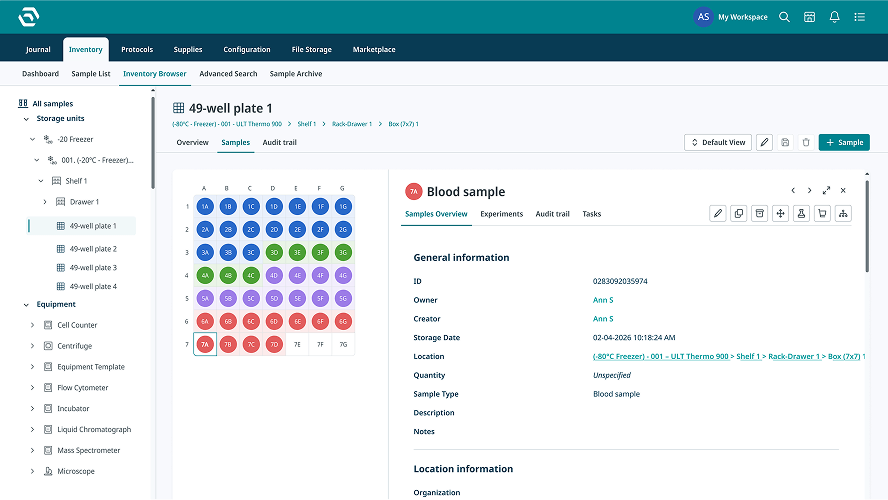
On the other hand, a QC LIMS is designed to manage sample receipt, test assignment, approved method execution, result capture, specification comparison, and review workflows in environments where repeatability and defensible documentation of execution are the primary requirements. The defining requirement is structured enforcement: the system needs to ensure that approved tests are performed consistently, and that results are reviewed against defined limits before any decision is made.
Both systems need audit trails, access controls, and traceability. The difference is in what they're tracing, and why.
Why do R&D and QC laboratories need different operating models?
Both R&D and QC labs operate from different starting points; the gap between the systems they use has to do with the activities they cover day to day.
R&D labs
A research scientist might start the morning by modifying an assay condition to test a new hypothesis. That change produces a new sample type not previously registered in the system. Midway through the experiment, an unexpected result prompts a note that links the observation to the originating protocol. By the end of day, results from three related experiments are being compared alongside the reagent lot and instrument used for each.
Every step in that sequence involves change. New sample type, modified method, unanticipated observation, cross-experiment linkage. A system that can't accommodate that kind of evolution doesn't just create workarounds; it actively breaks the chain of scientific context the researcher is trying to build.
QC labs
A QC analyst works from a different starting point. A lot-associated sample arrives, gets accessioned, and is assigned to an approved test method. The analyst follows defined steps, records measurements using specified units, and the system compares those results against established specifications. Any deviation from expected results triggers a formal review process. Nothing about that sequence should change based on analyst preference, and any departure from it is itself a documented event requiring investigation.
Both environments value reliable data. But the acceptable degree and timing of change are fundamentally different. That difference determines what each system needs to do well.
What should a LIMS for R&D labs manage?
A LIMS designed for research workflows needs to handle complexity without requiring the lab to freeze its processes to fit the software. Specifically, it should support:
Key capabilities an R&D LIMS should support
Just keep in mind: an R&D LIMS is not the same as an Electronic Laboratory Notebook (ELN). An ELN captures the narrative of an experiment: what the scientist did, observed, and decided. A LIMS manages the operational layer, covering the samples, inventory, equipment, and workflows surrounding that work.
The two systems complement each other. When they're connected, as they are in SciSure's platform, each sample links directly to the experiment that generated it, and each experiment record has access to the sample metadata associated with it.
For a deeper comparison of how ELNs and LIMS differ and work together, our ELN vs LIMS article covers the functional distinctions in detail.
What should a QC LIMS manage?
A LIMS designed for quality control environments needs to support structured, defensible execution of testing workflows. That typically includes:
Key capabilities a QC LIMS should support
For pharmaceutical QC specifically, the relevant US requirements include 21 CFR 211.160, which establishes general requirements for laboratory controls, and 21 CFR 211.194, which specifies laboratory records requirements. These are not universal QC requirements; they apply to pharmaceutical manufacturing under US CGMP. They do, however, represent a useful anchor for understanding the documentation and traceability standards a pharmaceutical QC LIMS must support.
R&D LIMS vs QC LIMS: A side-by-side comparison
These are tendencies, not rigid categories. Some research environments run structured studies that share characteristics with QC workflows. Some QC labs operate with more variability than others depending on the products and standards they work to. The table above describes the dominant design requirements of each type, and those design requirements are real, even when the boundaries aren't perfectly clean.
Is a QC LIMS more compliant than an R&D LIMS?
Not automatically. Compliance is not a property of a software category, but rather a result of how a system is configured, validated, and governed in relation to the specific requirements that apply to its intended use. A QC LIMS that isn't properly validated, doesn't enforce appropriate access controls, or isn't governed by adequate procedures, and training is not a compliant system, regardless of what it's called.
The same logic applies to R&D. Research labs can operate under GLP, GCP, or other regulated frameworks. An R&D LIMS deployed in a GLP study environment needs to support the documentation, audit trail, and access control requirements of that framework. The system type doesn't determine the compliance posture. The intended use, applicable requirements, and how the system is implemented do.
Language like "supports compliant use" or "can be configured and validated for the intended workflow" is more accurate than blanket claims about which category is more regulated. And it reflects how regulators actually think about laboratory systems: they look at whether the system, as deployed, supports the integrity of the work it governs, not whether it carries a QC or R&D label.
Do you need an R&D LIMS, a QC LIMS, or both?
The answer depends on where your organization sits in the research-to-release continuum. Three scenarios tend to define the decision:
Scenario 1: An R&D-oriented LIMS is the stronger starting point
Your primary work involves research, discovery, method development, or translational science. Sample types evolve, protocols change between studies, and the ability to link results to their originating experimental context is operationally important. You may work under GLP or other governed frameworks, but the dominant design requirement is configurable, contextual sample and workflow management. An R&D LIMS, particularly one with ELN connectivity, fits this environment better than a system built around fixed test panels and specification-bound result capture.
Scenario 2: A QC-oriented LIMS is the stronger starting point
Your primary work involves testing against approved methods and specifications, often in direct support of product release or batch disposition decisions. Workflow repeatability and defensible documentation of execution are the dominant requirements. You need the system to enforce structure, not accommodate variation. A QC-oriented LIMS built for that environment will serve this work more directly than a configurable research platform.
Scenario 3: Both capability models are needed
Some organizations have distinct R&D and QC functions that need to hand out samples or data from one environment to the other. In this case, the critical question is not just which system fits each team; it's how the handoff between them is governed. What does a sample status mean when it moves from research to QC? What documentation needs to accompany it? Who has visibility across both sides? These questions need explicit answers before the systems are selected, because the handoff is where data integrity risk is highest.
If you're scaling from early-stage research into a more structured quality function, exploring our guide on LIMS for Small Labs can help clarify what your current environment needs and what it will grow into.
What should R&D teams ask LIMS vendors?
Vendor demonstrations tend to look good regardless of whether the system fits. Here are ten questions that surface the meaningful differences:
Where SciSure fits for R&D laboratories
SciSure's LIMS is built for research and R&D environments where samples, experiments, inventory, and equipment need to stay connected, and where the system needs to accommodate how science actually evolves, not enforce a predetermined pipeline.
SciSure is designed for R&D environments across biotech, academic research, translational science, and life science organizations where flexible, traceable, experiment-connected sample management is the primary requirement.
If your organization needs deep manufacturing QC functions, including product specification management, automated pass/fail against specifications, formal OOS investigation management, batch release workflows, or CoA generation, evaluate these specific requirements directly with the SciSure team to confirm fit.
Map your R&D workflow before you build a vendor shortlist.
Before you evaluate a single product, document what your samples are, how they move, what happens when something changes, and what a defensible record looks like in your environment. That map tells you which LIMS design model fits your work, and which vendor questions actually matter.
- If your work is research-driven, the right system keeps scientific context intact as methods, samples, and hypotheses evolve.
- If it's QC-driven, the right system enforces consistent execution and produces documentation that stands up to external review.
- If it's both, the handoff between those environments is where your evaluation needs to focus first.
The right LIMS is the one that governs your actual work, not a system you have to work around. Talk to a SciSure specialist about the samples, experiments, inventory, integrations, and governance your system needs to connect.
Frequently asked questions
What is the main difference between an R&D LIMS and a QC LIMS?
An R&D LIMS is built to manage evolving samples, flexible workflows, and experimental context in research environments. A QC LIMS is built to support consistent execution of approved test methods, structured result capture, and review workflows in quality control settings. Both require traceability and governance, but they control different sources of risk. R&D teams need to preserve scientific context as methods and hypotheses change; QC teams need to prevent uncontrolled variation in how approved tests are run and reviewed.
Is an R&D LIMS the same as an ELN?
No. An Electronic Laboratory Notebook (ELN) captures the narrative of an experiment: what was done, observed, and decided. An R&D LIMS manages the operational layer, covering samples, inventory, equipment, and workflows. The two systems complement each other, and when they're connected in a single platform, each sample can be traced back to the experiment that generated it without manual cross-referencing. For a detailed comparison, see the ELN vs LIMS article.
Can one LIMS support both R&D and QC?
Some platforms offer capabilities relevant to both environments, but the design assumptions underlying each type of system are different. An R&D LIMS optimized for configurability and experimental context may not enforce the structured method execution and specification comparison a QC environment requires. A QC LIMS optimized for repeatable execution may be too rigid for iterative research workflows. Organizations with distinct R&D and QC functions should evaluate whether a single system can genuinely meet both sets of requirements, or whether two systems with a well-governed handoff is the more practical approach.
Does an R&D lab need a LIMS?
Most R&D labs reach a point where manual tracking (spreadsheets, notebooks, shared drives) becomes a liability rather than a system. Sample data becomes difficult to search, audit, and hand off. Institutional knowledge walks out the door when researchers leave. The question isn't whether a LIMS is needed; it's whether the lab has already absorbed the cost of not having one. For more on when the tipping point arrives and what to prioritize, our guide on LIMS for small labs addresses R&D lab needs specifically.
Is a QC LIMS required for GMP compliance?
No system is required by name. US CGMP regulations under 21 CFR 211 require that laboratory controls use appropriate equipment, methods, and records, but the specific system used to meet those requirements is an organizational decision. What matters is whether the system, as deployed, supports data integrity, method control, and the documentation standards applicable to the work. A QC LIMS can be configured and validated to support these requirements, but the system itself does not confer compliance. Appropriate procedures, training, access controls, and ongoing governance are equally necessary.
Which LIMS features matter most for research labs?
The most operationally important features for R&D environments are configurable sample types and fields, sample lineage and lifecycle tracking, direct links between samples and experiments, ELN connectivity, workflow automation (including event-based triggers and barcode automation), role-based permissions, and audit-ready records. Integration capabilities, including instrument connections, open APIs, and a developer ecosystem, become increasingly important as the lab scales and connects more systems. The SciSure LIMS covers these requirements for research and R&D teams.

Read more of our blogs about modern lab management
Discover the latest in lab operations, from sample management to AI innovations, designed to enhance efficiency and drive scientific breakthroughs.