What Makes a LIMS User-Friendly for R&D Labs?
Learn what makes a LIMS user-friendly for R&D, from everyday task speed and searchability to flexible workflows, ELN connections, and adoption.
Download Whitepaper
TL;DR
A user-friendly LIMS enables scientists, LabOps, and administrators to complete real tasks accurately, efficiently, and confidently in their actual working context. For R&D labs specifically, connectivity is a core part of usability, not an add-on.
- The definition of “usability” we’ve gone with.
The NIST summary of ISO 9241-11 frames usability around effectiveness, efficiency, satisfaction, and context of use. For a LIMS, that means: can your scientists actually complete core tasks, how long does it take, do they feel confident doing it, and does the system match how R&D work really flows?
- Why R&D labs need connected software
Every missing link between your ELN, LIMS, and inventory creates extra searches, manual transfers, duplicate entry, and lost context. In R&D, disconnected software creates a usability tax. Every extra login, manual transfer, missing relationship, and out-of-system spreadsheet becomes part of the user experience, even if each individual application has a polished interface.
- How to evaluate an R&D LIMS for user-friendliness.
Everyday task completion, findability, scientific context, flexible structure, high-volume efficiency, connected workflows, role-appropriate controls, error prevention, learnability, and sustainable administration together give you a testable definition of usability, not just an impression.
- Where SciSure Research fits.
SciSure Research combines ELN and LIMS capabilities in one environment, supporting sample registration, lineage tracking, barcode labeling, storage, inventory, and experiment linkage within governed workflows. Customers report faster sample location (Diel Lab at Cornell), data entry for subcultured cell lines dropping from around two minutes to around ten seconds (Terminus Bio), and flexible customization without feature overload.
Ready to see SciSure in action?
No commitment · Free consultation
A LIMS can look effortless in a vendor demo - and then a scientist sits down to actually follow a real sample from experiment to storage to analysis, and the cracks appear: three logins, two manual copy-and-paste steps, a barcode label that requires a separate application, and no obvious way to retrieve the full history.
Nearly every LIMS vendor claims their product is intuitive, but buyers need something more testable than a claim. This post gives you a practical definition of usability grounded in recognized frameworks, a set of 10 measurable criteria, and a workflow scenario you can run in every vendor demo.
What is a user-friendly LIMS?
A user-friendly LIMS is one that enables scientists, LabOps managers, and administrators to complete the tasks their roles require, accurately, in reasonable time, and with enough confidence to keep records current and complete. Usability is a property of the whole system in context, not just a feature list.
The NIST summary of ISO 9241-11 defines usability across four dimensions: effectiveness, efficiency, satisfaction, and context of use. These are not abstract categories. Each one translates directly into R&D LIMS evaluation criteria.
A LIMS that removes important controls to look clean has made a different tradeoff, not a better one. The goal is progressive simplicity: users see what is relevant to their role and task, and the system guides them toward complete, accurate records without unnecessary friction.
Why connectivity is part of usability in R&D
In R&D, disconnected software creates a usability tax. Every extra login, manual transfer, missing relationship, and out-of-system spreadsheet becomes part of the user experience, even if each individual application has a polished interface.
Consider a realistic end-to-end scenario: a scientist registers a biological sample from an experiment, splits it into three child aliquots, labels each with a barcode, places them in storage, records reagent use, updates two records at once, attaches an instrument result, shares findings with a collaborator, and retrieves the complete sample history for a reviewer.
In a disconnected environment, that workflow spans multiple applications. The experiment lives in one system. The sample is registered in another. The barcode label requires a third tool. The instrument results sit in a folder somewhere. The reviewer reconstructs the history by searching across all of them, if they can at all.
But in a connected environment, each step flows from the last. The experiment links to the sample. The sample links to storage and reagent consumption. The instrument result attaches to the same record. The history is complete and retrievable in one place.
This is the specific problem SciSure's ELN and LIMS were built to remove. A sample section in a SciSure experiment links to the actual registered sample record rather than a hand-typed sample name, which is the step where transcription errors usually enter.
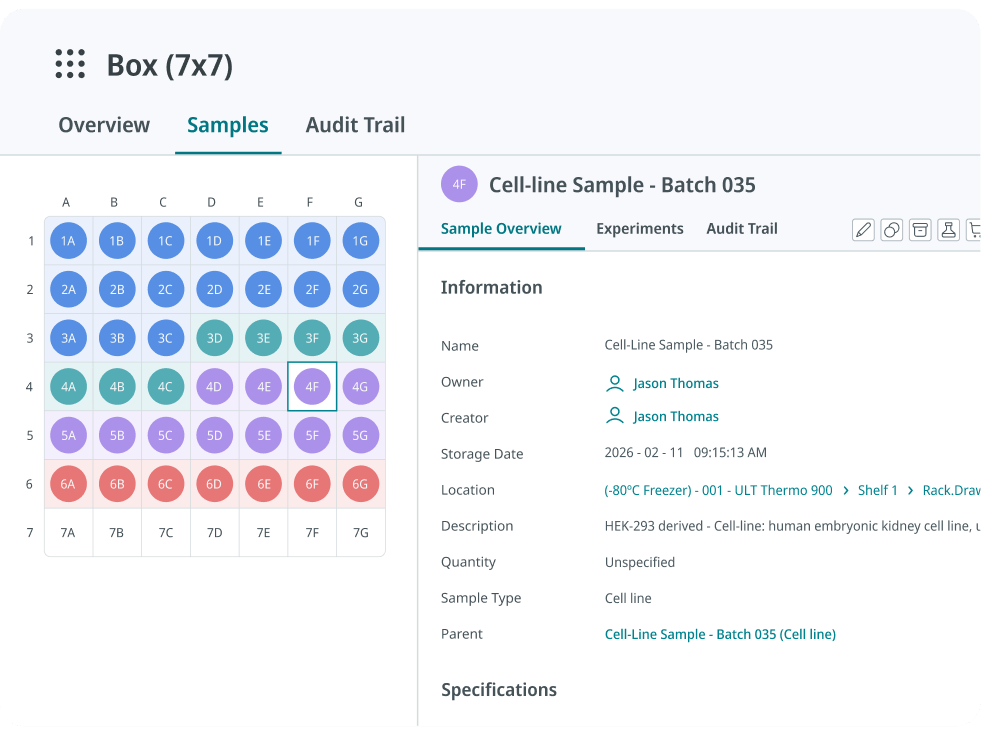
The honest version of this argument is broader than one vendor: a well-integrated specialist stack can also be usable, provided the connections between systems are reliable, governed, and feel natural to the scientist using them. The question to ask is not "Is this one system?" but "Does the connection between systems preserve scientific context and audit history without forcing manual work?"
For more practical ways to measure if your lab is succeeding, check out our guide on 12 practical lab KPIs.
Looks user-friendly vs. works user-friendly
Do flexibility and compliance controls make a LIMS harder to use?
They can, when designed poorly. But the tradeoff between ease and control is not inevitable.
Required fields, controlled vocabularies, role-based permissions, electronic signatures, and audit history can actually guide users toward complete, accurate records. A required field prevents a scientist from saving an incomplete entry. A controlled vocabulary ensures that "cell line" is always recorded in the same way. An audit trail tells a reviewer exactly what changed, and when, without anyone needing to reconstruct it manually.
The friction comes when controls are applied too broadly. Irrelevant required fields slow down every entry. Blanket approval workflows interrupt tasks that do not carry meaningful risk. Fields inherited from a QA/QC template that do not map to R&D practice frustrate scientists without improving data quality.
This is why configurable sample types matter more than they sound like they should. With SciSure, different scientific groups can model the materials and metadata their own work requires while still operating inside a shared organizational structure, so a chemistry group is not filling in fields designed for a cell line.
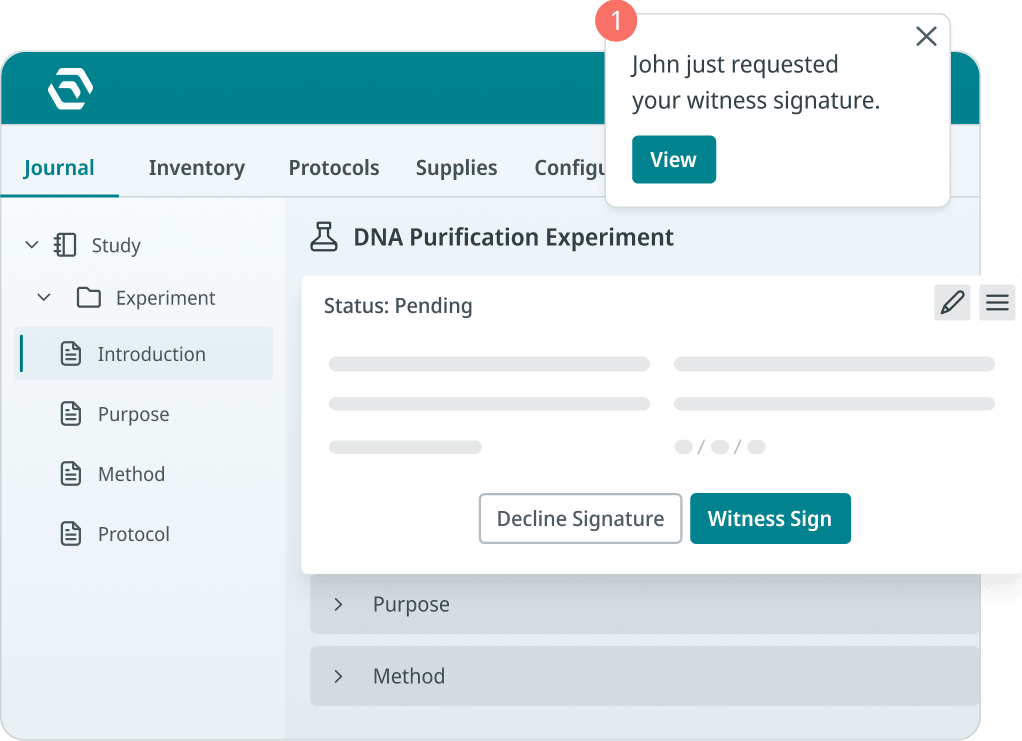
R&D teams need a balance: common structure for shared data, room for methods to evolve, and controls that protect the records that actually matter for reproducibility and compliance.
Compliance also depends on more than software. Configuration, validation procedures, training, governance, and change control all play a role. A LIMS that supports GLP or 21 CFR Part 11 workflows provides the controls; the organization still owns the implementation.
When you evaluate a LIMS, keep in mind: a system that feels smooth for scientists but impossible to audit is not a usability success.
What should R&D teams ask LIMS vendors?
These twelve questions cut through demo-mode polish and surface the information you need to evaluate usability in your actual environment.
- Can you show us a usability test conducted with real users, not demo specialists?
- How does the system link an experiment in the ELN to the samples created during that experiment?
- How does advanced search work? Can we filter by custom fields, parent-sample relationships, and date ranges simultaneously?
- What batch and barcode actions are available without additional add-ons or custom code?
- Who in our lab can configure a new sample type or add a custom field? Does it require a support ticket?
- What changes require custom code or professional services to implement?
- How does the system handle error correction while preserving audit history?
- What does onboarding typically look like, and how long before a scientist reaches independent use?
- When two systems are integrated, does the scientific context (experiment origin, parent-sample relationship) carry across? What happens to the audit trail?
- Do you have adoption data from similar R&D labs we can review?
- What are the most common complaints from scientist users in your G2 or peer reviews?
- Can we run an unscripted trial with our own data before committing?
What reviewers actually say
On G2, SciSure holds 4.2 out of 5 across 206 reviews, with an Ease-of-Use score of 7.9 drawn from 190 ratings.
- Ease of Use is likewise our single most frequently tagged strength in those reviews (43 mentions).
- Quality of Support scores 8.9 across 146 ratings.
- Sample Management for SciSure comes in at 8.9
- Inventory Management for SciSure comes in at 8.8.
Where SciSure fits for R&D laboratories
SciSure Research combines ELN and LIMS capabilities in one structured environment, designed for research and R&D labs where flexibility, evolving sample types, and fast iteration matter alongside traceability and governance.
Within SciSure Research, your team can:
- Register samples with configurable sample types and custom fields
- Track lineage, parent-child relationships, and lifecycle history
- Manage storage locations, compartments, and physical positions
- Use advanced search to filter by sample type, location, metadata, experiment link, or date
- Generate barcode labels and run batch updates across multiple records
- Link samples directly to experiments in the SciSure ELN
- Assign roles and permissions at group and organization level
- Capture audit logs, electronic signatures, and workflow automation where configured
- Extend functionality through APIs, an SDK, and Marketplace add-ons
- Access onboarding support and training through SciSure Customer Success
What customers have reported
The Diel Lab at Cornell University needed a system that scientists and PhD students could incorporate into daily work. The lab implemented SciSure's inventory, sample, and specimen tracking alongside the electronic lab notebook, replacing paper records and the time spent manually searching for samples and experimental information.
After onboarding and migration, the team reported more accurate inventory and stronger traceability across samples, reagents, experiments, SOPs, and research data. Search and retrieval let users pinpoint sample locations within seconds and made experimental details easier to share with internal and external collaborators.
Terminus Bio likewise needed to manage cell lines and trace their lineage without forcing specialized client workflows into an overly broad or rigid system. Before SciSure, the team relied on spreadsheets and manual markers, with individual sample entries taking around two minutes.
Using SciSure's cloning capabilities, customizable QR codes, and the Barcode Automation add-on, Terminus Bio brought data entry for subcultured cell lines down to around ten seconds while maintaining traceability across the cell-line lifecycle. The company also reported cutting data-management time by more than 90% through API access and custom reporting scripts.
Other systems are either too broad in scope or too rigid in their setup. SciSure offers a healthy balance of flexible functionality and the ability to customise certain aspects of our workflow without getting overly bogged down in features.
Since we have a unique workflow, the ability to customise certain aspects of our data tracking methods was key to our ability to successfully incorporate a LIMS.
Joshua Paster, Founder, Terminus Bio
The easiest way to evaluate a user-friendly LIMS is to test one
Every LIMS vendor can describe their product as intuitive. What you need to know is whether your scientists can register a sample, trace its history, and share a complete record with a reviewer, without extra logins, manual transfers, or lost context.
Bring us the workflow that gives your team the most trouble and we'll run it, not a demo dataset.
Frequently asked questions about LIMS usability
What makes a LIMS user-friendly?
A user-friendly LIMS allows scientists, LabOps managers, and administrators to complete their actual daily tasks accurately, efficiently, and with confidence. Based on the NIST summary of ISO 9241-11, usability covers effectiveness (can users complete tasks correctly?), efficiency (how long does it take?), satisfaction (do users feel confident?), and context of use (does the system fit real R&D workflows?). A clean interface is necessary but not sufficient on its own.
Is SciSure easy to use?
On G2, SciSure holds a 7.9 Ease of Use score on G2 from 190 ratings, and Ease of Use is the most frequently cited strength across its 206 reviews. Reviewers point to sample logging, real-time team visibility, and locating documents as the areas that work well, and some ask for interface improvements. Customers including the Diel Lab at Cornell and Terminus Bio have reported faster sample retrieval and substantially reduced data entry time. The most reliable test is still your own: run your workflow, with your data, before committing.
How can you test whether a LIMS is easy to use?
Run a standardized workflow scenario with a representative user during the vendor demo. The scenario should cover sample registration, aliquot creation, barcode labeling, storage assignment, reagent recording, batch updates, result attachment, and history retrieval. Capture task completion, time, re-entry points, application switches, errors, and user confidence. Score each vendor against the same criteria.
Can a LIMS be flexible and still support compliance?
Yes. Required fields, controlled vocabularies, permissions, electronic signatures, and audit trails can guide users toward complete, accurate records while still allowing methods and sample structures to evolve. The tradeoff becomes real when controls are applied too broadly, such as mandatory fields that are irrelevant to the current workflow, or approval steps that create friction without meaningful governance value. The goal is controls that match the actual risk level of each workflow.
Why should an R&D LIMS connect with an ELN?
In R&D, samples and experiments are inseparable. A sample is created during an experiment, used in subsequent experiments, and its history only makes sense alongside the experimental context. When the ELN and LIMS are disconnected, scientists must manually track which experiment produced which sample, creating re-entry burden, context loss, and audit gaps. An ELN-LIMS connection, whether within one platform or through a governed integration, preserves that context automatically.
How much LIMS training should users need?
There is no universal answer, but less is generally better, provided it does not come at the cost of record completeness or compliance. A well-designed LIMS should allow a scientist to complete core workflows within their first few sessions with structured onboarding. Complex administrative tasks and configuration may require more preparation. If common daily workflows require repeated support requests, that is a usability signal worth investigating.

Read more of our blogs about modern lab management
Discover the latest in lab operations, from sample management to AI innovations, designed to enhance efficiency and drive scientific breakthroughs.