ELN and LIMS Integration: What "Integrated" Actually Means
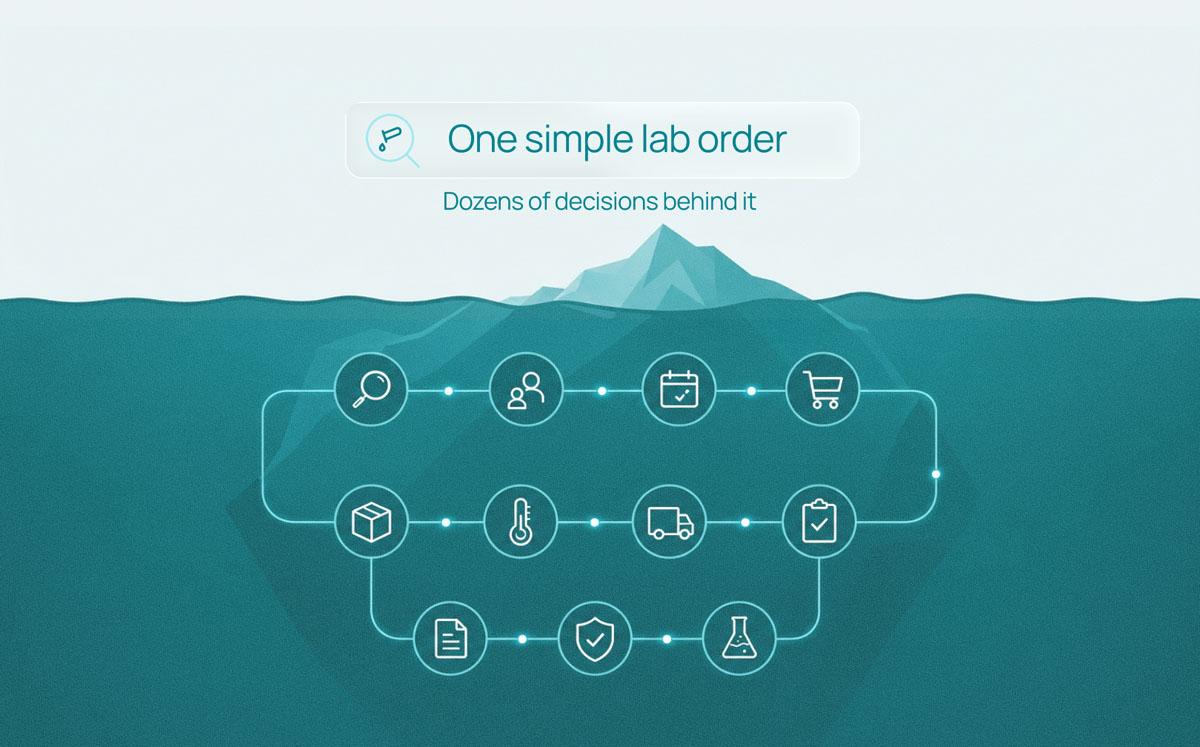
ELN and LIMS integration comes in three forms, and only one removes the handoff between experiments and samples. See how to tell them apart.

Download Whitepaper
TL;DR
ELN and LIMS integration means an experiment record and a sample record share the same identifiers, permissions, and audit trail, so using a sample in an experiment updates both without anyone retyping anything.
- Vendors use "integrated" for three different things.
It could mean one system with one data model, two products from the same vendor joined by a connector, and two vendors joined by middleware. Only the first removes the manual handoff. The other two shift the work to IT, and the difference shows up in your audit trail, not your feature list.
- Ask what happens when a sample is used in an experiment.
In a single system, the sample record updates itself and the link survives archiving, permission changes, and export. In a bundle, someone or something has to copy the identifier across, and that copy is where traceability breaks.
- What SciSure supports today.
SciSure Research combines ELN and LIMS capabilities in one system, so samples, storage, equipment, and experiments reference the same records without middleware. Health & Safety is a separate SciSure product with its own records and its own workflows.
- Proof from the bench.
Food Brewer barcoded cell cultures, equipment, chemicals, and consumables in SciSure and used the SDK to automate experiment creation and sample generation. They report a 60% productivity increase in R&D and 40% in upstream processing, plus full material traceability from tissue selection to 2,500L bioreactors.
Originally published in 2024, this 2026 update shares a vendor landscape table and buyer questions you're likely to run into when comparing them.
Ready to see SciSure in action?
No commitment · Free consultation
Your sample sits in a freezer with a barcode on it. Your experiment sits in a notebook with a protocol in it. Somewhere between the two, a scientist types a sample ID into a text field, and from that moment the two records only agree because a human was careful.
That is the gap ELN and LIMS integration is supposed to close. It usually doesn't, because "integrated" gets used to describe three fairly different arrangements, and only one of them actually removes the retyping.
This post is about telling them apart. If you're still working out whether you need an electronic lab notebook (ELN), a laboratory information management system (LIMS), or both, start with ELN vs LIMS: What's the Difference and come back. SciSure Research combines both in one system, which is why we spend a lot of time on this question with buyers, and why the distinctions below matter to us as much as to you.
What ELN and LIMS integration actually means
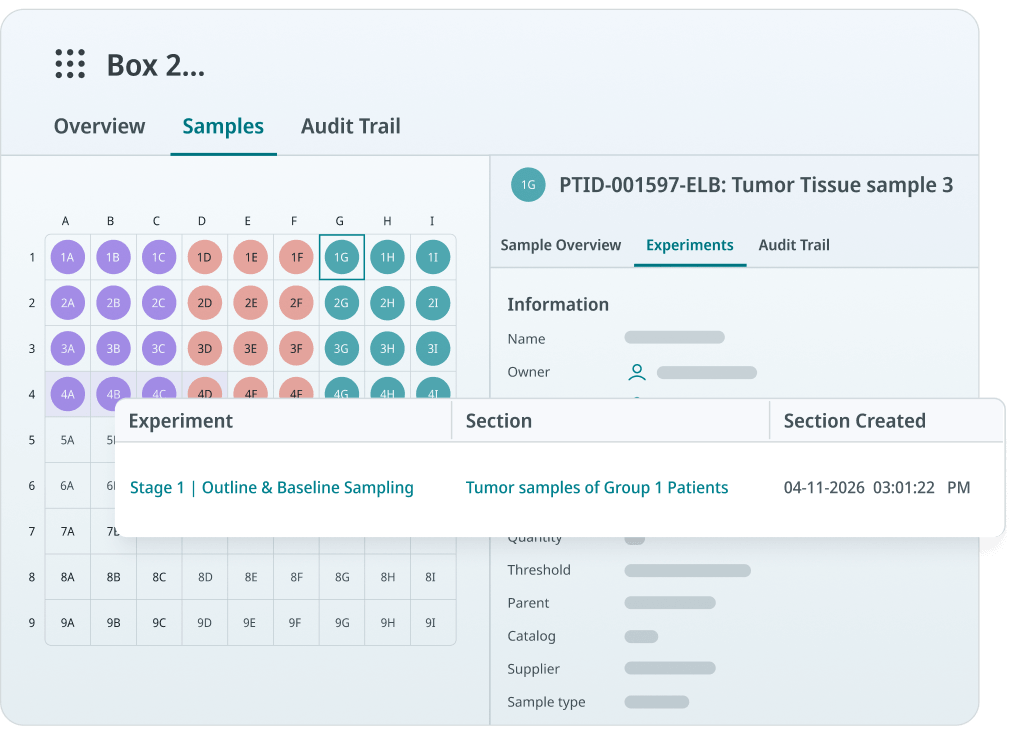
ELN and LIMS integration means an experiment record and a sample record share the same identifiers, the same permission model, and the same audit trail. When a scientist pulls a vial for an assay, the sample's quantity drops, the experiment shows which vial was used, and the sample's history shows which experiment consumed it. Nobody keys anything twice.
Anything short of that is data transfer. Data transfer is often fine. It is not the same thing, and it fails differently: quietly, months later, when someone archives a sample and the link in the experiment turns into an orphaned string.
One system, one data model
Experiments, samples, storage, and equipment are records in the same environment. Using a sample in an experiment creates a real reference between two objects, not a copied string, and that reference behaves consistently through archiving, export, permission changes, and audit-trail review.
The trade-off is scope. A single system covers what its data model covers. If you need a capability outside it, you extend it through an application programming interface (API) or an add-on rather than swapping in a specialist tool.
Two products from one vendor, joined by a connector
Common in vendor portfolios assembled through acquisition. The notebook and the inventory system were built by different teams at different times, and a connector holds them together. This can work well, and one vendor to call is genuinely worth something.
Make sure to double-check:
- Is the connector included or separately licensed?
- Do both products share one permission model?
- Do they release on the same schedule?
A connector that ships a quarter behind the products it connects is a maintenance job, not a feature.
Two vendors, joined by middleware
Best-of-breed. You pick the strongest notebook and the strongest sample system and connect them yourself, usually through REST APIs and an integration layer.
Labs with real informatics staff do this well, and for some workflows there is no alternative. But you now own the integration: its testing, its validation evidence in a regulated environment, its behaviour when either vendor changes a schema, and its documentation when the person who built it moves on. Budget for it as a system, not a project.
Which vendors offer integrated ELN and LIMS
This is a summary of what each vendor publishes, not an evaluation, and it changes as products change. Make sure to verify against their public documentation before you build your shortlist.
Keep in mind that several platforms that read as "one system" are LIMS-first products that added notebook capability, or notebook-first products that added inventory. Neither origin is a problem. It does shape which side feels mature, so weight your evaluation toward whichever side your team lives in daily.
Also keep in mind that "the vendor offers both" and "the two are one system" are different claims. LabArchives is the clearest example: the ELN and the inventory product are genuinely connected, and they are also separately purchased products. That's a legitimate model. It just isn't the same as a shared data model, and the pricing page tells you more than the product page does.
For a buyer-level view of how these architectures fit different laboratories, see our Benchling alternatives comparison by operating model.
What integration changes day to day
Sample lineage that survives the experiment
A sample generated in one experiment becomes the input to the next. In a single system, the lineage tree renders that chain without anyone maintaining it. Across two systems, lineage lives on the sample side and experiment context lives on the notebook side, and reconstructing the full picture is a manual job.
Reagent traceability during an investigation
When a lot goes bad, you need every experiment that touched it. That query is trivial when reagent records and experiment records are in one place and painful when they aren't.
Barcode actions that do more than look up
Scanning a vial can check it out, log the user and timestamp, decrement quantity, and attach it to the open experiment in one action. Chained actions like this need write access to both record types at once.
Audit trails that read as one story
Two separate audit trails, exported separately and correlated by timestamp, is an answer an auditor will accept and won't enjoy. One trail across samples, series, equipment, and experiments is a better afternoon for everyone.
How Food Brewer built traceability from tissue to bioreactor
Food Brewer produces cocoa from plant cell cultures, scaling selected tissues through multiple stages up to 2,500 litre bioreactors. Twenty-one people, about half in R&D and production, working on processes novel enough that regulatory approval and IP protection depend on documentation quality.
They built on SciSure from the start. Standardized naming and folder hierarchy across projects, experiments, and datasets. Barcoding across cell cultures, equipment, chemicals, and consumables, giving them traceability from the moment plant material enters the lab through scale-up, downstream processing, packaging, and delivery. Inventory thresholds with automated alerts. Substance exposure logged at every timepoint.

Then they went further, using the SciSure Software Development Kit to build automation applications. A single action now triggers experiment creation, generates or deletes samples, updates sample metadata, and launches downstream processes, with the remaining steps running in the background. They also built extract-transform-load pipelines to centralize screening assay results, bioprocess data, and experimental metadata in an internal database for modelling and company-wide KPIs.
Christopher Keim, Head of Process Automation, attributes a 60% productivity increase in R&D and 40% in upstream processing to those automation applications, because the team no longer tracks cultures, chemicals, consumables, and data integration by hand.
Questions to ask before you buy
- Show me a sample record and an experiment record referencing each other.
Not a slide. The actual screens, with the link clicked in both directions. - What happens to that link when the sample is archived?
And when the experiment is signed and locked? - Are ELN and sample management one licence or two?
If two, what does the connector cost and who supports it? - Do both sides share one permission model?
Or can a user see a sample they can't see the experiment for, and vice versa? - Can I export one audit trail covering samples and experiments together?
In what formats? - Which side came first?
Every platform has a stronger half. Knowing which one tells you where you'll hit friction.
Where SciSure fits, and where it doesn't
SciSure Research combines ELN and LIMS capabilities in one system.
- Samples, sample series, storage units, equipment, protocols, and experiments reference each other directly.
- Barcode automation supports single-sample, multi-sample, and chained actions in one scan.
- Triggers and automations fire on events like sample creation or a field change, and can send notifications, call webhooks, or create tasks.
- Audit trails span samples, series, equipment, and experiments, exportable to PDF, Excel, and CSV.
- An open API, a software development kit, and a Marketplace of add-ons handle what sits outside the core.
We do want to emphasize, SciSure Health & Safety is a separate SciSure product covering chemical inventory, safety data sheets, inspections, incidents, and training compliance. It has its own records and its own workflows.
SciSure LIMS is also primarily built for research and R&D, where sample types evolve and workflows need to stay configurable. If you're running high-throughput QA/QC with fixed, enforced process pipelines, consider a traditional manufacturing LIMS instead.
FAQs
What does ELN and LIMS integration mean?
ELN and LIMS Integration means an experiment record and a sample record share the same identifiers, permission model, and audit trail, so using a sample in an experiment updates both records without manual re-entry. Vendors also apply the term to two separate products connected by a vendor-built connector or by middleware you maintain. Those arrangements transfer data between systems rather than removing the handoff, which is why the same word covers quite different architectures.
Can I integrate an ELN and a LIMS from different vendors?
Yes, usually through REST APIs and an integration layer. Labs with informatics staff do this successfully when they need best-of-breed capability on both sides. Plan for it as an ongoing system rather than a one-off project: you own the testing, the behaviour when either vendor changes a schema, and, in regulated environments, the validation evidence for the integration itself.
Do I need both an ELN and a LIMS?
It depends on how much of your work is documentation versus sample volume. Research-heavy teams with evolving experiments often start with an ELN. Labs registering, tracking, and dispatching large numbers of samples usually need LIMS capability first. Many labs eventually want both, which is why the question of how they connect matters at the point of purchase rather than two years later.
Does SciSure require middleware to connect ELN and LIMS?
No, SciSure Research provides ELN and sample and inventory management in one system, so samples link directly to experiments and equipment records connect to entries without a connector between them. Connecting SciSure to external systems such as instruments or data warehouses uses the open API, the SDK, or Marketplace add-ons, and those integrations do require configuration.
If this sounds like the kind of support you need, get in touch with us. We'll walk you through what ELN and LIMS Integration looks like in one connected platform using your real-life workflows as the base.

Read more of our blogs about modern lab management
Discover the latest in lab operations, from sample management to AI innovations, designed to enhance efficiency and drive scientific breakthroughs.