Lab Supplies: The Hidden Complexity Behind Every Order
Every lab order involves decisions about products, suppliers, availability, inventory, and data. See how connected systems can simplify scientific purchasing.
Download Whitepaper
TL;DR
- Lab ordering is more complex than it looks. Researchers have to balance scientific requirements, supplier availability, pricing, lead times, internal purchasing preferences, and existing inventory before making what appears to be a simple purchase.
- More supplier choice should not mean more work. Scientists need access to a broad supplier ecosystem, but navigating different catalogs, websites, and purchasing channels creates friction. Centralizing product discovery can preserve scientific choice while making it much easier to find the right option.
- Sometimes the best order is no order at all. Visibility into existing inventory, stock levels, locations, expiration dates, and consumption can help teams avoid unnecessary purchases, reduce waste, and identify potential shortages before they disrupt research.
- Procurement and inventory data should flow together. When purchasing and inventory systems are disconnected, teams have to manually recreate information after materials arrive. Connecting those systems reduces repetitive data entry and creates more accurate, inventory-ready records.
- SciSure and ZAGENO connect both sides of the workflow. ZAGENO supports product discovery, supplier access, and purchasing, while SciSure supports materials within laboratory operations. Their integration synchronizes procurement activity with chemical inventory, creating a smoother flow from purchasing into the lab.
This guest blog was contributed in 2026 by Jim Spang, Director of Business Development & Strategic Partnerships at ZAGENO.
Ready to see SciSure in action?
No commitment · Free consultation
Every lab order requires decisions about products, suppliers, availability, inventory, and data. ZAGENO's Jim Spang explores the complexity behind a seemingly simple purchase and how better-connected systems can protect researchers' time.
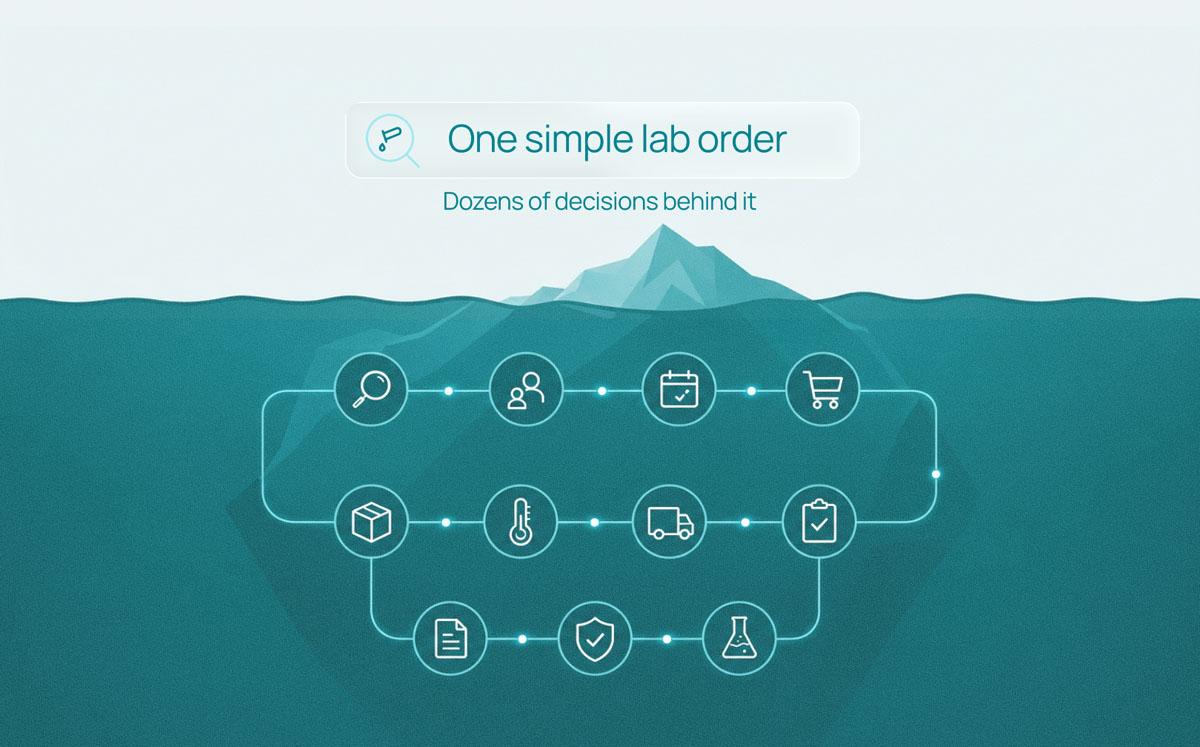
A scientist needs a reagent. They find it, order it, and get back to the experiment. At least, that's how lab ordering is supposed to work. In practice, every order for laboratory supplies can involve a surprising number of decisions.
Is this the right product? Is it already somewhere in the lab? Which supplier has it available? Is there a preferred supplier? What happens if it's backordered? Is an alternative acceptable? When will it arrive? And what happens to the purchasing data once the material reaches the lab?
One thing I've learned working with partners across the life sciences ecosystem is that the complexity isn't usually in any one step. It's in the handoffs between them.
That's the hidden complexity behind scientific purchasing, and it's why product discovery, suppliers, ordering, and inventory increasingly need to work together.
What lies behind a seemingly straight-forward lab order
Scientific purchasing carries a level of complexity that is easy to underestimate. Product specifications, availability, storage requirements, compatibility, shelf life, and supplier constraints can all influence whether an item is right for a particular experiment.
So the researcher isn't simply asking: Where can I buy this?
They're asking: Which product meets the scientific need, is available when I need it, and fits the way my organization buys?
And that's before an item ever reaches the cart. The breadth of scientific materials adds another layer. Laboratory supply chains can span routine consumables, chemicals, reagents, controls, specialized equipment, and custom products, each with different considerations around sourcing, storage, stability, and delivery.
The paradox of supplier choice
Scientific research depends on a broad supplier ecosystem. Labs may purchase routine consumables from major distributors, specialized reagents directly from manufacturers, chemicals from niche suppliers, custom products through quotes, and equipment through entirely different channels.
As organizations grow, researchers can find themselves moving between supplier websites, catalogs, punchouts, and purchasing routes simply to identify the right option.
More choice is critical. Scientists shouldn't have to compromise an experiment because an organization wants to reduce the number of vendors it manages.
But choice also creates more decisions.
A product may be available through several purchasing channels with different pricing, availability, or delivery timelines. A preferred supplier may be the right choice under normal circumstances but not when a critical item is backordered. A specialty product may only be available from a supplier the organization has never used before.
The objective shouldn't be to eliminate scientific choice. It should be to make that supplier ecosystem easier to navigate.
Centralizing access across suppliers can preserve choice without requiring researchers to navigate every supplier, catalog, or purchasing channel separately.
At ZAGENO, our lab supply marketplace brings together more than 50 million products from 6,000+ scientific brands, allowing researchers to search and compare products, suppliers, availability, and delivery information from one place.
The complexity still exists. The scientist just doesn't have to manage all of it manually.
Product discovery is where the hidden work begins
The amount of work that takes place before an order is submitted is easy to underestimate.
Sometimes a researcher knows the exact catalog number they need. Often, it’s something less precise:
- The experimental objective they're trying to achieve
- The type of reagent or consumable required
- The technical characteristics that matter
- A product they've used before that is now unavailable
- An existing item for which they need an acceptable alternative
That turns a simple search into a product discovery problem.
Researchers may need to compare specifications, locate alternatives, determine which suppliers have stock, evaluate lead times, and reconcile all of that against internal preferences or purchasing requirements.
Increasingly, AI can reduce some of that work. Natural-language search, product recommendations, chemical structure search, and alternative-product identification can make large scientific catalogs easier to navigate while leaving the scientific decision with the researcher.
We've explored this further in our article on how AI is changing scientific product discovery and purchasing.
But the principle is straightforward: technology should help researchers get to the right choice faster, not give them another interface to manage.
Sometimes the best purchasing decision is not to purchase
Before searching suppliers, there is another question worth answering: Do we already have it?
Inventory levels, consumption, storage capacity, expiration dates, safety requirements, and compliance considerations can all influence whether another order should be placed. SciSure's Jon Zibell explores that upstream context in What Procurement Needs to Know from the Lab Before an Order Is Placed.
That context matters. If a reagent is already available elsewhere in the organization, another order can create unnecessary spend and increase the risk of unused material expiring. If inventory is approaching a critical level, earlier visibility can help avoid a shortage that interrupts an experiment.
This is where lab inventory management becomes part of the purchasing decision, by providing visibility into chemicals, biological samples, reagents, consumables, equipment, stock levels, and locations, helping teams understand what they already have and what they actually need.
The best purchasing experience, then, isn't simply better access to external supply. It's connecting what the lab already knows with what it needs to buy next.
Ordering and inventory shouldn't require the same data twice
Once the right product has been found and ordered, another handoff begins. The information used to purchase the material needs to become useful inventory information when that material enters the lab.
When those systems operate separately, people become the integration layer.
Someone receives the package, identifies it, enters information into another system, updates inventory, and may also have to add chemical, storage, safety, or expiration information.
Each manual handoff creates work. It also creates another opportunity for information to be delayed, entered inconsistently, or missed.
SciSure explored this issue in Procurement and the Lab Are Already Connected. Your Software Just Doesn't Know It Yet. The organizational connection between purchasing and inventory has always existed. The opportunity is to make the systems reflect it.
This is why connecting systems increasingly matters as much as the capabilities of any individual platform.
ZAGENO's approach to scientific procurement orchestration connects purchasing with suppliers, enterprise systems, and scientific workflows, while SciSure's integration framework connects research tools, instruments, databases, and external applications. Neither system has to become the other. They need to exchange the right information at the right moment.
The order may be complete in the purchasing system. For the lab, that's where the next part of the workflow begins.
How SciSure and ZAGENO connect purchasing with chemical inventory
A big part of my role at ZAGENO is looking for what I call the "better together" story: where two companies solve adjacent problems and create more value by connecting what each does best.
The ZAGENO-SciSure partnership is a great example.
- ZAGENO focuses on the complexity involved in finding and buying scientific supplies: product discovery, supplier access, comparison, purchasing workflows, and ordering.
- SciSure focuses on the materials once they become part of laboratory operations, connecting inventory with research, lab operations, safety, and compliance.
The integration between ZAGENO and SciSure connects those two sides by synchronizing procurement activity with chemical inventory.
Purchasing data can become structured, inventory-ready chemical records rather than having to be recreated manually after an order reaches the lab. That reduces repetitive data entry, improves inventory accuracy, and creates a more continuous flow of information from ordering into laboratory operations.
It's the type of partnership I look for because the value doesn't come simply from connecting two pieces of software. It comes from removing a handoff that someone would otherwise have to manage.
The best partnerships create wins for everyone: us, our partner, and the end customer.
Here, that end customer is ultimately the research team.
What does a better lab order look like?
A researcher identifies a need.
Before another product is ordered, inventory data can help determine whether the material is already available somewhere in the organization.
If it needs to be purchased, the researcher can search across relevant scientific suppliers, compare appropriate products and purchasing options, identify an available or preferred choice, and place the order.
The resulting purchasing information can then feed the inventory process instead of being recreated manually when the material arrives.
Over time, that connection improves decisions on both sides.
Inventory data can show whether products already exist across locations, whether stock is approaching expiration, and how consumption is changing. Purchasing data can provide visibility into prior orders, suppliers, availability, and alternatives before a shortage becomes an experiment delay.
Neither dataset tells the complete story on its own. Together, they provide a more accurate view of supply and demand across the research organization.
That matters for cost control, inventory accuracy, and experimental continuity. It also means researchers and lab operations teams spend less time reconciling information across systems.
The future of lab purchasing should be invisible
Life sciences organizations are already managing a growing combination of research software, inventory tools, suppliers, enterprise systems, and AI.
Deloitte's 2026 Life Sciences Outlook identifies productivity, resilience, digital transformation, and external partnerships among the issues shaping the industry's priorities.
Adding more disconnected technology isn't the answer. Making the ecosystem work together is.
For researchers, the ideal experience isn't learning how to become better purchasers.
Scientists shouldn't need to understand supplier structures, catalog integrations, purchasing policies, inventory databases, and system architecture simply to get the materials required for an experiment.
Those complexities are real, but increasingly they can happen behind the scenes.
At ZAGENO, our job is to make the world of scientific products and suppliers easier to navigate. SciSure helps organizations manage the materials, research data, lab operations, safety, and compliance surrounding those products once they enter the laboratory.
By connecting those capabilities, SciSure and ZAGENO removes the friction between purchasing and inventory, allowing each platform to remain focused on what it does best while creating a smoother experience for the scientist.
Because the goal isn't simply to make lab ordering easier. It's to keep the complexity of getting materials out of the way of the science they make possible.
About the author
Jim Spang is Director of Business Development & Strategic Partnerships at ZAGENO, where he leads collaborations across the life sciences ecosystem. His approach centers on finding the "better together" story between complementary organizations and building partnerships that create meaningful value for research teams and the businesses that support them.

Read more of our blogs about modern lab management
Discover the latest in lab operations, from sample management to AI innovations, designed to enhance efficiency and drive scientific breakthroughs.