ELN and LIMS for CROs: What to Check Before You Invest
Buying an ELN or LIMS for your CRO? Check client data separation, sample traceability, audit readiness, cost tracking, hosting, and local requirements before you invest.

Download Whitepaper
TL;DR
The right electronic lab notebook (ELN) and laboratory information management system (LIMS) for a contract research organization (CRO) keeps each client's data separate, traces every sample from receipt to report, and produces records that hold up to sponsor audits and regulator inspections.
- Client data separation.
Before comparing features, check how the system keeps one sponsor's samples, results and files away from another's. With SciSure ELN & LIMS, groups, projects and role-based permissions can set those boundaries, and custom fields can carry client codes, contract numbers and study IDs on every record.
- Sample-to-report traceability.
A CRO needs to show who received a sample, where it was stored, which experiments used it and what happened to it afterwards. Look for configurable sample types, barcodes, parent-child lineage, check-in and check-out, and audit trails that link samples directly to experiment records. At HistologiX, a UK clinical research organisation, SciSure helped replace paper sample logs with searchable records and barcode-supported sample handling.
- Audit-ready records.
Sponsor auditors and inspectors want timestamped entries, visible change history, controlled SOP versions and signatures that lock the record. Software can support GLP (Good Laboratory Practice) and FDA 21 CFR Part 11 workflows, but your CRO still owns validation, SOPs, training and quality oversight.
- Costs and hosting.
Ask how study costs, consumables and instrument time connect to client projects, and where the data physically lives. Cloud, private cloud and on-premises options matter when client contracts, GDPR processor terms or internal IT policies set limits on data location and access.
- Local rules.
GLP oversight is organized differently in the United States, Germany and France. FDA 21 CFR Part 58, Germany's Chemicals Act (ChemG) with state inspectors, and France's split between ANSM, ANSES and COFRAC each shape what your ELN and LIMS must prove.
Ready to see SciSure in action?
No commitment · Free consultation
Why CROs buy lab software differently
If you run a CRO, your lab works on someone else's science. Every sample that arrives has an owner, a study code, and a contract behind it. Every result you send back may end up in a sponsor's regulatory submission or in an investor's due-diligence review.
That changes what you need from an ELN and a LIMS. A biotech buying an ELN mostly asks, "Will my scientists use this?" A CRO has to ask that too, plus a few harder questions:
- Can we keep Client A's data away from Client B?
- Can we show a sponsor's auditor exactly who handled their samples, and when?
This guide walks through the questions to answer before you sign. It's written for small and mid-sized CROs and contract development and manufacturing organizations (CDMOs) doing discovery, analytical, bioanalytical and preclinical work. It also covers what changes if you operate in the United States, Germany or France. Where it helps, we show how teams set this up in SciSure, which combines ELN and LIMS capabilities.
Who this guide is for
This guide fits you if your lab:
- Runs discovery or in vitro studies for pharma and biotech sponsors
- Is a preclinical or GLP test facility
- Runs defined analytical methods for clients, where the method is fixed and the client, sample and study change
- Is a bioanalytical lab handling client samples
- Is a CDMO development lab doing process or analytical development before GMP (Good Manufacturing Practice) work begins
It fits less well if your main job is GMP quality control and batch release. Those labs usually need a GMP-focused LIMS with specification management, batch records, and release workflows. For clarity: SciSure ELN & LIMS isn't built as a GMP batch-release system.
1. How will you keep each client's data separate?
Most CRO contracts include confidentiality terms. Many sponsors will ask, during qualification or audit, how you prevent one client's data from being seen by another client or by staff who don't work on their studies.
Client separation usually works on three levels:
- Structure.
Each client, program or study gets its own space in the system.
- Permissions.
Staff see only the clients and studies they work on, with separate rights to view, edit, sign, and export.
- External access.
If a sponsor scientist or quality reviewer needs to see records, their access is limited to their own studies and can be removed when the project ends. This also might require a separate license per client.
With SciSure, a group is the secure collaboration boundary for a lab or team. Access runs through roles with separate View, Add, Update and Delete permissions, plus specific rights for sharing, signing and working with other users' records. When a role doesn't have a permission, the related buttons and menus are hidden.
A practical SciSure pattern for CROs is to structure work by client and study, using groups or projects as the boundary. Custom fields on projects and studies can carry client codes, contract references and study numbers, so every experiment and sample sits under the right client from the start.
What to ask for in a demo
Log in as a user assigned to Client A and search for a Client B sample. Then ask what an administrator, an exporter and a sponsor reviewer can each see. If your management team needs reports across all clients, ask how that works without opening up client data to everyone.
2. Can you trace every sample from receipt to report?
For a CRO, the sample is often the most valuable thing in the building. It may be irreplaceable; it belongs to the client, and its history is part of the data you deliver.
You should be able to answer these questions for any sample, quickly:
- When did it arrive, who received it, and in what condition?
- What is the client's ID for it, and what is yours?
- Where is it stored right now, down to the box and position?
- Which aliquots came from it?
- Which experiments used it, and what did they produce?
- Who took it out of storage, and when did it go back?
SciSure ELN & LIMS handles this through configurable sample types. Each sample type is a template with the fields your lab needs, including required fields, dropdowns, dates, links to other samples and auto-numbering. Samples carry an internal ID and can also carry an external barcode, so the client's label and yours can live on the same record.
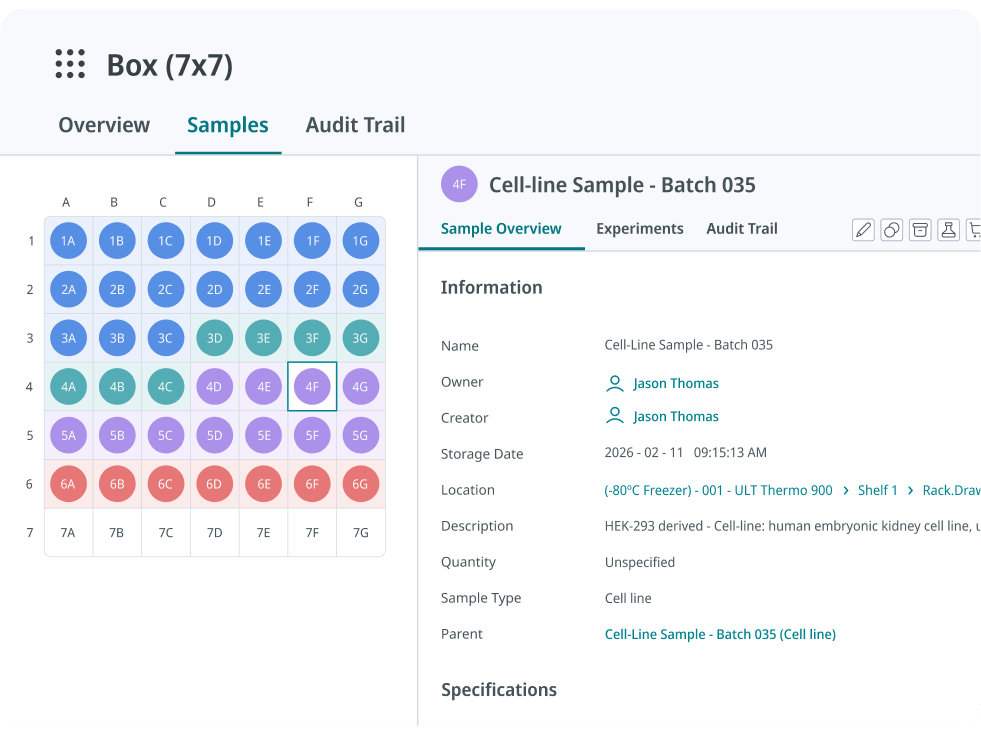
From there, parent-child relationships record aliquots and derived samples. Storage units model freezers, racks and boxes down to the exact position. Check-in and check-out are available through the free Sample Check-out add-on. Each sample has an audit trail showing who changed what and when.
The link between samples and experiments runs both ways. An experiment lists the samples it used and generated, and each sample record shows the experiments it appeared in. When a sponsor sends a manifest of 400 samples, Sample Batch Import can bring them in from a spreadsheet rather than one by one.
What to ask for in a demo
Bring a real (anonymized) sample manifest. Ask the vendor to import it, assign storage positions, create aliquots, use two of them in an experiment, and then show you the full history of one sample.
For a comparison, check out our guide to the best sample management & tracking software.
3. Will your records hold up to a sponsor audit or an inspection?
Sponsor auditors and regulators look for the same basics. Who did the work? When? What changed afterwards, and why? Which version of the SOP was used? Who reviewed and approved it?
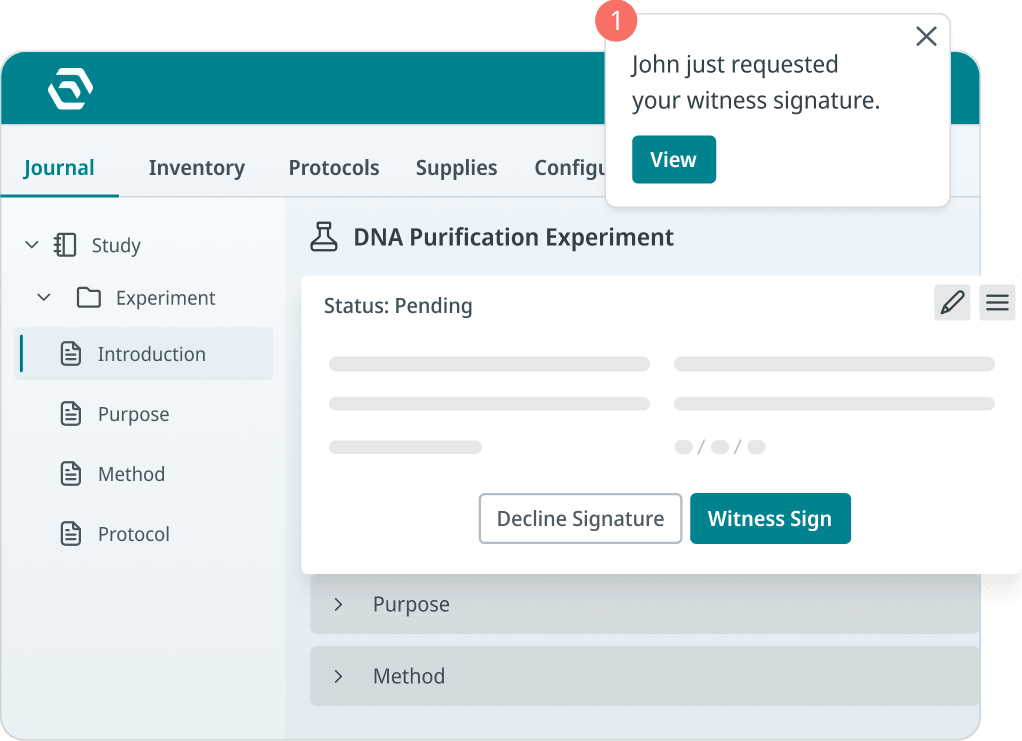
In SciSure, experiments are built from dated, timestamped sections, and each section keeps its own version history. Completed experiments can be signed and locked. If your group policy requires witness signing, the experiment goes to an assigned witness, who either approves and permanently locks it or declines it with a comment. Signed records stay readable but can't be edited, so amendments go into comments or linked copies, and the original stays intact.
Protocols and SOPs have their own versioning, signing, and publishing. When a scientist inserts a protocol into an experiment as a procedure section, the experiment records that specific version. One practical tip: insert the procedure rather than linking to it, because a protocol link shows the latest active version, not the version in use when the work was done.
Group policies can require digital signatures, witness signatures, password rules, and two-step verification. That lets a CRO apply stricter settings to GLP studies without forcing the same process on exploratory work.
One point every vendor should be honest about: software supports compliance, but it doesn't make a lab compliant. Your CRO still needs system validation, SOPs, training, quality assurance oversight, record retention, and change control. Our GxP compliance guide covers where that responsibility sits.
What to ask for in a demo
Ask the vendor to sign an experiment, have a witness decline it, correct it and sign again, and then show you the audit trail for the whole sequence. Ask what validation documentation they provide and what your team will need to produce itself.
4. Can you connect the science to what it costs?
A CRO's margin depends on knowing what a study really consumed: samples run, repeats, reagents, instrument time and analyst hours. In many CROs, that information lives in spreadsheets outside the lab system. Over time, quotes drift away from what the work actually costs, and nobody notices until a fixed-price project goes over budget.
When you evaluate an ELN and LIMS, look at how scientific records and cost-related information can sit together:
- Can you tag projects, studies and samples with client codes, purchase order numbers or cost-center codes?
- Can consumables be linked to the samples and studies that used them?
- Can instrument bookings be tied to a study?
- Can your finance or ERP (enterprise resource planning) system pull this data out, so nobody retypes it?
With SciSure ELN & LIMS, custom fields on projects, studies and samples can carry client and commercial references. Equipment records include booking calendars. Data can leave the system through Excel exports and the API, and automations can send webhook messages to other systems when records change.
5. Where will the data live, and who can reach it?
Client contracts sometimes specify where data may be stored and who may access it. Your IT team will have its own rules. And if you process personal data for a sponsor, data protection law adds more.
Hosting
SciSure ELN & LIMS is available as cloud, private cloud or on-premises. Public cloud customers choose an EU or US region. Private cloud offers dedicated resources and custom network restrictions, and on-premises keeps data on your own servers.
Identity and access
SciSure supports single sign-on (SSO) through SAML and identity providers such as Microsoft Entra ID, Okta and OneLogin, and two-step verification can be enforced at group or system level. Password policies, automatic logout, and account lockout after failed logins are configurable. For more details, check out our security documentation in our Trust Center.
Data protection
Under Article 28 of the GDPR, a processor can't engage with another processor without the controller's written authorization. If your CRO processes personal data on behalf of a sponsor, your ELN or LIMS vendor may count as a sub-processor. Check this with your data protection officer before you sign.
For a longer list of security questions, check out our guide on how to choose a data-secure ELN.
6. How will you report back to clients?
Most CROs deliver more than a final report; sponsors ask for raw data, sample lists, chain-of-custody records, and sometimes signed copies of experiment records. Check how easily you can:
- Export a full experiment record, with signatures and timestamps, as a PDF
- Export sample lists with only the columns a client needs
- Send data to a client's system through an API rather than email attachments
SciSure supports printing and exporting experiments, Excel export from advanced sample search, a Sample Export Column Selector add-on, and API access for system-to-system transfers.
7. What happens when a client's program moves into GxP work?
Your clients' needs change as their programs move forward. A discovery project becomes a GLP tox study. A process development project moves to GMP manufacturing. Decide early which work your ELN and LIMS will cover and where you'll hand off to other systems.
SciSure supports GLP- and Part 11-aligned workflows where configured and validated, and it's a good fit for discovery, analytical development and GLP study documentation. It isn't a GMP batch-record or QC release system. If part of your business runs under GMP, plan for how the two systems will exchange data.
HistologiX: From paper logs to searchable sample records
HistologiX, a UK clinical research organisation specializing in tissue-based analysis, used paper logs to track sample receipt, location and dispatch. As its client work grew, finding information meant searching those logs in person. The team adopted SciSure for Research to bring sample and stock information into a searchable system.
HistologiX now uses barcodes and scanners when checking samples in and out, locating them and recording disposal. Project managers and client account managers can also check sample and reagent status without asking a scientist to search the lab’s records. That visibility helps the team plan work and spend less time on sample administration.
"Adopting SciSure has improved HistologiX’s operational efficiency, enabling us to streamline material receipt, stock management, and sample logistics.
The reduced administrative workload has allowed our scientists to focus on what they do best – applying our expertise in tissue-based analysis to advance our client’s cutting-edge drug discovery."
- Laura Hubbard, Operations Director
Regional considerations: United States (GLP, Part 11 and contract labs)
In the US, 21 CFR Part 58 sets GLP rules for nonclinical laboratory studies that support applications for FDA research or marketing permits. Two parts matter directly for CROs:
- Not everything is GLP.
The definition of a nonclinical laboratory study excludes basic exploratory studies that test whether a compound has potential utility. Much discovery work falls outside GLP, so your system should make it clear which studies are GLP and which aren't.
- Sponsors must tell you.
Under section 58.10, when a sponsor uses a contract lab for part of a GLP study, the sponsor must notify the lab that the work is part of a GLP study. Your ELN and LIMS should make it easy to flag that status on the study and apply the right controls.
For electronic records, 21 CFR Part 11 section 11.10 lists controls for closed systems. These include limiting system access to authorized people, secure computer-generated audit trails with date and time stamps, and authority checks on who can sign or change a record.
What this means for your evaluation
Ask whether you can apply stricter settings to GLP studies only. With SciSure, group policies can require signatures, witness signatures, and two-step verification for specific groups, so a GLP group can run under tighter rules than a discovery group.
Regional considerations: Germany (GLP oversight, GDPR and cloud assurance)
In Germany, GLP principles are anchored in the Chemicals Act (Chemikaliengesetz, ChemG), sections 19a to 19d. According to the German Federal Institute for Risk Assessment (BfR), state (Länder) authorities inspect test facilities and check individual studies, while the GLP-Bundesstelle at the BfR coordinates GLP questions nationally and internationally.
For computer systems, German inspectors work from the OECD GLP documents. OECD Document No. 17 sets out a risk-based life-cycle approach to validating computerized systems, with a focus on data integrity. Its supplement on cloud computing, published by the BfR, says test facility management must control cloud suppliers and their subcontractors, and that written agreements should state whether parts of the service are subcontracted.
Two other points often come up in German procurement:
- GDPR (DSGVO).
The processor rules described above apply in full.
- BSI C5.
The Federal Office for Information Security (BSI) publishes the Cloud Computing Compliance Criteria Catalogue (C5), a set of minimum-security requirements for cloud services. The current version, C5:2026, was published in April 2026. Larger German buyers may ask whether a cloud vendor holds a C5 attestation or can map its controls to C5.
What this means for your evaluation
Ask for the vendor's written terms on subcontractors and hosting, and how its controls support your OECD No. 17 validation. SciSure offers an EU hosting region, private cloud and on-premises options, and a German-language interface.
Regional considerations: France (BPL oversight, health data hosting and language)
In France, GLP is called BPL (bonnes pratiques de laboratoire), and oversight is split by product type. According to COFRAC:
- ANSM (the national medicines and health products agency) inspects GLP for human medicines, cosmetics and tattoo products.
- ANSES, through its veterinary medicines agency (ANMV), covers veterinary medicines.
- COFRAC (the French accreditation committee) covers pesticides, food and feed additives and industrial chemicals, and makes GLP conformity decisions on behalf of the state.
COFRAC took over this role from the former interministerial chemicals group (GIPC) under Decree No. 2021-662. The ANSM says it inspects test facilities regularly, in principle every two years.
If your CRO handles personal health data, check one more rule. In France, a provider that hosts personal health data on behalf of someone else may need HDS (Hébergeur de Données de Santé, or health data host) certification. Version 2 of the HDS framework had to be in place for all existing certificates by 16 May 2026, and it tightens the rules on transferring data outside the EU. Most preclinical and analytical CRO work doesn't involve this kind of data. Bioanalytical labs handling clinical samples should check with their data protection officer whether any system that stores that data needs an HDS-certified host.
What this means for your evaluation
Confirm which authority oversees your studies, and whether any of your data would trigger HDS requirements. SciSure offers a French-language interface and an EU hosting region.
A quick checklist for your vendor evaluation
Where SciSure fits for CROs
SciSure ELN & LIMS is a good fit for CROs and CDMO development labs that need structured experiment records, client-level separation, detailed sample tracking and audit-ready documentation for discovery, analytical and GLP work. It works well when your sample types and client needs change often, because sample types, fields and templates are configurable rather than fixed.
SciSure, however, is not the right tool for GMP batch release or QC specification management. If that's the center of your business, you'll want a GMP-focused LIMS, and we'd rather help you figure that out early.
Frequently asked questions
What's the difference between an ELN and a LIMS for a CRO?
An ELN documents the scientific work: what was planned, performed, observed and approved. A LIMS manages samples, storage, inventory and their history. CROs usually need both, and they work best when experiment records link directly to the samples they used.
Does a CRO need a GLP-validated ELN?
Only for work that falls under GLP. No software is "GLP certified" on its own. Your CRO validates the system for its intended use, following guidance such as OECD Document No. 17 and, in the US, 21 CFR Part 11. The vendor's controls and documentation make that validation easier or harder.
Can one ELN keep different clients' data separate?
Yes, if the system has strong permission controls and you set it up by client from the start. Test it during evaluation by logging in as a user from one client team and trying to reach another client's data.
Can GLP data be stored in the cloud?
Yes. The OECD's supplement on GLP and cloud computing accepts cloud solutions, as long as the test facility controls the provider, has written agreements in place and can show that archived records stay intact, controlled and readable.
Does SciSure replace a GMP QC LIMS?
No. SciSure supports research, analytical development, and GLP-aligned workflows. It isn't built for GMP batch records or QC release.
If this sounds like the kind of support you need, get in touch with us. We'll walk you through how SciSure is built to fit your lab workflows, not the other way round.
Keep reading
- The 5 Best Electronic Lab Notebooks (ELN) in 2026 Ranked by Ease-of-Use & ROI: Based on Real User Reviews
- ELN Software Advantages: Who Gets The Most Out of an ELN?
- The Best Time To Implement an ELN? Before You Even Enter The Lab
- 6 Electronic Lab Notebook (ELN) Adoption Barriers & How To Help Your Research Team Overcome Them
- 7 Critical Features To Look For In A Sample Management Platform
- The Hidden Cost of Manual Lab Data Entry & Poor Sample Management

Read more of our blogs about modern lab management
Discover the latest in lab operations, from sample management to AI innovations, designed to enhance efficiency and drive scientific breakthroughs.