6 Electronic Lab Notebook (ELN) Adoption Barriers & How To Help Your Research Team Overcome Them

Discover 6 key reasons why research teams resist ELN adoption and how SciSure helps labs digitize experiments, samples, protocols, audit trails, and workflows with less disruption.

June 29, 2026
()
min read
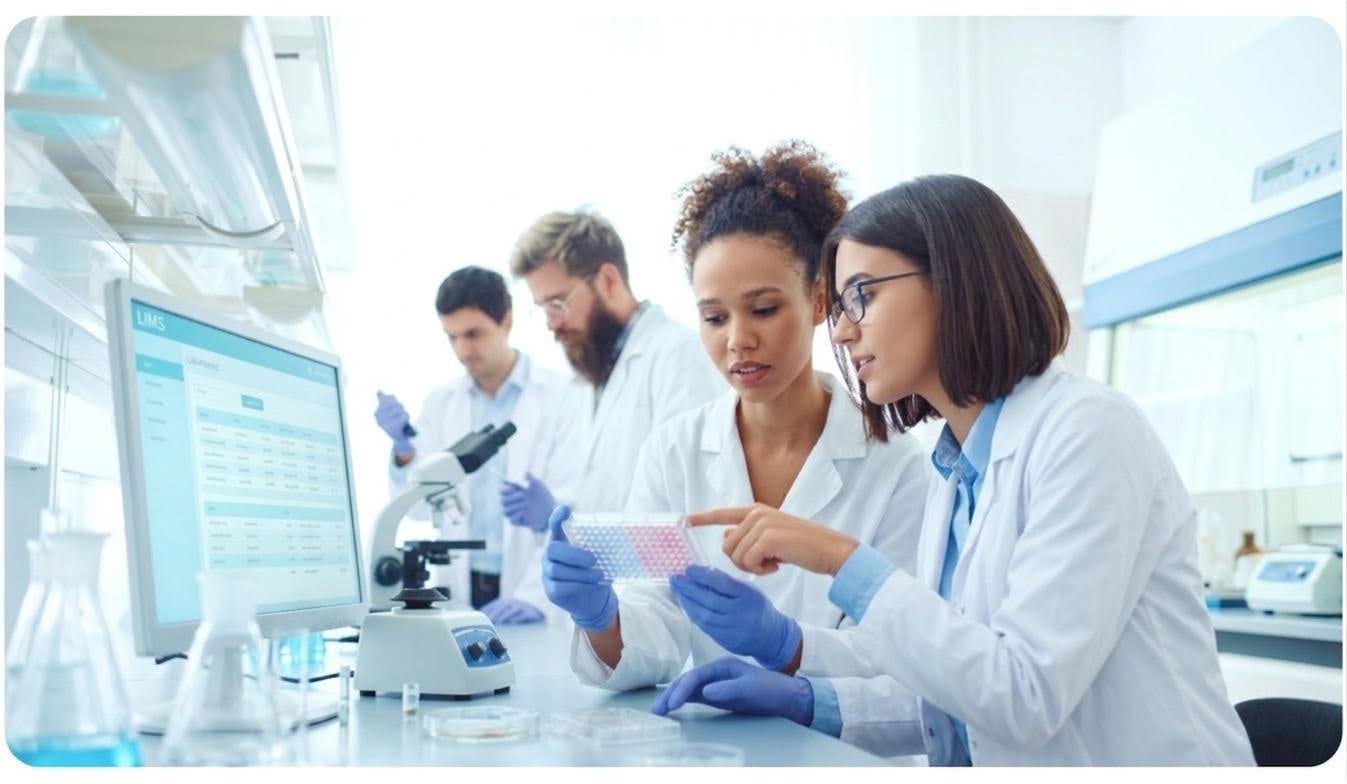
A laboratory

Download Whitepaper

By submitting this form, you agree with our Privacy Policy.
Thank you! Download the file by clicking below:
Download
Oops! Something went wrong while submitting the form.

Table of Contents

Thank you! Your submission has been received!
Oops! Something went wrong while submitting the form.

Table of Contents

TL;DR

ELN adoption succeeds when you start with one trusted workflow, connect experiments, samples, protocols, permissions, and audit trails, and prove value before scaling.

  • Start with a "familiar" workflow.
    Teams resist ELNs when migration feels risky, time-consuming, or unclear. Begin with one research group, one project, one study, and a few experiment templates so scientists can digitize familiar work before expanding into broader ELN, LIMS, inventory, and compliance workflows.
  • Connect research context.
    With SciSure, you can link experiments, samples, protocols, files, inventory records, project structures, and version history in one research environment. That helps your team preserve the full scientific story around each result: what happened, who did it, which materials were used, and where supporting evidence lives.
  • Stay compliant with data standards.
    Modern ELN adoption should account for the NIH Data Management and Sharing Policy, FAIR data principles, and audit-ready electronic records. Searchable metadata, linked samples, reusable protocols, signatures, and audit trails make research data easier to find, verify, reuse, and defend.
  • Build trust early.
    Make sure to address privacy, security, and compliance concerns early during rollout. With SciSure, you can define permissions for users, projects, experiments, samples, storage units, and protocols, while supporting SAML SSO, digital signatures, witness review, locked records, and audit trails for regulated or audit-sensitive workflows.
  • Prove research ROI.
    Food Brewer used SciSure to digitize cultivated cocoa R&D, standardize project and dataset structures, barcode cultures and consumables, and automate workflows through the SciSure SDK. The company reported 60% higher R&D productivity and 40% higher upstream processing productivity.

This post was originally published in 2023 and has been fully updated to reflect SciSure's positioning as a Scientific Management Platform, current industry research and safety benchmarks, and new customer results from Food Brewer.

Electronic lab notebooks have become much easier to evaluate than they were a decade ago. You can compare open-source tools, commercial ELNs, LIMS-connected platforms, sample management systems, and broader scientific management platforms without much trouble. The hard part is helping a real lab move away from paper notebooks, spreadsheets, OneNote pages, shared drives, legacy databases, and the "ask the one person who knows" system without slowing the research down.

That hesitation is understandable. Your team is already managing experiments, protocols, samples, instruments, approvals, publications, grants, and compliance expectations. A new ELN can sound like one more system to learn when the work already feels full.

Still, the expectations around research records have changed.

  • NIH's 2023 Data Management and Sharing Policy asks funded investigators to plan for how scientific data will be managed and shared.
  • The FAIR data principles push research teams toward records that are findable, accessible, interoperable, and reusable.
  • FDA-regulated teams must also think carefully about trustworthy electronic records, audit trails, electronic signatures, and access controls under 21 CFR Part 11 and FDA's 2024 guidance on electronic systems, records, and signatures in clinical investigations.

For many teams, the practical question is how to adopt an ELN in a way your scientists, lab managers, IT stakeholders, and compliance teams can trust. In this post, we'll cover some of the most common ELN adoption barriers one by one, and how you can help your team overcome them.

Why do research teams still resist ELNs?

Research teams resist ELNs because switching systems feels risky when experiments, samples, protocols, and compliance expectations are already moving. The resistance usually comes from six practical concerns that we'll cover in detail:

  • Lack of information
  • Lack of time
  • The learning curve
  • Fear of the unknown
  • Changes to daily work
  • and privacy or security questions

Those concerns are practical signals. Your team needs a clearer adoption plan.

6 ELN adoption barriers & how to address them

A useful ELN rollout should show people what will happen to their current work, how records will stay searchable, who can access what, how samples connect to experiments, and how completed records can be reviewed, signed, and preserved.

What if your team is unsure what an ELN should do?

Start by defining the records, samples, approvals, and reports your team needs to control before you compare vendors. A vague goal like, "We need an ELN" can send you into endless demos. A concrete goal like "We need searchable experiment records linked to sample inventory, protocol versions, attachments, user permissions, and signatures" gives everyone a better filter.

Ask your team practical questions first:

  • Which records are currently hardest to find?
  • Which workflows depend on spreadsheets or shared drives?
  • Which samples, reagents, or equipment need better traceability?
  • Which protocols should become reusable templates?
  • Which records need signatures, witness review, or audit trails?
  • Which data needs to support grants, publications, QA review, or regulated work?

An ELN like SciSure's points to the kind of structure that helps answer these questions. Experiments are organized under projects and studies. You can also create experiment templates from scratch or from existing experiments. Protocols can be versioned so teams can see what changed and restore prior versions as a new version. And finally, samples can be searched, filtered, linked to experiments, and reviewed through an audit trail.
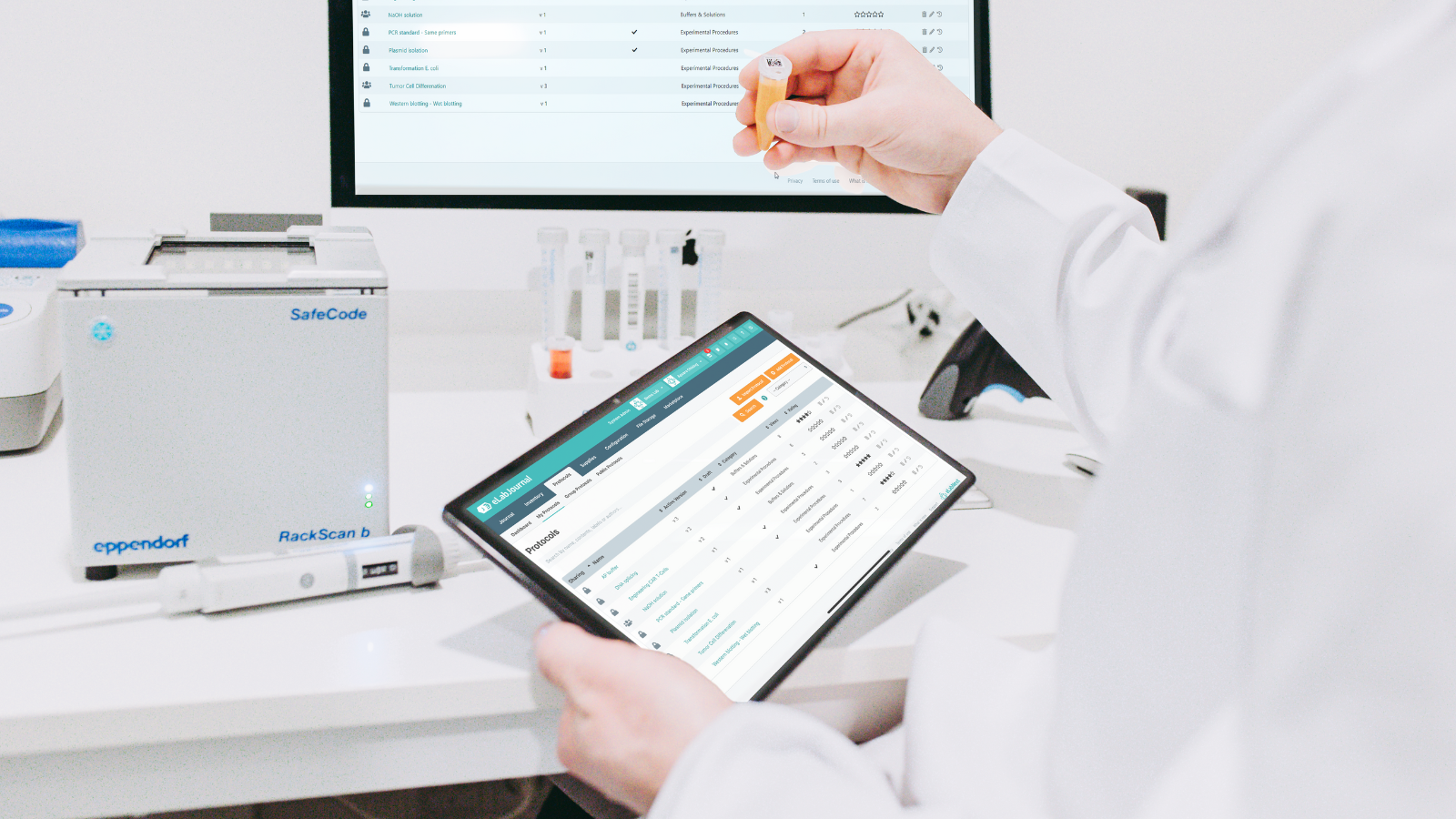
A scientist using the SciSure Electronic Lab Notebook (ELN)

That level of detail turns evaluation from a software beauty contest into a workflow decision. You are choosing how your team will preserve context around the work: the experiment, the protocol, the sample, the person, the timestamp, the file, and the decision.

What if no one has time to migrate to a new ELN?

In this case, treat implementation as a phased workflow project, beginning with one team, one project, one study, and a small set of templates. Your goal is to prove the new workflow in a contained area before asking the whole organization to change.

A practical starting sequence looks like this:

  • Pick one active research group or project.
  • Map the current workflow from protocol to experiment to sample record to result.
  • Build one or two experiment templates that match existing work.
  • Import or create the sample records needed for that project.
  • Decide which files, images, spreadsheets, or instrument outputs need to be attached.
  • Define who can create, edit, view, sign, witness, archive, or restore records.
  • Review the first completed records with the scientists who created them.

This keeps adoption close to the bench. People can complete a familiar workflow in a better system before they need to learn every feature.

SciSure
Ready to modernize your lab records without overwhelming your team?
With SciSure, you can start with the data that matters most. Migrate samples and equipment in bulk, then build project structures before adding experiments.
Talk to a specialist

What if the learning curve slows research?

Reduce the learning curve by turning familiar workflows into templates and reusable structures. Scientists see value faster when the first experiment, protocol, sample search, or review step feels recognizable.

Experimental templates are especially useful here. If your team runs a recurring assay, stability study, synthesis workflow, cell culture process, or sample intake procedure, the first ELN task should be to convert that workflow into a reusable experiment or protocol template. The person opening the ELN should see the steps, sections, fields, and attachments they already expect.
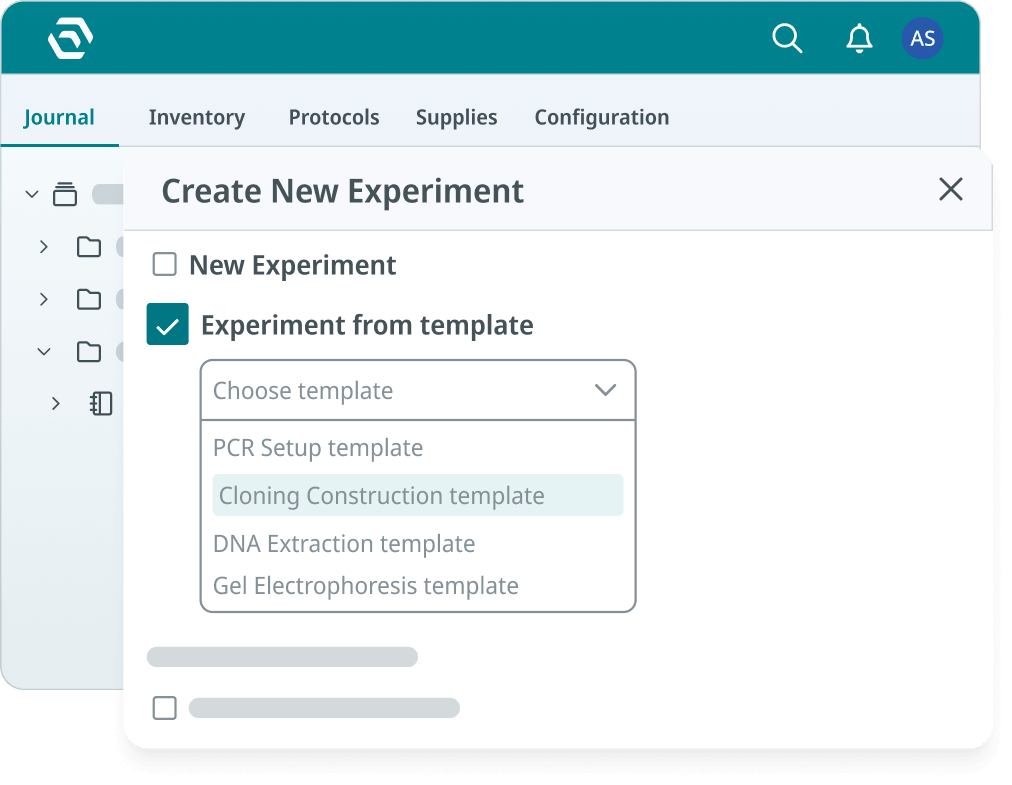
A SciSure ELN experimental template

This also supports reproducibility. NIH's rigor and reproducibility guidance emphasizes transparent, rigorous research. In everyday lab terms, that means your team should be able to understand what was done, which materials were used, which protocol version applied, and where the supporting data lives.

The learning curve gets shorter when the system reflects the work. A well-built template helps a new scientist follow the same structure as an experienced colleague. A linked sample record helps someone find the right material without opening a freezer and hoping the label is still legible. A versioned protocol helps the team avoid quietly using three different versions of the same method.

What if people are worried about losing control of their data?

Show users exactly how the ELN preserves context: who did the work, when it happened, where the sample was stored, which protocol version was used, and what changed over time. Real control comes from being able to find, understand, protect, and verify the work later.

This is where research standards and product capabilities meet. The FAIR principles are often discussed at the data repository level, but the habits start much earlier. If your ELN records are searchable, richly described, linked to samples and protocols, and structured with useful metadata, future data sharing and reuse become much easier.

Those details matter because fear of "losing control" often means fear of losing the story around the data. A good ELN should make the story easier to follow.

SciSure
Need more confidence in your research records?
With SciSure, you can support audit-sensitive workflows with locked records, digital signatures, witness review, and sample audit trails that show who changed what and when.
Request a demo

What if daily lab work changes too much?

Make the first daily change tangible: find a sample, attach a file, link inventory to an experiment, or sign a completed record. Adoption becomes less abstract when people can see how one small task gets easier.

For example, sample lookup is a strong early win. In a paper or spreadsheet workflow, a scientist may need to search a freezer, check a separate inventory sheet, ask a teammate, and open a notebook to confirm which sample was used. In SciSure's ELN and inventory workflow, users can search across stored sample information, use filters, save filter templates, view storage context in the Inventory Browser, and link inventory items directly to experiments.
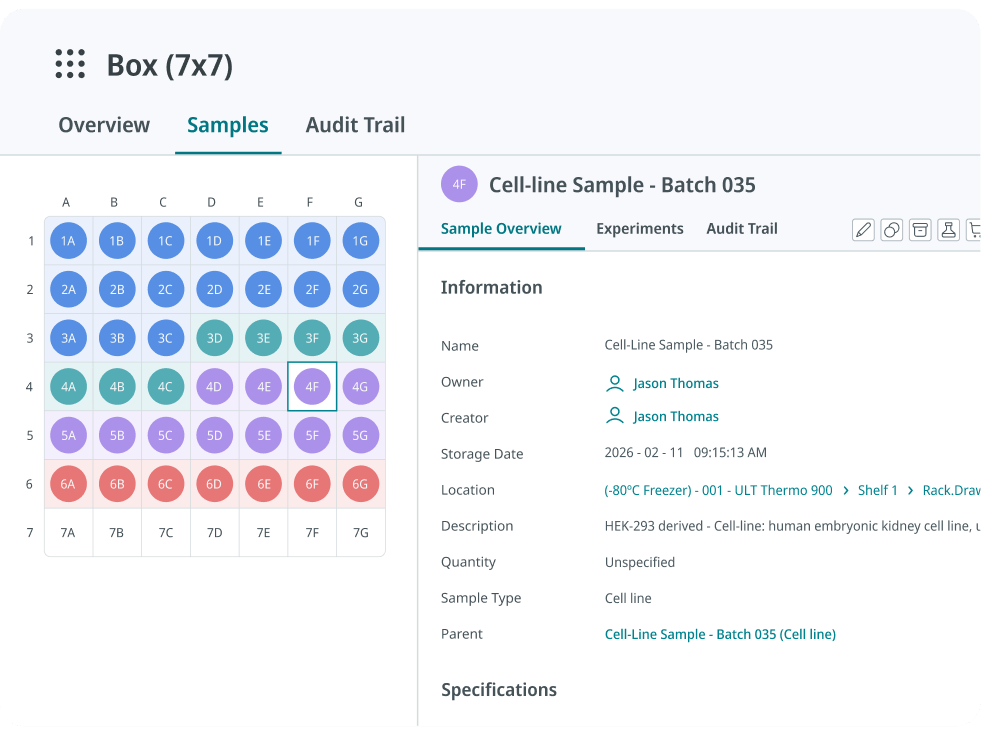
SciSure ELN's sample management template

That kind of change is concrete. It can reduce wasted time, limit unnecessary freezer access, and lower the risk of using the wrong material.

The same principle applies to protocols and files. A protocol imported into the ELN can be linked to a specific experiment. A file attached to a record can carry version history. A completed experiment can be signed and locked. Each step is small on its own. Together, they help your team move from memory-based work to traceable work.

What if privacy, security, or compliance concerns block adoption?

Bring IT, QA, lab leadership, and scientific users into the conversation early, because trust depends on permissions, identity, audit trails, signatures, and retention. Treat security concerns as adoption requirements from the start.

For most research teams, the practical questions are:

  • Can we control who can view, edit, sign, witness, archive, restore, or move records?
  • Can project, experiment, sample, storage, and user permissions reflect how our lab actually works?
  • Can our organization use SSO or identity provider workflows such as SAML?
  • Can completed records be locked while remaining available for review?
  • Can sample and experiment audit trails show who changed what and when?
  • Can we support internal review, grant reporting, QA expectations, or regulated work without rebuilding the record later?

With SciSure, you can define permission controls for users, projects, experiments, samples, storage units, protocols, and other objects. You also have access to SAML single sign-on support for identity providers such as Microsoft Entra ID, AD FS, Okta, OneLogin, Keycloak, and SimpleSAMLphp in supported configurations. For teams using organization-specific login, experiment signatures can use a two-step verification code in supported identity-provider configurations.

If your team operates in an FDA-regulated environment, 21 CFR Part 11 and FDA's 2024 guidance make electronic records and electronic signatures a serious evaluation topic. For labs outside Part 11 scope, the same questions are still useful: can you trust the record, retrieve it, understand its history, and show that the right people controlled it?

How can SciSure make ELN adoption more practical?

SciSure helps teams move from scattered records to connected research workflows by combining ELN structure, sample and inventory context, permissions, signatures, audit trails, and integrations in one environment. That matters because adoption succeeds when the software fits how your team actually works.

With SciSure, you can build a rollout around practical milestones:

  • Define projects and studies before adding experiments.
  • Create experiment templates for recurring workflows.
  • Version protocols so teams know which method was active.
  • Link samples, files, and inventory records to experiments.
  • Search sample information across fields and save repeatable filters.
  • Use permissions to control access by role and workflow.
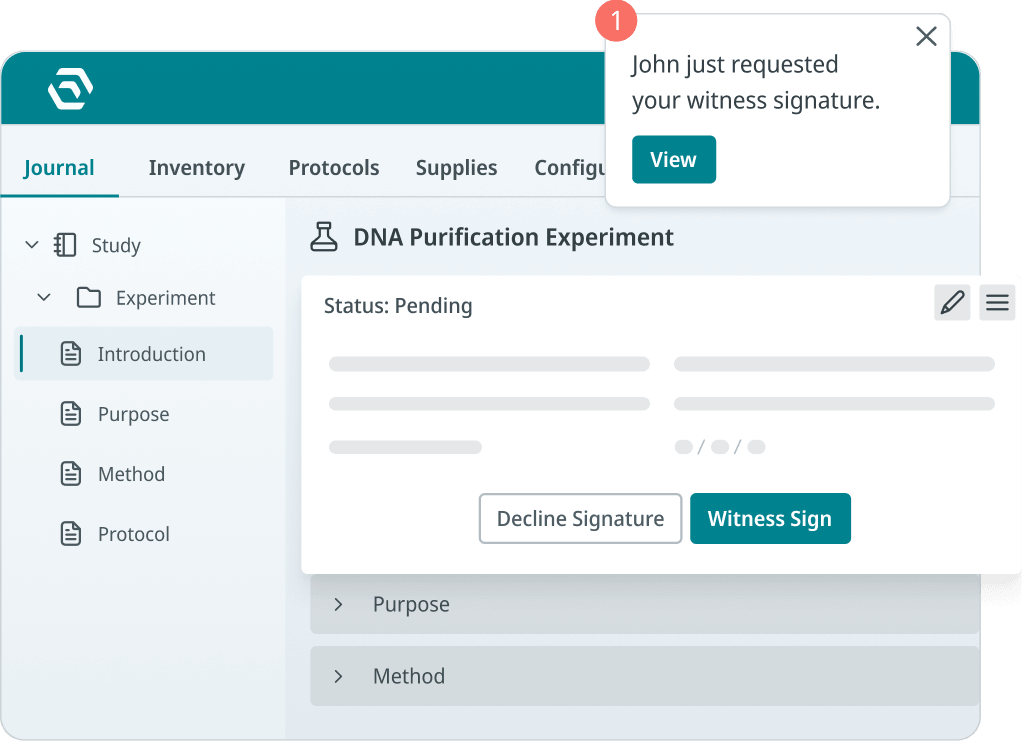
  • Sign, witness, lock, and review completed records where required.
  • Use add-ons and integrations, such as DMP Tool, Protocols.io, desktop file editing, file sync, mobile access, barcode workflows, and API-supported file uploads, where they fit your lab.
User permissions on the SciSure ELN platform

This gives your team a grounded path into digital research operations. Start with a workflow that people trust, a record structure that can scale, and a clear explanation of how the ELN supports the research standards your organization already needs to meet.

Digitalized R&D operations with SciSure at Food Brewer

Food Brewer is a growth-stage cultivated cocoa company scaling plant cell culture workflows from tissue selection to 2,500 liter bioreactors. With SciSure, Food Brewer:

  • Organized R&D and bioprocess tasks in a digital format
  • Standardized project, experiment, and dataset structures
  • Used barcoding for cell cultures, equipment, chemicals, and consumables,
  • and built automation through the SciSure SDK

The reported gains were concrete: 60% higher productivity in R&D and 40% higher productivity in upstream processing, supported by less manual tracking of cultures, chemicals, consumables, and data integration.

Food Brewer: R&D and Upstream Processing at Scale
Customer outcomes

Food Brewer: R&D and Upstream Processing at Scale

Less manual tracking, full sample traceability, and automation that scaled cultivated cocoa research from tissue selection to 2,500-liter bioreactors.

After implementing SciSure to unify data, samples, and processes:

40%-60% productivity gains

  • R&D productivity up 60%
  • Upstream processing up 40%
  • Full traceability across cultures, chemicals, and equipment
  • Faster onboarding and stronger regulatory and intellectual property documentation

Sources

SciSure customer story: Food Brewer, "Food Brewer scales cultivated cocoa research with SciSure." Metrics are condensed from that story.

For your ELN rollout, the lesson is practical: start with a bottleneck people already feel, prove the value in daily work, then expand into connected workflows. This gives your team a grounded path into digital research operations. ELN adoption gets easier when scientists start with a workflow they already trust, a record structure that can scale, and a clear explanation of how the ELN supports the research standards your organization already needs to meet.

What should you do before choosing or rolling out an ELN?

Before you choose or expand an ELN, align your team on these five decisions:

  • The first workflow to digitize.
  • The records, samples, protocols, and files that must stay connected.
  • The metadata and search fields your team will need later.
  • The permissions and signature workflows required for your environment.
  • The success metrics for the first 30, 60, and 90 days.

Next, build a short adoption plan that connects your scientific workflows to your recordkeeping, data management, and compliance needs. The plan can stay simple as long as it is specific.

Good adoption shows up when a scientist can repeat a workflow, find the right sample, understand the active protocol, attach the right evidence, review the completed record, and trust what they see.

If your current system can't do that reliably, the cost of staying put is already showing up in small ways: duplicated work, missing context, version confusion, sample uncertainty, slow onboarding, and fragile institutional memory. A thoughtful ELN rollout gives your team a way to fix those problems one workflow at a time.

If this sounds like the kind of lab you'd like to lead, get in touch with us. Let's build one that keeps your science reproducible, connected, and audit-ready at all times.

Read More:

Ready to see SciSure in action?

Get a personalized demo and see how SciSure fits your lab's workflows.
Request demo

No commitment · Free consultation

Electronic lab notebooks have become much easier to evaluate than they were a decade ago. You can compare open-source tools, commercial ELNs, LIMS-connected platforms, sample management systems, and broader scientific management platforms without much trouble. The hard part is helping a real lab move away from paper notebooks, spreadsheets, OneNote pages, shared drives, legacy databases, and the "ask the one person who knows" system without slowing the research down.

That hesitation is understandable. Your team is already managing experiments, protocols, samples, instruments, approvals, publications, grants, and compliance expectations. A new ELN can sound like one more system to learn when the work already feels full.

Still, the expectations around research records have changed.

  • NIH's 2023 Data Management and Sharing Policy asks funded investigators to plan for how scientific data will be managed and shared.
  • The FAIR data principles push research teams toward records that are findable, accessible, interoperable, and reusable.
  • FDA-regulated teams must also think carefully about trustworthy electronic records, audit trails, electronic signatures, and access controls under 21 CFR Part 11 and FDA's 2024 guidance on electronic systems, records, and signatures in clinical investigations.

For many teams, the practical question is how to adopt an ELN in a way your scientists, lab managers, IT stakeholders, and compliance teams can trust. In this post, we'll cover some of the most common ELN adoption barriers one by one, and how you can help your team overcome them.

Why do research teams still resist ELNs?

Research teams resist ELNs because switching systems feels risky when experiments, samples, protocols, and compliance expectations are already moving. The resistance usually comes from six practical concerns that we'll cover in detail:

  • Lack of information
  • Lack of time
  • The learning curve
  • Fear of the unknown
  • Changes to daily work
  • and privacy or security questions

Those concerns are practical signals. Your team needs a clearer adoption plan.

6 ELN adoption barriers & how to address them

A useful ELN rollout should show people what will happen to their current work, how records will stay searchable, who can access what, how samples connect to experiments, and how completed records can be reviewed, signed, and preserved.

What if your team is unsure what an ELN should do?

Start by defining the records, samples, approvals, and reports your team needs to control before you compare vendors. A vague goal like, "We need an ELN" can send you into endless demos. A concrete goal like "We need searchable experiment records linked to sample inventory, protocol versions, attachments, user permissions, and signatures" gives everyone a better filter.

Ask your team practical questions first:

  • Which records are currently hardest to find?
  • Which workflows depend on spreadsheets or shared drives?
  • Which samples, reagents, or equipment need better traceability?
  • Which protocols should become reusable templates?
  • Which records need signatures, witness review, or audit trails?
  • Which data needs to support grants, publications, QA review, or regulated work?

An ELN like SciSure's points to the kind of structure that helps answer these questions. Experiments are organized under projects and studies. You can also create experiment templates from scratch or from existing experiments. Protocols can be versioned so teams can see what changed and restore prior versions as a new version. And finally, samples can be searched, filtered, linked to experiments, and reviewed through an audit trail.

A scientist using the SciSure Electronic Lab Notebook (ELN)

That level of detail turns evaluation from a software beauty contest into a workflow decision. You are choosing how your team will preserve context around the work: the experiment, the protocol, the sample, the person, the timestamp, the file, and the decision.

What if no one has time to migrate to a new ELN?

In this case, treat implementation as a phased workflow project, beginning with one team, one project, one study, and a small set of templates. Your goal is to prove the new workflow in a contained area before asking the whole organization to change.

A practical starting sequence looks like this:

  • Pick one active research group or project.
  • Map the current workflow from protocol to experiment to sample record to result.
  • Build one or two experiment templates that match existing work.
  • Import or create the sample records needed for that project.
  • Decide which files, images, spreadsheets, or instrument outputs need to be attached.
  • Define who can create, edit, view, sign, witness, archive, or restore records.
  • Review the first completed records with the scientists who created them.

This keeps adoption close to the bench. People can complete a familiar workflow in a better system before they need to learn every feature.

SciSure
Ready to modernize your lab records without overwhelming your team?
With SciSure, you can start with the data that matters most. Migrate samples and equipment in bulk, then build project structures before adding experiments.
Talk to a specialist

What if the learning curve slows research?

Reduce the learning curve by turning familiar workflows into templates and reusable structures. Scientists see value faster when the first experiment, protocol, sample search, or review step feels recognizable.

Experimental templates are especially useful here. If your team runs a recurring assay, stability study, synthesis workflow, cell culture process, or sample intake procedure, the first ELN task should be to convert that workflow into a reusable experiment or protocol template. The person opening the ELN should see the steps, sections, fields, and attachments they already expect.

A SciSure ELN experimental template

This also supports reproducibility. NIH's rigor and reproducibility guidance emphasizes transparent, rigorous research. In everyday lab terms, that means your team should be able to understand what was done, which materials were used, which protocol version applied, and where the supporting data lives.

The learning curve gets shorter when the system reflects the work. A well-built template helps a new scientist follow the same structure as an experienced colleague. A linked sample record helps someone find the right material without opening a freezer and hoping the label is still legible. A versioned protocol helps the team avoid quietly using three different versions of the same method.

What if people are worried about losing control of their data?

Show users exactly how the ELN preserves context: who did the work, when it happened, where the sample was stored, which protocol version was used, and what changed over time. Real control comes from being able to find, understand, protect, and verify the work later.

This is where research standards and product capabilities meet. The FAIR principles are often discussed at the data repository level, but the habits start much earlier. If your ELN records are searchable, richly described, linked to samples and protocols, and structured with useful metadata, future data sharing and reuse become much easier.

Those details matter because fear of "losing control" often means fear of losing the story around the data. A good ELN should make the story easier to follow.

SciSure
Need more confidence in your research records?
With SciSure, you can support audit-sensitive workflows with locked records, digital signatures, witness review, and sample audit trails that show who changed what and when.
Request a demo

What if daily lab work changes too much?

Make the first daily change tangible: find a sample, attach a file, link inventory to an experiment, or sign a completed record. Adoption becomes less abstract when people can see how one small task gets easier.

For example, sample lookup is a strong early win. In a paper or spreadsheet workflow, a scientist may need to search a freezer, check a separate inventory sheet, ask a teammate, and open a notebook to confirm which sample was used. In SciSure's ELN and inventory workflow, users can search across stored sample information, use filters, save filter templates, view storage context in the Inventory Browser, and link inventory items directly to experiments.

SciSure ELN's sample management template

That kind of change is concrete. It can reduce wasted time, limit unnecessary freezer access, and lower the risk of using the wrong material.

The same principle applies to protocols and files. A protocol imported into the ELN can be linked to a specific experiment. A file attached to a record can carry version history. A completed experiment can be signed and locked. Each step is small on its own. Together, they help your team move from memory-based work to traceable work.

What if privacy, security, or compliance concerns block adoption?

Bring IT, QA, lab leadership, and scientific users into the conversation early, because trust depends on permissions, identity, audit trails, signatures, and retention. Treat security concerns as adoption requirements from the start.

For most research teams, the practical questions are:

  • Can we control who can view, edit, sign, witness, archive, restore, or move records?
  • Can project, experiment, sample, storage, and user permissions reflect how our lab actually works?
  • Can our organization use SSO or identity provider workflows such as SAML?
  • Can completed records be locked while remaining available for review?
  • Can sample and experiment audit trails show who changed what and when?
  • Can we support internal review, grant reporting, QA expectations, or regulated work without rebuilding the record later?

With SciSure, you can define permission controls for users, projects, experiments, samples, storage units, protocols, and other objects. You also have access to SAML single sign-on support for identity providers such as Microsoft Entra ID, AD FS, Okta, OneLogin, Keycloak, and SimpleSAMLphp in supported configurations. For teams using organization-specific login, experiment signatures can use a two-step verification code in supported identity-provider configurations.

If your team operates in an FDA-regulated environment, 21 CFR Part 11 and FDA's 2024 guidance make electronic records and electronic signatures a serious evaluation topic. For labs outside Part 11 scope, the same questions are still useful: can you trust the record, retrieve it, understand its history, and show that the right people controlled it?

How can SciSure make ELN adoption more practical?

SciSure helps teams move from scattered records to connected research workflows by combining ELN structure, sample and inventory context, permissions, signatures, audit trails, and integrations in one environment. That matters because adoption succeeds when the software fits how your team actually works.

With SciSure, you can build a rollout around practical milestones:

  • Define projects and studies before adding experiments.
  • Create experiment templates for recurring workflows.
  • Version protocols so teams know which method was active.
  • Link samples, files, and inventory records to experiments.
  • Search sample information across fields and save repeatable filters.
  • Use permissions to control access by role and workflow.
  • Sign, witness, lock, and review completed records where required.
  • Use add-ons and integrations, such as DMP Tool, Protocols.io, desktop file editing, file sync, mobile access, barcode workflows, and API-supported file uploads, where they fit your lab.
User permissions on the SciSure ELN platform

This gives your team a grounded path into digital research operations. Start with a workflow that people trust, a record structure that can scale, and a clear explanation of how the ELN supports the research standards your organization already needs to meet.

Digitalized R&D operations with SciSure at Food Brewer

Food Brewer is a growth-stage cultivated cocoa company scaling plant cell culture workflows from tissue selection to 2,500 liter bioreactors. With SciSure, Food Brewer:

  • Organized R&D and bioprocess tasks in a digital format
  • Standardized project, experiment, and dataset structures
  • Used barcoding for cell cultures, equipment, chemicals, and consumables,
  • and built automation through the SciSure SDK

The reported gains were concrete: 60% higher productivity in R&D and 40% higher productivity in upstream processing, supported by less manual tracking of cultures, chemicals, consumables, and data integration.

Food Brewer: R&D and Upstream Processing at Scale
Customer outcomes

Food Brewer: R&D and Upstream Processing at Scale

Less manual tracking, full sample traceability, and automation that scaled cultivated cocoa research from tissue selection to 2,500-liter bioreactors.

After implementing SciSure to unify data, samples, and processes:

40%-60% productivity gains

  • R&D productivity up 60%
  • Upstream processing up 40%
  • Full traceability across cultures, chemicals, and equipment
  • Faster onboarding and stronger regulatory and intellectual property documentation

Sources

SciSure customer story: Food Brewer, "Food Brewer scales cultivated cocoa research with SciSure." Metrics are condensed from that story.

For your ELN rollout, the lesson is practical: start with a bottleneck people already feel, prove the value in daily work, then expand into connected workflows. This gives your team a grounded path into digital research operations. ELN adoption gets easier when scientists start with a workflow they already trust, a record structure that can scale, and a clear explanation of how the ELN supports the research standards your organization already needs to meet.

What should you do before choosing or rolling out an ELN?

Before you choose or expand an ELN, align your team on these five decisions:

  • The first workflow to digitize.
  • The records, samples, protocols, and files that must stay connected.
  • The metadata and search fields your team will need later.
  • The permissions and signature workflows required for your environment.
  • The success metrics for the first 30, 60, and 90 days.

Next, build a short adoption plan that connects your scientific workflows to your recordkeeping, data management, and compliance needs. The plan can stay simple as long as it is specific.

Good adoption shows up when a scientist can repeat a workflow, find the right sample, understand the active protocol, attach the right evidence, review the completed record, and trust what they see.

If your current system can't do that reliably, the cost of staying put is already showing up in small ways: duplicated work, missing context, version confusion, sample uncertainty, slow onboarding, and fragile institutional memory. A thoughtful ELN rollout gives your team a way to fix those problems one workflow at a time.

If this sounds like the kind of lab you'd like to lead, get in touch with us. Let's build one that keeps your science reproducible, connected, and audit-ready at all times.

Read More:

About the author:

Zareh Zurabyan

Zareh Zurabyan is VP of Commercial at SciSure, and a biotech executive with extensive experience scaling digital platforms for research and life science organizations. His work sits at the intersection of lab operations, digital strategy, and therapeutic development, helping institutions build technology stacks that support reproducibility, regulatory readiness, and long-term scientific productivity. Previously, he led growth efforts during the formation of SciSure from eLabNext (Eppendorf Group) and SciShield. He also advises early-stage biotech SaaS companies on market entry, post-acquisition strategy, and operational foundations.

See all posts from this author

Sign up for our newsletter

Get the latest tips, articles, and exclusive content on modern lab management delivered to your inbox.
Thank you for subscribing!
Please check your email to verify your submission.
Oops! Something went wrong while submitting the form.