Lab Safety Training: Requirements & Cost of Neglect
What happens when labs skip safety training? Here are some OSHA training rules, real incident costs, and free training resources in one place.

Download Whitepaper
TL;DR
Neglecting lab safety training puts people at risk of burns, exposures and explosions, and exposes organizations to OSHA penalties of up to $165,514 per willful or repeated violation, multi-million-dollar lawsuits and research shutdowns. OSHA's Laboratory Standard requires training before anyone works with hazardous chemicals and again before any new exposure.
- What OSHA requires.
The OSHA Laboratory Standard (29 CFR 1910.1450) requires training at initial assignment and before new exposure situations, covering chemical hazards, protective measures and your Chemical Hygiene Plan. Bloodborne pathogens training is annual, large quantity hazardous waste generators need an annual review, and your organization sets the refresher interval for general chemical training.
- The 2026 HazCom update.
OSHA's revised Hazard Communication Standard, aligned with GHS Revision 7, sets November 20, 2026 as the date for employers to update training, workplace labels and hazard communication programs for reclassified substances, and May 19, 2028 for mixtures. Labs are covered through 29 CFR 1910.1200(b)(3).
- What neglect really costs.
Federal OSHA maximums stay at $16,550 per serious violation and $165,514 per willful or repeated violation in 2026. The larger costs arrive later: UCLA's 2008 lab fire led to the first criminal case from an academic lab accident, and a 2016 University of Hawaii explosion ended in a $6.7 million settlement.
- Training that sticks.
Lab safety training works when it follows each person, triggers whenever their hazards change, and shows up in inspections. With SciSure Health & Safety, job activities can assign the right courses, track renewal dates and flag overdue training. San Diego State University raised training compliance from 56% to over 80% in a year.
This post was originally published on January 24, 2019, and was fully updated in November 2026 with current regulations, incident data and training resources.
Ready to see SciSure in action?
No commitment · Free consultation
When people work with hazards nobody trained them on, the consequences land on them first. Then they spread to the lab, the PI, the EHS team and the whole organization. And when investigators look back, they rarely find one careless researcher. They find a missed training record, a near miss nobody wrote down, or an inspection finding that never got closed.
This guide covers what lab safety training US labs are required to provide in 2026, what actually happens when it's neglected, where to find free training, and how to keep training current as people join, move and leave. At SciSure, we work with EHS and lab operations teams at universities, research institutes and biotech companies on exactly this problem, so we've included the patterns we see working in practice.
What lab safety training is required in 2026?
Several OSHA and EPA rules each require training for specific hazards, so the training you owe depends on what your lab works with. Here are the requirements most research labs run into.
Two details trip labs up. First, the Lab Standard ties training to the chemicals present in each person's work area, and to the details of your written Chemical Hygiene Plan. A generic campus orientation rarely covers that on its own. Second, the trigger is exposure, not the calendar. A researcher who moves from a cell culture lab to a synthetic chemistry lab needs new training before their first experiment there, even if their annual refresher was last month.
If your lab sits in a state that runs its own OSHA-approved plan, check that plan too. State plans can set their own requirements and dates.
The 2026 HazCom update and what it means for lab training
OSHA published its updated Hazard Communication Standard on May 20, 2024, aligning it with Revision 7 of the UN's Globally Harmonized System (GHS). In a final rule published January 15, 2026, OSHA pushed every compliance date back by four months. For employers, the dates that matter are:
- November 20, 2026
Update employee training, workplace labeling and your hazard communication program, as necessary, for substances. - May 19, 2028
Make the same updates for mixtures.
Labs aren't exempt. Under 29 CFR 1910.1200(b)(3), laboratory employers must still provide hazard communication information and training. In practice, that means your team needs to recognize new hazard classes and updated label elements on the safety data sheets (SDSs) and containers arriving from suppliers.
An updated SDS only helps if someone knows which containers it applies to, which labs hold them, and who works with them. Our guide to safety data sheets covers how to keep SDS access current.
What happens when labs neglect safety training?
When lab rules and training are ignored, people get hurt, regulators issue penalties, lawsuits and settlements follow, and research stops. The cases below show all four, and every one of them had warning signs on record before anyone was injured.
Source: R&D World, February 2026.
People get hurt first
Chemical burns, toxic inhalation, eye injuries, needlesticks, infections, fires and explosions. Most of these trace back to a step that training is meant to make automatic: the lab coat, the grounded cylinder, the scale-up someone should have approved. And the risk doesn't stay with the person who skipped the step. Uncapped waste and poor storage put colleagues, custodial staff and emergency responders at risk too.
Penalties are the visible cost, not the biggest one
Federal OSHA maximum penalties for 2026 are $16,550 per serious or other-than-serious violation, $16,550 per day for failure to abate, and $165,514 per willful or repeated violation, according to OSHA. These amounts didn't change for 2026 because no inflation adjustment was published. The National Safety Council estimates that each medically consulted work injury cost $48,000 in 2024 and each work-related death $1.54 million. Those figures measure the cost to society (wages, medical and administrative costs), not one employer's bill, but they show the scale.
Research stops
Investigations pull PIs and EHS staff away for months. Labs get shut down. Funders and partners start asking questions. For a commercial lab, a willful OSHA citation can also put client contracts at risk, because many contracts require proof of regulatory compliance.
Why lab safety training gets neglected
When safety training lapses, it's rarely because one person decided safety didn't matter. More often, the system around them made it easy to slip.
- Pressure to publish and deliver.
When grant deadlines, paper deadlines or development milestones loom, a refresher course feels like it can wait. - Decentralized labs.
In academic research, each PI runs their own group. Without a central view, EHS can't easily see who works where or with what. Our post on academic lab safety software looks at this problem for universities. - Constant turnover.
Students, postdocs and contractors rotate through labs every few years, and the people who know the procedures leave with them. Read our guide on managing turnover in the lab and the costs of losing an EHS team member. - Training tracked in spreadsheets.
A spreadsheet doesn't know that someone moved labs, started using a new chemical class, or let their bloodborne pathogens training expire. - Fast-growing startups.
Small teams often outsource EHS and only discover gaps when they move into bigger space. Our post on lab safety concerns for growing startups covers the most common ones.
How to build lab safety training that sticks
Make safety a shared priority
Leadership, PIs, lab managers and EHS each own part of the program. When leaders ask about overdue training in the same meeting where they ask about milestones, people notice.
Start from the hazards, not the course catalog
List the hazards each person actually works with (chemicals, biological agents, radiation, sharps, waste) and map training to those hazards.
Make it specific to the lab
Online courses cover general knowledge. OSHA also expects training on the chemicals in each person's work area, your Chemical Hygiene Plan and your own standard operating procedures (SOPs). Pair courses with hands-on walkthroughs for high-hazard procedures.
Trigger training on change
New hire, new lab, new chemical class, new procedure, a reclassified substance under HazCom. Each one should prompt training before the work starts, not at the next annual cycle.
Keep records where inspectors look
Track who completed what, when it expires and what's overdue. Bloodborne pathogens training records, for example, must be kept for three years.
Close the loop with inspections and near misses
If inspections keep finding the same issue, or a near miss shows people didn't know a procedure, that's a training gap. Our guide on why lab safety inspections matter more as your lab scales explains how to turn findings into program fixes. For the basics every researcher should follow, see our chemistry lab safety guide.
How SciSure supports lab safety training
SciSure Health & Safety connects training to the hazards people actually work with. Here's what that looks like, depending on the modules and configuration your organization has in place:
- Training assigned by job activity.
Job activities describe the hazards or work a person may encounter. Once one is assigned, SciSure can assign the associated courses, notify the person and calculate renewal dates. Groups can apply default job activities to new members, so new hires don't slip through. - Courses in the formats you already use.
PowerPoint, MP4 video, PDF and SCORM packages, with optional quizzes. Trainers can schedule classroom sessions, record attendance and, where configured, import records from a connected learning management system (LMS).
- Visibility across every lab.
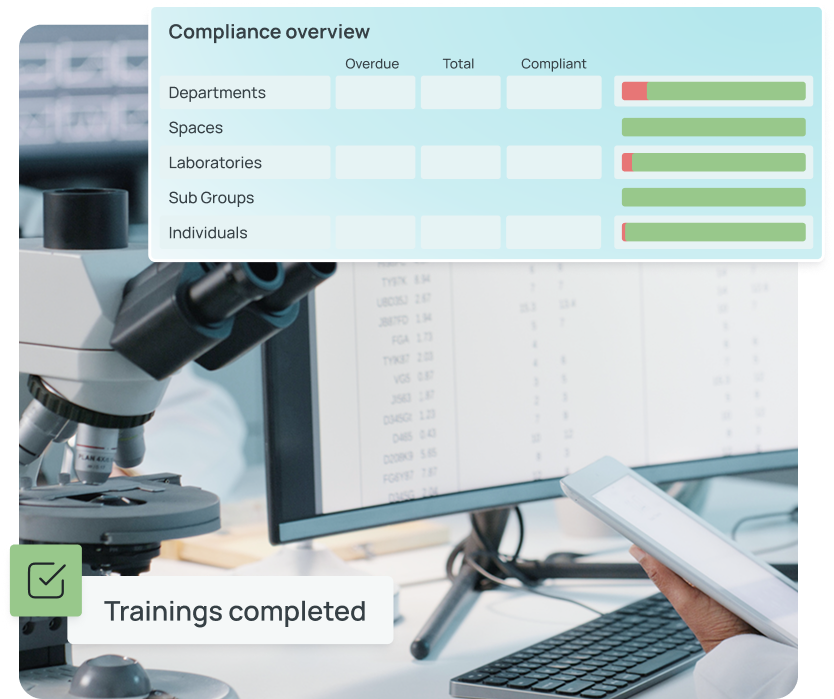
EHS teams can filter training records by group, course, person or location, review compliance dashboards and export the data. Certificates are available when enabled. - Training gaps surfaced in context.
Inspections can flag expired training, and ChemTracker shows which chemicals sit in which spaces and groups. That helps EHS teams see which labs hold substances affected by HazCom changes and target communications to the people who work with them.
When San Diego State University moved its EHS and lab safety program onto SciSure, it went from eight courses and about 500 completed training records in a year to 16 courses and more than 4,600 records the next year. Training compliance rose from 56% to over 80%, and reports that once took hours or even weeks now take minutes.
Comparing options? Our guide to the best EHS software for labs in 2026 evaluates five platforms on training, inspections, chemical inventory and more.
Where to find free lab safety training
These resources are a good starting point for general lab safety knowledge. They don't replace the lab-specific training OSHA expects on your own chemicals, SOPs and Chemical Hygiene Plan.
FAQs
What is the consequence of not following the lab rules and procedures?
The person doing the work, and anyone nearby, can be injured or exposed to hazardous chemicals or biological agents. Organizations can face OSHA citations of up to $16,550 per serious violation and $165,514 per willful or repeated violation in 2026, plus lawsuits, settlements, lab shutdowns and lost research. Past cases, such as UCLA in 2008, have also led to criminal charges.
What dangers are likely to occur if a laboratory user fails to follow the laboratory safety measures?
The most common are chemical burns and splashes, eye injuries, toxic inhalation, fires and explosions from reactive or flammable materials, cuts and needlesticks, and infections from biological agents. Poor storage and uncapped waste also put colleagues, custodial staff and emergency responders at risk, even if they never touched the experiment.
Does OSHA require lab safety training?
Yes. The OSHA Laboratory Standard (29 CFR 1910.1450) requires employers to train employees on the hazards of chemicals in their work area, how to protect themselves, and the details of the Chemical Hygiene Plan. Other standards add requirements for specific hazards, such as bloodborne pathogens (29 CFR 1910.1030).
How often is lab safety training required?
Under the Lab Standard, training is due at initial assignment and before any new exposure situation, and the employer sets the refresher frequency. Bloodborne pathogens training is required at least annually. Staff at large quantity hazardous waste generator sites need an annual review of their initial training.
What does the 2024 HazCom update mean for lab safety training?
OSHA's updated Hazard Communication Standard aligns US chemical labels and safety data sheets with GHS Revision 7. Employers must update training, workplace labeling and hazard communication programs, as necessary, by November 20, 2026 for substances and by May 19, 2028 for mixtures. Labs are covered through 29 CFR 1910.1200(b)(3).
Where can I find free lab safety training?
NIH's National Institute of General Medical Sciences (NIGMS) hosts free lab safety videos, CDC offers online biosafety courses, and OSHA publishes a free guide to training requirements by standard. These cover general knowledge. You still need lab-specific training on your own chemicals, procedures and Chemical Hygiene Plan.
How can software help with lab safety training?
Lab safety software can assign training based on the hazards each person works with, track completion and renewal dates, and flag overdue training before an inspection does. SciSure Health & Safety, for example, uses job activities to assign courses and gives EHS teams compliance dashboards across labs and groups. If this sounds like the kind of support you need, get in touch with us.
Keep reading
- Understanding SciShield: How SciSure Health & Safety Keeps Up With Lab Safety Data
- How to Manage Reactive Chemicals in the Lab: Warning Signs & More
- Chemical Inventory Reporting for Labs: Tier II, Right-to-Know & Fire Code Requirements
- Hazardous Chemical Management for Labs: A Loss Control Guide
- Chemical Compliance Management Software: A Buyer’s Guide
- How Can We Automate Lab Safety Inspection Workflows Across Multiple Labs?

Read more of our blogs about modern lab management
Discover the latest in lab operations, from sample management to AI innovations, designed to enhance efficiency and drive scientific breakthroughs.