Chemical Inventory Reporting for Labs: Tier II, Right-to-Know & Fire Code Requirements
A guide to chemical inventory reporting for labs: Tier II and RTK thresholds, the research lab exemption, state rules, fire code reports, and pitfalls.

Download Whitepaper
TL;DR
Chemical inventory reporting is how labs tell emergency planners, fire departments, and regulators which hazardous chemicals they hold, how much, and where, most often through EPCRA Tier II reports, state right-to-know programs, and fire code inventory statements.
- Tier II basics.
Under EPCRA Section 312, facilities holding OSHA hazardous chemicals at 10,000 pounds or more, or extremely hazardous substances at 500 pounds or their threshold planning quantity, file a Tier II report by March 1 each year with the state emergency response commission, local planning committee, and local fire department.
- The lab exemption.
EPCRA excludes chemicals used in a research laboratory under the direct supervision of a technically qualified individual. The exclusion applies to how each chemical is used, so stockrooms, pilot plants, production areas, and facility items such as backup-power batteries can still put a research site over Tier II thresholds.
- State and fire rules.
States and cities add their own layers. California's CERS program starts at 55 gallons, 500 pounds, or 200 cubic feet. Massachusetts expects separate filings to the state, local planning committee, and fire department. Fire code officials can also require hazardous materials inventory statements by control area.
- Data behind reports.
Every report draws on the same container-level facts: chemical identity, hazard class, quantity, unit, location, and owner. SciSure Health & Safety helps EHS teams keep that data current and generate Tier II, right-to-know, NFPA, and fire code reports from it, where configured.
Originally published in 2024, we updated this post in 2026 to add the research laboratory exemption, current EPA thresholds and penalty levels, OSHA's extended HazCom 2024 dates, Massachusetts and California examples, TRI and CFATS status, a reporting-readiness checklist, and new customer results from SmartLabs.
Ready to see SciSure in action?
No commitment · Free consultation
If you manage EHS (environmental health and safety) or lab operations, you may know the February routine. Someone needs last year's maximum and average daily amounts of every reportable chemical, by building, in pounds. The purchasing records say one thing, the shelves say another, and three lab groups share the storage room in question.
Chemical inventory reporting is how that information reaches the people who need it: state and local emergency planners, your fire department, and, under right-to-know rules, the public. This guide covers which reports apply to research labs, where the research laboratory exemption helps and where it stops, the challenges that slow reporting down, and how SciSure's chemical inventory tools help EHS teams produce reports from data they already maintain.
This post is part of our chemical compliance series. For fire code and maximum allowable quantities (MAQs), start with our guide to Fire Code Compliance and MAQs: What Life Science Labs Need to Know.
What is regulatory reporting for labs?
Regulatory reporting is the process of compiling, checking, and submitting data that a law or code requires you to share with a government body. For US research labs, most chemical-related reporting comes back to one dataset: your chemical inventory. What do you have, how much of it, where is it stored, and what hazards does it carry?
Different audiences use that data for different reasons:
- Emergency planners at state and local level use it to prepare for chemical releases and fires.
- Fire departments use it to plan responses and to review permits for hazardous materials storage.
- The public can request much of it under the Emergency Planning and Community Right-to-Know Act (EPCRA).
Picture a fire on a floor that stores flammable solvents, oxidizers, and compressed gas cylinders across four lab groups. The responders' first questions are what's in there, how much, and where. If your last report was built from a two-year-old spreadsheet, they're working from a guess. That's the practical reason chemical inventory reporting exists, and why accuracy matters more than the form itself.
Which chemical inventory reports apply to labs?
Most US labs deal with some combination of the reports below. Which ones apply depends on your quantities, your activities, and your state and city.
Sources: EPA hazardous chemical inventory reporting, EPA general reporting guidance, 40 CFR 372.38, CISA notice on the CFATS lapse.
A quick note on TRI, since "toxic chemical release inventory reporting" comes up a lot in lab searches. TRI rules let covered facilities leave out toxic chemicals manufactured, processed, or used in a laboratory under the supervision of a technically qualified individual. That exemption does not cover specialty chemical production, pilot plant operations, or activities outside the lab (40 CFR 372.38(d)). Most research-only sites won't file TRI reports, but sites that scale up or manufacture should check.
Are research labs exempt from Tier II reporting?
Partly. EPA's rules for EPCRA Sections 311 and 312 exclude any substance to the extent it is used in a research laboratory under the direct supervision of a technically qualified individual (EPA general reporting guidance; 40 CFR part 370).
Two words in that exclusion matter most: "to the extent." The exemption follows how a chemical is used. It does not cover a whole building because the building has "lab" on the door. In practice, research sites still end up filing Tier II reports because of chemicals that sit outside that research use:
- Central stockrooms and receiving areas holding bulk solvents and acids before they reach a lab.
- Pilot plant, scale-up, and specialty chemical production. Guidance summarized by Safety Partners notes that QC labs inside manufacturing can qualify for the exclusion, while full-scale pilot plants and specialty production labs cannot.
- Facility operations. Diesel for emergency generators counts toward the 10,000-pound threshold. Lead-acid batteries in forklifts or backup power systems contain sulfuric acid, an extremely hazardous substance with a 500-pound reporting threshold, and EPA requires you to add up sulfuric acid across all batteries and other forms on site (J. J. Keller summary of EPA battery guidance).
This exemption also belongs to EPCRA Sections 311 and 312 only. EPA notes it doesn't extend to other EPCRA sections, and state programs and fire codes set their own rules. A lab that owes nothing under federal Tier II can still owe a state hazardous materials business plan or a fire code inventory statement.
The practical move: decide the exemption chemical by chemical and area by area, write down why, and keep the full inventory either way. You'll need it for fire code, OSHA's Laboratory Standard, and your own emergency planning.
What is Tier II and Right-to-Know (RTK) reporting?
Tier II is the annual hazardous chemical inventory form required by EPCRA Section 312. EPCRA was passed so that communities and responders know what's stored nearby. A facility files if it held, at any one time in the previous calendar year (EPA):
- 10,000 pounds or more of any hazardous chemical that requires an SDS under OSHA's Hazard Communication Standard (HCS), or
- 500 pounds or the threshold planning quantity (TPQ), whichever is lower, of an extremely hazardous substance (EHS).
A Tier II report typically includes:
- The chemical or common name as it appears on the SDS
- The maximum amount present at any time and the average daily amount
- How the chemical is stored
- Where it is at the facility
- Whether you're asking to withhold location information from public disclosure
Reports go to your SERC, your LEPC, and your local fire department by March 1. If March 1 falls on a weekend, EPA asks that reports go out before it. There are no federal filing fees, though many states charge their own (EPA general reporting guidance).
Right-to-Know (RTK) refers to the public's right to request this information. EPA states that submitted inventory information must be made available to the public. Several states also run their own right-to-know programs with separate forms or thresholds, which is why you'll often see the two terms used together.
State example: Massachusetts Tier II reporting
Massachusetts is a good example of how state rules shape the work, and it's home to one of the densest life science clusters in the US.
- The Massachusetts SERC requires electronic filing. Its 2025 guidance directs filers to the HazConnect Tier II tool.
- Reports are filed by location. If you run several sites in the state, each one needs its own report, and all buildings on a site go into one report.
- Filing with the SERC doesn't cover your local emergency planning committee or fire department. The SERC's procedures say separate filings must still go to both, following their own requirements.
For a multi-site biotech in the Boston area, that means one dataset feeding several filings, each with its own format and recipient. The underlying numbers need to match across all of them.
State example: California CERS
California runs hazardous materials reporting through the Hazardous Materials Business Plan (HMBP) program and the California Environmental Reporting System (CERS). Its thresholds are far lower than federal Tier II: 55 gallons of a liquid, 500 pounds of a solid, or 200 cubic feet of a compressed gas, plus extremely hazardous substances at federal thresholds (Kern County CUPA). Plans are certified annually, and some local agencies require updates within 30 days when inventory changes significantly (San Luis Obispo County).
The takeaway for a lab that sits under federal Tier II thresholds: California may still expect a filing.
How is fire regulatory reporting different from Tier II?
Fire codes ask a different question. Tier II asks, "What hazardous chemicals are on this site, and how much?" Fire codes ask, "How much of each hazard class sits in each control area, and is it under the maximum allowable quantity for this building?"
Under the International Fire Code, a fire code official can require a Hazardous Materials Inventory Statement (HMIS) with a permit application. The model format in IFC Appendix H summarizes quantities for each control area by hazard class, separates storage from open and closed use, and compares totals against MAQs (IFC Appendix H example). Local amendments vary. Some fire departments accept a Tier II report as the inventory statement, and others use their own forms.
Both reports depend on the same inventory, but they cut it differently: Tier II by chemical and site, in pounds, and fire code by hazard class and control area, in pounds, gallons, or cubic feet. If your inventory doesn't record location down to the control area, the fire code version is the one that breaks.
What are the challenges of regulatory reporting for labs?
1. Keeping your chemical inventory up to date
A single research building can hold thousands of containers, with chemicals received, used, moved, and disposed of every day. With space at a premium, containers also end up in odd places. In a SciSure webinar, Sarah Eck, PE, CCPSC, Senior Process Safety Engineer at DEKRA North America, described flammable solvents in ordinary cabinets and boxes marked "refrigeration required" left under a table because nobody knew where they belonged. Add deliveries left in receiving, shipments sent to the wrong building, and supplies in janitor closets, and knowing what you have becomes a job of its own.
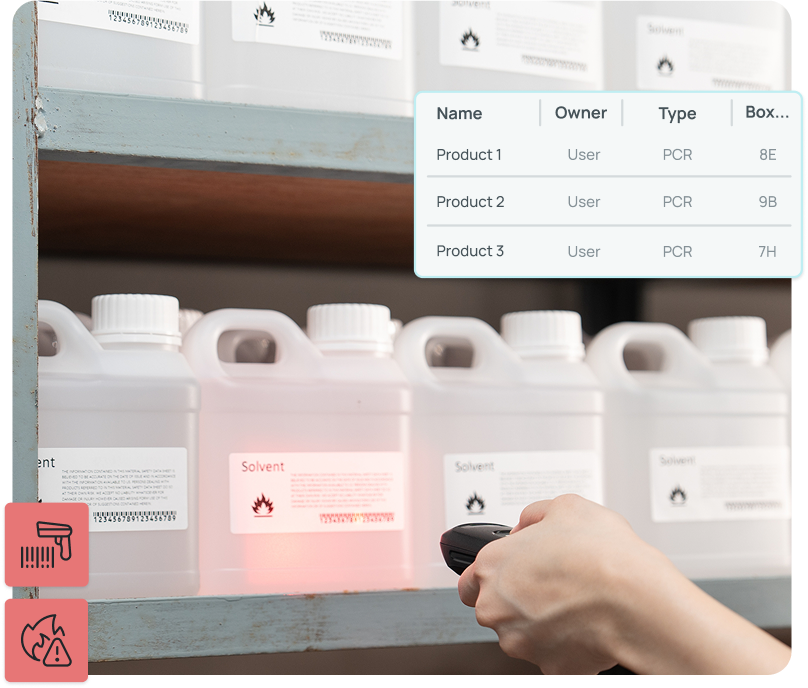
Container-level tracking with barcodes or RFID tags makes this manageable, because each container gets logged when it arrives and removed when it's used up. Our guide to chemical inventory tracking tools compares the options, and chemical inventory best practices for multi-site labs covers the routine that keeps the data current.
2. Tracking where chemicals are, especially in shared space
Every report needs location, and fire code reporting needs it down to the control area. That's hard when several groups share a floor. "Rarely does a single researcher have that zone all to themselves," said Jeffrey Foisel, now Lab Process Safety Specialist at DEKRA North America and formerly R&D Lab Process Safety Technology Leader at The Dow Chemical Company, in a SciSure webinar. Rather, you need an inventory that can total every container under a given regulation in a given space, whichever lab group owns it.
3. Keeping up with changing rules
Reporting rules move at federal, state, and local level. Two changes matter right now:
- OSHA's Hazard Communication Standard update.
OSHA revised the HCS in 2024 to align with Revision 7 of the Globally Harmonized System (GHS). On January 15, 2026, it extended every compliance date by four months, moving the first manufacturer deadline for substances to May 19, 2026 (OSHA). Because EPCRA defines hazardous chemicals by reference to the HCS, updated SDSs can change the hazard categories you report. Our guide to lab safety symbols and meanings covers the labeling side.
- Different formats by state.
Massachusetts uses its own online tool, California uses CERS, and other states accept EPA's Tier2 Submit software or their own systems (EPA state requirements).
4. Compiling and formatting the data
Without software, a Tier II report often starts with purchase and disposal records, then moves to spreadsheets. For each chemical, you work out the maximum amount on site at any point last year and the average daily amount. You convert volumes to pounds, which needs density data. You add up extremely hazardous substances across every mixture that contains them, which is how a few forklift batteries can push sulfuric acid over 500 pounds. Then you enter it all into the right state format, check every field, and hope nothing was missed.
Each manual step is a chance for error, and fire code reports repeat the work in different units and groupings.
5. Finding the time and the people
EHS and lab operations teams carry a long list of duties, and reporting often lands on whoever has a spare week. At a small university, that might be a researcher who also handles compliance. At a startup, it might be an outside consultant billing by the hour. Either way, reporting competes with everything else, and deadlines slip.
Centralizing the inventory changes the math. Across more than 30 organizations using SciSure, averaged workflow data showed inventory report generation (flammables, MAQs, CFATS) dropping from 21 hours to 7 minutes.

For how software costs compare with staff time and consultant fees, check out our guide to what EHS software actually costs.
What are the risks of inaccurate chemical inventory reporting?
- Penalties.
Under EPA's 2025 inflation adjustment, the maximum civil penalty for EPCRA violations is $71,545 per violation (40 CFR 19.4; Safety Partners summary). EPA sets actual amounts case by case, and states can add their own.
- Emergency response.
Responders plan around what you reported. If the report is wrong, they may walk into hazards they didn't expect, or hold back from a fire they could have fought. Our hazardous chemical management guide covers this from a loss-control angle.
- Permits and projects.
Fire code officials review inventory statements when issuing permits. Numbers that don't hold up can delay a move-in, a lease, or a new lab build-out.
- Credibility with regulators.
Once an inspector finds one inconsistency, the next question is what else is wrong. Check out our guide to 5 common questions from chemical regulators for what to have ready.
A reporting-ready chemical inventory: 7-point checklist
Use this before each reporting season, ideally in the fourth quarter so you have time to fix gaps before March 1.
- Every container has an identity.
Chemical name, CAS number where one exists, quantity, unit, and physical state. - Every container has a place.
Building, floor, room, and control area. - Every container has a current SDS.
Check coverage and fill gaps, especially for products with SDSs updated under HazCom 2024. - Low-threshold chemicals are flagged.
Mark extremely hazardous substances and anything with a state threshold lower than the federal one. - Exemption decisions are written down.
Record which areas and chemicals fall under the research laboratory exemption, and why. - The physical count matches the records.
Reconcile each space before reporting season, and follow up on anything missing or unrecorded. Our guide to why lab safety inspections matter as your lab scales covers building this into routine inspections. - The calendar is set.
March 1 for Tier II, your state's own dates, July 1 for TRI if it applies, and fire permit renewals.
How SciSure supports chemical inventory reporting
SciSure Health & Safety includes ChemTracker, SciSure's chemical inventory module. It's built so that the data you maintain day to day is the same data your reports come from. Depending on your configuration, SciSure can support:
- Container-level inventory
With barcode or RFID tracking, spreadsheet import, bulk edits, and photo-based entry through ChemSnap AI (values captured by AI should be checked by a person). - A central chemical database
Containers linked to it inherit hazard and regulatory data. Unlinked, local chemicals are supported too, with regulatory data added by your EHS team. - SDS Auto-Match
Which attaches a recent SDS to each container where a match is available, plus reports showing which containers still need one. - Reconciliation
So you can confirm, move, or remove containers space by space during physical audits. - Regulatory reports
Including containers, totals, and constituents by regulation; federal Tier II and selected state and local right-to-know outputs; NFPA summaries; fire code and MAQ reports by control area (using IBC 2015 tables by default, adjustable for sprinklers, cabinets, and control-area limits); CFATS screening; and CSV export. California users can export inventory data for CERS submission.
These reports support your review. Your SERC, LEPC, and local fire code official still set the final requirements, and not every report is enabled in every instance.
SmartLabs, a flexible lab space provider, uses SciSure for chemical inventory, SDS access, inspections, and MAQ tracking across its research centers.The Boston Fire Department requires SmartLabs to track MAQs weekly. "Just being able to pull that from SciSure makes a big difference," said Julianna Skelton, Senior EHS Lab Operations Manager.
If you're comparing options, our chemical compliance management software buyer's guide walks through what to evaluate, while our guide to 5 lab problems SciSure ChemTracker solves out of the box helps you see how it works in practice.
Chemical inventory reporting rewards the labs that treat it as a byproduct of good inventory data, rather than a February project. Know which reports apply to you, apply the research laboratory exemption carefully, keep location data down to the control area, and reconcile before the deadline arrives.
With SciSure, EHS teams can keep that data current throughout the year, so reports come from the same records the labs use every day. If this sounds like the kind of support you need or the lab you're trying to build, get in touch with us.
FAQs
What is chemical inventory reporting?
Chemical inventory reporting is the process of telling regulators, emergency planners, and fire departments which hazardous chemicals a facility holds, in what quantities, and where. In the US, the main reports are EPCRA Tier II, state right-to-know or hazardous materials filings, and fire code inventory statements.
Who has to file a Tier II report?
Any facility required to keep SDSs under OSHA's Hazard Communication Standard that held 10,000 pounds or more of a hazardous chemical, or 500 pounds or the threshold planning quantity (whichever is lower) of an extremely hazardous substance, at any one time in the previous calendar year.
Are research labs exempt from Tier II reporting?
Chemicals used in a research laboratory under the direct supervision of a technically qualified individual are excluded from EPCRA Tier II. The exclusion applies to how each chemical is used, so stockrooms, pilot plants, production areas, and facility items such as generator fuel or lead-acid batteries can still trigger a report.
When is the Tier II report due?
March 1 each year, covering the previous calendar year. If March 1 falls on a weekend or holiday, EPA asks that reports be submitted before it. Your state may have extra requirements, fees, or a specific filing system.
What's the difference between Tier II and Right-to-Know reporting?
Tier II is the federal EPCRA inventory form. Right-to-Know refers to the public's right to access that information, and to state programs that run their own inventory reports with separate forms or thresholds.
Do research labs need to file TRI reports?
Usually not for lab work. TRI rules let covered facilities exclude toxic chemicals used in a laboratory under the supervision of a technically qualified individual. The exemption does not cover specialty chemical production, pilot plant operations, or activities outside the lab.
Keep reading

Read more of our blogs about modern lab management
Discover the latest in lab operations, from sample management to AI innovations, designed to enhance efficiency and drive scientific breakthroughs.