Chemical Inventory Best Practices for Multi-Site Labs
Get a current, container-level view of what hazardous chemicals you have, where they are, who owns them, which SDSs and hazards apply, and what your organization needs to report.

Download Whitepaper
TL;DR
Chemical inventory best practices require container-level tracking, connected SDS and hazard data, routine reconciliation, report-ready records, and consistent governance across every laboratory and site.
- Accurate intake.
Capture each chemical when it enters the organization using a controlled chemical database, CAS number, manufacturer, product number, quantity, owner, location, and unique container ID. Barcode, RFID, photo-assisted intake, and validated bulk import reduce manual errors before they affect storage decisions, SDS matching, searches, or regulatory reports.
- Connected safety data.
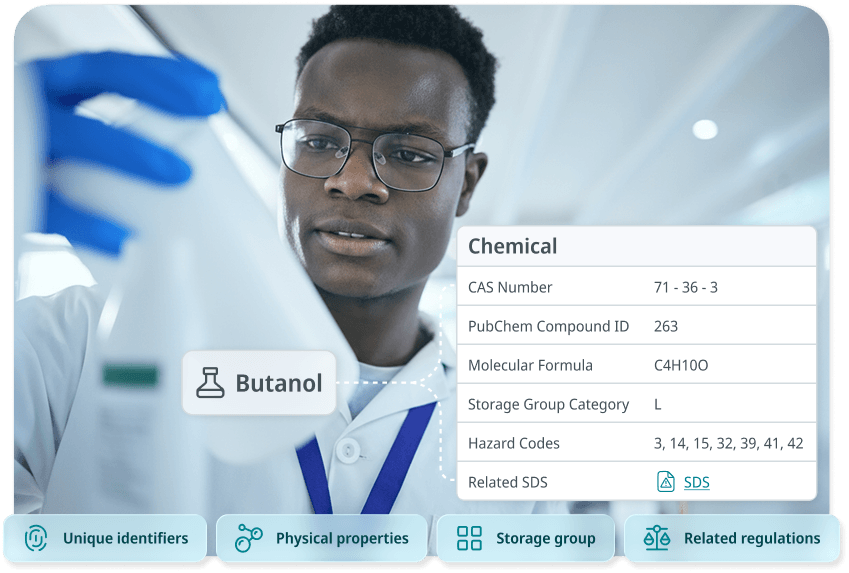
Link every container to the appropriate safety data sheet, GHS and NFPA classifications, storage group, compatibility information, and regulatory profile. Track SDS dates and versions, flag missing or aging documents, and assign exception review so researchers and EHS teams can reach reliable hazard information quickly.
- Live inventory control.
Update records whenever containers move, change owners, or leave the lab. Then reconcile physical stock on a risk-based schedule. Multi-dimensional search, bulk edits, spreadsheet import, and space-level reconciliation help identify missing, expired, duplicate, incompatible, or high-hazard materials before audits, inspections, or emergencies.
- Compliance-ready reporting.
Build Tier II, Right-to-Know, NFPA, fire-code, and maximum allowable quantity reporting from current container records. Confirm jurisdiction-specific thresholds, units, control areas, code editions, and authority requirements, while preserving visibility into the containers behind each total. This helps your EHS team to review exceptions without rebuilding spreadsheets.
- Enterprise safety operations.
Standardize location hierarchies, permissions, data rules, reporting responsibilities, and audit trails across laboratories, buildings, control areas, and sites. With an enterprise chemical inventory software like SciSure, you can connect chemical inventory, SDS management, regulatory reporting, inspections, training, incidents, and hazardous waste workflows, giving research facility safety officers governed visibility without slowing daily laboratory work.
This post was originally written in 2025 and has since been updated to reflect SciSure's enterprise level chemical inventory features, more recent regulatory and compliance standards, and customer proof from SmartLabs.
Ready to see SciSure in action?
No commitment · Free consultation
As an EHS director, you need a current, container-level overview across multiple labs, buildings, control areas, and sites. As a PI, you need a process that fits the way your researchers receive, move, use, and dispose of chemicals every day. If the process creates extra work at the bench, the data will drift. If each site follows a different process, you cannot trust the enterprise view.
Use these best practices to build a chemical inventory program that supports both daily lab safety and year-round compliance.
Read More:
- What EHS Software Actually Costs (Beyond the License Fee)
- The 5 Best EHS Software Platforms for Labs in 2026
Chemical inventory best practices for safe, compliant, scalable labs
The core practices are to track every container through its lifecycle, connect it to reliable SDS and hazard data, make updates easy, reconcile the physical and digital inventory, build reports from live data, and apply consistent governance across every site.
In practice, your chemical inventory should support this checklist:
These practices turn your inventory into an everyday safety tool instead of a list that your team cleans up before an inspection.
How do labs track chemical inventory for safety and regulatory compliance?
Labs track chemical inventory for safety and regulatory compliance by giving each container a unique record, linking it to its location, owner, quantity, SDS, and hazard profile, and updating that record whenever the container moves, changes, or leaves the lab.
A reliable container record should include these fields where applicable:
Chemical laboratories track inventory for safety and regulatory compliance by pairing this container-level record with a clear operating routine: capture good data at intake, update it at the point of change, and check it against the shelf on a defined schedule.
Why this matters: OSHA requires employers with hazardous chemicals to maintain labels and SDSs and train employees to handle those chemicals appropriately. Laboratory employers must also keep SDSs from incoming shipments readily accessible to employees. Likewise, facilities covered by EPCRA Sections 311 and 312 also use inventory data to support hazardous chemical reporting, including annual Tier II reports due by March 1. Your state, local, fire, or building code requirements may go further.
Read More: Fire Code Compliance and MAQs: What Life Science Labs Need to Know
1. Control the data when chemicals enter your organization
Strong intake prevents the errors that later undermine searches, storage decisions, SDS matching, and reports.
Don't ask receiving teams to type every field from scratch. Let them search a controlled chemical database by name, CAS number, product name, or product number, or capture key label details with a photo-assisted workflow. Then require the fields that make the container operationally useful: owner, location, amount, units, and a unique ID.
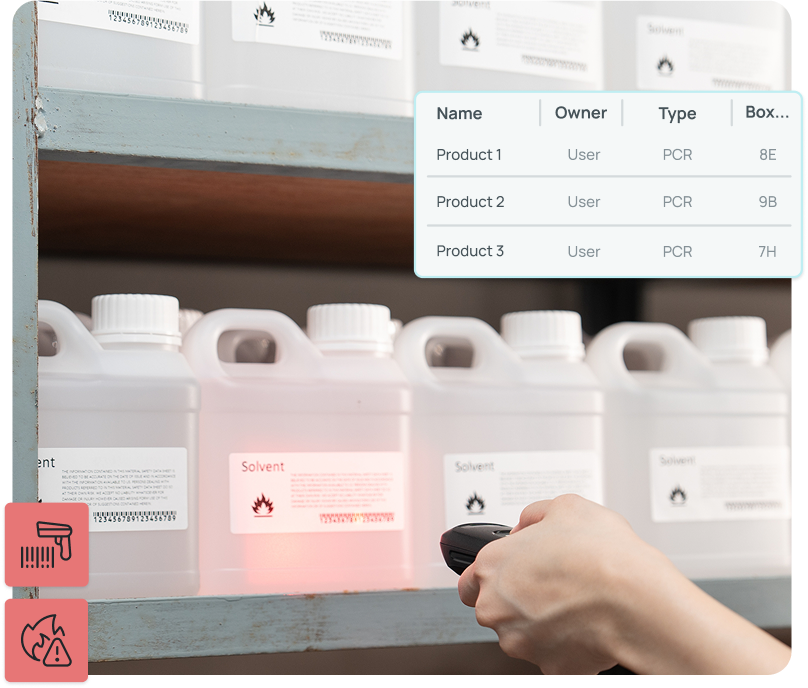
Use a barcode or RFID tag to connect the physical bottle to its digital record. For large shipments, lab moves, or newly acquired sites, use a validated bulk import instead of creating hundreds of records one by one. Your intake controls should catch duplicate chemicals, inconsistent names, missing identifiers, and invalid units before those records feed safety searches or compliance reports.
With SciSure, your receiving team can look up a chemical, assign its owner and location, record the amount, and scan a barcode or RFID tag in one intake flow. For example, with ChemSnap AI, you can use a smartphone photo to suggest available label details, while bulk import helps you migrate an existing lab or process a large shipment with validation and error review. Your team still verifies the record before relying on it.

2. Keep the SDS and hazard context with the container
Your team should be able to move from a container record to the right SDS and hazard information without opening another database, shared drive, or paper binder. A chemical name and quantity alone cannot support safe storage or defensible reporting. Rather, you should be able to connect each record to reliable identifiers, hazard classifications, storage groups and compatibility information, regulatory categories, and the best available SDS for that product.
Pay special attention to mixtures, commercial products, compressed gases, and locally created chemicals. If a record does not link to your controlled chemical database, flag it for EHS review. An unreviewed local entry may not carry the hazard or regulatory data that your searches and reports expect.
3. Make the inventory easy to use and sustainable to maintain
Your chemical inventory will stay current only if researchers and safety teams can use it during normal work. Test the workflow with questions your teams ask regularly:
- Where are all our peroxide formers?
- How much flammable solvent sits in this building or control area?
- Which chemicals belong to a departing PI?
- Which rooms contain oxidizers, water reactives, or compressed gases?
- Where might incompatible storage groups share the same space?
- Which containers have no SDS or no database match?
- What changed after the last reconciliation?
Your search should combine filters including hazard class and building, owner and status, or storage group and site. Results should appear quickly and include the records you expect. Common actions including receiving, transferring, editing, removing, and locating a container should take a few clear steps.
This is where a lab-specific system earns its place. Research organizations manage mixtures, one-off compounds, shared rooms, changing projects, frequent staff turnover, and many occasional users. Their location hierarchies, materials, change rates, and reporting workflows differ from those of a manufacturing plant. A generic industrial tool may store the data but still force your researchers into unfamiliar steps.
When daily use feels cumbersome, your teams might end up creating side spreadsheets and your source of truth starts to split.

4. Reconcile the inventory as an operating routine
Reconcile on a risk-based schedule so the digital inventory continues to match what sits on your shelves.
Set the frequency by risk and activity. A shared stockroom with frequent turnover needs more attention than a stable storage area. Use barcode or RFID scans to confirm what is present, correct locations and owners, remove containers that have left the lab, and restore records that someone removed by mistake.
Match the maintenance tool to the job:
With SciSure, you can bulk-edit containers that need the same change, import a spreadsheet when each record differs, or reconcile an entire space against the physical room. Just make sure to require each update to show who made it and when so you can explain material changes during an audit.
At the enterprise level, track a small set of data-quality measures across sites: time since last reconciliation, database-linkage rate, SDS coverage, records without an active owner, and unresolved inventory exceptions. These measures show you where to focus training and cleanup.
5. Build regulatory reporting into the data structure
Your inventory should capture the location, quantity, hazard, and regulatory data that each facility needs before a reporting deadline arrives. Start by listing the reports and reviews that apply to each site. Depending on your chemicals and jurisdictions, you may need federal Tier II or Right-to-Know reporting, state or local reports such as CERS or NYC RTK, NFPA summaries, reports by regulation, or fire-code and maximum allowable quantity reviews.
Then test whether the system can answer the underlying questions. Can it total chemicals in the units each jurisdiction requires, including appropriate units for compressed gases? Can it distinguish buildings, facilities, and control areas? Can you see which containers contribute to a total? Can you review mixtures and constituents without manually rebuilding the calculation?
Keep EHS review in the workflow. Confirm thresholds, code editions, jurisdictional rules, facility conditions, units, and report requirements with each authority. Your system should give you a current, traceable starting point instead of a folder of exports that no longer agree.
6. Standardize governance across sites without blocking local work
Make sure to standardize core data, permissions, and reporting rules across every site, then let authorized local teams maintain their own spaces. Here's how you can define the operating model before rollout:
Make sure to give your researchers access to their own lab records, PIs and lab managers visibility into their groups and spaces, site safety officers oversight of local facilities, and enterprise EHS a governed view across the organization. Give inspectors, auditors, and first responders timely information in a controlled, useful format.
This structure lets you scale from one lab to many without multiplying spreadsheets, duplicate chemical profiles, or conflicting reports.
Read More: Standardizing Research Across Global Labs
7. Connect chemical inventory to the rest of laboratory safety
Chemical inventory works best when it informs inspections, training, incidents, corrective actions, hazardous waste, and emergency planning.
A container record tells you what sits in a room. An inspection may show that someone stored it incorrectly. A training record shows whether the user understands the hazard. An incident record and corrective action show whether your team addressed a recurring problem. When these records live in disconnected systems, you have to reconstruct the full picture.
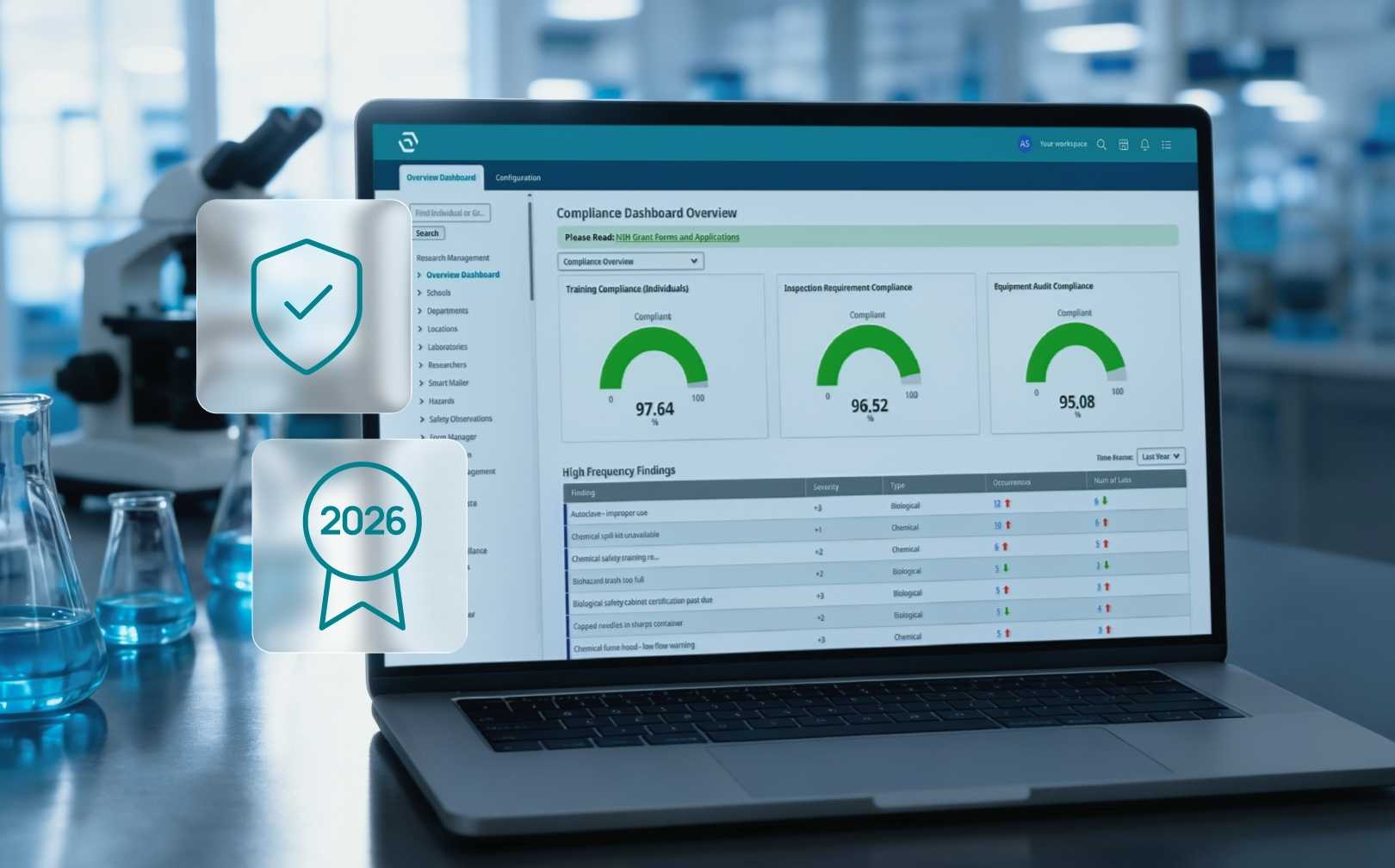
If you oversee research facility safety, SciSure supports laboratory safety management with chemical inventory tracking, SDS management, and compliance reporting from the same governed platform. You can also manage inspections, training, incidents, and hazardous waste without manually reconciling a separate tool for every safety process.
With this connected view, you can spot trends in hazardous-material use and near misses, improve storage, focus inspections, refine training, reduce overordering, guide disposal, and prepare emergency information. Share what you learn across teams so one site can act on a pattern another site found first.
8. Treat implementation support as part of the system
The right vendor should help you migrate the data, configure the program, train users, and extend the system as your organization changes.
Before you choose a platform, work through this implementation checklist:
Use your own scenarios during the demonstration and time the tasks that consume the most effort today. Ask the vendor to receive a container, find all oxidizers in one building, identify the records behind an MAQ total, reconcile a room, and show the different views for a PI, site safety officer, and enterprise EHS director. Then double the inventory volume, add a site, or introduce a new hazard class. You'll learn more from those tasks than from a generic feature tour.
What warning signs show that your chemical inventory system is falling short?
Your current system needs attention when routine work still depends on manual entry, side spreadsheets, disconnected SDS searches, annual reporting scrambles, or knowledge held by one person.
Look for these signs:
Worse, these problems rarely stay isolated. A weak intake process creates incomplete profiles. Incomplete profiles weaken searches and reports. Slow maintenance makes the inventory stale. Multi-site growth then magnifies every inconsistency.
What should you look for in chemical inventory software?
Your chemical inventory software of choice should make accurate daily work easy, produces the reports you actually need, and gives EHS consistent control across every lab and site. Here's a checklist to help you compare:
The best fit should work both for the organization you run today and the one you expect to run five years from now. Double the chemical volume, add a new site, or introduce a new hazard class in your evaluation scenario. If the process falls apart, the system will not scale with you.
Read More: 7 Features to Look for in Enterprise Chemical Inventory Software
How does SciSure support chemical inventory best practices?
SciSure gives research organizations one lab-focused platform for container tracking, SDS management, hazard data, reconciliation, compliance reporting, and broader safety workflows across multiple labs and facilities. That means your researchers can use practical inventory workflows while your safety team applies consistent standards and reviews consolidated data. Your EHS director can move from a site-level exception to the contributing container records, and your PI can find the chemical and SDS needed for daily work.
The goal is simple: help you keep the inventory accurate enough to use, connected enough to support safety, and structured enough to defend your reports.
SmartLabs: Chemical inventory at scale
SmartLabs shows what chemical inventory best practices look like across a complex research operation. Its EHS and Lab Operations team supports hundreds of lab spaces on both U.S. coasts, where partner companies follow different workflows and facilities face multiple jurisdictions and compliance requirements.
Before SciSure, SmartLabs managed chemical inventory and inspections in separate systems that did not communicate. The team went on to implement SciSure for chemical inventory, SDS management, inspections, and equipment, then expanded into other safety workflows. That gave EHS role-based access, faster hazard filtering, and one place to manage inventory alongside related safety work.
SmartLabs reports that inventory searches fell from about 15 minutes to one or two minutes, reconciliation for an entire research center dropped from an all-day task to as little as 20 minutes, and inventory reporting fell from about 30 minutes to one minute. The team also uses ChemTracker to support weekly maximum allowable quantity reviews required by the Boston Fire Department
For a multi-site EHS leader, the takeaway is practical: standardize the data and routine workflows first, then use the time you recover to investigate exceptions, improve safety programs, and support researchers.
Ready to strengthen chemical inventory across every site?
If this sounds like the kind of lab you'd like to build, we're here to build it alongside you.
Bring a real multi-site scenario to a SciSure demo: locate a high-hazard container, verify its SDS, reconcile its room, and review the report total it affects. Get in touch with us for a no-commitment free consultation on how SciSure fits your lab workflows.

Read more of our blogs about modern lab management
Discover the latest in lab operations, from sample management to AI innovations, designed to enhance efficiency and drive scientific breakthroughs.