How to Prepare a Strong IBC Submission: What Reviewers Wish You Knew

Want to boost your IBC submission outcomes? Explore reviewer expectations and discover how digital biosafety tools simplify proof of readiness and compliance.
December 10, 2025
()
min read
A laboratory

Download Whitepaper

By submitting this form, you agree with our Privacy Policy.
Thank you! Download the file by clicking below:
Download
Oops! Something went wrong while submitting the form.

Table of Contents

Thank you! Your submission has been received!
Oops! Something went wrong while submitting the form.

Table of Contents

TL;DR

IBC (Institutional Biosafety Committee) submissions frequently get delayed or rejected for avoidable reasons. Understanding what reviewers actually look for dramatically improves approval rates.

  • Commonly overlooked risks: Routine lab activities like vortexing, centrifuging, and sonicating can release recombinant material. Reviewers also look for documented containment measures for transport between buildings, shared lab spaces, field research, and waste management.
  • Exempt vs. covered classification: Understanding the NIH Guidelines distinctions between exempt and covered experiments prevents delays. Small protocol changes like switching plasmid backbones or cell lines can shift a project into a higher oversight category requiring a formal amendment.
  • Four common red flags: Vague containment descriptions that lack specifics, expired or missing facility certifications and training records, unreported protocol amendments, and inconsistent personnel information across submission documents.
  • Documentation best practices: Keep all facility certifications, training records, inspection reports, and equipment maintenance logs current, organized, and accessible in a centralized system so you can respond to reviewer questions quickly.

Every PI dreads it: you’ve spent weeks crafting your IBC submission, only to have it bounce back covered in comments. The issue isn’t necessarily that your science is unsafe, it’s that reviewers are looking for details, not assumptions. For the Institutional Biosafety Committee (IBC), biosafety readiness is demonstrated through evidence, not intent.

IBC reviews ensure that research involving recombinant or synthetic nucleic acids (r/sNA), infectious agents, and other biohazards meets NIH Guidelines—with appropriate containment, training, and facility controls in place. Yet submissions often fall short. Missing containment details, outdated certifications, or disorganized training records can turn an otherwise sound protocol into weeks of delay.

The good news is that most of these problems are avoidable. By understanding what reviewers are really looking for, and how to organize your biosafety documentation through structured, digitally traceable workflows, you can turn the IBC submission process from a compliance hurdle into a confident demonstration of readiness.

Here’s what experienced reviewers wish every PI knew before submitting, and how a more connected biosafety management system can help you get it right the first time.

The hidden risks that often get missed

When IBC reviewers flag a submission, it’s often because everyday lab activities haven’t been fully evaluated for how they could create exposure or release risks. The most common issues reviewers see aren’t catastrophic errors, but small, easily overlooked details that reveal gaps in biosafety posture.

Some of the most frequent examples include:

  • Aerosol generation: Vortexing, centrifuging, or sonicating can release recombinant material. If this isn’t captured in the risk assessment, reviewers will question whether appropriate containment (e.g., a certified biosafety cabinet or sealed rotors) is in place.
  • Inter-building transport: Moving materials between facilities introduces new containment requirements. Reviewers expect documented secondary containment (e.g., double packaging), labelling, and defined transport routes.
  • Shared or transitional spaces: Hallways, elevators, and cold rooms fall outside containment zones but are often used in workflows. Reviewers look for assurances that access is controlled and materials remain secured during transfers.
  • Field research: Work outside the lab introduces “unknown unknowns”. Reviewers expect to see how biosafety and communication plans extend beyond the bench.
  • Waste management: Reviewers look for validated inactivation methods, not generic statements like “waste will be autoclaved”.

Each of these risks may seem minor in isolation, but collectively they show how biosafety depends as much on operational behavior and documentation as on technical containment. IBC reviewers aren’t assessing your experimental design—they’re evaluating whether the biosafety risks associated with it are clearly understood, appropriately contained, and fully documented.

Exempt vs. covered: getting the basics right

Many IBC submission delays stem from a simple misunderstanding of how the NIH Guidelines classify work involving recombinant or synthetic nucleic acids. The difference between “exempt” and “covered” determines whether an activity must be reviewed and approved before it begins, or whether it can start concurrently with notification to the IBC.

Under the Guidelines:

IBC Requirements by NIH Guideline Category
Category (NIH Guidelines) IBC Requirement & Timing Typical Examples Notes
Section III-F — Exempt Work Exempt from NIH IBC review. Institutions may still request brief notification to confirm eligibility. Cloning non-hazardous DNA into non-pathogenic hosts (e.g., E. coli K-12, Saccharomyces cerevisiae). Experiments using synthetic DNA that cannot replicate or express in living cells. Can begin immediately once the lab confirms it meets exemption criteria. Must still follow institutional biosafety policies.
Section III-E — Notification at Initiation IBC must be notified, but work may begin concurrently with submission. Formal IBC review follows. Expression of non-toxic proteins in well-characterized mammalian cell lines. Use of replication-deficient viral vectors that do not produce infectious particles. Review occurs after work begins; revisions may be required if risk classification changes.
Section III-D and above — Prior Approval Required IBC approval must be obtained before initiating the work. May also require NIH OBA or other agency review. Experiments with human or animal pathogens. Work at BSL-2 or higher. Recombinant DNA in animals or transgenic plants with potential environmental release. Approval must be in place before any recombinant or infectious work starts. Documentation of containment and training is mandatory.

Problems arise when PIs assume their work is exempt but, in practice, it involves host–vector systems or agents that change the risk profile. For example:

  • Introducing a recombinant viral vector to mammalian cells often elevates containment requirements from BSL-1 to BSL-2.
  • Using cell lines of human origin can move a project from exempt to covered status.
  • Adding antibiotic-resistance markers or environmental release components may trigger Section III-D review.

Even seemingly small deviations (e.g., a new plasmid backbone, a collaborator’s vector, or a change in cell line) can shift a project into a new category. When that happens, reviewers expect a formal amendment to the existing protocol or a new IBC submission altogether. Clear documentation of how each experiment is classified and justified is the surest way to avoid rework and delays.

SciSure Health & Safety
Bring biosafety documentation into one system
Centralize training, certifications, and inspections so IBC reviewers can verify readiness without delays.
Request a demo

Facility and personnel readiness: the proof reviewers expect

Even when experiments are classified correctly, many IBC submissions stall because the lab can’t demonstrate readiness. Reviewers don’t just want to see that a project meets the right biosafety level—they want evidence that the facility, equipment, and people are all operating to that standard.

Typical proof points include:

  • Up-to-date biosafety cabinet (BSC) certifications and calibration records.
  • Training currency for every individual listed on the protocol.
  • Inspection reports confirming that containment and emergency systems are in place.
  • Equipment maintenance logs for devices used in primary containment.

Collecting and validating this evidence is often where submissions slow down. Certificates may live in shared drives, training records in HR systems, and inspection reports in separate EHS databases — none linked or time-stamped in a way reviewers can easily verify. The result: weeks of email back-and-forth for simple document requests.

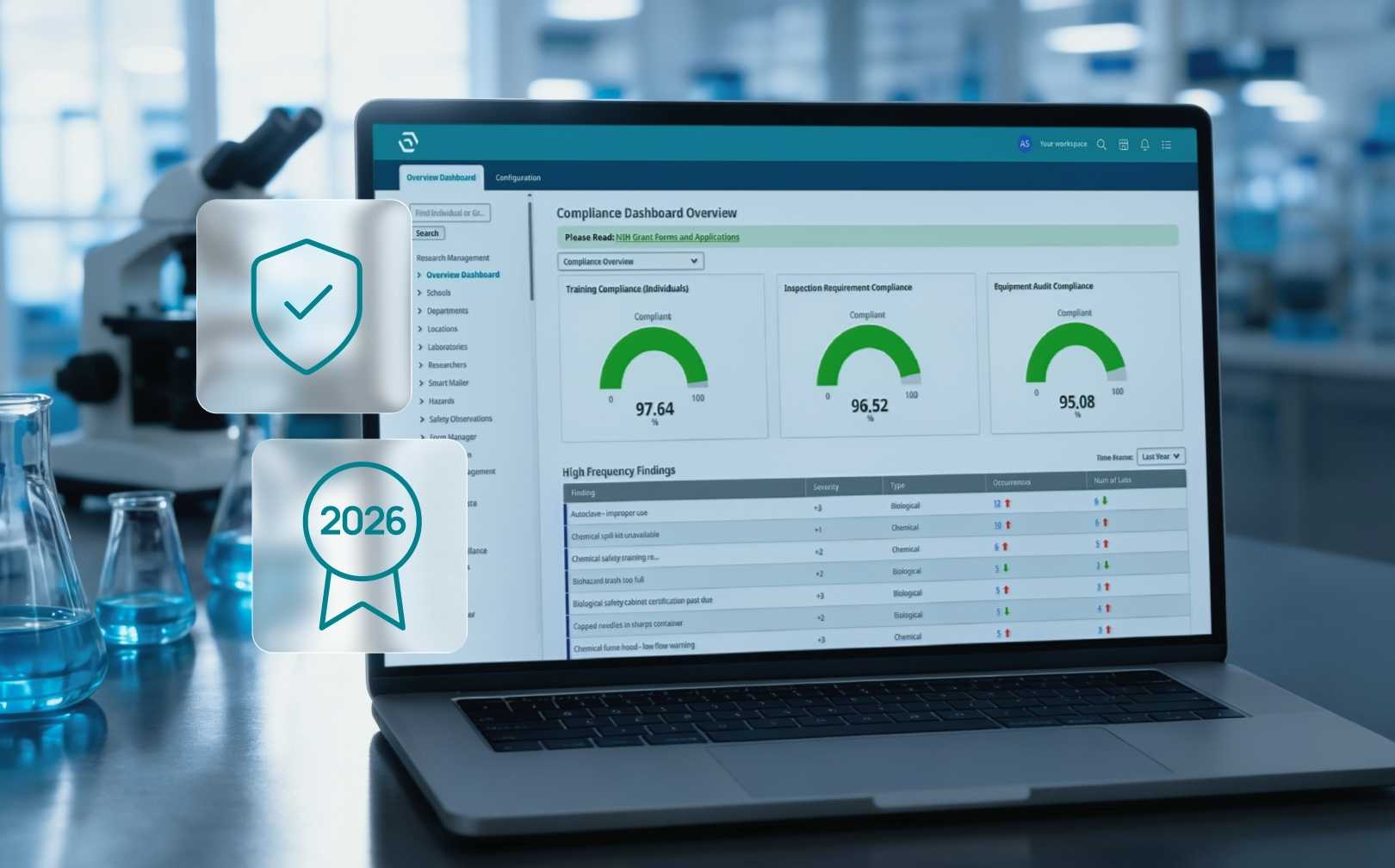
This is where connected biosafety infrastructure makes a measurable difference. The SciSure Scientific Management Platform (SMP) centralizes all proof-of-readiness data in one auditable framework. Its integrated modules for Bio-Registration, Training, Inspection, and Equipment link personnel, processes, and facilities to the projects they support—automatically tracking certification status, expiration dates, and compliance history.

For reviewers, this means clarity and confidence. For labs, it means fewer administrative loops, faster approval cycles, and a permanent digital record of biosafety assurance that’s always inspection-ready.

From reactive to ready with the Scientific Management Platform 

Traditionally, preparing for an IBC submission gets LabOps and EHS teams in reactive mode: gathering documents from various silos, scrambling for missing certificates, chasing review comments, and hoping nothing expires mid-review. The SciSure SMP flips that model — by embedding compliance into everyday biosafety workflows.

With the SMP, labs can:

  • Standardize submissions using configurable project forms and guided workflows that ensure all required fields and risk details are complete before review.
  • Track materials and agents with Bio Registration, linking recombinant and synthetic materials, personnel, and facilities to the projects they support—providing full traceability for every construct and containment requirement.
  • Link people, projects, and compliance—automatically tracking training status, role eligibility, and access rights to prevent expired or missing certifications.
  • Stay audit-ready by logging inspections, equipment certifications, and corrective actions in one secure, traceable system.
  • Collaborate efficiently with reviewers and biosafety officers through shared digital review workflows that replace scattered email chains and version confusion.

Together, these capabilities turn biosafety management from a reactive paperwork exercise into a transparent, connected process that accelerates IBC approvals. Every certification, training log, and inspection outcome is linked directly to the projects and personnel they support, giving reviewers instant proof of readiness and giving labs continuous confidence in their compliance status.

Pre-submission checks: Four common red flags

Even the most carefully prepared IBC submission can be sent back for clarification. Reviewers are not looking for perfection, but there are a few issues that almost guarantee revision. Catching these before you submit can save weeks of delay.

  1. Incomplete containment descriptions
    Protocols that simply state “work will be conducted at BSL-2” without detailing engineering controls, cabinet use, or waste handling raise immediate questions. Reviewers need to see how containment will be achieved, not just the biosafety level.
  2. Expired or missing documentation
    Out-of-date biosafety cabinet certificates or training records are the fastest route to a deferral. Reviewers can’t approve a project unless every record is current and verifiable.
  3. Unclear scope or unreported amendments
    When the described work doesn’t match the classification—say, new vectors or host cells have been added without an amendment—reviewers must pause to reassess risk.
  4. Inconsistent personnel listings
    Names that appear in one section but not another, or missing information on roles and responsibilities, often lead to administrative revision requests.

Most of these issues are administrative, not scientific. Labs that maintain centralized, time-stamped records of training, equipment, and protocol updates can catch errors automatically — preventing avoidable revisions and accelerating approval.

SciSure Research
Move from submission prep to continuous readiness
Connect projects, personnel, and compliance data to stay audit-ready and reduce IBC review cycles.
Talk to a specialist

Getting it right the first time

IBC submissions don’t have to be a cycle of revisions and resubmissions. With the right systems in place, biosafety compliance becomes clear, continuous, and far less stressful. The key is readiness—knowing your documentation, facilities, and people are aligned long before reviewers ever see your protocol.

The SciSure SMP helps labs get there. By uniting bio-registration, training, inspection, and equipment capabilities in one connected framework, it turns biosafety oversight into a transparent, auditable process that accelerates approvals and builds reviewer confidence.

Ready to simplify your next IBC submission? Contact us today to explore how the SMP can help your lab stay compliant and review-ready year-round.

Ready to see SciSure in action?

Get a personalized demo and see how SciSure fits your lab's workflows.
Request demo

No commitment · Free consultation

Every PI dreads it: you’ve spent weeks crafting your IBC submission, only to have it bounce back covered in comments. The issue isn’t necessarily that your science is unsafe, it’s that reviewers are looking for details, not assumptions. For the Institutional Biosafety Committee (IBC), biosafety readiness is demonstrated through evidence, not intent.

IBC reviews ensure that research involving recombinant or synthetic nucleic acids (r/sNA), infectious agents, and other biohazards meets NIH Guidelines—with appropriate containment, training, and facility controls in place. Yet submissions often fall short. Missing containment details, outdated certifications, or disorganized training records can turn an otherwise sound protocol into weeks of delay.

The good news is that most of these problems are avoidable. By understanding what reviewers are really looking for, and how to organize your biosafety documentation through structured, digitally traceable workflows, you can turn the IBC submission process from a compliance hurdle into a confident demonstration of readiness.

Here’s what experienced reviewers wish every PI knew before submitting, and how a more connected biosafety management system can help you get it right the first time.

The hidden risks that often get missed

When IBC reviewers flag a submission, it’s often because everyday lab activities haven’t been fully evaluated for how they could create exposure or release risks. The most common issues reviewers see aren’t catastrophic errors, but small, easily overlooked details that reveal gaps in biosafety posture.

Some of the most frequent examples include:

  • Aerosol generation: Vortexing, centrifuging, or sonicating can release recombinant material. If this isn’t captured in the risk assessment, reviewers will question whether appropriate containment (e.g., a certified biosafety cabinet or sealed rotors) is in place.
  • Inter-building transport: Moving materials between facilities introduces new containment requirements. Reviewers expect documented secondary containment (e.g., double packaging), labelling, and defined transport routes.
  • Shared or transitional spaces: Hallways, elevators, and cold rooms fall outside containment zones but are often used in workflows. Reviewers look for assurances that access is controlled and materials remain secured during transfers.
  • Field research: Work outside the lab introduces “unknown unknowns”. Reviewers expect to see how biosafety and communication plans extend beyond the bench.
  • Waste management: Reviewers look for validated inactivation methods, not generic statements like “waste will be autoclaved”.

Each of these risks may seem minor in isolation, but collectively they show how biosafety depends as much on operational behavior and documentation as on technical containment. IBC reviewers aren’t assessing your experimental design—they’re evaluating whether the biosafety risks associated with it are clearly understood, appropriately contained, and fully documented.

Exempt vs. covered: getting the basics right

Many IBC submission delays stem from a simple misunderstanding of how the NIH Guidelines classify work involving recombinant or synthetic nucleic acids. The difference between “exempt” and “covered” determines whether an activity must be reviewed and approved before it begins, or whether it can start concurrently with notification to the IBC.

Under the Guidelines:

IBC Requirements by NIH Guideline Category
Category (NIH Guidelines) IBC Requirement & Timing Typical Examples Notes
Section III-F — Exempt Work Exempt from NIH IBC review. Institutions may still request brief notification to confirm eligibility. Cloning non-hazardous DNA into non-pathogenic hosts (e.g., E. coli K-12, Saccharomyces cerevisiae). Experiments using synthetic DNA that cannot replicate or express in living cells. Can begin immediately once the lab confirms it meets exemption criteria. Must still follow institutional biosafety policies.
Section III-E — Notification at Initiation IBC must be notified, but work may begin concurrently with submission. Formal IBC review follows. Expression of non-toxic proteins in well-characterized mammalian cell lines. Use of replication-deficient viral vectors that do not produce infectious particles. Review occurs after work begins; revisions may be required if risk classification changes.
Section III-D and above — Prior Approval Required IBC approval must be obtained before initiating the work. May also require NIH OBA or other agency review. Experiments with human or animal pathogens. Work at BSL-2 or higher. Recombinant DNA in animals or transgenic plants with potential environmental release. Approval must be in place before any recombinant or infectious work starts. Documentation of containment and training is mandatory.

Problems arise when PIs assume their work is exempt but, in practice, it involves host–vector systems or agents that change the risk profile. For example:

  • Introducing a recombinant viral vector to mammalian cells often elevates containment requirements from BSL-1 to BSL-2.
  • Using cell lines of human origin can move a project from exempt to covered status.
  • Adding antibiotic-resistance markers or environmental release components may trigger Section III-D review.

Even seemingly small deviations (e.g., a new plasmid backbone, a collaborator’s vector, or a change in cell line) can shift a project into a new category. When that happens, reviewers expect a formal amendment to the existing protocol or a new IBC submission altogether. Clear documentation of how each experiment is classified and justified is the surest way to avoid rework and delays.

SciSure Health & Safety
Bring biosafety documentation into one system
Centralize training, certifications, and inspections so IBC reviewers can verify readiness without delays.
Request a demo

Facility and personnel readiness: the proof reviewers expect

Even when experiments are classified correctly, many IBC submissions stall because the lab can’t demonstrate readiness. Reviewers don’t just want to see that a project meets the right biosafety level—they want evidence that the facility, equipment, and people are all operating to that standard.

Typical proof points include:

  • Up-to-date biosafety cabinet (BSC) certifications and calibration records.
  • Training currency for every individual listed on the protocol.
  • Inspection reports confirming that containment and emergency systems are in place.
  • Equipment maintenance logs for devices used in primary containment.

Collecting and validating this evidence is often where submissions slow down. Certificates may live in shared drives, training records in HR systems, and inspection reports in separate EHS databases — none linked or time-stamped in a way reviewers can easily verify. The result: weeks of email back-and-forth for simple document requests.

This is where connected biosafety infrastructure makes a measurable difference. The SciSure Scientific Management Platform (SMP) centralizes all proof-of-readiness data in one auditable framework. Its integrated modules for Bio-Registration, Training, Inspection, and Equipment link personnel, processes, and facilities to the projects they support—automatically tracking certification status, expiration dates, and compliance history.

For reviewers, this means clarity and confidence. For labs, it means fewer administrative loops, faster approval cycles, and a permanent digital record of biosafety assurance that’s always inspection-ready.

From reactive to ready with the Scientific Management Platform 

Traditionally, preparing for an IBC submission gets LabOps and EHS teams in reactive mode: gathering documents from various silos, scrambling for missing certificates, chasing review comments, and hoping nothing expires mid-review. The SciSure SMP flips that model — by embedding compliance into everyday biosafety workflows.

With the SMP, labs can:

  • Standardize submissions using configurable project forms and guided workflows that ensure all required fields and risk details are complete before review.
  • Track materials and agents with Bio Registration, linking recombinant and synthetic materials, personnel, and facilities to the projects they support—providing full traceability for every construct and containment requirement.
  • Link people, projects, and compliance—automatically tracking training status, role eligibility, and access rights to prevent expired or missing certifications.
  • Stay audit-ready by logging inspections, equipment certifications, and corrective actions in one secure, traceable system.
  • Collaborate efficiently with reviewers and biosafety officers through shared digital review workflows that replace scattered email chains and version confusion.

Together, these capabilities turn biosafety management from a reactive paperwork exercise into a transparent, connected process that accelerates IBC approvals. Every certification, training log, and inspection outcome is linked directly to the projects and personnel they support, giving reviewers instant proof of readiness and giving labs continuous confidence in their compliance status.

Pre-submission checks: Four common red flags

Even the most carefully prepared IBC submission can be sent back for clarification. Reviewers are not looking for perfection, but there are a few issues that almost guarantee revision. Catching these before you submit can save weeks of delay.

  1. Incomplete containment descriptions
    Protocols that simply state “work will be conducted at BSL-2” without detailing engineering controls, cabinet use, or waste handling raise immediate questions. Reviewers need to see how containment will be achieved, not just the biosafety level.
  2. Expired or missing documentation
    Out-of-date biosafety cabinet certificates or training records are the fastest route to a deferral. Reviewers can’t approve a project unless every record is current and verifiable.
  3. Unclear scope or unreported amendments
    When the described work doesn’t match the classification—say, new vectors or host cells have been added without an amendment—reviewers must pause to reassess risk.
  4. Inconsistent personnel listings
    Names that appear in one section but not another, or missing information on roles and responsibilities, often lead to administrative revision requests.

Most of these issues are administrative, not scientific. Labs that maintain centralized, time-stamped records of training, equipment, and protocol updates can catch errors automatically — preventing avoidable revisions and accelerating approval.

SciSure Research
Move from submission prep to continuous readiness
Connect projects, personnel, and compliance data to stay audit-ready and reduce IBC review cycles.
Talk to a specialist

Getting it right the first time

IBC submissions don’t have to be a cycle of revisions and resubmissions. With the right systems in place, biosafety compliance becomes clear, continuous, and far less stressful. The key is readiness—knowing your documentation, facilities, and people are aligned long before reviewers ever see your protocol.

The SciSure SMP helps labs get there. By uniting bio-registration, training, inspection, and equipment capabilities in one connected framework, it turns biosafety oversight into a transparent, auditable process that accelerates approvals and builds reviewer confidence.

Ready to simplify your next IBC submission? Contact us today to explore how the SMP can help your lab stay compliant and review-ready year-round.

Sign up for our newsletter

Get the latest tips, articles, and exclusive content on modern lab management delivered to your inbox.
Thank you for subscribing!
Please check your email to verify your submission.
Oops! Something went wrong while submitting the form.