Chemical Profiles: The Secret to Safer, Smarter Labs
Incomplete chemical data creates safety blind spots. Connected chemical profiles keep labs compliant with OSHA, EPA, and NFPA requirements in 2026.
Download Whitepaper
TL;DR
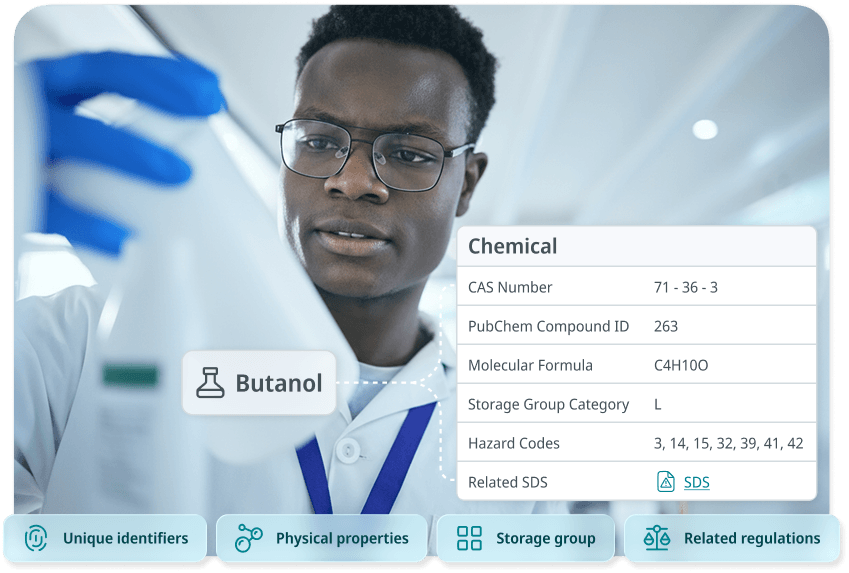
A chemical profile is the full set of data behind each substance in your lab: hazard classification, storage compatibility, Safety Data Sheet (SDS) linkage, quantity, location, and owner. Labs that maintain complete, connected profiles answer regulatory questions in minutes instead of weeks.
- The rules just changed.
OSHA (the US Occupational Safety and Health Administration) aligned its Hazard Communication Standard with the seventh revision of the Globally Harmonized System (GHS) in 2024. The first compliance deadline for substance classifications passed on May 19, 2026, and employers must update workplace labeling and training by November 20, 2026.
- Fire codes now reach further.
The 2024 edition of NFPA 45, the fire protection standard for laboratories using chemicals, expanded its scope to healthcare laboratories, added requirements for ductless fume hoods, and updated maximum allowable quantity (MAQ) guidance.
- A name is not a profile.
Listing "acetone" tells you nothing about flammability class, peroxide formation risk, or MAQ thresholds. Recent research shows hazard flags like reproductive toxicity routinely go undetected in lab inventories when profiles are incomplete.
- Fragmented data fails audits.
When SDSs, hazard data, and inventory live in separate systems, every update is a chance for misalignment. Regulators expect a traceable line from each container to the data that defines its risk.
- Connected profiles do the reporting for you.
SciSure's ChemTracker builds complete chemical profiles from a verified property database and turns them into fire code reports, Tier II reports, and NFPA hazard summaries from the same live container data.
Ready to see SciSure in action?
No commitment · Free consultation
The hidden gaps in lab safety
When chemical data is fragmented across SDS folders, spreadsheets, and procurement systems, even diligent teams spend hours chasing information that should be at their fingertips.
Every lab manager or EHS (environmental health and safety) leader knows the frustration of having an inventory list and still having no real insight into what those chemicals are or how they are regulated. That missing layer of context is where safety blind spots begin.
Safety, compliance, and operational efficiency all depend on one shared foundation: complete and connected chemical profiles.
What's changed in 2025 & 2026
The case for complete chemical profiles has grown stronger over the past two years, because the regulatory ground shifted under labs in three places at once.
OSHA's Hazard Communication Standard now follows GHS Revision 7
OSHA finalized its update to the Hazard Communication Standard in May 2024, aligning hazard classification, labels, and SDSs primarily with the seventh revised edition of the GHS. In January 2026, OSHA extended the compliance dates by four months. The first deadline, for manufacturers, importers, and distributors classifying substances, passed on May 19, 2026. That means updated SDSs and labels are arriving in labs right now.
What this means for you: Employers must update workplace labeling, written programs, and training by November 20, 2026, and the mixture classification deadline follows on November 19, 2027. If your inventory cannot match incoming SDS revisions to the right containers, the new hazard data never reaches the people handling the chemical.
OSHA's laboratory standard separately requires a written Chemical Hygiene Plan wherever hazardous chemicals are used, and that plan is only as good as the inventory behind it.
NFPA 45 has expanded its reach
The 2024 edition of NFPA 45, the standard on fire protection for laboratories using chemicals, has broadened its scope to cover laboratories in healthcare facilities where any quantity of ignitible liquid is present, added installation and training requirements for ductless chemical fume hoods, and updated its guidance on maximum allowable quantities of liquids and gases. Labs that could not previously say which containers count toward a flammable total in each control area now have one more reason to fix that.
EPA reporting keeps evolving. The US Environmental Protection Agency's Tier II requirements under the Emergency Planning and Community Right-to-Know Act still ask facilities for maximum and average daily amounts, storage details, and locations every year. Meanwhile, the agency's PFAS reporting rule under the Toxic Substances Control Act has been revised and postponed repeatedly, most recently in April 2026.
What this means for you: Watch out for the pattern. Reporting demands keep moving, and the organizations that respond fastest are the ones whose chemical identity data is structured enough to query.
None of these frameworks can be satisfied by a list of chemical names. They all assume you know what each substance is, how it is classified, where it sits, and in what quantity. That's a chemical profile.

A name on a label isn't enough
Listing a substance as acetone or toluene doesn't tell you if it's flammable, a peroxide former, or subject to specific MAQ thresholds. Without that metadata, meaning hazard class, storage compatibility, and SDS linkage, the chemical is simply a label, not a profile.
Why this matters
Inventory tools that only track container counts or locations fail to provide the picture regulators expect. A compliant system should know what a chemical is, how it behaves, and what it affects downstream, from storage configuration to disposal.
Storage compatibility is a good example of why the metadata matters. For example, a 2026 study in the Journal of Loss Prevention in the Process Industries compared chemical segregation methods and found that compatibility assessment depends on having accurate, substance-level hazard data for every chemical in the room. You cannot segregate what you have not classified.
Labs that rely on flat data spend hours every month verifying details that could be automatically populated and validated.
Incomplete data multiplies manual work
When chemical property data isn't tied to inventory records, staff must manually cross-reference CAS numbers (Chemical Abstracts Service registry numbers), SDS files, and vendor databases to retrieve hazard details. Each lookup is a point of friction, and each missing flag (like "pyrophoric" or "reproductive toxin") is a potential compliance risk.
Why this matters
Manual verification might work for 100 containers, but not for 10,000. The missing-flag problem is not hypothetical. Researchers recently built HazardPyMatch, a tool published in Cell Reports Methods in 2026, specifically because reproductive and other health hazards in laboratory inventories so often go unidentified. The fact that scientists needed to write software to find hazards hiding in their own stockrooms says everything about how common incomplete profiles are.
Legacy chemicals make it worse. A 2025 paper in ACS Chemical Health & Safety from the UCLA Center for Laboratory Safety documents how old, inherited, and forgotten containers accumulate in labs precisely because no one maintained a complete record from acquisition to disposal.
By contrast, systems integrated with a verified chemical property database can build complete profiles automatically, saving hours of effort while reducing missed hazards and reporting errors.
Fragmented data creates fragmented compliance
When SDSs, hazard information, and inventory data live in separate systems, you're managing by copy-and-paste, not by insight.
Every system update becomes an opportunity for misalignment: outdated SDS versions, mismatched hazard codes, or duplicate entries under slightly different names. With GHS Revision 7 SDSs now arriving from suppliers ahead of the November 2026 employer deadline, that misalignment risk is higher than it has been in a decade.
Why this matters
Regulators expect traceability: a clear line between what's in your lab and the data that defines its risks. Fragmented systems make that impossible, forcing teams into a cycle of reactive corrections instead of continuous readiness.
The volume problem is real. A 2025 analysis of SDS data structures found that the sheer number of safety data sheets from different suppliers makes centralizing and retrieving that data genuinely difficult. "We have an SDS binder somewhere," is not the same as "The right SDS is attached to the right container."
Disconnected systems are the real compliance bottleneck
Most labs struggle because of disconnected data, not necessarily poor data. SDS repositories and safety systems often operate independently, meaning updates in one place never flow to another.
Why this matters
This disconnect prevents EHS teams from seeing chemical usage trends, tracking storage limits in real time, or running unified compliance reports. The more fragmented your system becomes, the harder it is to scale safely.
Modern lab operations are moving toward platforms that connect these functions, automatically syncing intake, hazard data, and compliance reporting end to end.
Read More: The 5 Best EHS Software Platforms For Labs in 2026
How SciSure turns chemical profiles into working compliance
This is the gap SciSure's ChemTracker was built to close. Instead of storing names and counts, it builds a complete profile for every container: chemical identity by name, CAS number, or product number, hazard classification from a verified property database, SDS auto-match where enabled, owner, storage location, amount, and a barcode or RFID value as a unique container ID.
Those profiles then do the compliance work directly:
- Fire code reporting by control area.
ChemTracker's Fire Code Reports apply International Building Code (IBC) 2015 definitions and MAQ values per control area, with editable defaults where local code setups differ, with adjustments for flammable cabinets and sprinklers where configured. When a fire marshal asks what sits in a given room, the answer comes from live container data, not a reconstruction.
- Regulatory reports from one source.
By Regulation reports, federal Tier II and Right-to-Know style reports, configured state-level reports, and NFPA hazard summaries all pull from the same container records, so the numbers agree with each other.
- Inspections, incidents, and audit trails in the same system.
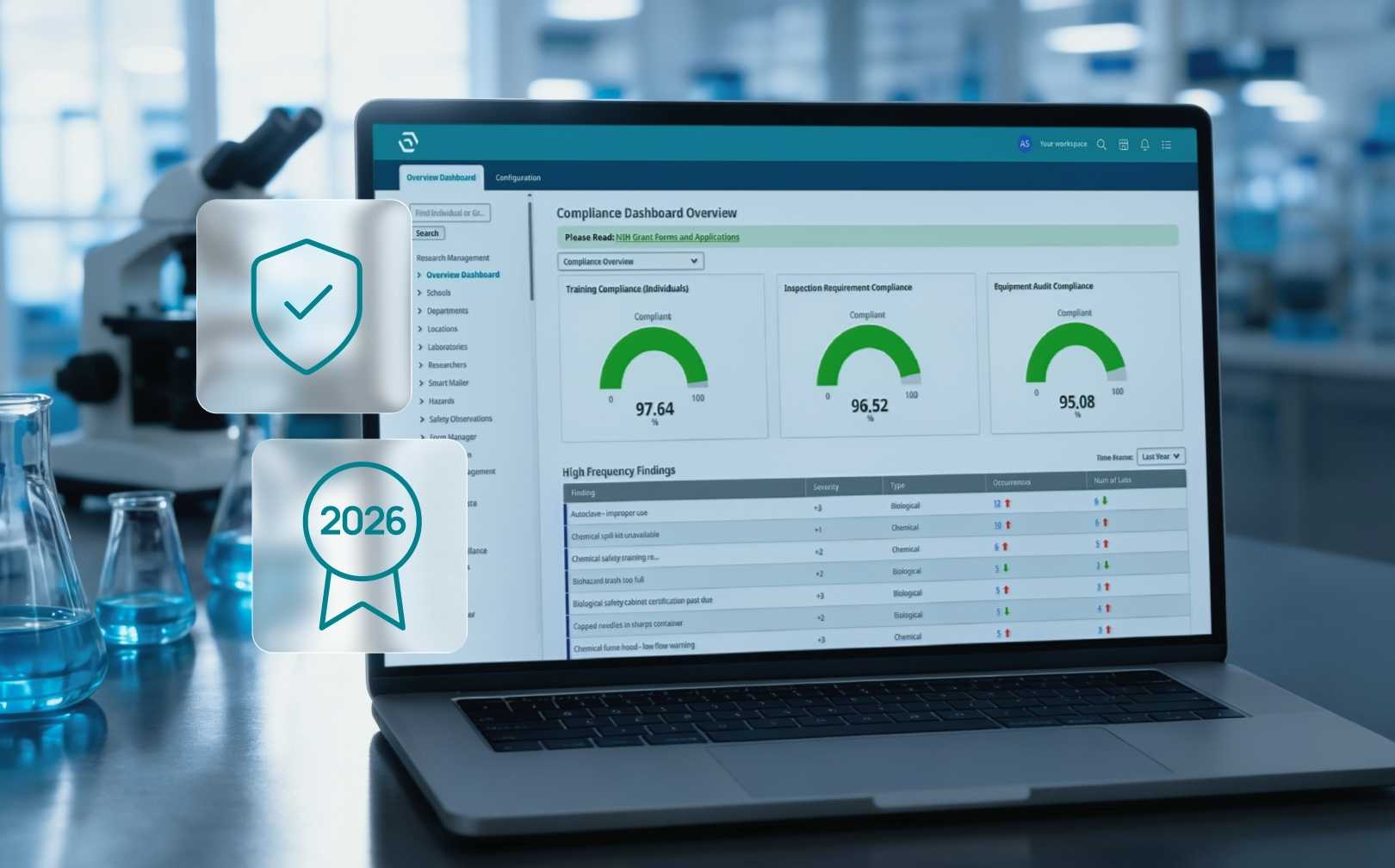
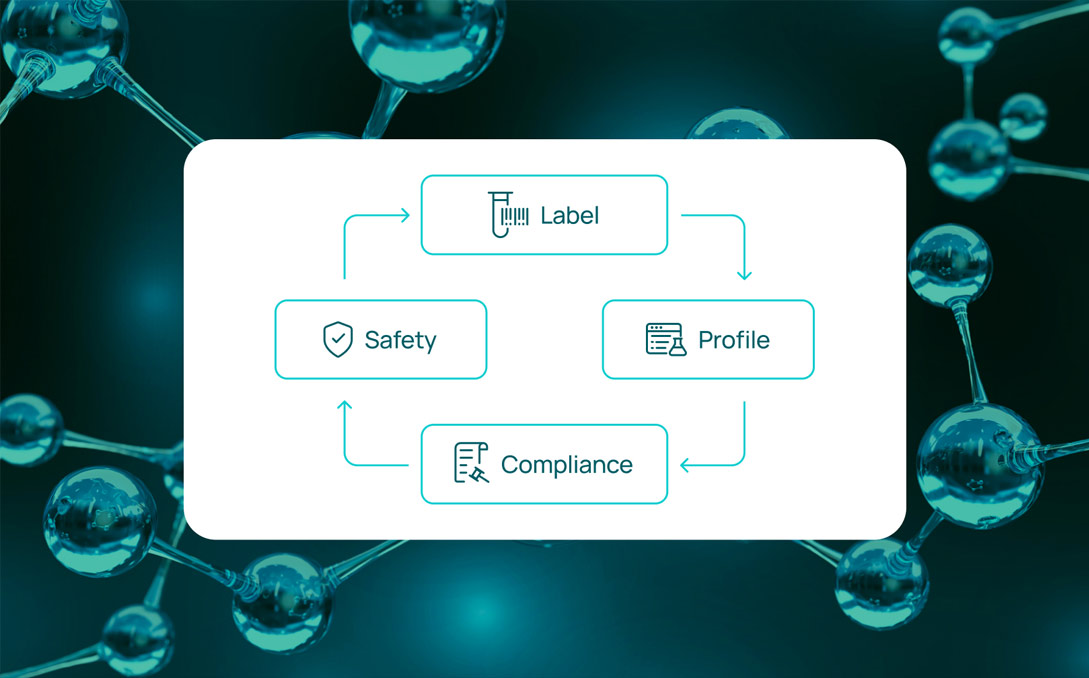
SciSure's Safety & Compliance tools connect hazardous material tracking with SDS management, inspections, incident management, training records, dashboards, and audit-ready reporting, so a finding during an inspection links back to the actual containers and profiles involved.
- Controlled bulk intake.
The spreadsheet import tool adds or edits up to 9,999 container records in one file with error flagging, which matters when a new lab joins your site with hundreds of legacy containers or a bulk solvent order lands the week before a report is due.
We covered the fire safety side of this in detail in our post on Streamlining Chemical Inventory Reporting for Fire Safety. The short version: the same connected profiles that keep your inventory honest also generate the reports your fire marshal, your state agency, and your auditors ask for.
The power of connected context
Chemical profiles are the connective tissue of laboratory safety and compliance. When every chemical in your system carries a complete, verified profile, your lab shifts from confusion to clarity.
The next 18 months will test that claim. Updated GHS Revision 7 SDSs are arriving now, employer obligations under the revised Hazard Communication Standard land in November 2026, and NFPA 45's 2024 edition is reaching more lab types than before. Labs with complete chemical profiles will absorb those changes as routine updates. Labs without them will rebuild their records under deadline pressure, again.
So if you're ready to stop managing chemicals by labels alone, get a personalized demo and see how SciSure fits your lab's workflows.

Read more of our blogs about modern lab management
Discover the latest in lab operations, from sample management to AI innovations, designed to enhance efficiency and drive scientific breakthroughs.