Chemical Compliance Management Software: A Buyer's Guide
Compare chemical compliance management software for research labs: SDS access, inventory tracking, reconciliation, and reporting, plus a 6-step rollout plan.

Download Whitepaper
TL;DR
Chemical compliance management software gives an Environmental Health and Safety (EHS) team one current record of which chemicals are on site, where they are stored, who owns them, and which Safety Data Sheet (SDS) applies, replacing binders and spreadsheets that are out of date the day they are finished.
- Start with spaces and people.
Before counting a single bottle, map buildings, rooms, lab groups, and principal investigators (PIs). A container record only helps when it points to a real room and a real owner. San Diego State University's EHS team started with lab spaces and door signs, then added SciSure's chemical inventory and SDS management on top.
- Load inventory in waves.
Bring departments in one at a time, starting with the highest-hazard buildings. With SciSure Health & Safety, teams can import containers by spreadsheet, scan barcodes or RFID tags, and use ChemSnap AI photo capture at intake, then confirm the records through room-by-room reconciliation.
- Make SDS access routine.
OSHA's Laboratory Standard expects SDSs received with chemical shipments to be kept and readily accessible to lab workers. SciSure's SDS Auto-Match attempts to attach a current SDS to each container, and an SDS coverage report shows which containers still need one added by hand.
- Plan for the programs around chemicals.
A growing research campus also needs biosafety committee workflows, laser and X-ray equipment records, inspections, training, and incident reporting. Software can hold the records and route the reviews, but roles such as a Biosafety Officer or Laser Safety Officer still have to be appointed by the institution.
This post was first published in 2022 and updated in 2026 to include a six-step rollout plan, OSHA Hazard Communication and NIH biosafety context, current SciSure capabilities with configuration caveats, and new customer results from San Diego State University.
Ready to see SciSure in action?
No commitment · Free consultation
You open the SDS binder in a lab you're inspecting and it's empty. The chemical list for that room is a spreadsheet last edited by a graduate student who left two years ago. Down the hall, another lab keeps its inventory on a whiteboard. Research activity on campus has grown every year, and the safety infrastructure hasn't kept up.
If that sounds familiar, you're not behind because you missed something. Most research institutions built their chemical records lab by lab, with each PI doing it their own way. That works until someone asks a campus-wide question: How much flammable liquid is in this building? Which labs use this carcinogen? Can a first responder see what's behind this door?
This guide covers what to look for in chemical compliance management software, the questions to ask vendors, how to roll it out across a campus, and where SciSure Health & Safety fits. It's written for EHS managers who are building or rebuilding a program, often while also standing up biosafety, radiation, and incident-reporting processes at the same time.
Why scattered chemical records become a safety problem
Spreadsheets and binders fail in predictable ways. Nobody owns updates, so records drift from what's actually on the shelf. SDSs go missing because they arrive with the shipment and get filed (or not) by whoever unpacks the box. And when every lab keeps its own format, EHS can't add the numbers up across a floor or building.
Those gaps turn into real exposure:
- SDS access.
Under OSHA's Laboratory Standard (29 CFR 1910.1450), employers must keep SDSs that come with incoming hazardous chemicals and make sure lab employees can get to them. An empty binder is a finding waiting to happen.
- Updated hazard communication rules.
OSHA's updated Hazard Communication Standard took effect on July 19, 2024. In January 2026, OSHA extended the compliance dates by four months, which pushes the first employer deadline for updating workplace labels, HazCom programs, and training into late 2026. As manufacturers revise SDSs under the new rule, your stored copies need to keep up.
- Fire code and storage limits.
Building and fire codes limit how much of each hazard class can sit in a control area. You can't check those limits, sometimes called maximum allowable quantities (MAQs), without knowing what's stored where. Your local fire authority still makes the final call. See how chemical inventory supports fire safety reporting for more.
- Emergency response.
When there's a spill, fire, or flood, responders need to know what's in the room now, not what was there at the last annual count.
What to look for in chemical compliance management software
Chemical compliance management software replaces the binder and the spreadsheet with one shared record. For a university or research institute, these are the capabilities that matter most, and how SciSure supports each one:
Just keep in mind: no chemical database holds every product on the market, which is why local entries exist. And not every product has an SDS available to auto-match, so plan for some manual attachment. For a deeper feature comparison, see 7 Features to Look for in Enterprise Chemical Inventory Software.
Questions to ask when you compare chemical compliance management software
If you're comparing several vendors, these questions separate a good demo from a good fit. Ask each vendor to show the answer live, not on a slide:
- Can you load a sample of our messiest spreadsheet during the demo?
- How are containers tied to rooms, lab groups, and people who work in more than one lab?
- What happens when a chemical isn't in your database, or has no SDS to match?
- How do labs reconcile a room, and how long does it take?
- Which reports are included, and which depend on configuration?
- Which safety modules can we add later without re-entering data?
- Who supports migration and training, and what does that cost? (Check out our guide on what EHS software actually costs beyond the license fee.)
How to roll out chemical compliance management software in 6 steps
A practical SciSure implementation pattern for campuses starting from little or no central data looks like this.
1. Map spaces, groups, and people first.
Build the list of buildings, rooms, lab groups, and PIs before you touch chemicals. Every container needs a home and an owner, and your facilities system may not be accurate. Expect to find labs you didn't know existed. Link each person to the labs they work in, because one researcher often works in more than one lab.
2. Agree on the rules before data comes in.
Decide what gets tracked at container level, what's excluded (for example, consumer products in normal use), how containers are labeled, and who can add, move, or remove records. Write these down in your chemical hygiene plan so PIs hear one message.
3. Load the inventory in waves.
Start with one high-hazard building or department, not the whole campus. Collect existing spreadsheets, clean them to a standard template, and import them. In SciSure, a single spreadsheet import can add or update up to 9,999 containers, and results are grouped under an import ID so you can check and fix them. For labs with no usable list, a physical walk-through with a barcode scanner or ChemSnap AI is often faster than cleaning a bad spreadsheet.
4. Attach SDSs and close the gaps.
Let auto-match run, then pull an SDS coverage report to see which containers still lack one. Upload local SDSs for the rest. Show lab staff how to find an SDS from a container, a room, or a chemical name, and agree on a backup plan for outages. OSHA's Hazard Communication Standard permits electronic SDS access as long as it doesn't create barriers to immediate employee access.
5. Reconcile, then set a rhythm.
Once a building is loaded, reconcile it room by room to confirm the records match the shelves. Then set a recurring count schedule that fits your hazards and staffing, and make new receipts part of the daily routine, so the inventory stays current between counts.
6. Connect chemicals to the rest of your safety program.
With spaces and chemicals in place, the same data can support door signs, targeted training, inspections, and hazardous waste pickup requests. In SciSure, door signs pull contacts and hazards from the space record, training can be assigned by job activity, and inspection findings attach to the exact room. You add modules when your team is ready, not all at once.
How San Diego State University went from "unknown" to real-time visibility
Before rolling out SciSure, San Diego State University's EHS director, Jennifer Ramil, couldn't get a reliable count of lab spaces, let alone who worked in them or what they used. As she put it, "I had no idea how many lab spaces we had."
The team started with lab spaces and door signs, then added ChemTracker chemical inventory and SDS management, followed by hazardous waste and radioisotope management. With 99 lab groups and 500 research spaces in scope, the order mattered: spaces first, then chemicals, then the programs that depend on both.
The results, from SDSU's customer story:
Beyond chemicals: Biosafety committees, lasers, X-ray units, and incidents
EHS managers modernizing a program rarely get to fix one thing at a time. If your campus is also forming committees or discovering equipment nobody registered, here's what to plan for.
Biosafety committees
If your institution receives NIH funding for recombinant or synthetic nucleic acid research, the NIH Guidelines require an Institutional Biosafety Committee (IBC) with at least five members, including two community members not affiliated with the institution, per NIH's IBC FAQ. A Biological Safety Officer is required if you work at Biosafety Level 3 or 4, do large-scale research over 10 liters, or do gene drive research, according to NIH's 2024 update. NIH also released a draft biosafety policy for research involving biohazards in September 2026, so check the final version before you write committee procedures.
Where enabled, SciSure's Biosafety Management workflows support registrations, reviewer notes, committee agendas, meetings, and minutes. For background, see our guide on Understanding Biohazards.

Lasers and X-ray equipment
The ANSI Z136.1 standard expects any institution operating Class 3B or Class 4 lasers to designate a Laser Safety Officer. X-ray machines bring their own registration and inspection requirements, so check with your state radiation control program before new units arrive.
With SciSure, you can record lasers and X-ray devices in the Equipment module with location, owner, audits, service records, and in-service or out-of-service status. That gives you the inventory and audit trail. It doesn't replace the safety officer or the state registration.
Incident and near-miss reporting
You can report incidents and near misses from the SciSure home page, including photos and affected people, with anonymous reporting where your organization allows it. Reports route to your investigation team for follow-up. It isn't an emergency channel, so emergencies still go through your campus emergency procedures first.
Getting useful EHS data out of the system
"EHS data analytics" often means one thing in practice: answering leadership's questions without a week of spreadsheet work. Once chemicals, spaces, and inspections live in one system, SciSure can support:
- Chemical reports by regulation, building, and control area, plus SDS coverage.
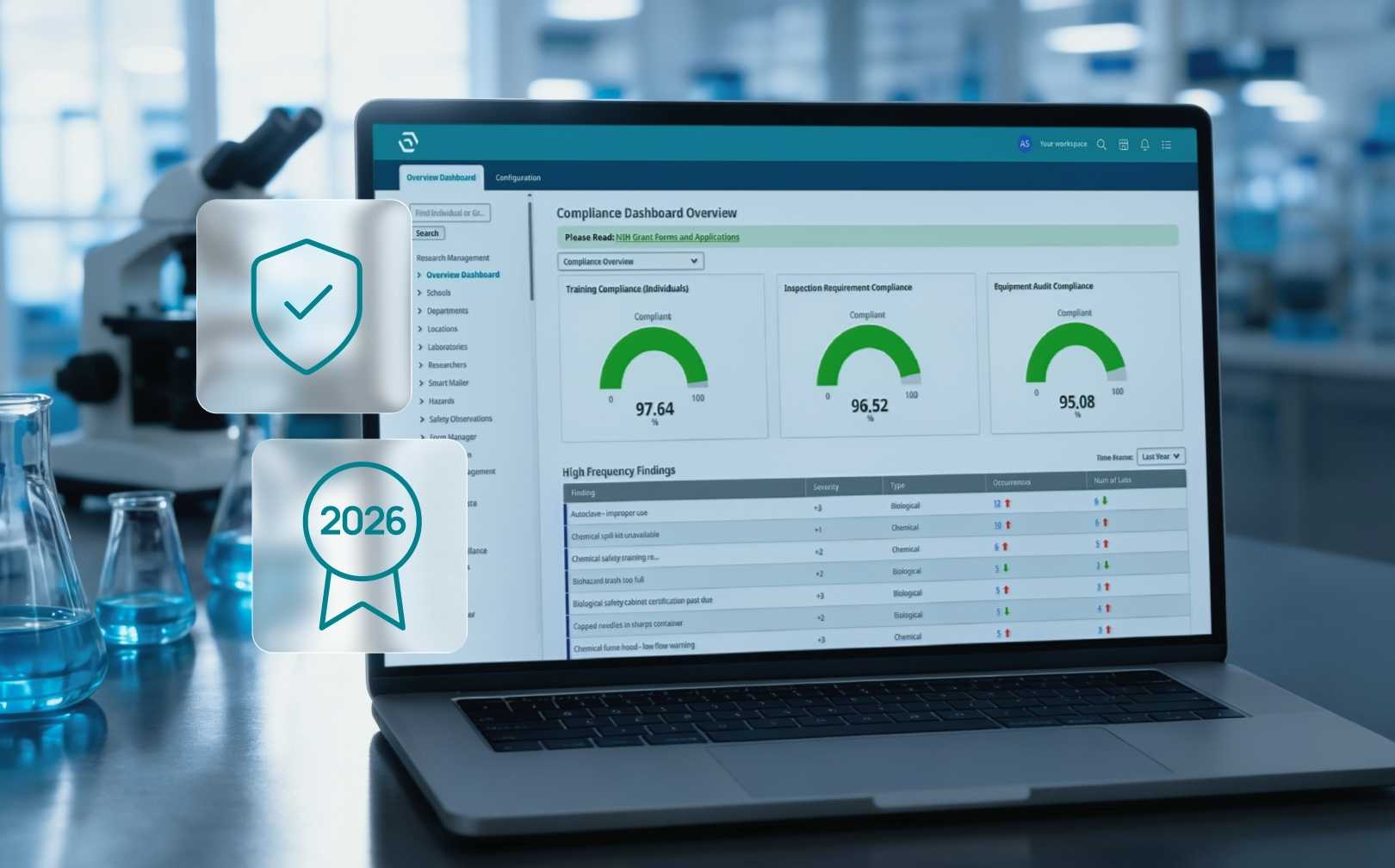
- Inspection dashboards showing common and repeat findings, trends over time, and department comparisons.
- Training compliance views by group, course, or person.
- CSV exports when you want to do further analysis in your own tools.
The fire code and MAQ reports use default tables that can be adjusted for sprinklers, cabinets, and control areas. They help you see where you stand, but your local fire authority's interpretation still decides.
What chemical compliance management software won't do for you
The word "compliance" in the category name oversells it a little. The software makes records current, searchable, and reportable. It doesn't make a campus compliant by itself. Your institution still owns the chemical hygiene plan, training content, safety officer appointments, committee decisions, inspections, and review of local codes.
The best outcome is that your EHS team spends less time chasing binders and more time on the conversations that change behavior in labs, like SDSU's experience of PIs taking a more active role once they could see their own data.
If this sounds like the kind of support you need, get in touch with us. We'll walk you through how SciSure Health & Safety fits with your lab's workflows and helps you stay audit-ready, year round.
FAQ
What is chemical compliance management software?
Chemical compliance management software is a system for tracking chemical containers, their locations, owners, hazards, and SDSs in one shared record. It replaces paper binders and spreadsheets, supports physical audits, and produces reports for fire code, regulatory, and leadership needs.
What's the difference between chemical inventory software and chemical compliance management software?
In practice the terms overlap. Chemical inventory software focuses on tracking containers. Chemical compliance management software adds SDS management, regulatory lists, and reports for fire code, Tier II, and other requirements. When comparing vendors, check which reports are included rather than relying on the label.
Can an electronic SDS system replace paper binders?
Yes, in most cases. OSHA's Hazard Communication Standard allows electronic SDS access as long as it doesn't create barriers to immediate employee access. Make sure lab staff know how to reach SDSs and what the backup is during an outage.
How long does it take to build a campus-wide chemical inventory?
It depends on the number of labs and the state of existing records. Most campuses move faster by rolling out one building or department at a time, rather than attempting a single campus-wide count.
Does SciSure's chemical database include every chemical?
No database includes every product. SciSure links containers to a central hazard and regulatory database where a match exists, and supports local entries for chemicals that aren't found, which oversight users can enrich with regulatory data.
Can SciSure track biological materials in the chemical inventory?
ChemTracker is designed for chemicals. Biological materials are better handled through biosafety registration workflows, which track materials, projects, people, and spaces for committee review.
Does chemical compliance management software make us compliant?
No. It gives you current, accurate records and reports. Compliance still depends on your institution's policies, training, safety officers, inspections, and review by the authorities that apply to your site.
Can SciSure track lasers and X-ray machines?
Yes, as equipment records with location, owner, audits, and service history, where the Equipment module is enabled. You still need a Laser Safety Officer for Class 3B and 4 lasers and any state registration for X-ray units.
What EHS analytics does SciSure provide?
SciSure provides chemical and regulatory reports, SDS coverage, inspection dashboards, and training compliance views, with CSV export for further analysis. Available reports and dashboards depend on your configuration and enabled modules.
Keep reading

Read more of our blogs about modern lab management
Discover the latest in lab operations, from sample management to AI innovations, designed to enhance efficiency and drive scientific breakthroughs.