Fire Code Compliance and MAQs: What Life Science Labs Need to Know
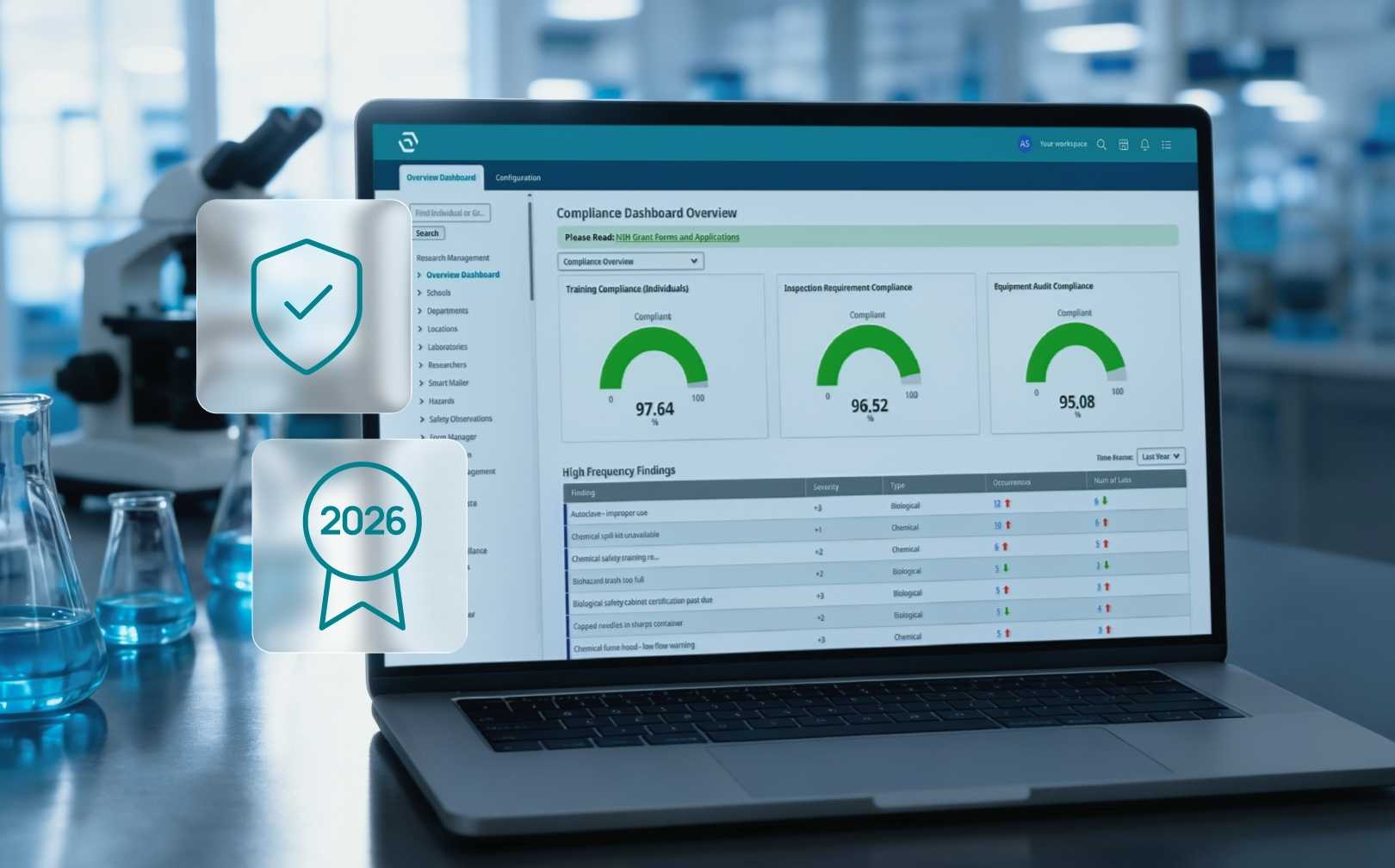
Fire code compliance for labs depends on accurate chemical inventory, MAQ visibility, SDS data, Tier II reporting, and local code requirements. Here are some common challenges you might run into, and how SciSure can help.
Download Whitepaper
TL;DR
Fire code compliance for labs requires accurate chemical inventory data, MAQ visibility, and local code interpretation so EHS and Lab Operations teams can protect researchers, first responders, facilities, and nearby communities.
- MAQ basics.
Maximum allowable quantities (MAQs) define how much hazardous material a lab can store before additional fire protection measures may be required. Limits vary by chemical hazard, storage method, physical state, building design, and control area, so EHS teams need current inventory quantities and locations.
- Code complexity.
Lab fire code compliance rarely depends on one rulebook. International Fire Code (IFC), International Building Code (IBC), NFPA 1, NFPA 45, state fire codes, municipal ordinances, landlord rules, and local authority having jurisdiction (AHJ) interpretations can all affect hazardous materials storage and lab operations.
- Building factors.
MAQ calculations change with real facility details, including floor level, sprinklers, fire-rated walls, storage cabinets, occupancy classification, and control area layout. A flammable liquid quantity that is acceptable on one floor or in one building may create a compliance issue in another.
- Inventory accuracy.
Life science labs change constantly as researchers add chemicals, move spaces, share storage areas, and scale new processes. Accurate container-level inventory data helps teams identify high-hazard materials, compare quantities against MAQs, support audits, and give emergency responders reliable hazard information. SciSure helps connect chemical inventory, SDS access, and MAQ reporting, so EHS teams have clear, accurate data to work with than a static point on a spreadsheet.
- Compliance risk.
Fire code non-compliance can increase risk to personnel, facilities, research continuity, and organizational reputation. Inadequate reporting or weak chemical controls can slow emergency response, trigger penalties, disrupt lab operations, and expose leadership to difficult questions after a fire, spill, or inspection finding.
This post was originally published in 2018 and has been fully updated to reflect SciSure's positioning as a Scientific Management Platform, current industry research and safety benchmarks, and new customer results from SmartLabs.
Ready to see SciSure in action?
No commitment · Free consultation
According to the Chemical Incident Tracker, there have been at least 1453 hazardous chemical incidents since January 2021 to present. That's an average of approximately five incidents every week. With the Coalition to Prevent Chemical Disasters tracking these numbers, their methodology also cautions that these reported incidents err on the conservative side. How come? Because not every chemical incident is reported publicly.
For life science labs, that's the uncomfortable backdrop behind fire code compliance. Fire codes and their associated maximum allowable quantities (MAQs) often get relegated to paperwork, but they're part of the system that helps protect researchers, facilities, first responders, and surrounding communities.
Even so, complying with the regulations can be downright painful. Not to mention the reports, inspections, audits, and fire marshal questions that come with them. In this post, we'll look at the common challenges life science labs face with fire code compliance and MAQs, what's changed in the regulatory landscape, and where software can help turn a scramble into a repeatable process.
Fire code basics for labs
Fire codes are regulations designed to protect lives and property by setting requirements for building construction, fire prevention, emergency access, fire protection systems, hazardous materials handling, storage limits, ventilation, alarms, sprinklers, and emergency planning. While not every fire code requirement applies directly to every lab, many do, especially for labs that store or use hazardous chemicals, flammable liquids, compressed gases, oxidizers, corrosives, toxics, water reactives, peroxide formers, pyrophorics, or other high-hazard materials.
In the United States, labs may need to account for several overlapping sources of requirements, including:
- The International Fire Code (IFC) and International Building Code (IBC), as adopted and amended locally
- NFPA standards such as NFPA 1 and NFPA 45
- State and municipal fire codes
- Local authority having jurisdiction (AHJ) interpretations
- Landlord, insurer, campus, or institutional requirements
That last piece matters. Model codes are not always the same as enforceable local law. A jurisdiction may be using a previous code edition, adopting only portions of a model code, or adding local amendments. The 2024 International Fire Code, for example, is the current ICC edition and includes requirements related to the storage and use of hazardous materials, as well as evolving topics such as lithium-ion batteries, energy storage systems, and A2L refrigerants. But whether that edition applies to your lab depends on your local adoption path.
In other words: know the model codes, but work with your AHJ.
Maximum allowable quantities (MAQs) of hazardous materials
MAQs establish how much of a hazardous material can be stored, used, or handled in a defined space before additional requirements are triggered. Those requirements may involve occupancy classification, control areas, fire-rated separation, ventilation, storage cabinets, gas cabinets, sprinklers, alarms, emergency power, permits, or other fire protection measures.
The exact MAQ depends on more than the name of the chemical. It can depend on:
- Hazard class
- Physical state
- Whether the material is in storage, open use, or closed use
- Whether the building has automatic sprinklers
- Whether chemicals are stored in approved cabinets or exhausted enclosures
- Floor level above or below grade
- Control area layout
- Occupancy classification
- Local code edition and AHJ interpretation
This is where things get tricky. A lab may be "under the limit" in one building and over the limit in another with the same chemicals, simply because the control areas, floor level, sprinklers, cabinets, or local code interpretation are different.
Why MAQs matter more now
Recent regulatory changes make the quality of your fire code inventory data more important than ever. First, OSHA updated the Hazard Communication Standard in 2024 to align primarily with GHS Revision 7 and improve how chemical hazards are communicated through labels and safety data sheets. On January 15, 2026, OSHA extended the compliance dates by four months, moving the first substance-related deadline to May 19, 2026 and extending the remaining deadlines as well. For labs, the practical takeaway is to make sure chemical records, SDSs, and hazard classifications are clean enough that updated hazard information can actually flow to the right containers, spaces, and people.
Second, EPA's EPCRA Sections 311-312 reporting obligations continue to put inventory accuracy in front of local emergency planners and fire departments. Covered facilities must submit annual hazardous chemical inventory reports by March 1 to the State or Tribal Emergency Response Commission, Local or Tribal Emergency Planning Committee, and local fire department. EPA's Tier II guidance also notes that Tier II information includes chemical names, maximum and average daily amounts, storage details, and locations. State, tribal, and local requirements may vary.
Third, the codes themselves keep moving. The 2024 editions of NFPA 1 and NFPA 45 are now in circulation, and the 2024 IFC continues to evolve around changing fire risks. But code adoption is uneven, so a lab may need to understand a current standard while still complying with an older locally adopted edition.
Put simply: the compliance question is shifting towards, "Can we trust the data well enough to make fire code, SDS, emergency planning, and regulatory reporting decisions from it?"
Common fire code compliance challenges for labs
For life science labs, navigating fire code compliance and MAQs can be particularly daunting because research environments change constantly. New projects begin, old containers linger, shared spaces shift ownership. Or maybe a solvent-heavy workflow gets scaled, a startup moves into a new suite, or a compressed gas cylinder appears where there was not one last month. Here are some of the most common challenges you might run into and how you can address them.
1. Different codes specify different limits and prevention measures
"One of the key challenges is that there's the International Fire Code (IFC), there's NFPA, there's any additional rules your landlord imparts - all of which may have some different nuances or cover different aspects," explains Jeffrey Foisel, Lab Process Safety Specialist at DEKRA North America and former R&D Lab Process Safety Technology Leader at the Dow Chemical Company.
For example, NFPA 45 outlines requirements for laboratories using chemicals, while IFC/IBC-based requirements may drive occupancy, hazardous material quantity, and control area considerations. NFPA 1 may apply as a broader fire code framework. Local codes may adopt one model, borrow from another, or add amendments that matter in very practical ways.
Your lab should work closely with their AHJ, facilities team, landlord, and EHS leadership to understand which codes apply, which edition is enforceable, and how local interpretations affect the lab.
2. Fire codes vary by state and municipality
Like most laws, many jurisdictions base their fire codes on nationally recognized model codes, but local adoption can lag by years. Municipalities may also add ordinances that reflect local building stock, emergency response capabilities, seismic risks, density, weather, or industrial history.
For a biotech company operating in Massachusetts, New York, and California, the practical reality may be three different compliance pictures. One site may be reviewed under a more recent model code. Another may be governed by a local amendment. A third may have state-specific reporting expectations layered on top of federal EPCRA requirements.
That creates a real operational problem: EHS and Lab Operations teams need enough standardization to run a company-wide safety program, but enough local flexibility to comply with each jurisdiction.
Read More: How to Standardize Research Across Global Labs
3. Regulatory reporting overlaps with fire code, but it's not the same thing
Fire code compliance and regulatory reporting often use the same source data: chemical identity, quantity, storage, hazard class, location, and ownership; but the reporting logic is not identical.
EPCRA Tier II, for example, is focused on emergency and hazardous chemical inventory information. EPA guidance says covered facilities report chemicals that meet threshold quantities, including 500 pounds or the threshold planning quantity for extremely hazardous substances, whichever is lower, and 10,000 pounds for most other hazardous chemicals. Tier II forms look at maximum and average daily amounts during the previous calendar year, storage type, and location.
MAQs, on the other hand, are a fire and building code concept. They look at hazardous material quantities by hazard class, control area, physical state, storage or use condition, and building characteristics.
So a lab should not assume that "We did Tier II" means "We understand our MAQs," or vice versa. Both depend on accurate inventory, but they answer different questions.
Read More: The 5 Best EHS Software Platforms for Labs in 2026
4. Your building design matters
The design of your building impacts everything from the number of occupants to the amount of chemicals allowed in a space. Which floor your lab is on, where fire-rated walls are located, whether the building is sprinklered, and whether the lab uses approved storage cabinets can all affect MAQs. For certain hazard categories, the use of approved cabinets, sprinklers, or both can change allowable quantities. For other hazards, the details may be more restrictive.
For example, a lab unit on the first floor of a building may be allowed to store more of a flammable liquid than a lab unit on an upper floor. If your building was constructed before modern sprinkler requirements were common, the numbers can become more restrictive. If a control area is not clearly defined, it may be hard to know which rooms and cabinets count together.
Having access to information about the location and characteristics of each space is crucial for compliance
5. Labs encompass diverse activities, processes, and chemicals
Life science labs are dynamic research environments with a wide range of chemicals, processes, and people, but this diversity can make both hazard classification and reporting difficult. For example, one lab may use small quantities of flammable solvents. Another may store compressed gases. Another may use oxidizers, corrosives, toxic materials, cryogens, lithium-ion battery prototypes, or experimental mixtures that do not map cleanly to a standard catalog entry.
This mean you need to know what each container is, where it is, how much is present, what hazards apply, whether the SDS is current, and whether that container contributes to a reporting threshold or MAQ calculation. The National Academies' Prudent Practices in the Laboratory makes the point bluntly: an organization cannot adequately manage safety, security, emergency planning, or waste disposal without knowing what chemicals are on-site and where they are stored.
SciSure's ChemTracker helps by connecting container-level inventory to chemical hazard and regulatory data, SDS records, barcode and RFID workflows, and reports. This is especially useful for shared spaces, incubators, universities, and fast-growing biotech teams where multiple groups may operate within the same building or control area. Here's a non-exhaustive list of the features you get with SciSure's chemical inventory tracking.
6. Change introduces new risks
"When you're growing, you're typically introducing a lot of new risk - new chemicals, or energy, or technology," said Sarah Eck, PE, CCPSC, Sr Process Safety Engineer, DEKRA North America. This is true for:
- A startup scaling from one bench to a full suite,
- A university onboarding a new principal investigator,
- A shared lab facility accepting a new resident company,
- Established companies when a new workflow changes the amount of flammable liquid, compressed gas, oxidizer, or reactive material in a control area.
The hard part is that change often shows up first as an operational detail: a new purchase, a move request, a shipment, a cabinet reassignment, a container that was never archived, or a local chemical entry that was linked incorrectly. By the time it becomes a report problem, it may already be an inspection problem.
Read More: 5 Common Questions from Chemical Regulators & How to Address Them
7. SDS and hazard communication data are moving targets
Fire code compliance depends on both volume and hazard classification. OSHA's Hazard Communication Standard requires chemical hazards to be classified and communicated through labels, SDSs, and employee training. For laboratories, OSHA requires incoming container labels not to be removed or defaced, SDSs to be maintained and readily accessible, and laboratory employees to receive information and training.
The 2024 HazCom update makes this even more relevant. As manufacturers update labels and SDSs under the revised standard, labs need a way to keep SDSs connected to the right inventory records. Otherwise, the update lives in a document repository while the lab continues operating from stale container data.
SciSure's SDS auto-match helps reduce that gap by attaching SDSs to chemical containers where the system can identify the appropriate match. Combined with ChemTracker's chemical database, this helps teams move from "we have an SDS somewhere" to "the relevant SDS and hazard context are connected to the container record."
Risks of non-compliance with fire safety regulations
The obvious risk is harm to people and property. Inadequate chemical controls can contribute to fires, explosions, toxic releases, evacuations, injuries, and facility damage.
There's also an emergency response risk. If first responders cannot quickly understand what hazards are present, where materials are located, and how much may be involved, response becomes harder and more dangerous. EPCRA reporting exists in part because local planners and responders need chemical identity, quantity, storage, and location information before something goes wrong.
Non-compliance can also disrupt business operations. A fire, inspection finding, stop-work order, failed occupancy review, or unresolved MAQ issue can delay research, slow a move-in, interrupt funding milestones, or create expensive remediation work.
And then there are the financial, legal, and reputational risks. "If we knew that sprinklers were a good idea and we had money sitting around and we chose not to sprinkle the lab and then there's a fire and people die, there'll be a conversation about whether or not that was the appropriate use of funds," explains John DeLaHunt, MBA, ARM, Assistant Director of Safety and Risk Management at The University of Texas at San Antonio. "Anyone who doesn't want to be on the wrong end of that conversation, at the news podium, or in the boardroom should be prioritizing fire prevention measures."
That is the heart of it. Fire code compliance is a leadership responsibility, more than just a technical exercise.
How SciSure helps EHS & Lab Ops teams stay ahead
The hardest part of fire code compliance is maintaining the data needed to apply them as labs, people, spaces, and chemical inventories change. SmartLabs is a good example of what this looks like in practice. As a flexible lab provider, the SmartLabs team needed safety and operations workflows that could scale across many research spaces without forcing EHS and Lab Operations teams to rebuild inventory and reporting records by hand.
After implementing SciSure's Health & Safety features across chemical inventory, SDS access, inspections, safety training, equipment management, biosafety, medical surveillance, and MAQ tracking, the results were concrete. SmartLabs reported that inventory search went from 15 minutes to 1-2 minutes, inventory reconciliation for an entire research center went from an all-day task to as little as 20 minutes, and chemical inventory reporting went from about 30 minutes to about 1 minute.
That's the practical benefit of connected chemical inventory: EHS and Lab Operations teams can spend less time rebuilding the same story from spreadsheets and more time reviewing the exceptions that actually need judgment. For fire code and MAQ work, that means the system of record is closer to what is physically happening in the lab.
Don't treat fire code review as a once-a-year cleanup
Navigating fire code compliance and MAQs is crucial for protecting researchers, first responders, facilities, and communities. But the work is getting harder as lab operations become more dynamic, reporting expectations become more data-dependent, and hazard communication requirements continue to evolve. The labs that manage this best will be the ones that keep chemical identity, quantity, location, SDS, hazard class, control area, and reporting data current as part of ordinary lab operations.
Because when a fire marshal, emergency planner, auditor, or internal leader asks, "What do we have, where is it, and what does it mean?" the answer should not depend on who last opened the spreadsheet.
If this sounds like a lab you'd like to build, get in touch with us to explore how SciSure's Health & Safety features can help you develop one that's audit-ready at all times.

Read more of our blogs about modern lab management
Discover the latest in lab operations, from sample management to AI innovations, designed to enhance efficiency and drive scientific breakthroughs.