Automated Lab Compliance Solutions For Your Next Lab Audit

Automated lab compliance solutions capture audit evidence as work happens. See what SciSure supports today across ELN, LIMS, and Health & Safety records.

August 12, 2026
()
min read
A laboratory

Download Whitepaper

By submitting this form, you agree with our Privacy Policy.
Thank you! Download the file by clicking below:
Download
Oops! Something went wrong while submitting the form.

Table of Contents

Thank you! Your submission has been received!
Oops! Something went wrong while submitting the form.

Table of Contents

TL;DR

Automated lab compliance solutions capture audit evidence while the work is happening, so signatures, timestamps, inventory changes, training completions, and inspection findings are already there when someone asks for them.

  • What auditors want.
    Most findings come down to four questions: was the person trained, was the procedure approved, is the record complete and attributable, and can you produce it now. OSHA's Laboratory Standard, FDA 21 CFR Part 11, GxP guidance, and ISO/IEC 17025 differ in scope but converge on those same categories of evidence.
  • Where the hours go.
    Manual audit prep is mostly reconstruction, not compliance. Across 30+ organizations using SciSure, generating a safety compliance summary for leadership dropped from three days to under 30 minutes, and rebuilding records for a single lab or group fell from 11 hours to 15 minutes.
  • What automation covers.
    Automated lab compliance solutions handle six things well: evidence capture at the point of work, audit trails you don't assemble by hand, electronic signatures with record locking, scheduled obligations like training renewals and inspections, on-demand reporting, and role-based access that makes a record defensible.
  • What SciSure supports today.
    The SciSure ELN covers experiment documentation, versioning, signatures, and witness signing. LIMS covers sample lineage, storage, and check-in and check-out history. Health & Safety covers container-level chemical inventory, SDS, inspections, training records, incidents, CAPA, waste, and regulatory reporting.
  • Where software stops.
    No platform makes a lab compliant on its own. Validation for your intended use, written SOPs, training delivery, quality oversight, retention, and change control stay with your organization. A good system makes proving all of that faster; it doesn't do it for you.


Originally published in 2024, this 2026 update expands on the specific records auditors ask for, what SciSure supports today across ELN, LIMS, and Health & Safety, workflow timings from more than 30 organizations using the platform, and a section on what compliance software genuinely can and cannot do for you.

Audits get a bad reputation, and mostly for one reason: the week before. The audit itself is usually fine. It's the scramble that hurts, the part where someone spends three days pulling training records out of one system, inventory counts out of a spreadsheet, and inspection findings out of an email thread from last March.

Automated lab compliance solutions are meant to remove that week. Not by making your lab more compliant in some abstract sense, but by making the evidence you already generate retrievable on the day someone asks for it. That's the whole idea. SciSure was built around audit-ready lab tracking software, and this post walks through what that actually looks like in practice, what the platform supports today, and where the honest limits sit.

What a lab audit is actually checking

Internal audits and self-inspections are the ones you run on yourself. A lab manager or EHS team walks the space, checks storage, labeling, waste accumulation, eyewash access, and training status, then logs findings and assigns corrective actions. These are the cheapest audits to fail and the most useful to run often. That's why safety inspections matter more as your lab scales.

External and regulatory audits come from OSHA, the EPA, your local fire marshal or authority having jurisdiction (AHJ), the FDA, or a sponsor. Depending on your work, that could mean the OSHA Laboratory Standard (29 CFR 1910.1450) and your written Chemical Hygiene Plan, the Hazard Communication Standard (29 CFR 1910.1200), EPA hazardous waste generator rules (40 CFR 262), EPCRA Tier II reporting, or FDA 21 CFR Part 11 for electronic records and signatures.

Accreditation and certification audits against ISO/IEC 17025, ISO 9001, or GLP and GMP expectations look at your quality system as a whole: documented procedures, competence records, equipment calibration, and how you handle deviations.

Underneath all of these, lab audits are all asking:

  1. Was the person doing the work trained and authorized to do it?
  2. Was the procedure current and approved?
  3. Is the record complete, attributable, contemporaneous, and unaltered (the ALCOA principles)?
  4. Can you produce it now, in front of me?

Question four is where most labs lose time. Not because the evidence doesn't exist, but because it lives in six places.

The real cost of manual audit prep

We looked at averaged workflow data from more than 30 organizations using the SciSure platform, and the pattern was consistent: the expensive part of compliance isn't doing the work, it's reassembling the proof.

Audit prep before and after SciSure, averaged across 30+ organizations

Audit prep task Before After
Generating a safety compliance summary for leadership 3 days (58 hours) Under 30 minutes
Reconstructing or verifying records for a lab or group 11 hours 15 minutes
Inventory report generation (flammables, MAQs, CFATS) 21 hours 7 minutes
Identifying everyone working with a specific high-risk material 14 hours 14 minutes
Correcting chemical inventory data 17.3 hours per month Under 2 minutes
Finding a Safety Data Sheet 7 minutes (sometimes a full day) 3 minutes

The full breakdown, including how to measure adoption and engagement in your own lab, is in our post on measuring lab software adoption.

Those numbers are averages and your results will differ, but the shape holds. If your compliance summary takes three days, you don't run it monthly. You run it when someone makes you. And a report you only run under duress is a report nobody trusts.

What "automated lab compliance" actually means

Evidence captured at the point of work

A container is scanned into a location when it arrives. A training course is marked complete when the person finishes it. An experiment section is timestamped when it's written. Nobody logs it twice, and nobody logs it a week later from memory.

Audit trails you don't assemble

Every change to a record carries who, what, and when, automatically. When an auditor asks why a sample quantity changed in April, you open the history instead of interviewing people.

Electronic signatures and record locking

A signed experiment locks. Amendments go in as comments or linked records so the original and its timestamps stay intact. This is the backbone of 21 CFR Part 11 style workflows, which we cover in more detail in our 21 CFR Part 11 compliance guide.
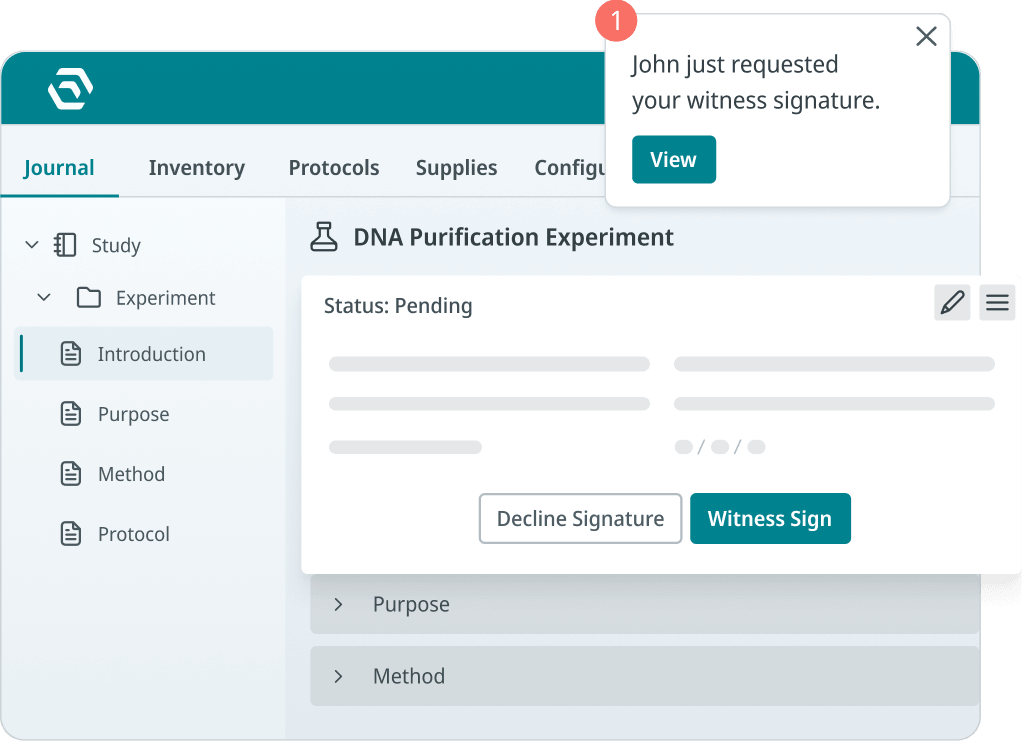
Witness signatures on the SciSure Electronic Lab Notebook (ELN)

Scheduled and triggered obligations

Training renewals, inspection schedules, sample expiration dates, equipment validation intervals, and quantity thresholds all run on their own timing. Automations use a trigger, optional conditions, and an action, so an expiring certification can email the person, notify the supervisor, and create a task without anyone watching a calendar.

Reports that run on demand

Chemical containers by regulation, NFPA summaries, fire code and maximum allowable quantity (MAQ) reports, Tier II and right-to-know outputs, training compliance by group, inspection findings by department. Where configured, these come out of the same records your teams maintain daily.

Role-based access control (RBAC)

Permissions determine who can view, add, update, and delete. That protects data, and it also makes the record defensible: an auditor can see that only qualified people could have made a given change.

SciSure
See what your next audit would look like
Get a walkthrough of how SciSure keeps chemical inventory, SDS, training records, and inspection findings retrievable on the day someone asks for them.
Talk to a specialist

What SciSure supports today

SciSure works as a laboratory compliance platform by combining ELN, LIMS, and Health & Safety capabilities within a modular Scientific Management Platform (SMP) strategy, so organizations can adopt what they need rather than everything at once. Here's how those capabilities map to the questions an auditor is likely to ask.

Research records: ELN and LIMS

Research audit questions and where SciSure holds the evidence

What the auditor asks Where the evidence lives
"Show me the raw data for this result." SciSure ELN experiment sections with timestamps, attachments, version history, and section-level logs
"Who approved this procedure, and which version was in use?" Protocol library with published versions, version history, signing, and witness signing where enabled
"Prove this record hasn't been altered." Digital signatures, record locking after signing, and full audit trails
"Where did this sample come from and where is it now?" SciSure LIMS sample lineage, parent and child relationships, storage position, check-in and check-out history
"Was the equipment in service and validated?" Equipment records with status, validation schedules, booking history, and links to the experiments that used them

Safety and compliance records: Health & Safety

Safety and compliance audit questions and where SciSure holds the evidence

What the auditor asks Where the evidence lives
"What chemicals are in this room, and how much?" Container-level chemical inventory with storage location, hazard classification, quantity, and barcode or RFID tracking
"Show me the SDS for this container." Central SDS library with auto-match against chemical name, CAS number, product number, and manufacturer, plus manual attachment
"Are you within your maximum allowable quantities?" Fire code and MAQ reports based on control areas, with sprinkler and cabinet configuration accounted for
"Is everyone in this lab current on training?" Training records driven by job activities, with assignment, renewal dates, overdue status, and compliance dashboards
"What did your last inspection find, and what did you do about it?" Inspection findings tied to specific spaces, corrective action assignment, follow-up correspondence, and resolution status
"How do you handle incidents?" Incident and near-miss reporting with root cause documentation and CAPA workflows
"Where does your hazardous waste go?" Waste stream profiles, pickup requests, satellite accumulation areas, and closed request history

After moving training and reporting onto SciSure, San Diego State University's EHS and lab safety program went from eight courses and roughly 500 completed records in a year to 16 courses and more than 4,600 records the next. Training compliance rose from 56% to over 80%, and the team could report with confidence that 100% of spaces where chemicals were used had been inspected. Reports that took an hour, or 2.5 hours, or in some cases two weeks, came out in minutes.

What this looks like in different kinds of labs

The evidence categories are stable across lab types, but what changes is which regulator turns up and which record they open first.

Molecular and diagnostics labs

If you operate under CLIA, CAP, or ISO 15189, inspectors focus on specimen chain of custody, reagent lot tracking, instrument maintenance, personnel competency assessment, and proficiency testing records. Digital systems help here mainly by making the chain unbroken: a specimen registered once, with lineage through every aliquot and every experiment that touched it, and quantities and storage positions that update as the material moves.

The other half is people. Competency and training records that expire on their own schedule, with the renewal chased by the system rather than by a person with a spreadsheet.

Testing and contract labs

Under ISO/IEC 17025, the pressure sits on method control and traceability of results. Assessors want the approved version of the method that was actually in use on the day, equipment calibration and validation status, and documented handling of nonconforming work. Inserting a protocol into an experiment as a procedure section (rather than linking to it) is what preserves the version that was live at the time, which matters more here than almost anywhere else.

Academic and institutional labs

The audit is usually EHS-led: chemical inventory accuracy, SDS access, waste accumulation, training compliance, and inspection coverage across a large number of decentralized labs. Coverage is the hard part, not depth. Check out SDSU's numbers here for what that shift looks like in practice, before and after implementing SciSure.

Customer outcomes · San Diego State University
SDSU's EHS & lab safety program, one year later
One year of program growth after moving training and reporting onto SciSure.
Before
After
Training coursesoffered to researchers and staff
Before
8
courses
After
16
courses
Completed training recordsper year
Before
~500
records
After
4,600+
records
Training complianceacross the program
Before
56%
compliant
After
80%+
compliant
Time to generate reportscompliance and training reporting
Before
1 hr–2 wks
per report
After
Minutes
per report
Source: San Diego State University EHS & Lab Safety program data, year over year.

Biotech and pharma R&D.

GxP expectations, 21 CFR Part 11 for electronic records, and increasingly EU GMP Annex 11. Signatures, witness signing, record locking, and audit trails carry most of the weight, alongside a validation package your quality team owns.

A practical lab audit readiness routine

Every month

Run your training compliance report and chase the overdue list. Run one self-inspection per lab. Reconcile inventory in one or two spaces rather than all of them at once.

Every quarter

Pull the compliance summary you'd hand to leadership and read it as though you were an auditor. Look for the gaps: labs with no recent inspection, containers without an SDS, spaces where the door sign hasn't been updated since a hazard changed. Close corrective actions that have been open too long.

Before an external audit

Confirm your Chemical Hygiene Plan and SOPs reflect what people actually do. Spot check a handful of records end to end: sample to experiment to signature, or container to SDS to training record. Run a mock audit with someone who wasn't involved in the work.

Ongoing

Keep the system the path of least resistance. If scientists find it faster to update inventory in the platform than in a spreadsheet, your records stay accurate without enforcement. That's the whole game, and it's why adoption and implementation matter more than feature lists.

SciSure
Turn audit prep into a routine instead of a fire drill
SciSure keeps training records, inspections, corrective actions, and chemical inventory on their own schedule, so the monthly and quarterly checks above run from data your teams already maintain.
Request a demo

Where automation stops

Software can provide controls that support compliant workflows: timestamps, signatures, approvals, record locking, version history, audit trails, access controls, but your organization still owns the rest. That means intended-use assessment, validation, written SOPs, training delivery, quality oversight, retention policy, security administration, and change control. Buying or configuring a system does not achieve compliance with 21 CFR Part 11, GxP, EU GMP Annex 11, or anything else on its own, and any vendor who tells you otherwise is selling you a problem you'll discover later.

Fire code and MAQ reports are decision support, not a legal determination; your AHJ still reviews your building against current local code. And configuration varies, so a feature described here may not be enabled in your instance depending on your modules, permissions, and deployment.

To learn more, check out our guide to GxP compliance for regulated labs and our post on how to compare ELN, LIMS, EHS, and Scientific Management Platforms.

Frequently asked questions

What are automated lab compliance solutions?

They're systems that capture compliance evidence as part of everyday lab work rather than as a separate documentation exercise. Instead of assembling records before an audit, the system already holds timestamped experiment records, sample lineage, chemical inventory, SDS, training completions, inspection findings, and corrective actions, and can report on them on demand.

Can compliance software make my lab compliant?

No. Software supplies controls that support compliant workflows, including audit trails, electronic signatures, record locking, and access control. Your organization remains responsible for validation against your intended use, written SOPs, training, quality oversight, retention, and change control.

How long does audit preparation take with an automated system?

It varies by scope and configuration. Across more than 30 organizations using SciSure, generating a safety compliance summary for leadership dropped from around three days to under 30 minutes, and reconstructing records for a single lab or group fell from 11 hours to 15 minutes. Your own results depend on data quality and adoption.

Does SciSure support FDA 21 CFR Part 11 workflows?

SciSure can support 21 CFR Part 11 style workflows through electronic signatures, two-factor signing, timestamps, record locking, witness signing, version history, and audit trails. Validating the system for your specific regulated use remains your responsibility.

How can digital solutions assist with regulatory compliance for molecular labs?

Molecular labs generate a lot of records that only matter if they connect: specimen registration, aliquot lineage, reagent lots, instrument use, and who was competent to run the assay. A laboratory compliance platform keeps those linked, so a CLIA or CAP inspector asking about one specimen can be answered from one record rather than four systems. It also handles the recurring obligations that quietly slip: competency reassessments, training renewals, equipment validation intervals, and reagent expiry.

What compliance software helps testing labs prepare for regulatory audits?

Testing labs assessed under ISO/IEC 17025 need method version control, equipment calibration and validation records, personnel competence evidence, and a defensible audit trail on every result. SciSure supports this through ELN protocol versioning and procedure sections, LIMS sample lineage and storage history, equipment records with validation schedules, and electronic signatures with record locking. Validation for your intended use stays with your lab.

What's the difference between an internal audit and a regulatory inspection?

An internal audit or self-inspection is run by your own team to find and fix issues before anyone external looks. A regulatory inspection is conducted by a body such as OSHA, the EPA, the FDA, or your local fire authority, and carries potential enforcement consequences. Labs that run frequent internal audits typically find external ones far less disruptive.

Which records do lab auditors ask for most often?

Training and competence records, current SOPs and the approved versions in use, chemical inventory with accessible SDS, inspection findings and their corrective actions, waste accumulation and disposal records, equipment calibration and validation, and the audit trail showing that records haven't been altered after the fact.

Do I need separate systems for research compliance and safety compliance?

Not necessarily. SciSure covers research documentation through ELN and LIMS and safety compliance through Health & Safety, adopted as separate capabilities or together. The practical benefit of one vendor is fewer places to look when an auditor asks a question that crosses both, such as who was trained to handle the material used in a given experiment.

Where to go next

If your last audit involved more searching than answering, that's a data problem rather than a discipline problem, and it's fixable.

Talk to a SciSure specialist about what audit readiness would look like in your labs, or read The 5 Best EHS Software Platforms for Labs in 2026 for a wider comparison.

Ready to see SciSure in action?

Get a personalized demo and see how SciSure fits your lab's workflows.
Request demo

No commitment · Free consultation

Audits get a bad reputation, and mostly for one reason: the week before. The audit itself is usually fine. It's the scramble that hurts, the part where someone spends three days pulling training records out of one system, inventory counts out of a spreadsheet, and inspection findings out of an email thread from last March.

Automated lab compliance solutions are meant to remove that week. Not by making your lab more compliant in some abstract sense, but by making the evidence you already generate retrievable on the day someone asks for it. That's the whole idea. SciSure was built around audit-ready lab tracking software, and this post walks through what that actually looks like in practice, what the platform supports today, and where the honest limits sit.

What a lab audit is actually checking

Internal audits and self-inspections are the ones you run on yourself. A lab manager or EHS team walks the space, checks storage, labeling, waste accumulation, eyewash access, and training status, then logs findings and assigns corrective actions. These are the cheapest audits to fail and the most useful to run often. That's why safety inspections matter more as your lab scales.

External and regulatory audits come from OSHA, the EPA, your local fire marshal or authority having jurisdiction (AHJ), the FDA, or a sponsor. Depending on your work, that could mean the OSHA Laboratory Standard (29 CFR 1910.1450) and your written Chemical Hygiene Plan, the Hazard Communication Standard (29 CFR 1910.1200), EPA hazardous waste generator rules (40 CFR 262), EPCRA Tier II reporting, or FDA 21 CFR Part 11 for electronic records and signatures.

Accreditation and certification audits against ISO/IEC 17025, ISO 9001, or GLP and GMP expectations look at your quality system as a whole: documented procedures, competence records, equipment calibration, and how you handle deviations.

Underneath all of these, lab audits are all asking:

  1. Was the person doing the work trained and authorized to do it?
  2. Was the procedure current and approved?
  3. Is the record complete, attributable, contemporaneous, and unaltered (the ALCOA principles)?
  4. Can you produce it now, in front of me?

Question four is where most labs lose time. Not because the evidence doesn't exist, but because it lives in six places.

The real cost of manual audit prep

We looked at averaged workflow data from more than 30 organizations using the SciSure platform, and the pattern was consistent: the expensive part of compliance isn't doing the work, it's reassembling the proof.

Audit prep before and after SciSure, averaged across 30+ organizations

Audit prep task Before After
Generating a safety compliance summary for leadership 3 days (58 hours) Under 30 minutes
Reconstructing or verifying records for a lab or group 11 hours 15 minutes
Inventory report generation (flammables, MAQs, CFATS) 21 hours 7 minutes
Identifying everyone working with a specific high-risk material 14 hours 14 minutes
Correcting chemical inventory data 17.3 hours per month Under 2 minutes
Finding a Safety Data Sheet 7 minutes (sometimes a full day) 3 minutes

The full breakdown, including how to measure adoption and engagement in your own lab, is in our post on measuring lab software adoption.

Those numbers are averages and your results will differ, but the shape holds. If your compliance summary takes three days, you don't run it monthly. You run it when someone makes you. And a report you only run under duress is a report nobody trusts.

What "automated lab compliance" actually means

Evidence captured at the point of work

A container is scanned into a location when it arrives. A training course is marked complete when the person finishes it. An experiment section is timestamped when it's written. Nobody logs it twice, and nobody logs it a week later from memory.

Audit trails you don't assemble

Every change to a record carries who, what, and when, automatically. When an auditor asks why a sample quantity changed in April, you open the history instead of interviewing people.

Electronic signatures and record locking

A signed experiment locks. Amendments go in as comments or linked records so the original and its timestamps stay intact. This is the backbone of 21 CFR Part 11 style workflows, which we cover in more detail in our 21 CFR Part 11 compliance guide.

Witness signatures on the SciSure Electronic Lab Notebook (ELN)

Scheduled and triggered obligations

Training renewals, inspection schedules, sample expiration dates, equipment validation intervals, and quantity thresholds all run on their own timing. Automations use a trigger, optional conditions, and an action, so an expiring certification can email the person, notify the supervisor, and create a task without anyone watching a calendar.

Reports that run on demand

Chemical containers by regulation, NFPA summaries, fire code and maximum allowable quantity (MAQ) reports, Tier II and right-to-know outputs, training compliance by group, inspection findings by department. Where configured, these come out of the same records your teams maintain daily.

Role-based access control (RBAC)

Permissions determine who can view, add, update, and delete. That protects data, and it also makes the record defensible: an auditor can see that only qualified people could have made a given change.

SciSure
See what your next audit would look like
Get a walkthrough of how SciSure keeps chemical inventory, SDS, training records, and inspection findings retrievable on the day someone asks for them.
Talk to a specialist

What SciSure supports today

SciSure works as a laboratory compliance platform by combining ELN, LIMS, and Health & Safety capabilities within a modular Scientific Management Platform (SMP) strategy, so organizations can adopt what they need rather than everything at once. Here's how those capabilities map to the questions an auditor is likely to ask.

Research records: ELN and LIMS

Research audit questions and where SciSure holds the evidence

What the auditor asks Where the evidence lives
"Show me the raw data for this result." SciSure ELN experiment sections with timestamps, attachments, version history, and section-level logs
"Who approved this procedure, and which version was in use?" Protocol library with published versions, version history, signing, and witness signing where enabled
"Prove this record hasn't been altered." Digital signatures, record locking after signing, and full audit trails
"Where did this sample come from and where is it now?" SciSure LIMS sample lineage, parent and child relationships, storage position, check-in and check-out history
"Was the equipment in service and validated?" Equipment records with status, validation schedules, booking history, and links to the experiments that used them

Safety and compliance records: Health & Safety

Safety and compliance audit questions and where SciSure holds the evidence

What the auditor asks Where the evidence lives
"What chemicals are in this room, and how much?" Container-level chemical inventory with storage location, hazard classification, quantity, and barcode or RFID tracking
"Show me the SDS for this container." Central SDS library with auto-match against chemical name, CAS number, product number, and manufacturer, plus manual attachment
"Are you within your maximum allowable quantities?" Fire code and MAQ reports based on control areas, with sprinkler and cabinet configuration accounted for
"Is everyone in this lab current on training?" Training records driven by job activities, with assignment, renewal dates, overdue status, and compliance dashboards
"What did your last inspection find, and what did you do about it?" Inspection findings tied to specific spaces, corrective action assignment, follow-up correspondence, and resolution status
"How do you handle incidents?" Incident and near-miss reporting with root cause documentation and CAPA workflows
"Where does your hazardous waste go?" Waste stream profiles, pickup requests, satellite accumulation areas, and closed request history

After moving training and reporting onto SciSure, San Diego State University's EHS and lab safety program went from eight courses and roughly 500 completed records in a year to 16 courses and more than 4,600 records the next. Training compliance rose from 56% to over 80%, and the team could report with confidence that 100% of spaces where chemicals were used had been inspected. Reports that took an hour, or 2.5 hours, or in some cases two weeks, came out in minutes.

What this looks like in different kinds of labs

The evidence categories are stable across lab types, but what changes is which regulator turns up and which record they open first.

Molecular and diagnostics labs

If you operate under CLIA, CAP, or ISO 15189, inspectors focus on specimen chain of custody, reagent lot tracking, instrument maintenance, personnel competency assessment, and proficiency testing records. Digital systems help here mainly by making the chain unbroken: a specimen registered once, with lineage through every aliquot and every experiment that touched it, and quantities and storage positions that update as the material moves.

The other half is people. Competency and training records that expire on their own schedule, with the renewal chased by the system rather than by a person with a spreadsheet.

Testing and contract labs

Under ISO/IEC 17025, the pressure sits on method control and traceability of results. Assessors want the approved version of the method that was actually in use on the day, equipment calibration and validation status, and documented handling of nonconforming work. Inserting a protocol into an experiment as a procedure section (rather than linking to it) is what preserves the version that was live at the time, which matters more here than almost anywhere else.

Academic and institutional labs

The audit is usually EHS-led: chemical inventory accuracy, SDS access, waste accumulation, training compliance, and inspection coverage across a large number of decentralized labs. Coverage is the hard part, not depth. Check out SDSU's numbers here for what that shift looks like in practice, before and after implementing SciSure.

Customer outcomes · San Diego State University
SDSU's EHS & lab safety program, one year later
One year of program growth after moving training and reporting onto SciSure.
Before
After
Training coursesoffered to researchers and staff
Before
8
courses
After
16
courses
Completed training recordsper year
Before
~500
records
After
4,600+
records
Training complianceacross the program
Before
56%
compliant
After
80%+
compliant
Time to generate reportscompliance and training reporting
Before
1 hr–2 wks
per report
After
Minutes
per report
Source: San Diego State University EHS & Lab Safety program data, year over year.

Biotech and pharma R&D.

GxP expectations, 21 CFR Part 11 for electronic records, and increasingly EU GMP Annex 11. Signatures, witness signing, record locking, and audit trails carry most of the weight, alongside a validation package your quality team owns.

A practical lab audit readiness routine

Every month

Run your training compliance report and chase the overdue list. Run one self-inspection per lab. Reconcile inventory in one or two spaces rather than all of them at once.

Every quarter

Pull the compliance summary you'd hand to leadership and read it as though you were an auditor. Look for the gaps: labs with no recent inspection, containers without an SDS, spaces where the door sign hasn't been updated since a hazard changed. Close corrective actions that have been open too long.

Before an external audit

Confirm your Chemical Hygiene Plan and SOPs reflect what people actually do. Spot check a handful of records end to end: sample to experiment to signature, or container to SDS to training record. Run a mock audit with someone who wasn't involved in the work.

Ongoing

Keep the system the path of least resistance. If scientists find it faster to update inventory in the platform than in a spreadsheet, your records stay accurate without enforcement. That's the whole game, and it's why adoption and implementation matter more than feature lists.

SciSure
Turn audit prep into a routine instead of a fire drill
SciSure keeps training records, inspections, corrective actions, and chemical inventory on their own schedule, so the monthly and quarterly checks above run from data your teams already maintain.
Request a demo

Where automation stops

Software can provide controls that support compliant workflows: timestamps, signatures, approvals, record locking, version history, audit trails, access controls, but your organization still owns the rest. That means intended-use assessment, validation, written SOPs, training delivery, quality oversight, retention policy, security administration, and change control. Buying or configuring a system does not achieve compliance with 21 CFR Part 11, GxP, EU GMP Annex 11, or anything else on its own, and any vendor who tells you otherwise is selling you a problem you'll discover later.

Fire code and MAQ reports are decision support, not a legal determination; your AHJ still reviews your building against current local code. And configuration varies, so a feature described here may not be enabled in your instance depending on your modules, permissions, and deployment.

To learn more, check out our guide to GxP compliance for regulated labs and our post on how to compare ELN, LIMS, EHS, and Scientific Management Platforms.

Frequently asked questions

What are automated lab compliance solutions?

They're systems that capture compliance evidence as part of everyday lab work rather than as a separate documentation exercise. Instead of assembling records before an audit, the system already holds timestamped experiment records, sample lineage, chemical inventory, SDS, training completions, inspection findings, and corrective actions, and can report on them on demand.

Can compliance software make my lab compliant?

No. Software supplies controls that support compliant workflows, including audit trails, electronic signatures, record locking, and access control. Your organization remains responsible for validation against your intended use, written SOPs, training, quality oversight, retention, and change control.

How long does audit preparation take with an automated system?

It varies by scope and configuration. Across more than 30 organizations using SciSure, generating a safety compliance summary for leadership dropped from around three days to under 30 minutes, and reconstructing records for a single lab or group fell from 11 hours to 15 minutes. Your own results depend on data quality and adoption.

Does SciSure support FDA 21 CFR Part 11 workflows?

SciSure can support 21 CFR Part 11 style workflows through electronic signatures, two-factor signing, timestamps, record locking, witness signing, version history, and audit trails. Validating the system for your specific regulated use remains your responsibility.

How can digital solutions assist with regulatory compliance for molecular labs?

Molecular labs generate a lot of records that only matter if they connect: specimen registration, aliquot lineage, reagent lots, instrument use, and who was competent to run the assay. A laboratory compliance platform keeps those linked, so a CLIA or CAP inspector asking about one specimen can be answered from one record rather than four systems. It also handles the recurring obligations that quietly slip: competency reassessments, training renewals, equipment validation intervals, and reagent expiry.

What compliance software helps testing labs prepare for regulatory audits?

Testing labs assessed under ISO/IEC 17025 need method version control, equipment calibration and validation records, personnel competence evidence, and a defensible audit trail on every result. SciSure supports this through ELN protocol versioning and procedure sections, LIMS sample lineage and storage history, equipment records with validation schedules, and electronic signatures with record locking. Validation for your intended use stays with your lab.

What's the difference between an internal audit and a regulatory inspection?

An internal audit or self-inspection is run by your own team to find and fix issues before anyone external looks. A regulatory inspection is conducted by a body such as OSHA, the EPA, the FDA, or your local fire authority, and carries potential enforcement consequences. Labs that run frequent internal audits typically find external ones far less disruptive.

Which records do lab auditors ask for most often?

Training and competence records, current SOPs and the approved versions in use, chemical inventory with accessible SDS, inspection findings and their corrective actions, waste accumulation and disposal records, equipment calibration and validation, and the audit trail showing that records haven't been altered after the fact.

Do I need separate systems for research compliance and safety compliance?

Not necessarily. SciSure covers research documentation through ELN and LIMS and safety compliance through Health & Safety, adopted as separate capabilities or together. The practical benefit of one vendor is fewer places to look when an auditor asks a question that crosses both, such as who was trained to handle the material used in a given experiment.

Where to go next

If your last audit involved more searching than answering, that's a data problem rather than a discipline problem, and it's fixable.

Talk to a SciSure specialist about what audit readiness would look like in your labs, or read The 5 Best EHS Software Platforms for Labs in 2026 for a wider comparison.

About the author:

Lesya Matarese

Lesya Matarese is a Principal Product Manager at SciSure, where she owns product areas covering biosafety and research compliance workflows, enterprise integrations and procurement automation, and regulatory reporting. She has spent more than a decade in scientific software, joining SciShield in 2015 as a project manager and business analyst and running implementations for research universities, biotech startups and large pharmaceutical companies before moving into product. Before that she worked in research herself. As a clinical research coordinator at Harvard Medical School and Beth Israel Deaconess Medical Center, she managed clinical trial protocols and was also her group's lab manager, safety officer and radiation safety officer.

See all posts from this author

Sign up for our newsletter

Get the latest tips, articles, and exclusive content on modern lab management delivered to your inbox.
Thank you for subscribing!
Please check your email to verify your submission.
Oops! Something went wrong while submitting the form.