Research Data Security: How to Collaborate Without Compromise
Explore how labs can collaborate without compromising security, protecting research data with controlled access, encryption, and transparent governance.
Download Whitepaper
TL;DR
Labs can collaborate securely by embedding data protection directly into research workflows through controlled access, encryption, automatic audit trails, and context-preserving data sharing rather than relying on email, spreadsheets, and ad-hoc file transfers.
- Why Traditional Sharing Fails: Email attachments, shared drives, and exported files strip research data of metadata, version history, and experimental lineage. Every copy creates an uncontrolled risk surface with no reliable record of who accessed, downloaded, or reshared sensitive information, making compliance reactive instead of assured.
- Compliance Demands Controlled Sharing: GDPR requires justified, proportionate access to human subject data. ISO 27001 and ISO 27701 mandate encryption and secure-by-design governance. GxP and GLP frameworks require traceable data integrity across the full lifecycle. All converge on one principle: data must move with purpose, control, and full accountability.
- Security as Operational Capability: Data protection belongs inside the scientific workflow, not in a separate IT function. SciSure's ISO/IEC 27001 certified platform enforces role-based access tied to scientific responsibility, keeps data within a controlled cloud environment, and generates continuous audit trails automatically as researchers work.
- Building Trust Through Transparent Governance: External partners need confidence that shared data is current and authoritative. Internal teams need assurance that collaboration won't create compliance exposure. When access controls, auditability, and context preservation are embedded by design, teams spend less time negotiating permissions and more time advancing research.
Ready to see SciSure in action?
No commitment · Free consultation
In the past, research data rarely traveled. Most research happened within a single lab, a single site, or a single organization. With the value of research data rising, and vehicles for collaboration becoming commonplace, this has changed. Data now moves constantly — across institutions, CROs, collaborators, cloud environments, and regulatory jurisdictions. And with every transfer, new questions about the vulnerabilities of data have arisen:
- Who can access the data?
- How is it protected in transit?
- Can that access be justified, monitored, and revoked?
- Once data leaves the lab, can oversight be maintained?
These questions aren’t theoretical. They define whether collaboration accelerates discovery or exposes data to avoidable risk. Sensitive research data now includes everything from human subject information to proprietary assay methods and IP-defining experimental results. Regulators expect clear accountability whenever that data moves. Internal teams need confidence that collaboration won’t compromise security.
The challenge is no longer whether labs should collaborate — that’s essential for modern science. The challenge is how to enable that collaboration without weakening security, losing control, or slowing down the pace of research. This article explores how labs can share research data responsibly and confidently, even across complex networks of partners and institutions.
Why traditional approaches to data sharing break down?
Most labs still share data using methods that were never designed for scale, sensitivity, or regulatory scrutiny. Email attachments, shared network drives, ad-hoc exports from ELNs, and consumer-grade file transfer tools may feel convenient, but they create silent vulnerabilities that multiply as collaboration grows.
Files lose their context
When research data is exported into spreadsheets, PDFs, or standalone files, it becomes disconnected from the metadata, version history, and experimental lineage that give it meaning. Once separated from source systems, it’s easy for collaborators to misinterpret results or work from outdated information.
Access becomes difficult to manage
Traditional tools rely on manual permission-setting or one-off decisions around access. As projects expand to include multiple collaborators, it becomes almost impossible to maintain visibility over who currently has access to which data — or why.
Sharing creates uncontrolled copies
Sending files via e-mail or uploading them to shared folders immediately creates duplicates that are not revokable. Every copy represents a new risk surface: new storage locations, new devices, and new people who may have access long after it is necessaery.
Auditability disappears
Most legacy methods provide no reliable record of who accessed or downloaded data, what they did with it, or whether it was subsequently shared again. Without traceability, compliance becomes reactive rather than assured.
As a result, the more a team collaborates, the harder it becomes to protect research data using tools that were never designed for secure, scalable, multi-partner exchange. Modern research simply demands a different model.
Compliance raises the stakes for collaboration
Regulatory frameworks don’t discourage collaboration, but they do require that research data is shared with purpose, control, and full accountability. GDPR, ISO, GLP, and broader GxP expectations all converge on the same principle: labs must understand how research data moves, who can access it, and what safeguards protect it along the way.
EU GDPR: Data minimization and justified access
GDPR demands that each data transfer is necessary, proportionate, and well-governed. When research data involves human subjects, the burden of proof is even higher. Labs must demonstrate that access is limited to those with a legitimate need—and that they can trace every action taken on that data.
ISO 27001 / ISO 27701: Security throughout the data lifecycle
ISO 27001 and its privacy extension, ISO 27701, set the global benchmark for protecting sensitive information, including research data. Both emphasize secure-by-design principles: controlled access, encryption, risk assessment, and well-defined governance. The goal is to ensure that research data remains protected whether it is being stored, transferred, analyzed, or shared across organizational boundaries.
GxP/GLP: Data integrity and traceability
Under GxP frameworks, the focus is not only on protecting research data but ensuring its integrity throughout its lifecycle. When data is exported, emailed, or fragmented across multiple tools, traceable ownership becomes difficult to maintain—exposing labs to avoidable compliance risk.
Across these standards, the message is consistent: Compliance issues rarely arise because research data is shared. They arise because it is shared without control, transparency, or context. As collaboration networks grow, maintaining that level of accountability becomes impossible with traditional workflows.
Security as an operational capability, not an IT add-on
The biggest shift we see in modern research organizations is this: data security is no longer an IT function. It’s an operational capability.
For many labs, security is still treated as something that happens outside the scientific workflow—a separate IT responsibility that operates in parallel to research. But as collaboration networks expand and research data moves more frequently between partners, this separation creates gaps that teams can’t afford. Protecting your data is no longer just a technical function. It’s an operational capability that shapes how science gets done.
When data security sits apart from day-to-day research activity, teams rely on workarounds: exporting files, emailing attachments, or granting one-off access because there’s no structured alternative. These informal practices create vulnerabilities not because researchers are careless, but because the workflow itself leaves them no better option.
A more sustainable approach embeds security directly into the way research data flows through a project. Access controls are tied to scientific responsibility rather than convenience. Data is encrypted by default, without requiring manual decisions. Auditability happens automatically as part of normal work, not as a separate task. Instead of restricting collaboration, these measures make it easier by providing clarity, consistency, and trust.
Treating security as an operational capability shifts the entire model. It moves labs away from reactive protection—patching gaps after they appear—to proactive governance, where research data stays controlled no matter how many teams, partners, or sites are involved. In practice, this allows collaboration to scale without multiplying risk.
Core Principles for Secure Scientific Collaboration
Secure collaboration doesn’t happen by accident. It’s the result of deliberate design choices that determine how research data is accessed, protected, and governed as it moves between people and organizations.
This is exactly how SciSure Research supports security: not as a bolt-on control, but as a foundational layer of the research workflow itself. As outlined in our Trust Center, the Scientific Management Platform is designed to protect sensitive research data while enabling collaboration at scale, supported by an ISO/IEC 27001–certified security framework. In this way, SciSure’s platform is not only built for efficient scientific workflow but also for managing and reducing risk across scientific organizations.
Controlled, role-based access
Secure collaboration begins with ensuring that access to research data reflects scientific responsibility. Instead of broad or static permissions, access must be scoped to projects, roles, and timeframes. SciSure supports this model through role-based access controls that align data visibility with a researcher’s function—making it possible to collaborate with internal teams or external partners without granting unnecessary or persistent access. LIMS software with role based permissions ensures only authorized personnel can access, relocate, or modify sample and inventory records.
Protection that travels with the data
Encryption is a baseline requirement for protecting research data, both at rest and in transit. But effective protection also means removing reliance on manual decisions or external file transfers. By keeping research data within a controlled, cloud-based environment, SciSure reduces the need to export or duplicate sensitive information—lowering exposure while maintaining accessibility for authorized users.
Automatic auditability and accountability
Regulatory confidence depends on being able to show not just that controls exist, but that they are consistently applied. SciSure maintains continuous audit trails that record access, changes, and activity on research data as part of normal system operation. This supports accountability without placing additional documentation burdens on scientists.
Context-preservation
Research data only retains its value when it remains connected to its experimental context. SciSure enables collaboration around shared records rather than detached files, ensuring that metadata, version history, and provenance travel with the data. This reduces misinterpretation, supports reproducibility, and strengthens trust between collaborators.
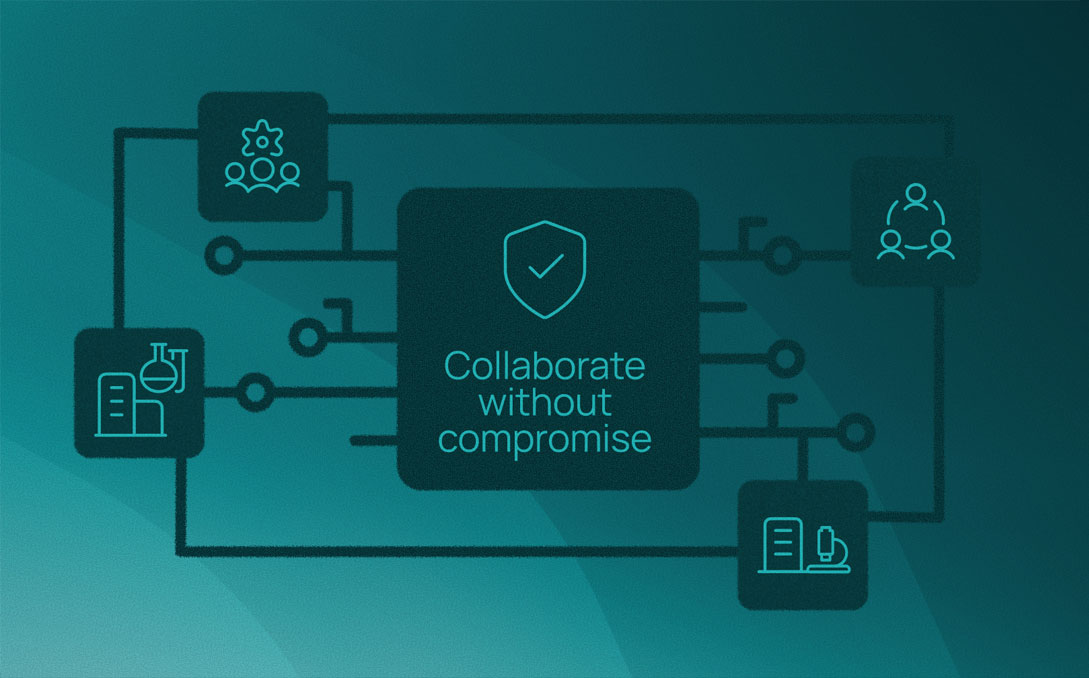
Taken together, these principles create an environment where research data can be shared confidently—protected by design, governed transparently, and supported by a robust security posture documented through our Trust Center.
Building trust across organizational boundaries
Secure collaboration is ultimately about trust. Not abstract trust in technology, but practical confidence between people and organizations that rely on shared data to move science forward.
External partners need to trust that the data they’re accessing is current, complete, and authoritative. Internal teams need confidence that collaboration won’t expose them to compliance risk or loss of control. And leadership needs assurance that research data is being governed consistently, regardless of how many collaborators or locations are involved.
This is where data security becomes a strategic enabler rather than a constraint. When access controls are clearly defined, activity is fully auditable, and protections are applied consistently, collaboration becomes easier. Teams spend less time negotiating permissions, chasing versions, or validating provenance, and more time focused on the science itself.
In complex research ecosystems, trust can’t be assumed. It has to be demonstrated, repeatedly, through consistent behavior and accountable systems. When research data is shared within an environment designed for transparency and control, collaboration stops feeling risky—and starts feeling reliable.
Collaborate with confidence
Collaboration is now fundamental to modern research, but it shouldn’t come at the expense of control. As research data moves across teams, institutions, and partners, the risks emerge when sharing lacks structure, visibility, and accountability.
Secure collaboration is a design choice. When research data is protected by default, access is clearly governed, and activity is fully traceable, teams can collaborate without hesitation. Compliance becomes sustainable rather than reactive, and trust becomes something that’s demonstrated through consistent practice—not assumed.
Platforms built for research environments make this possible by embedding security directly into everyday workflows. Instead of relying on manual workarounds or post-hoc controls, labs gain an operational foundation where collaboration scales without multiplying risk.
The goal isn’t to share less research data. It’s to share it responsibly, transparently, and with confidence—so collaboration accelerates discovery without compromise.
Ready to collaborate without compromise? Get in touch and discover how SciSure supports secure, compliant research data sharing.

Read more of our blogs about modern lab management
Discover the latest in lab operations, from sample management to AI innovations, designed to enhance efficiency and drive scientific breakthroughs.