Lab Safety Showers: Requirements, Types, and Compliance | SciSure

A complete guide to lab safety showers and eye wash stations, OSHA/ANSI Z358.1 requirements, equipment types, placement rules, maintenance standards, and training.
June 18, 2026
()
min read
A laboratory

Download Whitepaper

By submitting this form, you agree with our Privacy Policy.
Thank you! Download the file by clicking below:
Download
Oops! Something went wrong while submitting the form.

Table of Contents

Thank you! Your submission has been received!
Oops! Something went wrong while submitting the form.

Table of Contents

TL;DR

  • Lab safety showers and eye wash stations are required emergency response equipment in labs where workers may be exposed to injurious corrosive materials. Many labs handling chemical, biological, or irritant hazards also need appropriate emergency flushing equipment. 
  • In the US, OSHA requires suitable facilities for quick drenching or flushing where workers may be exposed to injurious corrosive materials. ANSI/ISEA Z358.1-2014 (R2020) is the current consensus standard used to define equipment performance, installation, maintenance, and use requirements.
  • Under ANSI Z358.1, all emergency equipment must be reachable within 10 seconds or approximately 55 feet from any hazard, on the same floor level, with no obstructions in the path.
  • Eye wash stations must deliver at least 0.4 gallons per minute at 30 PSI, with nozzle heads mounted 33 to 45 inches from the floor and at least 6 inches from any wall or obstruction.
  • Safety showers must deliver a minimum of 20 gallons per minute, and all equipment must supply tepid water between 60 and 100°F for a continuous 15-minute flush.
  • Weekly activation tests, annual inspections, and documented test records are required under ANSI Z358.1, not optional best practices.
  • SciSure helps labs stay on schedule with automated reminders and centralized documentation. SmartLabs uses SciSure’s Health & Safety features to manage safety training, onboarding, inspections, equipment, chemical inventory, SDS, biosafety, and medical surveillance across hundreds of lab spaces in the U.S.

This post was originally published in 2018 and has been fully updated to reflect SciSure's positioning as a Scientific Management Platform, current industry research and safety benchmarks, and new customer results from SmartLabs.

Introduction

In many workplaces, especially those involving chemicals, hazardous materials, or other potentially dangerous environments, eye wash stations and safety showers are critical components of an effective safety program. These facilities provide immediate decontamination to workers who have been exposed to harmful substances, reducing the risk of serious injury and promoting a safer work environment.

Here’s how integrating these safety measures with SciSure’s lab safety platform can make equipment checks, training, and documentation easier to manage.

Why eye wash stations and safety showers are essential

If someone in your lab gets a chemical splash in their eyes or on their skin, you have seconds to limit the damage. Permanent eye injury and severe chemical burns often come down to how fast someone reaches working equipment, not how thorough your safety policy looks on paper.

That's why proactive safety controls matter more than reactive ones. A shower that hasn't been tested in months, or a team that's never actually practiced using one, can fail you at the exact moment you need it most. Lapses in training, access, servicing, or certification turn a manageable exposure into a serious injury, and an OSHA violation into a lawsuit. 

ANSI Z358.1: the standard that governs emergency safety equipment

ANSI Z358.1 is the American National Standards Institute's consensus standard for emergency eyewash and shower equipment. It’s the primary reference used by OSHA when inspecting facilities and sets the minimum requirements for design, installation, performance, maintenance, and training. Any lab safety shower or eye wash lab installation should treat ANSI Z358.1 as the baseline, not a ceiling.

The standard covers all primary emergency equipment categories: safety showers, eye wash stations, eye and face wash stations, drench hoses, and combination units. Key provisions include:

  • Placement: Equipment must be reachable within 10 seconds, or approximately 55 feet, from any hazard area. It must be installed on the same floor level as the hazard, with no stairs or ramps between the hazard and the equipment.
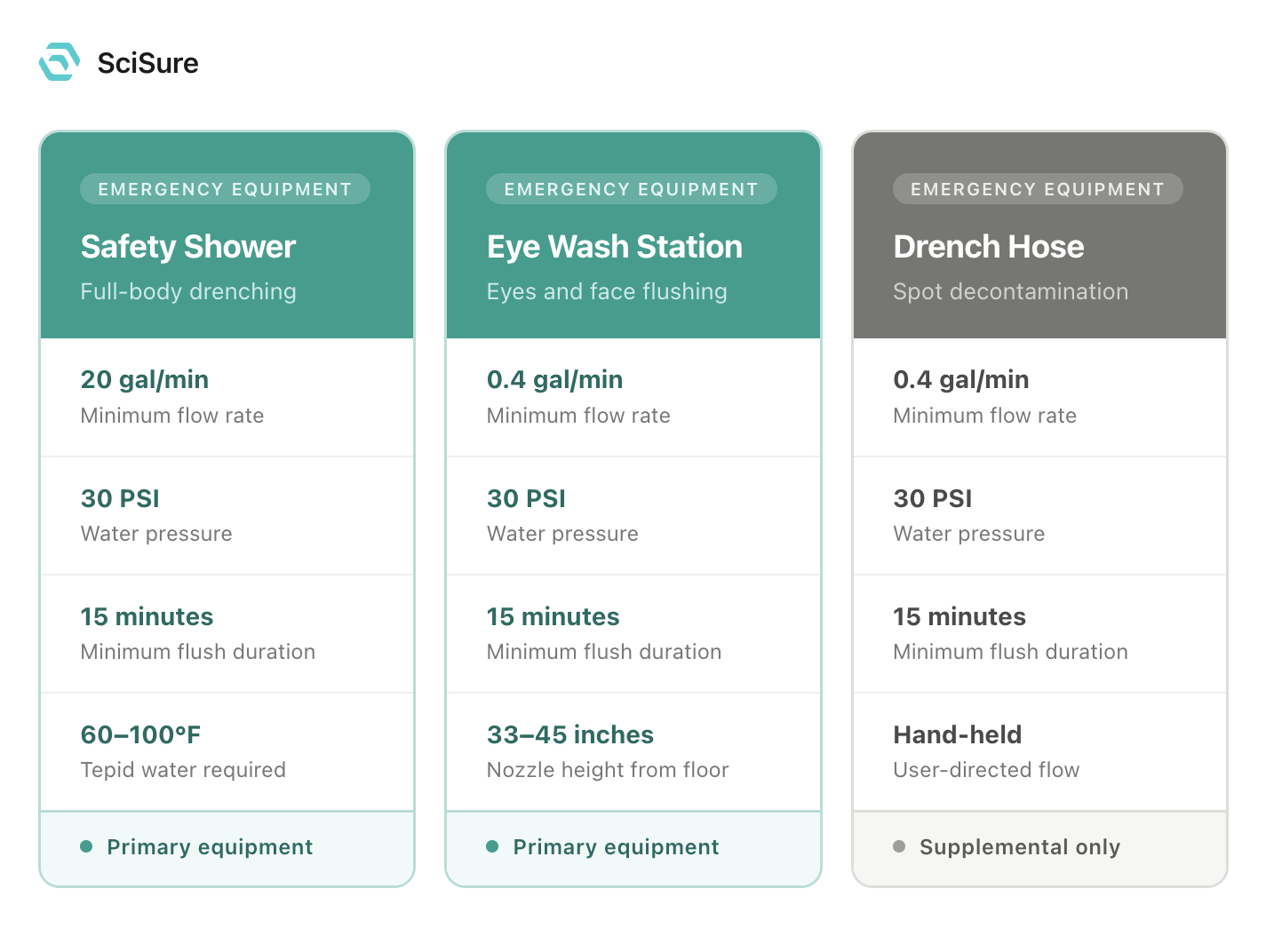
  • Flow rates: Safety showers must deliver a minimum of 20 gallons per minute. Eye wash stations must deliver at least 0.4 gallons per minute. Both must sustain flow for a minimum of 15 minutes.
  • Water pressure: Flow performance should be verified against the applicable ANSI/ISEA Z358.1 criteria and manufacturer specifications, including pressure conditions used for compliant operation.
  • Water temperature: Flushing fluid must be tepid, defined as between 60 and 100°F (16 to 38°C). Water that’s too cold can cause hypothermia or discourage thorough flushing; water that’s too hot can accelerate chemical absorption.
  • Valve operation: Activation valves must open in one second or less and remain open without the operator holding them, allowing the injured person to use both hands to hold their eyes open or remove contaminated clothing.
  • Nozzle positioning: Eye wash nozzle heads must be mounted between 33 and 45 inches above the floor and at least 6 inches from any wall or obstruction.
  • Dust covers: Nozzles must be protected from airborne contaminants by covers that automatically pop off upon activation.

Combination units that provide both a laboratory shower and eye wash station must be capable of operating both simultaneously at full flow rates.

SciSure EHS
Stay ahead of equipment compliance
SciSure helps lab safety teams manage equipment inspections, automate maintenance reminders, and keep documentation audit-ready across every site.
Talk to a specialist

How eye wash stations work

Eye wash stations are designed to flush the eyes with water or a specific eye wash solution to remove harmful substances. Here’s how they function:

  1. Activation: Most eye wash stations are activated by a simple push or pull lever, which starts the flow of water or solution.
  2. Flushing: The affected person positions their eyes over the nozzles, which release a gentle stream of fluid. The fluid washes away contaminants, reducing the risk of chemical burns or other eye damage.
  3. Duration: It’s recommended to flush the eyes for at least 15 minutes to ensure thorough decontamination.

How safety showers work

Safety showers are designed to drench the body with a large volume of water to wash away hazardous substances. Here’s how they function:

  1. Activation: Like eye wash stations, safety showers are activated by a pull handle or lever.
  2. Drenching: The affected person stands under the shower, which releases a deluge of water to quickly wash away contaminants from the skin and clothing.
  3. Duration: It’s recommended to use the safety shower for at least 15 minutes to ensure thorough decontamination.

Types of eye wash stations

Eye wash stations come in several configurations. The right choice depends on the lab's plumbing infrastructure, bench layout, and the nature of the chemical hazards present.

  • Plumbed stations: Permanently connected to a water supply and provide a continuous, reliable flow. The standard choice for labs with regular chemical exposure risk.
  • Portable stations: Self-contained eyewash stations can serve as primary emergency equipment when they meet ANSI/ISEA Z358.1 performance requirements and are maintained according to manufacturer instructions.
  • Personal eye wash units: Small squeeze bottles for immediate flushing at the point of exposure. These are supplemental only and must be followed by use of a plumbed or portable station for complete decontamination. They should also never replace a compliant eyewash station.
  • Faucet-mounted stations: Attach directly to an existing sink faucet. A practical option for some labs, but must meet ANSI Z358.1 flow and positioning requirements to qualify as primary equipment. Sink-mounted units are only valid if they have two separate orifices providing simultaneous bilateral flushing.
  • Bench-mounted stations: Fixed to a laboratory bench surface, keeping the unit at a consistent and accessible working height. Well-suited to labs where exposure risk is concentrated at the bench.
  • Swivel-mounted stations: Mounted on a rotating arm that allows the unit to be moved out of the way when not in use and swung into position during an emergency. Useful in space-constrained bench environments.
  • Bowl-mounted stations: Feature a basin that collects flushing fluid during use, reducing floor flooding. Often used where drainage is limited.

Types of safety showers

Safety shower configurations vary based on installation environment, available infrastructure, and whether combination functionality is required.

  • Plumbed showers: Permanently installed and connected directly to the water supply. Provide the most reliable and consistent flow and are the standard for fixed laboratory environments.
  • Portable showers: Self-contained mobile units that can be transported to locations without plumbing access. Used as temporary solutions or in field settings, but not a substitute for permanent plumbed units in established lab spaces.
  • Ceiling-mounted showers: Installed overhead with the spray head mounted at ceiling level, delivering a wide-diameter drenching pattern from above. Common in chemistry lab shower installations where floor space is limited or where overhead mounting suits the room layout.
  • Floor-mounted combination units: Integrate a full-body chemical shower with an eye wash station, and in some configurations a drench hose, in a single self-contained floor-standing unit. Ideal for labs with limited wall or ceiling mounting options that still need versatile emergency response capability. Both the shower and eye wash must be operable simultaneously at full flow under ANSI Z358.1.
  • Deck-mounted drench hoses: Installed directly on laboratory benches and activated via a squeeze handle. Allow users to direct water precisely to a specific area of the body. Effective for localized contamination on hands, arms, or equipment, but not suitable for full-body rinsing and classified as supplemental equipment under ANSI Z358.1.

Drench hoses

A drench hose is a hand-held, flexible hose connected to a laboratory sink or wall-mounted supply that delivers a directed flow of water for spot decontamination. It’s activated by a squeeze handle or lever and allows the user to target a specific area, such as a chemical splash on the forearm or face, with precision that a fixed shower head cannot provide.

Under ANSI Z358.1, drench hoses are classified as supplemental equipment. They do not meet the criteria for hands-free operation or simultaneous dual-eye flushing required of primary eye wash stations, and cannot replace a plumbed unit as the primary emergency response option. However, they are a practical addition to any bench where chemical handling occurs, providing immediate first response while the injured person moves to the primary station.

Installation, maintenance, and training requirements for drench hoses follow the same ANSI Z358.1 standards as primary emergency equipment.
Lab safety showers guide

Technical requirements at a glance

Equipment Min. flow rate Pressure Duration Nozzle height
Eye wash station 0.4 gal/min 30 PSI 15 min 33–45 inches from floor
Eye and face wash 3 gal/min 30 PSI 15 min 33–45 inches from floor
Safety shower 20 gal/min 30 PSI 15 min Spray pattern 60 inches above floor
Drench hose 0.4 gal/min 30 PSI 15 min Hand-held, user-directed

Additional requirements applicable to all equipment:

  • Water temperature: tepid, 60 to 100°F
  • Valve activation: one second or less, stay-open without hands
  • Nozzle clearance: minimum 6 inches from any wall or obstruction
  • Dust covers: must be fitted and auto-release on activation

Placement, signage, and lighting

Placement rules

ANSI Z358.1 requires that all emergency safety equipment be reachable within 10 seconds of the hazard, which translates to approximately 55 feet under normal walking pace. This calculation does not account for impaired mobility following a chemical exposure, so in practice equipment should be positioned as close to the hazard as possible rather than at the maximum permitted distance.

Additional placement requirements:

  • Equipment must be on the same floor level as the hazard. No stairs, ramps, or level changes are permitted between the hazard and the unit.
  • The path of travel must be completely unobstructed. Hoses, boxes, doors, and equipment all count as obstructions.
  • Combination units must allow simultaneous operation of both the shower and eye wash functions.

Signage and lighting

All emergency stations must be clearly marked with highly visible signage and located in well-lit areas so they can be found quickly even under stressful conditions or with impaired vision. Key requirements:

  • Install bright, standardized safety signage directly above each unit
  • Ensure adequate lighting around the unit at all times, including during power outages where emergency lighting applies
  • Signage must remain visible from the hazard area, not just from beside the unit
ANSI Z358.1 placement requirments

How to use eye wash stations and safety showers

  1. Immediate action: Use the eye wash station or safety shower immediately after exposure.
  2. Proper use: Ensure you know how to activate and use these stations correctly.
  3. Duration: Continue flushing for at least 15 minutes.
  4. Remove contaminated clothing: In the case of a safety shower, remove any clothing that may have been contaminated to prevent further skin exposure.
  5. Seek medical attention: After using the eye wash station or safety shower, seek medical attention promptly, even if you feel better.

Maintenance and accessibility

Keeping your emergency equipment functional isn’t optional. ANSI Z358.1 sets specific maintenance requirements that must be followed and documented.

  • Weekly activation tests: All safety showers, eye wash stations, and drench hoses must be activated weekly. This verifies the equipment functions correctly and flushes stagnant water from supply lines that could otherwise harbor bacteria or deliver discolored water during an emergency. If water is not clear when activated, continue running until it clears, then run for a further minute.
  • Annual inspections: A full performance inspection must be conducted annually, covering flow rate, water temperature, valve operation, nozzle positioning, clearance, and condition of dust covers.
  • Document all tests: Records of weekly activations and annual inspections must be maintained by the responsible department, principal investigator, or lab manager. Documentation is required for OSHA compliance and provides a clear audit trail during inspections.
  • Water temperature: Confirm that flushing water is tepid, between 60 and 100°F, during testing. Water outside this range either deters proper flushing or causes additional harm.
  • Clear access: Pathways to all units must remain unobstructed at all times, not just during inspections. Confirm this as part of the weekly check.

SciSure’s Health & Safety features support maintenance compliance by helping your team schedule inspections, automate reminders, centralize test records, and keep inspection histories audit-ready.

SciSure EHS
Never miss a weekly activation test
SciSure's equipment management tools track inspection schedules, log test results, and flag overdue checks so your safety equipment is always verified and ready.
Request a demo

Training and awareness

Having correctly installed and maintained equipment is only effective if lab personnel know how to use it, where it is, and what to do in the first moments after an exposure.

Training should cover:

  • Location of all units: Everyone working in or entering your lab space should be able to locate the nearest eye wash station, safety shower, and drench hose without hesitation. This includes contractors, visitors, and new starters on their first day.
  • Proper activation and use: Demonstrate activation of each unit type. Walk through the correct flushing procedure, including the 15-minute minimum duration, how to hold eyes open during flushing, and how to remove contaminated clothing under a chemical shower.
  • How to assist an injured colleague: A person with chemicals in their eyes may be unable to navigate to the station unassisted. Training should include how to guide an injured colleague to the nearest unit, how to activate equipment on their behalf, and how to support them during a 15-minute flush while emergency services are contacted.
  • Emergency response procedures: Training must include when to call for medical attention, what information to give emergency responders, and how to document the incident.
  • Regular drills: Practical drills should be conducted at regular intervals so that the response becomes automatic. A drill does not need to be a full emergency simulation; even a walk-through that confirms every team member can locate and activate each unit is valuable.

For multi-tenant lab operators, safety training is harder because people, hazards, and access needs vary by suite. That’s why SmartLabs uses SciSure’s Health & Safety features to manage chemical inventory, SDS, inspections, equipment, biosafety, medical surveillance, and safety training across hundreds of lab spaces. That matters for emergency preparedness: teams need to know which hazards are present, who has completed required training, and whether safety processes are being followed consistently.

“We onboard every single person who is entering lab spaces since it also has our safety training,” said Natalie Kosmandakis, EHS and Lab Operations Manager at SmartLabs. Read the full story on how SmartLabs makes operations safe and efficient across hundreds of lab spaces on both coasts.

Read MoreThe 5 Best EHS Software Platforms For Labs in 2026

Emergency preparedness in practice

Eye wash stations and safety showers only protect your team if they're accessible, functional, and familiar enough that no one hesitates in an emergency. Keep them maintained, keep your team trained, and they'll be ready the moment you actually need them.

SciSure supports labs in managing equipment compliance, inspection records, and safety training in one connected platform. To see how it fits your lab's safety program, talk to a specialist.

SciSure
Safety training and equipment management in one place
From onboarding new staff to tracking inspection records, SciSure brings lab safety workflows into a single connected system.
Talk to a specialist

FAQ

How often should safety showers and eye wash stations be tested?

Weekly, per ANSI Z358.1. All laboratory showers, eye wash lab stations, and drench hoses must be activated weekly to verify function and flush stagnant water from supply lines. A full annual performance inspection covering flow rate, water temperature, valve operation, and nozzle positioning is also required. All tests must be documented and records maintained by the responsible lab manager or safety officer.

Can eye wash stations be installed at any sink?

Not automatically. A faucet-mounted unit only qualifies as primary emergency equipment under ANSI Z358.1 if it has two separate orifices providing simultaneous bilateral flushing and meets the standard's flow rate and nozzle positioning requirements. A standard faucet without a compliant attachment does not count as an eye wash station regardless of its proximity to a hazard.

Are portable eye wash stations effective?

As supplemental equipment, yes. Self-contained eyewash stations can serve as primary emergency equipment when they meet ANSI/ISEA Z358.1 performance requirements and are maintained according to manufacturer instructions. At the same time, personal eyewash bottles are supplemental only and should not replace a compliant eyewash station. A finite fluid supply may not sustain the full 15-minute flush required by ANSI Z358.1. They do not replace permanently plumbed units in fixed laboratory environments with regular chemical hazard exposure.

What is the tepid water requirement for safety showers?

ANSI Z358.1 requires flushing fluid to be between 60 and 100°F. Water outside this range either deters proper flushing or accelerates chemical absorption into the skin. Verify temperature during every weekly activation test and annual inspection.

What happens if a lab safety shower or eye wash station is blocked?

It’s both an ANSI Z358.1 violation and an OSHA compliance failure. The standard requires a clear, unobstructed path between any hazard area and the nearest emergency equipment at all times. Labs should include a visual pathway check as part of their weekly activation routine, not just the annual inspection.

How does lab safety equipment management fit into a broader lab management system?

Emergency safety equipment management is one part of a broader lab operations picture. Labs that manage chemical inventories, sample records, and experiment documentation alongside equipment inspection logs get a more complete view of their compliance posture. Tools like LIMS software and an electronic lab notebook keep research data structured and traceable, and when safety equipment records sit alongside these systems, compliance oversight becomes significantly easier to maintain and demonstrate during audits. This connected view helps EHS teams see whether equipment is maintained, people are trained, and hazards are being managed across the lab.

Ready to see SciSure in action?

Get a personalized demo and see how SciSure fits your lab's workflows.
Request demo

No commitment · Free consultation

Introduction

In many workplaces, especially those involving chemicals, hazardous materials, or other potentially dangerous environments, eye wash stations and safety showers are critical components of an effective safety program. These facilities provide immediate decontamination to workers who have been exposed to harmful substances, reducing the risk of serious injury and promoting a safer work environment.

Here’s how integrating these safety measures with SciSure’s lab safety platform can make equipment checks, training, and documentation easier to manage.

Why eye wash stations and safety showers are essential

If someone in your lab gets a chemical splash in their eyes or on their skin, you have seconds to limit the damage. Permanent eye injury and severe chemical burns often come down to how fast someone reaches working equipment, not how thorough your safety policy looks on paper.

That's why proactive safety controls matter more than reactive ones. A shower that hasn't been tested in months, or a team that's never actually practiced using one, can fail you at the exact moment you need it most. Lapses in training, access, servicing, or certification turn a manageable exposure into a serious injury, and an OSHA violation into a lawsuit. 

ANSI Z358.1: the standard that governs emergency safety equipment

ANSI Z358.1 is the American National Standards Institute's consensus standard for emergency eyewash and shower equipment. It’s the primary reference used by OSHA when inspecting facilities and sets the minimum requirements for design, installation, performance, maintenance, and training. Any lab safety shower or eye wash lab installation should treat ANSI Z358.1 as the baseline, not a ceiling.

The standard covers all primary emergency equipment categories: safety showers, eye wash stations, eye and face wash stations, drench hoses, and combination units. Key provisions include:

  • Placement: Equipment must be reachable within 10 seconds, or approximately 55 feet, from any hazard area. It must be installed on the same floor level as the hazard, with no stairs or ramps between the hazard and the equipment.
  • Flow rates: Safety showers must deliver a minimum of 20 gallons per minute. Eye wash stations must deliver at least 0.4 gallons per minute. Both must sustain flow for a minimum of 15 minutes.
  • Water pressure: Flow performance should be verified against the applicable ANSI/ISEA Z358.1 criteria and manufacturer specifications, including pressure conditions used for compliant operation.
  • Water temperature: Flushing fluid must be tepid, defined as between 60 and 100°F (16 to 38°C). Water that’s too cold can cause hypothermia or discourage thorough flushing; water that’s too hot can accelerate chemical absorption.
  • Valve operation: Activation valves must open in one second or less and remain open without the operator holding them, allowing the injured person to use both hands to hold their eyes open or remove contaminated clothing.
  • Nozzle positioning: Eye wash nozzle heads must be mounted between 33 and 45 inches above the floor and at least 6 inches from any wall or obstruction.
  • Dust covers: Nozzles must be protected from airborne contaminants by covers that automatically pop off upon activation.

Combination units that provide both a laboratory shower and eye wash station must be capable of operating both simultaneously at full flow rates.

SciSure EHS
Stay ahead of equipment compliance
SciSure helps lab safety teams manage equipment inspections, automate maintenance reminders, and keep documentation audit-ready across every site.
Talk to a specialist

How eye wash stations work

Eye wash stations are designed to flush the eyes with water or a specific eye wash solution to remove harmful substances. Here’s how they function:

  1. Activation: Most eye wash stations are activated by a simple push or pull lever, which starts the flow of water or solution.
  2. Flushing: The affected person positions their eyes over the nozzles, which release a gentle stream of fluid. The fluid washes away contaminants, reducing the risk of chemical burns or other eye damage.
  3. Duration: It’s recommended to flush the eyes for at least 15 minutes to ensure thorough decontamination.

How safety showers work

Safety showers are designed to drench the body with a large volume of water to wash away hazardous substances. Here’s how they function:

  1. Activation: Like eye wash stations, safety showers are activated by a pull handle or lever.
  2. Drenching: The affected person stands under the shower, which releases a deluge of water to quickly wash away contaminants from the skin and clothing.
  3. Duration: It’s recommended to use the safety shower for at least 15 minutes to ensure thorough decontamination.

Types of eye wash stations

Eye wash stations come in several configurations. The right choice depends on the lab's plumbing infrastructure, bench layout, and the nature of the chemical hazards present.

  • Plumbed stations: Permanently connected to a water supply and provide a continuous, reliable flow. The standard choice for labs with regular chemical exposure risk.
  • Portable stations: Self-contained eyewash stations can serve as primary emergency equipment when they meet ANSI/ISEA Z358.1 performance requirements and are maintained according to manufacturer instructions.
  • Personal eye wash units: Small squeeze bottles for immediate flushing at the point of exposure. These are supplemental only and must be followed by use of a plumbed or portable station for complete decontamination. They should also never replace a compliant eyewash station.
  • Faucet-mounted stations: Attach directly to an existing sink faucet. A practical option for some labs, but must meet ANSI Z358.1 flow and positioning requirements to qualify as primary equipment. Sink-mounted units are only valid if they have two separate orifices providing simultaneous bilateral flushing.
  • Bench-mounted stations: Fixed to a laboratory bench surface, keeping the unit at a consistent and accessible working height. Well-suited to labs where exposure risk is concentrated at the bench.
  • Swivel-mounted stations: Mounted on a rotating arm that allows the unit to be moved out of the way when not in use and swung into position during an emergency. Useful in space-constrained bench environments.
  • Bowl-mounted stations: Feature a basin that collects flushing fluid during use, reducing floor flooding. Often used where drainage is limited.

Types of safety showers

Safety shower configurations vary based on installation environment, available infrastructure, and whether combination functionality is required.

  • Plumbed showers: Permanently installed and connected directly to the water supply. Provide the most reliable and consistent flow and are the standard for fixed laboratory environments.
  • Portable showers: Self-contained mobile units that can be transported to locations without plumbing access. Used as temporary solutions or in field settings, but not a substitute for permanent plumbed units in established lab spaces.
  • Ceiling-mounted showers: Installed overhead with the spray head mounted at ceiling level, delivering a wide-diameter drenching pattern from above. Common in chemistry lab shower installations where floor space is limited or where overhead mounting suits the room layout.
  • Floor-mounted combination units: Integrate a full-body chemical shower with an eye wash station, and in some configurations a drench hose, in a single self-contained floor-standing unit. Ideal for labs with limited wall or ceiling mounting options that still need versatile emergency response capability. Both the shower and eye wash must be operable simultaneously at full flow under ANSI Z358.1.
  • Deck-mounted drench hoses: Installed directly on laboratory benches and activated via a squeeze handle. Allow users to direct water precisely to a specific area of the body. Effective for localized contamination on hands, arms, or equipment, but not suitable for full-body rinsing and classified as supplemental equipment under ANSI Z358.1.

Drench hoses

A drench hose is a hand-held, flexible hose connected to a laboratory sink or wall-mounted supply that delivers a directed flow of water for spot decontamination. It’s activated by a squeeze handle or lever and allows the user to target a specific area, such as a chemical splash on the forearm or face, with precision that a fixed shower head cannot provide.

Under ANSI Z358.1, drench hoses are classified as supplemental equipment. They do not meet the criteria for hands-free operation or simultaneous dual-eye flushing required of primary eye wash stations, and cannot replace a plumbed unit as the primary emergency response option. However, they are a practical addition to any bench where chemical handling occurs, providing immediate first response while the injured person moves to the primary station.

Installation, maintenance, and training requirements for drench hoses follow the same ANSI Z358.1 standards as primary emergency equipment.

Lab safety showers guide

Technical requirements at a glance

Equipment Min. flow rate Pressure Duration Nozzle height
Eye wash station 0.4 gal/min 30 PSI 15 min 33–45 inches from floor
Eye and face wash 3 gal/min 30 PSI 15 min 33–45 inches from floor
Safety shower 20 gal/min 30 PSI 15 min Spray pattern 60 inches above floor
Drench hose 0.4 gal/min 30 PSI 15 min Hand-held, user-directed

Additional requirements applicable to all equipment:

  • Water temperature: tepid, 60 to 100°F
  • Valve activation: one second or less, stay-open without hands
  • Nozzle clearance: minimum 6 inches from any wall or obstruction
  • Dust covers: must be fitted and auto-release on activation

Placement, signage, and lighting

Placement rules

ANSI Z358.1 requires that all emergency safety equipment be reachable within 10 seconds of the hazard, which translates to approximately 55 feet under normal walking pace. This calculation does not account for impaired mobility following a chemical exposure, so in practice equipment should be positioned as close to the hazard as possible rather than at the maximum permitted distance.

Additional placement requirements:

  • Equipment must be on the same floor level as the hazard. No stairs, ramps, or level changes are permitted between the hazard and the unit.
  • The path of travel must be completely unobstructed. Hoses, boxes, doors, and equipment all count as obstructions.
  • Combination units must allow simultaneous operation of both the shower and eye wash functions.

Signage and lighting

All emergency stations must be clearly marked with highly visible signage and located in well-lit areas so they can be found quickly even under stressful conditions or with impaired vision. Key requirements:

  • Install bright, standardized safety signage directly above each unit
  • Ensure adequate lighting around the unit at all times, including during power outages where emergency lighting applies
  • Signage must remain visible from the hazard area, not just from beside the unit
ANSI Z358.1 placement requirments

How to use eye wash stations and safety showers

  1. Immediate action: Use the eye wash station or safety shower immediately after exposure.
  2. Proper use: Ensure you know how to activate and use these stations correctly.
  3. Duration: Continue flushing for at least 15 minutes.
  4. Remove contaminated clothing: In the case of a safety shower, remove any clothing that may have been contaminated to prevent further skin exposure.
  5. Seek medical attention: After using the eye wash station or safety shower, seek medical attention promptly, even if you feel better.

Maintenance and accessibility

Keeping your emergency equipment functional isn’t optional. ANSI Z358.1 sets specific maintenance requirements that must be followed and documented.

  • Weekly activation tests: All safety showers, eye wash stations, and drench hoses must be activated weekly. This verifies the equipment functions correctly and flushes stagnant water from supply lines that could otherwise harbor bacteria or deliver discolored water during an emergency. If water is not clear when activated, continue running until it clears, then run for a further minute.
  • Annual inspections: A full performance inspection must be conducted annually, covering flow rate, water temperature, valve operation, nozzle positioning, clearance, and condition of dust covers.
  • Document all tests: Records of weekly activations and annual inspections must be maintained by the responsible department, principal investigator, or lab manager. Documentation is required for OSHA compliance and provides a clear audit trail during inspections.
  • Water temperature: Confirm that flushing water is tepid, between 60 and 100°F, during testing. Water outside this range either deters proper flushing or causes additional harm.
  • Clear access: Pathways to all units must remain unobstructed at all times, not just during inspections. Confirm this as part of the weekly check.

SciSure’s Health & Safety features support maintenance compliance by helping your team schedule inspections, automate reminders, centralize test records, and keep inspection histories audit-ready.

SciSure EHS
Never miss a weekly activation test
SciSure's equipment management tools track inspection schedules, log test results, and flag overdue checks so your safety equipment is always verified and ready.
Request a demo

Training and awareness

Having correctly installed and maintained equipment is only effective if lab personnel know how to use it, where it is, and what to do in the first moments after an exposure.

Training should cover:

  • Location of all units: Everyone working in or entering your lab space should be able to locate the nearest eye wash station, safety shower, and drench hose without hesitation. This includes contractors, visitors, and new starters on their first day.
  • Proper activation and use: Demonstrate activation of each unit type. Walk through the correct flushing procedure, including the 15-minute minimum duration, how to hold eyes open during flushing, and how to remove contaminated clothing under a chemical shower.
  • How to assist an injured colleague: A person with chemicals in their eyes may be unable to navigate to the station unassisted. Training should include how to guide an injured colleague to the nearest unit, how to activate equipment on their behalf, and how to support them during a 15-minute flush while emergency services are contacted.
  • Emergency response procedures: Training must include when to call for medical attention, what information to give emergency responders, and how to document the incident.
  • Regular drills: Practical drills should be conducted at regular intervals so that the response becomes automatic. A drill does not need to be a full emergency simulation; even a walk-through that confirms every team member can locate and activate each unit is valuable.

For multi-tenant lab operators, safety training is harder because people, hazards, and access needs vary by suite. That’s why SmartLabs uses SciSure’s Health & Safety features to manage chemical inventory, SDS, inspections, equipment, biosafety, medical surveillance, and safety training across hundreds of lab spaces. That matters for emergency preparedness: teams need to know which hazards are present, who has completed required training, and whether safety processes are being followed consistently.

“We onboard every single person who is entering lab spaces since it also has our safety training,” said Natalie Kosmandakis, EHS and Lab Operations Manager at SmartLabs. Read the full story on how SmartLabs makes operations safe and efficient across hundreds of lab spaces on both coasts.

Read MoreThe 5 Best EHS Software Platforms For Labs in 2026

Emergency preparedness in practice

Eye wash stations and safety showers only protect your team if they're accessible, functional, and familiar enough that no one hesitates in an emergency. Keep them maintained, keep your team trained, and they'll be ready the moment you actually need them.

SciSure supports labs in managing equipment compliance, inspection records, and safety training in one connected platform. To see how it fits your lab's safety program, talk to a specialist.

SciSure
Safety training and equipment management in one place
From onboarding new staff to tracking inspection records, SciSure brings lab safety workflows into a single connected system.
Talk to a specialist

FAQ

How often should safety showers and eye wash stations be tested?

Weekly, per ANSI Z358.1. All laboratory showers, eye wash lab stations, and drench hoses must be activated weekly to verify function and flush stagnant water from supply lines. A full annual performance inspection covering flow rate, water temperature, valve operation, and nozzle positioning is also required. All tests must be documented and records maintained by the responsible lab manager or safety officer.

Can eye wash stations be installed at any sink?

Not automatically. A faucet-mounted unit only qualifies as primary emergency equipment under ANSI Z358.1 if it has two separate orifices providing simultaneous bilateral flushing and meets the standard's flow rate and nozzle positioning requirements. A standard faucet without a compliant attachment does not count as an eye wash station regardless of its proximity to a hazard.

Are portable eye wash stations effective?

As supplemental equipment, yes. Self-contained eyewash stations can serve as primary emergency equipment when they meet ANSI/ISEA Z358.1 performance requirements and are maintained according to manufacturer instructions. At the same time, personal eyewash bottles are supplemental only and should not replace a compliant eyewash station. A finite fluid supply may not sustain the full 15-minute flush required by ANSI Z358.1. They do not replace permanently plumbed units in fixed laboratory environments with regular chemical hazard exposure.

What is the tepid water requirement for safety showers?

ANSI Z358.1 requires flushing fluid to be between 60 and 100°F. Water outside this range either deters proper flushing or accelerates chemical absorption into the skin. Verify temperature during every weekly activation test and annual inspection.

What happens if a lab safety shower or eye wash station is blocked?

It’s both an ANSI Z358.1 violation and an OSHA compliance failure. The standard requires a clear, unobstructed path between any hazard area and the nearest emergency equipment at all times. Labs should include a visual pathway check as part of their weekly activation routine, not just the annual inspection.

How does lab safety equipment management fit into a broader lab management system?

Emergency safety equipment management is one part of a broader lab operations picture. Labs that manage chemical inventories, sample records, and experiment documentation alongside equipment inspection logs get a more complete view of their compliance posture. Tools like LIMS software and an electronic lab notebook keep research data structured and traceable, and when safety equipment records sit alongside these systems, compliance oversight becomes significantly easier to maintain and demonstrate during audits. This connected view helps EHS teams see whether equipment is maintained, people are trained, and hazards are being managed across the lab.

About the author:

SciSure Team

The SciSureTeam combines expertise in lab digitization, software development, and research management to deliver reliable insights and practical advice. Our goal is to empower scientists with the knowledge and tools to optimize workflows and stay ahead in the ever-evolving world of research.

See all posts from this author

Sign up for our newsletter

Get the latest tips, articles, and exclusive content on modern lab management delivered to your inbox.
Thank you for subscribing!
Please check your email to verify your submission.
Oops! Something went wrong while submitting the form.