How to Compare Lab Management Systems: ELN, LIMS, EHS, and Scientific Management Platforms

Compare ELN, LIMS, EHS, SDMS, LIS, and SciSure’s SMP: learn what each system does, where they overlap, and how to choose the right mix for your lab.

August 4, 2026
()
min read
A laboratory

Download Whitepaper

By submitting this form, you agree with our Privacy Policy.
Thank you! Download the file by clicking below:
Download
Oops! Something went wrong while submitting the form.

Table of Contents

Thank you! Your submission has been received!
Oops! Something went wrong while submitting the form.

Table of Contents

TL;DR

Lab management software covers several distinct jobs, so the right system mix depends on your workflows, hazards, regulatory obligations, and existing technology.

  • Core system types.
    ELNs document experiments, methods, observations, and approvals. LIMS platforms manage structured sample, inventory, and workflow data. EHS systems support safety and environmental programs such as chemical inventory, SDS access, inspections, incidents, training, and reporting. SDMS and LIS platforms address scientific files and clinical laboratory information, respectively.
  • Risk-based selection.
    Start with the workflows and risks that matter most. Research documentation may point you toward an ELN, sample-heavy operations toward a LIMS, and chemical, biological, radiation, occupational safety, or environmental obligations toward EHS. Safety requirements don't disappear because ELN or LIMS implementation happens first.
  • Integration tradeoffs.
    Separate best-of-breed systems can work well when ownership, interfaces, identifiers, access controls, and audit evidence are governed. Without that discipline, teams may re-enter data, reconcile conflicting records, and reconstruct context manually. Evaluate the quality of the connections, not simply the number of products or integrations.
  • Compliance boundary.
    Software can support regulated workflows, but it does not make an organization compliant by itself. For GxP or FDA-regulated work, intended use, validation, SOPs, training, access control, retention, and change control remain organizational responsibilities. EHS obligations likewise depend on hazards, quantities, activities, locations, and jurisdiction.
  • Where SciSure fits.
    The SciSure Scientific Management Platform brings ELN, LIMS, Health & Safety (EHS), and integrations into a modular platform strategy. Organizations can adopt the capabilities they need and expand over time. Exact cross-module workflows, add-ons, integrations, identity controls, and data exchange depend on scope, configuration, and deployment.


This post was originally published in 2024 and updated in 2026 to include EHS and Scientific Management Platforms, clearer compliance boundaries, and an enterprise evaluation framework.

What is a laboratory management system?

“Laboratory management system” is an umbrella term that may describe an ELN, LIMS, EHS platform, inventory tool, SDMS, LIS, or a broader platform that combines several of these functions. Geneally, the term refers to specialized software solutions designed to optimize and streamline a variety of operations within a laboratory setting. These systems are designed to digitalize and automate tasks, reduce human error, and improve overall efficiency within the lab.

At the same time, that ambiguity creates a practical scoping problem. An IT leader may mean the system that manages identities and integrations. A lab operations manager may mean sample and equipment tracking. A scientist may mean the ELN. An EHS leader may mean chemical inventory, training, inspections, or incident management.

Before you evaluate vendors, make sure you define the jobs the system must perform, the records it must govern, and the other systems it must connect with. That's the practical starting point to figuring out what best fits your labs' needs.

Lab management system types at a glance

System Primary purpose Typical scope and limitations
Electronic Lab Notebook (ELN) Document scientific work Covers experiments, methods, observations, files, reviews, signatures, and version history. It usually does not replace a complete EHS program or every high-throughput sample workflow.
Laboratory Information Management System (LIMS) Manage structured laboratory operations Covers samples, inventory, storage, chain of custody, testing steps, equipment, status, and reporting. It usually does not replace free-form scientific documentation or a complete EHS program.
Environment, Health, and Safety (EHS) Manage safety, environmental, and occupational-risk programs Covers chemical inventory, SDS, inspections, incidents, corrective actions, training, waste, biosafety, and reporting. It does not replace experiment documentation or general sample lifecycle management.
Scientific Data Management System (SDMS) Govern scientific data files Covers instrument output, raw files, metadata, indexing, access, and retention. It usually does not replace experiment execution, sample logistics, or safety management.
Laboratory Information System (LIS) Manage clinical laboratory information Covers patient and order data, results, validation, reporting, and HIS or EHR interfaces. It does not normally replace nonclinical R&D documentation or enterprise EHS.
Scientific Management Platform (SMP) Connect multiple scientific-management domains May connect ELN, LIMS, EHS, integrations, and shared workflows. It may not replace specialized systems whose required depth or regulatory scope is not included.

The main types of lab management systems

Electronic Laboratory Notebooks

An electronic laboratory notebook, or ELN, is a digital system for documenting scientific experiments, methods, observations, results, and related files. Depending on the product and configuration, an ELN may also provide:

  • Experiment templates
  • Protocol management
  • Collaboration and commenting
  • Advanced search
  • Version history
  • Electronic signatures
  • Witness signing
  • Review and approval workflows
  • Audit trails
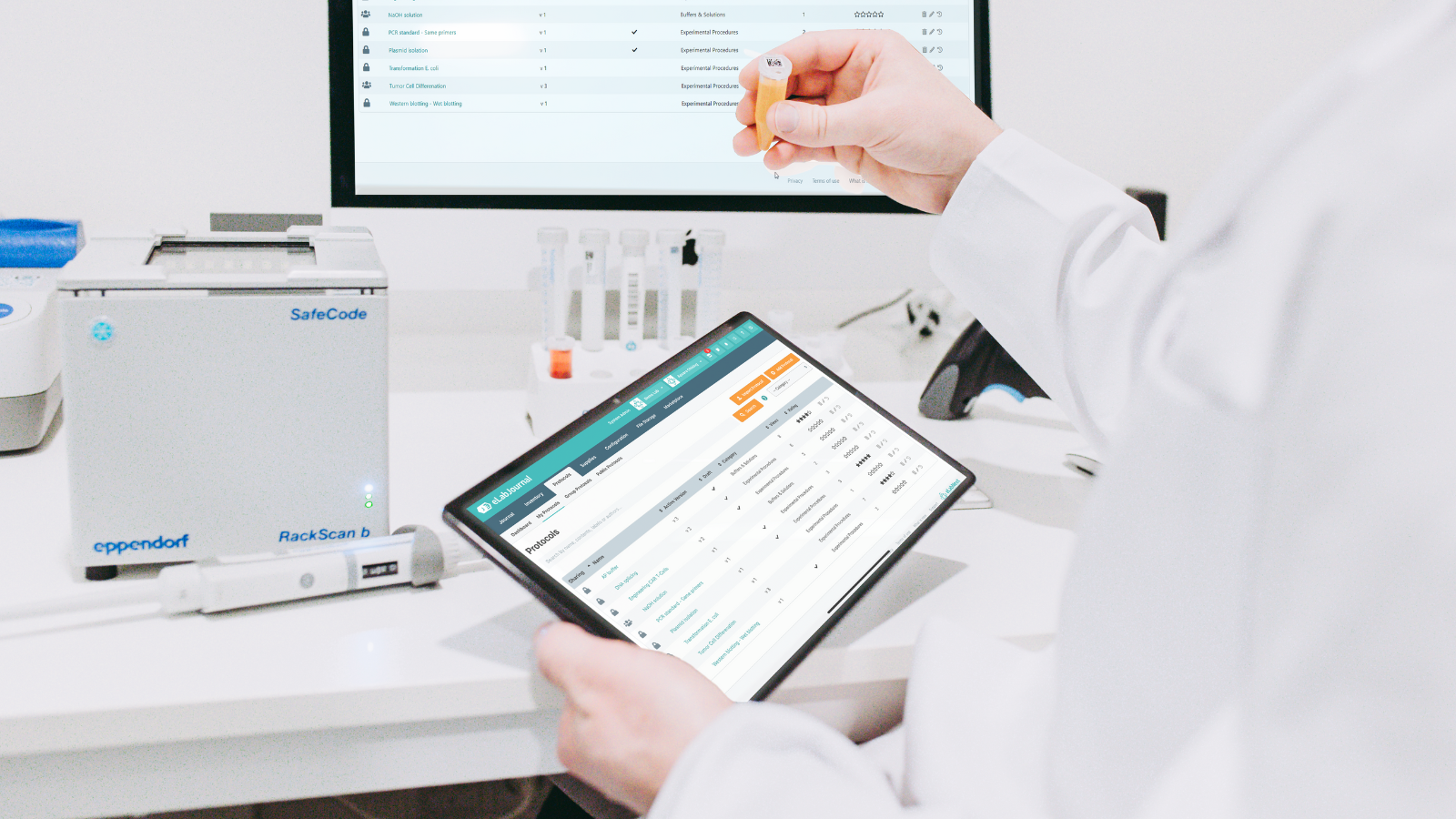
The SciSure Electronic Lab Notebook (ELN)
The SciSure Electronic Lab Notebook (ELN)

In regulated environments, an ELN can support GLP, GMP, GxP, and FDA 21 CFR Part 11 workflows when the necessary controls are available and appropriately configured. The regulated organization still owns its intended-use assessment, system validation, SOPs, training, quality oversight, retention policies, security administration, and change control.

The FDA’s Part 11 guidance explains that Part 11 applies to certain electronic records maintained or submitted under FDA record requirements. It is not a general certification that attaches to every electronic record or software product.

ELNs primarily serve scientists, principal investigators, research managers, and reviewers who need searchable and traceable research records. Their sample and inventory depth varies widely. Some ELNs include native sample management or integrate closely with a LIMS, while others remain focused on documentation.

Don't assume that a standalone ELN is automatically disconnected. Make sure you verify the product’s specific data model, sample-management capabilities, and available integrations.

Laboratory Information Management Systems

A laboratory information management system, or LIMS, manages structured sample, material, inventory, and laboratory workflow data. Common LIMS capabilities include:

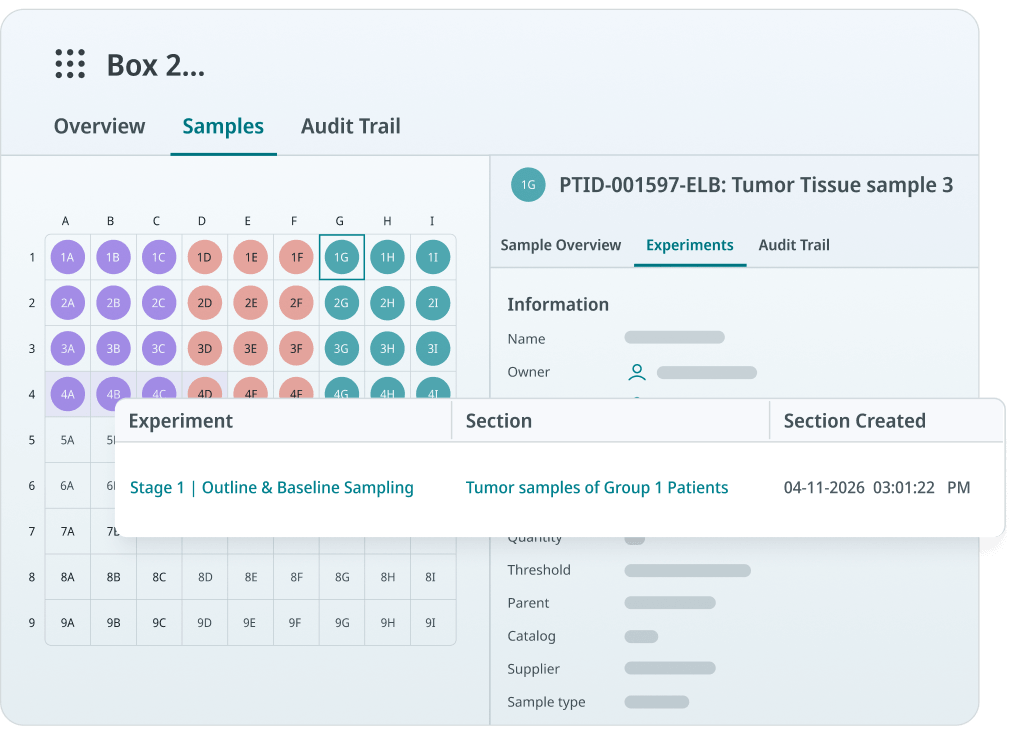
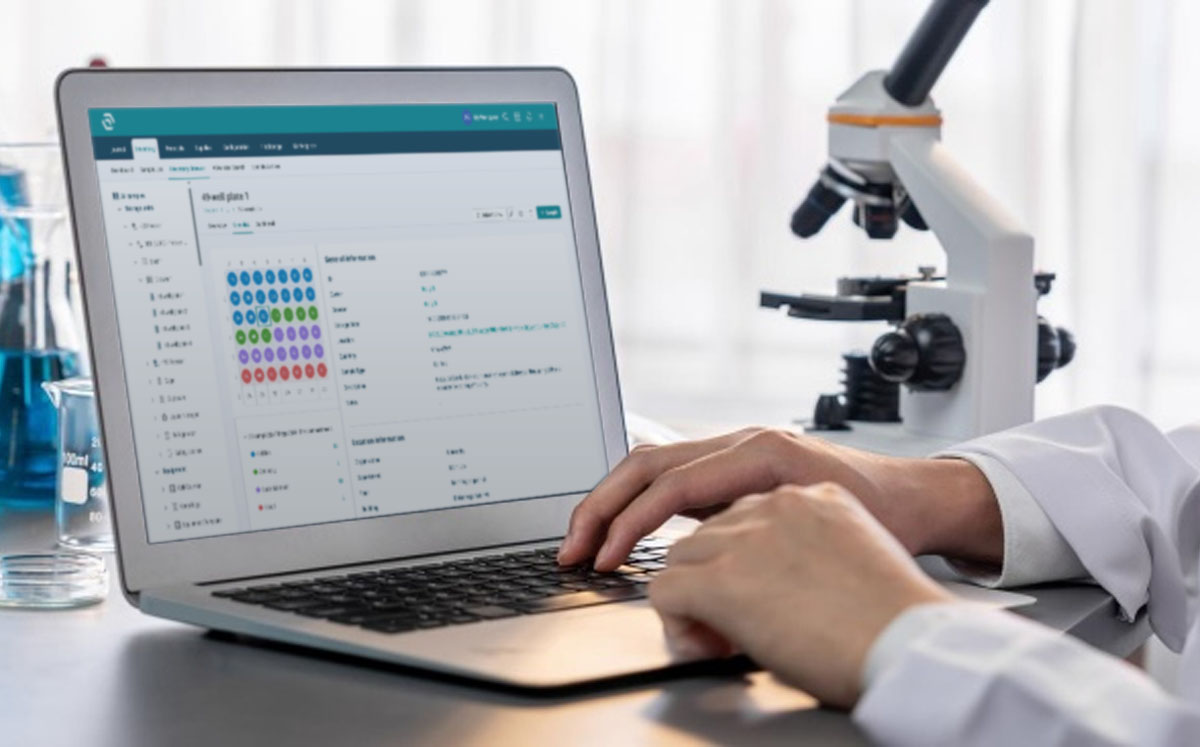
Inventory management with SciSure LIMS

LIMS implementations differ by setting. Many systems used in QA/QC, manufacturing, or high-throughput testing emphasize repeatable workflows, predefined stages, and strong process control. R&D-oriented implementations often need more flexible sample types, configurable relationships, and links to evolving experimental work. Neither model is inherently better. The right fit depends on the laboratory and its workflows.

Make sure to prioritize LIMS capabilities when you need to answer questions like:

  • What samples exist?
  • Where are they stored?
  • Who changed or moved them?
  • What material was used in a study?
  • What remains in stock?
  • Which workflow stage is complete?
  • When should a sample be archived or disposed of?

Also determine whether features such as lineage visualization, supplier ordering, equipment booking, or specialized biobanking are native, configurable, or available only through add-ons.

Environmental, Health, and Safety systems

Environmental, Health, and Safety systems support environmental programs, occupational health and safety, risk management, and regulatory reporting. In scientific organizations, relevant EHS capabilities may include:

Chemical inventory management with SciSure Health & Safety

The scope of EHS platforms varies significantly. A general-purpose EHS suite may be strong in enterprise incident management and corporate reporting but require considerable configuration for research-laboratory structures, hazards, and workflows. A lab-focused EHS system may better represent laboratories, rooms, principal investigators, chemical containers, biological registrations, and safety training. Evaluate the workflows you actually need instead of assuming every EHS product covers the same modules.

EHS priorities should follow your hazards and applicable requirements. For example, the OSHA Laboratory Standard requires information and training for employees exposed to hazardous chemicals in covered laboratories. Hazardous-chemical inventory reporting under EPA EPCRA Sections 311 and 312 applies only to covered facilities and chemicals at applicable thresholds. State, local, national, and industry-specific requirements may add further obligations.

SciSure
Bring research, lab operations, and safety together.
SciSure helps you document experiments, manage samples and inventory, and support EHS workflows, so you can build a more connected environment for scientists, LabOps, and safety teams.
Request a demo

Scientific Data Management Systems

A scientific data management system, or SDMS, manages scientific data files and their metadata. An SDMS can provide a controlled repository for:

  • Instrument output
  • Raw data
  • Analytical files
  • Metadata
  • Indexing and search
  • Access control
  • Retention
  • Data transfer between teams or systems

An SDMS usually complements an ELN or LIMS. The ELN records the scientific rationale and experiment context. The LIMS structures samples and operational workflows. The SDMS manages the underlying scientific data artifacts.

Some SDMS products also provide visualization or analysis capabilities, but these features are not included in every system and should be evaluated separately.

Laboratory Information Systems

A laboratory information system, or LIS, manages patient-related orders, specimens, test processing, results, validation, and reporting in clinical and diagnostic laboratories. An LIS commonly integrates with hospital information systems and electronic health records. LIS and LIMS functions can overlap, and vendors sometimes use the terms differently. The important distinction is the intended environment: patient care and clinical reporting create requirements that do not apply to most research-only laboratories.

The real cost of disconnected systems

Multiple disconnected systems can create problems such as a lack of clear ownership, unreliable interfaces, uncontrolled identifiers, undocumented handoffs, and inaccessible audit evidence. This doesn't mean that using them is automatically inefficient or non-compliant. It can, however, increase the risk of:

  • Duplicate entry.
    Scientists or administrators copy sample IDs, inventory details, training status, or results between systems.
  • Fragmented traceability.
    Each system may have a valid local audit trail, while the end-to-end history across an experiment, sample, instrument file, and safety record remains difficult to reconstruct.
  • Conflicting records.
    Separate systems may disagree about names, locations, owners, statuses, or versions when no master-data rules exist.
  • Administrative overhead.
    Each platform brings its own permissions, configuration, support, training, upgrades, and vendor management.
  • Poor adoption.
    A technically capable system can still fail if users cannot complete their daily work efficiently or do not understand where the authoritative record belongs.

Integration can reduce these problems, but an API alone is not enough. You also need defined data ownership, error handling, audit logging, access mapping, version behavior, and a process for monitoring failed or delayed exchanges.

How to evaluate lab management systems

1. Define the scope and system boundaries

List the workflows, record types, user groups, sites, and regulatory contexts in scope. Ask vendors to show which capabilities are:

  • Native to the system
  • Available through configuration
  • Licensed as separate modules
  • Dependent on add-ons
  • Provided by third-party systems
  • Planned for a future release

Avoid comparing broad labels such as “comprehensive platform," but rather compare the actual workflow: documenting an experiment, registering and moving a sample, reconciling chemical inventory, assigning training, closing an inspection finding, or retrieving evidence for an audit.

2. Evaluate data governance and regulated use

For regulated or high-integrity records, assess:

  • Role-based access
  • Timestamps
  • Version history
  • Audit trails
  • Electronic signatures
  • Witness signing where required
  • Review and approval
  • Record locking or finalization
  • Retention
  • Exports
  • Administrative logs

Then evaluate how your organization will validate and govern the configured system. Vendor functionality can support compliant use, but your procedures, training, quality controls, retention rules, and change-management process determine whether that use is defensible.

3. Test configurability without losing control

R&D teams need room to adapt. Regulated and operational teams need consistency. Make sure to test whether authorized administrators can configure sample types, fields, templates, protocols, inspection forms, permissions, and workflows without making the system ungovernable.

Ask how configuration changes are:

  • Requested
  • Approved
  • Tested
  • Documented
  • Promoted into production
  • Recorded in audit logs

“No-code” configurability is useful only if the resulting configuration remains controlled.

SciSure
Configure workflows without losing control.
Adapt experiment templates, sample structures, protocols, permissions, and safety workflows to your lab’s needs, while maintaining the oversight required for consistent, traceable operations.
Talk to a specialist

4. Inspect the integration architecture

Identify the systems that must exchange data, including:

  • Laboratory instruments
  • ERP systems
  • HR platforms
  • Learning-management systems
  • Identity providers
  • Scientific data repositories
  • Analytics platforms
  • Regulatory reporting tools

Look for documented APIs or SDKs, supported authentication, clear export formats, monitoring, error handling, and ownership of each interface. Confirm whether a marketplace listing provides live synchronization, a one-way transfer, an imported copy, or simply a launch point to another system.

5. Verify scale, security, and deployment fit

Test how the system handles:

  • Multiple groups
  • Multiple sites
  • Legal entities
  • Local administrators
  • Shared resources
  • Standardized workflows
  • Site-specific requirements

Review permission inheritance, cross-site visibility, reporting boundaries, and the separation of confidential records.

Also confirm the hosting and security model you require. Cloud, private-cloud, and on-premises options may differ in release cadence, integrations, administration, and validation effort.

6. Plan implementation, adoption, and ownership

Ask who will own the system after go-live, how data will be migrated, how templates and taxonomies will be governed, and how users will be trained. Evaluate the vendor’s:

  • Implementation process
  • Support model
  • Migration services
  • Documentation
  • Training resources
  • Customer references

References should come from organizations with workflows and scale similar to yours. A phased rollout can reduce risk, but each phase should still have a defined system of record and a plan for legacy data, integrations, and handoffs.

ELN vs. LIMS vs. EHS: Which combination does your lab need?

ELN vs. LIMS vs. EHS: Which system should your laboratory prioritize?

Laboratory type or operating pattern Likely priority Important qualification
Discovery or research-intensive laboratory ELN; add LIMS when samples, inventory, or workflows need more structure Assess EHS requirements in parallel based on hazards and applicable regulations.
Sample-heavy R&D, biobank, or testing operation LIMS, often connected to an ELN Confirm chain of custody, lifecycle, storage, lineage, and workflow depth.
QA/QC or GxP-regulated operation LIMS and/or ELN with appropriate controls and validation Part 11 and GxP priorities depend on intended use and the regulated records involved.
Chemical-, biological-, or radiation-intensive organization Laboratory-focused EHS, often alongside ELN and LIMS Required modules depend on hazards, quantities, programs, and jurisdiction.
Instrument-data-intensive environment SDMS connected to an ELN or LIMS Confirm file formats, metadata capture, retention, search, and instrument interfaces.
Clinical or diagnostic laboratory LIS, sometimes with LIMS-like capabilities Verify patient-data, order, result, interface, and clinical regulatory requirements.
Multi-site research enterprise A governed combination or platform spanning several categories Test local flexibility, central oversight, identity management, integrations, and data boundaries.

What is a Scientific Management Platform?

SciSure uses “Scientific Management Platform,” or SMP, to describe a modular approach that brings research documentation, sample and inventory management, safety oversight, and integrations closer together. The SciSure Scientific Management Platform includes four core capability areas.

Electronic Laboratory Notebook

The SciSure ELN can support structured experiment documentation, templates, protocols, collaboration, search, review, signatures, witness signing, versioning, and audit-supporting controls where enabled and configured.

Laboratory Information Management System

The SciSure LIMS can support sample and inventory records, configurable sample types, storage, barcode workflows, equipment, ordering, lifecycle tracking, audit trails, and sample relationships or lineage where supported and configured.

Health & Safety

SciSure for Health & Safety can support ChemTracker chemical inventory and SDS workflows, inspections, incident management, training, hazardous waste, biosafety, radiation safety, medical surveillance, reporting, and other modules depending on licensing and configuration.

Integrations

SciSure integrations include marketplace add-ons, APIs, SDK support, and instrument or third-party connections. Behavior and availability vary by integration and deployment.

SciSure for Research covers the ELN and LIMS capability areas; experiments can link to samples and inventory to preserve research context. SciSure for Health & Safety covers EHS and lab-safety workflows. The platform is modular, so your organization can begin with the capabilities it needs and expand over time.

SciSure's list of available Integrations

Across the broader platform, the exact level of data exchange, shared administration, identity integration, and workflow connection depends on the modules, add-ons, deployment, and implementation scope.

Make sure to ask for a demonstration of the specific end-to-end workflow you need rather than assuming every record is automatically linked across every capability.

SciSure
See your workflows in SciSure.
A SciSure specialist can show you how you how the relevant ELN, LIMS, EHS, and integration capabilities work within your real experiments, samples, inventory, or safety workflows.
Request a demo

Frequently asked questions

What is the difference between an ELN and a LIMS?

An ELN primarily documents scientific work: what was planned, performed, observed, and concluded. A LIMS primarily manages structured operational data: samples, locations, inventory, status, chain of custody, and workflow steps.

Many laboratories need both, and some products connect or combine them. For a deep dive, check out our guide on ELN vs LIMS: What's the difference?

Do I need separate ELN, LIMS, and EHS systems?

Not necessarily. Separate systems may be appropriate when you need specialist depth and can govern the integrations. At the same time, a modular platform can help you reduce duplicate administration and make cross-functional workflows easier. Make sure to compare actual capabilities, record ownership, integration behavior, validation scope, and total operating effort before deciding.

Once you know which system category you need, use our Benchling alternatives guide to compare specific platform types against your operating model.

How do I know whether my current systems create compliance risk?

Look out for these warning signs:

  • Undocumented manual transfers
  • Conflicting systems of record
  • Missing or inaccessible audit evidence
  • Uncontrolled spreadsheets
  • Weak access reviews
  • Incomplete training assignments
  • Inaccurate chemical inventory
  • Unresolved inspection findings
  • Records that cannot be retrieved in the required context

Whether any issue is a compliance gap depends on the applicable requirement, intended use, and compensating controls.

What lab management system should an enterprise laboratory prioritize?

Prioritize the workflows with the greatest impact on safety, data integrity, product quality, research continuity, or regulatory obligations. Then assess:

  • Governance
  • Access control
  • Auditability
  • Configurability
  • Integration architecture
  • Security
  • Deployment
  • Scalability
  • Implementation support
  • Adoption

Make sure vendors can demonstrate your workflow with realistic roles and records.

Does lab software make an organization Part 11 or GxP compliant?

No. Software can provide controls that support compliant workflows, such as timestamps, signatures, approvals, record locking, version history, and audit trails. Your organization remains responsible for intended-use assessment, validation, SOPs, training, quality oversight, retention, security administration, and change control.

How does SciSure differ from a standalone ELN or EHS system?

SciSure combines ELN, LIMS, Health & Safety, and integration capabilities within a modular Scientific Management Platform strategy. It's designed to reduce fragmentation across scientists, LabOps, EHS, and IT while allowing organizations to adopt capabilities over time. The relevant comparison is still workflow-specific. Confirm the modules, configuration, integrations, and deployment included in your proposed scope.

Choosing the right lab management platform

The best laboratory technology architecture gives each team the structure it needs while preserving clear ownership, traceability, and access to the complete record. That may be a connected set of specialized systems, a broader platform, or a phased combination of both.

Start by mapping your highest-risk workflows, authoritative records, users, integrations, and regulatory contexts. Then make vendors demonstrate how a real experiment, sample, chemical, training assignment, inspection finding, or data file moves through the proposed environment.

SciSure brings experiment documentation, sample and inventory management, Health & Safety, and integrations together through a modular Scientific Management Platform. Talk to a SciSure specialist to compare the capabilities and deployment approach with your current workflows. Else, check out our guide to automated lab compliance solutions to keep your lab audit-ready throughout the year.

Ready to see SciSure in action?

Get a personalized demo and see how SciSure fits your lab's workflows.
Request demo

No commitment · Free consultation

What is a laboratory management system?

“Laboratory management system” is an umbrella term that may describe an ELN, LIMS, EHS platform, inventory tool, SDMS, LIS, or a broader platform that combines several of these functions. Geneally, the term refers to specialized software solutions designed to optimize and streamline a variety of operations within a laboratory setting. These systems are designed to digitalize and automate tasks, reduce human error, and improve overall efficiency within the lab.

At the same time, that ambiguity creates a practical scoping problem. An IT leader may mean the system that manages identities and integrations. A lab operations manager may mean sample and equipment tracking. A scientist may mean the ELN. An EHS leader may mean chemical inventory, training, inspections, or incident management.

Before you evaluate vendors, make sure you define the jobs the system must perform, the records it must govern, and the other systems it must connect with. That's the practical starting point to figuring out what best fits your labs' needs.

Lab management system types at a glance

System Primary purpose Typical scope and limitations
Electronic Lab Notebook (ELN) Document scientific work Covers experiments, methods, observations, files, reviews, signatures, and version history. It usually does not replace a complete EHS program or every high-throughput sample workflow.
Laboratory Information Management System (LIMS) Manage structured laboratory operations Covers samples, inventory, storage, chain of custody, testing steps, equipment, status, and reporting. It usually does not replace free-form scientific documentation or a complete EHS program.
Environment, Health, and Safety (EHS) Manage safety, environmental, and occupational-risk programs Covers chemical inventory, SDS, inspections, incidents, corrective actions, training, waste, biosafety, and reporting. It does not replace experiment documentation or general sample lifecycle management.
Scientific Data Management System (SDMS) Govern scientific data files Covers instrument output, raw files, metadata, indexing, access, and retention. It usually does not replace experiment execution, sample logistics, or safety management.
Laboratory Information System (LIS) Manage clinical laboratory information Covers patient and order data, results, validation, reporting, and HIS or EHR interfaces. It does not normally replace nonclinical R&D documentation or enterprise EHS.
Scientific Management Platform (SMP) Connect multiple scientific-management domains May connect ELN, LIMS, EHS, integrations, and shared workflows. It may not replace specialized systems whose required depth or regulatory scope is not included.

The main types of lab management systems

Electronic Laboratory Notebooks

An electronic laboratory notebook, or ELN, is a digital system for documenting scientific experiments, methods, observations, results, and related files. Depending on the product and configuration, an ELN may also provide:

  • Experiment templates
  • Protocol management
  • Collaboration and commenting
  • Advanced search
  • Version history
  • Electronic signatures
  • Witness signing
  • Review and approval workflows
  • Audit trails
The SciSure Electronic Lab Notebook (ELN)
The SciSure Electronic Lab Notebook (ELN)

In regulated environments, an ELN can support GLP, GMP, GxP, and FDA 21 CFR Part 11 workflows when the necessary controls are available and appropriately configured. The regulated organization still owns its intended-use assessment, system validation, SOPs, training, quality oversight, retention policies, security administration, and change control.

The FDA’s Part 11 guidance explains that Part 11 applies to certain electronic records maintained or submitted under FDA record requirements. It is not a general certification that attaches to every electronic record or software product.

ELNs primarily serve scientists, principal investigators, research managers, and reviewers who need searchable and traceable research records. Their sample and inventory depth varies widely. Some ELNs include native sample management or integrate closely with a LIMS, while others remain focused on documentation.

Don't assume that a standalone ELN is automatically disconnected. Make sure you verify the product’s specific data model, sample-management capabilities, and available integrations.

Laboratory Information Management Systems

A laboratory information management system, or LIMS, manages structured sample, material, inventory, and laboratory workflow data. Common LIMS capabilities include:

Inventory management with SciSure LIMS

LIMS implementations differ by setting. Many systems used in QA/QC, manufacturing, or high-throughput testing emphasize repeatable workflows, predefined stages, and strong process control. R&D-oriented implementations often need more flexible sample types, configurable relationships, and links to evolving experimental work. Neither model is inherently better. The right fit depends on the laboratory and its workflows.

Make sure to prioritize LIMS capabilities when you need to answer questions like:

  • What samples exist?
  • Where are they stored?
  • Who changed or moved them?
  • What material was used in a study?
  • What remains in stock?
  • Which workflow stage is complete?
  • When should a sample be archived or disposed of?

Also determine whether features such as lineage visualization, supplier ordering, equipment booking, or specialized biobanking are native, configurable, or available only through add-ons.

Environmental, Health, and Safety systems

Environmental, Health, and Safety systems support environmental programs, occupational health and safety, risk management, and regulatory reporting. In scientific organizations, relevant EHS capabilities may include:

Chemical inventory management with SciSure Health & Safety

The scope of EHS platforms varies significantly. A general-purpose EHS suite may be strong in enterprise incident management and corporate reporting but require considerable configuration for research-laboratory structures, hazards, and workflows. A lab-focused EHS system may better represent laboratories, rooms, principal investigators, chemical containers, biological registrations, and safety training. Evaluate the workflows you actually need instead of assuming every EHS product covers the same modules.

EHS priorities should follow your hazards and applicable requirements. For example, the OSHA Laboratory Standard requires information and training for employees exposed to hazardous chemicals in covered laboratories. Hazardous-chemical inventory reporting under EPA EPCRA Sections 311 and 312 applies only to covered facilities and chemicals at applicable thresholds. State, local, national, and industry-specific requirements may add further obligations.

SciSure
Bring research, lab operations, and safety together.
SciSure helps you document experiments, manage samples and inventory, and support EHS workflows, so you can build a more connected environment for scientists, LabOps, and safety teams.
Request a demo

Scientific Data Management Systems

A scientific data management system, or SDMS, manages scientific data files and their metadata. An SDMS can provide a controlled repository for:

  • Instrument output
  • Raw data
  • Analytical files
  • Metadata
  • Indexing and search
  • Access control
  • Retention
  • Data transfer between teams or systems

An SDMS usually complements an ELN or LIMS. The ELN records the scientific rationale and experiment context. The LIMS structures samples and operational workflows. The SDMS manages the underlying scientific data artifacts.

Some SDMS products also provide visualization or analysis capabilities, but these features are not included in every system and should be evaluated separately.

Laboratory Information Systems

A laboratory information system, or LIS, manages patient-related orders, specimens, test processing, results, validation, and reporting in clinical and diagnostic laboratories. An LIS commonly integrates with hospital information systems and electronic health records. LIS and LIMS functions can overlap, and vendors sometimes use the terms differently. The important distinction is the intended environment: patient care and clinical reporting create requirements that do not apply to most research-only laboratories.

The real cost of disconnected systems

Multiple disconnected systems can create problems such as a lack of clear ownership, unreliable interfaces, uncontrolled identifiers, undocumented handoffs, and inaccessible audit evidence. This doesn't mean that using them is automatically inefficient or non-compliant. It can, however, increase the risk of:

  • Duplicate entry.
    Scientists or administrators copy sample IDs, inventory details, training status, or results between systems.
  • Fragmented traceability.
    Each system may have a valid local audit trail, while the end-to-end history across an experiment, sample, instrument file, and safety record remains difficult to reconstruct.
  • Conflicting records.
    Separate systems may disagree about names, locations, owners, statuses, or versions when no master-data rules exist.
  • Administrative overhead.
    Each platform brings its own permissions, configuration, support, training, upgrades, and vendor management.
  • Poor adoption.
    A technically capable system can still fail if users cannot complete their daily work efficiently or do not understand where the authoritative record belongs.

Integration can reduce these problems, but an API alone is not enough. You also need defined data ownership, error handling, audit logging, access mapping, version behavior, and a process for monitoring failed or delayed exchanges.

How to evaluate lab management systems

1. Define the scope and system boundaries

List the workflows, record types, user groups, sites, and regulatory contexts in scope. Ask vendors to show which capabilities are:

  • Native to the system
  • Available through configuration
  • Licensed as separate modules
  • Dependent on add-ons
  • Provided by third-party systems
  • Planned for a future release

Avoid comparing broad labels such as “comprehensive platform," but rather compare the actual workflow: documenting an experiment, registering and moving a sample, reconciling chemical inventory, assigning training, closing an inspection finding, or retrieving evidence for an audit.

2. Evaluate data governance and regulated use

For regulated or high-integrity records, assess:

  • Role-based access
  • Timestamps
  • Version history
  • Audit trails
  • Electronic signatures
  • Witness signing where required
  • Review and approval
  • Record locking or finalization
  • Retention
  • Exports
  • Administrative logs

Then evaluate how your organization will validate and govern the configured system. Vendor functionality can support compliant use, but your procedures, training, quality controls, retention rules, and change-management process determine whether that use is defensible.

3. Test configurability without losing control

R&D teams need room to adapt. Regulated and operational teams need consistency. Make sure to test whether authorized administrators can configure sample types, fields, templates, protocols, inspection forms, permissions, and workflows without making the system ungovernable.

Ask how configuration changes are:

  • Requested
  • Approved
  • Tested
  • Documented
  • Promoted into production
  • Recorded in audit logs

“No-code” configurability is useful only if the resulting configuration remains controlled.

SciSure
Configure workflows without losing control.
Adapt experiment templates, sample structures, protocols, permissions, and safety workflows to your lab’s needs, while maintaining the oversight required for consistent, traceable operations.
Talk to a specialist

4. Inspect the integration architecture

Identify the systems that must exchange data, including:

  • Laboratory instruments
  • ERP systems
  • HR platforms
  • Learning-management systems
  • Identity providers
  • Scientific data repositories
  • Analytics platforms
  • Regulatory reporting tools

Look for documented APIs or SDKs, supported authentication, clear export formats, monitoring, error handling, and ownership of each interface. Confirm whether a marketplace listing provides live synchronization, a one-way transfer, an imported copy, or simply a launch point to another system.

5. Verify scale, security, and deployment fit

Test how the system handles:

  • Multiple groups
  • Multiple sites
  • Legal entities
  • Local administrators
  • Shared resources
  • Standardized workflows
  • Site-specific requirements

Review permission inheritance, cross-site visibility, reporting boundaries, and the separation of confidential records.

Also confirm the hosting and security model you require. Cloud, private-cloud, and on-premises options may differ in release cadence, integrations, administration, and validation effort.

6. Plan implementation, adoption, and ownership

Ask who will own the system after go-live, how data will be migrated, how templates and taxonomies will be governed, and how users will be trained. Evaluate the vendor’s:

  • Implementation process
  • Support model
  • Migration services
  • Documentation
  • Training resources
  • Customer references

References should come from organizations with workflows and scale similar to yours. A phased rollout can reduce risk, but each phase should still have a defined system of record and a plan for legacy data, integrations, and handoffs.

ELN vs. LIMS vs. EHS: Which combination does your lab need?

ELN vs. LIMS vs. EHS: Which system should your laboratory prioritize?

Laboratory type or operating pattern Likely priority Important qualification
Discovery or research-intensive laboratory ELN; add LIMS when samples, inventory, or workflows need more structure Assess EHS requirements in parallel based on hazards and applicable regulations.
Sample-heavy R&D, biobank, or testing operation LIMS, often connected to an ELN Confirm chain of custody, lifecycle, storage, lineage, and workflow depth.
QA/QC or GxP-regulated operation LIMS and/or ELN with appropriate controls and validation Part 11 and GxP priorities depend on intended use and the regulated records involved.
Chemical-, biological-, or radiation-intensive organization Laboratory-focused EHS, often alongside ELN and LIMS Required modules depend on hazards, quantities, programs, and jurisdiction.
Instrument-data-intensive environment SDMS connected to an ELN or LIMS Confirm file formats, metadata capture, retention, search, and instrument interfaces.
Clinical or diagnostic laboratory LIS, sometimes with LIMS-like capabilities Verify patient-data, order, result, interface, and clinical regulatory requirements.
Multi-site research enterprise A governed combination or platform spanning several categories Test local flexibility, central oversight, identity management, integrations, and data boundaries.

What is a Scientific Management Platform?

SciSure uses “Scientific Management Platform,” or SMP, to describe a modular approach that brings research documentation, sample and inventory management, safety oversight, and integrations closer together. The SciSure Scientific Management Platform includes four core capability areas.

Electronic Laboratory Notebook

The SciSure ELN can support structured experiment documentation, templates, protocols, collaboration, search, review, signatures, witness signing, versioning, and audit-supporting controls where enabled and configured.

Laboratory Information Management System

The SciSure LIMS can support sample and inventory records, configurable sample types, storage, barcode workflows, equipment, ordering, lifecycle tracking, audit trails, and sample relationships or lineage where supported and configured.

Health & Safety

SciSure for Health & Safety can support ChemTracker chemical inventory and SDS workflows, inspections, incident management, training, hazardous waste, biosafety, radiation safety, medical surveillance, reporting, and other modules depending on licensing and configuration.

Integrations

SciSure integrations include marketplace add-ons, APIs, SDK support, and instrument or third-party connections. Behavior and availability vary by integration and deployment.

SciSure for Research covers the ELN and LIMS capability areas; experiments can link to samples and inventory to preserve research context. SciSure for Health & Safety covers EHS and lab-safety workflows. The platform is modular, so your organization can begin with the capabilities it needs and expand over time.

SciSure's list of available Integrations

Across the broader platform, the exact level of data exchange, shared administration, identity integration, and workflow connection depends on the modules, add-ons, deployment, and implementation scope.

Make sure to ask for a demonstration of the specific end-to-end workflow you need rather than assuming every record is automatically linked across every capability.

SciSure
See your workflows in SciSure.
A SciSure specialist can show you how you how the relevant ELN, LIMS, EHS, and integration capabilities work within your real experiments, samples, inventory, or safety workflows.
Request a demo

Frequently asked questions

What is the difference between an ELN and a LIMS?

An ELN primarily documents scientific work: what was planned, performed, observed, and concluded. A LIMS primarily manages structured operational data: samples, locations, inventory, status, chain of custody, and workflow steps.

Many laboratories need both, and some products connect or combine them. For a deep dive, check out our guide on ELN vs LIMS: What's the difference?

Do I need separate ELN, LIMS, and EHS systems?

Not necessarily. Separate systems may be appropriate when you need specialist depth and can govern the integrations. At the same time, a modular platform can help you reduce duplicate administration and make cross-functional workflows easier. Make sure to compare actual capabilities, record ownership, integration behavior, validation scope, and total operating effort before deciding.

Once you know which system category you need, use our Benchling alternatives guide to compare specific platform types against your operating model.

How do I know whether my current systems create compliance risk?

Look out for these warning signs:

  • Undocumented manual transfers
  • Conflicting systems of record
  • Missing or inaccessible audit evidence
  • Uncontrolled spreadsheets
  • Weak access reviews
  • Incomplete training assignments
  • Inaccurate chemical inventory
  • Unresolved inspection findings
  • Records that cannot be retrieved in the required context

Whether any issue is a compliance gap depends on the applicable requirement, intended use, and compensating controls.

What lab management system should an enterprise laboratory prioritize?

Prioritize the workflows with the greatest impact on safety, data integrity, product quality, research continuity, or regulatory obligations. Then assess:

  • Governance
  • Access control
  • Auditability
  • Configurability
  • Integration architecture
  • Security
  • Deployment
  • Scalability
  • Implementation support
  • Adoption

Make sure vendors can demonstrate your workflow with realistic roles and records.

Does lab software make an organization Part 11 or GxP compliant?

No. Software can provide controls that support compliant workflows, such as timestamps, signatures, approvals, record locking, version history, and audit trails. Your organization remains responsible for intended-use assessment, validation, SOPs, training, quality oversight, retention, security administration, and change control.

How does SciSure differ from a standalone ELN or EHS system?

SciSure combines ELN, LIMS, Health & Safety, and integration capabilities within a modular Scientific Management Platform strategy. It's designed to reduce fragmentation across scientists, LabOps, EHS, and IT while allowing organizations to adopt capabilities over time. The relevant comparison is still workflow-specific. Confirm the modules, configuration, integrations, and deployment included in your proposed scope.

Choosing the right lab management platform

The best laboratory technology architecture gives each team the structure it needs while preserving clear ownership, traceability, and access to the complete record. That may be a connected set of specialized systems, a broader platform, or a phased combination of both.

Start by mapping your highest-risk workflows, authoritative records, users, integrations, and regulatory contexts. Then make vendors demonstrate how a real experiment, sample, chemical, training assignment, inspection finding, or data file moves through the proposed environment.

SciSure brings experiment documentation, sample and inventory management, Health & Safety, and integrations together through a modular Scientific Management Platform. Talk to a SciSure specialist to compare the capabilities and deployment approach with your current workflows. Else, check out our guide to automated lab compliance solutions to keep your lab audit-ready throughout the year.

About the author:

Jonathan Amadio

Jonathan Amadio is a Strategic Account Executive at SciSure, based in Texas. He has a background in Biochemistry and Molecular Biology and gained experience in microbiology and clinical research out of the University of Houston College of Pharmacy before moving to industry. Named #1 Key Account Manager at eLabNext in 2024 and SciSure Research in 2025, Jonathan was also a featured speaker at Future Biotech Expo 2026 and is an active voice in the Texas Medical Center community.

See all posts from this author

Sign up for our newsletter

Get the latest tips, articles, and exclusive content on modern lab management delivered to your inbox.
Thank you for subscribing!
Please check your email to verify your submission.
Oops! Something went wrong while submitting the form.