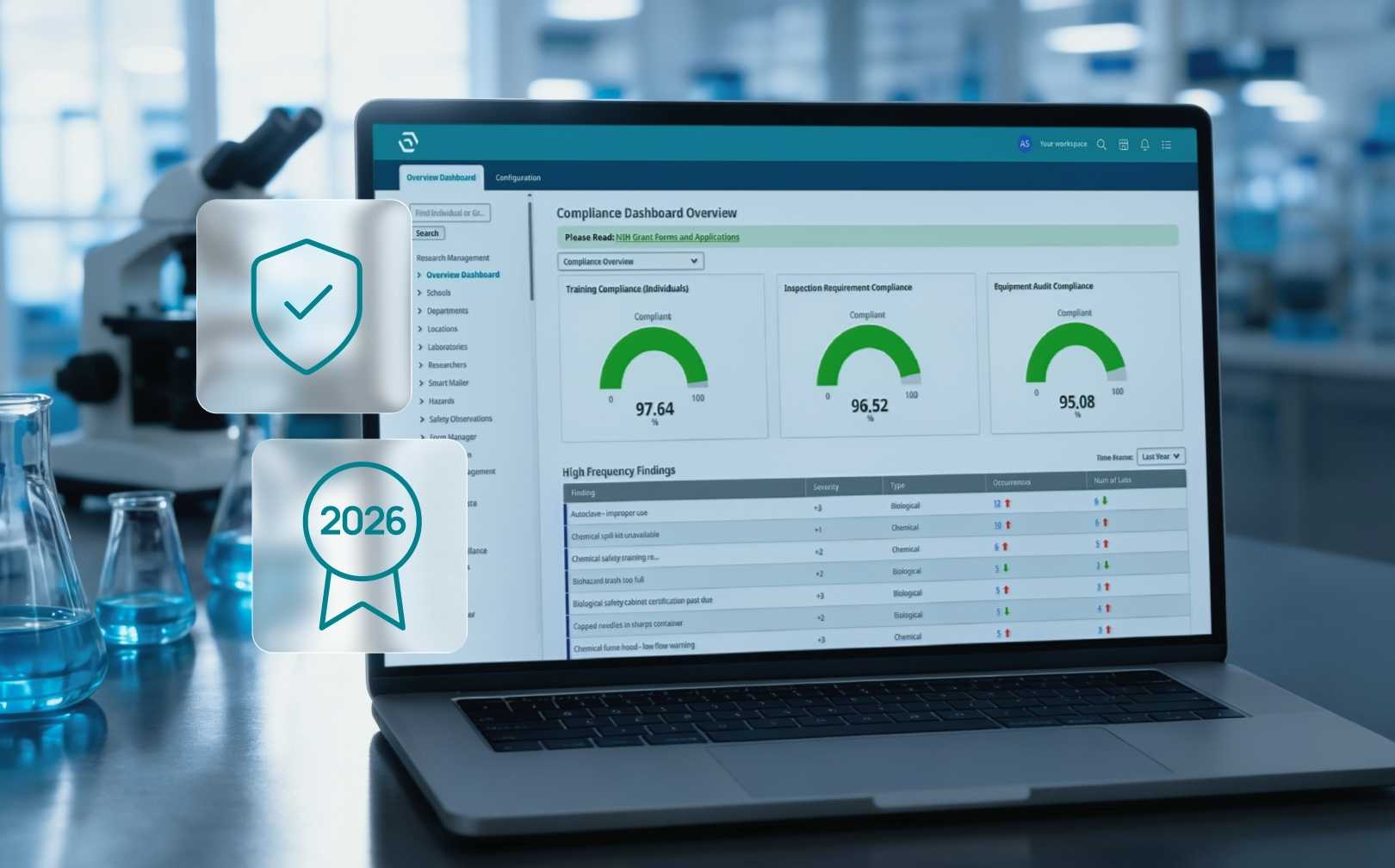
Why Lab Safety Inspections Matter More as Your Lab Scales
Lab safety inspections protect people first. Your goal as a leader is to make safety visible, actionable, and scalable before the next issue appears.
Download Whitepaper
TL;DR
A lab safety inspection is a structured check of both the physical lab and the management system behind it, verifying that chemicals, hazardous waste, biological agents, and emergency equipment are controlled, documented, and assigned an owner before a problem becomes an injury, a failed audit, or research downtime.
- The 2026 compliance backbone.
Inspections should surface the US standards behind lab work: OSHA's Laboratory Standard (29 CFR 1910.1450) and its written Chemical Hygiene Plan, the Hazard Communication Standard (29 CFR 1910.1200) updated to Globally Harmonized System (GHS) Revision 7, EPA hazardous waste rules (40 CFR 262.15), eyewash access (29 CFR 1910.151(c)), and National Fire Protection Association (NFPA) fire codes.
- Safety inspections tend to scale as labs grow.
A single inspection can catch a blocked eyewash, an unlabeled secondary container, an open waste bottle, expired training, or a missing safety data sheet. Across dozens of labs, the same finding signals a systemic gap in training assignment, purchasing, chemical storage, or building infrastructure rather than one lab's discipline.
- What strong inspection programs include.
Strong programs scope by risk, build checklists that mirror the actual work (chemical, biological, radiological), and inspect both the physical space and the management system behind it. They document each finding with its hazard, owner, and closure evidence, flag repeat findings, and add recurring self-inspections that turn safety into a continuous operating habit rather than a periodic audit event.
- Findings should be connected to context.
A finding is only as useful as the context around it. SciSure's Scientific Management Platform links inspections with ChemTracker chemical inventory, safety data sheets, hazardous waste, training, biological registration, radioisotope management, and printable door signs, so each finding connects to its hazard, its owner, and trends across labs, buildings, and time.
- San Diego State University: Inspection execution & visibility.
After adopting SciSure, San Diego State University (SDSU) reported inspecting 100% of spaces where chemicals were used, grew training from about 500 completed records to more than 4,600 in a year, raised training compliance from 56% to over 80%, and cut reports that once took hours to minutes.
This post was originally published in 2023 and has been fully updated to reflect SciSure's positioning as a Scientific Management Platform, current industry research and safety benchmarks, and new customer results from San Diego State University.
Ready to see SciSure in action?
No commitment · Free consultation
Lab safety inspections are how you prove that your safety program is working where the work actually happens: at the bench, in the chemical cabinet, beside the fume hood, near the waste container, and inside the workflows your researchers use every day.
If you manage one lab, an inspection can catch a blocked eyewash, an unlabeled secondary container, an expired training requirement, or a waste bottle that should have been closed. If you manage dozens or hundreds of labs, those same issues become enterprise risk. One missed finding can become an injury. One out-of-date chemical inventory can distort fire-code reporting. One unresolved corrective action can become a repeat audit issue. One unavailable SDS can slow an emergency response.
That's why inspections matter to lab managers and EHS directors, but also to senior leaders. For a COO, inspections help protect uptime. For a VP of Research, they help keep scientific work moving without preventable shutdowns. For legal, risk, and finance leaders, they create evidence that the organization is managing hazards systematically, not relying on memory, email threads, and last-minute cleanup.
At an enterprise scale, the real question is whether you can show what was inspected, what was found, who owns the follow-up, what changed, and whether the same issue keeps coming back.
Read More: The 5 Best EHS Software for Labs in 2026
Why lab safety inspection matters: The compliance context for 2026
Lab inspection programs should reflect the regulations and standards that apply to your work, location, funding, and hazards. This is not a complete legal checklist, and your local authority having jurisdiction, state requirements, institutional policies, and accreditation obligations may add more. But for many U.S. research organizations, these are the standards that should be visible in your inspection program.
OSHA Laboratory Standard
OSHA's Laboratory Standard, 29 CFR 1910.1450, applies to employers engaged in the laboratory use of hazardous chemicals. It requires a written Chemical Hygiene Plan that is capable of protecting employees from chemical health hazards and keeping exposures below applicable limits.
For inspections, that means your team should be able to verify more than general cleanliness. You should also be checking whether standard operating procedures match the work being performed, whether fume hoods and other protective equipment are functioning properly, whether PPE and hygiene practices are appropriate, whether training is current, and whether additional protections are in place for particularly hazardous substances such as select carcinogens, reproductive toxins, and substances with high acute toxicity.
Read More: Chemistry Lab Safety Guide: 14 Rules for a Safer Labs
OSHA Hazard Communication Standard
OSHA updated the Hazard Communication Standard in 2024. The current 29 CFR 1910.1200 text shows the rule became effective July 19, 2024. For substances, chemical manufacturers, importers, and distributors were required to comply with modified provisions by May 19, 2026. Employers must make any necessary substance-related updates to alternative workplace labels, the hazard communication program, and additional employee training by November 20, 2026. For mixtures, chemical manufacturers, importers, and distributors have until November 19, 2027, with employer updates due by May 19, 2028.
For lab managers and EHS directors, this makes SDS access, workplace labels, container-level inventory, and updated training more than paperwork. If a supplier's hazard classification changes, you need a way to know which labs may be affected, which labels or procedures need review, and which workers may need updated training.
Emergency equipment and eyewash access
OSHA 29 CFR 1910.151(c) requires suitable facilities for quick drenching or flushing of the eyes and body where someone may be exposed to injurious corrosive materials. Your inspection should verify that emergency showers and eyewashes are accessible, unobstructed, tested according to your institutional program, and known to the people working nearby.
A blocked eyewash is so much more than just a small housekeeping issue. In a real splash event, it's the difference between immediate response and preventable harm.
EPA Hazardous Waste Generator Rules
EPA regulates hazardous waste generators under RCRA. Generator category is based on how much hazardous waste is generated in a calendar month, not the size of the organization.
For satellite accumulation areas, 40 CFR 262.15 allows small and large quantity generators to accumulate limited amounts of hazardous waste at or near the point of generation under the control of the operator, provided the conditions are met. Containers must be in good condition, compatible with the waste, closed except when adding or removing waste, and marked with the words "Hazardous Waste" plus an indication of the hazards. Excess waste above the satellite accumulation limit must be managed within three consecutive calendar days.
In practical inspection terms, that means you should check the waste label, container condition, cap status, compatibility, location, accumulation area control, and whether the team understands when a pickup request or escalation is needed.
Read More: 4 Chemical Inventory Tracking Tools & Where they work Best
Fire Code, NFPA, and local AHJ expectations
Chemical-heavy labs should treat fire-code visibility as an inspection topic over just a facilities topic. Depending on your jurisdiction, this may involve International Fire Code or International Building Code requirements, NFPA standards, local amendments, and authority-having-jurisdiction interpretation.
The inspection question is simple: can you see whether flammable liquids, oxidizers, corrosives, compressed gases, and other hazardous materials are stored in the right place and within the limits that apply to the space? If the answer depends on someone manually reconciling purchase records, room signs, and cabinet counts before every audit, your program is carrying avoidable risk.
Biosafety and radiation safety
If your organization handles biological materials, recombinant or synthetic nucleic acids, infectious agents, toxins, or radiological materials, your inspections should include the oversight workflows that govern that work.
NIH's April 2024 Guidelines for Research Involving Recombinant or Synthetic Nucleic Acid Molecules detail safety practices and containment procedures for covered work. NIH also notes that IBC minutes from meetings taking place on or after June 1, 2025 must be posted on a public-facing institutional website, and that certain significant problems, violations, accidents, illnesses, spills, and exposures must be reported to NIH OSP.
For radiation programs, 10 CFR Part 20 establishes standards for protection against ionizing radiation for NRC-licensed activities. In lab inspection language, that means you may need to verify authorization, postings, inventory, storage, contamination controls, waste handling, dosimetry, survey records, and training.
Why this matters for your lab, no matter your stage of growth
Inspections generate early warnings about operational fragility. They show where the organization is absorbing risk quietly, before it turns into downtime, failed audits, injuries, fines, reputational damage, or research delays.
At enterprise scale, inspections also become a governance system. No matter your level, you need to know whether one lab's recurring issue is an isolated behavior problem or a sign that your training, procurement, storage, waste, or building infrastructure process is failing across the organization. This is where senior leaders should care.
For example:
- If several labs have the same chemical segregation issue, you may need better storage guidance, purchasing controls, or door sign data.
- If many inspection reports show expired training, the issue may be role-based training assignment, not lab discipline.
- If inspectors repeatedly find waste containers open, you may need to revisit waste stream profiles, pickup frequency, or lab-facing instructions.
- If a fire-code report shows a control area approaching a maximum allowable quantity, leadership may need to adjust space planning, purchasing, or occupancy decisions before growth creates a facilities problem.
- If a biological registration expires while work continues, the problem is not just a missing form. It is a breakdown in oversight visibility.
How to conduct a lab safety inspection
1. Define the scope by risk
Start by deciding which spaces, hazards, programs, and records are in scope. You may inspect a single lab, a department, a building, a multi-site research operation, or a specific program such as chemical storage, hazardous waste, biosafety, radiation safety, training, or emergency equipment. The scope should reflect the risk profile of the work, not only the floor plan.
Before the inspection, gather:
- Lab roster and responsible parties
- Spaces, storage rooms, shared equipment areas, and waste accumulation areas
- Chemical inventory and SDS records
- Biological registrations, IBC approvals, or project status where applicable
- Radiation authorizations, isotope records, or waste records where applicable
- Training requirements and completion records
- Previous inspection reports and open findings
- Incident, near-miss, and safety observation history
- Door signs, hazard profiles, emergency contacts, and PPE requirements
With SciSure, you can connect this context across inspections, training, personnel, chemical inventory, hazardous waste, incidents, biological registration, radioisotope management, safety contacts, and door signs. That matters because your inspection is only as strong as the information you bring into it.
2. Prepare a checklist that mirrors the real work
For a chemistry lab, that may mean chemical storage compatibility, SDS access, fume hood use, peroxide-former tracking, flammable limits, waste containers, eyewashes, spill materials, and door signs. For a biological lab, it may mean BSC certification, disinfectants, biological material registration, biohazard labeling, sharps, waste segregation, PPE, and exposure response. For a radiological lab, it may mean survey meters, postings, isotope security, dosimetry, contamination surveys, waste containers, and authorization limits.
SciSure's Inspection Module supports configurable inspection findings and inspection types, including checklist and questionnaire formats. Findings can include preconfigured comments and corrective action text, so inspectors are not rewriting the same guidance over and over. When a question is answered in a way that indicates a problem, the corrective action guidance can be brought into the report.
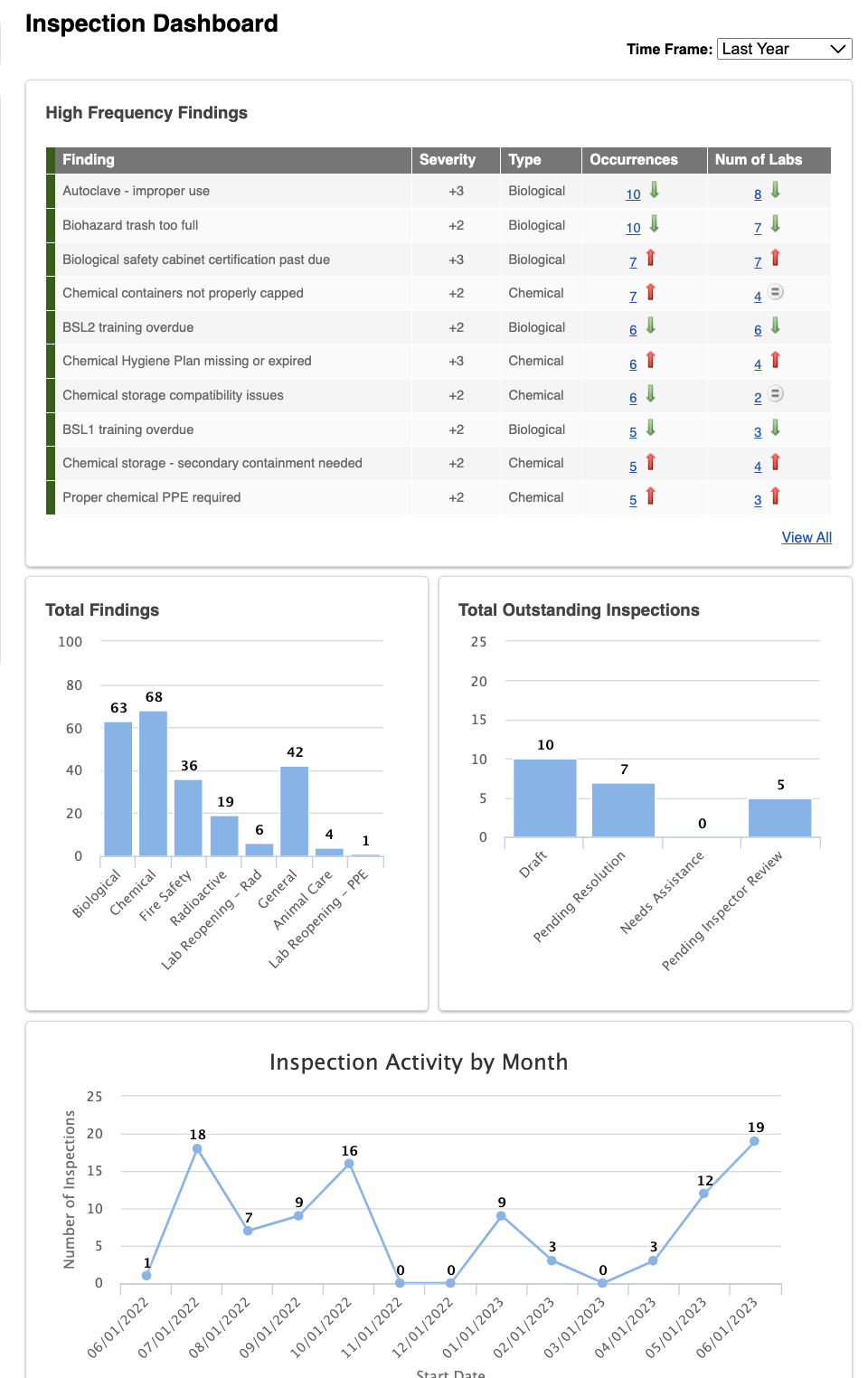
This is useful for consistency. It also gives leadership cleaner data later, because findings are structured enough to analyze across labs, departments, buildings, and time.
3. Inspect both the space and the system
During the walkthrough, look for the physical condition of the lab, but also the management system behind it.
For chemical safety, don't stop at whether the cabinet looks tidy. Ask whether the chemical inventory reflects what is actually there. Check whether labels and SDS records are accessible. Confirm that incompatible chemicals are segregated. Look for peroxide-formers, expired chemicals, unneeded legacy containers, compressed gases, and uncontrolled movement of hazardous materials between rooms.
SciSure's ChemTracker and SDS capabilities can support this by connecting container-level chemical inventory with hazard and regulatory data. It also includes SDS auto-match for chemical containers, including use of chemical names, synonyms, CAS numbers, manufacturer, product number, and SDS recency, with eligible containers rechecked over time. ChemTracker reports can also support Containers by Regulation, Totals by Regulation, NFPA reporting, Tier II / RTK-style reporting, and fire-code visibility where configured.
Here's a non-exhaustive list of SciSure's chemical inventory features.
Hazardous waste
For hazardous waste, inspect the label, cap, container condition, secondary containment, compatibility, accumulation area, pickup process, and whether the lab knows what to do when a container is full or a waste stream changes. SciSure's Hazardous Waste workflows support waste stream profiles, pickup requests, open request tracking, lab-level waste histories, bulk closing, filters, and exportable reports.
Training
For training, compare the hazards in the room with the people authorized to work there. If a researcher works in multiple labs, training should follow the person and the exposure, not a single spreadsheet tab. SciSure's Training workflows support training requirements, records, certificates, compliance visibility, and automated reminders configured by the organization's safety team.
Emergency readiness
For emergency readiness, check the eyewash, shower, spill supplies, exits, fire extinguishers, emergency contacts, door signage, and whether the posted information matches the hazards inside the room. SciSure Door Signs can use space-level hazard information, contact information, NFPA 704 data, GHS or ISO-style hazard icons, PPE/precaution icons, regulatory considerations, and entrance procedures to generate printable door signs.
4. Document findings with enough detail to fix them
Your goal should be to make the next safe action obvious. A useful finding should answer:
- What was observed?
- Where was it observed?
- Why does it matter?
- What corrective action is required?
- Who owns the follow-up?
- What evidence is needed to close it?
- Has this happened before?
With SciSure inspection reports, you can capture finding details, comments, corrective action text, the space where the item was found, and attachments such as photos. You can flag findings observed within the last 18 months, which helps inspectors and lab leaders see repeat issues rather than treating every finding as new. One-time issues may need correction, while recurring issues may need program-wide changes.
Track correspondence and closure
The inspection is done when the risk has been addressed and the record shows what happened. With SciSure's inspection workflows, you can also report status, coordinate correspondence, and follow-up communication inside the inspection report. A report may indicate whether follow-up is pending, whether resolution is required, or whether the inspection has been finalized. Correspondence can stay connected to the report instead of being scattered across email.
This creates a clearer audit trail. If an auditor, department head, or senior leader asks what happened after an inspection, you can show the report, the finding, the lab's response, and the closure path.
5. Include self-inspections
Self-inspections help lab teams identify hazards before EHS arrives. They also build ownership. A lab manager can use self-inspections to verify weekly eyewash checks, satellite accumulation area conditions, chemical storage, expired materials, equipment status, PPE availability, or training gaps.
SciSure Self-Inspection workflows let groups view self-inspection logs, inspect their own spaces, answer configured inspection questions, add details, and use pre-populated corrective action guidance when a "No" response identifies an issue.
For senior leaders, this matters because self-inspections turn safety from a periodic audit event into a recurring operating habit.
What to include in a lab inspection checklist
General lab safety
Check housekeeping, trip hazards, clear exits, emergency access, food and drink restrictions, PPE availability, lab-specific SOPs, signage, emergency contacts, spill response materials, and whether work practices match the documented procedures. For example, your lab might have the correct SOP for handling corrosive liquids, but the eyewash path is blocked by a cart. The paper requirement exists, but the emergency response would fail in real life.
Chemical Safety and SDS
Check container labels, secondary containers, incompatible storage, flammables, oxidizers, corrosives, compressed gases, peroxide-formers, expired chemicals, fume hood use, SDS access, and whether chemical inventory is current. For example, if one of your researchers orders an additional case of solvent because the spreadsheet says stock is low, but three bottles are already in a different room. The purchase pushes a control area closer to a fire-code threshold and creates unnecessary waste liability.
Hazardous waste
Check satellite accumulation areas, container condition, cap status, compatibility, labels, hazard indication, pickup requests, waste stream profile accuracy, and whether the lab knows what to do when waste changes. For example, a bottle labeled "waste" without hazard information may seem minor until a facilities employee, emergency responder, or waste vendor needs to know whether the contents are ignitable, corrosive, reactive, toxic, or incompatible with nearby materials.
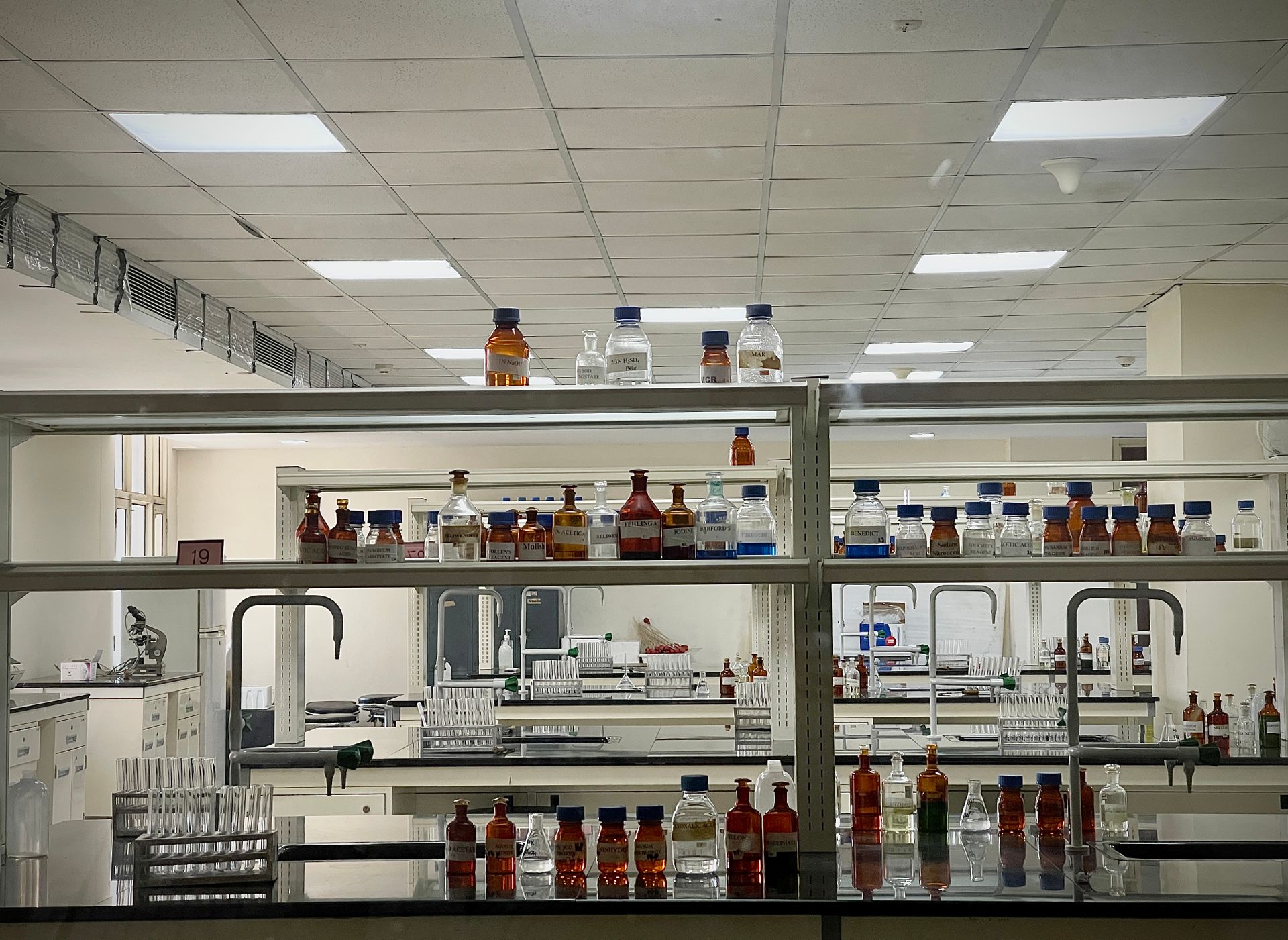
Biological safety
Check biohazard signage, BSC certification, disinfectant availability and contact time, PPE, sharps, biohazard waste, exposure response, biological registration status, IBC review status where applicable, and whether project amendments or renewals are current. For example, if your lab changes from non-pathogenic material to viral vector work, but the registration and training process has not caught up. The inspection should surface that mismatch before the work becomes an incident report.
Radiation safety
Where applicable, check authorized users, isotope inventory, security, postings, contamination surveys, survey meter calibration, dosimetry, radioactive waste containers, sewer disposal records where permitted, and renewal status. For example, one of your radioactive waste containers might be physically present and labeled, but the status in the system has not been updated. That creates uncertainty about pickup, decay, disposal, and accountability.
Training and personnel
Check whether personnel are associated with the right labs, spaces, job activities, hazards, and required training. Confirm that lapsed training is visible and actionable. For example, if one of your researchers has completed general lab safety training, but now works with a chemical, biological agent, or isotope that triggers additional requirements. Your inspection should catch the exposure-specific gap.
Incidents, near misses, and safety observations
A near miss involving a spill, a close call with a sharps container, or repeated unsafe storage observations should influence what the inspector looks for.
San Diego State University: Inspection execution & visibility in practice
Before implementing SciSure, San Diego State University's EHS team did not have reliable, current insight into how many lab spaces existed, who was working in which labs, or what hazards those labs contained. That kind of uncertainty is familiar to many EHS leaders at growing or decentralized institutions. If you can't see the people, spaces, hazards, and records clearly, every inspection program carries blind spots.
SDSU started with SciSure's platform and Door Signs, then added ChemTracker and SDS, Hazardous Waste, and Radioisotope Management. With better visibility, the EHS team could identify what hazards were present, communicate with the right people when safety-critical building issues occurred, and report with confidence that 100% of spaces where chemicals were used had been inspected. The team could also identify which labs were working with biological materials or other specific hazards.
The training results were also concrete. SDSU's EHS/Lab Safety program went from eight training courses and about 500 completed records in a year to 16 courses and more than 4,600 completed records the next year. Training compliance rose from 56% to over 80%. Reports that previously took an hour, 2.5 hours, or even two weeks could be generated in minutes.
For lab managers, that means less time chasing records and more time helping the lab stay ready. For EHS directors, it means better program oversight. For senior leaders, it means a clearer answer to a high-stakes question: do we actually know whether our research spaces are safe, compliant, and ready for inspection?
What the strongest inspection programs do well
First, they connect findings to hazards. A finding about a blocked eyewash, unlabeled waste bottle, expired BSC certification, or missing training record should be connected to the risk it creates.
Second, they connect findings to ownership. The lab manager, PI, EHS specialist, facilities team, biosafety officer, radiation safety officer, or department leader should know what they need to do next.
Third, they connect findings to enterprise visibility. EHS leaders should be able to see trends across buildings, departments, labs, hazard types, and time.
This is where a connected lab platform fits naturally. Inspections are more useful when they sit next to chemical inventory, SDS management, training, hazardous waste, incident reporting, biosafety, radioisotope management, door signs, safety contacts, audit logs, and reporting. Instead of asking every team to maintain a separate slice of the safety picture, you can make the picture visible across the organization.
Lab safety inspections protect people first.
They also protect research continuity, institutional trust, funding timelines, insurance posture, and the ability to scale without surprises.
For lab managers, inspections help you catch the practical issues that make a lab safer tomorrow: blocked equipment, mislabeled containers, incomplete training, unclear waste streams, outdated signs, or unresolved findings.
For EHS directors, inspections turn local observations into program intelligence. You can see where risk is concentrated, which labs need help, which corrective actions are stuck, and which hazards are changing.
For senior leaders, inspections are evidence of operational discipline. They show that safety is not dependent on heroic manual effort. It is built into the way the organization runs.
In all cases, your goal should be to make safety visible, actionable, and scalable before the next issue appears.
If this sounds like the kind of lab you'd like to lead, get in touch with us to explore how SciSure's Health & Safety features help you build a safer, more connected lab.

Read more of our blogs about modern lab management
Discover the latest in lab operations, from sample management to AI innovations, designed to enhance efficiency and drive scientific breakthroughs.