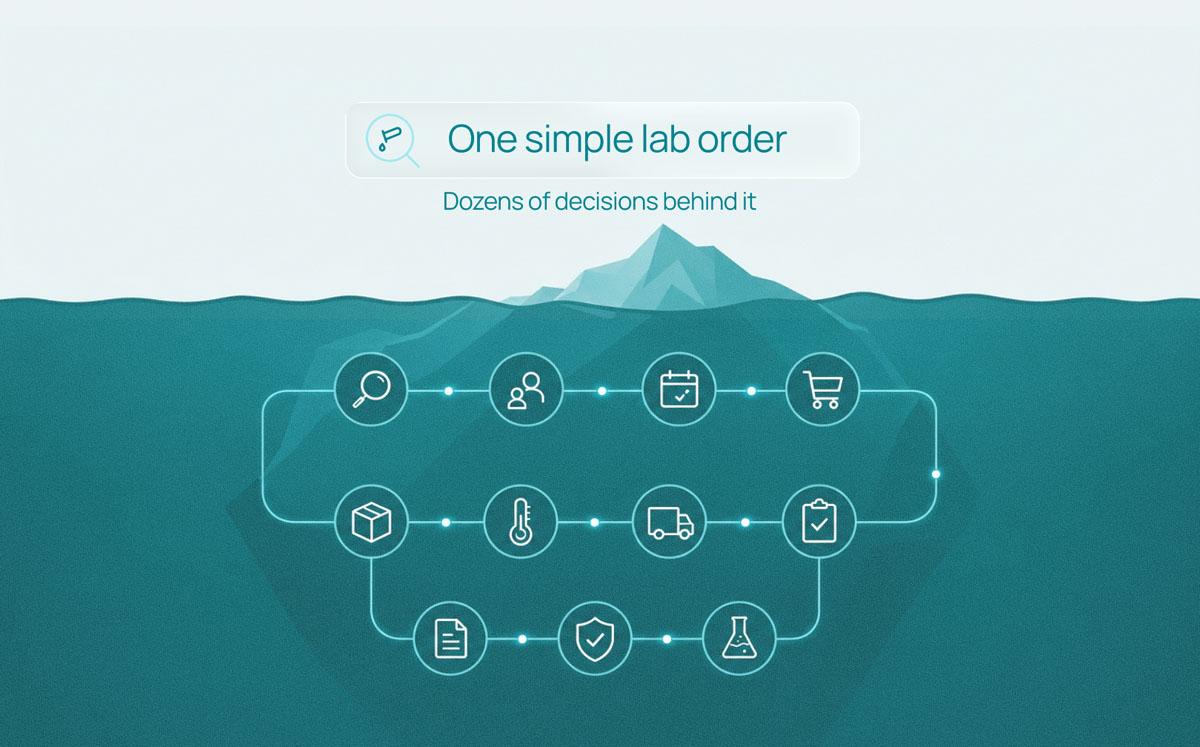
Why Lab Software ROI Starts with Implementation.

Any minute a scientist saves on administration is a minute that goes toward advancing science. That's why a solid Implementation process is where the ROI begins.

July 28, 2026
()
min read
A laboratory

Download Whitepaper

By submitting this form, you agree with our Privacy Policy.
Thank you! Download the file by clicking below:
Download
Oops! Something went wrong while submitting the form.

Table of Contents

Thank you! Your submission has been received!
Oops! Something went wrong while submitting the form.

Table of Contents

In every role I have held throughout my career, I have focused on using software to improve the lives of the humans who actually use it.

The throughline of my career, beginning in my early days as a Peoplesoft Implementation Consultant through my years at ADP up until my recent CEO stints in healthcare and in life sciences, is a focus on implementation. My mission was to find ways to deploy software better: with fewer steps, more automation, and less homework for the customer.

I say all of this because implementation is where you make your first, and often your biggest, impression on a new customer or an existing customer eager to do more with you.

So, I want to explain how we think about it at SciSure, and why I believe it is the real starting line for return on investment (ROI).

I will say this plainly, and I say it with real pride in our team: We have never had a failed implementation.

This is how we got there.

Installation is not implementation

As mentioned, I started as a Project Manager implementing PeopleSoft. In those early days, what I enjoyed most was sitting down with end users and showing them not what the software could do (that is a feature) but what it would do for them. How much faster they could finish a task, how much more they could see in a report they never had access to before, and how a configurable query could become a report that the organization replies upon.

I wrote the SQL database queries myself. I helped executives run their financial systems and end users to do their work faster, and more accurately. From there I spent years running implementation operations for larger organizations, including ADP - the largest human capital management company in the world - and later moved into healthcare. This included leading PatientKeeper, a former holding company of HCA Healthcare – the largest healthcare provider in the US.

These experiences have taught me that there are two kinds of implementation.

The first kind just gets the product turned on. The software was not there yesterday; it is there today. It is available. I call that installation.

The second kind treats the very first day as the moment the transfer of knowledge begins. You are setting up the software, but you are also showing the people who will live in it every day how it makes their work faster and their data clearer. You are teaching. You are showing how the new workflows are better, faster, and more precise than the legacy workflows.

At “go-live”, two things have happened. Yes, the system is running. But you also have a group of confident users who understand the software and are ready to bring everyone else along. That difference, between an installation and a genuine implementation complete with transfer of knowledge, is the whole game.

For most people receiving new software, implementation is a dirty word, and I understand why.

In their minds, implementation equals homework. It means extra tasks on top of a full-time job. It means hunting down information they may not have and making setup decisions they are not equipped to make. Senior stakeholders want nothing to do with it, which is one of the reasons software adoption often fails at enterprise. It’s long in duration and filled with calls, complicated documents, and meetings.

We reject that idea completely.

We engineer the homework out

At SciSure, we talk constantly about lowering what we call “activation energy”: the effort it takes a customer just to get started. Practically, that means we look at every step of implementation and ask how we can automate it, standardize it, simplify it, or remove it entirely.

Think about buying a car. In the old days, before you could even test drive, you had to call your bank to arrange financing, call the motor vehicle office about registration, and call your insurer for a quote and paperwork. You showed up at the dealership with a folder full of documents, and after a week of back and forth, you might finally drive away.

Today you get a quote online, book an appointment, test drive the car, and walk out a few hours later in a vehicle that is financed, registered, and insured. The steps did not disappear. The dealer just took them off your plate.

That is exactly the experience our customers have come to expect, and it is how we have engineered our implementations.


We arrive with a setup that says, based on organizations or labs like yours, here is the optimal configuration. We have templates that let you copy an existing lab rather than make a hundred decisions from scratch.  

For executives, we bring the reports other leaders in their position already rely on and ask which ones will help most. We even offer prospective customers an actual demonstration environment before they buy, so they can try it, and copy that setup straight into their live system if they move forward. Preserving the work performed in the demo environment should the prospect want continuity.

SciSure
See the reports your peers already trust.
Book an executive demo with SciSure to test out a life version of your scientific workflows, and keep every bit of work if you want to move forward.
Talk to a specialist.

There is a principle from “lean” that has stayed with me: the best task is the one you no longer have to do, because it was not adding value to the customer in the first place. That is the standard we hold ourselves to; hence we eliminate meetings, non value-added tasks, and long implementations.

This is where ROI begins

We put this effort into implementation because it is what makes the return arrive faster.

You pay your scientists to practice science. You do not pay them to do inventory counts, to key in materials, or log procurement receipts. If someone is coming in thirty minutes early or staying thirty minutes late to wrangle a system, that time is pure loss. When implementation is done right, that time comes back. You have given a researcher an hour a day to spend performing experiments or to spend at their discretion.

After 25 years in this industry, I can tell you that if you get the workflow right, everything else follows.


Better decisions, cleaner data insight, the analytics everyone is excited about: those are real, but they are second-order benefits. They are only trustworthy if the underlying workflow is sound. If your scientists are working around a system because it creates more work than it removes, you cannot trust the data coming out of it.  

Get the workflow right first, and the good data, and the good decisions, come with it.
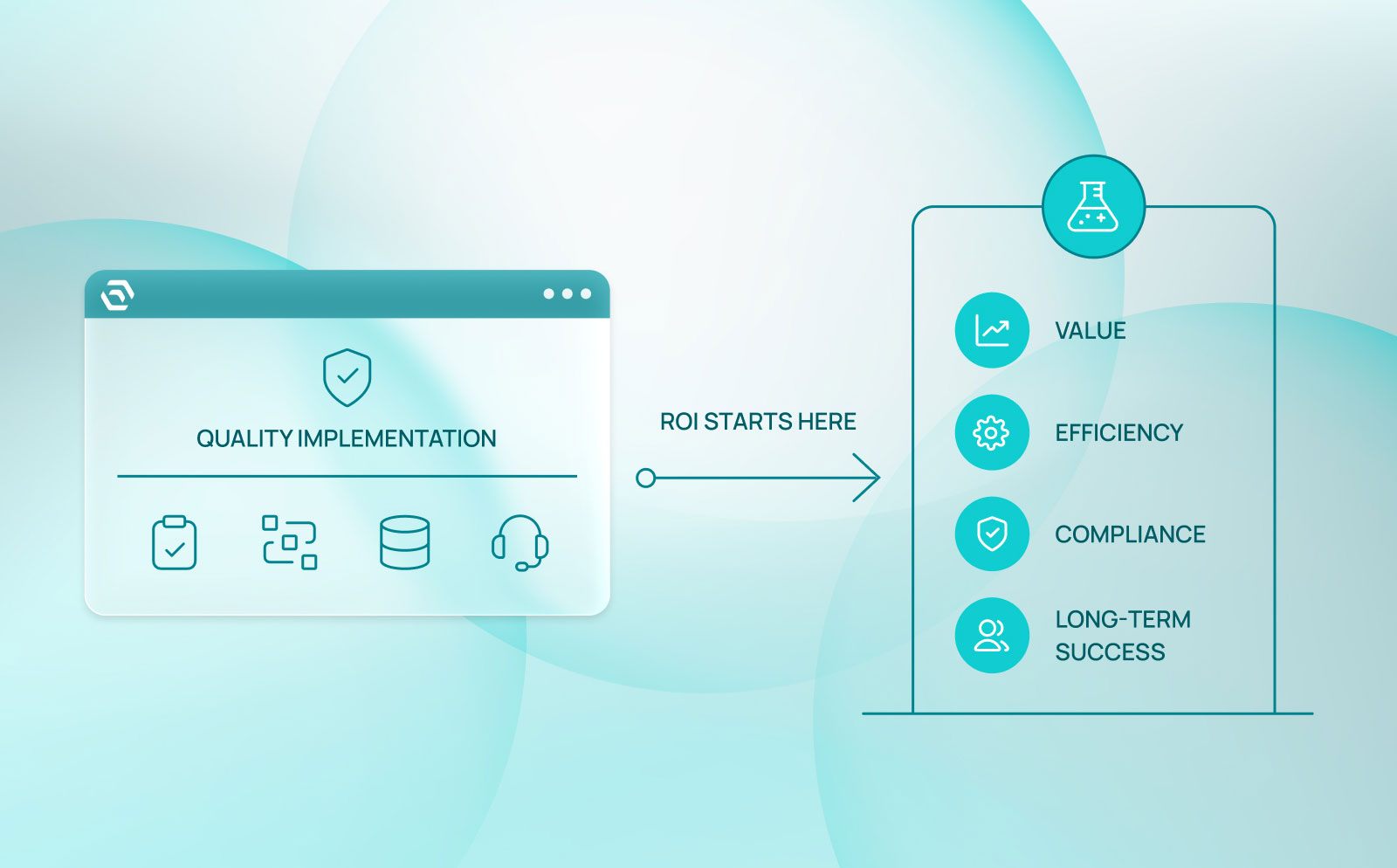
A solid Implementation process is tied to software ROI
Where a solid Implementation process is tied to software ROI

Speed and effort are not the same thing, and the difference matters.

Speed is the raw time from start to finish. Effort is the actual work it takes to set the system up and we optimize relentlessly for this specifically.

We have pre-configured data conversion templates for every competitor's system, so if you are switching from another tool, we already know its data structure and can carry that weight for you. We have engineered training into a series of videos, with on-site help when it is needed, to move knowledge across as efficiently as possible.

Speed matters, and we want customers live quickly. Our implementations are designed to consolidate effort so that customer-defined tasks are communicated early, discussed clearly, and completed timely.  This reduces ‘duration’ or white space in between decisions, resulting in both less effort and, as an outcome, greater speed.

We measure success on two things, and neither is "You can log in."

The first is time to live productive use. What counts is a researcher running a real workflow in SciSure that they used to do on paper or in another system. On average that takes about twelve weeks. It can be as fast as four. For the largest, most complex enterprises it can reach twenty-four.  If an implementation is running past six months, in my view it has run too long. We do not accept that as normal.

The second is how many people we train along the way. Training is our best proxy for a healthy implementation, for two reasons. More trained users mean more internal advocates, and it means more people realizing the benefits rather than just having access to them.

We likewise do not stop watching at go-live. We check adoption (and regular customer check in events known as “Value Realization” calls) at six months, nine months, a year, and consistently thereafter. If customers bought a certain number of licenses, we want them used, and we want them using the full range of system capability.

What good implementation leadership looks like

If you are evaluating vendors, the simplest test is this: a real implementation partner reduces customer homework. If a vendor's process seems to pile more work onto you, it is probably not as engineered as it should be. That's also why the license fee is often just the starting point when evaluating software.

On your side of the table, three things tend to slow the return down, and all three are manageable if you plan for them.  

First, consider variation across departments.

Different data structures, different setups, different opinions about how a field should be named. Our advice is to configure for roughly ninety percent of your use cases up front and handle the exceptions after, rather than trying to bend the system around every one-off before you have started.  

Next, consider data quality.

We put data scientists on your existing records before go-live so that old, messy data does not create a garbage-in, garbage-out situation that delays your return. Preserving data integrity in labs is a non-negotiable first step for us, including research data integrity.

Finally, factor in decision-making.  

We will never make a decision that affects your compliance or your science on your behalf; we do that as a partnership. But that means you need a strong Executive Sponsor and the right people at the table: information technology, compliance, operations, and representatives of the scientists themselves.

People first, then process, then technology.

We are not naive about this. We know we are not the only project on anyone's plate. That is exactly why we have built our entire methodology around minimizing decisions and deliverables.

The part I am proudest of

SciSure has implemented enterprise software at some of the largest biopharma, biotech, academic institutions, and healthcare companies and most respected research institutes in the world, from small incubators to the most prestigious organizations.  

When we take on a customer with hundreds or even thousands of labs, we do not try to light them all up at once. We start with a group of early adopters, often around fifty labs, get them live, capture their video testimonials, and use that momentum to bring the rest along.  

We look for the labs whose procedures are already well-documented and standardized, and for the influential principal investigator whose success makes her an advocate for everyone else. That is change management, and it is the opposite of a rush to install as many labs as fast as possible.

I have believed one thing my entire career: any minute a scientist saves on administration is a minute that goes toward advancing science.


And that is the whole point. We are confident in what we do, we have the record to back it up, and we are here to help you get on with the work that matters.

If this sounds like the kind of hands-on support you need, get in touch with us. We are always ready for a conversation and look forward to being a part of your scientific journey.

Ready to see SciSure in action?

Get a personalized demo and see how SciSure fits your lab's workflows.
Request demo

No commitment · Free consultation

In every role I have held throughout my career, I have focused on using software to improve the lives of the humans who actually use it.

The throughline of my career, beginning in my early days as a Peoplesoft Implementation Consultant through my years at ADP up until my recent CEO stints in healthcare and in life sciences, is a focus on implementation. My mission was to find ways to deploy software better: with fewer steps, more automation, and less homework for the customer.

I say all of this because implementation is where you make your first, and often your biggest, impression on a new customer or an existing customer eager to do more with you.

So, I want to explain how we think about it at SciSure, and why I believe it is the real starting line for return on investment (ROI).

I will say this plainly, and I say it with real pride in our team: We have never had a failed implementation.

This is how we got there.

Installation is not implementation

As mentioned, I started as a Project Manager implementing PeopleSoft. In those early days, what I enjoyed most was sitting down with end users and showing them not what the software could do (that is a feature) but what it would do for them. How much faster they could finish a task, how much more they could see in a report they never had access to before, and how a configurable query could become a report that the organization replies upon.

I wrote the SQL database queries myself. I helped executives run their financial systems and end users to do their work faster, and more accurately. From there I spent years running implementation operations for larger organizations, including ADP - the largest human capital management company in the world - and later moved into healthcare. This included leading PatientKeeper, a former holding company of HCA Healthcare – the largest healthcare provider in the US.

These experiences have taught me that there are two kinds of implementation.

The first kind just gets the product turned on. The software was not there yesterday; it is there today. It is available. I call that installation.

The second kind treats the very first day as the moment the transfer of knowledge begins. You are setting up the software, but you are also showing the people who will live in it every day how it makes their work faster and their data clearer. You are teaching. You are showing how the new workflows are better, faster, and more precise than the legacy workflows.

At “go-live”, two things have happened. Yes, the system is running. But you also have a group of confident users who understand the software and are ready to bring everyone else along. That difference, between an installation and a genuine implementation complete with transfer of knowledge, is the whole game.

For most people receiving new software, implementation is a dirty word, and I understand why.

In their minds, implementation equals homework. It means extra tasks on top of a full-time job. It means hunting down information they may not have and making setup decisions they are not equipped to make. Senior stakeholders want nothing to do with it, which is one of the reasons software adoption often fails at enterprise. It’s long in duration and filled with calls, complicated documents, and meetings.

We reject that idea completely.

We engineer the homework out

At SciSure, we talk constantly about lowering what we call “activation energy”: the effort it takes a customer just to get started. Practically, that means we look at every step of implementation and ask how we can automate it, standardize it, simplify it, or remove it entirely.

Think about buying a car. In the old days, before you could even test drive, you had to call your bank to arrange financing, call the motor vehicle office about registration, and call your insurer for a quote and paperwork. You showed up at the dealership with a folder full of documents, and after a week of back and forth, you might finally drive away.

Today you get a quote online, book an appointment, test drive the car, and walk out a few hours later in a vehicle that is financed, registered, and insured. The steps did not disappear. The dealer just took them off your plate.

That is exactly the experience our customers have come to expect, and it is how we have engineered our implementations.


We arrive with a setup that says, based on organizations or labs like yours, here is the optimal configuration. We have templates that let you copy an existing lab rather than make a hundred decisions from scratch.  

For executives, we bring the reports other leaders in their position already rely on and ask which ones will help most. We even offer prospective customers an actual demonstration environment before they buy, so they can try it, and copy that setup straight into their live system if they move forward. Preserving the work performed in the demo environment should the prospect want continuity.

SciSure
See the reports your peers already trust.
Book an executive demo with SciSure to test out a life version of your scientific workflows, and keep every bit of work if you want to move forward.
Talk to a specialist.

There is a principle from “lean” that has stayed with me: the best task is the one you no longer have to do, because it was not adding value to the customer in the first place. That is the standard we hold ourselves to; hence we eliminate meetings, non value-added tasks, and long implementations.

This is where ROI begins

We put this effort into implementation because it is what makes the return arrive faster.

You pay your scientists to practice science. You do not pay them to do inventory counts, to key in materials, or log procurement receipts. If someone is coming in thirty minutes early or staying thirty minutes late to wrangle a system, that time is pure loss. When implementation is done right, that time comes back. You have given a researcher an hour a day to spend performing experiments or to spend at their discretion.

After 25 years in this industry, I can tell you that if you get the workflow right, everything else follows.


Better decisions, cleaner data insight, the analytics everyone is excited about: those are real, but they are second-order benefits. They are only trustworthy if the underlying workflow is sound. If your scientists are working around a system because it creates more work than it removes, you cannot trust the data coming out of it.  

Get the workflow right first, and the good data, and the good decisions, come with it.

A solid Implementation process is tied to software ROI
Where a solid Implementation process is tied to software ROI

Speed and effort are not the same thing, and the difference matters.

Speed is the raw time from start to finish. Effort is the actual work it takes to set the system up and we optimize relentlessly for this specifically.

We have pre-configured data conversion templates for every competitor's system, so if you are switching from another tool, we already know its data structure and can carry that weight for you. We have engineered training into a series of videos, with on-site help when it is needed, to move knowledge across as efficiently as possible.

Speed matters, and we want customers live quickly. Our implementations are designed to consolidate effort so that customer-defined tasks are communicated early, discussed clearly, and completed timely.  This reduces ‘duration’ or white space in between decisions, resulting in both less effort and, as an outcome, greater speed.

We measure success on two things, and neither is "You can log in."

The first is time to live productive use. What counts is a researcher running a real workflow in SciSure that they used to do on paper or in another system. On average that takes about twelve weeks. It can be as fast as four. For the largest, most complex enterprises it can reach twenty-four.  If an implementation is running past six months, in my view it has run too long. We do not accept that as normal.

The second is how many people we train along the way. Training is our best proxy for a healthy implementation, for two reasons. More trained users mean more internal advocates, and it means more people realizing the benefits rather than just having access to them.

We likewise do not stop watching at go-live. We check adoption (and regular customer check in events known as “Value Realization” calls) at six months, nine months, a year, and consistently thereafter. If customers bought a certain number of licenses, we want them used, and we want them using the full range of system capability.

What good implementation leadership looks like

If you are evaluating vendors, the simplest test is this: a real implementation partner reduces customer homework. If a vendor's process seems to pile more work onto you, it is probably not as engineered as it should be. That's also why the license fee is often just the starting point when evaluating software.

On your side of the table, three things tend to slow the return down, and all three are manageable if you plan for them.  

First, consider variation across departments.

Different data structures, different setups, different opinions about how a field should be named. Our advice is to configure for roughly ninety percent of your use cases up front and handle the exceptions after, rather than trying to bend the system around every one-off before you have started.  

Next, consider data quality.

We put data scientists on your existing records before go-live so that old, messy data does not create a garbage-in, garbage-out situation that delays your return. Preserving data integrity in labs is a non-negotiable first step for us, including research data integrity.

Finally, factor in decision-making.  

We will never make a decision that affects your compliance or your science on your behalf; we do that as a partnership. But that means you need a strong Executive Sponsor and the right people at the table: information technology, compliance, operations, and representatives of the scientists themselves.

People first, then process, then technology.

We are not naive about this. We know we are not the only project on anyone's plate. That is exactly why we have built our entire methodology around minimizing decisions and deliverables.

The part I am proudest of

SciSure has implemented enterprise software at some of the largest biopharma, biotech, academic institutions, and healthcare companies and most respected research institutes in the world, from small incubators to the most prestigious organizations.  

When we take on a customer with hundreds or even thousands of labs, we do not try to light them all up at once. We start with a group of early adopters, often around fifty labs, get them live, capture their video testimonials, and use that momentum to bring the rest along.  

We look for the labs whose procedures are already well-documented and standardized, and for the influential principal investigator whose success makes her an advocate for everyone else. That is change management, and it is the opposite of a rush to install as many labs as fast as possible.

I have believed one thing my entire career: any minute a scientist saves on administration is a minute that goes toward advancing science.


And that is the whole point. We are confident in what we do, we have the record to back it up, and we are here to help you get on with the work that matters.

If this sounds like the kind of hands-on support you need, get in touch with us. We are always ready for a conversation and look forward to being a part of your scientific journey.

About the author:

Philip Meer

Philip Meer is the Chief Executive Officer of SciSure, leading the company in pioneering the first-ever Scientific Management Platform (SMP) by merging eLabNext and SciShield. With extensive experience in executive leadership, he has successfully driven growth and innovation across multiple technology and healthcare companies. Philip holds an MBA from NYU Stern School of Business and a BA in Economics and History from Brandeis University.

See all posts from this author

Sign up for our newsletter

Get the latest tips, articles, and exclusive content on modern lab management delivered to your inbox.
Thank you for subscribing!
Please check your email to verify your submission.
Oops! Something went wrong while submitting the form.