How Can We Automate Lab Safety Inspection Workflows Across Multiple Labs?

Growing labs mean growing handoffs, all of which affect your inspections program. Here are some practical tips on making it easier.

•
November 4, 2026
•
()
min read
A laboratory

Download Whitepaper

By submitting this form, you agree with our Privacy Policy.
Thank you! Download the file by clicking below:
Download
Oops! Something went wrong while submitting the form.

Table of Contents

Thank you! Your submission has been received!
Oops! Something went wrong while submitting the form.

TL;DR

You can automate lab safety inspection workflows by connecting recurring requirements, digital checklists, report delivery, reminders, and documented follow-up, while keeping people accountable for assessing hazards and verifying corrections.
‍

  • Schedule consistently.
    With SciSure Health & Safety, you can configure inspection requirements and reminders, then schedule inspections across selected labs. This helps central safety teams coordinate coverage while accommodating different activities and risks.
  • Keep inspection forms standardized.
    This helps teams record comparable information across locations. SciSure supports configurable checklists and questionnaires, corrective-action guidance, space-specific findings, and photo attachments. Inspectors can document what needs attention and give laboratory teams practical information to act on.
  • Every inspection report needs a clear response process.
    Set resolution deadlines, identify who will coordinate corrections, and keep correspondence with the report. Configured reminders and escalation notifications can help maintain visibility when an issue needs further attention from laboratory or department leadership.
  • Verify corrections.
    A laboratory report stating that work is complete should lead to an appropriate review. Distinguish findings awaiting action from reports awaiting inspector review, retain supporting evidence and examine recurring issues. Measure inspection coverage and resolution performance together to understand how the program is working.

Build a workflow that continues after the inspection

Across multiple labs, I've found that safety findings are never an isolated incident. For example, a lab manager may clear access to an eyewash, facilities may repair it, and a safety specialist may confirm that it is ready for use. Each handoff needs a responsible person, a response deadline, and a record of what happened.

As your lab expands and grows across multiple sites, coordinating those handoffs becomes a substantial part of the inspection program.

With SciSure Health & Safety implemented, you can help your teams manage that process through configurable inspection requirements, digital records, follow-up communication, and reporting. The aim is to make the work visible from the moment an inspection becomes due through to the review of completed corrections.

Here's how to build that workflow across your laboratories.

1. Establish which labs need which inspections

Start with an accurate inventory of your laboratory spaces and the groups responsible for them. Include shared rooms, support areas, and spaces occupied by several teams. For each area, establish:

  • Which activities and hazards determine its inspection requirements
  • Who conducts the inspection
  • Who provides and/or schedules follow-up inspections
  • Who receives the report and coordinates the response
  • How often the inspection is required under your safety program
  • Who provides coverage when the usual contact is unavailable

SciSure lets you configure recurring or one-time inspection requirements using recorded criteria such as laboratory type, hazards, and department. You can also schedule multiple inspections together, select an inspector and date, and review the resulting inspection queue.

Likewise, where enabled, automated reminders can draw attention to approaching deadlines and overdue requirements. That gives your team a consistent way to manage recurring checks as personnel, projects, and laboratory occupancy change.

One example I can share from the private sector shows why continuity matters. During an August 2022 inspection of Wilmington PharmaTech’s pharmaceutical R&D facility in Delaware, regulators found no records demonstrating required weekly waste-area inspections after March 30. The company subsequently acknowledged the lapse and supplied documentation of renewed checks.

Although this concerned waste-area inspections, the operational lesson applies to recurring safety tasks: clear ownership and completion records help teams maintain continuity through disruption.

2. Standardize inspection records while allowing for different hazards

A shared inspection framework makes findings easier to compare across laboratories. It should also accommodate differences between a chemistry laboratory, a biological research space, and a shared equipment room.

With SciSure, you can configure inspection types as checklists or questionnaires, with relevant findings and predefined corrective-action guidance. Inspectors can identify the affected space, add comments, and attach photographs or documents.

A useful finding should explain the observed condition clearly enough for someone else to act on it. For example:
‍

Emergency eyewash access is obstructed by a storage cart. Remove the obstruction and provide confirmation that the access route is clear.


That's more actionable than “eyewash issue.”

SciSure also flags findings previously observed for the laboratory or space within the preceding 18 months. This helps inspectors recognize recurring conditions and consider whether the response needs to address a wider issue, such as storage arrangements, maintenance ownership or training.

Read More: 5 common questions from chemical regulators and how to address them

SmartLabs: Connecting inspection work with hazard information

SmartLabs previously used separate chemical-inventory and inspection systems that did not communicate. Implementing SciSure Health & Safety meant bringing those workflows together, giving teams access to hazard information and inspection correspondence across its US research centers.

One manager reported halving her combined reporting and inspection time using ChemTracker. The result specifically credits chemical-hazard filtering and combines several activities but is an example for how connected information can support inspection work, rather than establishing a standalone time-saving percentage for the Inspections module.

For a multi-lab safety team, the practical benefit is having relevant information available when preparing an inspection, assessing a finding, and deciding what should happen next.

SciSure Health & Safety
Bring your inspection and hazard data together
Want to see how inspections, findings, corrective actions, and chemical hazard information can work together for your labs?
Talk to a specialist

3. Make the report the starting point for follow-up

A completed inspection should initiate a defined response process. With SciSure, inspectors can review a draft report before sending it to select recipients. They can set a report resolution deadline and use configured follow-up messaging. Responses, documents, and subsequent correspondence can remain associated with the inspection record.

Keeping responses within the report gives the lab manager, inspector, and safety team a shared history of the issue. It also makes the record easier to hand over when someone changes roles, or another specialist needs to step in.

For each report, establish who will coordinate the response. Where a correction depends on Facilities, a service provider or another department, make that responsibility explicit. Configure recipients and escalation rules to match the people who can move the work forward.

UT Austin: Effective inspections still need timely follow-up

UT Austin’s August 2025 internal audit found effective processes for identifying laboratory health and safety risks, alongside weaknesses in following up on findings. Follow-up generally occurred during the next scheduled inspection, which could be six months to a year later. Some corrections also depended on other university departments. The audit identified the need for clearer timelines, escalation, verification, and centralized tracking.

For organizations managing multiple labs, this is a useful distinction: inspection coverage measures where your team has looked; follow-up measures what happened to the issues it found.

4. Use reminders and escalation to maintain accountability

Set the response expectations before reports become overdue. Your procedure should explain when laboratory teams must respond, how they request assistance, and when unresolved matters reach department or organizational leadership.

SciSure supports configurable inspection messaging, including reminders and overdue escalation notifications. Availability and recipients depend on the inspection type and your configuration.

Make sure you test those settings during implementation. Confirm that the intended people receive the right message and understand what action is expected. Check self-inspection workflows separately, because their notification behavior can differ from inspections conducted by the safety team.

University of Maryland: A documented example of stronger follow-up

The University of Maryland’s 2021–2022 annual report describes using BioRAFT’s Inspection Module to distribute reports and automatically notify department chairs when findings remained unresolved beyond the specified response period. BioRAFT here represents a legacy name for SciShield, which merged with eLabNext in 2025 to form SciSure.

Comparing 2017 with 2021, Maryland reported:

  • Findings resolved within 30 days increased from 54% to 78%.
  • Findings resolved within 90 days increased from 77% to 96%.
  • Average findings per inspection fell from 2.33 to 1.19.

These are improvements in Maryland’s inspection program over time, with both comparison years following adoption. From this report, it’s clear how dedicated lab safety software helps combine inspection records, response expectations, escalation, and targeted support.

5. Separate reported completion from verified resolution

Define what evidence is needed to close an issue. For example, snapping a quick photo may be enough to confirm that an access route has been cleared. A repair may require a service record or a further check. Higher-risk findings may need a qualified specialist to review the correction.

SciSure’s inspection statuses distinguish reports awaiting resolution from those awaiting inspector reviews. Your team can use that distinction to review a laboratory response before finalizing the report.

Just keep in mind that the verification decision remains with the appropriate reviewer. Software just helps keep the response and supporting information available for that decision.

UC Merced: Corrections need an accurate completion record

UC Merced’s August 2024 laboratory safety audit identified 852 deficiencies awaiting verification and 2,416 marked unresolved in records covering FY2019–2023.

Auditors explicitly noted that many entries marked unresolved had actually been corrected but had not been documented properly. The problem lies with verification and recordkeeping after the fact.

An accurate record lets safety leaders distinguish work still requiring action from completed work awaiting review. And when your lab is scaling across multiple sites or growing from 5 members to 50, that distinction gets more useful over time.

6. Measure coverage, response and verification together

Choose a small set of measures before rolling out the workflow. Use consistent definitions, so results remain comparable across laboratories and reporting periods.

Inspection program performance: Measures and what they reveal

Measure What it helps you assess
Required inspections completed by their due date Whether the program is achieving planned coverage
Corrective actions past their resolution deadline Where follow-up needs attention
Time from report delivery to laboratory response How quickly teams engage with findings
Time awaiting inspector review Whether verification is becoming a bottleneck
Findings resolved within a defined period How effectively the program completes corrective work
Recurring findings by laboratory or finding type Where a broader intervention may be needed

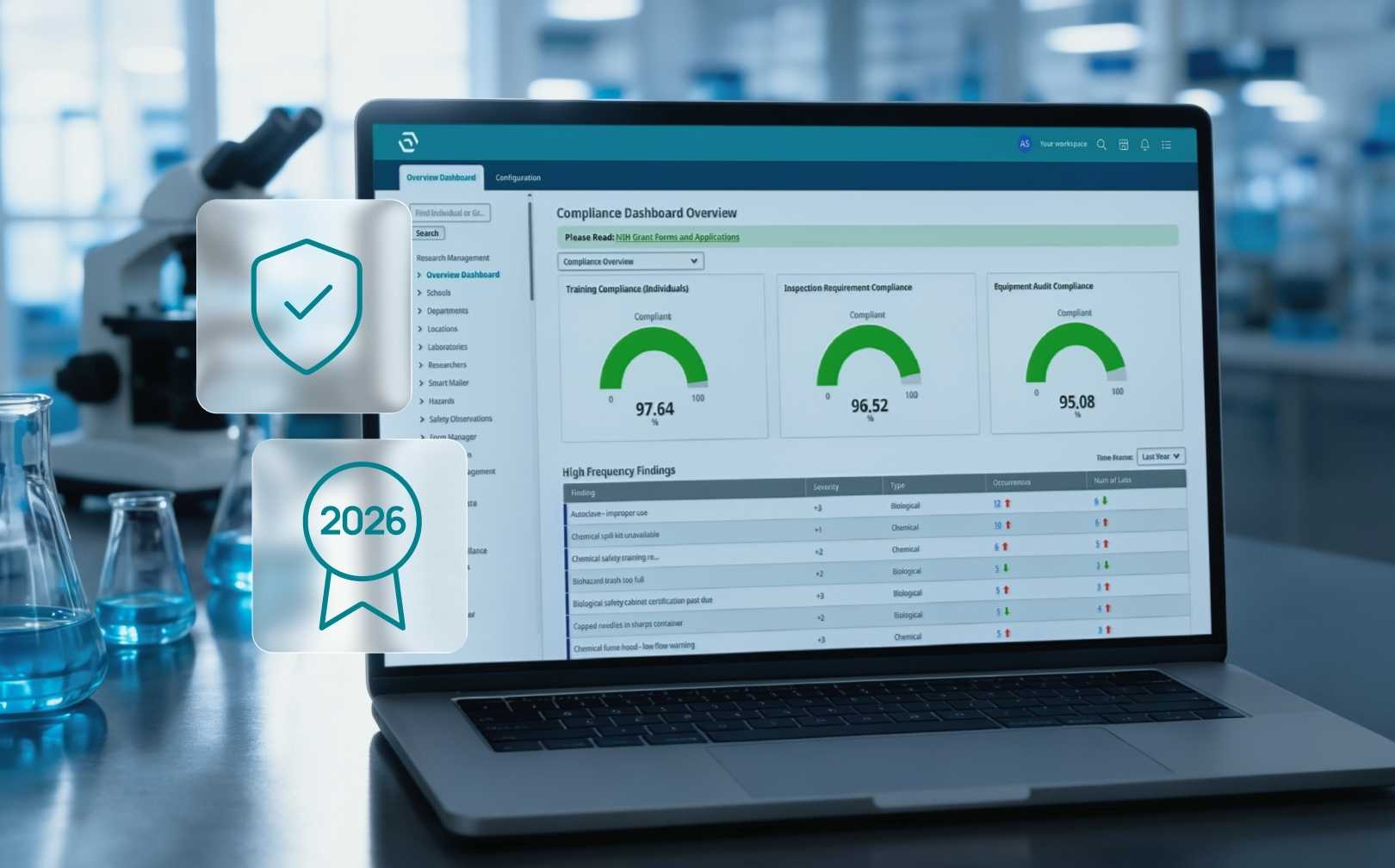
SciSure’s inspection dashboards give safety teams both the big picture and the lab-level detail from the same inspection records. At the organization level, EHS leaders can review inspection status, findings by type, common and repeat findings, trends over time, and comparisons between departments. This shows where the program is improving and where the same issues keep coming back.

Inspection dashboards on the SciSure platform

At the lab level, teams can see their recent findings and upcoming inspections, review each report, respond to findings, and record corrective actions. Inspectors also see a lab’s earlier findings when they inspect again, which makes recurring problems easier to catch. For program reviews, the Inspection Log and exports provide the full record behind both views.  

Where needed, you can calculate additional measures, such as repeat-finding rates or how long corrective actions take to close, from consistent inspection and follow-up records. Available dashboard views and fields depend on how your SciSure instance is configured.

Make sure you review the results with laboratory and department leaders. A recurring finding across several labs may call for shared training or a facilities change. A growing review queue may indicate that verification capacity needs attention.

SciSure Health & Safety
See your inspection workflow in one place
See how SciSure connects inspections, corrective actions, and chemical inventory in one connected platform.
Request a demo

7. Also consider self-inspections

Self-inspections play a smaller role in some safety programs, but they give labs a practical way to stay ready between formal inspections. Teams can use them to prepare for an upcoming EHS inspection, check a new lab before work begins, or confirm that a finding from a recent inspection has actually been fixed. Because lab members run the check themselves, they become more familiar with the standards they’re held to, and safety becomes a shared, routine habit rather than something that happens only when EHS visits.  

With SciSure, labs can complete self-inspections where they’re configured, alongside reviewing their inspection reports, responding to findings, and recording corrective actions, so their own checks and formal inspections stay in one place.

Frequently asked questions

What parts of lab safety inspections can be automated?

Recurring requirements, reminders, selected notifications, escalation messaging and reporting can be configured to reduce coordination work. Inspectors still assess conditions; laboratory teams carry out corrections, and authorized reviewers decide whether the evidence supports closure.

How do we keep inspections consistent across different labs?

Use shared inspection types and finding definitions, then tailor the applicable questions to each laboratory’s activities and hazards. Record the affected space and enough detail to make the finding understandable to the people responsible for responding.

Can laboratory self-inspections use the same approach?

Yes. SciSure supports self-inspection workflows, including configured questions, corrective-action guidance, and supporting attachments. Establish who reviews the results and how issues reach the safety team. Confirm the notification process during setup so users understand how to request help.

Put the complete inspection workflow into practice

A practical rollout starts with a representative group of laboratories. Configure their inspection requirements, forms, recipients and response deadlines. Test reminders, report delivery, and the path from a laboratory’s response to inspector review. Then use the results to refine the workflow before extending it across more labs.

Talk to SciSure about your inspection workflows to explore how your team can coordinate inspections, maintain follow-up records, and track resolution across your laboratories.

Keep reading

Ready to see SciSure in action?

Get a personalized demo and see how SciSure fits your lab's workflows.
Request demo

No commitment · Free consultation

Build a workflow that continues after the inspection

Across multiple labs, I've found that safety findings are never an isolated incident. For example, a lab manager may clear access to an eyewash, facilities may repair it, and a safety specialist may confirm that it is ready for use. Each handoff needs a responsible person, a response deadline, and a record of what happened.

As your lab expands and grows across multiple sites, coordinating those handoffs becomes a substantial part of the inspection program.

With SciSure Health & Safety implemented, you can help your teams manage that process through configurable inspection requirements, digital records, follow-up communication, and reporting. The aim is to make the work visible from the moment an inspection becomes due through to the review of completed corrections.

Here's how to build that workflow across your laboratories.

1. Establish which labs need which inspections

Start with an accurate inventory of your laboratory spaces and the groups responsible for them. Include shared rooms, support areas, and spaces occupied by several teams. For each area, establish:

  • Which activities and hazards determine its inspection requirements
  • Who conducts the inspection
  • Who provides and/or schedules follow-up inspections
  • Who receives the report and coordinates the response
  • How often the inspection is required under your safety program
  • Who provides coverage when the usual contact is unavailable

SciSure lets you configure recurring or one-time inspection requirements using recorded criteria such as laboratory type, hazards, and department. You can also schedule multiple inspections together, select an inspector and date, and review the resulting inspection queue.

Likewise, where enabled, automated reminders can draw attention to approaching deadlines and overdue requirements. That gives your team a consistent way to manage recurring checks as personnel, projects, and laboratory occupancy change.

One example I can share from the private sector shows why continuity matters. During an August 2022 inspection of Wilmington PharmaTech’s pharmaceutical R&D facility in Delaware, regulators found no records demonstrating required weekly waste-area inspections after March 30. The company subsequently acknowledged the lapse and supplied documentation of renewed checks.

Although this concerned waste-area inspections, the operational lesson applies to recurring safety tasks: clear ownership and completion records help teams maintain continuity through disruption.

2. Standardize inspection records while allowing for different hazards

A shared inspection framework makes findings easier to compare across laboratories. It should also accommodate differences between a chemistry laboratory, a biological research space, and a shared equipment room.

With SciSure, you can configure inspection types as checklists or questionnaires, with relevant findings and predefined corrective-action guidance. Inspectors can identify the affected space, add comments, and attach photographs or documents.

A useful finding should explain the observed condition clearly enough for someone else to act on it. For example:
‍

Emergency eyewash access is obstructed by a storage cart. Remove the obstruction and provide confirmation that the access route is clear.


That's more actionable than “eyewash issue.”

SciSure also flags findings previously observed for the laboratory or space within the preceding 18 months. This helps inspectors recognize recurring conditions and consider whether the response needs to address a wider issue, such as storage arrangements, maintenance ownership or training.

Read More: 5 common questions from chemical regulators and how to address them

SmartLabs: Connecting inspection work with hazard information

SmartLabs previously used separate chemical-inventory and inspection systems that did not communicate. Implementing SciSure Health & Safety meant bringing those workflows together, giving teams access to hazard information and inspection correspondence across its US research centers.

One manager reported halving her combined reporting and inspection time using ChemTracker. The result specifically credits chemical-hazard filtering and combines several activities but is an example for how connected information can support inspection work, rather than establishing a standalone time-saving percentage for the Inspections module.

For a multi-lab safety team, the practical benefit is having relevant information available when preparing an inspection, assessing a finding, and deciding what should happen next.

SciSure Health & Safety
Bring your inspection and hazard data together
Want to see how inspections, findings, corrective actions, and chemical hazard information can work together for your labs?
Talk to a specialist

3. Make the report the starting point for follow-up

A completed inspection should initiate a defined response process. With SciSure, inspectors can review a draft report before sending it to select recipients. They can set a report resolution deadline and use configured follow-up messaging. Responses, documents, and subsequent correspondence can remain associated with the inspection record.

Keeping responses within the report gives the lab manager, inspector, and safety team a shared history of the issue. It also makes the record easier to hand over when someone changes roles, or another specialist needs to step in.

For each report, establish who will coordinate the response. Where a correction depends on Facilities, a service provider or another department, make that responsibility explicit. Configure recipients and escalation rules to match the people who can move the work forward.

UT Austin: Effective inspections still need timely follow-up

UT Austin’s August 2025 internal audit found effective processes for identifying laboratory health and safety risks, alongside weaknesses in following up on findings. Follow-up generally occurred during the next scheduled inspection, which could be six months to a year later. Some corrections also depended on other university departments. The audit identified the need for clearer timelines, escalation, verification, and centralized tracking.

For organizations managing multiple labs, this is a useful distinction: inspection coverage measures where your team has looked; follow-up measures what happened to the issues it found.

4. Use reminders and escalation to maintain accountability

Set the response expectations before reports become overdue. Your procedure should explain when laboratory teams must respond, how they request assistance, and when unresolved matters reach department or organizational leadership.

SciSure supports configurable inspection messaging, including reminders and overdue escalation notifications. Availability and recipients depend on the inspection type and your configuration.

Make sure you test those settings during implementation. Confirm that the intended people receive the right message and understand what action is expected. Check self-inspection workflows separately, because their notification behavior can differ from inspections conducted by the safety team.

University of Maryland: A documented example of stronger follow-up

The University of Maryland’s 2021–2022 annual report describes using BioRAFT’s Inspection Module to distribute reports and automatically notify department chairs when findings remained unresolved beyond the specified response period. BioRAFT here represents a legacy name for SciShield, which merged with eLabNext in 2025 to form SciSure.

Comparing 2017 with 2021, Maryland reported:

  • Findings resolved within 30 days increased from 54% to 78%.
  • Findings resolved within 90 days increased from 77% to 96%.
  • Average findings per inspection fell from 2.33 to 1.19.

These are improvements in Maryland’s inspection program over time, with both comparison years following adoption. From this report, it’s clear how dedicated lab safety software helps combine inspection records, response expectations, escalation, and targeted support.

5. Separate reported completion from verified resolution

Define what evidence is needed to close an issue. For example, snapping a quick photo may be enough to confirm that an access route has been cleared. A repair may require a service record or a further check. Higher-risk findings may need a qualified specialist to review the correction.

SciSure’s inspection statuses distinguish reports awaiting resolution from those awaiting inspector reviews. Your team can use that distinction to review a laboratory response before finalizing the report.

Just keep in mind that the verification decision remains with the appropriate reviewer. Software just helps keep the response and supporting information available for that decision.

UC Merced: Corrections need an accurate completion record

UC Merced’s August 2024 laboratory safety audit identified 852 deficiencies awaiting verification and 2,416 marked unresolved in records covering FY2019–2023.

Auditors explicitly noted that many entries marked unresolved had actually been corrected but had not been documented properly. The problem lies with verification and recordkeeping after the fact.

An accurate record lets safety leaders distinguish work still requiring action from completed work awaiting review. And when your lab is scaling across multiple sites or growing from 5 members to 50, that distinction gets more useful over time.

6. Measure coverage, response and verification together

Choose a small set of measures before rolling out the workflow. Use consistent definitions, so results remain comparable across laboratories and reporting periods.

Inspection program performance: Measures and what they reveal

Measure What it helps you assess
Required inspections completed by their due date Whether the program is achieving planned coverage
Corrective actions past their resolution deadline Where follow-up needs attention
Time from report delivery to laboratory response How quickly teams engage with findings
Time awaiting inspector review Whether verification is becoming a bottleneck
Findings resolved within a defined period How effectively the program completes corrective work
Recurring findings by laboratory or finding type Where a broader intervention may be needed

SciSure’s inspection dashboards give safety teams both the big picture and the lab-level detail from the same inspection records. At the organization level, EHS leaders can review inspection status, findings by type, common and repeat findings, trends over time, and comparisons between departments. This shows where the program is improving and where the same issues keep coming back.

Inspection dashboards on the SciSure platform

At the lab level, teams can see their recent findings and upcoming inspections, review each report, respond to findings, and record corrective actions. Inspectors also see a lab’s earlier findings when they inspect again, which makes recurring problems easier to catch. For program reviews, the Inspection Log and exports provide the full record behind both views.  

Where needed, you can calculate additional measures, such as repeat-finding rates or how long corrective actions take to close, from consistent inspection and follow-up records. Available dashboard views and fields depend on how your SciSure instance is configured.

Make sure you review the results with laboratory and department leaders. A recurring finding across several labs may call for shared training or a facilities change. A growing review queue may indicate that verification capacity needs attention.

SciSure Health & Safety
See your inspection workflow in one place
See how SciSure connects inspections, corrective actions, and chemical inventory in one connected platform.
Request a demo

7. Also consider self-inspections

Self-inspections play a smaller role in some safety programs, but they give labs a practical way to stay ready between formal inspections. Teams can use them to prepare for an upcoming EHS inspection, check a new lab before work begins, or confirm that a finding from a recent inspection has actually been fixed. Because lab members run the check themselves, they become more familiar with the standards they’re held to, and safety becomes a shared, routine habit rather than something that happens only when EHS visits.  

With SciSure, labs can complete self-inspections where they’re configured, alongside reviewing their inspection reports, responding to findings, and recording corrective actions, so their own checks and formal inspections stay in one place.

Frequently asked questions

What parts of lab safety inspections can be automated?

Recurring requirements, reminders, selected notifications, escalation messaging and reporting can be configured to reduce coordination work. Inspectors still assess conditions; laboratory teams carry out corrections, and authorized reviewers decide whether the evidence supports closure.

How do we keep inspections consistent across different labs?

Use shared inspection types and finding definitions, then tailor the applicable questions to each laboratory’s activities and hazards. Record the affected space and enough detail to make the finding understandable to the people responsible for responding.

Can laboratory self-inspections use the same approach?

Yes. SciSure supports self-inspection workflows, including configured questions, corrective-action guidance, and supporting attachments. Establish who reviews the results and how issues reach the safety team. Confirm the notification process during setup so users understand how to request help.

Put the complete inspection workflow into practice

A practical rollout starts with a representative group of laboratories. Configure their inspection requirements, forms, recipients and response deadlines. Test reminders, report delivery, and the path from a laboratory’s response to inspector review. Then use the results to refine the workflow before extending it across more labs.

Talk to SciSure about your inspection workflows to explore how your team can coordinate inspections, maintain follow-up records, and track resolution across your laboratories.

Keep reading

About the author:

Joe DeBrocke

Joe DeBrocke is a Strategic Account Executive on SciSure’s enterprise team, based in Chicago. He works with life science organizations to bring their research data, sample tracking, safety and compliance into one system. Joe is a familiar face in the safety community, from the ABSA and CSHEMA Conferences to the Midwest Area Biosafety Network (MABioN) symposium, and he co-hosts lab operations workshops and webinars with Safety Partners and the LabOps Unite Community.

See all posts from this author

Sign up for our newsletter

Get the latest tips, articles, and exclusive content on modern lab management delivered to your inbox.
Thank you for subscribing!
Please check your email to verify your submission.
Oops! Something went wrong while submitting the form.