Hazardous Chemical Management for Labs: A Loss Control Guide
Six chemical risks that often turn into losses in research labs, the controls that reduce each one, and the records that show your program is working.

Download Whitepaper
TL;DR
Hazardous chemical management is the set of records and routines that tell a lab what chemicals it holds, where they are, who can safely use them and how they leave the building. Each of those routines is also a loss control that lowers the odds and cost of fires, spills, injuries and inspection findings.
- What loss control means.
Loss control is anything that makes a loss less likely or less severe. In a lab, that covers chemical fires, spills, exposures, damaged equipment, fines and lost research time. Insurers, fire marshals and OSHA (the Occupational Safety and Health Administration) all look for the same thing: evidence that your controls exist and are current.
- Six risks to control.
Most chemical losses in labs trace back to six gaps: not knowing what you have, missing safety data sheets (SDS), excess quantities in the wrong place, first responders without hazard information, untrained people handling chemicals, and spills or waste nobody follows up on.
- Rules behind the records.
In the US, the OSHA Laboratory Standard, the 2024 Hazard Communication update, EPCRA Tier II reporting, EPA hazardous waste rules and local fire codes all depend on accurate chemical data. OSHA's employer deadline for updated labels, programs and training on substances is November 20, 2026.
- Where SciSure fits.
SciSure Health & Safety, including the ChemTracker chemical inventory module, supports container-level inventory, SDS matching, fire code and MAQ reporting, door signs, training, inspections and hazardous waste workflows where configured. SmartLabs, San Diego State University and The Engine show what that looks like in practice.
This post was first published in 2020 and updated in 2026 to include lab-specific chemical risks, current OSHA, EPA and fire code context, The Hartford's 2025 claims data, and updated customer results from SmartLabs, SDSU and The Engine.
Ready to see SciSure in action?
No commitment · Free consultation
A fire marshal asks how much flammable liquid is stored on the third floor. A new postdoc can't find the SDS for the solvent she's about to open. A waste pickup gets rejected because nobody wrote down what's in the carboy. None of these is a disaster on its own, but each one is how a loss starts.
When The Hartford reviewed small-business claims from 2020 to 2024, fire damage was the costliest claim type, averaging $80,000 in 2025 (The Hartford, 2025). Those averages cover repair and replacement only, not business interruption (Insurance Journal). In a lab, business interruption means lost samples, repeated experiments and months added to a program timeline.
This guide walks through the six chemical risks that most often turn into losses in research labs, the controls that reduce each one, and where SciSure Health & Safety can help you keep the underlying records current.
What is a loss, and what is loss control?
In insurance terms, a loss is injury, damage or liability that costs your organization money. For labs, that includes chemical spills and fires, employee exposures, damaged equipment, regulatory fines and the research time lost while a space is closed.
Loss control is any measure that reduces how often losses happen or how bad they are when they do. It usually works in two ways:
- Prevention lowers the chance of a loss. Keeping incompatible chemicals apart is prevention.
- Reduction limits the damage once something goes wrong. A door sign that tells firefighters exactly what's behind the door is reduction.
Commercial insurers often employ loss control consultants who survey a business's exposures and recommend improvements. Fire marshals and OSHA inspectors ask similar questions. All three want evidence, not intentions: current records that show the controls are in place.
What hazardous chemical management covers in a lab
Hazardous chemical management is the day-to-day work of knowing which chemicals you have, where they're stored, which hazards apply, who is trained to handle them, and how they're disposed of. In US labs, several rules depend on that data:
- OSHA Laboratory Standard (29 CFR 1910.1450).
Labs must keep a written Chemical Hygiene Plan, review it at least annually, train employees when they're first assigned to work with hazardous chemicals, and keep SDSs from incoming shipments readily accessible (OSHA).
- OSHA Hazard Communication (HazCom) 2024 update.
Employers have until November 20, 2026 to update workplace labels, their written program and training for newly identified hazards in substances, and until May 19, 2028 for mixtures (AIHA, Federal Register).
- EPCRA Tier II reporting.
Under the Emergency Planning and Community Right-to-Know Act, facilities above threshold quantities submit an annual chemical inventory by March 1 to their state and local emergency planning bodies and the local fire department (EPA).
- EPA hazardous waste generator rules.
Your generator category, and the rules that come with it, depend on how much hazardous waste you produce each month. State categories can differ from the federal ones (EPA).
- Fire codes and maximum allowable quantities (MAQs).
Local fire codes limit how much of each hazard class can be stored in a control area. Your local fire authority has the final say. Our guide to fire code compliance and MAQs covers this in detail.
Each rule asks for slightly different data, but they all rely on the same foundation: an accurate, current chemical inventory.
Six chemical risks and the loss controls that reduce them
1. You don't know what you have or where it is
The loss it causes: You can't answer a fire marshal, a first responder or your own EHS (environmental health and safety) team with confidence. Duplicate orders pile up, peroxide formers age past their dates, and nobody notices a control area creeping toward its limit.
The control: Track every chemical at the container level, update the record when a container moves, changes owner or is used up, and reconcile the shelf against the system on a regular schedule.
How SciSure can help: With SciSure Health & Safety, ChemTracker records each container with its chemical identity, CAS number, amount, owning group, storage space and a unique barcode or RFID tag. Chemicals linked to the central chemical database pick up hazard and regulatory information automatically. Space-by-space reconciliation lets your team scan a room and confirm, relocate, transfer or remove what they find.
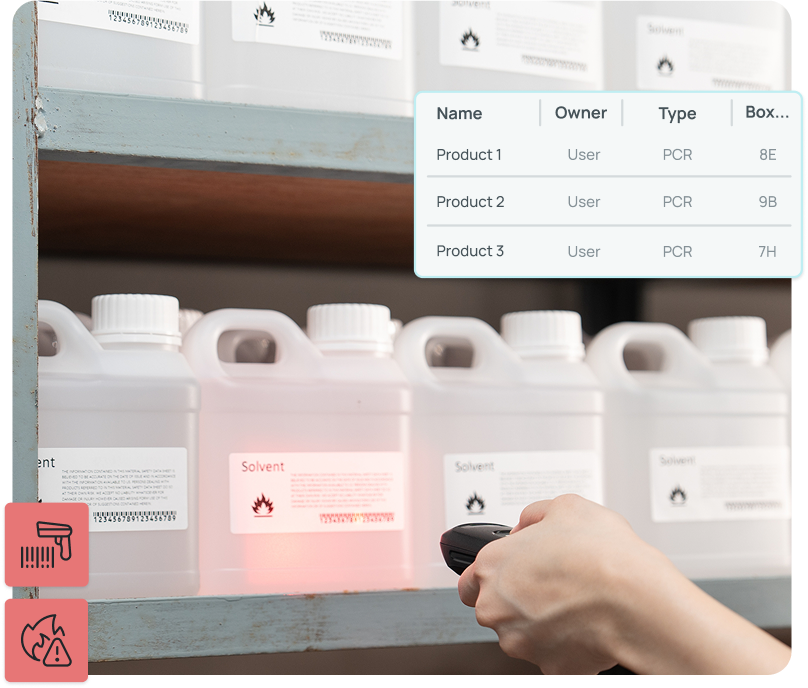
SmartLabs, which runs managed research centers for biotech and pharma companies, cut chemical inventory searches from 15 minutes to 1 to 2 minutes and reconciliation of an entire research center from a full day to as little as 20 minutes. Read the full SmartLabs story to learn how they got started.
For a step-by-step routine, check out our guide on chemical inventory best practices for multi-site labs and our comparison of chemical inventory tracking tools.
2. Safety data sheets are missing, outdated or in an empty binder
The loss it causes: A researcher handles a chemical without knowing its hazards or first aid measures. An inspector asks for an SDS and nobody can find it. With HazCom 2024 changing hazard classifications, older SDSs may no longer match what's on the label.
The control: Link each container to a current SDS that anyone in the lab can reach in seconds, and check coverage regularly so gaps get fixed before an inspection finds them.
How SciSure can help: SDS Auto-Match in ChemTracker tries to attach a recent SDS to each container using the chemical name, CAS number, product number, manufacturer and document date. Teams can also attach their own SDS manually or in bulk, and SDS coverage reports show which containers still need one. Not every product has a matching SDS available, so some records will still need a manual upload.

At The Engine, MIT's accelerator for early-stage "tough tech" companies, residents now find digital SDSs instead of relying on paper binders. The Lab Operations team cut the time to identify hazard information for resident companies, locations and individuals from several hours to under five minutes.
If your team is refreshing labels for the HazCom update, our guide to lab safety symbols and meanings covers GHS pictograms and labeling.
3. Too much of the wrong chemical in the wrong place
The loss it causes: Fire. Flammable liquids, oxidizers and compressed gases stored above their MAQs, in the wrong control area, or on a floor that can't hold them turn a small fire into a large one. Exceeding MAQs can also stop a building project or a lease in its tracks.
The control: Know your quantities by hazard class and by control area, check them before new materials arrive or labs move, and keep incompatible materials apart.
How SciSure can help: ChemTracker's fire code and MAQ reports total quantities by hazard class and control area. The default calculations use International Building Code (IBC) 2015 tables and can account for sprinklers, storage cabinets and adjusted control-area limits where configured. NFPA (National Fire Protection Association) summaries and Tier II outputs draw on the same inventory data. These reports support your review; they don't replace your local fire authority's interpretation of the code.
At SmartLabs, the Boston Fire Department requires weekly MAQ tracking. "Just being able to pull that from SciSure makes a big difference," said Julianna Skelton, Senior EHS Lab Operations Manager.
This risk grows as a lab adds people and projects. If that's where you are, our guide to lab safety concerns for growing startups covers what tends to break first.
4. First responders go in without hazard information
The loss it causes: When firefighters or a hazmat team don't know what's behind a door, they slow down or stay out, and a contained incident spreads. This is loss reduction in its plainest form: the faster responders understand the hazards, the less damage there is.
The control: Post current door signs that list the hazards, NFPA ratings, required PPE (personal protective equipment) and emergency contacts for each space, and update them when the chemicals inside change. Keep your Tier II data accurate, since it goes to your local fire department.
How SciSure can help: SciSure's Door Signs capability builds printable, dated signs from each space's current contacts, hazards, NFPA 704 values, PPE and entry requirements. ChemTracker's NFPA totals can inform the NFPA diamond, and EHS teams can see when each space's hazards and signs were last updated.
San Diego State University started its SciSure rollout with the platform and Door Signs, then added ChemTracker and SDS, Hazardous Waste and Radioisotope Management. Once the data was in one place, the team discovered chemicals stored in a building that wasn't sprinklered, and could notify the right people when safety showers or eyewash stations were out of service.
5. People handle chemicals they haven't been trained on
The loss it causes: Exposures, burns and injuries, followed by workers' compensation claims and OSHA findings. It's also the risk that hides best, because training records often live in a different spreadsheet from the lab roster.
The control: Tie training to what each person actually does and where they work, assign it before they start with a new hazard, and track renewals so nobody drifts out of date.
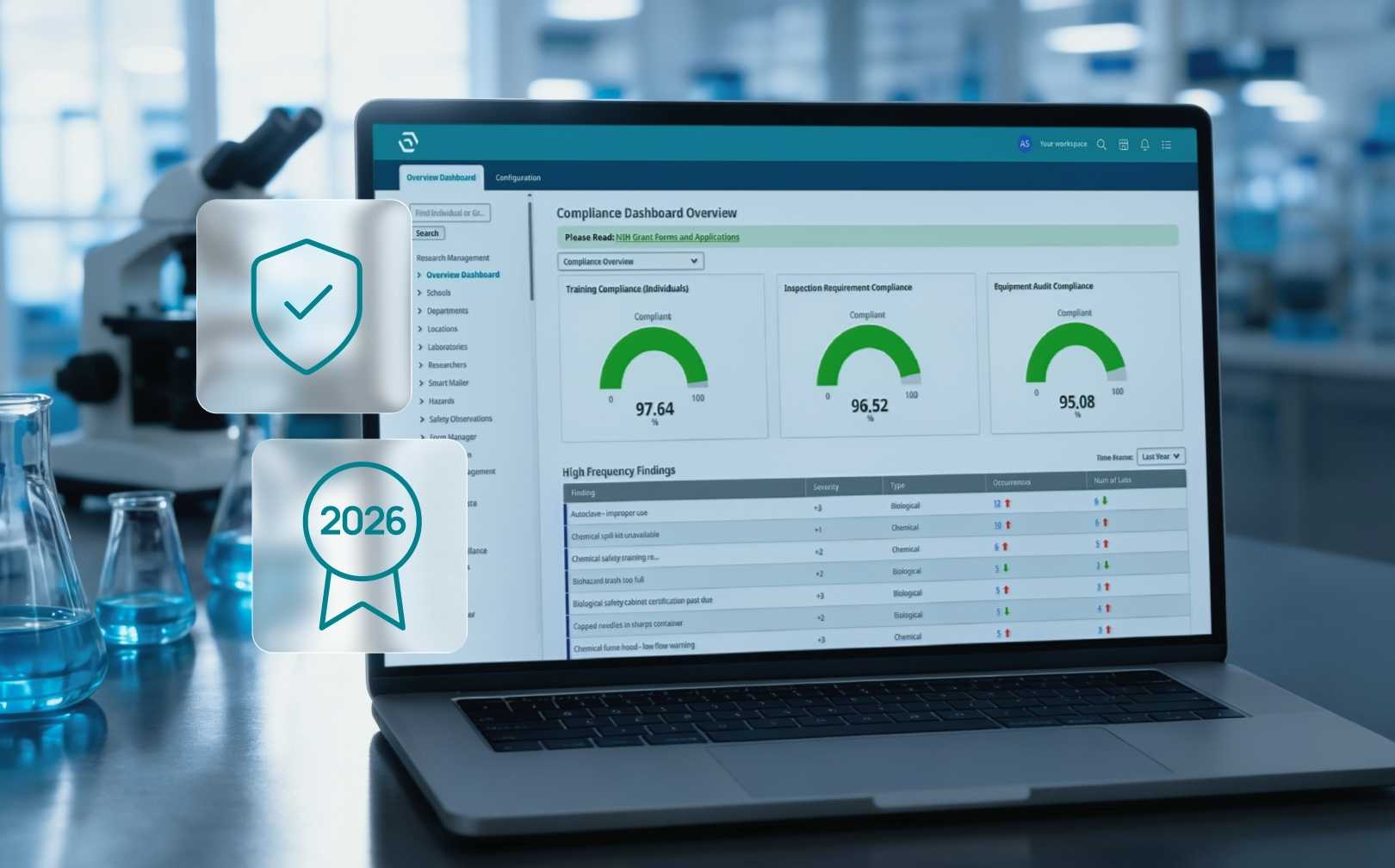
How SciSure can help: SciSure Health & Safety assigns training through job activities, so someone who starts working with a new hazard receives the right courses automatically. The platform tracks due dates and renewals, supports online courses and classroom sessions, and gives EHS teams compliance dashboards by group, course and person.
For the day-to-day habits that go with training, see our chemistry lab safety guide.
6. Spills, near misses and waste that nobody follows up
The loss it causes: The same finding shows up at every inspection. A near miss goes unreported until it becomes an incident. Waste sits in a satellite accumulation area longer than it should.
The control: Inspect on a schedule, assign corrective actions and track them to closure, make near misses easy to report, and give labs a clear way to request waste pickups.
How SciSure can help: SciSure's inspection tools record findings by space with photos and corrective actions, and dashboards show repeated findings across labs and departments. Staff can report incidents and near misses (anonymously where your organization allows it).
The Hazardous Waste module supports waste stream profiles, lab pickup requests and pickup history. Equipment audits cover safety equipment such as fume hoods, eyewash stations and fire extinguishers, which your Chemical Hygiene Plan expects to be working.
Our post on why lab safety inspections matter more as your lab scales goes deeper on inspection programs, and our lab asset inventory audit guide walks through checking chemicals and safety equipment side by side.
Showing your insurer, fire marshal or inspector that your controls work
The people who assess your risk usually ask for the same handful of records:
- A current chemical inventory by building and control area, with quantities by hazard class
- SDS coverage for the chemicals on site
- Training completion for everyone who works with hazardous chemicals
- Recent inspection findings and whether they were closed
- Hazardous waste records and your most recent Tier II submission
If pulling these together takes a week of spreadsheet work, that's a sign the controls exist on paper but aren't easy to prove. For ways to measure whether your safety software is actually saving that time, here's how 30+ labs measured lab software adoption after implementing SciSure.
Will better records lower your insurance premium? That depends on your insurer, your claims history and your market, so we won't promise it. What current records do is make the conversation with your broker, fire marshal or inspector shorter and more concrete.
Where SciSure fits
SciSure Health & Safety is built for laboratory safety: chemical inventory, SDS management, fire code and regulatory reporting, door signs, training, inspections, hazardous waste, biosafety and radiation safety. Which modules and reports you see depends on your configuration and license.
ChemTracker is designed for chemicals. Biological materials belong in biosafety registration or sample management workflows. Our guide to understanding biohazards covers that side. Its reports support your compliance work. Your Chemical Hygiene Officer, your local fire authority and your legal counsel still make the final calls.
Also keep in mind that software doesn't run the program for you. It works best when someone owns the inventory, the training rules and the inspection schedule.
If this sounds like the kind of support you need, get in touch with us. We'll walk you through how SciSure Health & Safety adapts to your lab workflows and keeps you audit-ready at all times.
FAQs
What is hazardous chemical management?
Hazardous chemical management is how a lab tracks which hazardous chemicals it has, where they're stored, which hazards apply, who is trained to use them and how they're disposed of. In the US, it supports compliance with the OSHA Laboratory Standard, OSHA Hazard Communication, EPCRA Tier II reporting, EPA hazardous waste rules and local fire codes.
What is loss control in a laboratory?
Loss control is any measure that makes a loss less likely or less severe. In a lab, examples include container-level chemical inventory, current safety data sheets, MAQ tracking, door signs for first responders, hazard-based training, regular inspections and structured hazardous waste pickups.
What's the difference between loss prevention and loss reduction?
Loss prevention lowers the chance that something goes wrong, such as separating incompatible chemicals. Loss reduction limits the damage once it does, such as giving firefighters accurate hazard information before they enter a lab.
What changes with OSHA's 2024 Hazard Communication update?
The update aligns the US standard more closely with the Globally Harmonized System (GHS), changing some hazard classifications, labels and SDS content. Employers have until November 20, 2026 to update workplace labels, written programs and training for newly identified hazards in substances, and until May 19, 2028 for mixtures.
Does chemical management software lower insurance premiums?
It can help, but it depends on your insurer, your claims history and your market. What software reliably does is make your controls easier to prove, with current inventory, SDS, training and inspection records ready when an insurer, fire marshal or inspector asks.
Can SciSure help with fire code and MAQ compliance?
Yes, where configured. ChemTracker in SciSure Health & Safety can report chemical quantities by hazard class and control area and compare them against MAQs, using IBC 2015 tables by default. Your local fire authority still makes the final interpretation for your building.
Learn more
- If you're comparing platforms, start with our chemical compliance management software buyer's guide and the 7 features to look for in enterprise chemical inventory software.
- For a wider view, see the top-rated EHS software for enterprise labs.
- Finally, here are 5 lab problems thatChemTracker solves out of the box.

Read more of our blogs about modern lab management
Discover the latest in lab operations, from sample management to AI innovations, designed to enhance efficiency and drive scientific breakthroughs.