How to Identify a Quality Chemical Inventory Database: 6 Things to Check

What makes a good chemical inventory database? Six things to check, from hazard data and SDS matching to search and upkeep, plus real time-savings data.

•
October 7, 2026
•
()
min read
A laboratory

Download Whitepaper

By submitting this form, you agree with our Privacy Policy.
Thank you! Download the file by clicking below:
Download
Oops! Something went wrong while submitting the form.

Table of Contents

Thank you! Your submission has been received!
Oops! Something went wrong while submitting the form.

TL;DR

A quality chemical inventory database ties every container to curated hazard, regulatory, and Safety Data Sheet (SDS) information, finds a chemical under any name, and stays accurate without heavy manual upkeep.
‍

  • Two kinds of inventory.
    "Chemical inventory database" can mean a government list such as the EPA's TSCA Inventory, which lists more than 86,000 substances, or your organization's own container-level record. This guide covers the second: the database behind your chemical inventory software that tracks what you have, where it is, who owns it, and how hazardous it is.
    ‍
  • Hazard data built in.
    The best databases link each container to hazard classes, CAS numbers, synonyms, and regulatory flags, so Tier II, fire code, and maximum allowable quantity (MAQ) reports come straight from your records. SciSure's ChemTracker uses a proprietary chemical database and lets oversight users add local entries for chemicals it doesn't list.
    ‍
  • An SDS on every container.
    OSHA's Hazard Communication Standard expects employers to keep SDSs available for the hazardous chemicals workers use. Look for automatic SDS matching by name, CAS number, product number, and manufacturer. OSHA's 2024 HazCom update, with compliance dates extended in January 2026, means fresh SDS versions are arriving now.
    ‍
  • Easy to keep accurate.
    A database is only as good as its upkeep. Barcode and RFID scanning, photo capture with human review, spreadsheet import, reconciliation tools, and purchase-to-inventory connections like SciSure Procurement Connect keep records current, while vendor-maintained chemical data saves your team from updating hazard information by hand.
    ‍
  • Measured time savings.
    Averaged workflow data from 30+ organizations using SciSure shows viewing a chemical record dropping from 17.23 minutes to 1.39 minutes, and monthly inventory data correction falling from 17.3 hours to under 2 minutes. SmartLabs cut reconciliation for a full research center from a full day to about 20 minutes.
    ‍

We first published this guide in 2019, and updated it in 2026 with current OSHA context, newer ways to capture chemical data, and updated social proof.

Your chemical inventory software is only as useful as the chemical database underneath it. This chemical inventory database decides whether a search for "IPA" finds your isopropanol, whether a flammable liquids report adds up, and whether the right SDS appears when someone needs it.

This guide explains what a chemical inventory database is, why the data behind your inventory matters for safety and compliance, and six things to check when you evaluate one. You'll also find before-and-after time savings from SciSure customers, questions to ask vendors, and answers to common questions.

What is a chemical inventory database?

A chemical inventory database is a structured record of the hazardous chemicals an organization holds, usually tracked container by container, with each record linked to hazard, regulatory, and safety information.

The term gets used in two ways, which is why search results mix government lookup tools with university safety pages:

Regulatory vs. organizational chemical inventories: What each one is and who uses it

Type What it is Who uses it
Regulatory chemical inventory A government list of substances in commerce, such as the EPA's TSCA Inventory (more than 86,000 chemicals). Other countries keep their own lists. Manufacturers and importers checking whether a substance is "new" or "existing"
Organizational chemical inventory database Your own container-level record of what's on site, where it is, how much there is, and how hazardous it is EHS teams, lab operations, PIs, researchers, emergency responders

This guide is about the second type.

What a good chemical inventory database holds

At minimum, every container record should carry:

  • Identity: chemical name, synonyms, CAS number, product name and number, manufacturer
  • Container: a unique barcode or RFID tag, size, amount remaining, units, physical state
  • Location and ownership: building, room, storage unit or control area, and the responsible lab group
  • Hazard and regulatory data: GHS hazard classes, NFPA ratings, and the regulatory lists the chemical appears on
  • Safety documentation: a linked, current SDS
  • Dates: received, opened, expiration, and disposal

Most chemical inventory tools capture some version of these fields. What separates a basic list from a quality database is everything that sits behind them: how the data is gathered, connected, searched, and kept current.

Why your chemical database matters more than the interface

Picture a fire marshal visit, a renovation, or a new lease. You need the total quantity of flammable liquids in one control area, compared against its maximum allowable quantity (MAQ). Without a chemical database, that means:

  1. Finding every container stored in the area
  2. Looking up each chemical's hazard classification under the building and fire codes
  3. Working out how much of each you have, including chemicals inside mixtures
  4. Converting everything into the units the code uses (gallons, pounds, cubic feet)
  5. Comparing the totals against the limits
  6. Checking all of it for transcription and math errors

A quality database handles steps two through five for you, because hazard classes, mixture constituents, and unit conversions already sit on each record. With SciSure, teams can generate fire code and MAQ reports by control area or floor, with hazard class assignments built in, while tracking in metric and reporting in gallons or pounds. Default calculations use International Building Code (IBC) 2015 tables, and your authority having jurisdiction (AHJ) still has the final word. Our guide to fire code compliance and MAQs covers the details.

How your chemical inventory database is tied to wider regulatory obligations

  • Hazard communication.
    ‍OSHA's Hazard Communication Standard requires employers to keep labels and SDSs available for hazardous chemicals and to train workers on them. OSHA's 2024 update aligns the standard with GHS Revision 7, and in January 2026 OSHA pushed every compliance date back four months, moving the first manufacturer deadline to May 19, 2026. Updated SDSs are flowing to labs now, so your database needs to keep up.
    ‍
  • Right-to-know and Tier II reporting. Augusta University uses its chemical inventory database to compile its annual Tier II report and twice-yearly state right-to-know lists.
    ‍
  • Fire code and MAQ compliance. UC Berkeley calls very high inventory accuracy a prerequisite for campus-wide MAQ compliance and requires every inventory to be certified annually.
    ‍
  • Emergency response and security. Cornell University uses its inventory to give hazard information to fire and hazmat teams and to monitor chemicals of interest flagged by the Department of Homeland Security.

If your database can't do the MAQ exercise above in a few clicks, every one of these jobs costs you more time than it should.

6 ways to identify a quality chemical inventory database

1. Hazard and regulatory data is attached to each chemical

When hazard data lives on the chemical record, you can search the whole organization by hazard class. Find every compressed flammable gas in a building, who owns it, and how much there is, without toggling between systems.

In SciSure's ChemTracker, containers linked to the central chemical database inherit its hazard and regulatory information automatically. Chemicals the database doesn't list can still be tracked as local entries, and oversight users can add regulatory data and pull properties from sources like PubChem.

This is what lets The Engine Accelerator's lab operations team see where compressed gases sit and use that to decide where resident companies should be located.
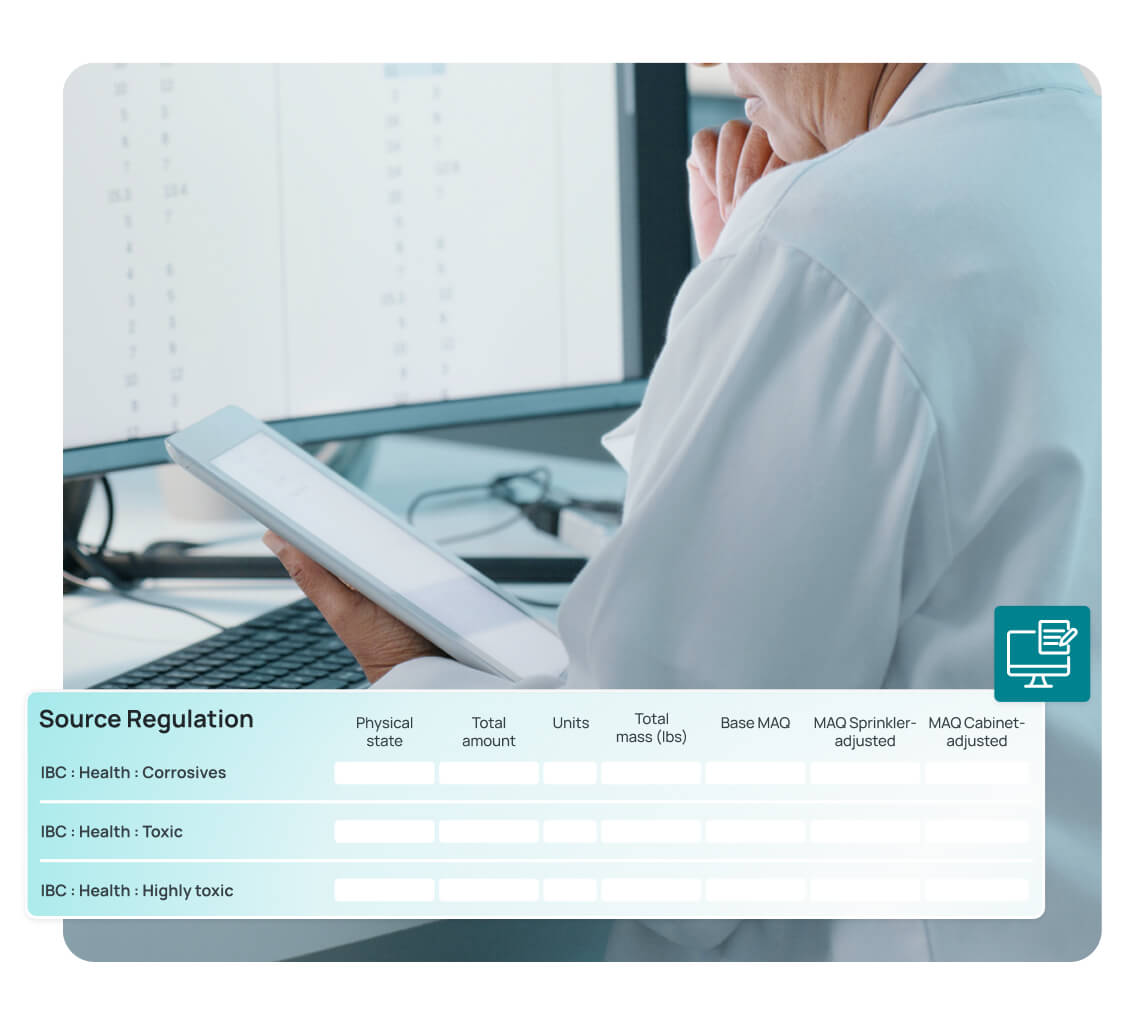
Regulatory reporting with SciSure Health & Safety

2. Search finds the right chemical, fast, under any name

One chemical can go by many names. Rubbing alcohol is also 2-propanol, isopropanol, isopropyl alcohol, and IPA (beer lovers beware). With more than 86,000 substances on the TSCA Inventory alone, nobody remembers every synonym or spelling.

Look for search that:

  • Suggests matches as you type
  • Recognizes synonyms, CAS numbers, product numbers, and partial names
  • Saves one chemical as one record, whatever name someone typed, so duplicates don't creep in
  • Returns results in seconds, even across hundreds of labs

Speed adds up. In averaged workflow data from 30+ organizations using SciSure, viewing a chemical record dropped from 17.23 minutes to 1.39 minutes. At SmartLabs, finding the chemical inventory for a given lab or group went from 15 minutes to 1 to 2 minutes.

Before vs After SciSure: Engagement usage data

Task Before → After Why it matters for engagement
Inventory report generation (flammables, MAQs, CFATS) 21 hours→7 min Scientists bring complex, multi-criteria reporting into the platform, something they only do when they trust its reliability.
Personnel report generation 5.5 hours→<5 min Engaged users rely on the system for broad operational oversight, not just local tasks, showing deeper organizational dependence.
Creating hazard-based lists of labs/groups (radioactive, infectious, flammable) 3.5 days→5 min Scientists repeatedly turn to the platform for high-volume EHS workflows, demonstrating confidence in its accuracy and search capability.
Creating a list of locations/spaces with a given hazard present (e.g., hazardous compressed gases) 1 week (52 hours)→~50 min Large, cross-facility tasks, typically avoided when systems feel cumbersome, are now routinely completed in the platform.
Cross-team manual messages (e.g., emails, Teams, ad-hoc requests) ~45/week→near zero Information lives in the system, not in people's inboxes, showing the platform has become the shared space where work actually happens.

3. It's curated, not scraped

Bulk-loading every chemical you can find online sounds thorough. In practice, uncurated records bring duplicates and gaps, slow down search, and confuse the people trying to keep inventory accurate.

A quality database adds chemicals for a reason, and people who understand chemistry and regulation check each entry. It should cover the chemicals research organizations actually use, including facilities chemicals like paints and cleaning products, and offer a clear path for the rest.

The Engine's team sees unusual chemicals and mixtures regularly and says, "You can find them in ChemTracker most times." When a chemical isn't listed, ChemTracker supports local entries and support requests.

4. The information is accurate and kept current by the vendor

Small structural differences, like one methyl group, can change a chemical's hazards. Databases assembled from product catalogs, physical-property references, or loosely parsed SDSs often miss the regulatory layer entirely.

Hazard classifications and regulations also change. If your team has to update chemical information by hand, it won't happen consistently. Look for a vendor that maintains the database for you and replaces outdated data instead of stacking a second record on top of the first. SciSure maintains a proprietary chemical and SDS database behind ChemTracker for this reason.

5. Every container links to a current SDS

Under OSHA's Hazard Communication Standard, workers need access to SDSs for the hazardous chemicals they use. A paper binder or shared drive goes stale the moment a supplier issues a new version, and the 2024 HazCom update means many are issuing new versions now.

With SciSure, SDS Auto-Match attaches a recent SDS to each container using chemical names and synonyms, CAS number, product number, manufacturer, and document date. New containers are checked shortly after they're added, and eligible containers are rechecked over time. Teams can also attach an SDS manually or in bulk when a product has no automatic match.

In SciSure's averaged customer data, finding an SDS dropped from 7 minutes (sometimes a full day) to 3 minutes. As one EHS director at Tulane University put it, "ChemTracker has created a much safer place, especially for emergency response purposes."

SciSure Health & Safety
See the database behind ChemTracker
Container-level tracking, SDS Auto-Match, and Tier II, fire code, and MAQ reports from one set of chemical records.
Talk to a specialist

6. Getting data in and keeping it accurate takes little effort

The best database in the world goes stale if updating it is painful. Check how chemicals enter the system and how drift gets caught. With SciSure, teams can:

  • Scan barcodes or RFID tags at receiving and during audits (check out our guide on chemical inventory tracking tools for a deep dive)
  • Snap a photo with ChemSnap AI, which reads the chemical name, container size, manufacturer, lot, and product details from the label for a person to review
  • Import spreadsheets to add or update containers in bulk during migration
  • Connect purchasing with Procurement Connect, which turns order data into structured chemical records and flags anything it can't confidently process for review
  • Reconcile by space, scanning containers to confirm, relocate, or remove them during periodic physical audits

SciSure's averaged customer data shows monthly chemical inventory data correction falling from 17.3 hours to under 2 minutes. SmartLabs, after implementing SciSure Health & Safety, reconciles an entire research center in as little as 20 minutes, a job that used to take all day.

What a quality chemical database saves in practice

SmartLabs runs flexible lab space for biopharma companies across hundreds of lab spaces. It started with ChemTracker and SDS management in December 2019. One weekly job is tracking MAQs for the Boston Fire Department, which the team now pulls straight from SciSure. EHS and Lab Operations Manager Natalie Kosmandakis says she has "cut my time in half" on reports and inspections.

Customer outcomes

SmartLabs: Chemical Inventory at Scale

Less manual reporting, faster hazard visibility, and lab operations that can scale across more people, spaces, and workflows.

After implementing SciSure's ChemTracker:

87%-99% of time saved

  • Search: 15 min to 1-2 min.
  • Reconciliation: all day to 20 min.
  • Reporting: 30 min to 1 min.

Sources

SciSure customer story: SmartLabs, "SmartLabs Elevates Lab Management to Artistry." Metrics and before/after claims are condensed from that story.

‍

The Engine Accerelator likewise replaced Excel, paper, and Access databases with ChemTracker while growing from 10 to 50 resident companies. With the time ChemTracker freed up, The Engine took on recombinant DNA permits and added 25 companies doing genetic engineering work.

Finally, San Diego State University added ChemTracker and SDS after starting with SciSure door signs. Accurate location data quickly surfaced surprises, like a chemical stored in a building without sprinklers, and let the EHS team confirm that 100% of spaces using chemicals had been inspected.

Questions to ask any chemical inventory vendor

Bring these to your next demo, ideally with a sample of your own inventory:

  • Who curates the chemical database, and how often is it updated?
  • What happens when a chemical or mixture isn't in the database?
  • Can I search by synonym, CAS number, product number, and partial name?
  • How are SDSs matched to containers, and what happens when no match exists?
  • Which regulatory reports draw directly from the data, and which are enabled in my configuration?
  • How are mixtures and unit conversions handled in fire code and MAQ reports?
  • How does data get in: barcode, RFID, photo, spreadsheet, or purchasing?
  • What do bulk edits and physical reconciliation look like after go-live?
SciSure Health & Safety
Curious how your chemical data would look in ChemTracker?
Bring a sample of your current inventory. We'll walk through chemical matching, SDS coverage, and the reports your team needs.
Request a demo

FAQs

What is a chemical inventory database?

A chemical inventory database is a structured record of the hazardous chemicals an organization holds, usually tracked by container. Each record links the chemical's identity, location, quantity, and owner to hazard, regulatory, and SDS information, so teams can search, report, and respond to emergencies from one source.

What's the difference between a regulatory chemical inventory and a chemical inventory database?

A regulatory chemical inventory is a government list of substances in commerce, such as the EPA's TSCA Inventory, used mainly by manufacturers and importers. A chemical inventory database is your organization's own record of the containers you hold, where they are, and how hazardous they are.

What information should a chemical inventory database include?

At minimum: chemical name and synonyms, CAS number, manufacturer and product number, a unique container ID, size and amount remaining, storage location, owning lab group, hazard classes, regulatory flags, a linked SDS, and key dates such as receipt and expiration.

How often should a chemical inventory be updated?

Records should change as containers arrive, move, and get used up, with periodic physical reconciliation to catch drift. Practices vary: UC Berkeley requires annual certification of each inventory, and Augusta University asks researchers to review theirs twice a year. Your local regulations and fire code may set their own timelines.

Can a chemical inventory database track biological materials?

ChemTracker is designed for chemicals measured by mass, volume, unit, or gas cylinder. Biological materials belong in biosafety registration or sample management workflows. Biological kits with hazardous chemical components can still be represented in ChemTracker.

Does a chemical inventory database make my lab compliant?

No software makes a lab compliant on its own. A quality database gives you accurate data for SDS access, Tier II, fire code, and MAQ reporting, but your team still applies local codes, professional judgment, and the requirements of your authority having jurisdiction.

Want to see how ChemTracker handles these?

Ready to see SciSure in action?

Get a personalized demo and see how SciSure fits your lab's workflows.
Request demo

No commitment · Free consultation

Your chemical inventory software is only as useful as the chemical database underneath it. This chemical inventory database decides whether a search for "IPA" finds your isopropanol, whether a flammable liquids report adds up, and whether the right SDS appears when someone needs it.

This guide explains what a chemical inventory database is, why the data behind your inventory matters for safety and compliance, and six things to check when you evaluate one. You'll also find before-and-after time savings from SciSure customers, questions to ask vendors, and answers to common questions.

What is a chemical inventory database?

A chemical inventory database is a structured record of the hazardous chemicals an organization holds, usually tracked container by container, with each record linked to hazard, regulatory, and safety information.

The term gets used in two ways, which is why search results mix government lookup tools with university safety pages:

Regulatory vs. organizational chemical inventories: What each one is and who uses it

Type What it is Who uses it
Regulatory chemical inventory A government list of substances in commerce, such as the EPA's TSCA Inventory (more than 86,000 chemicals). Other countries keep their own lists. Manufacturers and importers checking whether a substance is "new" or "existing"
Organizational chemical inventory database Your own container-level record of what's on site, where it is, how much there is, and how hazardous it is EHS teams, lab operations, PIs, researchers, emergency responders

This guide is about the second type.

What a good chemical inventory database holds

At minimum, every container record should carry:

  • Identity: chemical name, synonyms, CAS number, product name and number, manufacturer
  • Container: a unique barcode or RFID tag, size, amount remaining, units, physical state
  • Location and ownership: building, room, storage unit or control area, and the responsible lab group
  • Hazard and regulatory data: GHS hazard classes, NFPA ratings, and the regulatory lists the chemical appears on
  • Safety documentation: a linked, current SDS
  • Dates: received, opened, expiration, and disposal

Most chemical inventory tools capture some version of these fields. What separates a basic list from a quality database is everything that sits behind them: how the data is gathered, connected, searched, and kept current.

Why your chemical database matters more than the interface

Picture a fire marshal visit, a renovation, or a new lease. You need the total quantity of flammable liquids in one control area, compared against its maximum allowable quantity (MAQ). Without a chemical database, that means:

  1. Finding every container stored in the area
  2. Looking up each chemical's hazard classification under the building and fire codes
  3. Working out how much of each you have, including chemicals inside mixtures
  4. Converting everything into the units the code uses (gallons, pounds, cubic feet)
  5. Comparing the totals against the limits
  6. Checking all of it for transcription and math errors

A quality database handles steps two through five for you, because hazard classes, mixture constituents, and unit conversions already sit on each record. With SciSure, teams can generate fire code and MAQ reports by control area or floor, with hazard class assignments built in, while tracking in metric and reporting in gallons or pounds. Default calculations use International Building Code (IBC) 2015 tables, and your authority having jurisdiction (AHJ) still has the final word. Our guide to fire code compliance and MAQs covers the details.

How your chemical inventory database is tied to wider regulatory obligations

  • Hazard communication.
    ‍OSHA's Hazard Communication Standard requires employers to keep labels and SDSs available for hazardous chemicals and to train workers on them. OSHA's 2024 update aligns the standard with GHS Revision 7, and in January 2026 OSHA pushed every compliance date back four months, moving the first manufacturer deadline to May 19, 2026. Updated SDSs are flowing to labs now, so your database needs to keep up.
    ‍
  • Right-to-know and Tier II reporting. Augusta University uses its chemical inventory database to compile its annual Tier II report and twice-yearly state right-to-know lists.
    ‍
  • Fire code and MAQ compliance. UC Berkeley calls very high inventory accuracy a prerequisite for campus-wide MAQ compliance and requires every inventory to be certified annually.
    ‍
  • Emergency response and security. Cornell University uses its inventory to give hazard information to fire and hazmat teams and to monitor chemicals of interest flagged by the Department of Homeland Security.

If your database can't do the MAQ exercise above in a few clicks, every one of these jobs costs you more time than it should.

6 ways to identify a quality chemical inventory database

1. Hazard and regulatory data is attached to each chemical

When hazard data lives on the chemical record, you can search the whole organization by hazard class. Find every compressed flammable gas in a building, who owns it, and how much there is, without toggling between systems.

In SciSure's ChemTracker, containers linked to the central chemical database inherit its hazard and regulatory information automatically. Chemicals the database doesn't list can still be tracked as local entries, and oversight users can add regulatory data and pull properties from sources like PubChem.

This is what lets The Engine Accelerator's lab operations team see where compressed gases sit and use that to decide where resident companies should be located.

Regulatory reporting with SciSure Health & Safety

2. Search finds the right chemical, fast, under any name

One chemical can go by many names. Rubbing alcohol is also 2-propanol, isopropanol, isopropyl alcohol, and IPA (beer lovers beware). With more than 86,000 substances on the TSCA Inventory alone, nobody remembers every synonym or spelling.

Look for search that:

  • Suggests matches as you type
  • Recognizes synonyms, CAS numbers, product numbers, and partial names
  • Saves one chemical as one record, whatever name someone typed, so duplicates don't creep in
  • Returns results in seconds, even across hundreds of labs

Speed adds up. In averaged workflow data from 30+ organizations using SciSure, viewing a chemical record dropped from 17.23 minutes to 1.39 minutes. At SmartLabs, finding the chemical inventory for a given lab or group went from 15 minutes to 1 to 2 minutes.

Before vs After SciSure: Engagement usage data

Task Before → After Why it matters for engagement
Inventory report generation (flammables, MAQs, CFATS) 21 hours→7 min Scientists bring complex, multi-criteria reporting into the platform, something they only do when they trust its reliability.
Personnel report generation 5.5 hours→<5 min Engaged users rely on the system for broad operational oversight, not just local tasks, showing deeper organizational dependence.
Creating hazard-based lists of labs/groups (radioactive, infectious, flammable) 3.5 days→5 min Scientists repeatedly turn to the platform for high-volume EHS workflows, demonstrating confidence in its accuracy and search capability.
Creating a list of locations/spaces with a given hazard present (e.g., hazardous compressed gases) 1 week (52 hours)→~50 min Large, cross-facility tasks, typically avoided when systems feel cumbersome, are now routinely completed in the platform.
Cross-team manual messages (e.g., emails, Teams, ad-hoc requests) ~45/week→near zero Information lives in the system, not in people's inboxes, showing the platform has become the shared space where work actually happens.

3. It's curated, not scraped

Bulk-loading every chemical you can find online sounds thorough. In practice, uncurated records bring duplicates and gaps, slow down search, and confuse the people trying to keep inventory accurate.

A quality database adds chemicals for a reason, and people who understand chemistry and regulation check each entry. It should cover the chemicals research organizations actually use, including facilities chemicals like paints and cleaning products, and offer a clear path for the rest.

The Engine's team sees unusual chemicals and mixtures regularly and says, "You can find them in ChemTracker most times." When a chemical isn't listed, ChemTracker supports local entries and support requests.

4. The information is accurate and kept current by the vendor

Small structural differences, like one methyl group, can change a chemical's hazards. Databases assembled from product catalogs, physical-property references, or loosely parsed SDSs often miss the regulatory layer entirely.

Hazard classifications and regulations also change. If your team has to update chemical information by hand, it won't happen consistently. Look for a vendor that maintains the database for you and replaces outdated data instead of stacking a second record on top of the first. SciSure maintains a proprietary chemical and SDS database behind ChemTracker for this reason.

5. Every container links to a current SDS

Under OSHA's Hazard Communication Standard, workers need access to SDSs for the hazardous chemicals they use. A paper binder or shared drive goes stale the moment a supplier issues a new version, and the 2024 HazCom update means many are issuing new versions now.

With SciSure, SDS Auto-Match attaches a recent SDS to each container using chemical names and synonyms, CAS number, product number, manufacturer, and document date. New containers are checked shortly after they're added, and eligible containers are rechecked over time. Teams can also attach an SDS manually or in bulk when a product has no automatic match.

In SciSure's averaged customer data, finding an SDS dropped from 7 minutes (sometimes a full day) to 3 minutes. As one EHS director at Tulane University put it, "ChemTracker has created a much safer place, especially for emergency response purposes."

SciSure Health & Safety
See the database behind ChemTracker
Container-level tracking, SDS Auto-Match, and Tier II, fire code, and MAQ reports from one set of chemical records.
Talk to a specialist

6. Getting data in and keeping it accurate takes little effort

The best database in the world goes stale if updating it is painful. Check how chemicals enter the system and how drift gets caught. With SciSure, teams can:

  • Scan barcodes or RFID tags at receiving and during audits (check out our guide on chemical inventory tracking tools for a deep dive)
  • Snap a photo with ChemSnap AI, which reads the chemical name, container size, manufacturer, lot, and product details from the label for a person to review
  • Import spreadsheets to add or update containers in bulk during migration
  • Connect purchasing with Procurement Connect, which turns order data into structured chemical records and flags anything it can't confidently process for review
  • Reconcile by space, scanning containers to confirm, relocate, or remove them during periodic physical audits

SciSure's averaged customer data shows monthly chemical inventory data correction falling from 17.3 hours to under 2 minutes. SmartLabs, after implementing SciSure Health & Safety, reconciles an entire research center in as little as 20 minutes, a job that used to take all day.

What a quality chemical database saves in practice

SmartLabs runs flexible lab space for biopharma companies across hundreds of lab spaces. It started with ChemTracker and SDS management in December 2019. One weekly job is tracking MAQs for the Boston Fire Department, which the team now pulls straight from SciSure. EHS and Lab Operations Manager Natalie Kosmandakis says she has "cut my time in half" on reports and inspections.

Customer outcomes

SmartLabs: Chemical Inventory at Scale

Less manual reporting, faster hazard visibility, and lab operations that can scale across more people, spaces, and workflows.

After implementing SciSure's ChemTracker:

87%-99% of time saved

  • Search: 15 min to 1-2 min.
  • Reconciliation: all day to 20 min.
  • Reporting: 30 min to 1 min.

Sources

SciSure customer story: SmartLabs, "SmartLabs Elevates Lab Management to Artistry." Metrics and before/after claims are condensed from that story.

‍

The Engine Accerelator likewise replaced Excel, paper, and Access databases with ChemTracker while growing from 10 to 50 resident companies. With the time ChemTracker freed up, The Engine took on recombinant DNA permits and added 25 companies doing genetic engineering work.

Finally, San Diego State University added ChemTracker and SDS after starting with SciSure door signs. Accurate location data quickly surfaced surprises, like a chemical stored in a building without sprinklers, and let the EHS team confirm that 100% of spaces using chemicals had been inspected.

Questions to ask any chemical inventory vendor

Bring these to your next demo, ideally with a sample of your own inventory:

  • Who curates the chemical database, and how often is it updated?
  • What happens when a chemical or mixture isn't in the database?
  • Can I search by synonym, CAS number, product number, and partial name?
  • How are SDSs matched to containers, and what happens when no match exists?
  • Which regulatory reports draw directly from the data, and which are enabled in my configuration?
  • How are mixtures and unit conversions handled in fire code and MAQ reports?
  • How does data get in: barcode, RFID, photo, spreadsheet, or purchasing?
  • What do bulk edits and physical reconciliation look like after go-live?
SciSure Health & Safety
Curious how your chemical data would look in ChemTracker?
Bring a sample of your current inventory. We'll walk through chemical matching, SDS coverage, and the reports your team needs.
Request a demo

FAQs

What is a chemical inventory database?

A chemical inventory database is a structured record of the hazardous chemicals an organization holds, usually tracked by container. Each record links the chemical's identity, location, quantity, and owner to hazard, regulatory, and SDS information, so teams can search, report, and respond to emergencies from one source.

What's the difference between a regulatory chemical inventory and a chemical inventory database?

A regulatory chemical inventory is a government list of substances in commerce, such as the EPA's TSCA Inventory, used mainly by manufacturers and importers. A chemical inventory database is your organization's own record of the containers you hold, where they are, and how hazardous they are.

What information should a chemical inventory database include?

At minimum: chemical name and synonyms, CAS number, manufacturer and product number, a unique container ID, size and amount remaining, storage location, owning lab group, hazard classes, regulatory flags, a linked SDS, and key dates such as receipt and expiration.

How often should a chemical inventory be updated?

Records should change as containers arrive, move, and get used up, with periodic physical reconciliation to catch drift. Practices vary: UC Berkeley requires annual certification of each inventory, and Augusta University asks researchers to review theirs twice a year. Your local regulations and fire code may set their own timelines.

Can a chemical inventory database track biological materials?

ChemTracker is designed for chemicals measured by mass, volume, unit, or gas cylinder. Biological materials belong in biosafety registration or sample management workflows. Biological kits with hazardous chemical components can still be represented in ChemTracker.

Does a chemical inventory database make my lab compliant?

No software makes a lab compliant on its own. A quality database gives you accurate data for SDS access, Tier II, fire code, and MAQ reporting, but your team still applies local codes, professional judgment, and the requirements of your authority having jurisdiction.

Want to see how ChemTracker handles these?

About the author:

Mark Esposito

Mark Esposito is Sales Enablement Manager at SciSure, where he develops enablement programs, competitive positioning, and customer-facing content that help commercial teams engage buyers and communicate value. Prior to SciSure, he spent seven years at UL leading product marketing for its chemical safety and supply chain risk management unit. Before that, he spent over a decade in creative direction for clients across life sciences, chemical technologies, and higher education. He holds a BFA from Syracuse University.

See all posts from this author

Sign up for our newsletter

Get the latest tips, articles, and exclusive content on modern lab management delivered to your inbox.
Thank you for subscribing!
Please check your email to verify your submission.
Oops! Something went wrong while submitting the form.