OSHA HazCom Update: What Labs Should Do (Nov 2026)
OSHA's first HazCom employer deadline passed on November 20, 2026. Here's what changed, what applies to labs, and what to check before 2028.
Download Whitepaper
Ready to see SciSure in action?
No commitment · Free consultation
On November 20, 2026, the first employer deadline under OSHA's updated Hazard Communication Standard (HazCom) passed. By that date, employers were expected to update workplace labels, their hazard communication program and employee training for chemical substances (OSHA, 29 CFR 1910.1200(j)).
Plenty of labs aren't there yet. In our recent survey with Safety Partners, LLC, only 28% of EHS respondents said their lab was fully updated for HazCom.
If that sounds like your lab, the fix isn't complicated, and it's much easier to sort out now than when a chemical regulator starts asking questions. Here's what our survey found, what changed, which parts apply to research labs, and what to check now.
What our survey found about new rules
Between August and October 2026, SciSure and Safety Partners, LLC (part of Trinity Consultants' Life Sciences division) asked more than 60 people who run and support US labs about compliance, chemicals and safety culture. New rules came up again and again. When we asked where EHS teams expect pressure to grow, regulatory and compliance demands came second (21%), just behind staffing and workload (25%).
But awareness of the HazCom update itself was patchy:
- 41% of all respondents weren't familiar with the HazCom changes.
- Researchers knew the least. 52% of researchers weren't familiar with the changes, compared with 35% of EHS and operations staff.
- Only 28% of EHS respondents said their lab was fully updated for HazCom.
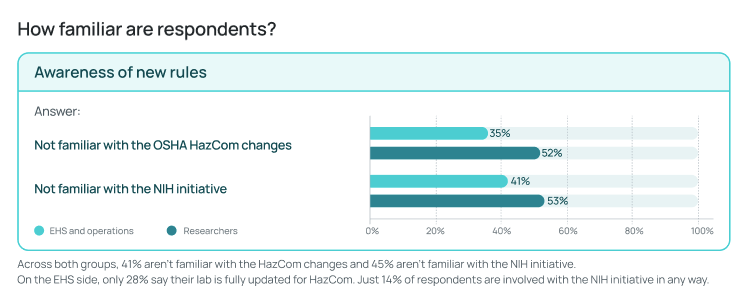
The gap between EHS and researchers is the part that matters most. Researchers are the ones opening the bottles and reading the labels every day. If they don't know labels and SDSs are changing, new hazard information can arrive with an order and never get read.
One principal investigator put it simply:
"I wasn't aware [there] are any major changes, so I didn't have any concerns. Now I will go check what type of changes might affect us."
That's a fair reaction, and a fixable one. Our sample is small, so treat these numbers as a snapshot rather than a national picture. Still, if a third of EHS staff and half of researchers aren't familiar with the update, it's worth checking where your own lab stands.
What changed in the 2024 HazCom update
OSHA published the update on May 20, 2024, and it took effect on July 19, 2024 (OSHA fact sheet). It mainly brings HazCom in line with Revision 7 of the Globally Harmonized System (GHS), the UN's shared system for classifying chemicals and writing labels and safety data sheets (SDSs).
The changes most likely to show up in a lab:
- Updated hazard criteria.
Several health and physical hazard classes have new criteria, including a significant change to flammable gases (J.J. Keller). Some chemicals on your shelves may now be classified differently, which is why the hazard data behind your chemical inventory matters. - New labels and SDSs from suppliers.
OSHA estimates the rule affects 94% of SDSs and 64% of shipped container labels (OH&S). Suppliers had to switch for substances by May 19, 2026, so updated documents are already arriving with your orders. - Clearer rules for small containers.
Containers of 100 mL or less can carry a shortened label: product name, pictograms, signal word, and the manufacturer's name and phone number, with the full label on the outer package. Containers of 3 mL or less only need the product name if a full label would get in the way (29 CFR 1910.1200(f)(12)). This matters for labs full of vials and tubes. - Changes to SDS sections 2, 3, 9 and 11
plus streamlined precautionary statements on labels (OSHA HCS Q&A). Our complete guide to safety data sheets walks through all 16 sections.
The key dates
OSHA pushed every deadline back by four months in January 2026 (Federal Register). The deadline that's still ahead for employers is May 19, 2028, for mixtures.
Source: 29 CFR 1910.1200(j)
What the update means for research labs
This is where a lot of labs get confused, because HazCom only partly applies to them.
Most research labs fall under OSHA's Laboratory Standard (29 CFR 1910.1450). Under it, your chemical hygiene plan does the job a written HazCom program does elsewhere. But four HazCom duties still apply to labs (29 CFR 1910.1200(b)(3)):
- Labels on incoming chemical containers can't be removed or defaced.
- SDSs that arrive with chemicals must be kept and be easy for lab staff to reach during every shift.
- Lab staff must get HazCom information and training.
- A lab that ships hazardous chemicals to someone else counts as a manufacturer or distributor, with the full label and SDS duties that come with it.
So the update reaches your lab in three practical ways. New labels and SDSs are arriving from suppliers, and your SDS library needs to keep up. Your team needs to know how to read the new information, including reclassified hazards and shortened small-container labels. And if you send samples or reagents to collaborators, you may have more to do than you think.
One more thing to watch: the Laboratory Standard only covers "laboratory scale" work, where containers can be handled safely by one person. Stockrooms, pilot-scale work and facilities areas may fall under full HazCom, including the written program.
What to check now
If your lab missed the November 20, 2026 deadline or hasn't finished its updates, start here:
- Match your SDS library to your suppliers.
Check that the SDSs your team can access are the latest versions, especially for chemicals ordered since May 2026. It's one of the quickest wins on this list. - Look at your secondary container labels.
If your lab makes its own labels for bottles or aliquots, make sure the hazard information still matches the new SDS. - Update training.
Walk people through the new label layouts, shortened small-container labels and any chemicals in your inventory that were reclassified. A short session at a lab meeting can cover a lot. - Review your chemical hygiene plan.
The Laboratory Standard asks you to review it at least once a year (29 CFR 1910.1450(e)). Make sure it reflects the HazCom changes. - Find out who ships chemicals.
Ask PIs whether anyone sends samples, reagents or compounds to other labs or companies. If they do, those shipments need compliant labels and SDSs. - Put May 19, 2028 in the calendar.
That's the employer deadline for mixtures. Many lab buffers, kits and solutions are mixtures, so plan the next round of updates now.
Most of this is record-keeping, which is also where labs struggle most. In our survey, chemical storage and inventory (24%) and labeling and SDSs (19%) were among the most common gaps found in internal reviews. If that's where your lab gets stuck, our chemical inventory best practices checklist is a good next read.
Where to go from here
HazCom is one of several changes landing on lab safety teams right now. The NIH is also working on a broader biosafety policy, and most EHS teams expect to handle all of it without a bigger budget.
We looked at how labs are coping in The State of EHS in US Labs: 2026 & Beyond, produced with our partners at Safety Partners, LLC (part of Trinity Consultants' Life Sciences Division). It covers budgets, regulations, AI and safety culture, based on what more than 60 EHS managers, lab operations staff and researchers told us.
Want a hand with your HazCom review? SciSure's chemical inventory matches containers to SDSs automatically, and Safety Partners' consultants can review your hazard communication program with you. Talk to our team to learn more.

Read more of our blogs about modern lab management
Discover the latest in lab operations, from sample management to AI innovations, designed to enhance efficiency and drive scientific breakthroughs.