Laboratory Data Management: A Complete Guide for Research Labs
Learn the key laboratory data management best practices, system requirements, regulatory considerations, and how to choose the right platform for your lab.

Download Whitepaper
TL;DR
- Laboratory data management is the controlled lifecycle of lab data, covering acquisition, validation, storage, security, traceability, preservation, sharing, regulatory documentation, and disposal.
- A laboratory data management system keeps raw and processed data, metadata, experiments, samples, protocols, inventory, instrument outputs, and analysis files connected from creation through archiving, which improves searchability, protects experimental context, supports reproducibility, and prevents institutional knowledge from being lost when people, projects, or systems change.
- Clear ownership, standardized metadata, role-based access, audit trails, version control, electronic signatures, retention rules, and user training keep records accurate and attributable, and applicable requirements vary by activity and jurisdiction, potentially including GLP, FDA 21 CFR Part 11, GDPR, HIPAA, ISO 15189, and ISO/IEC 27001 security controls.
- Lab data storage provides the active, primary environment for secure access while backups support recovery after deletion, corruption, or failure, and laboratory data preservation keeps records readable and scientifically meaningful over time by retaining authoritative copies, metadata, file formats, protocol versions, sample histories, software context, and tested restoration procedures.
- Effective lab data management standardizes capture at the source, links experiments with samples, inventory, equipment, and instruments, automates validated data exchange, applies least-privilege permissions, and tests backup recovery, while a laboratory data manager coordinates these policies, integrations, quality checks, retention schedules, training, and continuous review across scientific and operational teams.
This guide was originally published in 2024 but has been updated with actionable best practices, deployment-neutral hosting advice, clarified regulatory language, and current SciSure Scientific Management Platform positioning.
Ready to see SciSure in action?
No commitment · Free consultation
Introduction
Laboratory data management is the controlled management of lab data throughout its lifecycle, from experimental planning and acquisition through validation, documentation, processing, storage, analysis, sharing, retention, archiving, and eventual disposal. It covers raw and processed data, metadata, experiment records, samples, inventory, protocols, instrument outputs, analysis files, and compliance documentation.
When that data is poorly managed, the consequences are concrete: results become unreproducible, audits reveal gaps, and institutional knowledge walks out the door when a researcher leaves. For example, the Enzo Clinical Labs ransomware attack in April 2023 exposed the personal and medical data of more than 2.5 million patients. The 2013 Lifelabs incident in Canada resulted in the permanent loss of ECG data for over 16,000 patients when a hard drive was returned without its data after servicing. These are not edge cases. They are the predictable outcome of lab data management systems that were not built for the environments they were deployed in.
This guide covers what laboratory data management involves, why it matters, the key challenges labs face, what a structured system looks like, and how platforms like SciSure can help reduce risk across research and compliance workflows.
What is laboratory data management?
Laboratory data management (LDM) is the systematic organization, storage, retrieval, and analysis of data generated in a laboratory environment. This includes samples, inventory, experiments, findings, instruments, and associated documentation. It is central to biology, chemistry, physics, environmental sciences, and regulated industries including pharmaceuticals, clinical diagnostics, and biotechnology.
The primary goal of a laboratory data management system is to ensure that data is accurately recorded, securely stored, and easily accessible for analysis, reporting, and audit purposes.
A well-implemented lab data management approach accounts for:
- The scale and complexity of experiments being run
- Data security requirements and applicable regulatory frameworks
- The need for integration between instruments, platforms, and teams
- Scalability as research volume and team size grow
- Metadata and naming conventions
- Raw-versus-processed data relationships
- Retention, archiving, and disposal rules
- Data portability and export requirements
Why is laboratory data management important?
Laboratory data management is important because the integrity of research and clinical outcomes depends entirely on the quality of the data underlying them. Weak data management can create legal, financial, and reputational risk beyond just operational friction.
Research integrity and reproducibility
Inaccurate or incomplete records make results impossible to reproduce. Data that cannot be traced to its source, its inputs, or its handling history cannot be validated. In research environments, this undermines the credibility of findings and can invalidate years of work.
Regulatory compliance
The requirements that apply depend on the lab’s activities, jurisdiction, funding, and data types. FDA-regulated electronic records may fall under 21 CFR Part 11; personal data may be subject to GDPR or HIPAA; and non-clinical safety studies may operate under GLP principles. Standards such as ISO/IEC 27001 and ISO 15189 may also provide relevant security or quality-management frameworks. A laboratory data management system should support the controls required for the lab’s intended use, but the organization remains responsible for validation, procedures, training, and ongoing compliance.
Security and confidentiality
Medical and research labs hold high-value data: patient records, proprietary research findings, intellectual property, and clinical results. The 2019 American Medical Collection Agency breach, which exposed the data of more than 22 million patients, cost over €3.5 million in legal and regulatory remediation alone. Labs that rely on fragmented or unsecured systems expose themselves to the same risks.
Operational efficiency
When data is accessible, organized, and connected across systems, researchers spend less time searching for information and more time generating it. When it’s not, redundant data entry, version conflicts, and retrieval delays become a persistent tax on lab productivity.
Key challenges in laboratory data management
Most laboratory data management problems arise from systems that were not designed to work together, processes that were not enforced consistently, or security measures that were not updated as threats evolved.
Data silos and fragmentation
When experiments, sample records, instrument outputs, and compliance documentation live in separate systems, data becomes difficult to trace and even harder to use. Researchers work around gaps manually, introducing inconsistencies that compound over time.
Security vulnerabilities
Labs face ransomware attacks, phishing campaigns, supply chain compromises, and IoT device vulnerabilities. Hard drives and local servers introduce single points of failure. Inadequate access controls allow unauthorized users to view, modify, or export sensitive information. Our guide to ensuring lab data security offers some practical tips and best practices to get started.
Version control failures
Without systematic tracking of changes to datasets and analysis tools, it becomes impossible to identify which version of a record reflects the current state. Researchers working from outdated data produce results that cannot be reconciled with those from colleagues working from a different version. Check out our guide to building confidence in research through better lab management, which covers this in more detail.
Integration gaps
Most labs use multiple platforms: an instrument data system, an ELN, a LIMS or inventory tool, and potentially a compliance platform. When these don’t integrate, data must be transferred manually, introducing transcription errors and traceability gaps.
Compliance documentation burdens
Meeting GLP, FDA, ISO, or GDPR requirements demands continuous, structured documentation. Labs that manage this manually spend significant time on administrative overhead that a structured lab data management system could handle automatically.
Resource and budget constraints
Robust data management infrastructure requires investment in software, training, and ongoing IT support. Labs that attempt to manage data at scale with spreadsheets and shared drives pay for it in data loss, errors, and audit failures.
What does a laboratory data manager do?
A laboratory data manager is responsible for ensuring that lab data remains accurate, organized, secure, traceable, and accessible throughout its lifecycle. The role connects scientific workflows with the organization’s data-governance, quality, security, and compliance requirements.
On a typical day, a lab data manager would be busy with:
- Defining data-entry, metadata, naming, and documentation standards
- Establishing ownership, access, retention, archiving, and sharing rules
- Monitoring data quality, completeness, and traceability
- Coordinating connections between instruments, ELN, LIMS, and other systems
- Managing permissions and reviewing user access
- Supporting audit trails, version control, and regulated workflows
- Training users and maintaining data-management procedures
- Planning for backup, recovery, preservation, and data migration
Not every laboratory has a dedicated laboratory data manager. In smaller research teams, these responsibilities may be shared by a principal investigator, lab manager, quality lead, IT team, or data steward. Larger and more regulated organizations are more likely to assign formal ownership to a laboratory informatics or data-management function.
For a deep dive, check out our guide on what a lab manager actually does.
Lab data storage: How should a laboratory store its data?
Effective lab data storage means keeping data secure, searchable, recoverable, and connected to the scientific context required to interpret it. Your lab should evaluate:
- Whether data is held in a controlled, centralized environment
- Encryption and access controls for sensitive records
- Availability, redundancy, and recovery requirements
- Backup frequency and whether restoration is tested
- Data-residency and jurisdictional requirements
- Storage and retrieval performance for large datasets
- Retention periods and long-term archiving needs
- Integration with instruments, ELN, LIMS, and analysis systems
- Data portability if the laboratory changes platforms
- The internal IT resources required to operate the environment
Storage and backup might seem similar, but don’t treat them interchangeably. Storage is the primary location in which data is actively maintained and retrieved. A backup is a separate recovery copy intended to restore data after deletion, corruption, system failure, or another disruption.
The appropriate deployment model depends on what your lab needs:
- Cloud hosting can reduce infrastructure and maintenance requirements while providing scalability, managed updates, redundancy, and automated backups.
- Private-cloud hosting can provide dedicated resources, additional network controls, and greater flexibility for enterprise or data-residency requirements.
- On-premises hosting gives an organization direct control over infrastructure and local data storage, but generally requires greater internal responsibility for maintenance, security, backup, and recovery.
SciSure provides cloud, private-cloud, and on-premises hosting options, allowing laboratories to select a model suited to their IT policies, risk profile, and compliance requirements.
Laboratory data preservation and long-term access
Laboratory data preservation is the process of keeping scientific data usable, understandable, and trustworthy for as long as it is required. It goes beyond storing files or retaining a backup. Data may still technically exist while being scientifically unusable because its format is obsolete, its metadata is missing, or nobody can determine how it was generated.
A laboratory data preservation plan should address:
- Which raw data, processed data, protocols, code, and supporting records must be preserved
- The metadata needed to interpret and reuse each dataset
- The relationship between results, samples, instruments, methods, and software versions
- Which copy is considered the authoritative record
- Required retention periods and the event from which they are calculated
- Suitable file formats and procedures for future format migration
- Periodic integrity checks and restoration testing
- Approved archives or repositories for completed projects
- Access restrictions for sensitive or personal data
- Transfer of ownership when researchers leave or projects change hands
- Secure disposal when retention is no longer justified or permitted
Where possible, preservation should retain the full experimental context rather than a detached result file. A result is more valuable when it remains connected to the protocol version, sample history, instrument, parameters, analyst, and approvals involved in producing it. SciSure’s ELN and LIMS help maintain these relationships by connecting experiments, samples, inventory, protocols, and change histories.
Laboratory data management best practices
Effective laboratory data management is an operating model that determines how data is captured, connected, protected, reviewed, and preserved throughout its lifecycle. Don’t treat it as a one-time software implementation.
1. Define ownership and lifecycle rules before work begins
Document who owns each type of data, who may access it, where it should be stored, and how long it must be retained. A data management plan should also define naming conventions, required metadata, approved formats, sharing rules, archiving procedures, and eventual disposal requirements.
These decisions should be made at the start of a project rather than after data has accumulated across personal drives, instruments, notebooks, and spreadsheets.
2. Standardize data capture at the source
Use approved templates, protocols, controlled terminology, consistent units, and required metadata fields. Data should be recorded as the work happens, with enough context for another researcher to understand what was done, which materials were used, and how the result was generated.
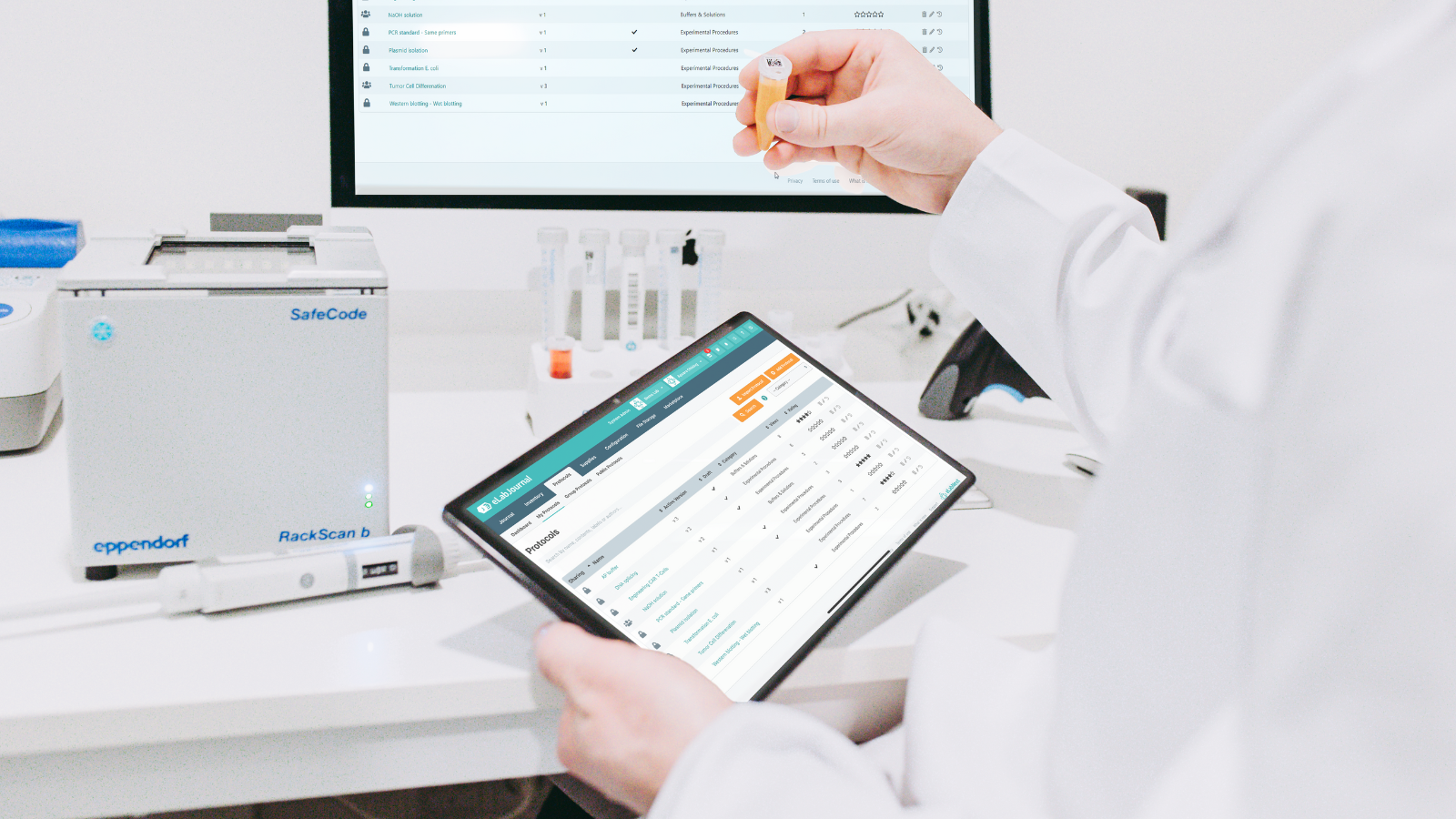
A structured electronic lab notebook helps teams standardize experiment documentation while retaining the flexibility required for evolving research workflows.
3. Connect experiments, samples, inventory, and equipment
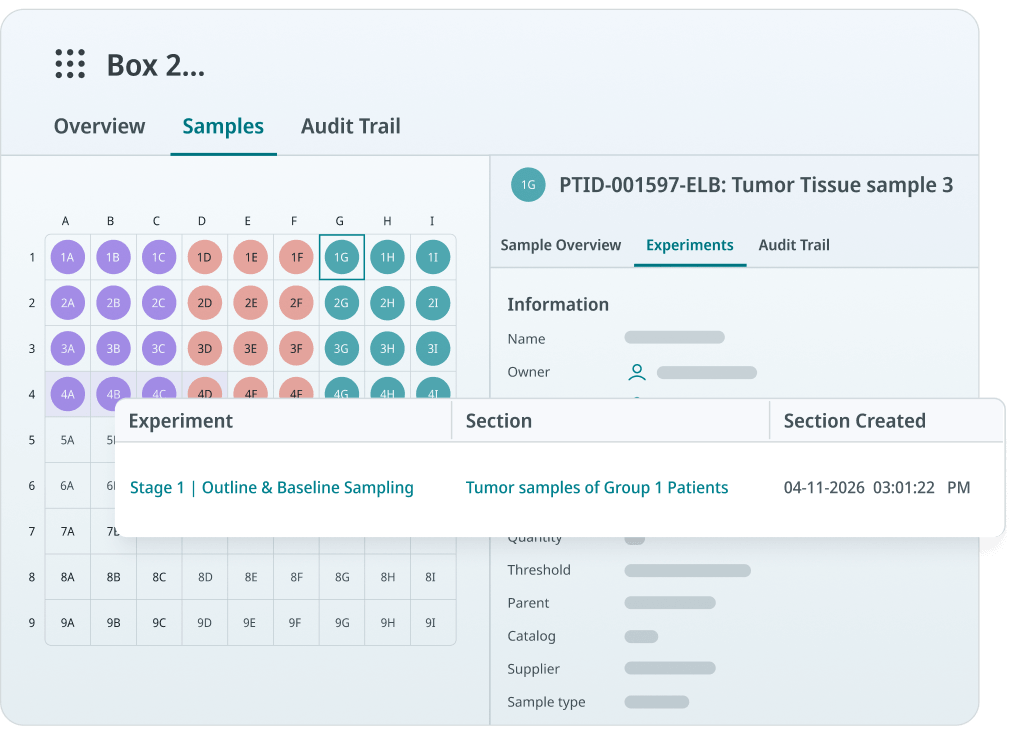
Avoid managing experimental context and physical materials in separate records. Each sample should have a unique identifier and a traceable history covering its origin, location, status, handling, and use in experiments.
Connecting an ELN with LIMS software allows experiment records to remain linked to samples, reagents, inventory, equipment, and results. This reduces duplicate entry and makes it easier to investigate discrepancies or reproduce previous work.
For a closer comparison, see ELN vs LIMS: What’s the Difference?.
4. Automate data exchange wherever practical
Manual copying between instruments, spreadsheets, ELNs, and LIMS introduces transcription errors and breaks provenance. Map how data moves through the laboratory, define consistent identifiers and validation rules, and automate transfers where the risk and value justify it.
SciSure’s integrations and data-connectivity capabilities support connections with laboratory instruments, databases, and third-party systems. Read more about the planning and governance involved in our post on LIMS integration.
5. Build traceability and version control into daily work
Every material change should be attributable to an individual and recorded with its date, time, and context. Use automatic audit trails, version histories, approval workflows, and electronic signatures where required. Shared credentials and uncontrolled working copies should be avoided.
For regulated records, the controls must be configured and validated for their intended use. Check out our guide to 21 CFR Part 11 compliance in laboratory systems for a deep dive.
6. Control access without obstructing collaboration
Apply least-privilege access so users can view or modify only the data required for their role. Review permissions regularly, remove access promptly when roles change, and keep sensitive data within controlled workflows instead of distributing unmanaged copies by email or shared folders.
Role-based permissions, encryption, and activity logs allow teams to collaborate while maintaining accountability. Learn more about collaborating without compromising research data security.
7. Design for resilience and test recovery
Choose a deployment model that fits the lab’s security, IT, and regulatory requirements. Define backup frequency, recovery objectives, retention periods, and responsibilities—and test that data can actually be restored.
Cloud hosting can reduce infrastructure overhead, but it is not the only valid model. SciSure offers cloud, private-cloud, and on-premises hosting options, allowing labs to select an approach appropriate to their risk profile and internal policies.
8. Connect safety and compliance records to lab operations
Chemical inventories, safety data sheets, equipment records, training requirements, incidents, and inspections form part of the laboratory’s operational data. Keeping these records connected to daily workflows reduces gaps between scientific work and compliance oversight.
SciSure’s lab safety software connects safety, risk, audit, and compliance activities with the broader laboratory environment.
9. Treat training and continuous review as part of the system
Provide role-specific onboarding, documented procedures, and refresher training. Monitor whether researchers are using required templates, completing records contemporaneously, and following approved sharing and storage practices.
Periodically review permissions, audit trails, integrations, backup restoration, retention rules, and data quality. A laboratory data management system remains effective only when both its configuration and its users’ practices evolve with the lab.
How SciSure supports connected laboratory data management
SciSure’s Scientific Management Platform brings together experiment documentation, sample and inventory management, safety and compliance workflows, and system integrations. This creates a connected record across scientists, LabOps, EHS, and IT rather than requiring teams to reconcile information from separate systems.
How Fraunhofer IZI improved data searchability and sample management with SciSure
The Fraunhofer Institute for Cell Therapy and Immunology IZI, a research facility of over 600 people in Leipzig, Germany, faced a common laboratory data management problem: decades of archived data spread across paper notebooks and disconnected systems, with no reliable way to search it or connect sample records to experiments.
After implementing SciSure, the team was able to structure projects into searchable categories, give all team members consistent access to shared data, and link samples directly to the experiments where they were used.
"SciSure helps us save time by enabling us to share our protocols with colleagues easily. It also takes care of our sample management. This reduces the time spent writing down experiments, as samples can be easily linked."
- Sabrina Rau, Scientist and Scientific Coordinator for ELN implementation at Fraunhofer IZI.
The team also used sample traceability to identify contamination sources by tracking which samples appeared across failed experiments; they could pinpoint the problem without manual cross-referencing. Read the full Fraunhofer IZI story.
What does a lab data management system need to include?
A structured lab data management system is a connected set of capabilities that work together to keep lab data accurate, secure, and usable over time. You can use the checklist below to evaluate whether your current approach covers the fundamentals:
- Data quality assurance processes and validation at the point of entry
- An information-security program supported by appropriate technical controls and independent certifications, such as ISO/IEC 27001, where relevant
- A resilient deployment model (cloud, private cloud, or on-premises) with documented backups, recovery procedures, and availability requirements.
- Reliable, searchable retrieval of both current and historical data
- Integration with instruments, ELN, LIMS, and other lab systems
- Governance policies for data access, ownership, and usage
- Automated backups with documented recovery procedures
- Audit trails that track the origin, modifications, and handling of every data record
- Configurable controls that support the lab’s applicable regulatory and quality requirements
- Systematic version control for datasets and analysis tools
- Role-based access controls and collaborative platforms that protect IP
- Training and documentation for all users
- Structured, reproducible data reporting
- Seamless ELN and LIMS integration within the same ecosystem
- Fit within the lab's budget, personnel capacity, and IT infrastructure
- Structured metadata, naming conventions, and validation rules
- Documented retention, archiving, and disposal policies
- Data portability and export capabilities that prevent vendor lock-in
- Periodic restoration testing, not merely the existence of backups
When lab data management fails, it fails visibly
The consequences of a failed data management system surface as lost samples that delay research timelines, audit findings that require expensive remediation, data breaches that trigger regulatory enforcement, or research results that can’t be reproduced and therefore cannot be published.
Labs that store critical data on local hard drives or unsecured servers remain vulnerable to ransomware, physical damage, and theft. Likewise for labs that use disconnected systems for experiments, samples, and compliance documentation create integration gaps that accumulate into traceability failures. If your lab lacks version control, it can produce datasets where no one can say with confidence which version is authoritative.
Strong laboratory data management depends on connected records, controlled access, reliable infrastructure, tested recovery, traceable changes, and practices that users can follow consistently. Not necessarily a single deployment model.
SciSure’s Scientific Management Platform connects experiment documentation, sample and inventory records, safety and compliance workflows, and integrations in one structured environment. This helps your lab (or labs) reduce manual handoffs, preserve experimental context, and maintain audit-ready records as their research grows.
FAQ
What is laboratory data management?
Laboratory data management is the systematic process of collecting, organizing, storing, retrieving, and protecting data generated in a laboratory. It covers experiment records, sample data, instrument outputs, compliance documentation, and any other information produced across lab operations. The goal is to ensure data is accurate, secure, traceable, and accessible to the people and systems that need it.
Why is laboratory data management important?
It’s important because the reliability of research outcomes, regulatory compliance, and institutional security all depend on how well lab data is managed. Poor laboratory data management leads to irreproducible results, audit failures, security breaches, and data loss that can permanently compromise research programs or expose organizations to legal and financial consequences.
What are the main challenges in laboratory data management?
The most common challenges include data silos created by disconnected systems, version control failures that make it unclear which dataset is authoritative, integration gaps between ELN, LIMS, and instrument platforms, inadequate security against ransomware and data breaches, compliance documentation burdens, and insufficient backup practices. Most of these problems are compounded when labs try to manage large data volumes with spreadsheets or local storage.
What regulations apply to laboratory data management?
The applicable regulations depend on the lab's industry and geography. Common frameworks include GLP (Good Laboratory Practice) for non-clinical safety studies, FDA 21 CFR Part 11 for electronic records and signatures, ISO 27001 for information security management, GDPR for personal data protection in the EU, and HIPAA for health information in the US. Labs in clinical settings may also be subject to ISO 15189 and CLIA requirements. Most regulated labs must satisfy multiple frameworks simultaneously.
What tools are used for laboratory data management?
The primary tools are LIMS for sample tracking, inventory management, and workflow documentation; ELNs for experiment records and protocol management; and lab safety software for EHS compliance and safety documentation. Integrated platforms that connect these capabilities in a single system reduce the data silos and traceability gaps that arise when each tool operates independently.
Talk to a specialist to explore how SciSure could support your laboratory data management requirements.

Read more of our blogs about modern lab management
Discover the latest in lab operations, from sample management to AI innovations, designed to enhance efficiency and drive scientific breakthroughs.