How To Choose ELN Software for Academic Labs: What To Consider Before Investing

Compare ELN software costs, hosting, support and institutional requirements for academic research, plus considerations for the US, Germany, and France.

•
October 19, 2026
•
()
min read
A laboratory

Download Whitepaper

By submitting this form, you agree with our Privacy Policy.
Thank you! Download the file by clicking below:
Download
Oops! Something went wrong while submitting the form.

TL;DR

Choosing an electronic lab notebook (ELN) for academic institutions requires a clear assessment of total costs, research workflows, data governance and ongoing support, alongside the requirements that apply in each country.
‍

  • Compare your total costs.  
    A free electronic lab notebook license can reduce software expenditure, but hardware, maintenance, backups, training and administration still need resources that include hidden and ongoing costs. Compare open-source and commercial ELNs over 3-5 years, including internal staff time, paid support and future migration costs, using the same assumptions for each option.  
  • Evaluate how your ELN of choice fits your institution.
    Universities, research institutes and university medical centers need an ELN that supports researchers while giving central teams appropriate oversight. Make sure to test group administration, institutional login, collaboration, researcher departures, and record exports. Include several laboratories in your pilot, so the decision reflects the institution’s wider requirements.
  • Check regional requirements, especially for hosting.
    Hosting decisions depend on your institution’s location, research data, and applicable policies. German institutions should consider the German Research Foundation (DFG) research-record expectations where relevant; French institutions may need to assess public-sector cloud rules or health-data hosting requirements. SciSure’s ELN is available globally, with cloud, private cloud and on-premises deployment options for its research platform and includes ongoing Implementation support beyond setup.
  • Consider what ongoing support you receive.
    Evaluate support coverage, language needs, implementation responsibilities and academic pricing for your institution. Confirm the hosting region and service scope of your proposed deployment before committing. SciSure provides ongoing support beyond simply installation and setup with a detailed Implementation process and Value Realization Calls.

Electronic lab notebook software can begin as a practical choice for one research group. When an institution adopts it across multiple laboratories, the decision also affects IT capacity, research continuity, and long-term budgets.

For scientific directors, heads of research infrastructure and procurement teams, the challenge is to select a system that researchers will use, and the institution can sustain. Data management teams and data stewards likewise need to consider the logistics behind implementing such a system and ensuring it delivers value over the long-term.

SciSure’s ELN is available globally, covering both US and European labs and organizations, with data centers hosted in Germany and the Netherlands. We’re based in three legal entities, in Groningen (the Netherlands), Berlin (Germany), and Boston (USA.) Our software interface is available in English, French, and German with localized language support offered by our Customer Success and Implementation teams.  

Whether you are evaluating SciSure, an open-source ELN or another commercial platform, these questions provide a framework for comparing your options.

What does implementing an ELN cost?

Both implementing and operating an ELN over an ongoing basis require costs beyond just the license fee, so you should budget accordingly. Someone must maintain the system, manage access, test backups, and support researchers. If your academic institution has the right technical expertise and infrastructure, you might find it a strong fit.

Watch out though: some open-source ELNs often involve service models resembling those of commercial ELNs. For example, some options position themselves as free and open source, but at the same time, include paid hosting professional support, and training.

Commercial ELNs, on the other hand, often provide these very same services within a more integrated service framework. They come with defined responsibilities for hosting, maintenance, support, updates, and user training.

This is why it makes sense to compare beyond license fees. Rather, you should consider the overall level of service, operational effort, cost predictability, and institutional resources required for the ELN you want to be implemented down the line.  

What an Electronic Lab Notebook (ELN) costs beyond the license fee

Cost area What to establish
Software and services License charges, included capabilities, and paid extras
Infrastructure Hardware for on-premises, storage, monitoring, backups, and recovery
Implementation Configuration, migration, integrations, and staff time
Ongoing operation Administration, training, maintenance, and user support
Expansion Costs when additional laboratories or users join
Exit and archiving Export assistance and continued access to retained records

Alongside these costs, make sure you include work carried out by your existing employees. Their time represents capacity that must remain available alongside other institutional responsibilities.  

Apply the same scrutiny to commercial proposals. Clarify what the subscription covers and which tasks your own teams will still perform.

Can your ELN software support the needs of multiple teams?

An ELN needs to support more than experiment documentation. IT and data management teams need to administer the system across the institution, principal investigators need oversight of their groups’ work, and researchers need practical tools for their daily workflows. Evaluate these needs separately, then test how they work together.

For IT and data management teams: Institution-wide administration

Can the ELN support your organizational structure and processes for managing access and retaining research records? Ask whether it can:

  • Organize users and projects by research group, department, and site, including projects that span these boundaries.
  • Add and remove users through your institution’s identity management process, with clearly defined administrative roles and permissions.
  • Preserve research records when users leave and support institutional requirements for retention, retrieval, and export.

For principal investigators: Group oversight and continuity

Can PIs oversee their groups’ research, manage collaboration, and keep projects accessible as team members change? Ask whether it can:

  • Create distinct research groups with appropriate permissions and share selected records with other groups or external collaborators.
  • Give authorized group leaders visibility into projects, documentation, and responsibilities.
  • Transfer project responsibility when a researcher leaves and retrieve completed work, including its supporting files, over the long term.

For researchers and project groups: Daily workflows and collaboration

Can researchers document, find, and build on their work without unnecessary administrative effort? Ask whether it can:

  • Connect experiment documentation with samples, supporting files, and related project records.
  • Support shared project workflows so colleagues can contribute to and review research with appropriate access.
  • Find previous work and export records with the attachments and metadata needed to interpret and reuse them.

Ask each provider or internal implementation team to demonstrate these capabilities using a realistic scenario. For example, a doctoral researcher leaving while colleagues continue the project. Involve representatives from all three levels and record any configuration, additional services, or manual work required. This gives your institution a clearer basis for assessing suitability than a feature list alone.

The University of Pittsburgh’s Behavioral Immunology Lab selected SciSure to replace a labor-intensive mix of paper and Excel sample tracking, with affordability and inventory management central to its needs. Implementation took around one month, giving researchers searchable sample locations and standardized labels to support their daily work.
‍

SciSure has saved us plenty of time - a 50% improvement - when it comes to tracking and managing samples.

‍
- Zak Hutchinson, Behavioral Immunology Laboratory Manager, University of Pittsburgh

‍

Where will research data be hosted and accessed?

Start with your institution’s data classifications, policies, and research agreements. A basic research laboratory and a medical research group handling identifiable health information may have different requirements.

For every proposed deployment, establish:

  • Where production data and backups are stored.
  • Who can access the system for administration and support.
  • Which legal entities and infrastructure providers are involved.
  • How international collaboration and data transfers will be handled. international collaboration and data transfers will be handled.
  • Who is responsible for updates, recovery, and incident response.

Confirm the hosting region and operational responsibilities attached to the specific option you are considering. Make sure to involve your IT, information security, and data protection teams early enough to assess the proposed arrangement.

SciSure Research
Your research data, your choice of hosting.
Choose SciSure cloud, private cloud or on-premises hosting to meet your institution’s data-location policies and decide how much infrastructure your IT team manages.
Talk to a specialist

Germany: Research-record retention and institutional hosting criteria

For institutions receiving DFG funding, the DFG Code of Conduct is an important reference. Its archiving guideline generally calls for research data and materials underpinning published findings to remain accessible and identifiable for ten years, with justified exceptions. Your ELN and archiving arrangements should support the applicable retention period, including after researchers leave.

Ask central IT to identify any additional institutional or applicable public-sector requirements for cloud security, processing agreements, and international access. Where German or EU hosting is required by your institution, specify it in the evaluation and confirm production and backup locations separately.

In Germany, the Fraunhofer Institute for Cell Therapy and Immunology IZI in Leipzig needed easier data retrieval and collaboration across an organization with seven departments. SciSure helped teams organize projects, share access to research data, and link samples to experiments, reducing repetitive documentation.
‍

"SciSure helps us save time by enabling us to share our protocols with colleagues easily. It also takes care of our sample management. This reduces the time spent writing down experiments, as samples can be easily linked."

- Sabrina Rau, Scientist and Scientific Coordinator, Fraunhofer IZI


With offices based in the Netherlands, Germany, and the US, SciSure also offers German-language assistance. Make sure you confirm the contacts and support arrangements included in your proposal.

France: Public-sector cloud rules and health-data hosting

French institutions should establish whether their organization and project fall within the state’s Cloud au centre doctrine. For in-scope systems handling particularly sensitive data, the doctrine specifies additional protections, including SecNumCloud qualification or an accepted European equivalent for commercial cloud services. These requirements should be assessed against the institution’s status and the data involved.

Medical research teams should also determine whether their hosting activity falls within France’s health-data hosting requirements under Article L1111-8 of the Public Health Code. CNIL’s cloud security guidance identifies the requirement for HDS-certified hosting where applicable. This should be assessed for the actual data and activity rather than assumed for every academic ELN deployment.

An example from Paris: Institut Pasteur’s ELN selection and rollout, which shows how a research institution can bring these considerations into its evaluation. Legal and data security requirements were essential to its decision, alongside functionality, ease of use, and cost. The institute evaluated more than 20 ELN and sample-tracking solutions, with scientists from around 50 research units contributing to the final choice of SciSure. A dedicated IT team then supported implementation across four deployment waves, using workshops and monthly training sessions to help researchers adopt the platform.

Customer Story  ·  Academia
A Digital Transformation at Institut Pasteur
How one of the world's leading research institutes unified its lab data, samples and documentation with SciSure.
The Challenge

Paper notebooks and mismatched tools across 12 departments

Hours lost locating samples and organizing records

Data scattered across drives, computers and cloud storage

No shared standard, raising the risk of lost research work

The Solution
20+
ELN & sample tools evaluated
7 → 2
Compared, then taken to proof of concept
1
Unified ELN + LIMS platform deployed
Chosen for: ELN + LIMS in one Ease of use Cost-effectiveness Legal & data security
The Impact

One central hub

Protocols, experiments and samples connected in a single place.

Full traceability

Clear record of what was done, and by whom, across every unit.

Faster retrieval

The inventory browser makes sample tracking quick and simple.

Equipment module

Centralized instrument info and shared team bookings.

SOPs linked

Standard procedures tied directly to the right experiments.

Secure backups

Research data stored reliably and accessible from anywhere.

“
SciSure has been a game-changer for our lab. Its intuitive interface and tracking capabilities turned sample management from a time-consuming task into a swift, effortless process.
Mariano Martinez  · Research Engineer & Lab Manager, Bacterial Cell Cycle Mechanisms Unit, Institut Pasteur
SciSure Research
Keep research moving as your institution grows
Help researchers find and share data, preserve knowledge when teams change, and spend less time managing records with SciSure.
Request a demo

Will support work across multi-site organizations or international labs?

For an institution operating internationally, support needs to extend beyond the availability of a help desk. Ask your vendor about which time zones and languages are covered, how urgent issues are escalated, and who supports integrations or institution-specific configurations. Clarify the difference between response targets and resolution commitments.

Training, likewise, also needs an owner. New students, visiting researchers and changing project teams create an ongoing onboarding requirement. Compare how much ongoing implementation support your vendors provide after installation and setup. Whether support comes from an internal team, an open-source service partner or a commercial provider, document responsibilities and backup coverage.

Who will maintain your ELN when the person responsible leaves?

Your ELN software of choice should remain supportable when the person who introduced it changes roles or leaves your organization. A poor or missing handover can leave teams without the knowledge or access needed to keep the system running.

This matters whether you choose open-source or commercial software, hosted in the cloud or on-premises. Each option can distribute responsibilities differently between your institution, the provider, and any implementation partners. Establish who will:

  • Maintain the system, apply updates, and resolve technical issues.
  • Manage administrator access, configuration, and integrations.
  • Oversee backups, recovery, and continued access to research records.
  • Keep documentation current and train a replacement.

Ask each provider or internal implementation team to explain what would happen if your main ELN administrator left. A named deputy, documented handover process, and clear support arrangements should be part of the implementation plan, so continuity does not depend on one person’s availability or knowledge.

How should you approach ELN procurement and implementation?

It’s understandable if you’re considering an immediately available tool because of budget constraints and a lengthy purchasing process. However, before a pilot grows into an institutional service, involve your research, central IT, and procurement team early so that the evaluation reflects both day-to-day use and institutional responsibilities.

Make sure you:

  • Define essential functional, technical, security, and support requirements before reviewing any solutions or demos.
  • Establish the appropriate procurement route and clarify the full scope of institutional commitment, including licensing, hosting, support training, and internal resources.
  • Run a pilot of your short-listed solutions with several representative labs to test the solution under realistic conditions.
  • Test both routine documentation, plus access changes, project handovers, data exports, and other situations likely to rise over the system’s lifecycle.
  • Evaluate researcher feedback together with admin effort, technical requirements, and support needs.
  • Use the findings to plan a phased rollout with named owners, enough training and support capacity, and clear criteria for expanding adoption.

Here’s how implementing a Scientific Management Platform like SciSure works in practice: who needs to be involved and why an executive sponsor is vital to the process.
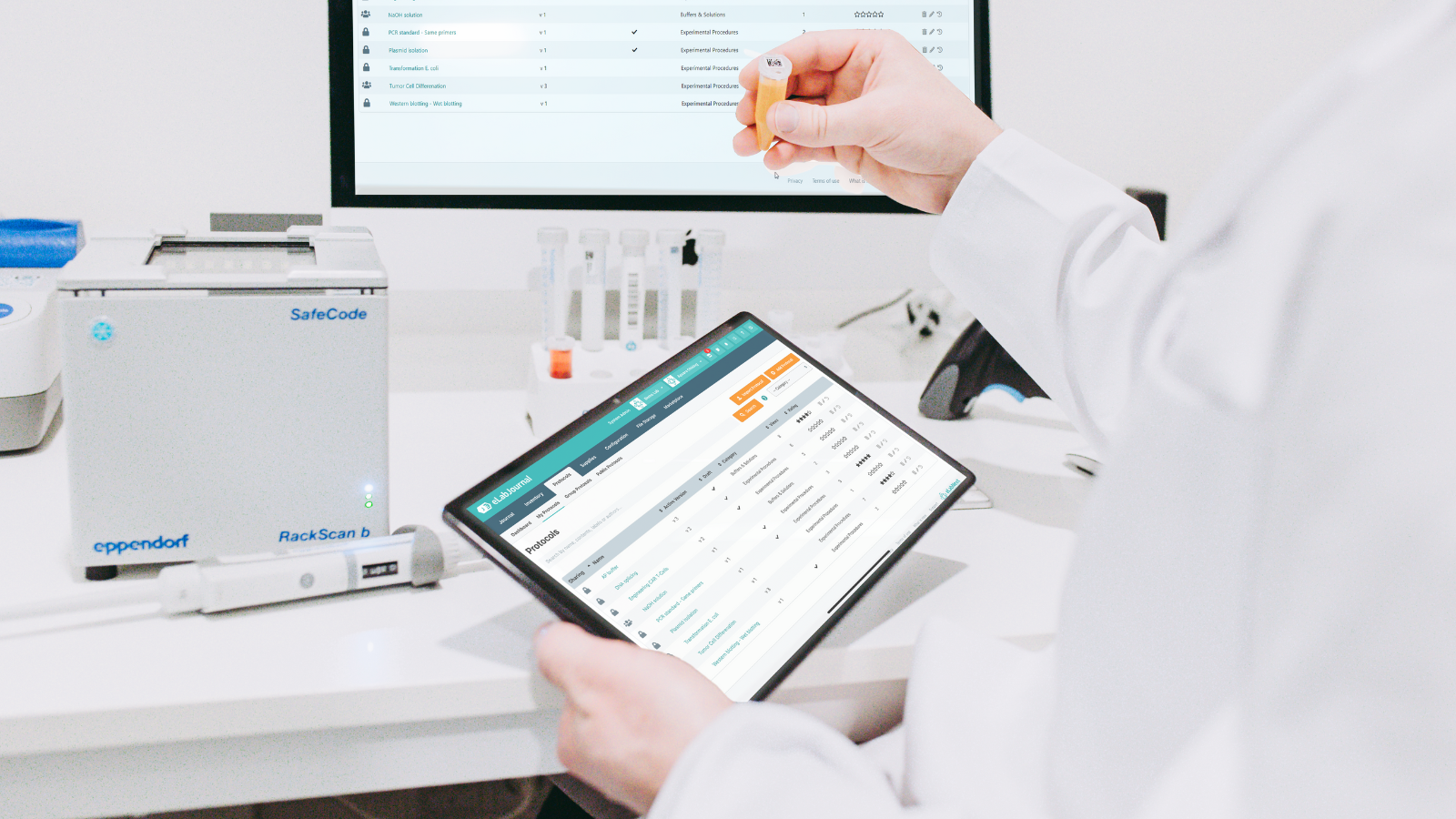
SciSure's Electronic Lab Notebook (ELN) Software

Can you customize your ELN while keeping security and support dependable?

Open-source software is not inherently less secure, and some projects offer professional commercial support. The key distinction is whether your chosen solution has the resources, processes, and accountability your institution needs. An established commercial provider can offer dedicated support and formal security management, but these arrangements should be verified during evaluation.

Open-source ELNs might sound appealing if your institution wants to modify the software or build your own functionality. But this flexibility means that it’s also necessary to have a clear plan for maintaining custom code, applying security updates, and responding when something goes wrong. If a project relies on a small development team or volunteers, you might not be able to implement fixes if someone’s out of office or otherwise unavailable. This means you’ll be on your own when it comes to investigating issues or implementing a workaround.

Ask each provider or internal implementation team:

  • Who monitors vulnerabilities, develops fixes, and installs updates?
  • What incident response process, escalation route, and response commitments are in place?
  • Who checks that custom functionality remains secure and compatible after upgrades?
  • How do responsibilities differ between cloud and on-premises deployments?

Customization is also possible within a commercially supported platform. SciSure’s APIs, SDK, and Developer Hub enable institutions to build integrations and extend functionality for their workflows. Alongside these capabilities, SciSure reports ISO/IEC 27001 certification for information security management, giving institutions a concrete basis for evaluating both flexibility and security governance. Ask how that support covers your proposed deployment and any custom extensions.

Frequently asked questions

Is a free ELN suitable for an academic institution?

It can be, depending on your research workflows, institutional requirements, and the resources available to operate the system. Include costs for hosting, maintenance, training and support in the comparison, and test the proposed implementation with representative laboratories. Just keep in mind that not all free/open-source ELN software includes free hosting, training, or setup support.

Is SciSure’s ELN available globally?

Yes. SciSure’s ELN is available globally. Confirm the hosting region, support arrangements and configuration available for proposed deployment, together with any local requirements that affect its use.

What should institutions in Germany consider?

Make sure you assess applicable data protection and institutional hosting requirements, alongside research-record retention. DFG-funded institutions should consider the DFG Code of Conduct’s archiving expectations. Specify any required hosting locations and confirm support access, backup arrangements and German-language assistance.

Do all French academic ELNs require HDS or SecNumCloud?

Not necessarily; HDS requirements depend on the health-data hosting activity. SecNumCloud requirements can arise for particularly sensitive systems within the scope of the state cloud doctrine. Establish applicability with your institution’s data protection, security, and procurement teams.

What should an academic ELN proposal include?

An academic ELN proposal should include a breakdown of licenses, hosting, implementation, training, support, and expansion costs. Consider any available academic discounts and renewal terms so that your institution can compare options over the same period.

SciSure offers academic discounts to help institutions make their research budgets go further. Request an academic quote covering your research groups, hosting preferences and support needs to understand the cost of introducing SciSure across your institution.

Talk to a SciSure specialist about your institution’s ELN requirements to discuss hosting options, implementation support, and academic pricing.

Keep reading

Ready to see SciSure in action?

Get a personalized demo and see how SciSure fits your lab's workflows.
Request demo

No commitment · Free consultation

Electronic lab notebook software can begin as a practical choice for one research group. When an institution adopts it across multiple laboratories, the decision also affects IT capacity, research continuity, and long-term budgets.

For scientific directors, heads of research infrastructure and procurement teams, the challenge is to select a system that researchers will use, and the institution can sustain. Data management teams and data stewards likewise need to consider the logistics behind implementing such a system and ensuring it delivers value over the long-term.

SciSure’s ELN is available globally, covering both US and European labs and organizations, with data centers hosted in Germany and the Netherlands. We’re based in three legal entities, in Groningen (the Netherlands), Berlin (Germany), and Boston (USA.) Our software interface is available in English, French, and German with localized language support offered by our Customer Success and Implementation teams.  

Whether you are evaluating SciSure, an open-source ELN or another commercial platform, these questions provide a framework for comparing your options.

What does implementing an ELN cost?

Both implementing and operating an ELN over an ongoing basis require costs beyond just the license fee, so you should budget accordingly. Someone must maintain the system, manage access, test backups, and support researchers. If your academic institution has the right technical expertise and infrastructure, you might find it a strong fit.

Watch out though: some open-source ELNs often involve service models resembling those of commercial ELNs. For example, some options position themselves as free and open source, but at the same time, include paid hosting professional support, and training.

Commercial ELNs, on the other hand, often provide these very same services within a more integrated service framework. They come with defined responsibilities for hosting, maintenance, support, updates, and user training.

This is why it makes sense to compare beyond license fees. Rather, you should consider the overall level of service, operational effort, cost predictability, and institutional resources required for the ELN you want to be implemented down the line.  

What an Electronic Lab Notebook (ELN) costs beyond the license fee

Cost area What to establish
Software and services License charges, included capabilities, and paid extras
Infrastructure Hardware for on-premises, storage, monitoring, backups, and recovery
Implementation Configuration, migration, integrations, and staff time
Ongoing operation Administration, training, maintenance, and user support
Expansion Costs when additional laboratories or users join
Exit and archiving Export assistance and continued access to retained records

Alongside these costs, make sure you include work carried out by your existing employees. Their time represents capacity that must remain available alongside other institutional responsibilities.  

Apply the same scrutiny to commercial proposals. Clarify what the subscription covers and which tasks your own teams will still perform.

Can your ELN software support the needs of multiple teams?

An ELN needs to support more than experiment documentation. IT and data management teams need to administer the system across the institution, principal investigators need oversight of their groups’ work, and researchers need practical tools for their daily workflows. Evaluate these needs separately, then test how they work together.

For IT and data management teams: Institution-wide administration

Can the ELN support your organizational structure and processes for managing access and retaining research records? Ask whether it can:

  • Organize users and projects by research group, department, and site, including projects that span these boundaries.
  • Add and remove users through your institution’s identity management process, with clearly defined administrative roles and permissions.
  • Preserve research records when users leave and support institutional requirements for retention, retrieval, and export.

For principal investigators: Group oversight and continuity

Can PIs oversee their groups’ research, manage collaboration, and keep projects accessible as team members change? Ask whether it can:

  • Create distinct research groups with appropriate permissions and share selected records with other groups or external collaborators.
  • Give authorized group leaders visibility into projects, documentation, and responsibilities.
  • Transfer project responsibility when a researcher leaves and retrieve completed work, including its supporting files, over the long term.

For researchers and project groups: Daily workflows and collaboration

Can researchers document, find, and build on their work without unnecessary administrative effort? Ask whether it can:

  • Connect experiment documentation with samples, supporting files, and related project records.
  • Support shared project workflows so colleagues can contribute to and review research with appropriate access.
  • Find previous work and export records with the attachments and metadata needed to interpret and reuse them.

Ask each provider or internal implementation team to demonstrate these capabilities using a realistic scenario. For example, a doctoral researcher leaving while colleagues continue the project. Involve representatives from all three levels and record any configuration, additional services, or manual work required. This gives your institution a clearer basis for assessing suitability than a feature list alone.

The University of Pittsburgh’s Behavioral Immunology Lab selected SciSure to replace a labor-intensive mix of paper and Excel sample tracking, with affordability and inventory management central to its needs. Implementation took around one month, giving researchers searchable sample locations and standardized labels to support their daily work.
‍

SciSure has saved us plenty of time - a 50% improvement - when it comes to tracking and managing samples.

‍
- Zak Hutchinson, Behavioral Immunology Laboratory Manager, University of Pittsburgh

‍

Where will research data be hosted and accessed?

Start with your institution’s data classifications, policies, and research agreements. A basic research laboratory and a medical research group handling identifiable health information may have different requirements.

For every proposed deployment, establish:

  • Where production data and backups are stored.
  • Who can access the system for administration and support.
  • Which legal entities and infrastructure providers are involved.
  • How international collaboration and data transfers will be handled. international collaboration and data transfers will be handled.
  • Who is responsible for updates, recovery, and incident response.

Confirm the hosting region and operational responsibilities attached to the specific option you are considering. Make sure to involve your IT, information security, and data protection teams early enough to assess the proposed arrangement.

SciSure Research
Your research data, your choice of hosting.
Choose SciSure cloud, private cloud or on-premises hosting to meet your institution’s data-location policies and decide how much infrastructure your IT team manages.
Talk to a specialist

Germany: Research-record retention and institutional hosting criteria

For institutions receiving DFG funding, the DFG Code of Conduct is an important reference. Its archiving guideline generally calls for research data and materials underpinning published findings to remain accessible and identifiable for ten years, with justified exceptions. Your ELN and archiving arrangements should support the applicable retention period, including after researchers leave.

Ask central IT to identify any additional institutional or applicable public-sector requirements for cloud security, processing agreements, and international access. Where German or EU hosting is required by your institution, specify it in the evaluation and confirm production and backup locations separately.

In Germany, the Fraunhofer Institute for Cell Therapy and Immunology IZI in Leipzig needed easier data retrieval and collaboration across an organization with seven departments. SciSure helped teams organize projects, share access to research data, and link samples to experiments, reducing repetitive documentation.
‍

"SciSure helps us save time by enabling us to share our protocols with colleagues easily. It also takes care of our sample management. This reduces the time spent writing down experiments, as samples can be easily linked."

- Sabrina Rau, Scientist and Scientific Coordinator, Fraunhofer IZI


With offices based in the Netherlands, Germany, and the US, SciSure also offers German-language assistance. Make sure you confirm the contacts and support arrangements included in your proposal.

France: Public-sector cloud rules and health-data hosting

French institutions should establish whether their organization and project fall within the state’s Cloud au centre doctrine. For in-scope systems handling particularly sensitive data, the doctrine specifies additional protections, including SecNumCloud qualification or an accepted European equivalent for commercial cloud services. These requirements should be assessed against the institution’s status and the data involved.

Medical research teams should also determine whether their hosting activity falls within France’s health-data hosting requirements under Article L1111-8 of the Public Health Code. CNIL’s cloud security guidance identifies the requirement for HDS-certified hosting where applicable. This should be assessed for the actual data and activity rather than assumed for every academic ELN deployment.

An example from Paris: Institut Pasteur’s ELN selection and rollout, which shows how a research institution can bring these considerations into its evaluation. Legal and data security requirements were essential to its decision, alongside functionality, ease of use, and cost. The institute evaluated more than 20 ELN and sample-tracking solutions, with scientists from around 50 research units contributing to the final choice of SciSure. A dedicated IT team then supported implementation across four deployment waves, using workshops and monthly training sessions to help researchers adopt the platform.

Customer Story  ·  Academia
A Digital Transformation at Institut Pasteur
How one of the world's leading research institutes unified its lab data, samples and documentation with SciSure.
The Challenge

Paper notebooks and mismatched tools across 12 departments

Hours lost locating samples and organizing records

Data scattered across drives, computers and cloud storage

No shared standard, raising the risk of lost research work

The Solution
20+
ELN & sample tools evaluated
7 → 2
Compared, then taken to proof of concept
1
Unified ELN + LIMS platform deployed
Chosen for: ELN + LIMS in one Ease of use Cost-effectiveness Legal & data security
The Impact

One central hub

Protocols, experiments and samples connected in a single place.

Full traceability

Clear record of what was done, and by whom, across every unit.

Faster retrieval

The inventory browser makes sample tracking quick and simple.

Equipment module

Centralized instrument info and shared team bookings.

SOPs linked

Standard procedures tied directly to the right experiments.

Secure backups

Research data stored reliably and accessible from anywhere.

“
SciSure has been a game-changer for our lab. Its intuitive interface and tracking capabilities turned sample management from a time-consuming task into a swift, effortless process.
Mariano Martinez  · Research Engineer & Lab Manager, Bacterial Cell Cycle Mechanisms Unit, Institut Pasteur
SciSure Research
Keep research moving as your institution grows
Help researchers find and share data, preserve knowledge when teams change, and spend less time managing records with SciSure.
Request a demo

Will support work across multi-site organizations or international labs?

For an institution operating internationally, support needs to extend beyond the availability of a help desk. Ask your vendor about which time zones and languages are covered, how urgent issues are escalated, and who supports integrations or institution-specific configurations. Clarify the difference between response targets and resolution commitments.

Training, likewise, also needs an owner. New students, visiting researchers and changing project teams create an ongoing onboarding requirement. Compare how much ongoing implementation support your vendors provide after installation and setup. Whether support comes from an internal team, an open-source service partner or a commercial provider, document responsibilities and backup coverage.

Who will maintain your ELN when the person responsible leaves?

Your ELN software of choice should remain supportable when the person who introduced it changes roles or leaves your organization. A poor or missing handover can leave teams without the knowledge or access needed to keep the system running.

This matters whether you choose open-source or commercial software, hosted in the cloud or on-premises. Each option can distribute responsibilities differently between your institution, the provider, and any implementation partners. Establish who will:

  • Maintain the system, apply updates, and resolve technical issues.
  • Manage administrator access, configuration, and integrations.
  • Oversee backups, recovery, and continued access to research records.
  • Keep documentation current and train a replacement.

Ask each provider or internal implementation team to explain what would happen if your main ELN administrator left. A named deputy, documented handover process, and clear support arrangements should be part of the implementation plan, so continuity does not depend on one person’s availability or knowledge.

How should you approach ELN procurement and implementation?

It’s understandable if you’re considering an immediately available tool because of budget constraints and a lengthy purchasing process. However, before a pilot grows into an institutional service, involve your research, central IT, and procurement team early so that the evaluation reflects both day-to-day use and institutional responsibilities.

Make sure you:

  • Define essential functional, technical, security, and support requirements before reviewing any solutions or demos.
  • Establish the appropriate procurement route and clarify the full scope of institutional commitment, including licensing, hosting, support training, and internal resources.
  • Run a pilot of your short-listed solutions with several representative labs to test the solution under realistic conditions.
  • Test both routine documentation, plus access changes, project handovers, data exports, and other situations likely to rise over the system’s lifecycle.
  • Evaluate researcher feedback together with admin effort, technical requirements, and support needs.
  • Use the findings to plan a phased rollout with named owners, enough training and support capacity, and clear criteria for expanding adoption.

Here’s how implementing a Scientific Management Platform like SciSure works in practice: who needs to be involved and why an executive sponsor is vital to the process.

SciSure's Electronic Lab Notebook (ELN) Software

Can you customize your ELN while keeping security and support dependable?

Open-source software is not inherently less secure, and some projects offer professional commercial support. The key distinction is whether your chosen solution has the resources, processes, and accountability your institution needs. An established commercial provider can offer dedicated support and formal security management, but these arrangements should be verified during evaluation.

Open-source ELNs might sound appealing if your institution wants to modify the software or build your own functionality. But this flexibility means that it’s also necessary to have a clear plan for maintaining custom code, applying security updates, and responding when something goes wrong. If a project relies on a small development team or volunteers, you might not be able to implement fixes if someone’s out of office or otherwise unavailable. This means you’ll be on your own when it comes to investigating issues or implementing a workaround.

Ask each provider or internal implementation team:

  • Who monitors vulnerabilities, develops fixes, and installs updates?
  • What incident response process, escalation route, and response commitments are in place?
  • Who checks that custom functionality remains secure and compatible after upgrades?
  • How do responsibilities differ between cloud and on-premises deployments?

Customization is also possible within a commercially supported platform. SciSure’s APIs, SDK, and Developer Hub enable institutions to build integrations and extend functionality for their workflows. Alongside these capabilities, SciSure reports ISO/IEC 27001 certification for information security management, giving institutions a concrete basis for evaluating both flexibility and security governance. Ask how that support covers your proposed deployment and any custom extensions.

Frequently asked questions

Is a free ELN suitable for an academic institution?

It can be, depending on your research workflows, institutional requirements, and the resources available to operate the system. Include costs for hosting, maintenance, training and support in the comparison, and test the proposed implementation with representative laboratories. Just keep in mind that not all free/open-source ELN software includes free hosting, training, or setup support.

Is SciSure’s ELN available globally?

Yes. SciSure’s ELN is available globally. Confirm the hosting region, support arrangements and configuration available for proposed deployment, together with any local requirements that affect its use.

What should institutions in Germany consider?

Make sure you assess applicable data protection and institutional hosting requirements, alongside research-record retention. DFG-funded institutions should consider the DFG Code of Conduct’s archiving expectations. Specify any required hosting locations and confirm support access, backup arrangements and German-language assistance.

Do all French academic ELNs require HDS or SecNumCloud?

Not necessarily; HDS requirements depend on the health-data hosting activity. SecNumCloud requirements can arise for particularly sensitive systems within the scope of the state cloud doctrine. Establish applicability with your institution’s data protection, security, and procurement teams.

What should an academic ELN proposal include?

An academic ELN proposal should include a breakdown of licenses, hosting, implementation, training, support, and expansion costs. Consider any available academic discounts and renewal terms so that your institution can compare options over the same period.

SciSure offers academic discounts to help institutions make their research budgets go further. Request an academic quote covering your research groups, hosting preferences and support needs to understand the cost of introducing SciSure across your institution.

Talk to a SciSure specialist about your institution’s ELN requirements to discuss hosting options, implementation support, and academic pricing.

Keep reading

About the author:

Aziz Benamara

Dr. Aziz Benamara is an Account Manager for France and Europe at SciSure, combining a background in molecular chemistry with experience in scientific sales and business development. He holds a PhD in Molecular Chemistry from PSL Research University and an engineering degree from ESPCI Paris. His research at Sanofi focused on developing synthetic strategies for compounds of potential interest in medicinal chemistry. His experience also includes connecting with researchers to provide them microfluidic systems for various applications. Aziz works with research teams to understand their needs, supporting laboratory digitalization through tailored solutions for data management, inventory, and compliance, while building lasting partnerships across scientific sectors.

See all posts from this author

Sign up for our newsletter

Get the latest tips, articles, and exclusive content on modern lab management delivered to your inbox.
Thank you for subscribing!
Please check your email to verify your submission.
Oops! Something went wrong while submitting the form.