Free Electronic Lab Notebook Software: Is It Worth It?

Is free ELN software worth it? Explore adoption, support and hidden costs to choose an electronic lab notebook your researchers will actually use.

September 17, 2026
()
min read
A laboratory

Download Whitepaper

By submitting this form, you agree with our Privacy Policy.
Thank you! Download the file by clicking below:
Download
Oops! Something went wrong while submitting the form.

Table of Contents

Thank you! Your submission has been received!
Oops! Something went wrong while submitting the form.

Table of Contents

TL;DR

Free electronic lab notebook (ELN) software is worth it when your lab can genuinely cover hosting, administration, training and support; if nobody owns those, the licence you saved costs more in parallel paper records and lost research time.

  • What "free" means.
    "Free" electronic lab notebook options might include open-source software, a permanent free tier, an academic or individual plan, and a time-limited trial. Each carries its own responsibilities, pros, and cons.
  • When free works.
    A free ELN suits an individual researcher, a small team, or an institution with established IT support. The conditions matter more than headcount: capabilities match your documentation needs, someone owns onboarding and maintenance, export options meet requirements, and you have tested it with representative experiments.
  • Labs that pick on price often keep using paper.
    Researchers maintain parallel records across notebooks, shared folders and the ELN, results become hard to retrieve without the person who produced them, and departures leave gaps colleagues must reconstruct. The digital system still consumes setup, hosting and staff time.
  • Total cost beyond licence.
    Budget for hosting and updates, tested backup and recovery, storage limits, connections between experiments and samples, user administration when people leave, and data export. An export that opens cleanly can still take significant work to load into another system later.
  • Also consider implementation as part of the process.
    At SciSure, implementation, training and adoption reviews are part of the approach, and its G2-reported time to ROI is eight months against 13 months or more for several listed platforms. Institut Pasteur chose SciSure after evaluating over 20 systems, rolling out across roughly 50 research units in four waves.

Moving from paper notebooks to an electronic lab notebook (ELN) takes more than creating accounts. Researchers need to learn new workflows, organize existing records, and build new documentation habits while keeping experiments moving.

A free or inexpensive ELN can make that transition accessible. However, a low price does not tell you whether people will use it consistently.

When they speak to us, some researchers describe choosing an ELN because it was free or inexpensive, only to find that their colleagues continued working on paper. The software was available, but the transition never became part of everyday lab work.

That experience highlights an essential question for any ELN evaluation: what will it take for your team to use the system successfully?

What does “free electronic lab notebook software” actually mean?

“Free” can describe several different offers, each with its own responsibilities and costs.

Model What it means What to evaluate
Open-source software Software available under an open-source license, often without a license fee Hosting, maintenance, backups, technical ownership and support
Permanent free tier Ongoing access to a limited version of a product User, storage, feature and administration limits
Academic or individual plan Free access for eligible researchers or institutions Eligibility, collaboration features and what happens if your needs change
Free trial Temporary access to a commercial product Trial length, included capabilities and the cost of continuing

Open-source software can also provide paid hosting and support options. For example, eLabFTW offers free community support, with professional support and hosting available through Deltablot. The relevant comparison is the complete deployment and service package your lab would use.

Before comparing prices, establish what each option includes and which responsibilities remain with your team.

When is a free ELN worth it?

A free ELN can work well for an individual researcher, a small team, or an institution with established technical support. It may be a suitable choice when:

  • Its capabilities match your documentation and collaboration needs.
  • Researchers can use it comfortably during their normal working day.
  • Someone owns onboarding, administration, and ongoing maintenance.
  • Storage, access, and export options meet your requirements.
  • Your team can obtain the support it needs.
  • You have tested the system with representative experiments.

Team size alone should not determine your decision. A large institution with dedicated IT staff may successfully maintain an open-source deployment, while a small lab without technical support may prefer a managed service.

The key is whether the lab can sustain the system and its use over time.
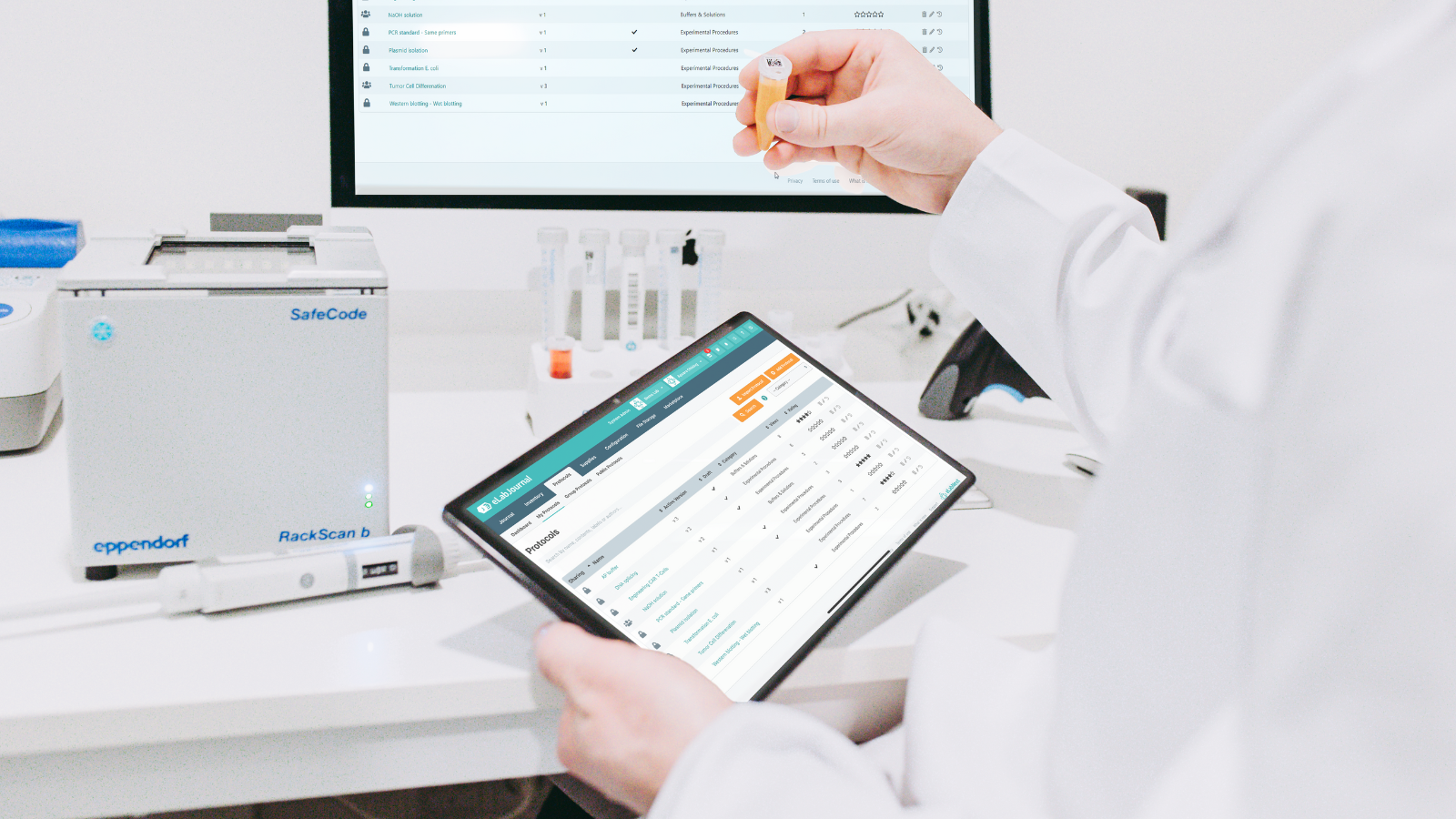
The SciSure Electronic Lab Notebook (ELN)

The hidden cost of a free ELN your team does not use

A lab can have an ELN in place and still depend on paper notebooks, spreadsheets and personal folders. Researchers may encounter unfamiliar workflows, struggle to find the right template, or leave a question unresolved because they do not know where to get help. Under pressure to complete experiments, they return to familiar methods.

When that happens, several costs remain.

  • The lab still spends resources on the digital system.
    Even with no license fee, setup, hosting, administration and staff time have a cost. Paid subscriptions or services add to that investment where applicable.
  • Researchers maintain parallel records.
    Notes may begin on paper, results sit in shared folders, and only part of the experiment reaches the ELN. Re-entering information creates extra work and opportunities for errors.
  • Research becomes harder to retrieve and reuse.
    A result may exist, but finding its method, sample details and supporting files can depend on the person who produced it.
  • Knowledge becomes vulnerable during staff changes.
    When records are scattered or incomplete, departures can leave gaps that colleagues must reconstruct.

These problems do not mean data loss is inevitable. They mean that valuable research can remain difficult to find, interpret, share, or preserve, despite the lab’s investment in digitization.

An ELN delivers value when researchers use it consistently, and colleagues can rely on the records it contains.

Why implementation and support belong in the budget

Moving away from paper changes everyday behavior, which is why factoring in ongoing support should be a part of your evaluation from the start. Researchers need to see how the new system helps them document an experiment, retrieve a result or hand work over to a colleague.

Ask how your team will receive help with:

  • Translating existing workflows into usable templates.
  • Bringing relevant records into the system.
  • Training researchers with different levels of digital confidence.
  • Resolving questions during active work.
  • Onboarding new colleagues.
  • Reviewing adoption and addressing recurring difficulties.

Community documentation and internal expertise may provide everything your team needs. Other labs will benefit from structured implementation, training, and ongoing vendor support.

For teams working across sites, also consider support hours, training availability and how consistently each group can access help. When comparing proposals, confirm the scope of those services and any additional costs.

SciSure ELN
Get your team into a workflow that sticks.
Implementation, training and ongoing adoption reviews are part of how we work with researchers, so your team settles into routines that hold and keep refining them long after launch.
Talk to a specialist

What else contributes to the total cost of an ELN?

Adoption is central, but your evaluation should also account for the work required to keep the system reliable.

Hosting and maintenance

For self-hosted software, someone must manage infrastructure, updates, security, and troubleshooting. Include that person’s time in the cost comparison.

For hosted software, establish which responsibilities the provider handles, and which remain with your organization.

Backup and recovery

Confirm how records are backed up, who can restore them, and how recovery is tested. A documented recovery process matters more than an assumption that somebody is taking care of it.

Storage and connected workflows

Check whether the system can accommodate representative files and connect experiment records to the samples, reagents and protocols your researchers use.

Restrictions or disconnected systems can create additional steps that affect both productivity and adoption.

User administration

Consider how you will add researchers, manage permissions, support collaborators, and retain access to records when people leave.

Data export and migration

Test exports before committing. Identify what happens to attachments, metadata, record history, and links between records.

An export that is readable may still require substantial work to move into another system. Include that potential effort in your long-term planning.

How to assess the return on your ELN investment

Start with the work your team does today. How much time goes into locating records, entering the same information twice, reconciling sample details, or helping colleagues navigate disconnected systems? Which of those tasks could an ELN realistically reduce?

For example, if 20 researchers each save 15 minutes per working day, that represents 25 hours of team time per five-day week. This is an example, rather than a forecast; your pilot should establish what is achievable in your lab.

Keep an eye out for measures like:

  • The time needed to find a complete experimental record.
  • The time spent on duplicate data entry.
  • The completeness of records in the agreed workflow.
  • Consistent use across the intended team.
  • The time required to onboard a new researcher.

SciSure’s G2-reported time to ROI stands at eight months, alongside figures of 13 months or more for several other listed platforms. These reviewer-based figures are a reference point, and your results will depend on your workflows, implementation scope, and adoption. Use those benchmarks alongside evidence from your own team.

G2-reported figures on time to ROI for popular ELN solutions

Platform G2-reported time to ROI
SciSure 8 months
Labguru 13 months
SciNote 18 months
IDBS E-Workbook Undisclosed
Benchling Undisclosed

For more practical ways to measure success in you lab, check out our guide to lab KPIs and how they help your team stay accountable.

Putting supported adoption into practice: Institut Pasteur

Institut Pasteur faced a challenge familiar to many research organizations: teams used a mixture of paper records and separate digital tools, making information harder to locate and share. After evaluating more than 20 ELN and sample-tracking solutions, the institute selected SciSure, formerly eLabNext, with scientists from around 50 research units contributing to the final decision.

Implementation included a dedicated internal IT team, four deployment waves, workshops, and monthly training for existing and new users. The institute reports improved research data organization, easier collaboration, and better connections between experiments, protocols and samples.

The lesson for any lab evaluating an ELN is practical: budget for the people, training and ongoing support that help researchers make digital documentation part of everyday work.

Read the Institut Pasteur customer story.

SciSure offers a 30-day ELN and LIMS trial with experiment, sample, inventory and protocol management, allowing labs to evaluate these connected workflows. Get in touch with us for a transparent estimate tailored to your lab’s workflows. We’ll help you evaluate the software, implementation, and support your team’s needs, so you can understand the investment and the value you want it to deliver.

Frequently asked questions

Is free electronic lab notebook software really free?

It can be free of license charges, but hosting, maintenance, training, administration and support may still require money or staff time. Compare the complete cost of operating and using the system.

Does a free ELN mean limited support?

Support varies by product and deployment. Some offer community resources, others have paid support options, and some institutions provide support internally. Confirm the help available to your researchers before committing.

Why do researchers keep using paper after an ELN is introduced?

Possible reasons include unfamiliar workflows, insufficient training, unresolved questions, and unclear documentation expectations. Talk to researchers and observe their work to identify what is preventing consistent use.

Can paying for an ELN help a lab save money?

It can, if the software and support reduce enough administrative effort, duplication and other avoidable costs to justify the investment. Measure those improvements during the pilot and after rollout.

Does SciSure offer a free trial?

Yes. SciSure offers a 30-day ELN and LIMS trial with experiment, sample, inventory and protocol management. Get a demo account to test it out on your lab workflows.

Ready to see SciSure in action?

Get a personalized demo and see how SciSure fits your lab's workflows.
Request demo

No commitment · Free consultation

Moving from paper notebooks to an electronic lab notebook (ELN) takes more than creating accounts. Researchers need to learn new workflows, organize existing records, and build new documentation habits while keeping experiments moving.

A free or inexpensive ELN can make that transition accessible. However, a low price does not tell you whether people will use it consistently.

When they speak to us, some researchers describe choosing an ELN because it was free or inexpensive, only to find that their colleagues continued working on paper. The software was available, but the transition never became part of everyday lab work.

That experience highlights an essential question for any ELN evaluation: what will it take for your team to use the system successfully?

What does “free electronic lab notebook software” actually mean?

“Free” can describe several different offers, each with its own responsibilities and costs.

Model What it means What to evaluate
Open-source software Software available under an open-source license, often without a license fee Hosting, maintenance, backups, technical ownership and support
Permanent free tier Ongoing access to a limited version of a product User, storage, feature and administration limits
Academic or individual plan Free access for eligible researchers or institutions Eligibility, collaboration features and what happens if your needs change
Free trial Temporary access to a commercial product Trial length, included capabilities and the cost of continuing

Open-source software can also provide paid hosting and support options. For example, eLabFTW offers free community support, with professional support and hosting available through Deltablot. The relevant comparison is the complete deployment and service package your lab would use.

Before comparing prices, establish what each option includes and which responsibilities remain with your team.

When is a free ELN worth it?

A free ELN can work well for an individual researcher, a small team, or an institution with established technical support. It may be a suitable choice when:

  • Its capabilities match your documentation and collaboration needs.
  • Researchers can use it comfortably during their normal working day.
  • Someone owns onboarding, administration, and ongoing maintenance.
  • Storage, access, and export options meet your requirements.
  • Your team can obtain the support it needs.
  • You have tested the system with representative experiments.

Team size alone should not determine your decision. A large institution with dedicated IT staff may successfully maintain an open-source deployment, while a small lab without technical support may prefer a managed service.

The key is whether the lab can sustain the system and its use over time.

The SciSure Electronic Lab Notebook (ELN)

The hidden cost of a free ELN your team does not use

A lab can have an ELN in place and still depend on paper notebooks, spreadsheets and personal folders. Researchers may encounter unfamiliar workflows, struggle to find the right template, or leave a question unresolved because they do not know where to get help. Under pressure to complete experiments, they return to familiar methods.

When that happens, several costs remain.

  • The lab still spends resources on the digital system.
    Even with no license fee, setup, hosting, administration and staff time have a cost. Paid subscriptions or services add to that investment where applicable.
  • Researchers maintain parallel records.
    Notes may begin on paper, results sit in shared folders, and only part of the experiment reaches the ELN. Re-entering information creates extra work and opportunities for errors.
  • Research becomes harder to retrieve and reuse.
    A result may exist, but finding its method, sample details and supporting files can depend on the person who produced it.
  • Knowledge becomes vulnerable during staff changes.
    When records are scattered or incomplete, departures can leave gaps that colleagues must reconstruct.

These problems do not mean data loss is inevitable. They mean that valuable research can remain difficult to find, interpret, share, or preserve, despite the lab’s investment in digitization.

An ELN delivers value when researchers use it consistently, and colleagues can rely on the records it contains.

Why implementation and support belong in the budget

Moving away from paper changes everyday behavior, which is why factoring in ongoing support should be a part of your evaluation from the start. Researchers need to see how the new system helps them document an experiment, retrieve a result or hand work over to a colleague.

Ask how your team will receive help with:

  • Translating existing workflows into usable templates.
  • Bringing relevant records into the system.
  • Training researchers with different levels of digital confidence.
  • Resolving questions during active work.
  • Onboarding new colleagues.
  • Reviewing adoption and addressing recurring difficulties.

Community documentation and internal expertise may provide everything your team needs. Other labs will benefit from structured implementation, training, and ongoing vendor support.

For teams working across sites, also consider support hours, training availability and how consistently each group can access help. When comparing proposals, confirm the scope of those services and any additional costs.

SciSure ELN
Get your team into a workflow that sticks.
Implementation, training and ongoing adoption reviews are part of how we work with researchers, so your team settles into routines that hold and keep refining them long after launch.
Talk to a specialist

What else contributes to the total cost of an ELN?

Adoption is central, but your evaluation should also account for the work required to keep the system reliable.

Hosting and maintenance

For self-hosted software, someone must manage infrastructure, updates, security, and troubleshooting. Include that person’s time in the cost comparison.

For hosted software, establish which responsibilities the provider handles, and which remain with your organization.

Backup and recovery

Confirm how records are backed up, who can restore them, and how recovery is tested. A documented recovery process matters more than an assumption that somebody is taking care of it.

Storage and connected workflows

Check whether the system can accommodate representative files and connect experiment records to the samples, reagents and protocols your researchers use.

Restrictions or disconnected systems can create additional steps that affect both productivity and adoption.

User administration

Consider how you will add researchers, manage permissions, support collaborators, and retain access to records when people leave.

Data export and migration

Test exports before committing. Identify what happens to attachments, metadata, record history, and links between records.

An export that is readable may still require substantial work to move into another system. Include that potential effort in your long-term planning.

How to assess the return on your ELN investment

Start with the work your team does today. How much time goes into locating records, entering the same information twice, reconciling sample details, or helping colleagues navigate disconnected systems? Which of those tasks could an ELN realistically reduce?

For example, if 20 researchers each save 15 minutes per working day, that represents 25 hours of team time per five-day week. This is an example, rather than a forecast; your pilot should establish what is achievable in your lab.

Keep an eye out for measures like:

  • The time needed to find a complete experimental record.
  • The time spent on duplicate data entry.
  • The completeness of records in the agreed workflow.
  • Consistent use across the intended team.
  • The time required to onboard a new researcher.

SciSure’s G2-reported time to ROI stands at eight months, alongside figures of 13 months or more for several other listed platforms. These reviewer-based figures are a reference point, and your results will depend on your workflows, implementation scope, and adoption. Use those benchmarks alongside evidence from your own team.

G2-reported figures on time to ROI for popular ELN solutions

Platform G2-reported time to ROI
SciSure 8 months
Labguru 13 months
SciNote 18 months
IDBS E-Workbook Undisclosed
Benchling Undisclosed

For more practical ways to measure success in you lab, check out our guide to lab KPIs and how they help your team stay accountable.

Putting supported adoption into practice: Institut Pasteur

Institut Pasteur faced a challenge familiar to many research organizations: teams used a mixture of paper records and separate digital tools, making information harder to locate and share. After evaluating more than 20 ELN and sample-tracking solutions, the institute selected SciSure, formerly eLabNext, with scientists from around 50 research units contributing to the final decision.

Implementation included a dedicated internal IT team, four deployment waves, workshops, and monthly training for existing and new users. The institute reports improved research data organization, easier collaboration, and better connections between experiments, protocols and samples.

The lesson for any lab evaluating an ELN is practical: budget for the people, training and ongoing support that help researchers make digital documentation part of everyday work.

Read the Institut Pasteur customer story.

SciSure offers a 30-day ELN and LIMS trial with experiment, sample, inventory and protocol management, allowing labs to evaluate these connected workflows. Get in touch with us for a transparent estimate tailored to your lab’s workflows. We’ll help you evaluate the software, implementation, and support your team’s needs, so you can understand the investment and the value you want it to deliver.

Frequently asked questions

Is free electronic lab notebook software really free?

It can be free of license charges, but hosting, maintenance, training, administration and support may still require money or staff time. Compare the complete cost of operating and using the system.

Does a free ELN mean limited support?

Support varies by product and deployment. Some offer community resources, others have paid support options, and some institutions provide support internally. Confirm the help available to your researchers before committing.

Why do researchers keep using paper after an ELN is introduced?

Possible reasons include unfamiliar workflows, insufficient training, unresolved questions, and unclear documentation expectations. Talk to researchers and observe their work to identify what is preventing consistent use.

Can paying for an ELN help a lab save money?

It can, if the software and support reduce enough administrative effort, duplication and other avoidable costs to justify the investment. Measure those improvements during the pilot and after rollout.

Does SciSure offer a free trial?

Yes. SciSure offers a 30-day ELN and LIMS trial with experiment, sample, inventory and protocol management. Get a demo account to test it out on your lab workflows.

About the author:

Aziz Benamara

Dr. Aziz Benamara is an Account Manager for France and Europe at SciSure, combining a background in molecular chemistry with experience in scientific sales and business development. He holds a PhD in Molecular Chemistry from PSL Research University and an engineering degree from ESPCI Paris. His research at Sanofi focused on developing synthetic strategies for compounds of potential interest in medicinal chemistry. His experience also includes connecting with researchers to provide them microfluidic systems for various applications. Aziz works with research teams to understand their needs, supporting laboratory digitalization through tailored solutions for data management, inventory, and compliance, while building lasting partnerships across scientific sectors.

See all posts from this author

Sign up for our newsletter

Get the latest tips, articles, and exclusive content on modern lab management delivered to your inbox.
Thank you for subscribing!
Please check your email to verify your submission.
Oops! Something went wrong while submitting the form.