
Customize SciSure to work your way
Your lab, your workflows, your way. SciSure gives you full control over how you connect your research tools, instruments, and databases. Create custom connections that fit exactly how your team works–now and in the future.
.avif)
Trusted by 550,000+ scientists, EHS, and LabOps worldwide in 55,000+ laboratories










 Customer story
“Working with the SciSure team has been a collaborative and productive experience.”
 Customer story
"SciSure helps us save time by enabling us to share our protocols with colleagues easily. It also takes care of our sample management."
 Customer story
“I'm thoroughly impressed with how SciSure has transformed our daily operations.”
 Customer story
“SciSure cuts down time and energy spent on tasks. I’ve loved working with it.”
 Customer story
“We’ve replaced Excel, paper, and Access databases with efficiency, turning manual tasks from hours into minutes.”
Customer story“Working with the SciSure team has been a collaborative and productive experience.”
Customer story"SciSure helps us save time by enabling us to share our protocols with colleagues easily. It also takes care of our sample management."
Customer story“I'm thoroughly impressed with how SciSure has transformed our daily operations.”
Customer story“SciSure cuts down time and energy spent on tasks. I’ve loved working with it.”
Customer story“We’ve replaced Excel, paper, and Access databases with efficiency, turning manual tasks from hours into minutes.”
Build a platform that works for you
Ready-to-use integrations
Instantly connect SciSure to 40+ prebuilt add-ons to streamline workflows without extra setup.
Related:

40+ integrations

Free and premium add-ons

Constantly growing library
.avif)
Custom integrations with our API & SDK
Build custom integrations with SciSure’s open API and SDK to connect lab instruments, automate reporting, and sync data.
Related:

Open API

Developer SDK

Full developer support
.avif)
Flexible & adaptable to your lab’s needs
Easily integrate new tools as your lab evolves without switching platforms or disrupting workflows.
Related:

Connect any research tool

Automate your workflows

Future-proof your setup
.avif)
Connect instantly with 40+ add-ons
Our Marketplace offers a range of integrations to streamline operations, data collection, and research workflows.

Astra Iris - AI Support Assistant
AI-powered support assistant built directly into SciSure Research.
DataChaperone - Analysis & AI Platform
Automated, audit-ready data analysis directly inside your ELN.
.png)
DYMO® LabelWriter™ 550 Series
Streamline your lab labeling workflow with precision and ease
.avif)
DMPTool.org
Streamline workflows and enhance collaboration by integrating and managing data management plans from DMPTool within SciSure
.avif)
Protocols.io
Bring trusted protocols directly into your ELN
.avif)
Nikon NIS-Elements
For seamless exchange of data and notes between Nikon NIS-Elements microscopy-based imaging platform and eLabNext
Empower your lab with custom integrations
SciSure’s API and SDK give labs complete flexibility to build integrations that fit their unique workflows.


.avif)
How labs are customizing SciSure to their needs
See how research teams are connecting their tools, automating workflows, and optimizing data flow with SciSure.













See SciSure in action
Every lab is different, and SciSure is built to adapt. Book a demo today to see how our Scientific Management Platform (SMP) can transform your team’s workflows, streamline compliance, and help your research move faster.
Frequently asked questions
Everything you need to know about the product and billing.
SciSure supports prebuilt add-ons from our Marketplace, direct API connections, and fully customizable integrations via our SDK.
No. Many integrations are plug-and-play. However, some integrations require a paid license.
Most add-ons are free, while some premium integrations require a subscription. Pricing details are available in the user interface Marketplace.
Yes! SciSure’s API allows you to connect lab instruments, automate data collection, and sync results with your workflows.
Visit our Developer Portal for API documentation, SDK downloads, and integration guides.
Can’t find the answer you’re looking for? Please chat to our friendly team.
Stay ahead in lab innovation
Bringing people together
What began as an idea to create more open discussions quickly turned into a room filled with curiosity, thoughtful perspectives, and excitement about where science and technology are heading together. Conversations started before the talks even began and continued throughout the evening.
There was openness, curiosity, and a real willingness to exchange perspectives and learn from one another. That human side of science and technology is something we care deeply about at SciSure.
.jpg)
Why we started SciSure Talks
SciSure Talks was never meant to be just another event series. We started this initiative because we believe the future of science will be shaped not only by technology, but also by the communities surrounding it.
There is something powerful about real human interaction. In-person events create trust, spontaneity, and genuine connection in ways that rarely happen online. Often, the most valuable moments are the unexpected conversations between sessions, the ideas exchanged over coffee or realizing that many people are navigating similar challenges.
This first NL edition also marks an important step forward for SciSure as we continue building more community-driven experiences around thought leadership, collaboration, and growth.
.jpg)
Safe AI for Science: Conversations that mattered
While AI continues advancing rapidly, many laboratories still operate with fragmented systems and disconnected datasets. This makes it difficult for even advanced AI models to integrate naturally into scientific workflows.
For this first NL edition of SciSure Talks, we featured two speakers with experience across scientific infrastructure, digital transformation, and innovation.
Erwin Seinen, Founder and Chief Innovation Officer at SciSure, opened the evening with a session on how AI is evolving inside laboratory environments. Drawing from his background in digital lab solutions and scientific software, Erwin explored how connected AI systems are moving beyond isolated tools and becoming part of everyday scientific workflows. His talk focused on balancing efficiency and discovery with strong safeguards around intellectual property, governance, and data security.
.jpg)
Following this, Rob Zwartenkot shared perspectives on decision-making, execution, and responsibility pathways within modern labs and organizations. His session explored how architecture, interaction, and system design influence the way people, software, and systems operate together, offering practical insights into building more structured and scalable research environments.
To close the evening, the sessions transitioned into an interactive discussion titled “A Shared Perspective on Your AI Journey.” Rather than ending with presentations alone, the evening naturally shifted into open discussion and networking.
Looking Ahead
The first NL edition of SciSure Talks welcomed an incredible mix of people across science, biotech, and technology, and we are grateful to everyone who joined us at BioPartner Leiden.
We are excited to continue growing SciSure Talks and creating more opportunities for the community to connect, exchange ideas, and shape the future of science and innovation together.
.jpg)
SciSure Talks: Safe AI for Science | First NL Edition in Leiden
The first Dutch edition of SciSure Talks at BioPartner Leiden welcomed researchers, founders, and innovators for an evening focused on AI in science, meaningful connections, and the future of innovation in biotech and healthcare.
Introduction
Laboratory audits are a formal mechanism for evaluating whether a lab's operations, documentation, and quality systems meet applicable internal policies, regulatory requirements, accreditation standards, or third-party frameworks such as ISO/IEC 17025 or GLP.
A lab audit matters because small documentation gaps can become big questions about safety, compliance, and data integrity. If you can’t trace a sample, or can’t verify how you calibrated an instrument, or leave training records incomplete, your lab may struggle to prove that its results and operations are reliable. Regular audits help your team find those weak points while they are still fixable, before an external inspector, accreditor, sponsor, or customer is the one asking for evidence.
This guide covers the full process: why laboratory audits matter, how to build and use a lab audit checklist, a step-by-step walkthrough of how to plan and conduct a quality audit, and best practices that improve outcomes at every stage.
What is a lab audit?
A laboratory audit is a structured, documented evaluation of a lab's operations, systems, and processes against defined standards and requirements. These may include internal quality policies, regulatory frameworks such as ISO/IEC 17025, GLP, or FDA 21 CFR Part 11 , or third-party accreditation criteria. The goal is to assess conformance, identify gaps, and drive corrective and preventive actions (CAPAs) that bring the lab into alignment.
Lab audits are not just a compliance checkbox. Done well, they help labs prove that their results are traceable, their people are trained, and their safety and quality systems can withstand external scrutiny.
Why conduct a laboratory quality audit
A lab audit gives quality and operations teams structured visibility into documentation gaps, training lapses, equipment non-conformances, and process drift before an external inspector or accreditation body identifies them first.
The purpose of a laboratory EHS audit
Laboratory Environment, Health and Safety (EHS) audits assess the compliance of laboratory operations, systems, and processes against EHS regulatory requirements, company standards, and best practices. They identify opportunities for improvement, and the lab undergoing the audit should develop CAPAs to address any gaps identified.
The importance of compliance
EHS compliance is a commitment to operate legally, protect workers, and preserve the environment. Non-compliance with EHS regulations can result in:
- Uncontrolled risks that harm employees or the environment
- Violations resulting in regulatory enforcement
- Fines and penalties
- Reputational damage
Research integrity and data quality
In research environments, audit findings are directly tied to data reliability. Gaps in sample handling, incomplete experiment records, or undocumented equipment calibration all create traceability failures that can invalidate results. Structured audits, supported by tools like an electronic lab notebook and LIMS software, help labs maintain records that hold up under scrutiny.
This is where connected systems matter: when experiment records, sample histories, equipment logs, signatures, and audit trails live in one place, teams can answer audit questions with evidence instead of reconstruction. SciSure’s Health & Safety features helps teams schedule, assign, conduct, and review inspections and self-inspections based on hazard and risk criteria, with real-time dashboards that make findings, trends, and corrective actions easier to track between formal audits.
Operational improvement
Beyond compliance, audits identify inefficiencies: redundant processes, unclear responsibilities, outdated SOPs, and training gaps that slow lab operations down. A well-run audit program creates a feedback loop that drives continuous improvement across teams.
Role of a lab audit checklist
A lab audit checklist is a structured tool that guides auditors through the complexities of an EHS or quality assessment. It helps auditors strategically and comprehensively evaluate a lab's practices, maintains consistency across audits, and provides a clear documentation trail.
Who needs to be concerned?
Laboratory audit programs are relevant to EHS employees, quality personnel, EHS auditors responsible for conducting or overseeing lab audits, and laboratory managers. They are applicable across industries and organizational sizes.
Step-by-step guide to performing a laboratory quality audit
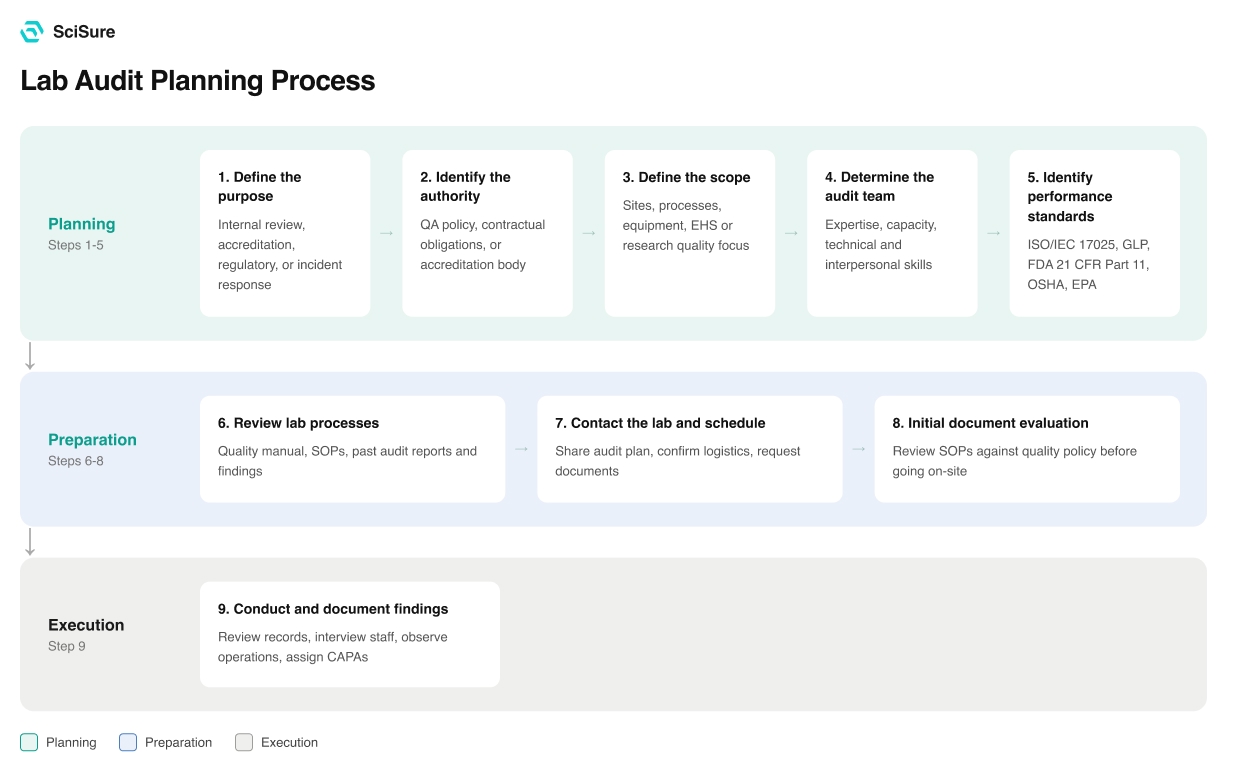
A structured lab audit follows a defined sequence, from establishing purpose and authority through to post-audit corrective actions. The steps below apply to both EHS audits and research quality audits, with relevant standards called out where the two tracks differ.
Step 1: Define the purpose of the audit
Start by clearly articulating what the audit is intended to achieve. Is it an internal self-assessment, preparation for external accreditation, a regulatory compliance review, or a response to a specific incident or finding? Common purposes include:
- Internal self-assessment against quality standards
- Preparation for external accreditation or certification
- Regulatory compliance review
- Response to a specific incident or prior finding
The purpose shapes every subsequent decision, from scope to team composition to the standards the audit will be measured against. A well-defined purpose keeps the audit targeted and prevents scope creep.
Step 2: Identify the authority for the audit
Before planning begins, establish where the authorization for the audit originates. This may come from the organization's quality assurance policy or manual, contractual obligations with clients requiring demonstrated compliance, or requests for third-party accreditation such as ISO/IEC 17025 or ISO 15189.
For EHS audits, authority typically derives from regulatory frameworks including OSHA or EPA requirements. Documenting the source of authority establishes the audit's legitimacy and ensures all parties understand its scope and objectives from the outset.
Step 3: Define the scope of the audit
Scope determines the audit's boundaries and directly affects how resources are allocated. Key questions to work through:
- Will the audit cover a single lab or multiple sites?
- Does it encompass all operations, or specific processes, equipment types, or analytical methods?
- For EHS audits: does scope include hazard communication, chemical inventory, hazardous waste management, industrial hygiene, air and water quality, and emergency response?
- For research quality audits: does scope cover experiment documentation, sample handling, data integrity, and equipment calibration?
Getting scope right upfront minimizes operational disruption and keeps the audit focused on what actually matters.
Step 4: Determine the audit team
Audit success depends on assembling the right people, not just enough people. Consider whether team members have specialized knowledge of the analytical methods, instruments, or regulations relevant to the audit. Check that the team is large enough to cover documentation review, process observation, and personnel interviews simultaneously without gaps. Technical competence matters, but so do interpersonal skills. Auditors who communicate clearly and professionally with lab personnel tend to surface more accurate findings than those who create a defensive atmosphere.
Step 5: Identify performance standards
The applicable standards define what "compliant" actually means for this audit. Because regulatory expectations can change, your team should also confirm that their checklist reflects current requirements, not just the standards used in the last audit. Subscribing to regulator updates, maintaining a legal register, or reviewing industry guidance can help keep audit criteria current.
Here are some common frameworks by audit type:
Research quality audits: ISO/IEC 17025, GLP, FDA 21 CFR Part 11, ISO 15189 for clinical labs, CLIA for U.S. clinical laboratory testing, and FDA 21 CFR Part 11 where electronic records and signatures are in scope.
EHS audits: OSHA regulations, EPA requirements, internal EHS management system criteria, local regulatory requirements
The audit team should review the lab's quality manual and SOPs to verify alignment with these standards, confirm that critical functions such as sample handling, data integrity, and quality control are fully addressed, and map each checklist item directly to a specific requirement or best practice. Where no formal requirement exists, a recognized industry best practice should serve as the benchmark.
Step 6: Develop a technical understanding of laboratory processes
Before arriving on-site, conduct an in-depth review of the lab's quality manual, relevant SOPs, quality control protocols, and historical audit reports including past findings and corrective actions. This preparation allows the team to prioritize high-risk areas, anticipate likely findings, and refine the audit checklist to reflect the specific nuances of the lab's operations. Labs with structured digital records tend to have significantly shorter pre-audit preparation cycles because documentation is centralized, searchable, and version-controlled rather than scattered across shared drives and paper files.
Step 7: Contact the laboratory and finalize the audit schedule
Early communication with the lab being audited sets the tone for the whole process. Confirm timing, locations, and resource availability. Share the formal audit plan in advance so that lab managers and personnel can prepare. Request preliminary documentation such as training records, recent SOPs, and past inspection reports. Scheduling respectfully, and not arriving unannounced, minimizes disruption to ongoing work and establishes a collaborative dynamic from the start.
Step 8: Perform initial document evaluation
Before going on-site, review lower-tier documents such as procedures and SOPs against higher-level requirements including the organization's quality policy and applicable regulatory standards. Look for discrepancies between procedural documents and overarching guidelines, areas where documentation lacks clarity or completeness, and gaps that will need direct follow-up during the on-site visit. This step gives the audit team a structured roadmap before physical observation begins and prevents critical gaps from being missed in the flow of on-site activity.
Step 9: Conduct the audit and document findings
Execute the audit systematically across three interconnected activities: document review, personnel interviews, and direct observation of lab operations. These do not always happen in sequence. Be prepared to move between them as the audit unfolds.
Record all findings, both conformances and non-conformances, with specific references to relevant standards. After the on-site phase:
- Analyze findings for trends and recurring issues
- Determine the severity of each non-conformance against the applicable audit standard
- Develop a CAPA plan with assigned responsibilities, required actions, and clear deadlines
- Use findings to drive updates to documentation, training, engineering or administrative controls, equipment management, and EHS or quality management system processes
Lab safety software can support ongoing inspection management, corrective action tracking, and audit trail maintenance between formal audit cycles. For example, SciSure’s Health & Safety features can support inspection workflows, corrective action tracking, audit-ready records, training records, equipment management, and chemical inventory documentation between formal audit cycles.
Audit standards by track
Laboratory audits do not follow a single universal standard. The applicable framework depends on whether the audit covers research quality, EHS compliance, or both. The table below maps the most common standards to each track.
Many labs must satisfy both tracks simultaneously. These standards are not mutually exclusive.
How to create a customized laboratory audit checklist
Building a customized checklist starts with three inputs: the audit's scope, the applicable standards, and the lab's specific risk profile. Together, these determine which categories, questions, and risk areas the checklist needs to cover. Here's what to consider when building yours:
Checklist structure
Create categories and subcategories that map to the EHS or quality topics the audit must cover. For EHS audits, these might include environmental management, occupational health and safety, hazardous material handling, and emergency response. For research quality audits, categories typically cover experiment documentation, sample management, equipment calibration, and data integrity controls. Each question in the checklist should be objective, concise, and designed to elicit a specific response rather than a vague yes or no.
Identifying lab-specific risks
A good checklist goes beyond generic compliance questions. Rather, we recommend you:
- Identify systemic gaps in EHS management that may affect multiple processes, such as deficiencies in Management of Change processes or inadequate worker representation on safety committees.
- Assess environmental exposure pathways including air emissions, wastewater, hazardous waste generation, and energy use.
- Evaluate the lab’s hazard identification and risk assessment process, then verify that workplace safety controls are documented, current, and applied to employees and contractors.
- For equipment and instrumentation, focus on EHS-critical assets such as fume hoods, biosafety cabinets, and gas monitoring systems, and check that calibration and maintenance records are current.
- Verify personnel training records against role-specific requirements.
Adapting to regulatory requirements
Every checklist item should correspond to a specific regulation, company requirement, or recognized best practice. Map the checklist to the local regulations applicable to the lab and modify it to reflect the areas of focus defined during audit scoping. A checklist built for a single-site EHS audit in a pharmaceutical research environment will look very different from one designed for a multi-site ISO/IEC 17025 quality audit.
Collaborative checklist and audit schedule development
Plan the audit schedule in coordination with lab managers and involve subject matter experts, whether internal EHS team members or external consultants, in checklist development. Their expertise helps anticipate challenges that generic templates miss. Assign roles within the audit team before arriving on-site: who leads each section, who conducts walkthroughs, and who documents interview notes.
How to use a lab audit checklist
Used well, a lab audit checklist should help you follow clear, actionable steps at every stage. If you’re still using spreadsheets, forms, or shared documents, these can work for simple checklists. But with time, they become harder to manage when findings, owners, deadlines, evidence, and follow-up actions need to stay connected across audit cycles. Here’s how a lab audit checklist can help at every stage of the process.
Pre-audit preparation
Before the on-site visit, ensure the full audit team has reviewed the checklist's structure, content, and the rationale behind each item, including whether questions are driven by regulation, company policy, or best practice. Define roles and responsibilities clearly. Finalize the audit schedule and send interview invites in advance so lab personnel can prepare.
During the audit
Conduct the audit systematically but stay flexible. The schedule rarely survives contact with the lab exactly as planned. In any order that the situation requires, review documents and records, conduct interviews, and observe operations. Document all findings as you go, both positive observations and non-conformances, rather than relying on memory at the end of the day.
Post-audit actions
Once findings are in, look for trends and recurring issues, classify non-conformances by severity, and use that picture to build a CAPA plan that addresses immediate concerns while putting systemic fixes in place to prevent recurrence.
Just remember: not every useful audit outcome needs to be a non-conformance. Capture OFIs separately so the lab can act on improvement opportunities before they become compliance gaps.
CAPAs should specify responsible parties, required actions, and clear deadlines. Engage leadership periodically on progress, particularly for issues that require resource allocation or system-level changes.
Arctic Therapeutics: Audit-ready records & EHS inspection workflows with SciSure
Arctic Therapeutics operates an ISO 15189 certified clinical research laboratory in Iceland. Before implementing SciSure, the team managed laboratory operations across disconnected tools and manual processes. Experiment documentation lacked standardization, inventory was tracked across spreadsheets and paper records, and equipment logs were maintained separately.
After centralizing workflows in SciSure, the team saved approximately two hours per week on registration and inventory processes while strengthening ISO 15189 compliance through controlled access, record locking, and structured experiment documentation. Because records are centralized and locked once finalized, the lab can produce traceable documentation on demand instead of reconstructing it when an audit comes around.
Read the full Arctic Therapeutics story.
Best practices for a successful laboratory audit
The difference between an audit that drives real improvement and one that produces a report no one acts on often comes down to execution. These practices apply regardless of audit type or scope.
Stay objective
Approach every finding as an opportunity to strengthen the lab's systems, not to assign blame. Auditors who focus on process failures rather than individual errors tend to surface more accurate information and generate findings that labs are willing to act on. Examine systemic causes before drawing conclusions about individual responsibility.
Document your findings thoroughly
Prepare detailed, organized reports that clearly outline observations, non-conformances, and areas for improvement. Each finding should include specific examples, references to the relevant standard or requirement, and actionable recommendations. Vague findings produce vague corrective actions. The quality of the audit report directly determines the quality of the CAPA response.
Keep communication clear
Establish open lines of communication with lab personnel early in the audit process. Use clear, accessible language when discussing complex issues, particularly with staff who may not be familiar with the regulatory framework being applied. Encourage questions and feedback. An audit conducted collaboratively surfaces better information than one conducted adversarially.
Build software into your audit readiness strategy
Relying on manual records, spreadsheets, and disconnected systems significantly increases the time and effort required to prepare for and respond to audits. Centralizing documentation in structured digital systems means records are searchable, version-controlled, and accessible when an auditor asks for them, rather than scattered across shared drives or filing cabinets.
Follow up with structure
A finding without a closed CAPA is an open risk. Develop a structured follow-up process that includes scheduled reviews, progress tracking, and if necessary, mini-audits to verify that corrective actions have been implemented effectively. Audit findings should feed directly into the lab's continuous improvement cycle, not disappear into a report that sits unread.
Making audits work for your lab
A well-prepared audit checklist and a structured audit process are not administrative overhead. They are the mechanisms by which labs demonstrate that their operations, data, and safety practices meet the standards that research integrity and regulatory compliance demand.
Labs that audit consistently, document thoroughly, and close findings with genuine corrective action build the kind of compliance posture that holds up under external scrutiny and supports better science. For labs managing both research quality and EHS requirements, having systems that connect experiment records, sample data, equipment logs, and safety documentation in one place makes the difference between audit preparation that takes days and audit preparation that takes hours.
SciSure supports audit readiness across both research and EHS workflows. If you want to see how it fits your lab's compliance requirements, talk to a specialist.
FAQ
What is a laboratory audit?
A laboratory audit is a structured, documented process for evaluating whether a lab's operations, systems, and documentation meet defined requirements. These requirements may come from internal quality policies, regulatory frameworks such as ISO/IEC 17025, GLP, or OSHA, or third-party accreditation criteria. The audit identifies gaps, non-conformances, and opportunities for improvement, and the lab is expected to develop corrective and preventive actions in response to findings.
How to prepare for a laboratory audit?
Preparation begins well before the on-site visit.
- Start by reviewing the applicable regulatory requirements and any past audit reports to identify recurring issues.
- Gather current SOPs, training records, equipment calibration logs, and other relevant documentation.
- Ensure records are organized, complete, and accessible.
- Map your existing documentation against the performance standards that will be applied during the audit to identify gaps before the auditor does.
Labs that maintain structured, centralized records throughout the year spend significantly less time preparing for audits than those that reconstruct documentation on demand.
What is a laboratory audit checklist?
A laboratory audit checklist is a structured document that guides auditors through the evaluation of a lab's operations, processes, and documentation against defined standards. It maps each assessment item to a specific regulatory requirement, company policy, or best practice, ensuring the audit is consistent, comprehensive, and defensible. A well-built checklist is tailored to the specific audit type, scope, and applicable frameworks rather than applied as a generic template.
Who is responsible for conducting a laboratory audit?
Responsibility depends on the audit type and organizational structure. Internal audits are typically led by a quality manager, EHS manager, or designated audit team with relevant technical expertise. External audits are conducted by third-party bodies, accreditation organizations, or regulatory agencies.
Resources
Links to relevant regulatory bodies:
Recommended reading materials:
- "Laboratory Auditing for Quality and Regulatory Compliance" by Donald Singer, Raluca-Ioana Stefan, and Jacobus Staden
- “Environmental Health and Safety Audits” by Lawrence Cahill

How to Plan and Perform a Lab Audit in 9 Steps
A practical guide to understanding and conducting lab audits. Explore types, requirements, a step-by-step process, and best practices for building a lab audit checklist.
A few weeks ago, I took my son fishing. He’d found a pond tucked down in the woods and wanted to check it out, so we turned off onto a little dirt road. The first stretch was littered with potholes, some of them eight inches deep. I was crawling along at 5 miles an hour, genuinely worried about bottoming out. Then the dirt turned to gravel. Bumpy, but I could get up to 15.
And then, for the last stretch down to the water, the road was paved, and we were cruising.
I've thought about that road a lot since. Stretch the metaphor a bit, and it’s exactly what buying and standing up lab software feels like. Some vendors put your scientists on that pothole road and hope they just tough it out. Most people don't tough it out. They give it a shot, decide it’s not worth the suspension damage, turn around, and don’t come back.
If you’re the director or VP who signs off on an EHS purchase, your job is to figure out, before the contract is signed, which road you’re buying. The license fee alone won't tell you.
In fact, the license fee is the wrong starting point
The most common mistake I see buyers make is opening the conversation with "Just tell me what the license costs. We'll figure out if it's a fit."
I evaluate software regularly myself, and I never start there, because I know the risk that comes with it. The questions I ask first are different:
- Here's the problem we're trying to solve. Is this a good fit?
- How long does it historically take for a company of our size, with our needs, to stand this up and get it live?
- Is custom work needed?
- Are services, support, and consulting included in that fee, or am I going to discover a cap on support hours three months in?
And most importantly:
- Will my team actually use it?
That last one matters more than people think. A low license fee is often low because something was taken out: the implementation timeline that nobody commits to, the pre-built configurations that don't exist, the support that turns out to be outsourced. You can absolutely get the cheap license. What you’re really paying for is the privilege of helping that vendor figure it out on the fly, and figuring it out on the fly is tremendously expensive.
And it doesn't stop at the vendor's invoice. Add your own IT security requirements and the fees to plug whatever holes the license doesn't cover. Add the internal resources: the meetings, the brainstorming sessions, the hours your IT, legal, and lab operations people sink into a stalled rollout. I hear it constantly from teams who chose the low bid and call us six months later:
"Everything you said about the hours of meetings, it's happening."
People wave this away with, "We're already paying those salaries, so we don't track it." That's a line-item view of a business decision. The right question is what the impact is on the whole organization, not whether one budget row looks good.
If scientists don't use it, you might as well spend $0
The number one question I hear from scientific organizations is "Will our scientists and researchers actually use this?" And it really is the right question. I cannot tell you how many projects I walk into where a quarter or a third of the scientists are using the existing system, and the rest are being pushed and enforced into it.
Because if the users don't adopt the technology, then what was the point of any of it? If the license fee is X and you're getting nothing out of it, you may as well have not invested in it in the first place.
I said something at an event recently that I stand by: forcing your scientists to change the way they work won’t make it easier for them to adopt something new.
Sure, you could push for a change, and once in a while that works. Or you could involve them in the process, set clear goals, help them understand why things are changing, and the good it does for them. Choosing the latter route shifts your efforts towards the 30% of digital transformations that end up succeeding down the line.
Scientists who’ve been let down by a poor system will scrutinize every piece of the next one, and they should. They were handed something that hurt them instead of helping them. The software has to genuinely reduce their administrative burden, and someone has to explain the why.
Get both right and the usual three-way friction between scientists, operations, and the safety/compliance team starts to melt away. Get either wrong and you're back on that pothole road.
So, when you evaluate vendors, evaluate for adoption. Ask other organizations in the community about what their experience was. Did they get quick adoption? What was the speed to value? Those answers predict your outcome far better than the quote does.
The customization trap
Here's a pitch that sounds great in a demo:
"We'll customize whatever you want."
And here's why that should sound the alarm bells right away: to get a vendor to build exactly what you need, you have to communicate the problem, the desired solution, and the requirements with near-perfect clarity, then sit in the feedback loop of building, testing, and re-testing until it's right.
Most software providers will tell you that's not a heavy lift. That’s just not true. It is a very heavy lift, and people underestimate all the things it consumes: time, cost, resources, expertise. Not to mention the opportunity cost that your organization loses by not spending time on other critical projects.
I watched one organization choose a vendor who promised all the development they asked for, on a timeline of under one year. When we crossed paths again around two and a half years later, the project was still in testing. Small groups were piloting pieces of it, but the people who were supposed to be in the system doing their jobs still weren't there.
Think about the lost data and lost value across nearly three years of "almost live." We’re talking direct financial losses to your organization here, all of which need to be factored in before you make your decision.
Larger organizations will always need some custom work, and that's fine. The question to ask is how much of the system needs to be custom-built and custom maintained, because every custom workflow is also a maintenance commitment after go-live.
What you want underneath is a platform that is configurable, one that adapts to your environment without being rebuilt from scratch for every new requirement.
The cheapest option might just end up costing you the most
Here’s a common pattern I’ve come across during procurement meetings. Three vendors are in play, all with their credibility and trust at stake. Someone points to the simplest thing to measure and says:
“This one is cheapest, and on the call, they promised they can do everything the other two can.”
Vendors will breeze through a demo, glaze over your requirements with a "Yep, we can do that," and leave out the parts that still need development under the hood. If a vendor guarantees a timeline, ask them to put their money where their mouth is: write it into the contract that if they don't deliver, you don't pay. Watch how the conversation changes.
Because here's the math on the downside. Say the cheap option saves you 10 or 20%. If adoption fails and you have to switch, every dollar you put into that license is gone. A 10% saving that becomes a 100% sunk cost means you could have run the better vendor for 5-7 years and still not lost as much.
The shortest turnaround I've seen is a team that pulled the plug six months in. The longest stuck it out for two full years before admitting the system had never properly stood up. In the short term, "I put $10,000 back in the budget" is an easy thing to celebrate internally.
When it unravels, your name is attached to it. And the strongest defense against this is both boring and effective: a written business justification.
A good business justification takes cost and flips it into a quality and risk conversation
And that's where leaders actually operate. Here are the vendors in play, here’s the one we recommend, and here’s why, across speed to value, adoption likelihood, risk, internal resource demands. Finally, here’s our take on whether this partner can scale with us for the next decade.
No organization plans to stay the same size for ten years. Your vendor has to be able to grow and change with you, and if you're not confident that they'll still be your partner ten years out, any energy you'll pour into standing them up isn't worth it.
I've typed out this story on a Mac. If I wanted the lowest cost machine, I wouldn’t be looking at Apple. I'm looking at reliability, quality, and speed, because I want to do my best work on it. Multiply that logic across hundreds or thousands of people who will touch your EHS system every week. An incremental gain per person adds up fast. An incremental loss adds up faster.
None of this means cost doesn't matter. It just means rethinking cost as your total cost of ownership. First, whittle the field down to the vendors who can genuinely deliver the experience and the outcomes you need. Once you’ve got your list of qualified vendors, that’s when price comes into the picture.
Get to that paved road and stick to it
Back at that pond, my son and I had a great afternoon, and the drive out on the paved stretch took no thought at all. That's the standard, or at least, it should be. When you stand up new software, your scientists should come out of the gate on pavement: moving, effective, no friction, no wondering whether the whole thing will bottom out.
Every dollar you didn't spend on implementation, support, and adoption is a pothole you're asking your scientists to drive over. They’ll try it once, maybe twice. Then they'll turn around and go home, and you'll be left holding a license fee for an empty road.
So, before you sign, ask the question the cheapest bidder hopes you won't:
"What will it cost us to get every scientist onto the paved road, and how fast can you get us there?"
The vendor who answers that one honestly, in writing, is the one worth paying for.

What EHS Software Actually Costs (Beyond the License Fee)
After years of watching scientific organizations pick the cheap option and regret it, here's what I'd actually weigh before signing, and the question most vendors hope you won't ask.