How To Improve Experimental Reproducibility Across Multiple Labs

Learn how to improve experimental reproducibility across multiple labs with controlled protocols, scientific traceability, secure data, and SciSure.

July 23, 2026
()
min read
A laboratory

Download Whitepaper

By submitting this form, you agree with our Privacy Policy.
Thank you! Download the file by clicking below:
Download
Oops! Something went wrong while submitting the form.

Table of Contents

Thank you! Your submission has been received!
Oops! Something went wrong while submitting the form.

Table of Contents

TL;DR

You can improve research reproducibility at scale by standardizing experimental design, controlling protocol versions, linking every result to its samples and metadata, and keeping scientific review and communication with the record.

  • Design before execution.
    Define your hypothesis, controls, sample size, inclusion and exclusion criteria, randomization, blinding, and analysis plan before work begins. Shared experiment templates turn those decisions into required fields, help you review rigor early, and reduce the undocumented choices that make results difficult to reproduce later.
  • Control every method.
    Give every lab one current, searchable protocol while preserving prior versions, approvals, variables, and deviations. SciSure lets you publish active protocol versions, retain version history, compare or restore earlier versions, and insert controlled procedures into experiments, so you can see which method governed each run.
  • Trace every result.
    Build scientific traceability by connecting results with experiment records, raw data, samples, reagent lots, storage conditions, equipment, protocol versions, operators, timestamps, and review decisions. That connected context helps you identify sources of variability, transfer methods between labs, investigate unexpected results, and defend conclusions without reconstructing the work manually.
  • Govern across labs.
    Set an enterprise minimum for experimental design, metadata, protocol control, sample identification, access, review, and retention. Let each lab configure discipline-specific fields within that framework. Then measure adoption, completeness, deviations, retrieval time, and cross-site method-transfer success instead of assuming that one software rollout creates consistency.


We originally published this article in 2024. This 2026 refresh adds enterprise and multi-lab positioning, current NIH and FDA context, current SciSure capabilities, related resources, a clearer platform comparison, and verified customer proof from Frontera Therapeutics on faster documentation and information retrieval across a global R&D organization.

What is reproducibility in research?

Reproducibility in scientific research means that you can use a complete record of the design, methods, materials, data, and analysis to obtain consistent results under defined conditions. Understanding reproducibility in research starts with one practical test: can a qualified colleague repeat or reanalyze the work without relying on undocumented knowledge?

Reproducibility depends on the decisions and context your team captures before, during, and after every experiment. When protocols, raw data, sample records, reagent lots, calculations, and scientific decisions live in separate systems, you force the next scientist to reconstruct the work before repeating it.

Reproducibility vs replicability in research

The National Academies distinguishes reproducibility from replicability: you test reproducibility when you obtain consistent computational results using the same data, code, methods, and conditions. You test replicability when you run a new study, collect new data, and obtain consistent results.

In laboratory research, you might use reproducibility more broadly to describe repeating an experiment under comparable conditions. Define the outcome you mean before you compare operators, instruments, labs, or platforms.

Why reproducibility matters in research

A 2016 Nature survey of 1,576 researchers found that more than 70% had tried and failed to reproduce another scientist’s experiment. That matters when you consider that the benefits of reproducibility in research include:

  • Faster method transfer
  • Clearer troubleshooting
  • More reliable decisions
  • Less duplicated work
  • Stronger use of samples and funding
  • and greater confidence when you build the next study on earlier findings.

Digitalization can remove many practical causes of that failure, including protocol drift, missing metadata, mislabeled samples, inaccessible raw data, and decisions buried in email or chat. You still need rigorous experimental design, statistical judgment, training, and scientific review.

How does SciSure accelerate research reproducibility?

SciSure's scientific management platform can help you centralize protocols, experiments, samples, data, and experiment-specific communication in a controlled environment. You can use protocol version history, templates, comments, mentions, notifications, role-based permissions, audit trails, single sign-on, and flexible hosting options to keep scientific context available to the right people. Keep general conversation in your collaboration tool, and capture every decision that changes the experiment in the experiment record.

SciSure protocols in practice
SciSure lab protocols in practice

Check out our guide to building confidence through better lab data management for a deep dive on why connected context matters when collaborators, reviewers, funders, or regulators need to understand how you produced a result.

Why reproducibility breaks as research scales

If you lead a large research institution, growth multiples variation: for example, new labs adopt local naming conventions, teams copy protocols and change them without a controlled review, instruments generate files in different formats, or researchers discuss exceptions in meetings or messages without properly recording them. You cannot solve that variation with reminders alone. You need an operating system that makes the reproducible path the easiest path and gives you enough oversight to see where practices diverge.

Common reproducibility failures and the controls that address them

Failure point What you experience Control to put in place
Design varies Teams choose controls, sample sizes, or analysis rules inconsistently Required design fields, review gates, and study-specific templates
Protocols drift Sites run different copies without knowing which version changed One active version, controlled updates, history, and recorded deviations
Materials lose context You cannot trace a result to the sample, lot, passage, or storage history Unique identifiers, barcodes, sample lineage, and experiment links
Data separates from context Raw files, calculations, and results sit in different folders or systems Connected records, standard metadata, integrations, and searchable storage
Decisions disappear Review comments and exceptions remain in meetings, email, or chat Contextual comments, mentions, review workflows, and durable change records
Local practices diverge You cannot compare work or transfer methods reliably between labs Enterprise standards with defined local configuration and shared metrics

How can laboratory tools enhance the reproducibility of scientific experiments?

Laboratory tools enhance reproducibility when they guide good practice, capture context during the work, and make records easy to inspect later. Choose tools that connect the full evidence chain instead of creating another isolated repository.

Standardize experimental design before work starts

Use templates to require the fields that matter for your research: hypothesis, primary outcome, controls, biological and technical replicates, sample-size rationale, randomization, blinding, exclusion rules, equipment settings, and analysis plan. The NIH definition of scientific rigor centers on robust, unbiased experimental design, methodology, analysis, interpretation, and reporting.

A template cannot judge whether your design is scientifically sound. It can make your chosen design explicit, complete, reviewable, and consistent across teams. Build a review step before execution for high-impact, expensive, or regulated experiments.
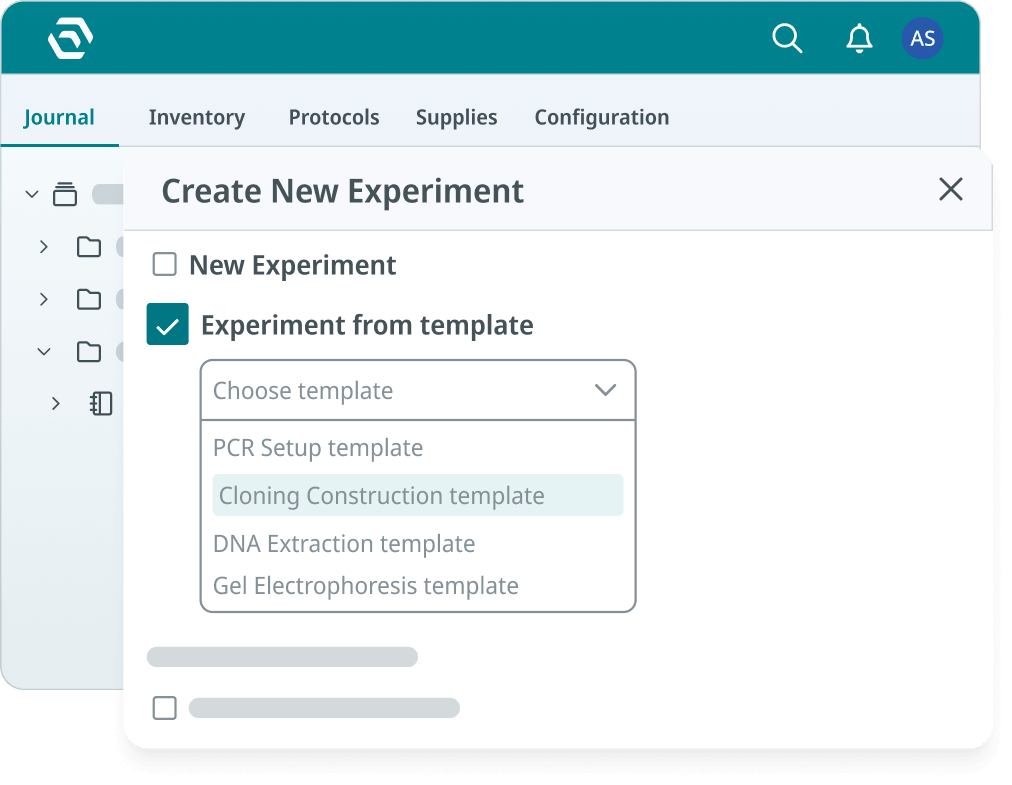
Experimental templates in the SciSure Electronic Lab Notebook (ELN)
Experimental templates in the SciSure Electronic Lab Notebook (ELN)

Keep protocols version controlled and executable

Give your team a searchable protocol library with named owners, controlled publishing, version history, approval rules, and review dates. Let an active version remain available while the owner revises a draft. Record permitted variables and formulas, and require scientists to document deviations where they occur.

SciSure lets you create and manage protocols and SOPs, publish an active version, preserve prior versions, compare changes, restore earlier content as a new version, share protocols with authorized groups, and insert procedures into ELN experiments. Our guide to digitalizing lab protocols shows how to build that control without slowing bench work.

Create scientific traceability from sample to result

Scientific traceability gives you a connected, chronological account of what happened, who acted, when they acted, and which materials, methods, data, and decisions shaped the outcome. Build that chain as the experiment progresses.

Link each result to:

  • The experiment record and exact protocol version.
  • Sample identity, parent-child lineage, lot or batch, passage, concentration, and storage history.
  • Reagents, consumables, and expiration details that can affect performance.
  • Equipment identity, method settings, calibration, and maintenance status where relevant.
  • Raw data, processed data, code, calculations, and analysis parameters.
  • Operator, collaborator, review, signature, deviation, and timestamp history.

SciSure connects experiment documentation through its ELN with sample and inventory context through its LIMS. Sample audit trails record who changed sample information, when the change occurred, and what changed. Barcodes and searchable sample fields help you keep the physical material connected to its digital record.

SciSure
Connect every experiment to its samples
Bring experiment documentation, samples, and inventory into one connected workflow with SciSure’s ELN and LIMS.
Request a demo

Standardize sample handling and processing

The best practices for reproducible sample handling in scientific research start with controlling every step that can alter sample identity, quality, or condition. Assign a unique identifier when you collect or create a sample, use barcodes during transfers, and define requirements for preparation, mixing, aliquoting, transport, storage, hold times, and freeze-thaw cycles.

Capture the source or donor, lot, passage, concentration, volume, container, location, operator, timestamps, and storage history with the experiment. Set acceptance and rejection criteria, verify relevant equipment settings, use comparable quality-control checkpoints, and record deviations when they occur.

The features of high reproducibility in sample processing for research projects include controlled instructions, traceable materials, qualified equipment, defined environmental conditions, consistent metadata, documented deviations, and measurable quality checks. When labs use different equipment, define the critical parameters that must remain consistent and document approved equivalents instead of assuming that every local process produces a comparable sample.

Capture data and metadata where work happens

Capture information once, as close to its source as possible. Manual transcription and delayed documentation invite errors and missing context. Instead, use structured fields, instrument connections, APIs, file links, and automated timestamps to reduce re-entry while preserving the original data.

The FAIR principles can help make data findable, accessible under appropriate conditions, interoperable, and reusable. FAIR data also still needs experimental context. A searchable file without the governing protocol, sample lineage, units, code, or analysis parameters will not support reliable reuse.

Check out our overview of SciSure integrations to figure out where instruments, data sources, and external systems should exchange information with the research record.

Keep scientific communication with the record

Use contextual comments, mentions, notifications, reviews, and approvals for discussions that change experimental execution or interpretation. With SciSure, collaborators can comment on experiment sections, mention assigned collaborators, receive notifications, and retain comment history. Add any information that belongs in the completed scientific record to the experiment itself before signing.
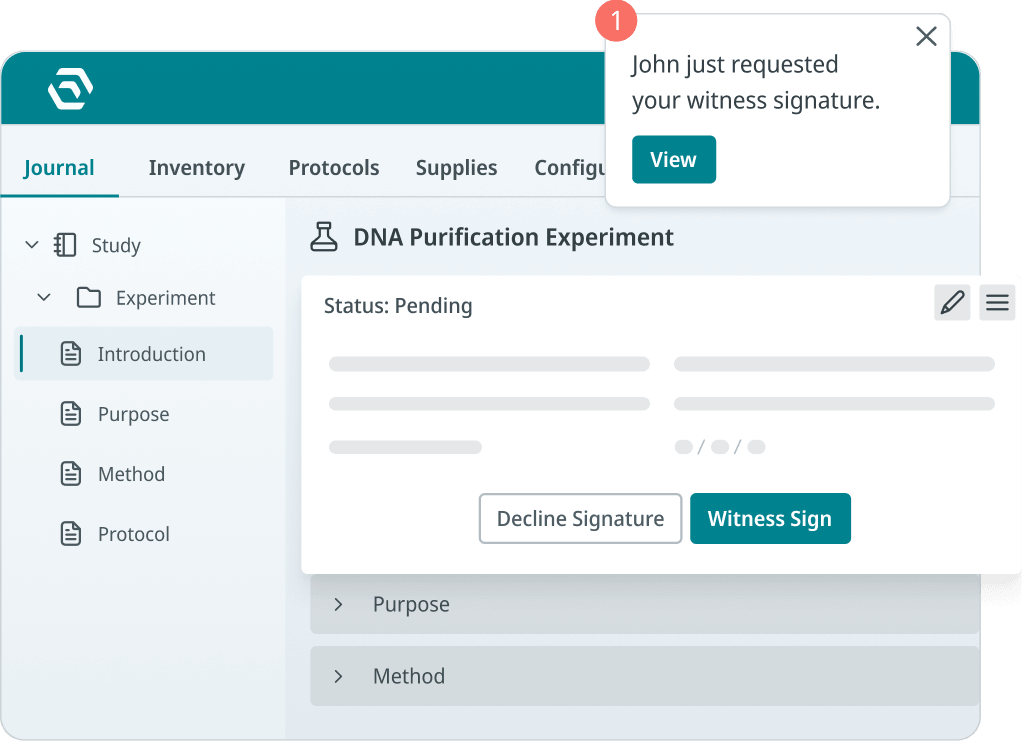
Witness signing in the SciSure Electronic Lab Notebook (ELN)

You can keep meeting coordination and general conversation in Teams, Slack, or email. Write the decision, rationale, and resulting change into the experiment record. This practice protects institutional knowledge when a scientist changes roles or leaves.

Use the same connected record for mentorship and knowledge transfer. Give your senior scientists enough context to review the design, method, data, and interpretation together. Give new team members a clear example of how to execute the method and document the result. You will end up reducing dependence on verbal handoffs while keeping scientific judgment visible.

Secure access without blocking collaboration

Match access to responsibility. Configure who can view, create, update, share, sign, witness, archive, or restore protocols and experiments. Use single sign-on where it fits your identity architecture, and decide whether shared cloud, private cloud, or on-premises hosting matches your institutional requirements. Our post on research data security adds practical guidance for sharing research context without creating uncontrolled copies.

SciSure
Protect research access at every level
Control who can access your projects, studies, experiments, protocols, samples, and equipment with role-based permissions.
Talk to a specialist

How to improve the reproducibility of an experiment

Use these strategies for improving experimental reproducibility in research. Apply them as a connected workflow, not as a checklist you complete after results arrive.

Define the claim you need to test.

State the hypothesis, primary outcome, acceptable variability, and conditions under which the result should hold. Decide whether you want same-operator repeatability, cross-operator reproducibility, cross-lab method transfer, or independent replication.

Review the prior evidence.

Assess the rigor of earlier work, known sources of variation, negative findings, biological assumptions, and the quality of the materials or models you plan to use. Document why you selected the method and where uncertainty remains.

Predefine the design and analysis.

Set controls, sample size, replicates, randomization, blinding, inclusion and exclusion criteria, endpoints, transformations, and statistical tests before execution. Ask a qualified reviewer to challenge the design while you can still change it.
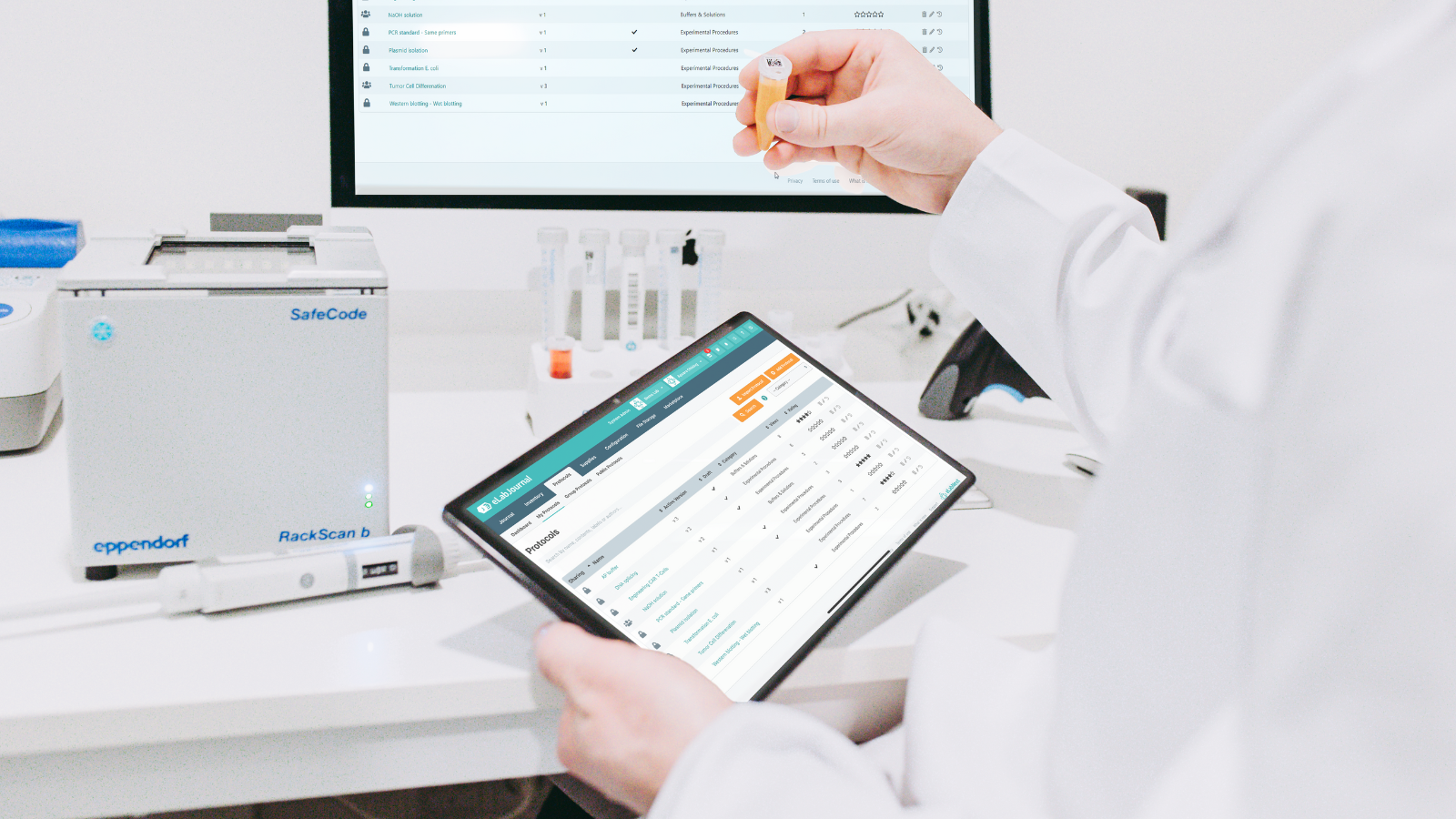
The SciSure Electronic Lab Notebook (ELN)

Verify materials and equipment.

Authenticate cell lines and critical biological materials, capture lot and passage information, confirm reagent suitability, and verify equipment calibration or maintenance where those factors can change the result.

Use one controlled method.

Start from the active protocol, record approved variables, and capture deviations when they occur. Preserve the version used for the experiment instead of pointing only to a document that can change later.

Capture provenance automatically where possible.

Link samples, files, calculations, instrument output, metadata, operators, and timestamps during the work. Use consistent units, identifiers, and naming conventions across the lab.

Review, sign, repeat, and learn.

Check completeness before closing the record. Repeat critical work across operators, days, instruments, or sites as your scientific question requires. Track recurring deviations and failed transfers as improvement signals, then update training, templates, or methods through controlled change.

How to improve experimental reproducibility across multiple labs

Ensuring reproducibility across multiple labs starts with one enterprise framework that protects scientific rigor without forcing every discipline into the same experimental template. If you direct research at a U.S. academic institution with thousands of employees, standardize the minimum evidence every lab must capture, then let each group add fields and workflows that reflect its science.

Our guide to standardizing research across global labs explores how shared data models, workflows, permissions, and oversight help you control drift across locations.

Enterprise reproducibility governance framework

Governance layer Standardize centrally Configure locally
Experimental design Required rationale, controls, replicates, exclusions, and review rules Discipline-specific endpoints, calculations, and design fields
Protocols Ownership, naming, versioning, approvals, review cycles, and retirement Method content, approved variables, and local safety instructions
Data and metadata Identifiers, units, provenance, retention, access, and export requirements Assay metadata, instrument fields, and domain vocabularies
Samples and materials Unique IDs, required lineage, movement history, and audit expectations Sample types, storage structures, labels, and custom fields
Access and review Role model, identity controls, signature policy, and offboarding Project membership, reviewers, witnesses, and collaboration groups
Performance Common definitions, dashboards, audit cadence, and escalation thresholds Scientific targets and corrective actions for each lab

Start with one cross-lab method or research program where variation creates visible cost. Map the workflow, agree on the minimum record, configure templates and permissions, migrate only the active content you need, and run the method in two or three labs. Use the pilot to find ambiguous instructions, missing metadata, local workarounds, and training gaps before you expand.

Track measures that tell you whether practice has changed:

  • Percentage of experiments created from an approved template.
  • Percentage of active protocols with a named owner and current review.
  • Completeness of required design and metadata fields.
  • Percentage of critical results linked to raw data, samples, lots, and protocol versions.
  • Time required to find and reconstruct an experiment.
  • Recurring deviations, failed repeats, and unresolved review findings.
  • Cross-operator and cross-site method-transfer success.

Name an enterprise owner for the framework and a scientific champion in each lab. Review metrics with researchers, not only with IT or quality teams. When you find friction, improve the template, integration, training, or governance rule that created it.

SciSure
Planning a multi-lab reproducibility program?
Book a SciSure demo to map your protocols, experimental records, sample traceability, permissions, integrations, and rollout metrics.
Talk to a specialist

Which platforms offer protocols for reproducible research in the life sciences?

SciSure and dedicated method platforms such as protocols.io offer protocol capabilities for reproducible life science research. Many ELNs and LIMS platforms also store procedures, but you should evaluate how well each option connects the exact method version to execution, samples, data, review, and audit history.

Protocol platform comparison for reproducible research

Platform approach Best fit Implementation impact
SciSure Scientific Management Platform You need controlled protocols connected with ELN, LIMS, samples, inventory, collaboration, and audit context Configuration, permissions, hosting, integrations, validation scope, and enterprise governance
protocols.io You need to develop, version, run, share, or publish detailed methods in private or public workspaces How the method and run record connect with your samples, experiment data, and institutional systems
Standalone ELN or LIMS You have a narrower documentation or sample-management need and a stable integration architecture Whether users must copy identifiers or rebuild links between methods, materials, raw data, and results

SciSure also offers a protocols.io add-on that lets you find and import protocols from your protocols.io account into the ELN. After you import a file, SciSure tracks that copy separately and does not synchronize it with the repository. Make sure to define which system owns the master version before you use both.

SciSure
Turn every review into a stronger method
Keep protocols, experiment records, review decisions, and deviations connected in SciSure.
Request a demo

How reproducibility supports compliance without creating false assurance

Reproducible records can support grant obligations, quality systems, inspections, submissions, and research-integrity reviews. Start with the rules and commitments that apply to your work:

  • For NIH-funded research, use the NIH Data Management and Sharing Policy to plan how you will manage, preserve, and share scientific data.
  • NIH also launched a broader replication and reproducibility initiative in 2026, reinforcing the need for institutional infrastructure, incentives, and practice.
  • If you create or maintain electronic records under FDA requirements, assess the scope and controls in 21 CFR Part 11, including validation, authorized access, record protection and retrieval, time-stamped audit trails, authority checks, training, and electronic-signature controls.
  • If you conduct nonclinical laboratory studies that fall within FDA GLP requirements, review 21 CFR Part 58 for protocol, SOP, quality assurance, equipment, specimen, raw-data, reporting, and retention obligations.

Technology can support those controls. Your institution still owns regulatory scoping, computer-system validation where required, procedures, training, data classification, retention, change control, and ongoing oversight. Configure the platform around your approved quality and research-governance processes.

What enterprise reproducibility looks like in practice

Frontera Therapeutics shows how enterprise reproducibility works across multiple sites: its gene-therapy operation spans early research in Boston, clinical development in Shanghai, and GMP manufacturing in Suzhou. Before SciSure, the R&D workflow relied on paper notebooks, Excel spreadsheets, shared network folders, and individual electronic documents.

After centralizing experimental records, sample inventories, protocols, and documentation in SciSure, the Boston R&D team cut time spent on documentation and information retrieval by approximately 20–30%. The connected record also sped up preparation for audits, technology transfers, and project reviews while strengthening sample and experiment traceability.

Frontera Therapeutics: Streamlining enterprise reproducibility with SciSure

Your takeaway here is operational: start where fragmentation slows decisions, then connect the method, material, data, and review context around that work. Scale after you can show faster retrieval, more complete records, and a method another person or site can execute.

SciSure
Give every lab a reproducible path from protocol to result.
Talk to a SciSure specialist about a connected ELN, LIMS, and scientific management rollout for your institution.
Request a demo

FAQs

What is reproducibility in research?

Reproducibility means preserving enough information about your experimental design, methods, materials, samples, data, analysis, and decisions for you or a qualified colleague to obtain consistent results under defined conditions. A reproducible record should not depend on undocumented knowledge or verbal instructions.

What is the difference between reproducibility and replicability in research?

You test reproducibility when you use the same data, code, methods, and conditions to obtain consistent results. You test replicability when you conduct a new study with new data and reach consistent findings. Because disciplines use these terms differently, define the outcome you want before setting cross-lab metrics.

What are the best practices for reproducible sample handling?

Use unique sample identifiers, controlled processing instructions, barcodes, defined storage and transport conditions, consistent metadata, qualified equipment, acceptance criteria, quality-control checkpoints, and documented deviations. Connect each sample’s lineage and handling history with the experiment, protocol version, operator, and resulting data.

Does SciSure accelerate research reproducibility by centralizing experimental protocols, data, and team communications securely and efficiently?

Yes. SciSure can centralize protocols, experiment records, samples, data links, comments, mentions, notifications, reviews, and audit context. Role-based permissions, supported SSO configurations, and multiple hosting options help you control access. Keep general chat in your collaboration platform, and store experiment-changing decisions with the scientific record.

How can laboratory tools enhance the reproducibility of scientific experiments?

Laboratory tools can standardize design fields, control protocol versions, capture raw data and metadata, track samples and reagent lots, record deviations, automate timestamps, and keep reviews with the experiment. These controls reduce undocumented variation and give you the context needed to repeat, transfer, troubleshoot, and assess the work.

How to improve reproducibility of an experiment?

Predefine the hypothesis, controls, sample size, replicates, randomization, blinding, exclusions, and analysis plan. Authenticate critical materials, verify equipment, use one controlled protocol, record deviations, link raw data and samples, and review the complete record. Repeat critical work across operators, days, instruments, or sites as your question requires.

What is scientific traceability?

Scientific traceability lets you follow a result back through the experiment, protocol version, samples, lots, equipment, raw data, calculations, people, timestamps, deviations, and review decisions that produced it. Strong traceability helps you locate variability, reconstruct work, transfer methods, protect institutional knowledge, and support audit or integrity reviews.

How do you ensure reproducibility across multiple labs?

Set an enterprise minimum for design, metadata, protocol control, sample identification, access, review, and retention. Let labs add discipline-specific fields within that framework. Pilot one shared method, train local champions, monitor completeness and deviations, test cross-site method transfer, and improve the workflow before you expand.

Which platforms offer protocols for reproducible research in the life sciences?

SciSure offers protocol and SOP management connected with ELN, LIMS, samples, inventory, comments, permissions, and audit context. protocols.io focuses on developing, versioning, running, sharing, and publishing methods. Standalone ELN and LIMS platforms may also manage protocols. Compare version control, execution links, sample context, access, review, integrations, and governance.

Does software guarantee reproducible results?

No. Software can standardize workflows, preserve context, reduce manual errors, and make review easier. You still need sound hypotheses, appropriate controls, adequate statistical power, validated methods, qualified people, reliable materials, maintained equipment, transparent analysis, and a culture that examines unexpected or negative results.

If you need to improve experimental reproducibility across multiple labs, get in touch with us. Let's discuss your current challenges and see how SciSure can support consistent, traceable research at enterprise scale.

Ready to see SciSure in action?

Get a personalized demo and see how SciSure fits your lab's workflows.
Request demo

No commitment · Free consultation

What is reproducibility in research?

Reproducibility in scientific research means that you can use a complete record of the design, methods, materials, data, and analysis to obtain consistent results under defined conditions. Understanding reproducibility in research starts with one practical test: can a qualified colleague repeat or reanalyze the work without relying on undocumented knowledge?

Reproducibility depends on the decisions and context your team captures before, during, and after every experiment. When protocols, raw data, sample records, reagent lots, calculations, and scientific decisions live in separate systems, you force the next scientist to reconstruct the work before repeating it.

Reproducibility vs replicability in research

The National Academies distinguishes reproducibility from replicability: you test reproducibility when you obtain consistent computational results using the same data, code, methods, and conditions. You test replicability when you run a new study, collect new data, and obtain consistent results.

In laboratory research, you might use reproducibility more broadly to describe repeating an experiment under comparable conditions. Define the outcome you mean before you compare operators, instruments, labs, or platforms.

Why reproducibility matters in research

A 2016 Nature survey of 1,576 researchers found that more than 70% had tried and failed to reproduce another scientist’s experiment. That matters when you consider that the benefits of reproducibility in research include:

  • Faster method transfer
  • Clearer troubleshooting
  • More reliable decisions
  • Less duplicated work
  • Stronger use of samples and funding
  • and greater confidence when you build the next study on earlier findings.

Digitalization can remove many practical causes of that failure, including protocol drift, missing metadata, mislabeled samples, inaccessible raw data, and decisions buried in email or chat. You still need rigorous experimental design, statistical judgment, training, and scientific review.

How does SciSure accelerate research reproducibility?

SciSure's scientific management platform can help you centralize protocols, experiments, samples, data, and experiment-specific communication in a controlled environment. You can use protocol version history, templates, comments, mentions, notifications, role-based permissions, audit trails, single sign-on, and flexible hosting options to keep scientific context available to the right people. Keep general conversation in your collaboration tool, and capture every decision that changes the experiment in the experiment record.

SciSure protocols in practice
SciSure lab protocols in practice

Check out our guide to building confidence through better lab data management for a deep dive on why connected context matters when collaborators, reviewers, funders, or regulators need to understand how you produced a result.

Why reproducibility breaks as research scales

If you lead a large research institution, growth multiples variation: for example, new labs adopt local naming conventions, teams copy protocols and change them without a controlled review, instruments generate files in different formats, or researchers discuss exceptions in meetings or messages without properly recording them. You cannot solve that variation with reminders alone. You need an operating system that makes the reproducible path the easiest path and gives you enough oversight to see where practices diverge.

Common reproducibility failures and the controls that address them

Failure point What you experience Control to put in place
Design varies Teams choose controls, sample sizes, or analysis rules inconsistently Required design fields, review gates, and study-specific templates
Protocols drift Sites run different copies without knowing which version changed One active version, controlled updates, history, and recorded deviations
Materials lose context You cannot trace a result to the sample, lot, passage, or storage history Unique identifiers, barcodes, sample lineage, and experiment links
Data separates from context Raw files, calculations, and results sit in different folders or systems Connected records, standard metadata, integrations, and searchable storage
Decisions disappear Review comments and exceptions remain in meetings, email, or chat Contextual comments, mentions, review workflows, and durable change records
Local practices diverge You cannot compare work or transfer methods reliably between labs Enterprise standards with defined local configuration and shared metrics

How can laboratory tools enhance the reproducibility of scientific experiments?

Laboratory tools enhance reproducibility when they guide good practice, capture context during the work, and make records easy to inspect later. Choose tools that connect the full evidence chain instead of creating another isolated repository.

Standardize experimental design before work starts

Use templates to require the fields that matter for your research: hypothesis, primary outcome, controls, biological and technical replicates, sample-size rationale, randomization, blinding, exclusion rules, equipment settings, and analysis plan. The NIH definition of scientific rigor centers on robust, unbiased experimental design, methodology, analysis, interpretation, and reporting.

A template cannot judge whether your design is scientifically sound. It can make your chosen design explicit, complete, reviewable, and consistent across teams. Build a review step before execution for high-impact, expensive, or regulated experiments.

Experimental templates in the SciSure Electronic Lab Notebook (ELN)
Experimental templates in the SciSure Electronic Lab Notebook (ELN)

Keep protocols version controlled and executable

Give your team a searchable protocol library with named owners, controlled publishing, version history, approval rules, and review dates. Let an active version remain available while the owner revises a draft. Record permitted variables and formulas, and require scientists to document deviations where they occur.

SciSure lets you create and manage protocols and SOPs, publish an active version, preserve prior versions, compare changes, restore earlier content as a new version, share protocols with authorized groups, and insert procedures into ELN experiments. Our guide to digitalizing lab protocols shows how to build that control without slowing bench work.

Create scientific traceability from sample to result

Scientific traceability gives you a connected, chronological account of what happened, who acted, when they acted, and which materials, methods, data, and decisions shaped the outcome. Build that chain as the experiment progresses.

Link each result to:

  • The experiment record and exact protocol version.
  • Sample identity, parent-child lineage, lot or batch, passage, concentration, and storage history.
  • Reagents, consumables, and expiration details that can affect performance.
  • Equipment identity, method settings, calibration, and maintenance status where relevant.
  • Raw data, processed data, code, calculations, and analysis parameters.
  • Operator, collaborator, review, signature, deviation, and timestamp history.

SciSure connects experiment documentation through its ELN with sample and inventory context through its LIMS. Sample audit trails record who changed sample information, when the change occurred, and what changed. Barcodes and searchable sample fields help you keep the physical material connected to its digital record.

SciSure
Connect every experiment to its samples
Bring experiment documentation, samples, and inventory into one connected workflow with SciSure’s ELN and LIMS.
Request a demo

Standardize sample handling and processing

The best practices for reproducible sample handling in scientific research start with controlling every step that can alter sample identity, quality, or condition. Assign a unique identifier when you collect or create a sample, use barcodes during transfers, and define requirements for preparation, mixing, aliquoting, transport, storage, hold times, and freeze-thaw cycles.

Capture the source or donor, lot, passage, concentration, volume, container, location, operator, timestamps, and storage history with the experiment. Set acceptance and rejection criteria, verify relevant equipment settings, use comparable quality-control checkpoints, and record deviations when they occur.

The features of high reproducibility in sample processing for research projects include controlled instructions, traceable materials, qualified equipment, defined environmental conditions, consistent metadata, documented deviations, and measurable quality checks. When labs use different equipment, define the critical parameters that must remain consistent and document approved equivalents instead of assuming that every local process produces a comparable sample.

Capture data and metadata where work happens

Capture information once, as close to its source as possible. Manual transcription and delayed documentation invite errors and missing context. Instead, use structured fields, instrument connections, APIs, file links, and automated timestamps to reduce re-entry while preserving the original data.

The FAIR principles can help make data findable, accessible under appropriate conditions, interoperable, and reusable. FAIR data also still needs experimental context. A searchable file without the governing protocol, sample lineage, units, code, or analysis parameters will not support reliable reuse.

Check out our overview of SciSure integrations to figure out where instruments, data sources, and external systems should exchange information with the research record.

Keep scientific communication with the record

Use contextual comments, mentions, notifications, reviews, and approvals for discussions that change experimental execution or interpretation. With SciSure, collaborators can comment on experiment sections, mention assigned collaborators, receive notifications, and retain comment history. Add any information that belongs in the completed scientific record to the experiment itself before signing.

Witness signing in the SciSure Electronic Lab Notebook (ELN)

You can keep meeting coordination and general conversation in Teams, Slack, or email. Write the decision, rationale, and resulting change into the experiment record. This practice protects institutional knowledge when a scientist changes roles or leaves.

Use the same connected record for mentorship and knowledge transfer. Give your senior scientists enough context to review the design, method, data, and interpretation together. Give new team members a clear example of how to execute the method and document the result. You will end up reducing dependence on verbal handoffs while keeping scientific judgment visible.

Secure access without blocking collaboration

Match access to responsibility. Configure who can view, create, update, share, sign, witness, archive, or restore protocols and experiments. Use single sign-on where it fits your identity architecture, and decide whether shared cloud, private cloud, or on-premises hosting matches your institutional requirements. Our post on research data security adds practical guidance for sharing research context without creating uncontrolled copies.

SciSure
Protect research access at every level
Control who can access your projects, studies, experiments, protocols, samples, and equipment with role-based permissions.
Talk to a specialist

How to improve the reproducibility of an experiment

Use these strategies for improving experimental reproducibility in research. Apply them as a connected workflow, not as a checklist you complete after results arrive.

Define the claim you need to test.

State the hypothesis, primary outcome, acceptable variability, and conditions under which the result should hold. Decide whether you want same-operator repeatability, cross-operator reproducibility, cross-lab method transfer, or independent replication.

Review the prior evidence.

Assess the rigor of earlier work, known sources of variation, negative findings, biological assumptions, and the quality of the materials or models you plan to use. Document why you selected the method and where uncertainty remains.

Predefine the design and analysis.

Set controls, sample size, replicates, randomization, blinding, inclusion and exclusion criteria, endpoints, transformations, and statistical tests before execution. Ask a qualified reviewer to challenge the design while you can still change it.

The SciSure Electronic Lab Notebook (ELN)

Verify materials and equipment.

Authenticate cell lines and critical biological materials, capture lot and passage information, confirm reagent suitability, and verify equipment calibration or maintenance where those factors can change the result.

Use one controlled method.

Start from the active protocol, record approved variables, and capture deviations when they occur. Preserve the version used for the experiment instead of pointing only to a document that can change later.

Capture provenance automatically where possible.

Link samples, files, calculations, instrument output, metadata, operators, and timestamps during the work. Use consistent units, identifiers, and naming conventions across the lab.

Review, sign, repeat, and learn.

Check completeness before closing the record. Repeat critical work across operators, days, instruments, or sites as your scientific question requires. Track recurring deviations and failed transfers as improvement signals, then update training, templates, or methods through controlled change.

How to improve experimental reproducibility across multiple labs

Ensuring reproducibility across multiple labs starts with one enterprise framework that protects scientific rigor without forcing every discipline into the same experimental template. If you direct research at a U.S. academic institution with thousands of employees, standardize the minimum evidence every lab must capture, then let each group add fields and workflows that reflect its science.

Our guide to standardizing research across global labs explores how shared data models, workflows, permissions, and oversight help you control drift across locations.

Enterprise reproducibility governance framework

Governance layer Standardize centrally Configure locally
Experimental design Required rationale, controls, replicates, exclusions, and review rules Discipline-specific endpoints, calculations, and design fields
Protocols Ownership, naming, versioning, approvals, review cycles, and retirement Method content, approved variables, and local safety instructions
Data and metadata Identifiers, units, provenance, retention, access, and export requirements Assay metadata, instrument fields, and domain vocabularies
Samples and materials Unique IDs, required lineage, movement history, and audit expectations Sample types, storage structures, labels, and custom fields
Access and review Role model, identity controls, signature policy, and offboarding Project membership, reviewers, witnesses, and collaboration groups
Performance Common definitions, dashboards, audit cadence, and escalation thresholds Scientific targets and corrective actions for each lab

Start with one cross-lab method or research program where variation creates visible cost. Map the workflow, agree on the minimum record, configure templates and permissions, migrate only the active content you need, and run the method in two or three labs. Use the pilot to find ambiguous instructions, missing metadata, local workarounds, and training gaps before you expand.

Track measures that tell you whether practice has changed:

  • Percentage of experiments created from an approved template.
  • Percentage of active protocols with a named owner and current review.
  • Completeness of required design and metadata fields.
  • Percentage of critical results linked to raw data, samples, lots, and protocol versions.
  • Time required to find and reconstruct an experiment.
  • Recurring deviations, failed repeats, and unresolved review findings.
  • Cross-operator and cross-site method-transfer success.

Name an enterprise owner for the framework and a scientific champion in each lab. Review metrics with researchers, not only with IT or quality teams. When you find friction, improve the template, integration, training, or governance rule that created it.

SciSure
Planning a multi-lab reproducibility program?
Book a SciSure demo to map your protocols, experimental records, sample traceability, permissions, integrations, and rollout metrics.
Talk to a specialist

Which platforms offer protocols for reproducible research in the life sciences?

SciSure and dedicated method platforms such as protocols.io offer protocol capabilities for reproducible life science research. Many ELNs and LIMS platforms also store procedures, but you should evaluate how well each option connects the exact method version to execution, samples, data, review, and audit history.

Protocol platform comparison for reproducible research

Platform approach Best fit Implementation impact
SciSure Scientific Management Platform You need controlled protocols connected with ELN, LIMS, samples, inventory, collaboration, and audit context Configuration, permissions, hosting, integrations, validation scope, and enterprise governance
protocols.io You need to develop, version, run, share, or publish detailed methods in private or public workspaces How the method and run record connect with your samples, experiment data, and institutional systems
Standalone ELN or LIMS You have a narrower documentation or sample-management need and a stable integration architecture Whether users must copy identifiers or rebuild links between methods, materials, raw data, and results

SciSure also offers a protocols.io add-on that lets you find and import protocols from your protocols.io account into the ELN. After you import a file, SciSure tracks that copy separately and does not synchronize it with the repository. Make sure to define which system owns the master version before you use both.

SciSure
Turn every review into a stronger method
Keep protocols, experiment records, review decisions, and deviations connected in SciSure.
Request a demo

How reproducibility supports compliance without creating false assurance

Reproducible records can support grant obligations, quality systems, inspections, submissions, and research-integrity reviews. Start with the rules and commitments that apply to your work:

  • For NIH-funded research, use the NIH Data Management and Sharing Policy to plan how you will manage, preserve, and share scientific data.
  • NIH also launched a broader replication and reproducibility initiative in 2026, reinforcing the need for institutional infrastructure, incentives, and practice.
  • If you create or maintain electronic records under FDA requirements, assess the scope and controls in 21 CFR Part 11, including validation, authorized access, record protection and retrieval, time-stamped audit trails, authority checks, training, and electronic-signature controls.
  • If you conduct nonclinical laboratory studies that fall within FDA GLP requirements, review 21 CFR Part 58 for protocol, SOP, quality assurance, equipment, specimen, raw-data, reporting, and retention obligations.

Technology can support those controls. Your institution still owns regulatory scoping, computer-system validation where required, procedures, training, data classification, retention, change control, and ongoing oversight. Configure the platform around your approved quality and research-governance processes.

What enterprise reproducibility looks like in practice

Frontera Therapeutics shows how enterprise reproducibility works across multiple sites: its gene-therapy operation spans early research in Boston, clinical development in Shanghai, and GMP manufacturing in Suzhou. Before SciSure, the R&D workflow relied on paper notebooks, Excel spreadsheets, shared network folders, and individual electronic documents.

After centralizing experimental records, sample inventories, protocols, and documentation in SciSure, the Boston R&D team cut time spent on documentation and information retrieval by approximately 20–30%. The connected record also sped up preparation for audits, technology transfers, and project reviews while strengthening sample and experiment traceability.

Frontera Therapeutics: Streamlining enterprise reproducibility with SciSure

Your takeaway here is operational: start where fragmentation slows decisions, then connect the method, material, data, and review context around that work. Scale after you can show faster retrieval, more complete records, and a method another person or site can execute.

SciSure
Give every lab a reproducible path from protocol to result.
Talk to a SciSure specialist about a connected ELN, LIMS, and scientific management rollout for your institution.
Request a demo

FAQs

What is reproducibility in research?

Reproducibility means preserving enough information about your experimental design, methods, materials, samples, data, analysis, and decisions for you or a qualified colleague to obtain consistent results under defined conditions. A reproducible record should not depend on undocumented knowledge or verbal instructions.

What is the difference between reproducibility and replicability in research?

You test reproducibility when you use the same data, code, methods, and conditions to obtain consistent results. You test replicability when you conduct a new study with new data and reach consistent findings. Because disciplines use these terms differently, define the outcome you want before setting cross-lab metrics.

What are the best practices for reproducible sample handling?

Use unique sample identifiers, controlled processing instructions, barcodes, defined storage and transport conditions, consistent metadata, qualified equipment, acceptance criteria, quality-control checkpoints, and documented deviations. Connect each sample’s lineage and handling history with the experiment, protocol version, operator, and resulting data.

Does SciSure accelerate research reproducibility by centralizing experimental protocols, data, and team communications securely and efficiently?

Yes. SciSure can centralize protocols, experiment records, samples, data links, comments, mentions, notifications, reviews, and audit context. Role-based permissions, supported SSO configurations, and multiple hosting options help you control access. Keep general chat in your collaboration platform, and store experiment-changing decisions with the scientific record.

How can laboratory tools enhance the reproducibility of scientific experiments?

Laboratory tools can standardize design fields, control protocol versions, capture raw data and metadata, track samples and reagent lots, record deviations, automate timestamps, and keep reviews with the experiment. These controls reduce undocumented variation and give you the context needed to repeat, transfer, troubleshoot, and assess the work.

How to improve reproducibility of an experiment?

Predefine the hypothesis, controls, sample size, replicates, randomization, blinding, exclusions, and analysis plan. Authenticate critical materials, verify equipment, use one controlled protocol, record deviations, link raw data and samples, and review the complete record. Repeat critical work across operators, days, instruments, or sites as your question requires.

What is scientific traceability?

Scientific traceability lets you follow a result back through the experiment, protocol version, samples, lots, equipment, raw data, calculations, people, timestamps, deviations, and review decisions that produced it. Strong traceability helps you locate variability, reconstruct work, transfer methods, protect institutional knowledge, and support audit or integrity reviews.

How do you ensure reproducibility across multiple labs?

Set an enterprise minimum for design, metadata, protocol control, sample identification, access, review, and retention. Let labs add discipline-specific fields within that framework. Pilot one shared method, train local champions, monitor completeness and deviations, test cross-site method transfer, and improve the workflow before you expand.

Which platforms offer protocols for reproducible research in the life sciences?

SciSure offers protocol and SOP management connected with ELN, LIMS, samples, inventory, comments, permissions, and audit context. protocols.io focuses on developing, versioning, running, sharing, and publishing methods. Standalone ELN and LIMS platforms may also manage protocols. Compare version control, execution links, sample context, access, review, integrations, and governance.

Does software guarantee reproducible results?

No. Software can standardize workflows, preserve context, reduce manual errors, and make review easier. You still need sound hypotheses, appropriate controls, adequate statistical power, validated methods, qualified people, reliable materials, maintained equipment, transparent analysis, and a culture that examines unexpected or negative results.

If you need to improve experimental reproducibility across multiple labs, get in touch with us. Let's discuss your current challenges and see how SciSure can support consistent, traceable research at enterprise scale.

About the author:

Dmitry Bachin, PhD

Dmitry Bachin, PhD, is an Account Manager at SciSure. He works with life science labs across Europe on lab digitization, including electronic lab notebook (ELN) implementation and digital lab workflows. Before moving into commercial roles, Dmitry completed a PhD in plant molecular biology and spent nearly four years in industrial biotechnology working on scientific projects. He is based in Groningen, the Netherlands, is a member of the Dutch Biotech Society (NBV), and is a familiar face at life science events across the UK and Benelux.

See all posts from this author

Melde dich für unseren Newsletter an

Holen Sie sich die neuesten Tipps, Artikel und exklusiven Inhalte zum modernen Labormanagement in Ihren Posteingang.
Danke! Deine Einreichung ist eingegangen!
Please check your email to verify your submission.
Hoppla! Beim Absenden des Formulars ist etwas schief gelaufen.