


Digitalizing Lab Protocols: A Guide to Compliance at Scale
Here's how to digitalize lab protocols with version control, audit trails, and connected SciSure ELN and LIMS workflows for compliant lab operations at scale.

Download Whitepaper
TL;DR
Digitalizing lab protocols gives laboratories a centralized, version-controlled way to create, approve, use, and trace procedures, improving efficiency, reproducibility, collaboration, compliance, and audit readiness.
- Controlled procedures.
A digital protocol management system replaces paper binders, local files, and shared-drive copies with one searchable source for current methods, owners, approvals, attachments, and version history. Draft, publish, compare, restore, and archive controls reduce outdated-procedure risk while preserving a traceable record of every revision.
- Connected lab context.
Linking a published protocol version to an electronic lab notebook experiment, sample, dataset, inventory record, or LIMS workflow preserves the scientific context behind the work. Scientists can execute procedures more efficiently, while reviewers can reconstruct methods, results, ownership, and changes without searching across disconnected systems.
- Compliance and governance.
Permissions, timestamps, electronic signatures, witness review, record locking, audit trails, and controlled change workflows can support GLP, GxP, FDA 21 CFR Part 11, ISO/IEC 17025, and EU GMP Annex 11 requirements. The laboratory still owns validation, regulatory scoping, training, retention, access control, and quality-system governance.
- Scalable operations.
At enterprise scale, digital protocols help standardize methods across laboratories, departments, and sites while allowing governed local variation. Central ownership, role-based permissions, effective dates, reusable templates, configurable variables, and shared metadata support method transfer, faster onboarding, cross-site collaboration, and more consistent protocol execution
- SciSure integration.
SciSure connects protocol and SOP management with ELN and LIMS workflows, enabling teams to create structured procedures, publish active versions, search protocol content, manage approvals, and link methods to experiments and samples. A phased rollout should prioritize high-use or high-risk procedures, verified migration, representative pilots, role-based training, and measurable adoption.
This article was originally published in 2024 and updated in 2026 with current SciSure positioning, regulatory and compliance context, refreshed product capabilities, related SciSure resources, and new customer proof from Myllia Biotechnology on protocol sharing, experiment links, traceability, and collaboration.
Ready to see SciSure in action?
No commitment · Free consultation
Your protocols shape how scientists prepare samples, operate equipment, handle chemicals, capture results, and repeat successful methods. When those instructions live across binders, local drives, shared folders, and old experiment records, your team spends more time searching and has less confidence that everyone is following the current version.
Digitalizing lab protocols gives you a controlled workflow for creating, reviewing, publishing, finding, and using procedures. It also helps you connect each method to the experiment, sample, result, and person that used it. That connection supports faster work, clearer collaboration, stronger reproducibility, and more defensible records.
For larger organizations, digitalizing protocols is also a governance and scale challenge. Methods may need to remain consistent across departments, sites, business units, and external collaborators while still allowing controlled variation for local equipment, regulatory requirements, or scientific workflows. A connected protocol system helps central teams establish standards without separating those standards from the experiments, samples, and records created in each lab. This makes protocol management relevant not only to scientists at the bench, but also to Lab Operations, Quality, IT, and scientific leadership.
In this post, we'll cover how digital laboratory protocols help you with version control and compliance, keep procedures connected, and how SciSure can help create the conditions for safer, more seamless science.
What are digital lab protocols?
A digital lab protocol is a structured set of instructions for performing a scientific task or experimental method. It can define materials, equipment, quantities, timings, temperatures, safety precautions, calculations, acceptance criteria, and troubleshooting steps. Common examples include PCR workflows, cell culture procedures, sample preparation methods, equipment calibration routines, and chemical handling procedures.
Protocols and standard operating procedures often overlap, and organizations use the terms differently. In many labs, a protocol describes a specific scientific method, while an SOP carries more formal governance for a recurring organizational process. Your quality system should define the document types, owners, approval rules, review cycles, and change controls that apply in your environment.
For more writing and governance guidance, check out our guide to mastering lab SOPs and its practical advice on getting more from lab procedures.
Why paper and scattered files create protocol risk
Paper can work for a small, stable team with a limited method set, but risk grows when your lab adds people, sites, instruments, collaborators, regulated work, or frequent method changes. A shared drive can create similar problems when files are copied, renamed, downloaded, and edited without a clear publishing workflow.
Read More: Paper vs. Electronic Lab Notebooks: A Guide for Enterprise Labs
Your team then has to answer basic questions manually: Which version is approved? Who changed it? Which experiments used it? Who still needs training? Can an auditor retrieve the history? A digital protocol system should make those answers available through the normal workflow.
Why does protocol risk increase at enterprise scale?
In a larger organization, protocol problems rarely stay within one lab. A method update may affect multiple teams, sites, instruments, studies, training programs, and regulated records. When each group maintains its own copy, organizations can struggle to determine which version is authoritative and whether a change has been adopted consistently.
Enterprise growth makes things more complex. Acquired laboratories may bring different document structures and legacy systems. Individual sites may develop local variations without a clear relationship to the centrally approved method. External partners may also need controlled access to selected procedures without receiving access to unrelated scientific records.
A scalable protocol-management model should answer these questions:
- Which procedures are owned centrally, and which are owned by an individual site or team?
- Which parts of a method can be adapted locally?
- How are revisions communicated, reviewed, and put into effect across affected groups?
- Can reviewers identify which sites, users, and experiments relied on each version?
- How are duplicate or obsolete procedures retired without losing their history?
These questions turn protocol digitalization from a document-conversion project into an organization-wide governance initiative.
Read More: Standardizing Research Across Global Labs
What are the benefits of digitalizing lab protocols?
Find the current method quickly
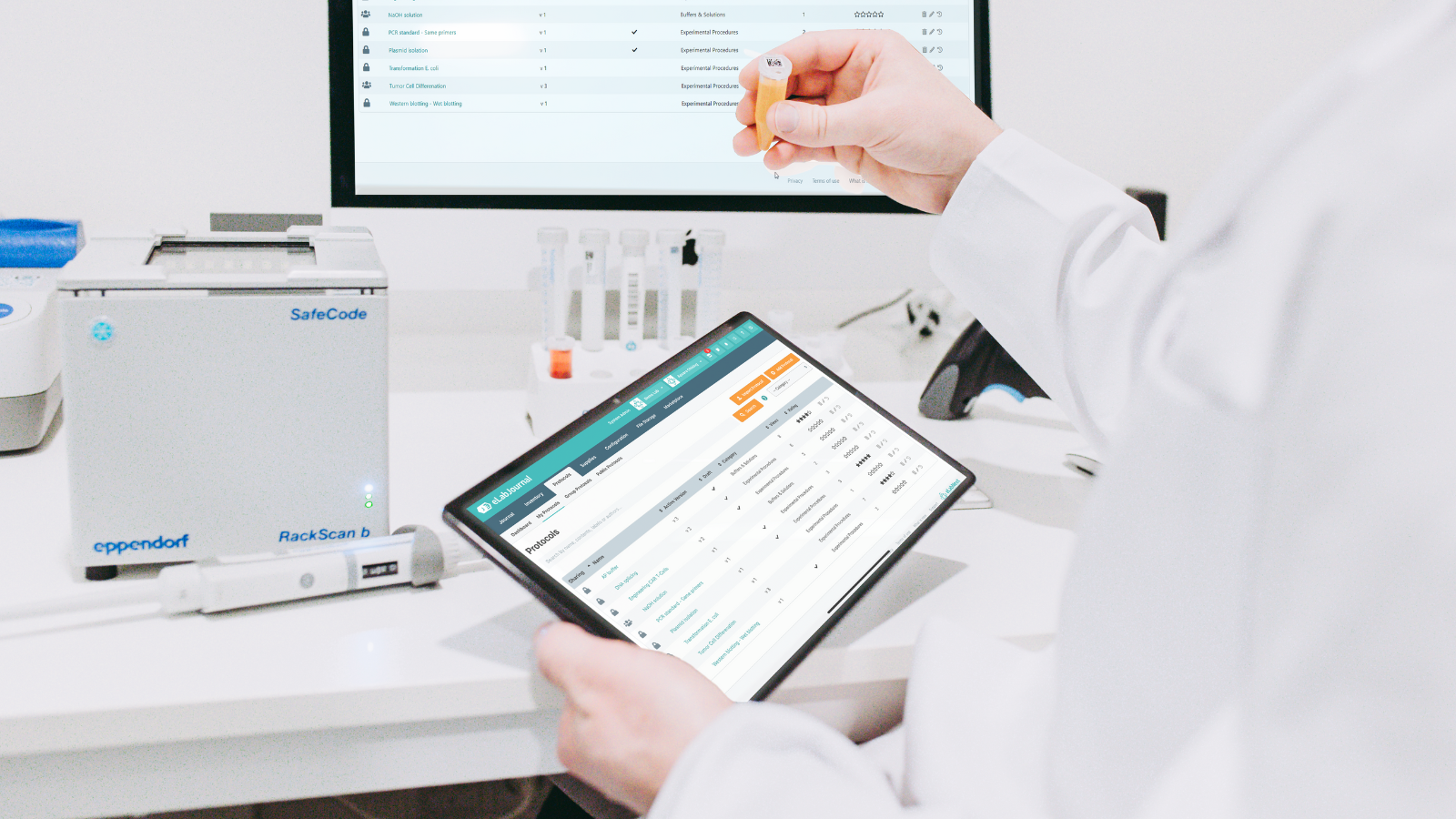
Searchable digital records help you find a method by title, category, label, author, step name, or step content. Your scientists spend less time asking colleagues for files, and managers can see which version is active without decoding filenames. Strong search also supports onboarding, method transfer, troubleshooting, and inspection preparation.
Control changes without disrupting work
A controlled publishing cycle lets an active protocol remain available while an owner updates a draft. When the revision is approved, the system can publish a new version and preserve prior versions in history. Comparison and restore options help you understand what changed and recover a previous method without overwriting the audit trail.
Configure recurring procedures
Variables and formulas let you reuse a standard method while adjusting approved parameters such as sample count, volume, concentration, dilution, or incubation time. This reduces manual calculation and copy-paste errors. Your protocol owner should define which fields users can change and which steps must stay fixed.
Connect procedures to experiments and samples
When a scientist inserts a protocol into an electronic lab notebook, the experiment can retain the method context alongside observations, files, samples, and results. This gives reviewers a clearer evidence chain, supports traceability, and helps you manage your lab data better.
Strengthen review and audit readiness
Version history, user attribution, permissions, timestamps, signatures, witness review, and record locking can support audit-ready workflows when they match your regulatory scope and quality procedures. These controls also help unregulated research teams protect intellectual property, preserve institutional knowledge, investigate unexpected results, and demonstrate reproducibility.
Scale training, method transfer, and multi-site collaboration
Shared, current procedures help new team members learn the approved workflow and enable experienced scientists to collaborate across projects and locations. At enterprise scale, this consistency also supports method transfer between research, development, testing, manufacturing, and external partners.
Your organization can use centrally governed methods or templates to define the elements that must remain consistent while allowing authorized teams to configure approved parameters or local implementation details. This helps preserve scientific intent without forcing every lab to operate identically when equipment, materials, or regulatory requirements differ.
Protocol governance should also define what happens after a revision is published. Depending on the risk and scope of the change, your organization may need to notify affected users, assign training, capture acknowledgement, establish an effective date, or confirm that linked procedures and work instructions remain current. Connecting these activities with the protocol lifecycle gives managers and Quality teams a clearer view of whether a change has moved from approval into everyday practice.
Here's a guide on enhancing reproducibility through digitalization that explores the wider research value of consistent methods and connected context.
Which compliance requirements should you consider?
Start with the work your lab performs, the records your organization must keep, and the jurisdictions or accreditation programs that apply. A digital platform can support controls, but your organization remains responsible for regulatory interpretation, validation, procedures, training, retention, and ongoing governance.
These standards we cover here work as a practical starting point. Your local requirements, quality system, sponsor obligations, or authority having jurisdiction may add more.
For a deeper regulated-records discussion, here's a guide to GLP and GMP compliance for electronic lab notebooks.
What changes when you manage protocols across an enterprise?
In an enterprise environment, compliance decisions need to account for both the intended use of the system and the way it will be operated across different groups. A workflow used for exploratory research may require different controls from one used for regulated testing, manufacturing support, or records submitted to an authority.
Before rollout, Quality, IT, scientific stakeholders, and system owners should agree on:
- Which system is the authoritative source for each type of protocol, SOP, or work instruction
- Which workflows and electronic records are within regulated scope
- Whether validation is required for the intended use
- How users receive access and how access is reviewed or removed
- Which approval, signature, locking, retention, and audit-review rules apply
- How integrations, backups, exports, and disaster-recovery processes will be governed
- Whether hosting location, data residency, or organizational security requirements affect deployment
- How changes to system configuration will be assessed, tested, approved, and documented
The objective is to match controls to risk while maintaining a governance model that the organization can operate consistently.
How does SciSure support protocol and SOP management?
SciSure brings protocol management into the same scientific environment as experiment documentation, samples, inventory, approvals, and audit evidence. For research teams, you can use SciSure to:
- Create protocols and SOPs as structured, step-by-step records.
- Add configurable variables and formulas for approved procedure parameters.
- Keep protocols in draft until they are finalized and published.
- Preserve version history, compare versions, and restore prior content as a new version.
- Organize protocols with categories and labels, then search names, authors, steps, and step contents.
- Share published protocols with selected groups or across the organization, subject to configuration and permissions.
- Insert a published procedure into an ELN experiment and retain a link to the protocol version used.
- Configure rights to create, view, update, publish, sign, witness, share, or archive procedures.
- Use signature and witness-signature workflows where your group policy requires them.
- Review protocol logs for sharing, publication, and approval events.

SciSure’s current Protocols and SOP Management program also extends controlled SOP access to Health and Safety and Lab Operations teams. The early-access workflow emphasizes centralized organization-wide SOPs, digital sign-off and version control, editable lab-specific templates, and the ability for researchers to turn an organization-wide SOP into an editable protocol for their team.
This connected approach helps you move from a static document library to an operating workflow. Scientists can reach the method while they document an experiment, and managers can connect procedure governance with the ELN, LIMS, samples, inventory, and safety context your lab already manages.
From organization-wide standards to lab execution
Protocol governance often needs to operate at more than one level. Quality, Lab Operations, or Health and Safety teams may own organization-wide procedures, while individual laboratories need practical instructions that reflect their equipment, methods, and scientific work. SciSure’s early-access SOP workflow is designed around this relationship. Central teams can organize and control organization-wide SOPs with versioning and digital sign-off, while researchers can use editable lab-specific templates or turn an applicable SOP into a protocol for their team.
The lab-level procedure can then sit alongside the experiment, sample, inventory, approval, and audit context involved in performing the work. This creates a clearer path from organizational policy to scientific execution without treating protocols as isolated files.
For an enterprise, the value is giving central owners, local managers, scientists, and reviewers an appropriate view of the same connected procedure lifecycle.
What does digital protocol management look like in practice?
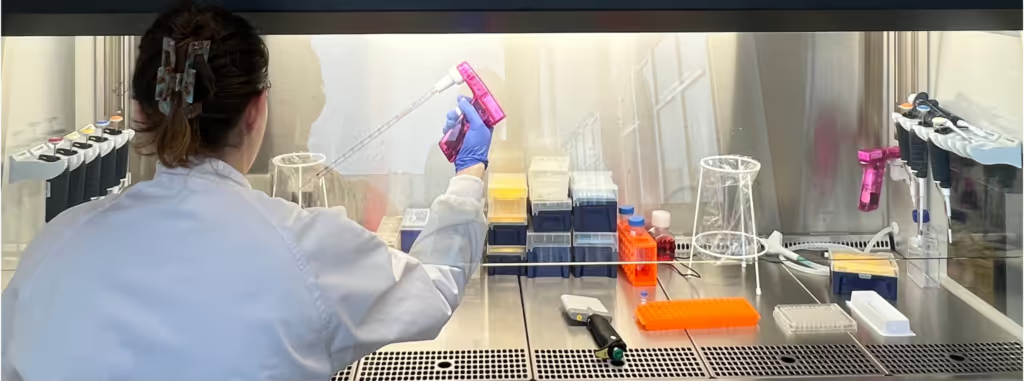
Here's an example in practice from Myllia Biotechnology: before using SciSure, the growing CRISPR screening company relied on paper lab journals, which made research documentation harder to search, organize, and share. Myllia implemented SciSure ELN and LIMS to centralize experiment documentation and strengthen sample and inventory management.
The team can now easily upload, generate, and link protocols and SOPs to specific experiments. Experiments, samples, data, and methods are available to the team in one connected environment, which improved research-document traceability, supported sample visibility, and made collaboration more transparent across projects.
The lesson for your rollout is concrete: connect the procedure to the work that uses it. A searchable protocol library solves one problem. A protocol that also carries experiment, sample, data, ownership, and version context gives reviewers a usable scientific record.
What could this look like across multiple sites?
Consider an organization with discovery laboratories in several locations and a regulated testing group at another site. The teams use related sample-preparation methods, but their equipment, review requirements, and local responsibilities differ.
The organization could establish a governed core method that defines the scientific steps and acceptance criteria that must remain consistent. Authorized site owners could then maintain approved local details, such as instrument models, responsibilities, or site-specific safety instructions. Each experiment would retain the context of the protocol version actually used.
When the core method changes, central owners could review the impact, publish the revision, and coordinate the transition across affected sites. Reviewers would have a clearer record of what changed, which local procedures were affected, and which method version supported a particular experiment or result.
This type of operating model helps an organization standardize where consistency matters while preserving controlled flexibility where laboratory conditions legitimately differ.
How should an enterprise plan a digital lab protocol system rollout?
A multi-site rollout requires requires agreement on decision rights, system boundaries, ownership, migration priorities, and the relationship between centrally controlled content and lab-specific procedures. Create a cross-functional rollout group that represents the people who will govern, administer, and use the system. Depending on scope, this may include scientists, Lab Operations, Quality, IT, information security, system administrators, and change-management or training leads.
The group should define a target operating model before migration begins:
- Who owns each document type
- Which decisions are made centrally and which are made by a site or department
- How global templates and local variants relate to one another
- Which system is authoritative for protocols, SOPs, training, and experiment records
- How integrations and user access will be managed
- How deployment will be phased across workflows, departments, or sites
- Which measures will show whether the rollout is succeeding
This governance work reduces the risk of recreating the organization’s existing shared-drive structure inside a new system.
Next, make sure to:
1. Map your current sources and risks
List every place where protocols, SOPs, work instructions, and supporting files live. Include paper binders, shared drives, local files, legacy ELNs, quality systems, equipment software, and external repositories. Record the owner, active version, last review date, users, regulatory scope, linked training, and known duplicates.
For an enterprise assessment, organize the inventory by site, department, document type, regulatory scope, and current system. Record where the same method has been copied or adapted by multiple groups and whether those variations are intentional, approved, or simply the result of local practice.
Also document dependencies such as training records, QMS documents, ELN experiments, LIMS workflows, instruments, identity systems, and external collaborators. This helps the organization distinguish a straightforward content migration from a workflow that requires integration or broader change management.
2. Define ownership and lifecycle rules
Decide who can author, review, approve, publish, revise, share, archive, and restore each document type. Define how long a draft can remain open, when periodic review occurs, how urgent changes are handled, and how users learn that a new version is effective.
Also make sure to separate content ownership from system administration. A scientific owner may be accountable for the method, Quality may approve a controlled procedure, a site owner may manage local implementation, and IT may administer the platform.
Define which decisions belong to each role and how disagreements or urgent changes will be escalated. For organization-wide content, specify whether local teams can create variants, which elements they may change, and whether those variants require additional approval.
3. Standardize structure and metadata
Create templates for common protocol families. Use consistent titles, categories, labels, authors, purpose statements, materials, equipment, hazards, steps, acceptance criteria, attachments, and references. Good metadata improves search and supports the protocol-optimization practices we cover in our guide to optimizing biotechnology protocols.
Enterprise metadata should make it possible to identify the procedure’s business unit, site, scientific area, owner, regulatory scope, effective status, and relationship to other documents. Avoid creating so many required fields that scientists bypass the process, but include enough structure to support governance and retrieval.
Where methods are shared across sites, distinguish the controlled core from approved local fields. This reduces duplicate maintenance and makes the relationship between the organization-wide method and its local implementations visible.
4. Configure permissions and approvals
Give each role the access needed for its work. Separate viewing, editing, publishing, signing, witness review, sharing, and archiving where risk requires it. If electronic signatures are in scope, define signature meaning, credential controls, record locking, retention, and validation before launch.
Next, map access to organizational roles rather than individual exceptions wherever possible. Define how people receive, change, and lose access as they join the organization, change roles, move sites, or leave.
For regulated or high-risk workflows, involve Quality and IT in determining approval routes, signature meaning, record locking, retention, audit review, and periodic access review. Test these controls with representative users before scaling the configuration across the organization.
5. Migrate and verify content
Prioritize current, high-use, high-risk procedures. Clean formatting, remove duplicates, confirm owners, verify active versions, and rebuild variables or formulas that did not migrate cleanly. Ask a subject-matter expert to compare the digital version with the approved source before publishing it.
Also make sure to plan migration in waves instead of attempting to move every procedure at once. Prioritize current, frequently used, high-risk, or strategically important methods and define acceptance criteria for each migration group.
Maintain a record of the source, owner, review status, migration decision, and verification result. Decide how legacy systems and inactive content will be archived so that historical records remain retrievable without allowing obsolete procedures to appear current.
6. Pilot one live workflow
Choose a procedure that scientists use frequently and that produces a clear experiment or sample record. Run the full path from finding the current protocol through execution, result capture, review, signature, and retrieval. Use the pilot to adjust templates, permissions, training, and support materials.
For an enterprise pilot, choose a workflow that is contained enough to manage but representative enough to test the operating model. Ideally, it should involve a central content owner, at least one lab-level user group, a real experiment or sample record, and the review controls expected in future phases.
Test not only whether scientists can execute the protocol, but also whether administrators can manage access, owners can publish revisions, reviewers can retrieve the relevant history, and another site could adopt or adapt the method.
7. Train, measure, and improve
Train people through the tasks they perform, then measure search time, protocol reuse, outdated-version incidents, approval turnaround, completion quality, support requests, and linked experiment records. Review these signals after 30, 60, and 90 days, then expand to the next workflow or site.
Plan deployment by workflow, department, or site, with clear entry criteria for each wave. Use feedback from early groups to improve templates, governance, training, and support before expanding.
Enterprise measures may include:
- Time required to find the current procedure
- Percentage of active procedures with a named owner
- Approval and revision-cycle time
- Number of duplicate or obsolete procedures retired
- Use of organization-wide templates across sites
- Percentage of experiments linked to the applicable protocol version
- Outdated-version incidents or protocol-related deviations
- Training or acknowledgement completion following significant revisions
- User adoption and support requests by department or site
Review these measures as operational signals, not simply as implementation milestones.
What should you look for in digital protocol management software?
An enterprise evaluation should examine more than how an individual scientist writes and follows a protocol. It should also test how scientific leaders, Quality, IT, Lab Operations, and system administrators govern the procedure lifecycle across the organization.
Besides the bench workflow, ask vendors to demonstrate:
- Organization, group, and site-level administration
- Central templates with controlled team- or site-specific adaptation
- Clear ownership across global and local content
- Scalable role and permission management
- Authentication and user-lifecycle options that meet organizational IT requirements
- Connections with ELN, LIMS, QMS, inventory, training, and other relevant systems
- APIs, integration options, and reliable data export
- Bulk content migration and metadata-management capabilities
- Audit history, approval, signature, retention, and locking options for applicable workflows
- Security, hosting, backup, recovery, and data-residency provisions
- Validation documentation or implementation support where regulated use requires it
- Reporting that helps administrators monitor ownership, review status, adoption, and change activity
- Implementation, training, governance, and ongoing support for multiple departments or sites
- A documented approach to business continuity and retrieving data if the organization changes systems
Your representatives from Science, Quality, IT, and Lab Operations should all be present during the evaluation. Give each vendor the same enterprise scenario: a central method, a controlled site variation, a revision, an approval requirement, an experiment link, and a request to retrieve the full history.
This shows you how the system works across roles, not just how it looks during protocol authoring.
FAQs
What is a digital lab protocol?
A digital lab protocol is a structured electronic procedure that your team can create, review, publish, search, use, and update in a controlled system. It can include steps, materials, equipment, hazards, attachments, configurable variables, calculations, approvals, and links to experiments or samples.
How are lab protocols and SOPs different?
A protocol usually describes how to perform a specific scientific method or experimental task. An SOP usually carries broader organizational governance for a recurring process. Your organization may define the terms differently, so document the purpose, owner, approval route, training requirement, review cycle, and change-control rules for each type.
Which protocols should you digitalize first?
Start with procedures that are used frequently, revised often, difficult to find, safety-critical, regulated, or closely tied to sample and experiment records. A contained pilot gives you enough workflow complexity to test search, versioning, permissions, approvals, migration, training, and support before a broader rollout.
How does version control improve reproducibility?
Version control shows which procedure was active, what changed, who published the change, and which version supported a specific experiment. That history helps another scientist repeat the method, helps a reviewer investigate an unexpected result, and helps your organization retire outdated instructions without losing prior context.
Does digital protocol software make a lab compliant?
Digital protocol software provides technical controls that can support compliant use. Your organization still needs to determine scope, validate intended use where required, approve procedures, manage access, train users, control changes, retain records, review audit trails, and operate the system under an effective quality program.
How can an organization standardize protocols without removing local flexibility?
Start by separating the elements that must remain consistent from those that may vary by lab or site. The controlled core might define scientific intent, required steps, acceptance criteria, or safety requirements. Approved local fields could cover equipment, responsibilities, materials, or parameters that legitimately differ.
Assign owners to both levels and document how local variants are created, reviewed, updated, and retired. This allows the organization to standardize critical content without encouraging unofficial copies or forcing inappropriate uniformity.
Does digital protocol management replace a quality management system?
Not necessarily. An ELN or protocol-management platform may control scientific procedures and connect them with experimental work, while a QMS may remain the authoritative system for formal quality documents, training, deviations, CAPAs, or other regulated processes.
The organization should define which system owns each record type, how related documents are linked, and how changes move between systems. The appropriate model depends on regulatory scope, intended use, existing architecture, and the organization’s quality procedures.
Who should own enterprise protocol governance?
Ownership is usually cross-functional. Scientific owners are responsible for method content, Quality defines applicable controls, Lab Operations supports practical implementation, IT governs the technical environment, and local laboratory leaders manage adoption.
One accountable owner should be named for each procedure, even when several functions contribute to its lifecycle. The organization should also define who can publish, approve, adapt, archive, and restore content.
What should an organization pilot before a multi-site rollout?
Choose a frequently used procedure with a clear owner, a real experiment or sample connection, and enough governance complexity to test the intended operating model. Include users from at least one implementing lab and, where possible, a second group that needs to reuse or adapt the method.
The pilot should test search, execution, revision, approval, permissions, migration, training, retrieval, and the relationship between central content and local use. Resolve gaps in governance and configuration before expanding to additional sites.
Can SciSure connect protocols with ELN and LIMS records?
Yes. You can publish protocols for use in ELN experiments, retain a link to the method version used, and connect experiment documentation with samples, inventory, attachments, approvals, and audit history. SciSure LIMS adds sample, storage, barcode, inventory, equipment, lifecycle, permission, and audit-log context.
Can you migrate existing protocols into SciSure?
Yes. You can import text from existing protocols or SOPs and structure it into steps, then add details that require manual setup, such as images, variables, and formulas. Review every migrated procedure against the approved source, confirm its owner and metadata, and finalize it only after content verification.
Read More:
- The 5 Best Electronic Lab Notebooks (ELN) in 2026 Ranked by Ease-of-Use & ROI: Based on Real User Reviews
- How to Choose a Data-Secure ELN and Protect Enterprise IP
- Why ELN/LIMS Adoption Fails at the Enterprise Level & What Management Needs to Do Differently
- Electronic Lab Notebook Best Practices: What to do after you Implement an ELN
- Implementing an Electronic Lab Notebook (ELN) in a New Lab: A Step-by-Step Guide
- How to Transition from Another ELN: A Practical Migration Strategy for Research Labs
- 6 Electronic Lab Notebook (ELN) Adoption Barriers & How To Help Your Research Team Overcome Them
- GxP Regulatory Guidelines: GLP and GMP Compliance for Electronic Laboratory Notebooks (ELNs)

Read more of our blogs about modern lab management
Discover the latest in lab operations, from sample management to AI innovations, designed to enhance efficiency and drive scientific breakthroughs.


