How to Get the Most from Your Lab Procedures

Learn how to write effective lab protocols and SOPs, why standardization matters, and how digital tools like SciSure connect procedures to your ELN and LIMS records.

July 22, 2026
()
min read
A laboratory

Download Whitepaper

By submitting this form, you agree with our Privacy Policy.
Thank you! Download the file by clicking below:
Download
Oops! Something went wrong while submitting the form.

Table of Contents

Thank you! Your submission has been received!
Oops! Something went wrong while submitting the form.

Table of Contents

TL;DR

Strong lab procedures, whether protocols or SOPs, are the foundation of consistent, safe, and reproducible science.

  • Protocols vs. SOPs.
    A lab protocol defines how to perform a specific experiment or test, with detail on conditions, parameters, and equipment. An SOP governs recurring organizational processes, from sample handling to chemical safety. Both require ownership, version control, and clear steps to be useful.
  • Why standardization matters.
    Standardized lab procedures reduce variability, support reproducibility, protect personnel, and satisfy regulatory requirements under frameworks such as FDA 21 CFR Part 58, ISO/IEC 17025, and the OSHA Laboratory Standard.
  • How to write an effective lab procedure.
    Define the purpose, scope, materials, safety controls, numbered steps, quality checks, documentation requirements, and revision history. A good lab report example or lab observation book entry should connect directly to the procedure version used.
  • Digital tools change the equation.
    Paper binders and shared drives make lifecycle control difficult at scale. SciSure enables centralized protocol and SOP management with version control, approval workflows, audit trails, and direct links to ELN experiments and LIMS records.
  • SciSure connects lab procedures to work.
    Myllia Biotechnology moved from paper lab journals to SciSure ELN and LIMS, enabling the team to upload, generate, and link protocols and SOPs to specific experiments, improving traceability and collaboration across projects.

This post was originally published in 2024 and updated in 2026 with current SciSure positioning, refreshed compliance context, updated product capabilities, related SciSure resources, and verified customer proof from Myllia Biotechnology on protocol sharing, experiment links, traceability, and collaboration.

Everyone who's worked in a lab has encountered a protocol or lab standard operating procedure (SOP) at some point. Most scientists know these documents matter. Fewer have thought carefully about what makes them work well, and what happens when they don't.

A poorly maintained procedure can slow down your newest team member, produce a result that nobody can reproduce, or put a person in a hazardous situation without adequate guidance. The costs are real: repeated experiments, failed audits, training gaps, and avoidable safety incidents. The good news is that the solution is straightforward. Clear, owned, version-controlled procedures that are connected to the work they govern make the difference.

This guide covers the key differences between lab protocols and SOPs, why standardization matters, how to write steps in a lab procedure that people will actually follow, and how digital tools like SciSure help you manage the whole lifecycle. If you are writing your first SOP or rethinking how your lab manages procedures at scale, this is where to start.

Request a SciSure demo to see how protocol and SOP management works in practice.

What are the main differences between lab protocols and SOPs?

The terms "lab protocol" and "SOP" are often used interchangeably, but they serve different functions. Understanding the distinction helps you decide how to structure, own, and control each type of document.

Lab SOPs vs Lab Protocols vs General Instructions

Document type Primary purpose Example
Laboratory SOP Standardize a recurring process across a team, lab, site, or organization Hazardous chemical spill response
Lab protocol Describe a scientific method, experiment, assay, preparation, or test Cell culture passaging protocol
Work instruction Explain one narrow task within a larger SOP or protocol Daily balance verification steps

Lab protocols

A lab protocol is a detailed set of instructions for carrying out a specific experimental task. Common lab report examples and lab report sample formats show how protocols feed directly into documented results: the method used, the parameters applied, and the steps followed all appear as part of the scientific record.

Protocols are highly specific by design. They define concentrations, temperatures, timings, equipment models, and acceptable ranges. When a scientist asks "how do you write a lab report" or "what should a lab report look like," the answer almost always starts with the protocol: what was the approved method, and which version was used?

Protocols can be adjusted for specific research needs, but changes should be deliberate and documented, not informal.

SciSure lab protocols

Standard operating procedures (SOPs)

An SOP provides broader governance for any recurring lab activity. It covers everything from equipment calibration and hazardous chemical handling to data recording, incident response, and lab cleanliness. SOPs are the backbone of compliance: in U.S. laboratories covered by the OSHA Laboratory Standard, 29 CFR 1910.1450, for example, the Chemical Hygiene Plan must include SOPs relevant to the safe handling of hazardous chemicals.

SOPs also define who is responsible for each step, what constitutes a deviation, and how to escalate when something goes wrong. A chemistry sample lab report or lab observation book entry may reference an SOP that governed sample handling throughout the experiment.

For a deeper look at how SOPs and protocols relate to one another at the governance level, our guide to mastering lab SOPs covers ownership, review cycles, and document hierarchy in detail.

Why standardization in lab procedures matters

When your team follows the same numbered steps, uses the same parameters, and records results the same way, you get data that can be compared, reproduced, and defended. Here's why it matters across six dimensions.

Consistency and reproducibility

A standardized lab procedure produces the same result regardless of who performs it or when. This is the foundation of credible science. If two researchers follow the same protocol and get different results, the problem can be traced to execution, materials, or conditions, not to an inconsistent method. Reproducibility also supports method transfer: when a procedure moves between teams or sites, a standardized baseline makes the transition faster and more reliable.

Quality control

Following a controlled procedure minimizes variability from operator differences and methodology gaps. Quality checkpoints built into the procedure, such as acceptance criteria, stop conditions, and required verification steps, catch problems before they compound. A chemistry sample lab report that references a controlled method gives reviewers confidence that the data is trustworthy.

Lab safety

SOPs place hazard controls exactly where the risk occurs: beside the fume hood step, after the reagent addition, before the equipment operation. Detailed safety instructions define required personal protective equipment, emergency response steps, and waste handling. Standardizing these controls reduces accidents and protects everyone working in the lab.

SciSure
Ready to standardize your lab procedures?
SciSure helps you keep protocols consistent, reproducible, and audit-ready by managing experiment documentation and versioned protocols in one connected ELN/LIMS.
Request a demo

Efficiency and resource management

Clear procedures reduce the time spent on training, answering repeated questions, and redoing work. New personnel can follow a well-written lab procedure independently, which frees experienced scientists for work that requires judgment. Standardized resource usage, from reagent volumes to equipment settings, also reduces waste and lowers operating costs.

Regulatory compliance

Many laboratories operate under strict regulatory frameworks. FDA Good Laboratory Practice, 21 CFR Part 58 requires written and approved SOPs with documented deviations. ISO/IEC 17025:2017 requires controlled methods, valid procedures, and management of changes for testing and calibration laboratories. Standardized procedures with proper version control, approval records, and revision history support these requirements.

Cost efficiency

Repeated experiments cost money. Wasted reagents cost money. Training someone on a process that nobody can locate costs time and money. Standardized procedures reduce all three. Consistent protocols minimize the waste of expensive samples and ensure that costly runs are not repeated because the method was unclear.

How to write an effective lab procedure

A good lab procedure, whether a protocol or an SOP, follows a clear structure. The sections below answer the question "how do you write a lab report" or "how do you write steps in a lab" from the ground up. Follow this stepwise process when drafting new procedures or refreshing existing ones.

See how SciSure's protocol and SOP management tools support the writing and review process.

1. Define the purpose

Start with a single clear statement of what the procedure accomplishes and why it exists. This sets the context for everyone who uses the document. A purpose statement also helps reviewers assess whether the procedure is still current and whether its scope has drifted.

2. Scope and application

Explain when and where the procedure applies, who should use it, and what it excludes. Define any prerequisites: required training, qualifications, instrument status, or environmental conditions. Clear scope prevents a cell culture protocol from being applied to a sample type it was never designed for.

3. List of materials and equipment

Provide a complete list of everything needed to perform the procedure: reagents, equipment models, software versions, safety gear, forms, and linked documents. Incomplete materials lists are one of the most common reasons a procedure fails at the bench.

4. Detailed steps

Break the procedure into clear, numbered steps. Each step should describe one action with measurable parameters where applicable. Use active verbs, define acceptable ranges and hold times, and flag decision points. When scientists ask what a lab report should look like, this section is usually what they mean: a step-by-step account of what was done, in the correct order. A lab observation book connects these steps to real-time results.

5. Safety and compliance notes

Place safety instructions beside the steps where the hazard occurs, not in a separate section that gets skipped. Define required controls, prohibited actions, spill or emergency response steps, and waste handling routes. For laboratories under the OSHA Chemical Hygiene Plan, these notes are not optional.

SciSure
Turn audit prep into a non-event
When your procedures live in one governed system, compliance stops being a scramble. No more rebuilding the story from spreadsheets when an auditor asks, "Who did what, and when?"
Talk to a specialist

6. Quality control checks

Integrate acceptance criteria, verification steps, and stop conditions throughout the procedure. Specify how results should be evaluated and recorded. A chemistry sample lab report that documents quality checks at each stage gives reviewers a much clearer picture of whether the experiment was performed correctly.

7. Documentation and reporting

Define what to record, where to record it, when, and how to handle corrections. If the work creates an ELN experiment, sample record, or equipment log, identify the system and the required links.

8. Review and approval

Before the procedure is published, a senior scientist or peer should verify its accuracy and practicality. Approval should come from an authorized role, not just the author. The review process confirms that the procedure works as written and that the right people have signed off.

9. Revision history

Keep a log of every change: the date, what changed, and who approved it. This revision history is what makes a procedure defensible during an audit and usable during a method transfer. It also tells a new team member how the procedure has evolved over time.

How digital tools change what's possible for lab procedure management

Digital protocol and SOP management changes the challenges of managing procedures over their lifecycle. A controlled system gives your team one searchable source for approved procedures, with draft and publish controls that keep active versions separate from work in progress. Every change is tracked. Approvals are recorded. And the procedure can be linked directly to the experiment, sample, or equipment record that used it.

Paper binders and shared drives can hold procedures, but they make lifecycle control difficult. Files get downloaded, renamed, and edited without a publishing workflow. The current version becomes unclear. Training records separate from documents. Audit preparation requires manual reconstruction. The result is a team that wastes time searching for instructions they are not sure are current, and a manager who cannot confirm that the right procedure governed a specific experiment.

Here's an example of this in practice from Myllia Biotechnology. Before using SciSure, the growing CRISPR screening company relied on paper lab journals, which made research documentation harder to search, organize, and share. Myllia implemented SciSure ELN and SciSure LIMS to centralize experiment documentation and strengthen sample and inventory management. The team can now upload, generate, and link protocols and SOPs to specific experiments. Experiments, samples, data, and methods are all available in one connected environment, which improved research-document traceability, supported sample visibility, and made collaboration more transparent across projects.
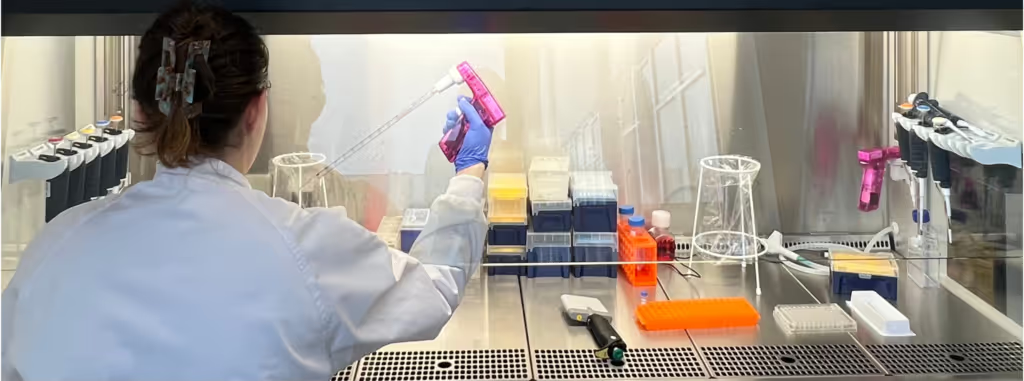
Myllia biotechnology, a CRISPR screening company

The lesson: a searchable protocol library solves one problem. A protocol that also carries experiment, sample, data, and version context gives reviewers a usable scientific record.

What SciSure's protocol and SOP management enables

SciSure brings protocol and SOP management into the same environment as your ELN experiments, LIMS records, inventory, and audit evidence. With SciSure, your team can:

  • Create protocols and SOPs as structured, step-by-step records with configurable variables and formulas.
  • Keep procedures in draft until they are finalized and published, with full version history preserved.
  • Search protocol names, authors, steps, and step contents across the entire library.
  • Share published protocols with selected groups or across the organization, subject to configured permissions.
  • Insert a published procedure into an ELN experiment and retain a durable link to the version used.
  • Configure role-based rights for viewing, editing, publishing, signing, witnessing, sharing, and archiving.
  • Use signature and witness-signature workflows where your quality system requires them.
  • Review audit logs for sharing, publication, and approval events.

SciSure's Protocols and SOP Management also extends controlled SOP access to Health and Safety and Lab Operations teams, with centralized organization-wide SOPs, digital sign-off, version control, and editable lab-specific templates. Researchers can turn an organization-wide SOP into a working protocol for their team, keeping the lab-level procedure connected to the experiment, sample, and audit context involved in performing the work.

For a full picture of how digitalization supports the protocol lifecycle, our guide to digitalizing lab protocols covers version control, compliance considerations, multi-site governance, and rollout planning in detail.

SciSure
Keep every procedure connected to the work
Manage protocols and SOPs in the same environment as your experiments, samples, and audit evidence, with SciSure.
Request a demo

Move from procedures on paper to procedures in practice

Getting the most from your lab procedures means making them clear, owned, version-controlled, and connected to the work they govern. Write them with the people who perform the steps. Test them at the point of use before publishing. Define who owns each document and when it gets reviewed. And connect the procedure to the experiment, sample, or record it produced, so reviewers can understand what instructions applied at the time.

If your lab is still managing procedures through binders, shared drives, or disconnected file systems, the administrative cost of that approach grows every time you add a person, a site, or a regulated workflow.

Talk to a SciSure specialist about how protocol and SOP management, ELN, and LIMS can work together in your lab. No commitment, just an honest look at what a connected procedure workflow could mean for your team.

FAQs

What is the difference between a lab protocol and an SOP?

A lab protocol describes how to perform a specific scientific method or experimental task, with detail on concentrations, temperatures, equipment settings, and accepted parameter ranges. An SOP standardizes a recurring organizational process, such as sample handling, equipment calibration, or hazardous chemical procedures. Your quality system should define how each document type is owned, approved, reviewed, and retired.

What should a lab report include?

A strong lab report includes a clear statement of the method used (ideally linked to the active protocol version), a list of materials and equipment, step-by-step observations, recorded data, quality control results, and a conclusion that interprets findings against the expected outcome. The procedure version that governed the work should be identifiable in the record.

How do you write steps in a lab procedure?

Write one action per step, use active verbs, define measurable parameters, and flag decision points or stop conditions. Number steps in sequence and include branching instructions where the outcome can vary. Test the steps at the bench with a representative user before approving the document. Remove anything that belongs in a supporting reference rather than the procedure itself.

How do you write a lab conclusion?

A lab conclusion summarizes what the experiment set out to test, what the results showed, whether the outcome matched the expected criteria, and what that means for the research question or process. A good conclusion also notes any deviations from the protocol, their impact on the results, and whether the procedure needs review.

What makes a lab procedure audit-ready?

An audit-ready procedure has a named owner, a current version with approval history, an effective date, controlled access, a retrievable revision log, and clear links to the training or acknowledgment records that prove it was reviewed. Your organization should also be able to show which procedure version was active during a specific experiment or incident.

How does digital protocol management support regulatory compliance?

Digital protocol management provides technical controls, such as version history, role-based access, approval workflows, electronic signatures, and audit trails, that can support requirements under frameworks including FDA 21 CFR Part 58, FDA 21 CFR Part 11, ISO/IEC 17025, and EU GMP Annex 11. Software provides controls; your organization remains responsible for regulatory interpretation, validation, training, retention, and ongoing governance.

How do you decide which procedures to digitalize first?

Start with procedures that are used frequently, revised often, difficult to locate, safety-critical, tied to regulated work, or directly connected to sample and experiment records. These are the procedures where an outdated or missing version creates the most risk and the most rework.

Can SciSure connect protocols with ELN and LIMS records?

Yes. SciSure allows you to publish protocols for use in ELN experiments, retain a link to the procedure version used, and connect experiment documentation with samples, inventory, approvals, and audit history. SciSure LIMS adds sample, storage, barcode, inventory, equipment, and lifecycle context to that connected record.

SciSure
Connect your protocols to the work they run
Publish a protocol once and drop it straight into an ELN experiment, with a durable link back to the exact version you used, so your documentation stays reproducible and audit-ready.
Request a demo

Ready to see SciSure in action?

Get a personalized demo and see how SciSure fits your lab's workflows.
Request demo

No commitment · Free consultation

Everyone who's worked in a lab has encountered a protocol or lab standard operating procedure (SOP) at some point. Most scientists know these documents matter. Fewer have thought carefully about what makes them work well, and what happens when they don't.

A poorly maintained procedure can slow down your newest team member, produce a result that nobody can reproduce, or put a person in a hazardous situation without adequate guidance. The costs are real: repeated experiments, failed audits, training gaps, and avoidable safety incidents. The good news is that the solution is straightforward. Clear, owned, version-controlled procedures that are connected to the work they govern make the difference.

This guide covers the key differences between lab protocols and SOPs, why standardization matters, how to write steps in a lab procedure that people will actually follow, and how digital tools like SciSure help you manage the whole lifecycle. If you are writing your first SOP or rethinking how your lab manages procedures at scale, this is where to start.

Request a SciSure demo to see how protocol and SOP management works in practice.

What are the main differences between lab protocols and SOPs?

The terms "lab protocol" and "SOP" are often used interchangeably, but they serve different functions. Understanding the distinction helps you decide how to structure, own, and control each type of document.

Lab SOPs vs Lab Protocols vs General Instructions

Document type Primary purpose Example
Laboratory SOP Standardize a recurring process across a team, lab, site, or organization Hazardous chemical spill response
Lab protocol Describe a scientific method, experiment, assay, preparation, or test Cell culture passaging protocol
Work instruction Explain one narrow task within a larger SOP or protocol Daily balance verification steps

Lab protocols

A lab protocol is a detailed set of instructions for carrying out a specific experimental task. Common lab report examples and lab report sample formats show how protocols feed directly into documented results: the method used, the parameters applied, and the steps followed all appear as part of the scientific record.

Protocols are highly specific by design. They define concentrations, temperatures, timings, equipment models, and acceptable ranges. When a scientist asks "how do you write a lab report" or "what should a lab report look like," the answer almost always starts with the protocol: what was the approved method, and which version was used?

Protocols can be adjusted for specific research needs, but changes should be deliberate and documented, not informal.

SciSure lab protocols

Standard operating procedures (SOPs)

An SOP provides broader governance for any recurring lab activity. It covers everything from equipment calibration and hazardous chemical handling to data recording, incident response, and lab cleanliness. SOPs are the backbone of compliance: in U.S. laboratories covered by the OSHA Laboratory Standard, 29 CFR 1910.1450, for example, the Chemical Hygiene Plan must include SOPs relevant to the safe handling of hazardous chemicals.

SOPs also define who is responsible for each step, what constitutes a deviation, and how to escalate when something goes wrong. A chemistry sample lab report or lab observation book entry may reference an SOP that governed sample handling throughout the experiment.

For a deeper look at how SOPs and protocols relate to one another at the governance level, our guide to mastering lab SOPs covers ownership, review cycles, and document hierarchy in detail.

Why standardization in lab procedures matters

When your team follows the same numbered steps, uses the same parameters, and records results the same way, you get data that can be compared, reproduced, and defended. Here's why it matters across six dimensions.

Consistency and reproducibility

A standardized lab procedure produces the same result regardless of who performs it or when. This is the foundation of credible science. If two researchers follow the same protocol and get different results, the problem can be traced to execution, materials, or conditions, not to an inconsistent method. Reproducibility also supports method transfer: when a procedure moves between teams or sites, a standardized baseline makes the transition faster and more reliable.

Quality control

Following a controlled procedure minimizes variability from operator differences and methodology gaps. Quality checkpoints built into the procedure, such as acceptance criteria, stop conditions, and required verification steps, catch problems before they compound. A chemistry sample lab report that references a controlled method gives reviewers confidence that the data is trustworthy.

Lab safety

SOPs place hazard controls exactly where the risk occurs: beside the fume hood step, after the reagent addition, before the equipment operation. Detailed safety instructions define required personal protective equipment, emergency response steps, and waste handling. Standardizing these controls reduces accidents and protects everyone working in the lab.

SciSure
Ready to standardize your lab procedures?
SciSure helps you keep protocols consistent, reproducible, and audit-ready by managing experiment documentation and versioned protocols in one connected ELN/LIMS.
Request a demo

Efficiency and resource management

Clear procedures reduce the time spent on training, answering repeated questions, and redoing work. New personnel can follow a well-written lab procedure independently, which frees experienced scientists for work that requires judgment. Standardized resource usage, from reagent volumes to equipment settings, also reduces waste and lowers operating costs.

Regulatory compliance

Many laboratories operate under strict regulatory frameworks. FDA Good Laboratory Practice, 21 CFR Part 58 requires written and approved SOPs with documented deviations. ISO/IEC 17025:2017 requires controlled methods, valid procedures, and management of changes for testing and calibration laboratories. Standardized procedures with proper version control, approval records, and revision history support these requirements.

Cost efficiency

Repeated experiments cost money. Wasted reagents cost money. Training someone on a process that nobody can locate costs time and money. Standardized procedures reduce all three. Consistent protocols minimize the waste of expensive samples and ensure that costly runs are not repeated because the method was unclear.

How to write an effective lab procedure

A good lab procedure, whether a protocol or an SOP, follows a clear structure. The sections below answer the question "how do you write a lab report" or "how do you write steps in a lab" from the ground up. Follow this stepwise process when drafting new procedures or refreshing existing ones.

See how SciSure's protocol and SOP management tools support the writing and review process.

1. Define the purpose

Start with a single clear statement of what the procedure accomplishes and why it exists. This sets the context for everyone who uses the document. A purpose statement also helps reviewers assess whether the procedure is still current and whether its scope has drifted.

2. Scope and application

Explain when and where the procedure applies, who should use it, and what it excludes. Define any prerequisites: required training, qualifications, instrument status, or environmental conditions. Clear scope prevents a cell culture protocol from being applied to a sample type it was never designed for.

3. List of materials and equipment

Provide a complete list of everything needed to perform the procedure: reagents, equipment models, software versions, safety gear, forms, and linked documents. Incomplete materials lists are one of the most common reasons a procedure fails at the bench.

4. Detailed steps

Break the procedure into clear, numbered steps. Each step should describe one action with measurable parameters where applicable. Use active verbs, define acceptable ranges and hold times, and flag decision points. When scientists ask what a lab report should look like, this section is usually what they mean: a step-by-step account of what was done, in the correct order. A lab observation book connects these steps to real-time results.

5. Safety and compliance notes

Place safety instructions beside the steps where the hazard occurs, not in a separate section that gets skipped. Define required controls, prohibited actions, spill or emergency response steps, and waste handling routes. For laboratories under the OSHA Chemical Hygiene Plan, these notes are not optional.

SciSure
Turn audit prep into a non-event
When your procedures live in one governed system, compliance stops being a scramble. No more rebuilding the story from spreadsheets when an auditor asks, "Who did what, and when?"
Talk to a specialist

6. Quality control checks

Integrate acceptance criteria, verification steps, and stop conditions throughout the procedure. Specify how results should be evaluated and recorded. A chemistry sample lab report that documents quality checks at each stage gives reviewers a much clearer picture of whether the experiment was performed correctly.

7. Documentation and reporting

Define what to record, where to record it, when, and how to handle corrections. If the work creates an ELN experiment, sample record, or equipment log, identify the system and the required links.

8. Review and approval

Before the procedure is published, a senior scientist or peer should verify its accuracy and practicality. Approval should come from an authorized role, not just the author. The review process confirms that the procedure works as written and that the right people have signed off.

9. Revision history

Keep a log of every change: the date, what changed, and who approved it. This revision history is what makes a procedure defensible during an audit and usable during a method transfer. It also tells a new team member how the procedure has evolved over time.

How digital tools change what's possible for lab procedure management

Digital protocol and SOP management changes the challenges of managing procedures over their lifecycle. A controlled system gives your team one searchable source for approved procedures, with draft and publish controls that keep active versions separate from work in progress. Every change is tracked. Approvals are recorded. And the procedure can be linked directly to the experiment, sample, or equipment record that used it.

Paper binders and shared drives can hold procedures, but they make lifecycle control difficult. Files get downloaded, renamed, and edited without a publishing workflow. The current version becomes unclear. Training records separate from documents. Audit preparation requires manual reconstruction. The result is a team that wastes time searching for instructions they are not sure are current, and a manager who cannot confirm that the right procedure governed a specific experiment.

Here's an example of this in practice from Myllia Biotechnology. Before using SciSure, the growing CRISPR screening company relied on paper lab journals, which made research documentation harder to search, organize, and share. Myllia implemented SciSure ELN and SciSure LIMS to centralize experiment documentation and strengthen sample and inventory management. The team can now upload, generate, and link protocols and SOPs to specific experiments. Experiments, samples, data, and methods are all available in one connected environment, which improved research-document traceability, supported sample visibility, and made collaboration more transparent across projects.

Myllia biotechnology, a CRISPR screening company

The lesson: a searchable protocol library solves one problem. A protocol that also carries experiment, sample, data, and version context gives reviewers a usable scientific record.

What SciSure's protocol and SOP management enables

SciSure brings protocol and SOP management into the same environment as your ELN experiments, LIMS records, inventory, and audit evidence. With SciSure, your team can:

  • Create protocols and SOPs as structured, step-by-step records with configurable variables and formulas.
  • Keep procedures in draft until they are finalized and published, with full version history preserved.
  • Search protocol names, authors, steps, and step contents across the entire library.
  • Share published protocols with selected groups or across the organization, subject to configured permissions.
  • Insert a published procedure into an ELN experiment and retain a durable link to the version used.
  • Configure role-based rights for viewing, editing, publishing, signing, witnessing, sharing, and archiving.
  • Use signature and witness-signature workflows where your quality system requires them.
  • Review audit logs for sharing, publication, and approval events.

SciSure's Protocols and SOP Management also extends controlled SOP access to Health and Safety and Lab Operations teams, with centralized organization-wide SOPs, digital sign-off, version control, and editable lab-specific templates. Researchers can turn an organization-wide SOP into a working protocol for their team, keeping the lab-level procedure connected to the experiment, sample, and audit context involved in performing the work.

For a full picture of how digitalization supports the protocol lifecycle, our guide to digitalizing lab protocols covers version control, compliance considerations, multi-site governance, and rollout planning in detail.

SciSure
Keep every procedure connected to the work
Manage protocols and SOPs in the same environment as your experiments, samples, and audit evidence, with SciSure.
Request a demo

Move from procedures on paper to procedures in practice

Getting the most from your lab procedures means making them clear, owned, version-controlled, and connected to the work they govern. Write them with the people who perform the steps. Test them at the point of use before publishing. Define who owns each document and when it gets reviewed. And connect the procedure to the experiment, sample, or record it produced, so reviewers can understand what instructions applied at the time.

If your lab is still managing procedures through binders, shared drives, or disconnected file systems, the administrative cost of that approach grows every time you add a person, a site, or a regulated workflow.

Talk to a SciSure specialist about how protocol and SOP management, ELN, and LIMS can work together in your lab. No commitment, just an honest look at what a connected procedure workflow could mean for your team.

FAQs

What is the difference between a lab protocol and an SOP?

A lab protocol describes how to perform a specific scientific method or experimental task, with detail on concentrations, temperatures, equipment settings, and accepted parameter ranges. An SOP standardizes a recurring organizational process, such as sample handling, equipment calibration, or hazardous chemical procedures. Your quality system should define how each document type is owned, approved, reviewed, and retired.

What should a lab report include?

A strong lab report includes a clear statement of the method used (ideally linked to the active protocol version), a list of materials and equipment, step-by-step observations, recorded data, quality control results, and a conclusion that interprets findings against the expected outcome. The procedure version that governed the work should be identifiable in the record.

How do you write steps in a lab procedure?

Write one action per step, use active verbs, define measurable parameters, and flag decision points or stop conditions. Number steps in sequence and include branching instructions where the outcome can vary. Test the steps at the bench with a representative user before approving the document. Remove anything that belongs in a supporting reference rather than the procedure itself.

How do you write a lab conclusion?

A lab conclusion summarizes what the experiment set out to test, what the results showed, whether the outcome matched the expected criteria, and what that means for the research question or process. A good conclusion also notes any deviations from the protocol, their impact on the results, and whether the procedure needs review.

What makes a lab procedure audit-ready?

An audit-ready procedure has a named owner, a current version with approval history, an effective date, controlled access, a retrievable revision log, and clear links to the training or acknowledgment records that prove it was reviewed. Your organization should also be able to show which procedure version was active during a specific experiment or incident.

How does digital protocol management support regulatory compliance?

Digital protocol management provides technical controls, such as version history, role-based access, approval workflows, electronic signatures, and audit trails, that can support requirements under frameworks including FDA 21 CFR Part 58, FDA 21 CFR Part 11, ISO/IEC 17025, and EU GMP Annex 11. Software provides controls; your organization remains responsible for regulatory interpretation, validation, training, retention, and ongoing governance.

How do you decide which procedures to digitalize first?

Start with procedures that are used frequently, revised often, difficult to locate, safety-critical, tied to regulated work, or directly connected to sample and experiment records. These are the procedures where an outdated or missing version creates the most risk and the most rework.

Can SciSure connect protocols with ELN and LIMS records?

Yes. SciSure allows you to publish protocols for use in ELN experiments, retain a link to the procedure version used, and connect experiment documentation with samples, inventory, approvals, and audit history. SciSure LIMS adds sample, storage, barcode, inventory, equipment, and lifecycle context to that connected record.

SciSure
Connect your protocols to the work they run
Publish a protocol once and drop it straight into an ELN experiment, with a durable link back to the exact version you used, so your documentation stays reproducible and audit-ready.
Request a demo

About the author:

Alisha Simmons-Ramirez

Alisha Simmons-Ramirez is a Strategic Account Executive at SciSure, where she works with biotech and pharma organizations to bring SciSure's platform into their labs. Her path into sales started at the bench: she ran release testing on drug products at Neovii Biotech GmbH and Kite Pharma using methods like HPLC, ELISA, and flow cytometry, documenting results under GMP and GDP standards. She later moved into commercial roles, promoting UV-Vis spectroscopy instrumentation to research labs at Implen before taking on full-cycle account work, from discovery through implementation and long-term adoption, with scientists and lab leadership across biotech and pharma. She holds a BS in Biochemistry from Mannheim University of Applied Sciences.

See all posts from this author

Melde dich für unseren Newsletter an

Holen Sie sich die neuesten Tipps, Artikel und exklusiven Inhalte zum modernen Labormanagement in Ihren Posteingang.
Danke! Deine Einreichung ist eingegangen!
Please check your email to verify your submission.
Hoppla! Beim Absenden des Formulars ist etwas schief gelaufen.