How Can Lab Safety Teams Use AI Responsibly? What Our 2026 Survey Found
6 in 10 lab EHS teams already use AI, mostly for paperwork. Here's how to use it responsibly, with people still making the safety calls.

Download Whitepaper
TL;DR
Lab safety teams can use AI responsibly by starting with routine EHS work, keeping chemical, training and incident records in one connected system, writing a human review step into their procedures, and building toward hazard and incident analysis with a named person accountable for every safety decision.
- How do lab safety teams use AI today?
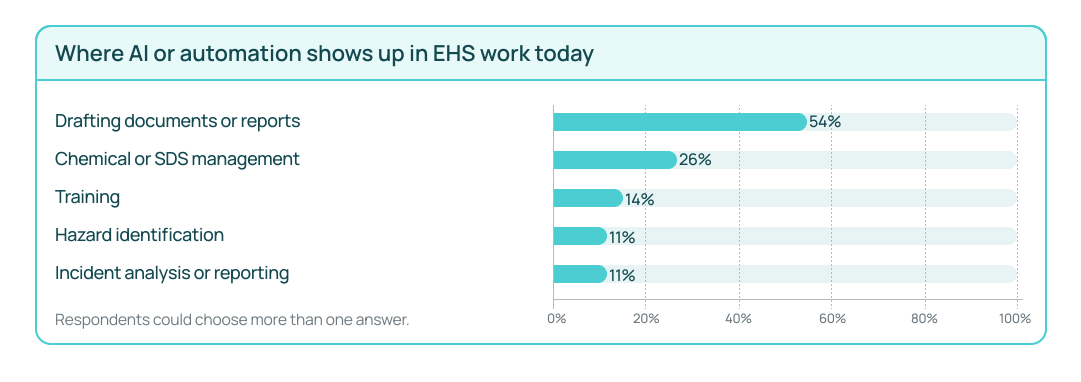
In SciSure and Safety Partners' State of EHS in US Labs: 2026 & Beyond survey, 6 in 10 EHS teams already use AI or automation. Most use it to draft documents (54%) or manage chemicals and SDSs (26%). Only 11% use it for hazard identification or incident analysis, and 64% expect to rely on it more in 2027.
- Start routine, then build.
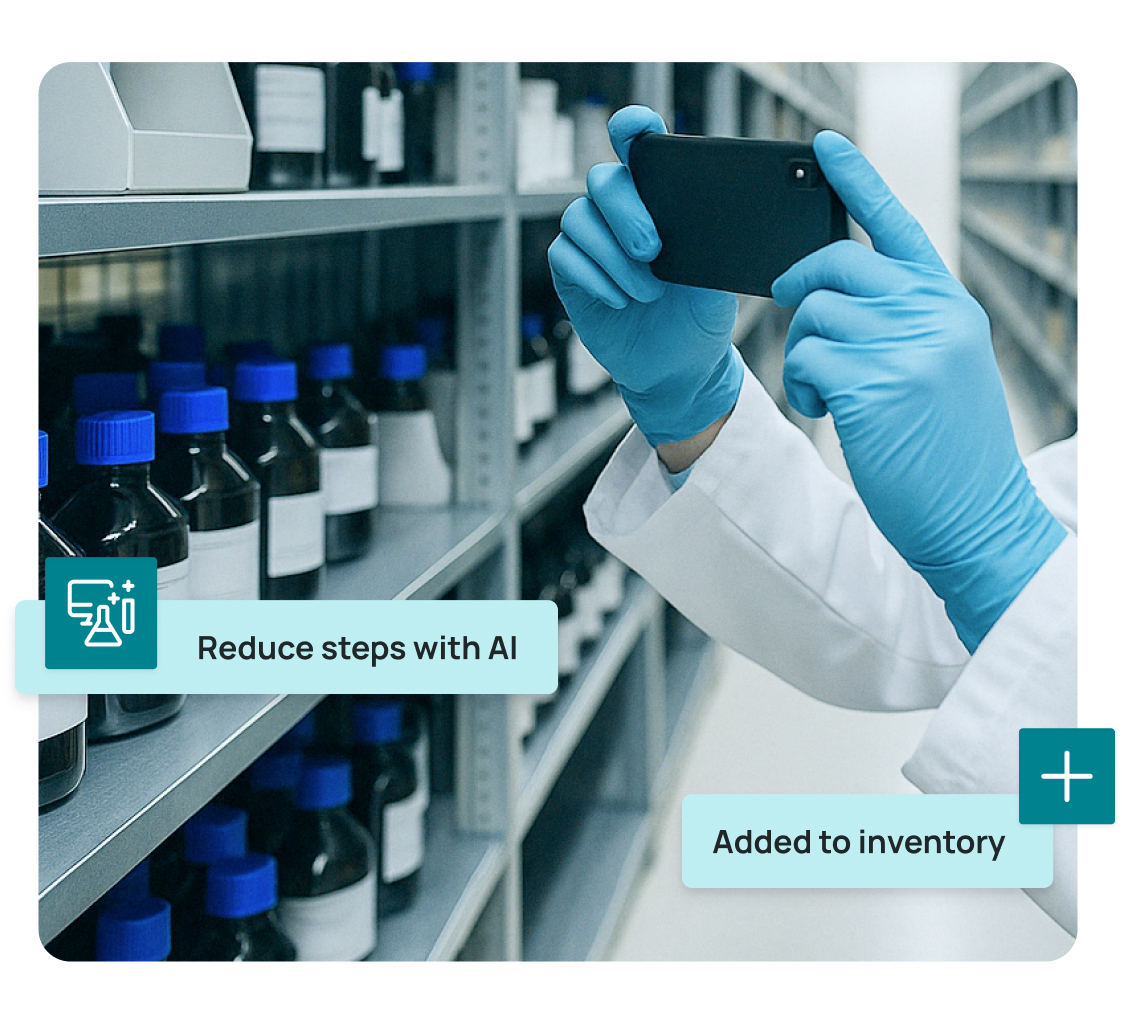
Drafting standard operating procedures (SOPs), training material and reports, or capturing container label details with tools like SciSure's ChemSnap AI, are the right first uses. Each stage builds the clean records and review habits needed for higher-value work, such as spotting trends across incidents and near misses or flagging recurring inspection findings, with EHS making the final call.
- People should always own safety decisions.
Almost half of respondents (49%) say AI is useful for safety decisions only if a person reviews the output. Wrong hazard classifications can lead to incompatible chemical storage, the wrong personal protective equipment (PPE) or unprotected exposure, so EHS teams should decide who checks AI output, what they check and how that review is recorded.
- Connected records come first.
AI is only as good as the data it can reach, and it can't summarize what was never documented. With 58% of labs keeping incident records in spreadsheets, on paper or nowhere, chemical inventories, SDSs, training, inspections and biosafety approvals belong in one system that respects permissions, keeps an audit trail, and stays with the organization when people leave.
- Measure what AI frees up.
Judge AI by faster time to close inspection findings, better training coverage against requirements, more near-miss reports and fewer repeat findings. The time saved is best spent bringing EHS into research planning.
Ready to see SciSure in action?
No commitment · Free consultation
When EHS teams ask us where AI fits in lab safety, we usually start with a different question: where's the friction?
That's the lens we used in The State of EHS in US Labs: 2026 & Beyond, the report SciSure put together with our partners at Safety Partners. Between August and October 2026, we asked more than 60 people who run and support US labs how they manage their environmental, health and safety (EHS) programs. That included EHS managers, lab operations and facilities staff, principal investigators (PIs) and scientists at universities and biotech companies.
Here's what they shared with us on AI use in the lab where health and safety are concerned:
- 6 in 10 lab EHS teams already use AI or automation in some form.
- 64% expect to rely on it more in 2027.
- Very few are letting it make safety calls.
We think that's a sensible place to start, but it shouldn't be where AI use stops. Here's how teams can build from routine tasks toward hazard and incident analysis, with a person still owning every safety call.
What lab safety teams use AI for today
From our survey, we found that most EHS teams use AI for paperwork, but very few use it where safety decisions get made.
We also asked how people feel about software or AI helping with safety decisions. Here's how they responded:
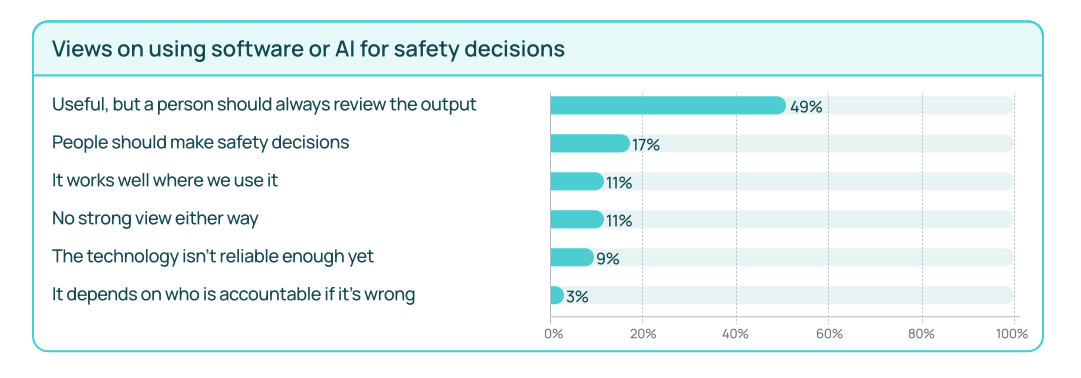
One more number sits right next to all of this: 58% expect their EHS budget to stay flat or shrink over the next two years. Put those two numbers side by side and the reason for the interest is plain. The work keeps growing and the headcount doesn't.
One PI at a university summed it up: "Clunky software tools in an AI era don't help."
Why starting with the paperwork is the right call
Some people will read that 11% as EHS falling behind. We read it as a sensible starting point, with plenty of room to build from.
A safety decision comes with accountability. Someone has to be able to explain why a control was chosen, who signed off on a risk assessment, and what they knew at the time. A model can draft that explanation, but it can't own it. Independent testing backs up the caution: when researchers benchmarked large language models on lab safety scenarios, Lab Manager's summary concluded that labs should treat AI as an assistive tool, not a decision authority.
Accuracy is the other reason for caution, because wrong hazard classification can mean incompatible chemicals stored together, the wrong personal protective equipment (PPE), or an exposure nobody was protected against. A lot of the hazard information AI tools draw on comes from public sources and SDSs, which are a starting point but aren't always right for a specific chemical or task.
At the summer event at CSHEMA (the Campus Safety, Health and Environmental Management Association), the first audience questions in vendor AI sessions were about accuracy and reliability. That skepticism is healthy, because good adoption and responsible AI use means starting slow: crawl, walk, jog, run.
- Drafting an SOP (standard operating procedure) from a template is crawling.
- Pulling details off an SDS or a container label is walking.
- Spotting patterns across a year of incidents, with a person checking the output, is jogging.
Each stage builds the clean records and review habits the next one needs. That's how teams get to the higher-stakes uses without cutting corners.
You can't eliminate risk in a research environment, but you can reduce how likely it is and how bad it gets. AI is one more control for that, and like any control, someone needs to check that it works.
AI is only as good as the data it can reach
And in a lot of EHS programs, that data is still hard to reach: our survey found that 58% of labs keep their incident records in spreadsheets, on paper, or don't record them at all. Labs that use dedicated safety software are far more likely to track near misses systematically (74% compared with 42%).

The usual setup looks like this. Scientists, lab operations and EHS each work in their own tools: a spreadsheet here, a learning management system (LMS) there, an inspection app, a manual check on purchase orders. None of them talk to each other. Point AI at that and you get faster answers built on incomplete records.
AI likewise can't summarize information that was never documented. It can search years of inspection reports, flag open or overdue actions for a lab, and draft a first-pass handover note. It can't tell you why an Institutional Biosafety Committee (IBC) approved a project if the reasoning lives in someone's inbox. And it can't tell you that the open fume hood sash in last month's inspection report was the third one, or that the PI already promised a fix by email.
That gap shows up most when someone from your EHS team leaves. If your safety program depends on what one person remembers, AI won't fill the hole. It will give the next person a tidy summary of half the story.
So before asking what AI can do for your program, ask what it would be reading:
- Is the chemical inventory current, down to the container?
- Is each SDS linked to the chemicals it describes?
- Do training records match the hazards people actually work with?
- Are incidents and near misses in one place, or in five?
This is also why operational simplicity has to come first. Researchers work around heavy systems, and data that never gets captured can't help anyone, person or AI.
4 practical steps towards responsible AI use in lab safety
Start with your biggest time sink
List the tasks your team repeats every week: chasing training renewals, retyping container details, rebuilding the same report for the safety committee. Pick one. Drafting SOPs, training material and reports, or pulling details from SDSs and container labels, are good low-stakes first uses.
Get your records in order
Chemical inventories, SDSs, training and incident records kept current in one system give AI something reliable to work from. Approvals carry their history, inspections carry their follow-up, and records stay with the organization when people leave.
Write the review step into your procedures
Decide who checks AI output, what they check, and how that check gets recorded. Nearly half of our respondents already agree a person should review the output. Writing it down turns that into practice, and it makes new tools easier to approve.
Once the review habit is in place, you can bring AI into higher-value work, like spotting trends across incidents and near misses or flagging recurring inspection findings, with EHS checking the output and making the call.
Use AI inside the systems you trust
Tools that respect your permissions and keep an audit trail are easier to defend when an inspector or auditor asks how a record was created. A chemical inventory pasted into a public chatbot is much harder to defend.
Here's what that looks like in SciSure: ChemSnap AI reads a photo of a chemical container and pulls out the chemical name, container size, manufacturer, lot number and product number. A team member checks those details before they go into the inventory. The AI saves the typing, and a person still owns the record.
How to tell if AI is actually helping
Measure what AI should free up instead, and use denominators:
- Time to close
From inspection scheduled to every finding verified as fixed. If AI drafts your inspection reports, this number should drop. - Training coverage
Training completed against training required, and how long people have been overdue. Courses delivered doesn't count. - Near miss reports
If AI makes reporting quicker, expect more reports. That usually means people trust the system. - Repeat findings
Are recurring issues across a lab, site or organization getting caught sooner? - How people feel
Ask researchers and EHS staff whether safety admin feels lighter, and the simplest question of all: do you feel safe here?
"Zero incidents" is a weak measure on its own, because numbers can be bent to tell almost any story. AI metrics carry the same risk. "We used AI 400 times this quarter" tells you about activity. It doesn't tell you whether anyone is safer.
Track the review step too. How often does the reviewer change the AI's output? If the answer is never, check that the review is really happening.
The bigger prize: EHS in the room earlier
The best use of the time AI gives back is getting EHS into research planning.
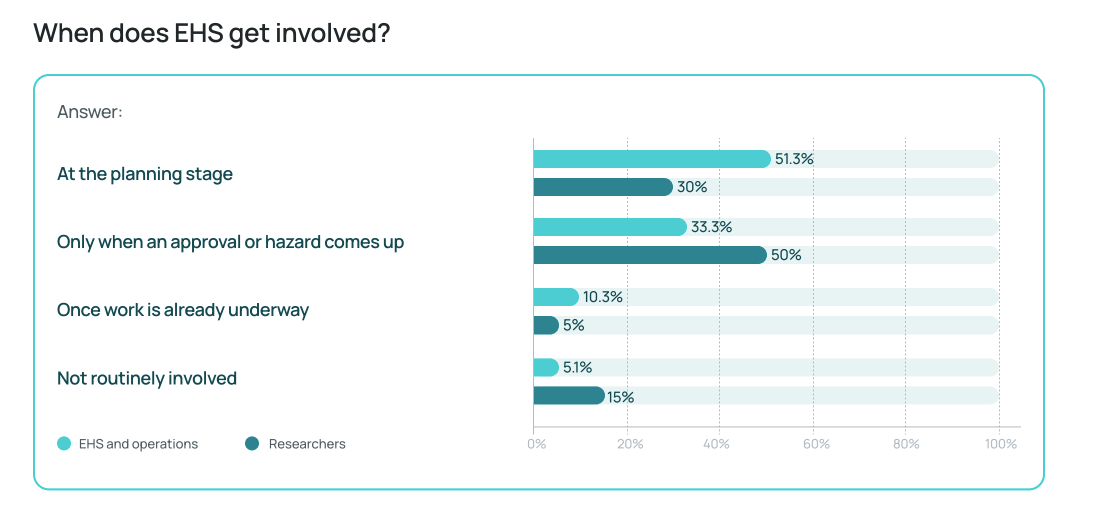
Our survey found a gap here. About half of EHS and operations respondents (51%) say EHS gets brought into new research projects at the planning stage. Only 30% of researchers say the same, and half of researchers (50%) say EHS shows up only when an approval or a hazard comes up. EHS can't plan for work it doesn't know about.
Every hour spent chasing training records or retyping container labels is an hour EHS isn't spending in those early conversations. That's where we'd send the time back: toward an EHS team researchers call early, because good safety work removes friction and helps the science move faster.
If you're working out where AI fits in your own program, we'd like to hear what you're trying and what's getting in the way.
Our team and our partners at Safety Partners are always happy to talk it through.

Read more of our blogs about modern lab management
Discover the latest in lab operations, from sample management to AI innovations, designed to enhance efficiency and drive scientific breakthroughs.