
Customize SciSure to work your way
Your lab, your workflows, your way. SciSure gives you full control over how you connect your research tools, instruments, and databases. Create custom connections that fit exactly how your team works–now and in the future.
.avif)
Trusted by 550,000+ scientists, EHS, and LabOps worldwide in 55,000+ laboratories





 Customer story
"SciSure helps us save time by enabling us to share our protocols with colleagues easily. It also takes care of our sample management."

 Customer story
“Working with the SciSure team has been a collaborative and productive experience.”


Build a platform that works for you
Ready-to-use integrations
Instantly connect SciSure to 40+ prebuilt add-ons to streamline workflows without extra setup.
Related:

40+ integrations

Free and premium add-ons

Constantly growing library
.avif)
Custom integrations with our API & SDK
Build custom integrations with SciSure’s open API and SDK to connect lab instruments, automate reporting, and sync data.
Related:

Open API

Developer SDK

Full developer support
.avif)
Flexible & adaptable to your lab’s needs
Easily integrate new tools as your lab evolves without switching platforms or disrupting workflows.
Related:

Connect any research tool

Automate your workflows

Future-proof your setup
.avif)
Connect instantly with 40+ add-ons
Our Marketplace offers a range of integrations to streamline operations, data collection, and research workflows.

Astra Iris - AI Support Assistant
AI-powered support assistant built directly into SciSure Research.
DataChaperone - Analysis & AI Platform
Automated, audit-ready data analysis directly inside your ELN.
.png)
DYMO® LabelWriter™ 550 Series
Streamline your lab labeling workflow with precision and ease
.avif)
DMPTool.org
Streamline workflows and enhance collaboration by integrating and managing data management plans from DMPTool within SciSure
.avif)
Protocols.io
Bring trusted protocols directly into your ELN
.avif)
Nikon NIS-Elements
For seamless exchange of data and notes between Nikon NIS-Elements microscopy-based imaging platform and eLabNext
Empower your lab with custom integrations
SciSure’s API and SDK give labs complete flexibility to build integrations that fit their unique workflows.


.avif)
How labs are customizing SciSure to their needs
See how research teams are connecting their tools, automating workflows, and optimizing data flow with SciSure.













See SciSure in action
Every lab is different, and SciSure is built to adapt. Book a demo today to see how our Scientific Management Platform (SMP) can transform your team’s workflows, streamline compliance, and help your research move faster.
Frequently asked questions
Everything you need to know about the product and billing.
SciSure supports prebuilt add-ons from our Marketplace, direct API connections, and fully customizable integrations via our SDK.
No. Many integrations are plug-and-play. However, some integrations require a paid license.
Most add-ons are free, while some premium integrations require a subscription. Pricing details are available in the user interface Marketplace.
Yes! SciSure’s API allows you to connect lab instruments, automate data collection, and sync results with your workflows.
Visit our Developer Portal for API documentation, SDK downloads, and integration guides.
Can’t find the answer you’re looking for? Please chat to our friendly team.
Stay ahead in lab innovation
Labs are under growing pressure to operate more sustainably. Across academia, biotech, and pharma, sustainability is no longer a “nice to have” but an operational expectation tied to cost, compliance, and credibility. In many cases, the biggest barrier is not a lack of commitment, but a lack of visibility.
In this collaborative piece between My Green Lab and SciSure, we’ll cover some ways how connected operational data and measured sustainability frameworks complement each other – to overcome the visibility gap.
Why resource-intensive labs need consistent data tracking
Some of the biggest drivers of lab sustainability - inventory use, energy demand, waste streams, procurement patterns, equipment utilization - are often tracked inconsistently. This could mean data spread across separate systems or simply not tracked in a way that is easy to act on. This data might sit in spreadsheets, manual logs, disconnected platforms, and team-specific processes. The result is a visibility gap that makes it more difficult to understand where impact is coming from and where meaningful improvements are possible.
Laboratories are among the most resource-intensive spaces in any organization. Some consume up to 10 times more energy than offices, producing up to 12 times more waste per square foot, and generating up to 5.5 million metric tons of plastic waste each year. This level of resource intensity means even small inefficiencies can have a significant environmental and financial impact – especially when multiplied across daily operations.
That gap matters. Without clear, connected data, much of that impact remains unmanaged - not because it is invisible, but because it is not actionable.
The cost of fragmented lab data
When sustainability-related data is fragmented or incomplete, labs can miss the patterns shaping their day-to-day impact. Materials are ordered but not fully used. Reagents expire before anyone realizes they were still on the shelf. Waste is recorded at the point of disposal but rarely traced back to the workflow decisions that generated it. Equipment continues running around the clock, even when only needed for a few hours.
Without a reliable system for inventory or storage, there is no way to ensure materials are used efficiently. Procurement teams question why consumables like pipette tips are being reordered so frequently, while researchers are repeating experiments due to equipment malfunctions, expired reagents, or simply the unpredictability of biology. Meanwhile, operational inefficiencies, like a thermostat placed directly beside an aging freezer, go unnoticed because no one has the data to connect these dots.
Large autoclaves can consume 84 kWh per day, and variable air volume fume hoods can consume around 110 kWh per day when left open. This means that inefficiencies at the operational level translate directly into increased environmental and financial costs. Teams are left trying to improve sustainability without a complete view of lab operations.
This is often where progress slows down. The challenge is not a lack of effort or intention. Rather, it is simply difficult to improve what is only visible in fragments.
How does a sustainable lab work in practice?
Sustainability in the lab is shaped by everyday operations. It shows up in how materials are purchased, stored, consumed, and discarded. It shows up in how equipment is used, how workflows are followed, and how information is recorded. When those activities are managed separately, the data behind them is separate as well. That makes it harder to move from good intentions to measurable change.
Measurable change is increasingly becoming an expectation. Across the industry, there is a shift away from general sustainability claims toward data-backed, verifiable outcomes that can stand up to internal reporting, external scrutiny, and evolving regulatory frameworks. The current program framework at My Green Lab reflects this shift through third-party verification, impact estimation, and product-level data that can support both ESG goals and compliant purchasing decisions.
Read more: Digital Tools for Safer and More Sustainable Life Science Labs
The role of operational visibility in labs
When labs have a clearer view of inventory, workflows, equipment use, compliance records, and related operational data, it becomes easier to spot inefficiencies that would otherwise stay hidden. Teams can begin asking more practical questions: Where are materials regularly going unused and why? Which processes are creating avoidable waste? Are there patterns in storage, ordering, or equipment use that could be improved? What is being measured well, and what is still missing?
These are not just sustainability questions. They are operational ones - with direct sustainability implications. In fact, many of the most persistent sustainability challenges in labs are also compliance and efficiency challenges. Overstocked chemicals increase both safety risk and waste. Poor inventory visibility drives duplicate purchasing. Inefficient equipment use increases both energy consumption and operating costs.
This is one reason the conversation around lab sustainability is shifting. Broad recommendations still have value, but many teams have already heard the standard advice. What is needed now are better insights into the systems and behaviors that drive impact over time.
Where a Scientific Management Platform closes the visibility gap
By bringing together operational data tied to inventory, storage, equipment, safety, and compliance, a Scientific Management Platform (SMP) like SciSure helps labs move from fragmented information to actionable insights that support a safe, sustainable lab. Plainly defined, an SMP is a unified system that connects digital lab platform tools like ELNs (Electronic Lab Notebooks), LIMS (Laboratory Information Management System), and EHS (Environment, Health, and Safety) workflows all in one place.
This is where connected operational data and measured sustainability frameworks can complement each other. One helps labs build a clearer view of what is happening day to day. The other helps translate that visibility into outcomes that can be assessed, benchmarked, and improved over time. Together, they enable a shift from reactive sustainability efforts to proactive, system-level improvement, eventually becoming embedded as an outcome of better operational decisions.
Here's an example of how it works in practice: Photanol, an Amsterdam-based biotech that uses cyanobacteria to convert CO2 into carbon-based chemicals as a sustainable alternative to fossil-derived feedstocks. Before implementing SciSure in 2021, the team relied on paper lab books and shared cloud folders - a setup that became harder to manage as the company expanded across multiple sites. Now, with SciSure implemented, every sample is traceable end-to-end – i.e., a finished product can be traced back to its initial cloning step in a few clicks.
In doing so, Photanol halved their administration time and eliminated version-control issues for protocols. For an organization whose entire commercial mission depends on validating dozens of biological production routes, this connected operational data enables sustainability claims to be backed by reproducible, auditable evidence. Turning fragmented documentation into something that can stand up for internal review, partner scrutiny, and regulatory frameworks.
A connected data ecosystem addresses the invisible impact head on
With clearer data and visibility into the operational realities shaping their environmental footprint, lab teams are better equipped to make informed decisions, reduce avoidable waste, and embed sustainable practices into research.
The hidden challenges are not always a lack of action; often, they are a lack of connected context. The waste is visible, but the cause - and therefore the solution - is not. The energy use is known, but the pattern behind it is not. The expired inventory is obvious, but the ordering and usage behavior that led to it is harder to see. These are small gaps on their own, but across a lab, they add up.
That is the invisible impact.
This is also why sustainability can feel difficult to improve, even when teams are trying hard to do the right thing. It is also why leading organizations are beginning to approach sustainability as a system-level outcome – driven by better data, better visibility, and better decision-making across the lab ecosystem. That broader systems view is especially important in biotech and pharma, where My Green Lab reports that most emissions come from the supply chain, including about 75% for public companies and 88% for private companies.
The impact you can improve is usually the impact you can see. And what you are not tracking may affect more than you think.

The Invisible Impact: How What You Aren’t Tracking Is Holding Back Sustainability in the Lab
Learn how connected lab data helps research teams close sustainability visibility gaps, reduce waste, and turn daily operations into measurable impact.
Across the scientific ecosystem, lab sustainability has entered a new era. What was once treated as a reporting obligation has become a redesign challenge touching every part of the scientific value chain – from how labs operate and purchase equipment to how organizations plan, invest, and measure long-term impact.
Industry leaders increasingly see sustainability as a core business issue: shaping strategic priorities, influencing operational decisions, guiding capital allocation, and strengthening organizational resilience. The environmental agenda no longer competes with commercial performance – the two are fast becoming inseparable. Strong sustainability capability reduces risk, protects supply continuity, improves asset utilization, and prepares organizations for rapidly evolving expectations from regulators, investors, and health systems.
Despite this shift, lab sustainability remains one of the hardest areas to address. Labs are energy-intensive, process-heavy, and behaviorally complex environments. Real progress requires alignment between standards, equipment intelligence, and daily operational practice – not isolated initiatives or symbolic gestures.
At SciSure, we believe the only way to achieve meaningful, measurable improvement in lab sustainability is through collaboration. No single organization can solve the sustainability challenge in isolation. Standards must guide behaviors; data must reveal what’s actually happening inside equipment; and digital workflows must translate both into everyday action.
That’s why SciSure chose a collaborative approach to its sustainability mission; forging partnerships with organizations that are leading the way in their respective sustainability domains:
- My Green Lab, the global authority defining what sustainable laboratory practice looks like.
- Elemental Machines, the equipment intelligence platform that makes sustainability measurable and actionable.
- Polycarbin, the circular economy platform helping labs reduce waste and adopt more sustainable consumables.
To shine a light on these exciting partnerships and what they mean for SciSure customers, we spoke with James Connelly, CEO of My Green Lab, Kevin Ghiasi, VP of Global Alliances at Elemental Machines, and James O’Brien, Co-founder and CEO of Polycarbin. Their insights reveal how standards, equipment intelligence, and digital lab workflows combine to help SciSure Scientific Management Platform (SMP) users move from ambition to truly sustainable operations.
My Green Lab: Building the culture and standards behind lab sustainability
Improving lab sustainability can feel like a daunting challenge, particularly in environments built for precision, safety, and scientific performance. From energy-intensive equipment to complex waste streams, labs have historically been among the most resource-intensive environments around. Yet many of the most effective sustainability improvements are surprisingly practical, rooted in better habits, clearer standards, and consistent measurement.
This is the space where My Green Lab has become a global leader. Through its widely adopted certification programs, educational initiatives, and sustainability frameworks, the organization has helped thousands of laboratories embed sustainability into their daily operations. Today, My Green Lab Certification is widely recognized as a leading standard for sustainable laboratory practice, adopted by many of the largest pharmaceutical and biotechnology organizations.
For James Connelly, CEO of My Green Lab, the biggest barrier to improving lab sustainability is not a lack of awareness. Scientists increasingly understand the environmental impact of laboratory operations. The real challenge lies in translating that awareness into consistent daily habits across complex research environments.
“A lot of sustainability ultimately comes down to behavior change. You have to build a culture where everyone is thinking about sustainability as part of how they do their work every day. Many of the improvements are actually very straightforward: things like closing fume hood sashes, turning off equipment when it’s not in use, or consolidating autoclave and washer loads. But those small actions, when adopted consistently across an organization, can drive very significant environmental and energy savings.”
These practical adjustments may appear incremental in isolation, but across large research institutions they compound into meaningful improvements in sustainability. Equipment usage, freezer management, waste segregation, and procurement choices all influence the environmental footprint of laboratory work.
While behavior change is essential, James emphasized that lasting progress requires structure and accountability. Without consistent frameworks and credible measurement, sustainability initiatives risk becoming fragmented – or worse, performative.
“It’s important that sustainability programs are meaningful and verifiable. Certification needs to be measurable, independently audited, and repeatable across laboratories. Otherwise, it risks becoming a checkbox exercise rather than something that actually changes how labs operate.”
This emphasis on verification has shaped the My Green Lab Certification program, which pairs education and behavioral guidance with independent auditing to ensure laboratories are implementing recognized best practices. The framework also includes tools that help organizations estimate environmental and financial benefits from sustainability improvements, reinforcing the connection between responsible laboratory operations and long-term organizational performance.
“One of the challenges the industry faces is that many sustainability claims are difficult to compare or verify. Standards and third-party certification create a level playing field, so organizations can make informed decisions and ensure that sustainability improvements are real and measurable.”
Beyond operational practices inside the lab, My Green Lab has also expanded its influence across the broader research ecosystem. Programs such as the ACT EcoLabel introduce standardized environmental impact labels for laboratory products, allowing procurement teams to compare equipment and consumables based on verified sustainability metrics. As life science organizations increasingly extend sustainability expectations to suppliers and research partners to address scope 3 emissions, these standards are becoming an important part of how organizations approach lab sustainability across the value chain.
Embedding sustainability standards directly into the digital lab
For SciSure, partnering with My Green Lab reflects a strategic choice. Rather than attempting to replicate sustainability frameworks that have been developed and refined over many years, SciSure chose to collaborate with the organization already helping define global best practices for lab sustainability. The goal is not to reinvent sustainability standards, but to make them easier for laboratories to adopt by embedding them directly into the digital systems scientists already use.
From My Green Lab’s perspective, SciSure also represented a natural partner for advancing sustainable lab practices. Because the platform is already embedded across leading research institutions worldwide, it provides a direct connection to the environments where impactful sustainability decisions are made every day.
In practice, this partnership connects My Green Lab’s educational resources and sustainability frameworks with the digital workflows that manage safety, inventory, and compliance inside the SciSure SMP. This allows sustainability guidance to appear alongside the operational tasks scientists already complete, from training and chemical management to equipment oversight and compliance documentation.
By aligning sustainability practices with everyday operational processes, the collaboration helps lab teams move beyond standalone initiatives and integrate lab sustainability directly into their routine lab activity.
“Partnerships allow sustainability programs to reach scientists where they’re already working. If you can integrate sustainability education and guidance into the digital tools labs already rely on for safety, compliance, and operations, it becomes much easier for people to adopt meaningful practices while still ensuring that the results are measurable and verifiable.”
Looking ahead, the collaboration will continue to deepen as SciSure works to bring My Green Lab training programs and sustainability guidance directly into its platform environment. This will allow laboratory teams to access sustainability education alongside other required safety and compliance training, creating a more seamless pathway from awareness to action.
“The most important thing labs can do is start. There are practical steps that any lab can implement today, and when those actions are supported by the right standards and tools, they can deliver meaningful improvements in sustainability.”
By aligning globally recognized sustainability standards with digital lab workflows, the partnership helps SciSure customers take a more structured approach to lab sustainability—connecting education, behavior, and operational oversight within the systems scientists already rely on every day.
Elemental Machines: Turning lab sustainability into measurable operational intelligence
While My Green Lab helps define scientific sustainability standards, achieving meaningful progress also requires visibility into how laboratory environments and equipment actually perform. Sustainability frameworks establish best practices and guide behavior across the lab, but turning those principles into measurable operational improvements depends on understanding how equipment, infrastructure, and environmental conditions behave in real lab environments.
This is where Elemental Machines plays a critical role. Through connected sensors, environmental monitoring, and advanced analytics, the platform provides laboratories with continuous insight into how equipment, infrastructure, and environmental conditions behave in real time.
For Kevin Ghiasi, VP of Global Alliances at Elemental Machines, improving lab sustainability begins with establishing a reliable baseline of operational data.
“We see ourselves as the data foundation that makes sustainability measurable and actionable. Many labs want to improve sustainability, but they lack consistent visibility into equipment behavior, environmental stability, utilization patterns, and asset criticality. Without that baseline, improvement is difficult to quantify.”
In many labs, equipment such as ultra-low temperature freezers, incubators, and environmental chambers operate continuously with little insight into how often they are actually used or how efficiently they are running. Over time, this lack of visibility can lead to redundancies, unnecessary energy consumption, and equipment lifecycles that are shorter than they need to be.
By capturing environmental and equipment data through connected sensors and combining that information with structured analytics, Elemental Machines helps organizations identify inefficiencies that would otherwise remain hidden. This includes monitoring temperature stability, tracking equipment utilization, and evaluating the operational criticality of assets across the lab.
“Sustainability often follows operational discipline. When labs have structured data about how equipment is being used and how critical it is to operations, they can make more informed decisions about energy use, asset management, and resource allocation.”
One of the most significant shifts enabled by this type of monitoring is the move from reactive to proactive lab management. Rather than discovering inefficiencies after the fact, laboratories can identify opportunities to optimize operations as they occur.
“Sensor-driven monitoring allows labs to move from reactive operations to proactive operations. When you combine environmental monitoring with utilization data and criticality scoring, you can identify equipment that doesn’t need to run continuously, consolidate workloads onto fewer assets, and safely power down low-criticality devices during idle periods.”
These adjustments can have a substantial decarbonization impact, particularly in energy-intensive research environments. Underutilized or redundant equipment can significantly increase both energy consumption and operational costs. By revealing usage patterns and asset importance, laboratories can make informed decisions about consolidating equipment, retiring aging assets, or adjusting operating schedules without compromising scientific productivity.
Beyond energy savings, this level of operational insight also helps laboratories protect the integrity of their scientific work. Environmental stability monitoring can alert teams to temperature fluctuations or equipment performance issues that could compromise sensitive samples or experimental results.
Integrating equipment intelligence into the digital lab
For SciSure, the partnership with Elemental Machines adds a critical measurement and detection layer to the broader sustainability ecosystem being built across the platform.
Through integration between the two platforms, environmental monitoring and equipment intelligence from Elemental Machines can be connected directly to the operational systems scientists use to manage their work inside SciSure. This empowers labs to see how equipment conditions and performance relate to the samples, materials, and workflows managed within the digital lab environment.
Instead of sustainability metrics being reviewed separately from day-to-day research activity, environmental data becomes part of the same operational context as everyday research activities.
“Integration allows operational data to inform systems of record. When environmental intelligence and equipment utilization insights are embedded directly into workflow systems like SciSure, organizations can align procurement decisions, maintenance strategies, and equipment lifecycle management with real operational data.”
This kind of integration transforms sustainability from a retrospective reporting exercise into an ongoing operational discipline. Laboratories can monitor equipment performance continuously, identify inefficiencies early, and adjust practices in ways that improve both environmental outcomes and research efficiency.
Looking ahead, Kevin expects sustainability efforts across the life sciences industry to become increasingly data-driven, transparent, and integrated into broader operational decision-making.
“Over the next few years, sustainability will become more tightly connected to operational KPIs, governance, and risk management. Organizations will need objective, defensible metrics that demonstrate progress over time, and connected equipment data will play a foundational role in making that possible.”
For SciSure customers, the integration with Elemental Machines represents an important step toward making lab sustainability both measurable and operationally actionable. Instead of reviewing sustainability metrics in isolation, teams can see how equipment conditions, utilization patterns, and environmental stability intersect with the samples, materials, and workflows managed within the SciSure SMP.
This visibility empowers labs to identify inefficiencies earlier, optimize energy-intensive equipment, and make more informed decisions about asset utilization and infrastructure planning. By embedding equipment intelligence directly into the operational systems scientists already rely on, the partnership helps transform sustainability from a reporting exercise into a continuous operational discipline.
Polycarbin: Extending sustainability into lab materials and circularity
While standards and equipment intelligence are essential to improving lab sustainability, a significant portion of a laboratory’s environmental footprint lies in the materials it consumes and the waste it generates. Single-use plastics, packaging, and procurement decisions all contribute to Scope 3 emissions, making sustainable sourcing and waste reduction a critical part of the sustainability equation.
Historically, laboratory waste has been treated as an unavoidable byproduct of scientific progress, with large volumes of materials classified as hazardous and sent for incineration or landfill, even when they pose no such risk.
For James O’Brien, Co-founder and CEO at Polycarbin, addressing this blind spot is central to enabling more sustainable science:
“There’s long been this assumption in labs that everything is hazardous and nothing can be recovered. In reality, a significant portion of that material is non-infectious, non-hazardous, and perfectly capable of being diverted into closed-loop recycling streams.”
This misconception has helped sustain a fundamentally inefficient, linear model of consumption. Laboratory plastics are typically produced from fossil fuel-derived virgin resins, used once, and then discarded, creating both environmental impact and supply chain volatility.
Polycarbin’s mission is to replace this linear model with a circular one; recovering laboratory plastics and returning them to the supply chain as high-quality, lab-grade materials.
Through its closed-loop recycling platform, Polycarbin enables laboratories to divert a broad range of waste materials such as rigid plastics, pipette tip boxes, and PPE into dedicated recycling streams, where they are processed and remanufactured into new lab-grade products.
“We’re producing materials that are DNase-free, RNase-free, pyrogen-free, and tested to USP Class VI standards. There are absolutely applications where recycled materials can meet the performance and compliance expectations of modern labs.”
By maintaining these stringent quality standards, Polycarbin directly challenges one of the most persistent barriers to adoption: the assumption that circularity requires a compromise in scientific rigor.
For Polycarbin, circularity is only part of the solution. Ensuring that sustainability efforts are credible, measurable, and actionable is equally important. This is where the company’s Carbin Counter™ platform plays a central role, providing labs with real-time insight into the environmental impact of their recycling activities.
“One of the things we’re most proud of is Carbin Counter, our platform that tracks and quantifies the environmental impact of a lab’s recycling activity in real time. Labs can see exactly how much plastic waste has been diverted from landfill, what their carbon savings look like, and how they’re trending against their own sustainability goals.
That visibility changes behavior — it turns recycling from a passive act into something teams can rally around and improve over time. It creates a culture where sustainability is a metric people actually care about, not just a value statement on a website.”
Built on ISO-compliant, third-party verified life cycle analysis, the platform enables organizations to connect everyday lab activity with defensible sustainability metrics—supporting ESG reporting, regulatory compliance, procurement decisions, and Scope 3 emissions tracking.
Making circularity operational in the digital lab
While visibility and circular systems are essential, implementing these approaches in real-world lab environments requires alignment with existing workflows, safety requirements, and regulatory constraints.
This is where Polycarbin’s partnership with SciSure becomes critical.
By integrating with SciSure, Polycarbin can align its recycling programs with the workflows, safety classifications, and compliance requirements already defined within the digital lab environment. This provides a clearer, more structured view of laboratory operations, helping teams identify which materials can be safely diverted, ensure appropriate training, and scale sustainability initiatives with confidence.
“In labs that use SciSure, there’s a much clearer picture of what’s happening across workflows. That makes it significantly easier to introduce sustainable practices in a compliant, scalable way.”
More broadly, the partnership reflects a shift toward sustainability as an operational capability, rather than a standalone initiative.
“Sustainability becomes much easier to address when you have a well-run, well-organized lab. Platforms like SciSure provide that coordination layer, making it easier to adopt solutions like ours and embed them into everyday operations.”
By extending sustainability into materials, procurement, and waste workflows, Polycarbin addresses a critical but often overlooked part of the lab sustainability challenge. In combination with the standards provided by My Green Lab and the operational intelligence delivered by Elemental Machines, this creates a more complete picture of what sustainable science requires: connecting how labs operate, what they measure, and what they consume into a truly circular, data-driven system.
Bringing standards, data, and workflows together for more sustainable science
Improving lab sustainability is not a challenge any single organization can solve alone. Labs operate within complex ecosystems of technologies, suppliers, infrastructure, and scientific workflows. Meaningful progress requires collaboration across that ecosystem – bringing together the standards that guide behavior, the data that reveals operational realities, the materials and procurement decisions that shape environmental impact, and the systems that turn all of these into consistent daily practice.
As Jon Zibell, VP of Partnerships at SciSure, explains, advancing lab sustainability depends on connecting these elements through strong, purpose-built partnerships.
“Sustainability in the lab isn’t driven by any single solution, it requires a connected ecosystem of trusted partners working together to deliver real value to shared customers. At SciSure, we’re focused on breaking down data silos between applications, reducing administrative burden, and creating a more seamless, intuitive user experience through integrated technologies. We’re always looking to partner with leading organizations like My Green Lab, Elemental Machines, and Polycarbin to expand that ecosystem and accelerate impact across the industry.”
SciSure’s sustainability partnerships reflect this philosophy. My Green Lab provides globally recognized frameworks, education, and certification standards that help laboratories establish credible sustainability practices. Elemental Machines contributes the operational intelligence needed to understand how equipment, infrastructure, and environmental conditions behave in real time. Polycarbin extends this ecosystem into materials and circularity, enabling labs to reduce waste, adopt more sustainable consumables, and embed closed-loop practices into their operations.
Together, these capabilities provide both the standards, data, and material systems required to improve sustainability in scientific research environments. But translating those insights into everyday practice requires another critical element: operational integration.
Through the SMP, SciSure connects sustainability frameworks, equipment intelligence, circular material flows, and laboratory workflows within a single digital environment. Scientists can access training, manage safety and compliance processes, monitor equipment conditions, make more informed procurement decisions, and track environmental performance through the same systems that govern their daily lab operations.
As sustainability expectations across the science industry continue to grow, collaboration will only become more important. By bringing together partners like My Green Lab, Elemental Machines, and Polycarbin, SciSure is delivering on its mission to make safer, smarter, and more sustainable labs achievable—helping research organizations move toward a more tangible, coordinated, data-driven approach to lab sustainability.
Because solving the sustainability challenge will not come from any single tool or organization, but from ecosystems working together to drive meaningful change.
Ready to make your lab’s sustainability efforts more measurable and actionable? We’re here to help. Contact our team to discuss how SciSure can support your sustainable future.

Lab Sustainability That Moves the Needle: Inside SciSure’s Partnerships with My Green Lab, Elemental Machines, and Polycarbin
Discover how SciSure and its partners make lab sustainability achievable, embedding measurable, actionable practices into everyday lab operations.
Every scientist knows the frustration of digging through Excel spreadsheets and paper notebooks in search of experimental data, forgotten details, or reagent locations. As we’ve discussed before, digitizing your lab is how to get around these troubles.
However, understanding the different digital lab systems and their acronyms can be confusing.
You may have noticed that most digital platforms for the life sciences fall into two categories: Laboratory Information Management Systems (LIMS) and Electronic Lab Notebooks (ELN). On paper, they sound the same, but there are major distinctions between them. In this blog post, we’ll explore ELN vs LIMS, explain how the systems differ, and provide guidance to help you choose the right solution for your lab.
ELN vs LIMS: Everything you need to know
Understanding how ELN and LIMS function helps laboratories align tools with research, sample management, and compliance workflows.
What is an ELN?
An ELN is a software platform designed to record and manage data, observations, sample information, and experimental methods that one would conventionally record in a paper lab notebook. ELNs are an excellent solution for keeping up with growing regulatory pressures to maintain data integrity and security. Moreover, they allow you to easily collaborate with team members, record experimental observations, integrate with instruments, create detailed reports, and search using simple keyword queries.
Benefits of Using an ELN
- Searchability: Given their digital nature, entries into ELNs are easily searchable, which makes them very time-efficient.
- Easy collaboration: ELNs allow labs to share data, notes, and images with colleagues, making it an excellent solution for working on projects and experiments with a team.
- Security: ELNs allow for digital signatures, so sign-off on projects and experiments can be done easily and securely.
- Traceability: ELNs provide a comprehensive audit trail of all actions taken within the system, making it easy to track who has done what and when.
- Standardization: ELNs can include a protocol module, enabling you to set up individual or group working templates, making it easy to standardize processes and workflows.

What is a LIMS?
In contrast to an ELN, a LIMS is software designed to manage samples, configurable tracking, and laboratory operations. Modern LIMS platforms, like SciSure’s, are purpose-built for research labs, biobanking labs, and life science R&D environments where flexibility, traceability, and fast configuration matter.
Unlike traditional LIMS built for rigid manufacturing or QA/QC pipelines, a research-focused LIMS gives you the tools to define your own sample types, automate alerts and tasks via event-based triggers, manage equipment and supplies centrally, and dispatch samples between teams with a complete audit trail. This makes the LIMS vs ELN comparison especially relevant for labs that process high volumes of samples and require structured but configurable workflows.
Benefits of using a LIMS
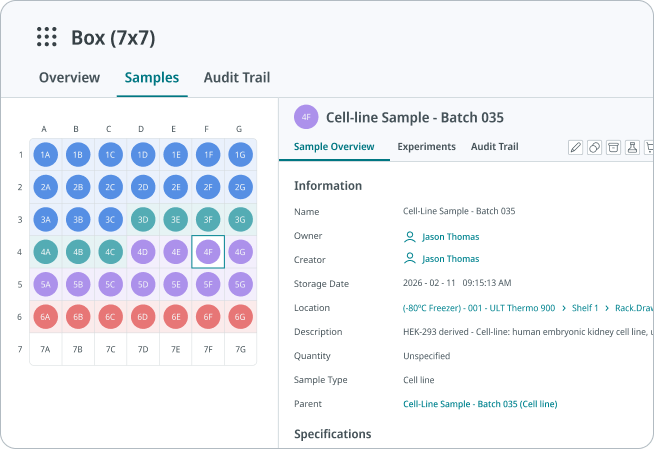
- Configurable sample tracking: Define custom sample types, fields, and views. Track samples via metadata, check-out/check-in, dispatch between groups, and visual lineage trees with multi-parent support.
- GLP-compliant audit trails: Complete, exportable audit trails across samples, series, equipment, and experiments. Exportable to PDF, Excel, and CSV to support compliance and data integrity requirements.
- Triggers & automations: Event-based automations (sample created, archived, field changed) and scheduled automations (before/after expiration, custom intervals). Actions include email notifications with smart values, webhooks to Slack/Teams, and auto-task creation, with pre-built templates to get started quickly.
- Barcode automation: Perform single-sample, multi-sample, and chained actions in a single scan. Supports rack scanning via VisionMate, RackScan, and BioMicroLab for high-throughput sample handling.
- Equipment management: Custom fields, validation tracking with expiration alerts, booking and planner functionality, status management, and audit trail export.
- Supplies & ordering: Built-in product catalog and shopping list with a full procurement pipeline (Pending → Ordered → Received → Completed).
ELN vs LIMS: Where each fits within a lab's process
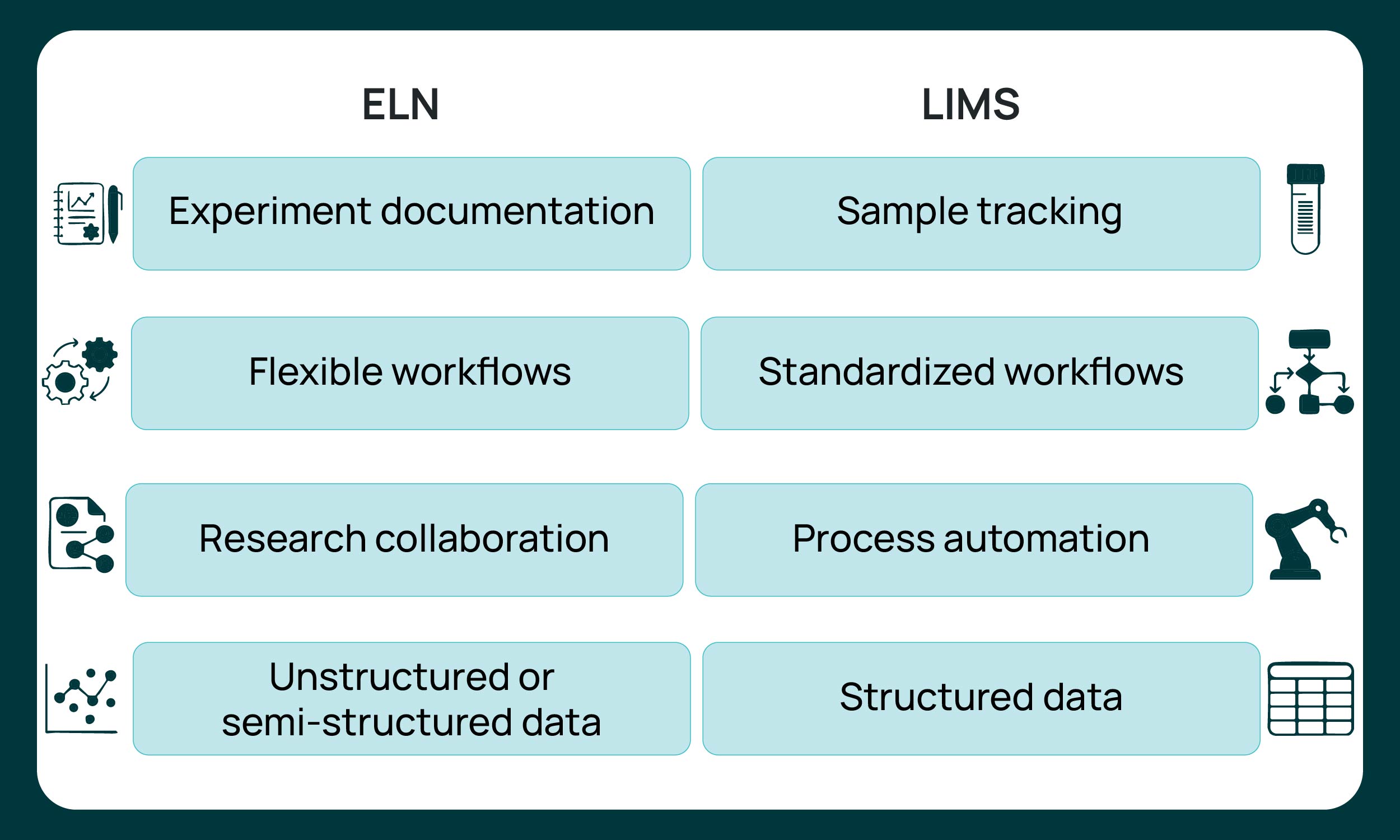
While ELNs and LIMS are both digital software platforms for laboratory data management, the two have significant differences. ELNs are designed for many of the same functions as traditional paper notebooks — recording experimental protocols — with the added benefits of searchability, data organization, and collaboration tools. LIMS platforms focus on configurable sample tracking, inventory management, and operational efficiency. They are typically used by labs that manage large numbers of samples and require structured but adaptable workflows.

Features comparison
When comparing ELN vs LIMS, one of the most practical ways to understand the difference is by looking at the core features each system provides. While both platforms help laboratories manage scientific data digitally, they are built to support different aspects of laboratory work.
An electronic lab notebook is primarily designed to support research documentation and experiment tracking, while LIMS software focuses on configurable sample tracking, inventory management, and operational efficiency. Many modern laboratories evaluate LIMS vs ELN based on which feature set best supports their daily activities.
Experiment documentation and research records
ELNs are designed to capture experimental workflows, observations, and research notes in a structured digital format. Scientists can document experimental procedures, record results, attach images or files, and maintain a complete history of their research activities.

Key ELN capabilities include:
- Recording experimental protocols and procedures
- Capturing observations, notes, and results
- Attaching datasets, images, and instrument outputs
- Creating searchable experiment records
- Supporting collaboration between researchers
This functionality makes ELNs particularly valuable in research-driven environments such as academic laboratories, biotechnology companies, and early-stage drug discovery teams where experiments evolve frequently.
Sample and workflow management
LIMS platforms are built to manage samples and laboratory operations at scale. Rather than focusing primarily on experiment documentation, LIMS systems provide configurable lifecycle tracking via metadata, check-out/check-in, dispatch between groups, and barcode automation, all tied to a complete audit trail.
Typical LIMS capabilities include:
- Custom sample types, fields, sample series, and shareable views
- Sample dispatch with accept/deny and full audit trail (custody transfer)
- Check-out/check-in with user and timestamp logging
- Visual sample lineage tree with multi-parent support
- Inventory and reagent tracking via the Supplies module
These capabilities make LIMS well-suited for facilities that handle large sample volumes, such as clinical labs, quality control labs, and biobanks.
Automation and process control
Automation is one area where the LIMS vs ELN difference becomes particularly clear. SciSure’s LIMS delivers a powerful automation story through Triggers & Automations and Barcode Automation, working differently from rigid workflow pipelines.
Triggers & Automations allow labs to:
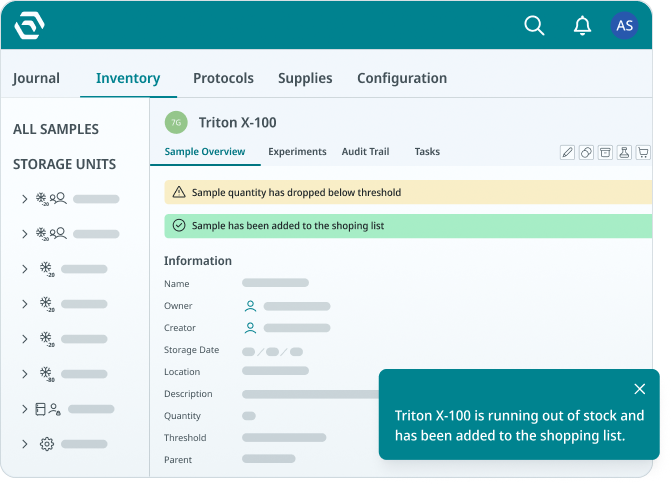
- Set event-based triggers: sample created, archived, or a field changed
- Schedule automations: before/after expiration, at custom intervals
- Automate actions: send email notifications with smart values, fire webhooks to Slack or Teams, or auto-create tasks
- Start quickly with pre-built automation templates
Barcode Automation enables single-sample, multi-sample, and chained actions in a single scan, with rack scanning support via VisionMate, RackScan, and BioMicroLab. The open API and SDK extend automation further to connect with external systems and instruments.
While ELNs can integrate with instruments, their primary purpose remains documenting research rather than managing automated tracking pipelines.
Collaboration and knowledge sharing
ELNs excel at supporting collaboration across research teams. Scientists can share experiment entries, comment on results, and access research history from anywhere. This creates a centralized knowledge base that helps teams build on previous experiments rather than repeating work.
By contrast, LIMS collaboration is typically more process-driven. Team members interact with the system mainly through sample assignments, dispatch workflows, and results tracking rather than open-ended research documentation.
Compliance and data traceability
Both ELN and LIMS systems support regulatory compliance and data traceability, but they approach it differently.
ELNs provide audit trails that track changes to experiment records, helping maintain research integrity and documentation transparency.
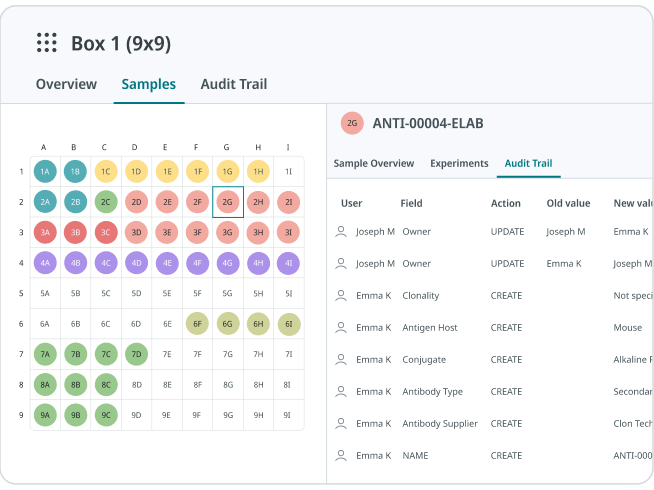
SciSure’s LIMS delivers GLP-compliant audit trails across samples, series, equipment, and experiments, which are all exportable to PDF, Excel, or CSV. This level of traceability is critical in regulated industries such as pharmaceuticals, clinical diagnostics, and manufacturing quality control.
Why many laboratories use both
As laboratories become more data-driven, many organizations find that ELN and LIMS platforms work best when used together. An ELN manages research documentation and experimental insights, while a LIMS manages configurable sample tracking and inventory operations. By combining both systems, laboratories can support flexible scientific discovery while maintaining the structured traceability that ensures efficiency, reproducibility, and compliance.
User experience & user interface
When evaluating ELN vs LIMS, functionality is only part of the equation. The user experience (UX) and user interface (UI) of a platform can significantly influence how effectively laboratory teams adopt and use the system in their daily workflows.
Researchers, lab managers, and technicians interact with these platforms constantly. If a system is difficult to navigate, requires extensive training, or slows down routine tasks, adoption can suffer regardless of how powerful the software is. For this reason, many laboratories consider usability alongside features when comparing LIMS vs ELN solutions.
User experience in ELN platforms
ELNs are typically designed with researchers in mind. Their interfaces often resemble familiar notebook-style layouts, making them intuitive for scientists who are used to documenting experiments in traditional paper notebooks.
Many electronic lab notebook platforms prioritize flexibility and ease of documentation. Common user experience features include:
- Notebook-style experiment entries that mirror traditional lab workflows
- Drag-and-drop data uploads for images, spreadsheets, and instrument outputs
- Easy editing and annotation of experimental records
- Full-text search capabilities to quickly locate experiments and results
- Collaboration tools that allow teams to share notes and comment on experiments
Because research workflows can change frequently, ELN interfaces are generally designed to be flexible and adaptable to evolving experiments.
User experience in LIMS platforms
LIMS software is typically built around structured workflows and configurable processes. The interface focuses on efficiency, sample tracking, and task management. Users often interact with LIMS platforms through dashboards and workflow modules. These interfaces commonly include:
- Sample registration and tracking dashboards
- Data entry forms connected to configurable protocols
- Automated notifications and status updates via Triggers & Automations
- Reporting and analytics views for operational monitoring
- Task assignment and automation management tools
While this structure may feel more defined compared to ELNs, it ensures consistency in laboratories that process large volumes of samples or operate under strict regulatory requirements.
Ease of adoption across laboratory teams
Laboratories often include a mix of scientists, technicians, quality assurance specialists, and data managers. ELNs tend to be easier for researchers to adopt because they support flexible documentation and experimental exploration. LIMS platforms are often preferred by laboratory operations teams who need reliable configurable sample tracking, traceability, and standardized reporting.
To address these differences, many organizations now deploy ELN and LIMS together, allowing research teams to work in an intuitive documentation environment while operations teams manage configurable sample tracking and inventory through LIMS.
Why does usability matter in digital lab platforms?
User experience plays a critical role in the success of digital laboratory systems. A well-designed interface can improve productivity, reduce training time, and encourage consistent use across the organization. Modern laboratory platforms increasingly prioritize usability by offering customizable dashboards, intuitive navigation, and integrations with existing lab tools. When evaluating ELN vs LIMS, laboratories should consider not only the capabilities of each system but also how easily their teams can integrate the software into everyday workflows.
When should you choose LIMS over an ELN?
A LIMS is usually the better option when your lab needs to manage high sample volumes with structured, configurable tracking. Here are the clearest signals:
- High sample volumes: Labs that register, track, and dispatch large numbers of samples, like biobanks, clinical labs, and QC facilities, benefit from a LIMS designed to manage sample series, check-out/check-in, and bulk operations efficiently.
- Compliance and audit readiness: If your lab follows GLP or other regulatory standards, a LIMS with complete, exportable audit trails across samples, equipment, and experiments is essential for maintaining data integrity.
- Equipment and supplies management: Centralized equipment validation tracking, expiration alerts, booking, and a procurement pipeline (Pending → Ordered → Received → Completed) reduce operational overhead.
- Sample dispatch between teams: Labs that transfer samples across groups need the custody tracking that dispatch with accept/deny workflows and full audit trails provides.
- Automated alerts and inventory monitoring: Triggers & Automations let labs set expiration alerts, stock-level notifications, and auto-task creation, reducing manual follow-up and human error.
Aligning the system with your team’s workflow is crucial. A LIMS will better support your operations if configurable sample tracking and automation are more important to you than open-ended experiment documentation.
What makes ELN the right choice for your laboratory?
If your primary focus is documenting experiments, organizing research notes, and managing protocols, an ELN is often the better choice.
ELNs support flexible workflows, making them well-suited for research environments where experiments evolve. They also make collaboration easier by allowing teams to share observations, results, and documentation across projects.

This is especially relevant in biotech and pharmaceutical R&D, where early-stage research requires adaptability alongside structured recordkeeping.
When making this decision, it is useful to involve the people who will use the system daily and evaluate how they plan to work. If your team needs flexibility, collaboration, and structured experiment documentation, an ELN will be the stronger fit.
Budget can also play a role. ELNs and LIMS often follow different pricing models, so reviewing available options and comparing costs helps ensure the system aligns with your lab’s needs.
Which factors should guide your lab management software decision?
Choosing between ELN and LIMS depends largely on how your laboratory operates and the type of data you manage. While both systems support digital lab workflows, they serve different purposes. Evaluating a few key factors can help determine whether LIMS vs ELN is the right fit for your lab.
Key considerations include:
- Type of work: Research-driven labs often benefit from an electronic lab notebook for documenting experiments and protocols, while biobanking, QA, and clinical labs typically rely on LIMS software for configurable sample tracking and operational efficiency.
- Sample volume: Labs processing large numbers of samples generally require LIMS to manage tracking, automation, and reporting efficiently.
- Regulatory requirements: Highly regulated environments may need the GLP-compliant audit trails and traceability that LIMS provides.
- Integration needs: Modern laboratories connect multiple systems, so compatibility with instruments and other software should be considered.
- Future scalability: As labs grow, they may expand from using only ELN or LIMS to implementing ELN and LIMS together to support both research documentation and configurable sample management workflows.
Carefully evaluating these factors helps laboratories select a solution that supports both their current needs and long-term goals.
How do LIMS and ELN work together with expert integration?
While laboratories often compare ELN vs LIMS as separate solutions, many modern labs use both systems together. When properly integrated, LIMS and ELN complement each other by supporting different parts of the scientific workflow.
An electronic lab notebook helps researchers document experiments, observations, and protocols, while LIMS software manages configurable sample tracking, inventory, and reporting. SciSure’s key differentiator is that ELN and sample/inventory management exist within a single platform, with no middleware required.
Samples link directly to ELN experiments. Equipment records connect to ELN entries. This creates a connected environment where research documentation and operational workflows remain aligned without manual data transfers or integration overhead.
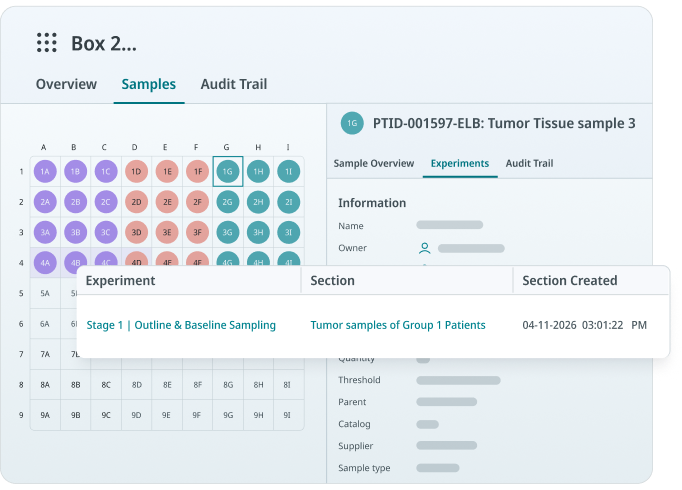
For teams that need to connect with external systems, SciSure’s open API, SDK, and Marketplace provide pre-built add-ons and instrument integrations, along with webhook support for Slack, Teams, and other tools.
By combining ELN and LIMS in a unified platform, laboratories can:
- Connect experimental records with sample metadata
- Reduce manual data entry and transcription errors
- Maintain complete traceability from experiment design to results
- Automate alerts, tasks, and notifications across research and operations teams
- Extend the platform via API/SDK and Marketplace without building custom middleware
ELN or LIMS: Webinars
The webinar will provide an outline of the differences between LIMS and ELNs, and how to decide which one is more suitable for your lab.
You will learn:
- What is the difference between LIMS and ELNs?
- How to choose which one best suits your lab?
- What are the advantages of ELNs?
Future trends in laboratory data management
As laboratories continue to digitize their workflows, the role of ELN and LIMS systems is evolving. Modern platforms are increasingly designed to work together, helping laboratories manage both experimental documentation and configurable sample management within connected digital environments.
Several trends are shaping the future of LIMS vs ELN platforms:
- Greater system integration, allowing laboratory instruments, data platforms, and lab software to exchange information automatically
- Cloud-based platforms improving accessibility and collaboration across research teams
- Advanced data analytics, enabling laboratories to extract insights from large experimental datasets
- AI-driven solutions, helping automate data analysis, tracking optimization, and research documentation
As these technologies mature, laboratories will increasingly adopt integrated ELN and LIMS solutions that support efficient data management, improve reproducibility, and accelerate scientific discovery.
The right lab software starts with the right question
Ultimately, the choice between a LIMS and ELN will largely depend on what you’re trying to accomplish, your primary lab needs, your work and regulatory environment, and your budget. Understanding what each system does can drastically help guide your decision. And as the next generation of connected digital lab software and AI-driven solutions enter the life science market, the problems that can be solved using these platforms will evolve and change, further streamlining laboratory operations.
Many laboratories today implement ELN and LIMS together to manage both experimental documentation and configurable sample workflows within a unified platform.
If you want to learn more about how SciSure’s digital lab solutions accelerate progress in the life sciences industry, schedule a personal demo today.
FAQ
Which types of laboratories can gain from LIMS?
Many laboratories benefit from implementing LIMS software, particularly those that manage large numbers of samples or follow standardized workflows. Clinical laboratories, quality control labs, environmental testing facilities, and biobanks commonly rely on LIMS to track samples, automate alerts and tasks, and maintain accurate records. These systems help ensure consistency, traceability, and regulatory compliance in environments where configurable sample management is essential.
Do LIMS support integration with other systems?
Yes, most modern LIMS platforms are designed to integrate with other laboratory tools and systems. SciSure’s LIMS connects with laboratory instruments, data analysis software, inventory systems, and external platforms via an open API, SDK, and Marketplace with pre-built add-ons. Webhook integrations with Slack and Teams allow automated notifications to flow into the tools your team already uses. Integration allows laboratories to automate data transfer, reduce manual entry, and maintain consistent records across different systems.
How do I select the appropriate LIMS for my laboratory?
Selecting the right LIMS software begins with understanding your laboratory’s workflows, data management needs, and regulatory requirements. Laboratories should evaluate factors such as sample volume, integration capabilities, scalability, and ease of use. Many organizations also compare how ELN vs LIMS platforms support their processes, especially if both research documentation and configurable sample and inventory management are required. Choosing a system that aligns with both current needs and future growth can help ensure long-term success.
ELN vs LIMS: What's the Difference
ELN or LIMS — which does your lab actually need? Explore the key differences and choose the best digital solution for your life science research workflows.