
Customize SciSure to work your way
Your lab, your workflows, your way. SciSure gives you full control over how you connect your research tools, instruments, and databases. Create custom connections that fit exactly how your team works–now and in the future.
.avif)
Trusted by 550,000+ scientists, EHS, and LabOps worldwide in 55,000+ laboratories










 Customer story
“Working with the SciSure team has been a collaborative and productive experience.”
 Customer story
"SciSure helps us save time by enabling us to share our protocols with colleagues easily. It also takes care of our sample management."
 Customer story
“I'm thoroughly impressed with how SciSure has transformed our daily operations.”
 Customer story
“SciSure cuts down time and energy spent on tasks. I’ve loved working with it.”
 Customer story
“We’ve replaced Excel, paper, and Access databases with efficiency, turning manual tasks from hours into minutes.”
Customer story“Working with the SciSure team has been a collaborative and productive experience.”
Customer story"SciSure helps us save time by enabling us to share our protocols with colleagues easily. It also takes care of our sample management."
Customer story“I'm thoroughly impressed with how SciSure has transformed our daily operations.”
Customer story“SciSure cuts down time and energy spent on tasks. I’ve loved working with it.”
Customer story“We’ve replaced Excel, paper, and Access databases with efficiency, turning manual tasks from hours into minutes.”
Build a platform that works for you
Ready-to-use integrations
Instantly connect SciSure to 40+ prebuilt add-ons to streamline workflows without extra setup.
Related:

40+ integrations

Free and premium add-ons

Constantly growing library
.avif)
Custom integrations with our API & SDK
Build custom integrations with SciSure’s open API and SDK to connect lab instruments, automate reporting, and sync data.
Related:

Open API

Developer SDK

Full developer support
.avif)
Flexible & adaptable to your lab’s needs
Easily integrate new tools as your lab evolves without switching platforms or disrupting workflows.
Related:

Connect any research tool

Automate your workflows

Future-proof your setup
.avif)
Connect instantly with 40+ add-ons
Our Marketplace offers a range of integrations to streamline operations, data collection, and research workflows.

Astra Iris - AI Support Assistant
AI-powered support assistant built directly into SciSure Research.
DataChaperone - Analysis & AI Platform
Automated, audit-ready data analysis directly inside your ELN.
.png)
DYMO® LabelWriter™ 550 Series
Streamline your lab labeling workflow with precision and ease
.avif)
DMPTool.org
Streamline workflows and enhance collaboration by integrating and managing data management plans from DMPTool within SciSure
.avif)
Protocols.io
Bring trusted protocols directly into your ELN
.avif)
Nikon NIS-Elements
For seamless exchange of data and notes between Nikon NIS-Elements microscopy-based imaging platform and eLabNext
Empower your lab with custom integrations
SciSure’s API and SDK give labs complete flexibility to build integrations that fit their unique workflows.


.avif)
How labs are customizing SciSure to their needs
See how research teams are connecting their tools, automating workflows, and optimizing data flow with SciSure.













See SciSure in action
Every lab is different, and SciSure is built to adapt. Book a demo today to see how our Scientific Management Platform (SMP) can transform your team’s workflows, streamline compliance, and help your research move faster.
Frequently asked questions
Everything you need to know about the product and billing.
SciSure supports prebuilt add-ons from our Marketplace, direct API connections, and fully customizable integrations via our SDK.
No. Many integrations are plug-and-play. However, some integrations require a paid license.
Most add-ons are free, while some premium integrations require a subscription. Pricing details are available in the user interface Marketplace.
Yes! SciSure’s API allows you to connect lab instruments, automate data collection, and sync results with your workflows.
Visit our Developer Portal for API documentation, SDK downloads, and integration guides.
Can’t find the answer you’re looking for? Please chat to our friendly team.
Stay ahead in lab innovation
Running a safe, efficient research program comes down to two things: how well you use your resources, and how well you use your time. When both of those live in paper binders, scattered spreadsheets, and people's heads, you spend your day fighting the job instead of doing it. That's why so many universities, research institutes, and companies have moved their EHS (Environmental Health and Safety) data into software that digitizes and centralizes it.
The shift is now mainstream: in one 2025 industry analysis, more than three-quarters of compliance leaders said digital EHS technology is the only scalable way to keep up with the inspections, certifications, and audit trails they have to manage across sites. Tasks get done faster. Gaps in the safety program become obvious. And your researchers get to focus on research, because there's finally one place to look instead of ten.
Below are 10 reasons to make the switch backed by industry research, and by two universities that did exactly this to slash their two-week reports to ten minutes.
Why Should You Digitize & Centralize Your EHS Data?
The short answer: a single, real-time system shows you your risks the moment they appear, makes audits painless, and frees your team from hours of manual reporting. Here are the 10 reasons that matter most.
1. You'll actually understand your risks.
Unseen risk is expensive: the National Safety Council counted 103 million workdays lost to work injuries in the U.S. Likewise, the total cost of work injuries in 2023 came to $176.5 billion. The bulk of these are preventable: real-time data is how you catch those risks early. You know the minute a researcher's training lapses or a new chemical lands in one of your labs, so you can respond before it becomes a problem.
2. Your reports get fast and accurate.
When laboratory information lives in ten places, every report is a scavenger hunt. Put it in one system and you can pull an up-to-date radiological inventory or inspection report in minutes.
3. You can handle audits without the panic.
What happens when an auditor asks about training, lab hazards, equipment, or assets? Without a central system, a request like that can stall your team for days, or you might not find the information at all. With everything in one place, you're always ready.
4. You can find exactly what you need.
Which of your labs handle particularly hazardous substances? Has everyone been trained for the equipment they use? A central database lets you answer in seconds, without digging around or interrupting a single researcher.
5. Your institutional knowledge stays put.
When EHS staff leave, the safety knowledge stuck in their heads and their personal spreadsheets tends to leave with them. A central system keeps it: what one person knew is now something everyone on the team can reach.
6. Your data is protected.
Paper gets lost, burned, or soaked by a leaky pipe. Spreadsheets aren't much safer; they might get overwritten by a colleague, accidentally deleted, or lost to a crashed laptop. Software with nightly backups and disaster recovery survives all of that (and a spilled cup of coffee).
7. You spend your budget where it counts.
As your inspections, activities, and findings collect in one place, you can more easily spot trends and gaps. This helps you put your people and your funding where they'll make the biggest difference.
8. You can reach the right people instantly.
Good software lets you communicate inside the system, so you can send a targeted note to everyone with animal contact, or a chemical-safety reminder to specific lab groups. Replies stay on the record and in one place, instead of buried in your inbox.
9. You give everyone their time back.
Researchers and safety staff lose hours to filling out forms, compiling reports, and chasing down overdue items. This is exactly the admin-heavy, error-prone work that automation and AI are taking over: Verdantix expects AI-enabled EHS software to be standard by 2026. You'll see the proof in the two universities below, where reports that took days now take minutes.
10. You cut costs.
Workplace injuries are expensive, and most are preventable. The National Safety Council put the total cost of U.S. work injuries at $176.5 billion in 2023, and Liberty Mutual's 2025 Workplace Safety Index found employers pay more than $1 billion a week in direct workers' compensation costs for serious non-fatal injuries. Catching hazards before they turn into incidents is where the savings come from, and that starts with seeing them.
What Digitized EHS Data Looks Like In A Real Lab
After implementing SciSure, two university EHS teams went from scattered paper, spreadsheets, and guesswork to one real-time system, and the payoff showed up fastest in reporting: jobs that used to take days now take minutes. Here's what changed, in their own numbers.
At San Diego State University, EHS director Jennifer Ramil couldn't say how many lab spaces the university had, who worked in them, or what they were handling. The records technically existed in a facilities system, but as she put it, the information was "out of date yesterday."
At Boston College, EHS director Gail Hall had spent years cycling through paper binders, an Excel spreadsheet, and home-grown software. The problem, in her words, was "records here and records there." The goal was to centralize everything and link people to their labs, their hazards, and the right training.
Here's what digitizing their EHS data with the SciSure platform did for them.
Reporting dropped from days to minutes
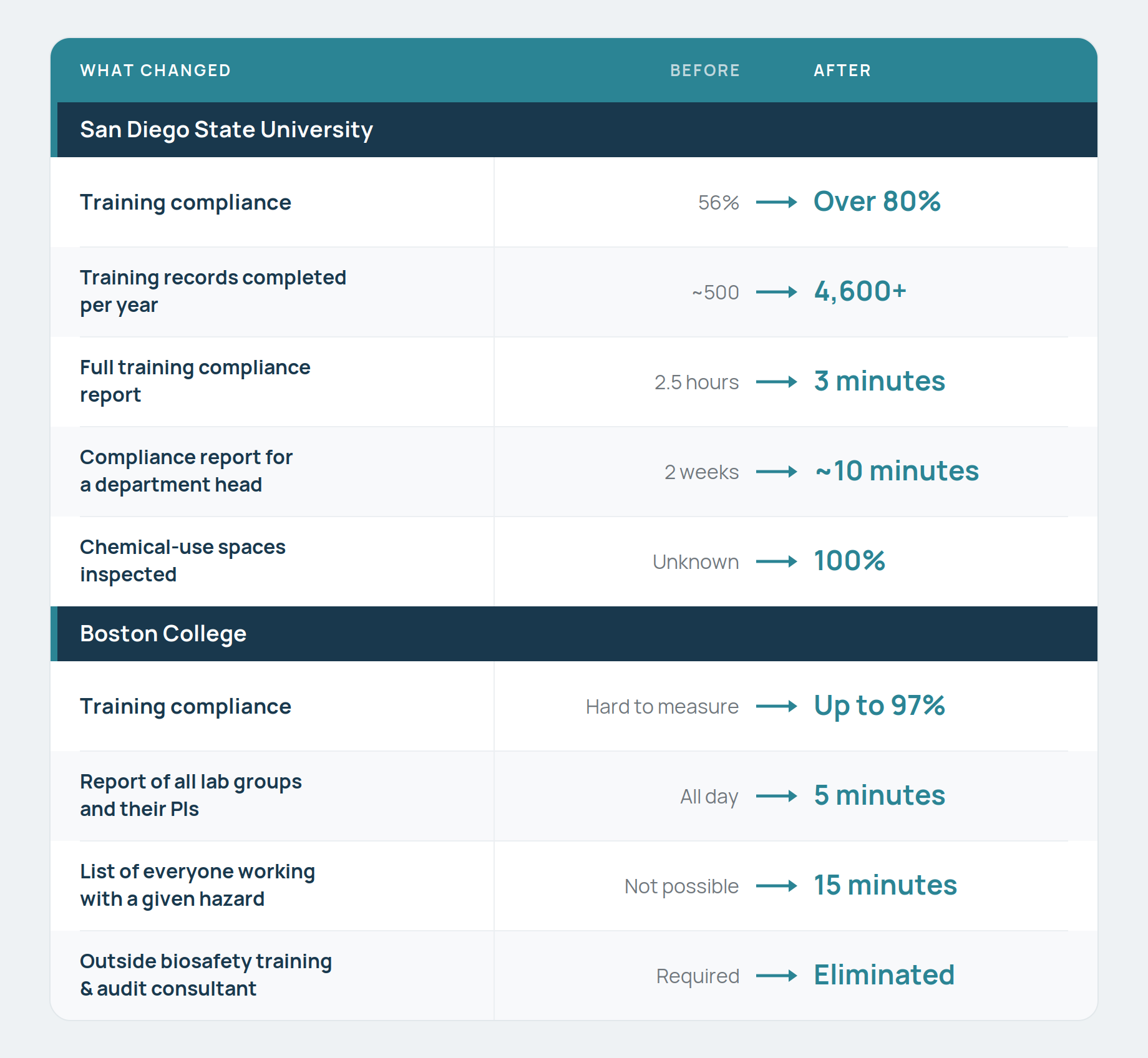
The clearest win was time. At Boston College, a report listing every lab group and its PIs (Principal Investigators) used to take all day. Now it takes 5 minutes. A list of everyone working with a specific hazard wasn't even possible before, and now takes about 15 minutes.
San Diego State's numbers are just as stark:
- A report of users overdue for a course used to take an hour. Now it's 3 minutes.
- A full training compliance report used to take 2.5 hours. Now it's 3 minutes.
- That same compliance report, formatted for a department head, used to take two weeks. Now it's about 10 minutes.
- Looking up one person's training records used to take several hours. Now it's 1 minute.
Training compliance climbed & stayed there
At San Diego State, training compliance rose from 56% to over 80%, and the team grew from 8 courses and roughly 500 completed records a year to 16 courses and more than 4,600 records.
Likewise, Boston College reports up to 97% compliance, and its Training LMS (Learning Management System) let the team drop an outside consultant they had been paying for biosafety training and audits.
Identifying who's due for a course, then writing and sending the reminder? At San Diego State that used to take days. Now, in Jennifer's words, it's "automated."
Guesswork turned into real-time visibility
San Diego State went from not knowing how many labs it had to reporting, with confidence, that 100% of the spaces where chemicals are used had been inspected. That visibility changed behaviour too: Jennifer's PIs started taking an active role in managing their own labs, which she called "worth its weight in gold."
At Boston College, pulling scattered records into one place finally let the team connect every person to their lab, their hazards, and their required training.
Both teams traded "I'm not sure" for "here's the answer."
The data made the case for more resources
At Boston College, the information the team could finally extract from SciSure showed senior administration the need for more people, and the university approved two new Lab Safety Specialists. Once leadership could actually see the hazards across campus, the staffing argument made itself. That same visibility lets EHS spot trends and justify budgets with evidence, instead of asking for resources on a hunch.
How SciSure helps you digitize your lab's EHS data
SciSure brings your chemical inventory, safety data sheets, hazardous waste, biosafety, inspections, incidents, equipment, and training into one connected system, so your EHS data is real-time, searchable, and audit-ready instead of scattered across binders and spreadsheets.
SciSure is a Scientific Management Platform (formed from the merger of eLabNext and SciShield) that covers the ELN (Electronic Lab Notebook), LIMS (Laboratory Information Management System) for sample and inventory tracking, and Health & Safety (EHS) in one place. For your EHS team specifically, that means:
- One source of truth.
Chemicals, hazards, training, inspections, and incidents live together, so you stop hunting across systems for an answer. - Real-time answers.
You see a lapsed certification or a newly added chemical the moment it happens, not weeks later. - Audit readiness by default.
When an auditor asks, the report is minutes away, not days. - Time back.
Your safety staff and your researchers get hours of their week returned, the way Boston College and San Diego State did.
Digitizing and centralizing your lab's EHS data helps you run a safer, more efficient research program with a return you can actually measure. But hey, don't take our word for it:
And if you want to see what your own reporting could look like at 5 minutes instead of all day, book a demo or talk to a SciSure specialist.
10 Reasons to Digitize & Centralize Your Lab's EHS Data (and What It Actually Delivers)
Understand risks, protect your data, spend your budget where it counts, and more.
If you’re working at a lab, your risk of having an accident is highest when you’re in the middle of a routine task; even more so if you’re handling hazardous chemicals. This is why going over basic lab safety procedures with your staff is a priority, no matter their level of experience or how straightforward your processes are. Here’s a practical chemical lab safety guide based on the most recently updated environment, health, and safety guidelines to get you started.
Lab safety in chemistry: Why it matters
With a solid chemistry lab safety procedure set up, you can identify, reduce, and control hazards where chemicals are used, stored, or produced. Chemical labs present hazards that need layered controls: chemical exposure, burns, fire and explosions, slips and falls, extreme temperatures, radiation, electrical hazards, and pressurized systems. Without proper precautions, those hazards turn into injuries, illnesses, lawsuits, medical costs, regulatory penalties, and lost time. According to OSHA estimates, workers suffer more than 190,000 illnesses and 50,000 deaths each year tied to chemical exposures. The agency also notes that these figures are likely an undercount, since some illnesses take years to surface.
Here's the part that should bother you most: nearly all of these incidents are preventable. Studies of chemistry lab accidents consistently show that injuries come from skipping basic precautions, not from inherently high-risk experiments. The death of Sheri Sangji, a UCLA researcher in 2009, after a pyrophoric chemical ignited her clothing, is still one of the most cited cases. More importantly, this accident was entirely preventable with proper training, supervision, and PPE enforcement.
For organizations running multiple labs, the challenge goes beyond individual behavior. Safety has to be systematic: documented, trained, tracked, and enforced the same way across every site, every department, and every new hire. When the safety infrastructure is fragmented or informal, the organization inherits the risk of its weakest link.
In my experience, the labs that get this right treat safety as a culture, not a policy. A lab with a strong safety culture, one that emphasizes personal and community responsibility rather than just compliance, will always be better at spotting risks and preventing accidents than a lab that just has the right rules written down somewhere.
14 Chemistry Lab Safety Guidelines every team should follow
These guidelines address the most common ways people get hurt in chemistry labs. Each one is grounded in OSHA requirements, institutional best practices, and the day-to-day reality of working with hazardous materials.
1. Wear safety glasses at all times
Eye protection is required whenever you're in the lab, not just during active experiments. Chemical splashes, broken glass, and projectile fragments can happen at any moment. The American Academy of Ophthalmology, citing BLS data, reports that nearly 20,000 workplace eye injuries happen each year, often costing the worker at least one missed day. Likewise, Prevent Blindness estimates that around 90% of them are preventable with proper eyewear. Safety glasses should meet ANSI Z87.1 standards, and splash-resistant goggles should be used when working with corrosive liquids or running reactions with splash risk.
2. Wear protective clothing that actually fits
Protect your skin from chemical contact with a lab coat, closed-toe shoes, and long pants. Avoid loose sleeves, dangling jewelry, and open-toed footwear. When working with corrosive, flammable, or cryogenic materials, you may need additional personal protective equipment (PPE) including chemical-resistant gloves, a face shield, or a flame-resistant lab coat.
- Glove selection matters.
Not all gloves resist all chemicals. Check the glove manufacturer's chemical compatibility chart before you choose, because the wrong glove can give you a false sense of protection while a chemical permeates through it.
- Fit matters as much as type.
PPE only protects you if it fits. Gloves and goggles are often sized around an average that doesn't suit everyone, which means ill-fitting PPE causes accidents of its own. Make sure everyone on the team can try different sizes and pick what's safe and comfortable for them.
When selecting PPE, make sure to double-check the specific hazards in your Chemical Hygiene Plan. Compliance is patchier than most people assume: a UCLA Center for Laboratory Safety survey found that self-reported use of eye protection was just 61% in academic labs, versus 83% in industry.
As I always tell teams: PPE should never be selected without first doing a risk assessment to determine what equipment you need and what level of protection the task calls for.
3. Never eat, drink, smoke, or vape in the lab
Food and drink in the lab create a direct route for chemical ingestion through contaminated surfaces, hands, or airborne particles. This applies even in areas that look clean. Smoking and vaping add ignition risk near flammable materials and solvents.
4. Know where your emergency equipment is
In an emergency, every second counts, and hunting for equipment you should already know how to find can turn a manageable incident into a serious injury. Before you start any work, make sure you know the locations of:
- Fire extinguishers,
- Fire blankets,
- Safety showers,
- Eyewash stations,
- First aid kits,
- and spill response materials
Your lab should make sure emergency equipment is inspected regularly, accessible without obstruction, and documented in their safety management system. San Diego State University found that digitizing their EHS operations gave them real-time visibility into lab spaces, equipment, and training compliance, which they simply didn't have when relying on paper.
5. Use fume hoods for hazardous chemical work
Fume hoods are engineered controls that protect you from inhaling toxic, volatile, or irritating chemicals. Do any work involving hazardous vapors, gases, or aerosols inside a properly functioning fume hood. Check the airflow before you start, keep the sash at the recommended height, and don't store chemicals inside the hood unless it's specifically designated for that.
6. Practice thorough hand hygiene
Wash your hands before and after working in the lab, before eating or drinking outside it, and after removing gloves. Good hand hygiene protects you and your colleagues from chemical transfer and cross-contamination. Use soap and water, not hand sanitizer, which doesn't remove chemical residue effectively.
7. Don't work alone with hazardous chemicals
Avoid working with hazardous chemicals or high-risk processes when you're alone in the lab. If something goes wrong during a high-hazard procedure, you want someone nearby who can recognize the problem and respond or call for help if you can't.
This is also where a written protocol reaches its limit. A procedure that tells people how to identify and assess hazards is no substitute for keen attention and active supervision by a knowledgeable lab manager or principal scientist. Recognizing a hazard and judging how serious it is at the moment is a skill that takes attention, practice, and mentoring to develop. In fact, a UCLA survey of researchers found that accidents and injuries were notably lower in labs where the lead scientist was actively engaged in safety, not just in labs that had the rules written down.
8. Never mouth-pipette
Using mouth suction to fill a pipette is a dangerous, outdated practice that risks ingestion or inhalation of hazardous materials, biological contaminants, or radioactive substances. Always use a mechanical pipetting device. This one applies universally, no matter what you're handling.
9. Handle glassware and sharp objects with care
Never force glass tubing through a cork or rubber stopper. It can shatter under pressure and cause severe cuts. Use proper lubrication (glycerin or water) when inserting glass into stoppers, protect your hands with a towel, use a gentle twisting motion, and fire-polish all cut edges before use.
The same care applies to needles, blades, and broken glass. Handle them deliberately, never recap or bend needles by hand, and dispose of them in a designated sharps container rather than a regular waste bin. Sharps injuries are easy to underestimate. In hospital settings alone, the CDC estimates about 385,000 needlestick and sharps injuries among healthcare workers each year, and at least half go unreported.
10. Always add acid to water
Adding water to concentrated acid sets off a violent exothermic reaction that can splash concentrated acid onto skin, eyes, and clothing. Always add acid to water, slowly and with constant stirring. This applies to all strong acids, including sulfuric, hydrochloric, and nitric.
11. Use designated waste containers
Dispose of chemical waste in properly labeled, designated containers. Never pour chemicals down the drain unless your waste management program explicitly authorizes it. Segregate waste by compatibility (acids, bases, halogenated solvents, non-halogenated solvents) and keep containers sealed when not in active use. Proper chemical waste disposal is both a safety practice and a regulatory requirement under EPA and state environmental rules.
12. Securely replace chemical containers after use
As soon as you've taken what you need, replace every cap, lid, and stopper. Open containers let volatile liquids evaporate, release toxic vapors, and absorb moisture from the air, all of which can create hazardous conditions or degrade the chemical. It also prevents spills during transport or storage.
13. Secure compressed gas cylinders at all times
Compressed gas cylinders are heavy and stored under very high pressure, which makes an unsecured one genuinely dangerous. If it tips and the valve shears off, the cylinder can rupture or take off like a projectile. A typical cylinder stands about 4 feet tall, weighs 75 to 80 pounds, and can be pressurized to roughly 2,200 psi (for reference, a car tire sits around 30 to 35 psi).
The BLS recorded 10 deaths and roughly 3,900 injuries tied to pressurized containers in 2016 alone. Strap or chain every cylinder to a wall or bench, keep the valve cap on when a cylinder isn't in use, and move them with a proper cylinder cart, never by rolling or dragging.
14. Report all accidents and incidents immediately
Every accident, injury, near-miss, or unsafe condition should go to your supervisor immediately, no matter how minor it seems. Incident reporting isn't just a compliance box; it's the foundation of a learning safety culture. Organizations that track and analyze incidents can spot patterns, fix root causes, and prevent the next one.
For organizations managing safety across multiple labs or sites, centralized reporting is essential. When reports are scattered across emails, paper forms, or local spreadsheets, the patterns become invisible, and corrective actions are hard to track.
The Chemical Hygiene Plan: Your lab's safety foundation
A Chemical Hygiene Plan (CHP) is a documented program required by OSHA's Laboratory Standard (29 CFR 1910.1450) that lays out the procedures, safe work practices, and protective measures an organization uses to protect employees from chemical hazards. Here’s what yours should address:
- PPE requirements specifying what protection is needed for different chemical classes and operations
- Hazard identification including how Safety Data Sheets (SDS) are maintained, accessed, and kept current
- Standard operating procedures for specific chemical categories, including particularly hazardous substances (carcinogens, reproductive toxins, acutely toxic chemicals)
- Spill response protocols covering containment, cleanup, decontamination, and reporting for different chemical types and quantities
- Waste disposal procedures aligned with EPA regulations and institutional waste programs
- Training requirements specifying what's required before lab access, how often refreshers happen, and how completion is documented
- Medical consultation provisions for employees who may have been exposed to hazardous chemicals
- Record-keeping standards for maintaining audit-ready safety records
The Chemical Hygiene Plan isn't a static document. Review it annually, and update it whenever new chemicals, processes, or regulatory requirements come in. For organizations with multiple labs, keeping CHP standards consistent across sites is what prevents the compliance gaps that appear when each lab quietly develops its own way of doing things.
Building a safety culture that scales
The 14 guidelines above protect individual researchers. But for organizations running dozens or hundreds of labs, safety must work as institutional infrastructure, not just personal discipline.
Training compliance at scale
Everyone who enters a lab should get documented safety training before they begin, with refreshers at regular intervals. But tracking that across an entire organization, especially one with high turnover from students, postdocs, and rotating staff, becomes impossible with spreadsheets and paper. San Diego State University digitized their EHS workflows to fix exactly this. Before, the team had no reliable way to connect researchers to the labs they worked in or the training they needed. After centralizing training management, they went from 8 courses and 500 completion records a year to 16 courses with over 4,600 records, while lifting overall training compliance from 56% to more than 80%.
Chemical inventory visibility
Organizations working with hazardous chemicals need real-time visibility into what's present, where it's stored, and in what quantities, across every lab and every building. That information is critical for emergency response, fire code compliance, Tier II reporting, and Maximum Allowable Quantity (MAQ) management.
When chemical inventory lives in spreadsheets or local databases, it goes stale and inconsistent, and it's inaccessible to the people who need it most: first responders, EHS officers, and leadership. The Engine, MIT's Tough Tech accelerator, grew from 10 to 50 resident laboratory companies and found that digitizing chemical inventory cut the time needed to find hazard information from several hours to under five minutes.
Inspection and audit readiness
Regulatory inspections happen on their own schedule. The organizations that prepare reactively, scrambling to assemble documentation when an audit is announced, are the ones most likely to have gaps. Safety infrastructure should generate audit-ready records continuously, as a byproduct of normal operations, not as a special project. That means inspection checklists, training records, chemical inventories, incident reports, and corrective action logs should all live in one connected system where they're always current and always accessible.
Connecting safety to research operations
In a lot of organizations, EHS runs in a completely separate system from the research it's meant to protect. Chemical inventories in one tool, training records in another, experiment documentation in a third, incident reports in email. That fragmentation makes it hard to see how safety connects to the daily work of science.
Modern platforms unify the two. SciSure's Scientific Management Platform connects chemical inventory management, training, inspections, and safety compliance with ELN, LIMS, and sample management in one environment, so safety is built into how science gets done rather than bolted on as a separate administrative chore.
Safety is infrastructure, not just behavior
Lab safety usually gets framed as a set of personal habits: wear your goggles, wash your hands, report incidents. Those habits matter. But for a research organization, safety is also an institutional capability that needs documentation, training systems, chemical oversight, and consistent governance across every lab and every site.
The 14 guidelines here are the behavioral foundation. A well-maintained Chemical Hygiene Plan is the procedural framework. And the right digital infrastructure is what makes sure both actually get implemented, tracked, and enforced as the organization grows.
When safety is treated as infrastructure rather than individual willpower, organizations don't just avoid accidents. They earn the operational confidence to grow, collaborate, and push their science forward without cutting corners.
Ready to strengthen your organization's safety infrastructure? Talk to a specialist about how SciSure connects EHS, chemical management, and training with your research operations.
Chemistry Lab Safety Guide: 14 Rules For A Safer Lab
These 14 practical lab safety guidelines for chemistry labs cover PPE, chemical handling, hygiene plans, and digital systems to help your lab stay safe & compliant.
Small labs operate under real constraints: lean teams where one person covers multiple roles, no dedicated IT support, and compliance requirements that don't shrink just because the headcount does. Sample data that starts in spreadsheets quickly becomes difficult to search, audit, or hand off reliably. At a certain point, the system holding your research together becomes the thing slowing it down.
A LIMS is not an enterprise-only investment, but choosing the wrong one compounds the problem. A system built around rigid, predefined testing pipelines introduces complexity that iterative R&D teams don’t need and can’t maintain. This guide covers what one actually needs from a LIMS software for small labs, and what functionally separates a system designed for research workflows from one that wasn't.
Why small labs need a LIMS earlier than they think
The assumption that LIMS software is built for large organizations tends to hold until something goes wrong. A mislabeled sample, a failed audit, a researcher who leaves and takes institutional knowledge with them. By the time the need becomes obvious, the cost of fixing it is higher than the cost of having started earlier.
Manual tracking systems have a compounding problem. In a lean team where the same person is running experiments, managing inventory, and handling compliance documentation, gaps accumulate quietly. Spreadsheets don't enforce data entry standards, don't maintain version history, and don't generate the structured audit trails that regulatory reviewers expect. The bigger the dataset grows, the harder it becomes to retroactively impose structure on it.
Compliance requirements don't scale down with lab size. FDA 21 CFR Part 11, GxP, and institutional requirements apply based on the work being done, not the headcount. Building data structure into daily workflows from the start is significantly less disruptive than reconstructing it when an audit is scheduled.
What a LIMS actually manages in a small lab context
A Laboratory Information Management System (LIMS) is often described in terms of sample storage, but in an R&D context, that framing undersells what the system actually does.
LIMS software built for the R&D sector manages samples, inventory, workflows, equipment, and the associated data connecting them. That means tracking a sample from initial registration through lineage, storage, and disposal, maintaining accurate inventory records without manual reconciliation, and linking equipment usage to specific experiments.
It is worth distinguishing this from LIMS platforms built around rigid, predefined testing pipelines. Those systems are designed for high-throughput environments where workflows are standardized and process rigidity is itself a compliance requirement. That design works well in the right context, but it does not account for the iterative, protocol-driven work of R&D. For small teams evaluating LIMS systems for small laboratories, the category label alone does not tell you whether a system fits your type of work. A LIMS designed for research accommodates flexible workflows, variable sample types, and evolving experimental parameters — regardless of whether the work is basic research, translational, or clinical R&D.
Key features to prioritize when choosing a LIMS for a small lab
Not every LIMS feature matters equally to a small lab. The evaluation should focus on what directly reduces operational risk, supports lean workflows, and holds up as the lab grows.
Sample tracking and traceability
Sample loss in a small lab is a proportionally larger problem than in a large one. There is no redundancy to absorb it. A LIMS designed for R&D tracks samples from initial registration through lineage, transfer, and disposal using configurable metadata fields that reflect how the lab actually works. Check-out/check-in, sample dispatch with accept and deny controls, and Barcode Automation reduce manual handling for researchers already covering multiple responsibilities. When a sample's full history is recorded systematically, locating it or handing it off takes minutes rather than a manual search through notebooks and spreadsheets.
The University of Pittsburgh Behavioral Immunology Laboratory replaced a hybrid manual tracking method with sample management workflows in SciSure LIMS, using identification filters and Barcode Automation to locate and move samples without building custom layouts for each study. Lab Manager Zak Hutchinson reported a 50% improvement in the time spent tracking and managing samples.
Workflow automation for lean teams
In a small lab, one researcher often handles sample registration, inventory tracking, instrument operation, and compliance documentation within the same day. Each manual handoff between those tasks is an opportunity for error and a drain on time that should go toward analytical work.
Triggers and Automations address this directly. Sample registration can be configured to trigger automatically based on defined conditions, status notifications go out without manual follow-up, and webhook alerts route to Slack or Teams when action is required. Barcode Automation reduces inventory updates to a scan, eliminating manual data entry for reagents and consumables. When instruments are connected, data capture happens without transcription, removing one of the most common sources of error in small lab environments.
The practical outcome is that the system handles the administrative layer of lab operations consistently, without depending on a researcher to remember each step. For lean teams where capacity is the primary constraint, that reliability is what makes automation worth implementing.
Audit-ready records from day one
Small labs going through their first regulatory review frequently discover the same problem: records that made sense day-to-day were never structured for external scrutiny. Reconstructing compliant documentation from informal notes, disconnected files, and spreadsheets is time-consuming and produces results that don't hold up well under review.
A LIMS builds compliance into daily workflows rather than treating it as a separate process. Every sample registration, status change, data entry, and user action is logged automatically. Records are version-controlled, timestamped, and searchable without requiring researchers to maintain a parallel documentation system. That structure is present from the first day of use, not assembled retroactively when an audit is scheduled.
For labs operating under FDA 21 CFR Part 11, electronic records and signatures need to meet specific integrity and traceability requirements. GxP-aligned workflows require that research activities are documented in a consistent, reproducible format. SOC 2 Type II certification provides assurance around the security and availability of the systems holding that data. Small labs that choose a LIMS meeting these standards are not over-engineering their compliance posture. They are avoiding the cost of rebuilding it later.
Arctic Therapeutics centralized sample management, inventory, and quality documentation workflows in SciSure LIMS, saving two hours per week on sample and inventory management while strengthening their ISO 15189 compliance support and maintaining full traceability across samples and reagents.
ELN integration for research workflows
In many small labs, experiment documentation and sample data live in separate tools with no structured connection between them. A researcher completes work in an electronic lab notebook, then manually cross-references sample records in a spreadsheet or a disconnected system. That gap creates duplicated effort, introduces transcription errors, and makes it difficult to reconstruct the full context of a result when it matters most.
When a LIMS connects workflows with an electronic lab notebook, the research record becomes more complete and easier to maintain. Linking experiments to sample records directly means a result is traceable to the specific sample, preparation method, and reagent lot associated with it. It improves visibility across research activities without requiring researchers to maintain parallel records in multiple places. For small R&D teams where one person may be responsible for both experimental work and documentation, reducing that administrative overhead has a direct impact on how reliably records are kept.
Siloed tools also create institutional knowledge risk. When experiment context and sample data are stored separately, the connection between them often exists only in a researcher's memory. Connecting those workflows reduces that dependency and makes research records more durable over time.
Scalability without a system switch
Outgrowing a LIMS is not an easy upgrade. It means exporting and migrating research data, retraining staff on a new system, re-validating workflows under applicable regulatory frameworks, and managing that transition while the lab continues to operate. For a small team without dedicated IT resources, that process is disruptive in a way that is difficult to fully anticipate at the point of first adoption.
Scalable infrastructure means the system accommodates growth without requiring a platform change. Role-based access controls allow permissions to be configured precisely as teams expand and responsibilities shift. Multi-site support means the same system that works for a single lab can extend to additional locations without architectural changes. An open API ecosystem of add-ons allows the lab to connect instruments, integrate procurement systems, and extend functionality as operational complexity increases, without outgrowing the core platform.
The decision to choose an affordable LIMS system for small laboratories based primarily on upfront cost tends to defer rather than avoid the scalability problem. A system that fits today's workflows but cannot accommodate next year's headcount, compliance requirements, or operational scope will eventually need to be replaced. The cost of that replacement, in time, data integrity risk, and operational disruption, typically exceeds whatever was saved in the original selection.
What makes a LIMS right for R&D vs other lab types
Implementing a LIMS built for rigid, high-throughput pipelines in a research lab is a design mismatch, not just a feature gap.
Some LIMS platforms are built around standardized test panels and predefined workflows designed for speed and consistency across high-throughput environments. Others are designed for manufacturing contexts where process rigidity is itself a compliance requirement. Both do what they are designed for well. Neither architecture accounts for the way R&D labs actually work — including clinical R&D teams, translational research groups, and biobanks that need the flexibility to adapt workflows as research evolves.
Research workflows are iterative. Protocols change between experiments, sample types vary across projects, and inventory needs shift depending on what is being tested. A LIMS designed for the R&D sector accommodates that variability, connecting protocols to experiments, experiments to samples, and samples to equipment and inventory. When evaluating LIMS solutions for small labs, the practical question is not whether a system can track samples. Most can. The question is whether it was designed for research workflows specifically, and whether it will support that work without requiring the lab to reshape its processes around the software.
Common mistakes small labs make when choosing a LIMS
Most LIMS selection mistakes reflect the constraints small labs operate under: limited time for evaluation, pressure to keep costs down, and no dedicated IT staff to assess implementation complexity before committing.
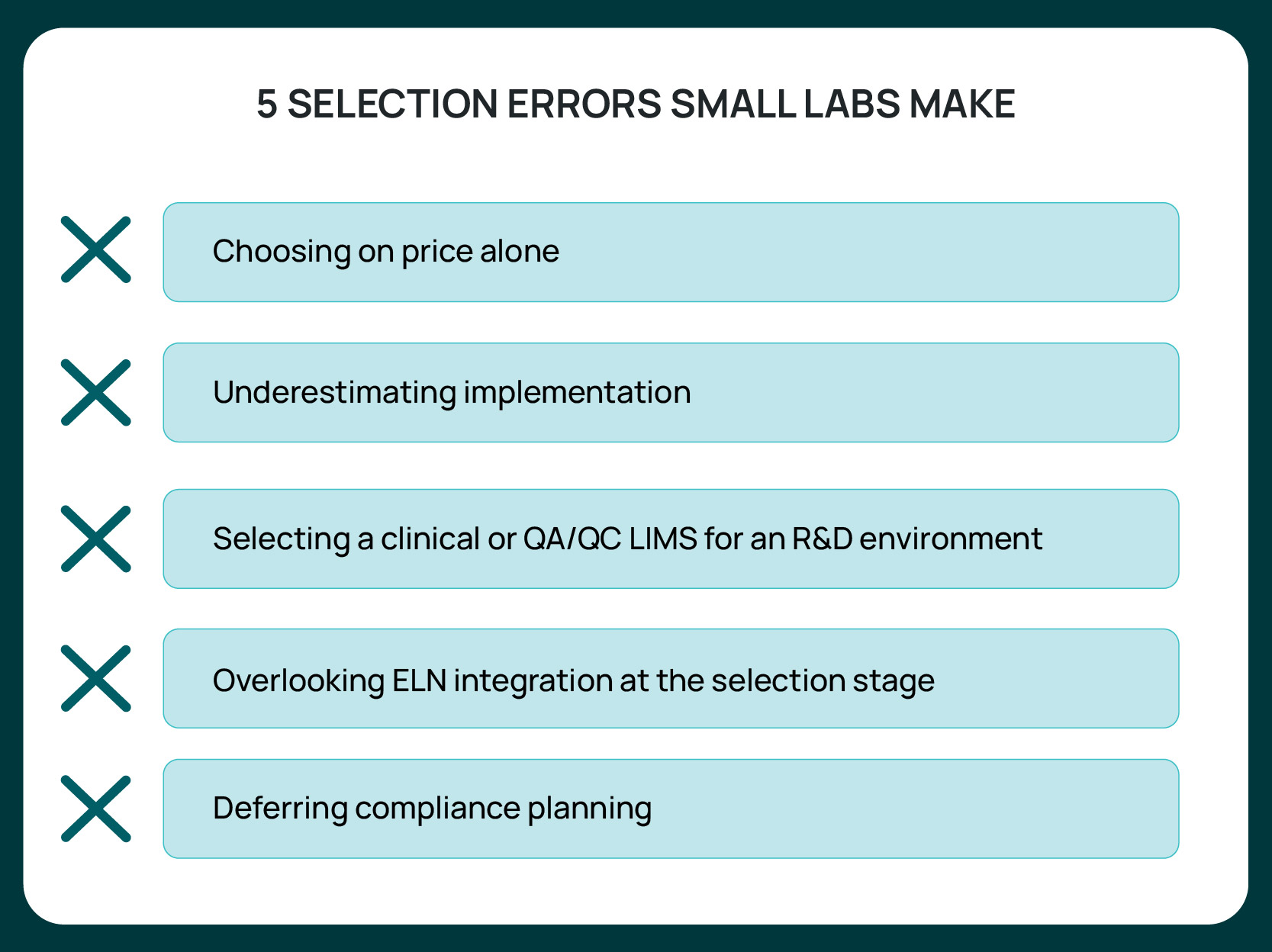
Choosing on price alone. Affordability matters, particularly for grant-funded labs, but the upfront cost of affordable LIMS for small labs rarely reflects total cost of ownership. A system that requires extensive customization, lacks adequate support, or cannot scale will generate costs that the initial comparison did not capture.
Underestimating implementation. A LIMS requires real configuration: user roles, metadata schemas, workflow structures, and data migration. Labs that treat this as a formality often find adoption stalls when researchers encounter a system that was never properly set up for their workflows.
Selecting a LIMS built for rigid, predefined pipelines and applying it to iterative R&D work. The rigidity that makes those systems effective in their intended context creates friction in iterative R&D work, and the mismatch typically becomes apparent only after implementation.
Overlooking ELN integration at the selection stage. A LIMS that cannot connect workflows with experiment documentation adds administrative overhead rather than reducing it.
Deferring compliance planning. FDA 21 CFR Part 11, GxP, and institutional requirements apply to how records are created from day one, not just when an audit is scheduled. Retrofitting a compliant data structure onto an existing system is significantly harder than choosing one that supports it from the start.
How to evaluate LIMS options as a small lab
With limited time and no dedicated IT staff, small labs need an evaluation framework that surfaces the right questions quickly.
R&D workflow fit. Does the system manage samples, inventory, equipment, and workflows in a research context, or was it built around rigid, predefined testing pipelines? This is the first filter, not an afterthought.
Implementation complexity. How much configuration is required before the system is usable? What does the vendor provide in terms of onboarding support, documentation, and setup guidance? A system that takes months to configure is a significant burden for a small team.
ELN integration capability. Can the system connect workflows with experiment documentation directly, or will the lab be managing two disconnected tools? For R&D teams, this is a core functional requirement.
Compliance certifications. Does the system support FDA 21 CFR Part 11, GxP, and SOC 2 Type II requirements? Verifying this at the selection stage is significantly easier than discovering gaps during an audit.
API and integration ecosystem. Can the system connect to instruments, procurement tools, and external platforms as the lab grows? An open integrations ecosystem reduces the risk of the platform becoming a bottleneck.
Vendor support quality. What does ongoing support look like after implementation? For small labs without internal technical resources, vendor responsiveness matters more than it might in a larger organization.
Scalability. Will the system accommodate more users, additional sites, and increased data complexity without requiring a platform migration?
SciSure LIMS is one example of a LIMS designed for the R&D sector that covers these criteria: connecting sample management with ELN workflows, supporting relevant compliance frameworks, and providing an open API and Marketplace ecosystem for extensibility.
The right LIMS grows with your lab
Small labs don't need a stripped-down LIMS. They need the right one.
The cost of choosing poorly is not abstract. It shows up as data that cannot be migrated cleanly, researchers retraining on a new system, and research continuity disrupted mid-project. For a lean team, that setback compounds the longer the wrong system stays in place.
A LIMS that fits R&D workflows brings structure to sample data from the start, connects workflows across experiments, inventory, and equipment, and scales as the lab grows in headcount, project complexity, and compliance requirements. That is a different outcome from simply having a system in place.
If you are evaluating LIMS software options for small labs, SciSure covers these criteria for R&D teams at any stage. Talk to a specialist to find out if it fits your workflows.
FAQ
Do small labs really need a LIMS?
Yes, and earlier than most expect. The assumption that LIMS is an enterprise tool leads small labs to delay adoption until manual systems have already created problems. A LIMS designed for the R&D sector suits labs at any stage. The earlier data is structured consistently, the less effort it takes to maintain traceability and support compliance as the lab grows.
What is the difference between a LIMS and a spreadsheet-based system?
Spreadsheets are flexible but passive. They don't enforce data entry standards, maintain version history, or generate audit trails. A LIMS provides structured sample records and automatic activity logging that holds up under regulatory review. In SciSure LIMS, every sample registration and status change is logged automatically, something a spreadsheet cannot replicate regardless of how carefully it is maintained.
How long does it take to implement a LIMS in a small lab?
It depends on workflow complexity and how much data needs to be migrated. A small lab with straightforward workflows can typically get operational within a few weeks. Custom metadata schemas, multiple user roles, and legacy data migration will extend that timeline. Vendor onboarding support is a meaningful factor in how quickly a small team reaches full adoption.
What features should a small lab prioritize in a LIMS?
Sample tracking with configurable metadata, workflow automation, audit-ready records, ELN integration, and scalable infrastructure are the core priorities. Compliance certifications such as FDA 21 CFR Part 11 and GxP support should be verified at the selection stage rather than assumed. SciSure covers these priorities for R&D teams at any stage.
Can a LIMS integrate with an ELN for small research teams?
Yes, and it is one of the more important capabilities to verify before selecting a system. When LIMS and ELN workflows are siloed, researchers end up maintaining parallel records across disconnected tools. SciSure connects LIMS and ELN workflows directly, linking experiments to sample records and improving visibility across research activities.
Is a cloud-based LIMS better for small labs?
For most small labs, cloud deployment removes the burden of managing on-premise infrastructure, which matters when there is no dedicated IT staff. Security remains a valid consideration regardless of deployment model. SciSure holds SOC 2 Type II and ISO 27001 certifications, providing assurance around data security and access controls.
LIMS for Small Labs: What to Look For & Why It Matters
Explore how LIMS for small labs helps teams structure data, automate workflows, improve traceability, reduce manual work, and stay audit ready as they grow.