
Customize SciSure to work your way
Your lab, your workflows, your way. SciSure gives you full control over how you connect your research tools, instruments, and databases. Create custom connections that fit exactly how your team works–now and in the future.
.avif)
Trusted by 550,000+ scientists, EHS, and LabOps worldwide in 55,000+ laboratories










 Customer story
“Working with the SciSure team has been a collaborative and productive experience.”
 Customer story
"SciSure helps us save time by enabling us to share our protocols with colleagues easily. It also takes care of our sample management."
 Customer story
“I'm thoroughly impressed with how SciSure has transformed our daily operations.”
 Customer story
“SciSure cuts down time and energy spent on tasks. I’ve loved working with it.”
 Customer story
“We’ve replaced Excel, paper, and Access databases with efficiency, turning manual tasks from hours into minutes.”
Customer story“Working with the SciSure team has been a collaborative and productive experience.”
Customer story"SciSure helps us save time by enabling us to share our protocols with colleagues easily. It also takes care of our sample management."
Customer story“I'm thoroughly impressed with how SciSure has transformed our daily operations.”
Customer story“SciSure cuts down time and energy spent on tasks. I’ve loved working with it.”
Customer story“We’ve replaced Excel, paper, and Access databases with efficiency, turning manual tasks from hours into minutes.”
Build a platform that works for you
Ready-to-use integrations
Instantly connect SciSure to 40+ prebuilt add-ons to streamline workflows without extra setup.
Related:

40+ integrations

Free and premium add-ons

Constantly growing library
.avif)
Custom integrations with our API & SDK
Build custom integrations with SciSure’s open API and SDK to connect lab instruments, automate reporting, and sync data.
Related:

Open API

Developer SDK

Full developer support
.avif)
Flexible & adaptable to your lab’s needs
Easily integrate new tools as your lab evolves without switching platforms or disrupting workflows.
Related:

Connect any research tool

Automate your workflows

Future-proof your setup
.avif)
Connect instantly with 40+ add-ons
Our Marketplace offers a range of integrations to streamline operations, data collection, and research workflows.

Astra Iris - AI Support Assistant
AI-powered support assistant built directly into SciSure Research.
DataChaperone - Analysis & AI Platform
Automated, audit-ready data analysis directly inside your ELN.
.png)
DYMO® LabelWriter™ 550 Series
Streamline your lab labeling workflow with precision and ease
.avif)
DMPTool.org
Streamline workflows and enhance collaboration by integrating and managing data management plans from DMPTool within SciSure
.avif)
Protocols.io
Bring trusted protocols directly into your ELN
.avif)
Nikon NIS-Elements
For seamless exchange of data and notes between Nikon NIS-Elements microscopy-based imaging platform and eLabNext
Empower your lab with custom integrations
SciSure’s API and SDK give labs complete flexibility to build integrations that fit their unique workflows.


.avif)
How labs are customizing SciSure to their needs
See how research teams are connecting their tools, automating workflows, and optimizing data flow with SciSure.













See SciSure in action
Every lab is different, and SciSure is built to adapt. Book a demo today to see how our Scientific Management Platform (SMP) can transform your team’s workflows, streamline compliance, and help your research move faster.
Frequently asked questions
Everything you need to know about the product and billing.
SciSure supports prebuilt add-ons from our Marketplace, direct API connections, and fully customizable integrations via our SDK.
No. Many integrations are plug-and-play. However, some integrations require a paid license.
Most add-ons are free, while some premium integrations require a subscription. Pricing details are available in the user interface Marketplace.
Yes! SciSure’s API allows you to connect lab instruments, automate data collection, and sync results with your workflows.
Visit our Developer Portal for API documentation, SDK downloads, and integration guides.
Can’t find the answer you’re looking for? Please chat to our friendly team.
Stay ahead in lab innovation
A few weeks ago, I took my son fishing. He’d found a pond tucked down in the woods and wanted to check it out, so we turned off onto a little dirt road. The first stretch was littered with potholes, some of them eight inches deep. I was crawling along at 5 miles an hour, genuinely worried about bottoming out. Then the dirt turned to gravel. Bumpy, but I could get up to 15.
And then, for the last stretch down to the water, the road was paved, and we were cruising.
I've thought about that road a lot since. Stretch the metaphor a bit, and it’s exactly what buying and standing up lab software feels like. Some vendors put your scientists on that pothole road and hope they just tough it out. Most people don't tough it out. They give it a shot, decide it’s not worth the suspension damage, turn around, and don’t come back.
If you’re the director or VP who signs off on an EHS purchase, your job is to figure out, before the contract is signed, which road you’re buying. The license fee alone won't tell you.
In fact, the license fee is the wrong starting point
The most common mistake I see buyers make is opening the conversation with "Just tell me what the license costs. We'll figure out if it's a fit."
I evaluate software regularly myself, and I never start there, because I know the risk that comes with it. The questions I ask first are different:
- Here's the problem we're trying to solve. Is this a good fit?
- How long does it historically take for a company of our size, with our needs, to stand this up and get it live?
- Is custom work needed?
- Are services, support, and consulting included in that fee, or am I going to discover a cap on support hours three months in?
And most importantly:
- Will my team actually use it?
That last one matters more than people think. A low license fee is often low because something was taken out: the implementation timeline that nobody commits to, the pre-built configurations that don't exist, the support that turns out to be outsourced. You can absolutely get the cheap license. What you’re really paying for is the privilege of helping that vendor figure it out on the fly, and figuring it out on the fly is tremendously expensive.
And it doesn't stop at the vendor's invoice. Add your own IT security requirements and the fees to plug whatever holes the license doesn't cover. Add the internal resources: the meetings, the brainstorming sessions, the hours your IT, legal, and lab operations people sink into a stalled rollout. I hear it constantly from teams who chose the low bid and call us six months later:
"Everything you said about the hours of meetings, it's happening."
People wave this away with, "We're already paying those salaries, so we don't track it." That's a line-item view of a business decision. The right question is what the impact is on the whole organization, not whether one budget row looks good.
If scientists don't use it, you might as well spend $0
The number one question I hear from scientific organizations is "Will our scientists and researchers actually use this?" And it really is the right question. I cannot tell you how many projects I walk into where a quarter or a third of the scientists are using the existing system, and the rest are being pushed and enforced into it.
Because if the users don't adopt the technology, then what was the point of any of it? If the license fee is X and you're getting nothing out of it, you may as well have not invested in it in the first place.
I said something at an event recently that I stand by: forcing your scientists to change the way they work won’t make it easier for them to adopt something new.
Sure, you could push for a change, and once in a while that works. Or you could involve them in the process, set clear goals, help them understand why things are changing, and the good it does for them. Choosing the latter route shifts your efforts towards the 30% of digital transformations that end up succeeding down the line.
Scientists who’ve been let down by a poor system will scrutinize every piece of the next one, and they should. They were handed something that hurt them instead of helping them. The software has to genuinely reduce their administrative burden, and someone has to explain the why.
Get both right and the usual three-way friction between scientists, operations, and the safety/compliance team starts to melt away. Get either wrong and you're back on that pothole road.
So, when you evaluate vendors, evaluate for adoption. Ask other organizations in the community about what their experience was. Did they get quick adoption? What was the speed to value? Those answers predict your outcome far better than the quote does.
The customization trap
Here's a pitch that sounds great in a demo:
"We'll customize whatever you want."
And here's why that should sound the alarm bells right away: to get a vendor to build exactly what you need, you have to communicate the problem, the desired solution, and the requirements with near-perfect clarity, then sit in the feedback loop of building, testing, and re-testing until it's right.
Most software providers will tell you that's not a heavy lift. That’s just not true. It is a very heavy lift, and people underestimate all the things it consumes: time, cost, resources, expertise. Not to mention the opportunity cost that your organization loses by not spending time on other critical projects.
I watched one organization choose a vendor who promised all the development they asked for, on a timeline of under one year. When we crossed paths again around two and a half years later, the project was still in testing. Small groups were piloting pieces of it, but the people who were supposed to be in the system doing their jobs still weren't there.
Think about the lost data and lost value across nearly three years of "almost live." We’re talking direct financial losses to your organization here, all of which need to be factored in before you make your decision.
Larger organizations will always need some custom work, and that's fine. The question to ask is how much of the system needs to be custom-built and custom maintained, because every custom workflow is also a maintenance commitment after go-live.
What you want underneath is a platform that is configurable, one that adapts to your environment without being rebuilt from scratch for every new requirement.
The cheapest option might just end up costing you the most
Here’s a common pattern I’ve come across during procurement meetings. Three vendors are in play, all with their credibility and trust at stake. Someone points to the simplest thing to measure and says:
“This one is cheapest, and on the call, they promised they can do everything the other two can.”
Vendors will breeze through a demo, glaze over your requirements with a "Yep, we can do that," and leave out the parts that still need development under the hood. If a vendor guarantees a timeline, ask them to put their money where their mouth is: write it into the contract that if they don't deliver, you don't pay. Watch how the conversation changes.
Because here's the math on the downside. Say the cheap option saves you 10 or 20%. If adoption fails and you have to switch, every dollar you put into that license is gone. A 10% saving that becomes a 100% sunk cost means you could have run the better vendor for 5-7 years and still not lost as much.
The shortest turnaround I've seen is a team that pulled the plug six months in. The longest stuck it out for two full years before admitting the system had never properly stood up. In the short term, "I put $10,000 back in the budget" is an easy thing to celebrate internally.
When it unravels, your name is attached to it. And the strongest defense against this is both boring and effective: a written business justification.
A good business justification takes cost and flips it into a quality and risk conversation
And that's where leaders actually operate. Here are the vendors in play, here’s the one we recommend, and here’s why, across speed to value, adoption likelihood, risk, internal resource demands. Finally, here’s our take on whether this partner can scale with us for the next decade.
No organization plans to stay the same size for ten years. Your vendor has to be able to grow and change with you, and if you're not confident that they'll still be your partner ten years out, any energy you'll pour into standing them up isn't worth it.
I've typed out this story on a Mac. If I wanted the lowest cost machine, I wouldn’t be looking at Apple. I'm looking at reliability, quality, and speed, because I want to do my best work on it. Multiply that logic across hundreds or thousands of people who will touch your EHS system every week. An incremental gain per person adds up fast. An incremental loss adds up faster.
None of this means cost doesn't matter. It just means rethinking cost as your total cost of ownership. First, whittle the field down to the vendors who can genuinely deliver the experience and the outcomes you need. Once you’ve got your list of qualified vendors, that’s when price comes into the picture.
Get to that paved road and stick to it
Back at that pond, my son and I had a great afternoon, and the drive out on the paved stretch took no thought at all. That's the standard, or at least, it should be. When you stand up new software, your scientists should come out of the gate on pavement: moving, effective, no friction, no wondering whether the whole thing will bottom out.
Every dollar you didn't spend on implementation, support, and adoption is a pothole you're asking your scientists to drive over. They’ll try it once, maybe twice. Then they'll turn around and go home, and you'll be left holding a license fee for an empty road.
So, before you sign, ask the question the cheapest bidder hopes you won't:
"What will it cost us to get every scientist onto the paved road, and how fast can you get us there?"
The vendor who answers that one honestly, in writing, is the one worth paying for.

What EHS Software Actually Costs (Beyond the License Fee)
After years of watching scientific organizations pick the cheap option and regret it, here's what I'd actually weigh before signing, and the question most vendors hope you won't ask.
Chemical regulators are usually trying to confirm that your inventory, emergency access, SDSs, labels, storage, and training records are current, searchable, and tied to the real hazards in your lab.
That may sound like a lot, but the pattern is pretty simple: regulators want to see whether your chemical safety program works on an ordinary Tuesday, not just during inspection week. OSHA's Hazard Communication Standard requires employers with hazardous chemicals to maintain labels and safety data sheets and train workers to handle chemicals appropriately. Likewise, EPA's EPCRA Sections 311-312 rules require covered facilities to share SDS or hazardous chemical lists and submit annual inventory reports for reportable chemicals by March 1.
The rules are also moving. OSHA updated the Hazard Communication Standard in 2024 to align primarily with the seventh revision of GHS and improve label and SDS information. On January 15, 2026, OSHA also extended the first HCS 2024 substance evaluation deadline from January 19, 2026 to May 19, 2026 and extended the other compliance dates by four months.
In plain English: if your chemical data is stale, disconnected, or hard to explain, it's only getting harder to defend. In this post, we'll cover the five questions you would expect to hear, plus how to answer them before someone with a clipboard is standing in your doorway.
Why do first impressions still matter during a chemical inspection?
First impressions matter because regulators use your first few answers to judge whether your chemical safety program is controlled, current, and credible. If you can quickly show what chemicals are present, where they are stored, which SDSs apply, and how your team handles training and inspections, the visit starts from a place of confidence. If your team has to search three spreadsheets, call a lab manager, and open a dusty binder before answering a basic inventory question, the inspection starts with doubt.
That does not mean every answer has to be perfect in the first five minutes. It means you need a clear system, a responsible owner, and records that connect to what is physically happening in the lab. OSHA's own HazCom program guidance starts with identifying responsible staff, preparing a list of hazardous chemicals, maintaining labels and SDSs, training employees, and periodically reassessing the program.
1. Is your chemical inventory up to date?
Your chemical inventory is up to date when every container has an accurate identity, location, amount, owner, hazard context, and status.
The National Academies' Prudent Practices in the Laboratory is blunt about this: an organization cannot adequately manage safety, security, emergency planning, or waste disposal without knowing what chemicals are on-site and where they are stored. It also recommends tracking inventory at the container level, with fields such as the:
- Container name,
- Formula,
- CAS number,
- Source,
- Original quantity,
- Hazard classification,
- Acquisition date,
- Storage location,
- and responsible person
A regulator may ask this as a simple question, but what they're really checking for is a living process. Can you show that new chemicals are entered promptly? Are empty, expired, abandoned, or deteriorated containers removed or archived? Can you reconcile what is in the system with what is on the shelf? Do your inventory records distinguish commercial chemicals, synthesized materials, mixtures, compressed gases, and local entries?
If your answer depends on a spreadsheet that one person updates after an annual walk-through, you're carrying unnecessary risk. A better answer sounds like this: "We track chemicals at the container level, we reconcile spaces on a defined schedule, and we can filter by room, owner, hazard class, status, and SDS availability."
2. Can first responders quickly see what is on-site?
First responders need a clear, current view of chemical names, quantities, storage methods, and locations before an emergency becomes a guessing game.
EPA's Tier II guidance shows why this matters. Covered facilities must submit annual hazardous chemical inventory information to the SERC or TERC, LEPC or TEPC, and local fire department, and Tier II information includes chemical names, maximum and average daily amounts, storage type, and location details that are useful to local planners and responders.
This is where "inventory accuracy" becomes more than an audit task. In a fire, spill, odor complaint, or unknown-container situation, someone may need to know whether a room contains water-reactive materials, oxidizers, corrosives, flammable solvents, toxic gases, or peroxide formers. The answer has to be fast enough to support action.
3. Are SDSs easy to find and tied to the right chemicals?
SDSs are inspection-ready when employees can access the right SDS for the right chemical during their work shift, including during power outages or other disruptions. OSHA says employers must maintain SDSs for all hazardous chemicals present in the workplace and make them readily accessible to workers in their work areas during shifts. Electronic SDS access is allowed, but OSHA also says there must be an adequate backup system in case the primary electronic system fails. This means workers must be trained to use the system, and hard copies must be immediately available to medical personnel in a medical emergency.
The practical inspection question is, "Can the right person find the right SDS quickly enough to use it?" That means SDSs should be searchable by chemical name, CAS number, manufacturer, and product identifier where possible. They should also be linked to inventory records so you can spot missing SDSs before an inspection does.
This matters even more as SDS data becomes more complex. A 2025 paper on SDS knowledge representation notes that the sheer number of SDSs across manufacturers and suppliers makes centralized access and data sharing challenging. You do not need to solve that whole industry problem in one day, but you do need a reliable way to connect SDSs to the chemicals your people actually use.
4. Are chemical labels complete, readable, and consistent?
Chemical labels are compliant enough for inspection when they identify the chemical, communicate the relevant hazards, remain legible, and match the SDS and inventory record.
OSHA's labeling guidance says permanent container labels must show the chemical identity and appropriate hazard warnings, and the hazard warning should give users an immediate understanding of the primary health or physical hazards. For secondary containers, OSHA explains that labels are needed when the material is not used within the same work shift, the worker who made the transfer leaves the work area, or the container moves to another area.
This is one of those inspection findings that often starts small. For example, a label gets wet or a researcher pours a solvent into a bottle and plans to label it "in a minute." A mixture sits in a flask after the person who made it leaves. A manufacturer label fades until the CAS number is barely readable. Each case makes it harder to connect the container to the SDS, storage rule, waste pathway, and emergency response plan.
For SDS and labeling workflows, a platform like SciSure is the most useful when you want to close the gap between "We probably have the right document somewhere" and "This container record, SDS, hazard data, and location are connected."
5. Are chemicals stored properly?
Chemicals are stored properly when the storage method follows hazard compatibility, quantity limits, container condition, security needs, and local fire and building code requirements.
Regulators may ask this question while looking inside a cabinet, walking through a stockroom, or reviewing a report. Prudent Practices recommends storing chemicals in designated cabinets or shelves, keeping exits and emergency equipment clear, avoiding benchtop and hood storage except for chemicals in current use, separating incompatible chemicals, and storing flammable liquids in approved flammable-liquid storage cabinets. OSHA's laboratory safety guidance also tells employers to minimize materials in the immediate work area, return unneeded materials to storage promptly, and store solvents properly in approved flammable-liquid storage cabinets.
This is also where inventory and storage have to talk to each other. If your system can show total flammable liquid quantities by control area, that helps you spot issues before a fire marshal does. If it can identify incompatible storage groups, expired peroxide formers, deteriorated containers, or abandoned chemicals, you can fix problems while they are still housekeeping and training issues rather than inspection findings.
Recent research points in the same direction. A 2025 analysis of more than a decade of chemical-industry fire investigation reports found that narrative incident data can reveal risk patterns around hazardous chemical leakage, unsafe storage practices, equipment or facility problems, and ignition conditions. That study is not a lab-specific regulation, but the lesson applies: storage problems become easier to prevent when you can see the pattern early.
What does regulator readiness look like in practice?
Regulator readiness looks like replacing scattered spreadsheets, paper binders, and disconnected records with searchable chemical, SDS, hazard, and training data your team can trust.
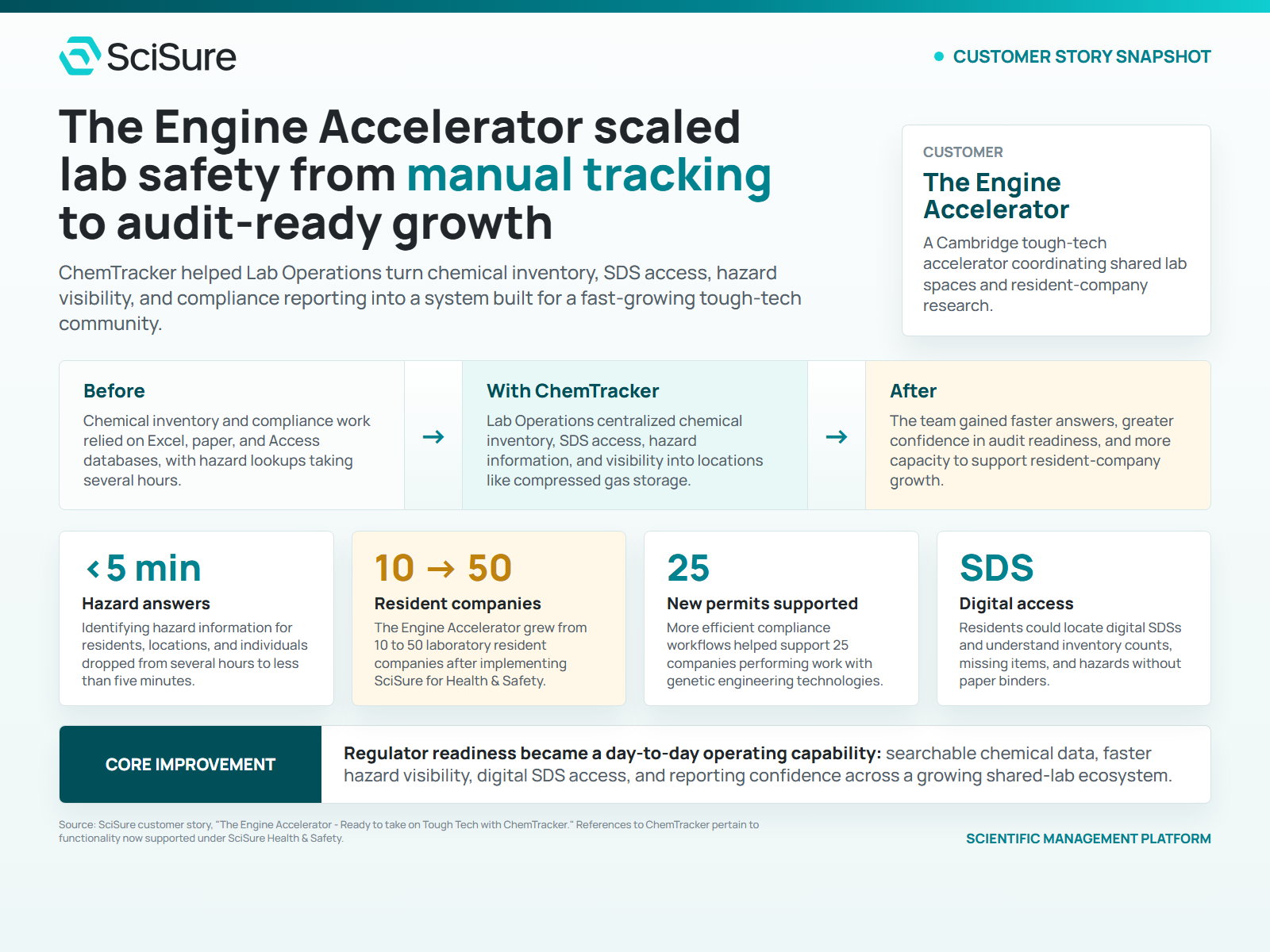
A strong example is The Engine Accelerator, a Cambridge-based tough-tech accelerator supporting resident companies across shared lab environments. Upon implementing SciSure's ChemTracker module, The Engine grew from 10 to 50 laboratory resident companies, while its Lab Operations team had to coordinate chemical inventory, permitting, and compliance across many different research programs.
Before implementation, the team relied on Excel spreadsheets, paper, and Access databases to manage complex lab operations. After adopting ChemTracker, a capability now supported under SciSure's Health & Safety solutions, The Engine improved the process of identifying hazard information for resident companies, locations, and individuals from several hours to less than five minutes. Residents could find digital SDSs instead of relying on paper binders and gain better awareness of the hazards present in their labs.
So when a regulator asks what is in a room, where a compressed gas is located, whether SDSs are accessible, or how your team knows its data is accurate, the answer should come from a system your team already uses every day.
What should you do before the next regulator visit?
Begin your prep by testing whether your team can answer the five questions quickly with records that match the lab, not just with policies that sound good on paper. Start with a short self-audit:
- Pick three rooms and confirm the physical inventory matches your system.
- Search for SDSs by chemical name, CAS number, manufacturer, and product identifier.
- Check whether secondary containers are labeled and still in the right work area.
- Review storage by hazard group, especially flammables, oxidizers, corrosives, reactives, peroxide formers, and compressed gases.
- Confirm who owns HazCom updates, chemical hygiene plan updates, employee training, inspections, and corrective actions.
- Review whether your Tier II, fire code, MAQ, or local reporting workflows use current container data.
The goal is to make your normal process strong enough that an inspection feels like showing your work. Regulators just want proof that your chemical safety program is current, connected, and usable by the people who depend on it.
If your inventory is live, your SDSs are accessible, your labels are readable, your storage decisions are documented, and your emergency response information is easy to share, you are in a much better position to answer confidently. But if those pieces live in separate binders, spreadsheets, inboxes, and institutional memory, the audit will feel harder than it needs to.
If your lab feels more like the latter, get in touch with us. Let's explore how SciSure's Health & Safety features can help you build one that's audit-ready at all times.

5 Common Questions From Chemical Regulators & How to Address Them
Learn the five chemical regulator questions labs hear most often, from inventory accuracy and SDS access to labeling, storage, emergency response, and audit-ready records.
From digital transformation and automation to connected infrastructure and emerging technologies, London Lab Live created an environment full of new ideas, practical insights, and valuable industry conversations.
And aside from exploring Big Ben, the London Eye, and enjoying more British tea than expected, our team spent two incredibly productive days connecting with attendees, partners, and innovators across the industry.
Connecting with the Lab Community
During the London Lab Live, we had conversations with teams across every part of the lab ecosystem, from researchers and lab managers to digital transformation and operations leaders. Many shared similar challenges around fragmented systems, disconnected data, scalability, and preparing labs for a more digital and technology-driven future.
These conversations strongly connected with SciSure’s presentation, delivered by Bjorg Ebbendorf, Key Account Manager at SciSure. The session explored how modern laboratories are evolving toward more connected, scalable, and data-driven environments, with a strong focus on structured data, digital infrastructure, and future-proof lab operations.
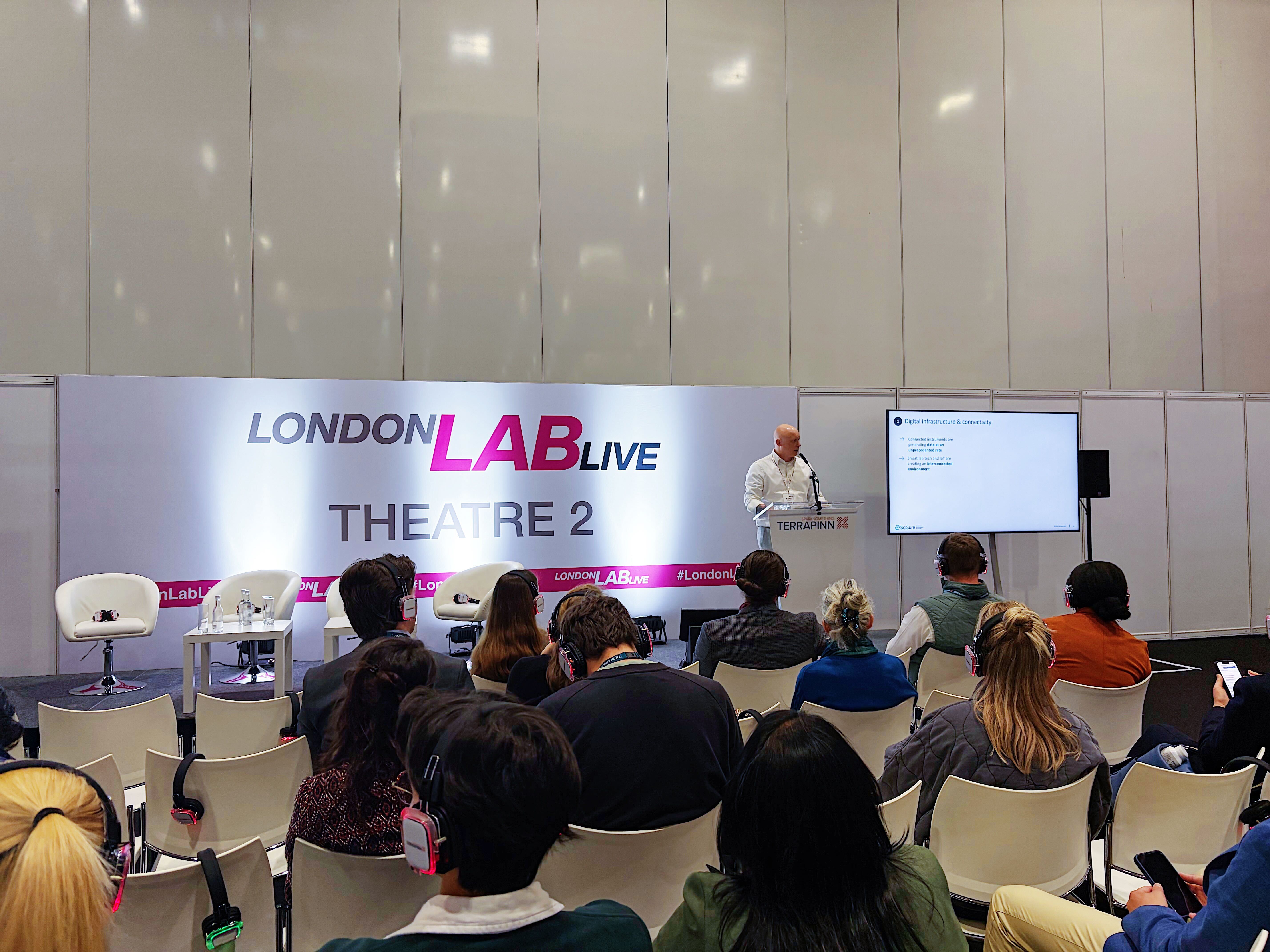
Bjorg shared perspectives on how labs can move away from fragmented workflows and build ecosystems that support interoperability, automation, and more efficient scientific processes. The presentation also emphasized the importance of approaching emerging technologies practically and responsibly, focusing on secure, explainable, and scalable systems that create real operational value inside laboratory environments.
Ultimately, the session reflected a broader industry shift toward more integrated and technology-enabled ways of working across modern labs.
Strengthening Existing Partnerships
One of the best parts of events like London Lab Live is reconnecting with people and organizations we have built relationships with over time.
Between sessions, booth visits, and coffee breaks, we had the chance to catch up with teams from My Green Lab, US Lab Partners, and many other companies working toward more sustainable, scalable, and forward-thinking laboratory environments.
These moments matter just as much as the presentations themselves. They are a reminder that real progress in life sciences does not happen in isolation. It happens through collaboration, shared ideas, and partnerships between people who are all working toward improving the future of modern labs in different ways.

Next Stop: Future Labs Live Basel
One thing events like London Lab Live constantly reinforce is how quickly the laboratory landscape is evolving. Teams are being asked to scale faster, operate smarter, and adapt to new technologies while still maintaining efficiency, compliance, and flexibility.
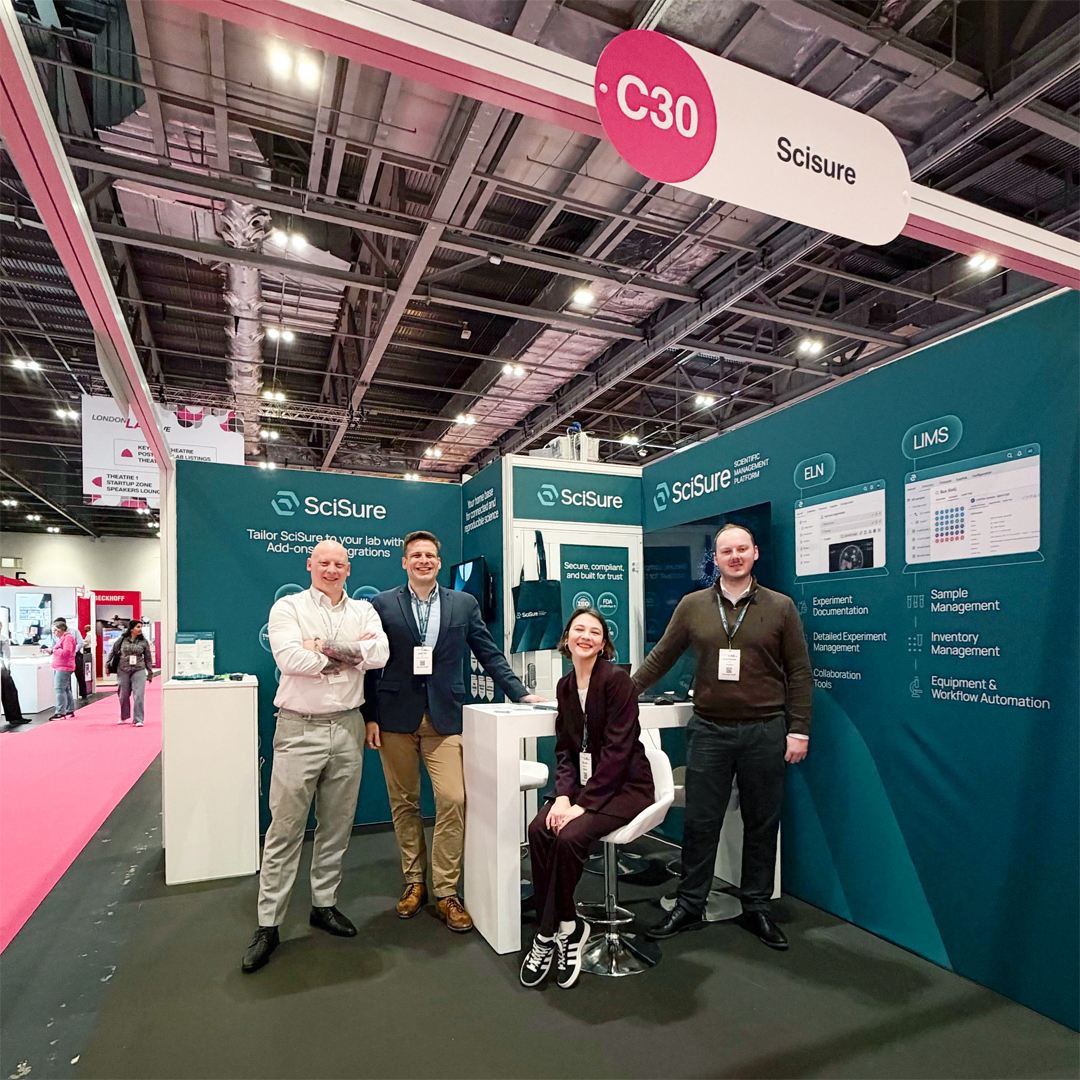
Our next stop: Future Labs Live Basel on 27–28 May. The SciSure team was at Booth 120, continuing conversations around connected lab environments, scalable digital infrastructure, and what future-ready laboratories actually need in practice, not just in theory. Stay tuned for the update!
London Lab Live 2026: Conversations Around the Future of Modern Labs
At the beginning of May, the SciSure team joined London Lab Live 2026, one of the leading events focused on the future of laboratories, life sciences, and scientific innovation.