Which lab platform fits your team?
Both cover experiments, protocols, samples, inventory, and equipment.
The difference is where your data lives.
One platform for research and lab operations
With SciSure, your experiments link to their samples, storage locations, and equipment, and every sample shows the experiments it came from.
Research ELN with built-in project tools
Labguru is a research ELN and LIMS with built-in project coordination tools. For automated, high-volume sample operations, Cenevo pairs it with Mosaic, a separate sample management product.
ELN and LIMS with electronic batch records, chemistry tools, protocols, and lab management.
Built-in project coordination with Gantt charts, calendars, and timers.
High-volume sample operations are offered through the separate Mosaic product.
Hosted on AWS through shared cloud or a dedicated private cloud.
Regional hosting servers are listed for the US, EU, Canada, and UK.
Daily backups are stored on a separate server and Amazon S3.
One Scientific Management Platform
SciSure Research is an ELN and LIMS built for experiments, inventory, and flexible sample tracking, with configurable sample types, sample lineage, and hosting in the cloud, a private cloud, or on your own servers.
One platform for ELN, LIMS, samples, inventory, and equipment.
Protocol variables and formulas, plus freezer heatmaps and free-position search.
No-code automations, Slack and Teams webhooks, an open API, SDK, and Marketplace add-ons.
Health & Safety capabilities are available in North America through private cloud hosting.
Choose cloud, private cloud, or on-premises hosting on your own servers with local data storage.
Regional cloud hosting uses data centers in Europe and North America.
Cloud data is replicated across geographically separated centers, with daily encrypted off-site backups.
SciSure users report payback in 8 months
According to G2 reviewer data, SciSure customers report an estimated ROI of 8 months, compared with 13 months reported for Labguru. That is roughly five months less time before the platform pays for itself.

Source: G2 reviewer-reported estimated ROI.
Figures reflect what reviewers report and vary by lab, scope, and implementation.
Comparing SciSure with Labguru:
Research, samples, and platform
Coordination without a second planning tool
Labguru’s project management tools include Gantt charts with dependencies, calendars, and timers inside experimental steps. SciSure keeps work moving with alerts and tasks that come from the records themselves.
Automations
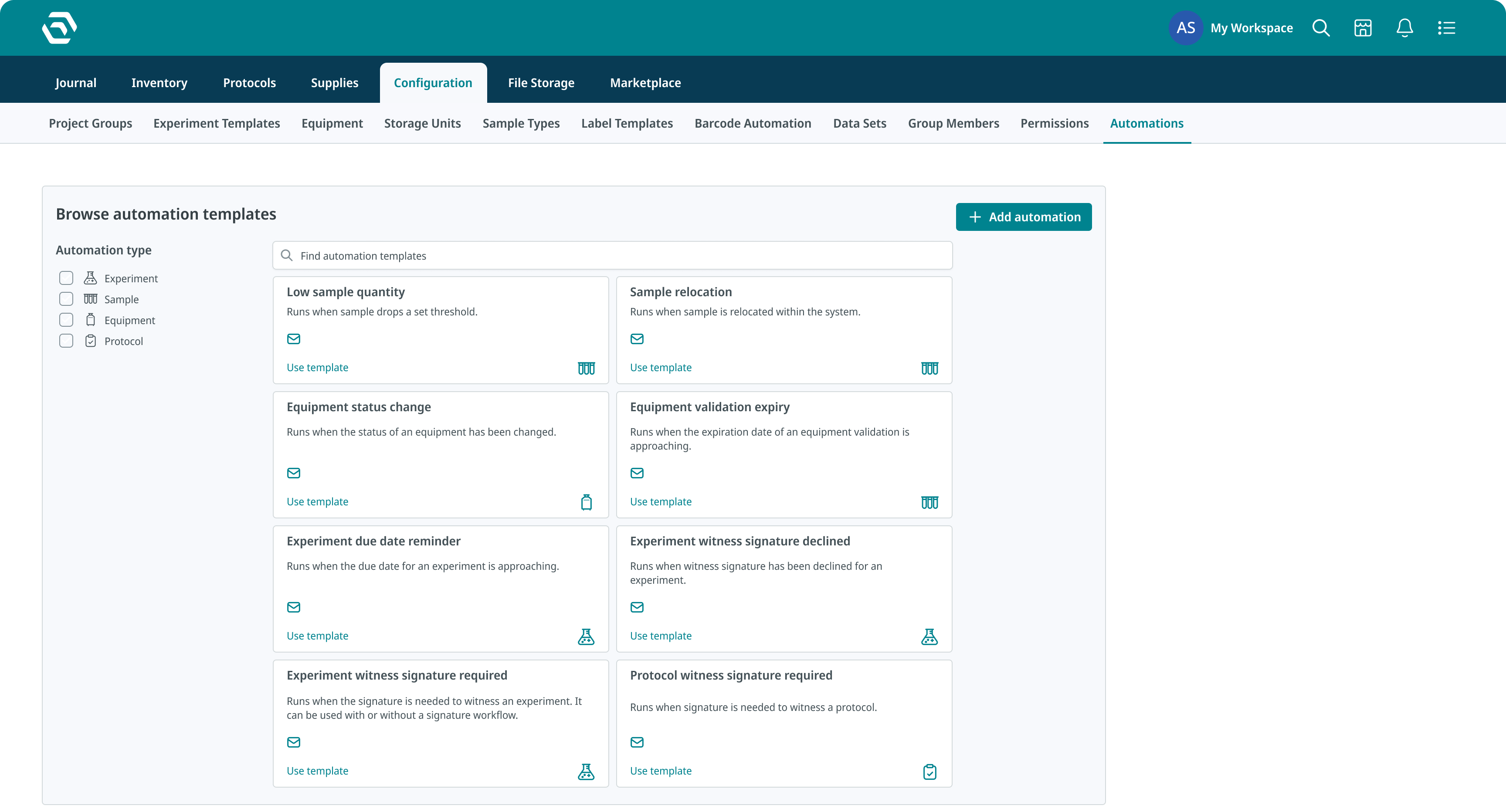
Pick a trigger, add conditions, choose an action. Triggers fire on events, like a field changing, or on time, like a week before a sample expires. Actions send an email, create a task, or post to Slack or Teams. Scheduled notifications arrive as one message, not twelve.
Tasks
[Copy pending in Figma]
Things running out
[Copy pending in Figma]
Work in progress
[Copy pending in Figma]
BUILT ON CUSTOMER TRUST
Recognized across EHS, ELN, and LIMS
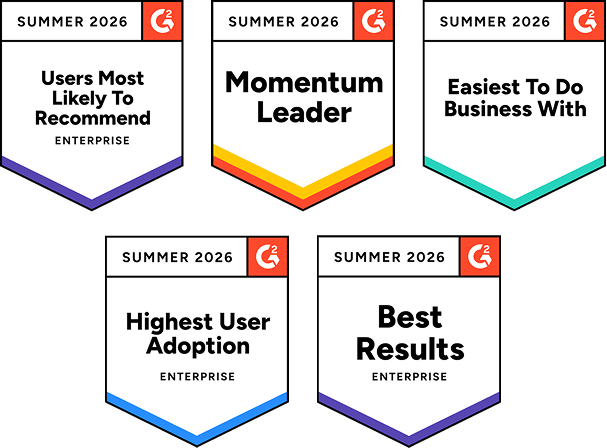
SciSure was recognized in the G2 Spring 2026 Reports across EHS, ELN, LIMS, Lab Inventory Management, Occupational Health and Safety, and EQS.
Hear it from the labs succeeding with SciSure
Labs around the world, just like yours, are connecting the work and data behind modern discovery with SciSure. Swipe through the results they measured.
“SciSure’s intuitive interface and robust tracking capabilities have dramatically streamlined our sample management. What was once a time-consuming task is now a swift and effortless process.”
Department of Translational Medicine

“Other systems are either too broad in scope or too rigid in their setup. SciSure offers a healthy balance of flexible functionality and the ability to customise certain aspects of our workflow without getting overly bogged down in features.”

“SciSure has saved us plenty of time (a 50% improvement) when it comes to tracking and managing samples.”

“SciSure has significantly improved how we manage samples, inventory, and quality documentation in our lab. The platform makes it easy to track samples, manage CoA and SDS documentation for our reagents, and extract data for quality monitoring and reporting.”

Map your workflows with a SciSure specialist
Bring one workflow that costs your team time. We'll walk you through how SciSure adapts to the way you work, not the other way round.
Frequently asked questions
SciSure provides ELN and LIMS in one connected platform, while Labguru and Mosaic are separate, partially integrated products under Cenevo. Both platforms support ELN and LIMS workflows, though SciSure covers research and sample management alongside the safety and compliance programs an EHS team runs, including chemical inventory, SDS, biosafety, training, inspections, and regulatory reporting. Labguru focuses on research and lab management and offers more project coordination tooling plus electronic batch records.
Yes. Both platforms support experiment documentation, reusable protocols, sample and inventory tracking, equipment scheduling, permissions, audit trails, electronic signatures, and API access. Ask each vendor to demonstrate these capabilities using your lab's actual samples, instruments, storage structure, and approval processes.
SciSure, where health and safety is available. It covers container-level chemical inventory, SDS management, biosafety, training, inspections, incidents, waste, and regulatory reporting. Labguru does not currently list an equivalent. Its Chemistry module handles compound management for research, which is a different job from container-level inventory and hazard tracking. Health and safety is currently available to customers in North America. If your lab is outside those markets, or you manage safety in a separate system that works well, compare the two platforms on research and lab operations and ask each vendor how they integrate with what you already run.
SciSure Health & Safety is currently only available to customers in North America; this platform covers the rules and regulations relevant for the US and Canada at present. Research and lab operations (covering SciSure ELN, LIMS, samples, inventory, equipment, protocols, automations, and all hosting models) are available everywhere SciSure sells. If safety coverage matters to your evaluation and you are outside those markets, talk to us before you compare.
No. Mosaic is a separate product from Labguru, under the same Cenevo umbrella. Cenevo was formed when Labguru and Titian Software came together in 2025, and it publishes both under one brand. Mosaic is built for sample-centric lab operations, with Labguru as the experiment-centric ELN, LIMS, and inventory environment. If sample management is part of your evaluation, confirm with your Cenevo rep which product is in your quote, which one holds each record, and how the two connect.
With SciSure, experiments and samples live in the same product. SciSure Research is one system covering the ELN, sample and inventory management, protocols, and equipment, under one group structure, one set of roles and permissions, and one audit trail. Nothing is copied between systems or reconciled afterwards, because there is only one system holding it. Labguru (experiment documentation) and Mosaic (sample management) are separate products under Cenevo. Ask your Cenevo rep which product covers sample management in your proposal and how the two products exchange data. With SciSure, the ELN and sample management are one product, so experiments and samples reference each other directly rather than across a product boundary.
SciSure makes variable parameters and formulas part of the core ELN protocol experience, so your team can adjust experimental settings without rebuilding the procedure or moving calculations into a separate spreadsheet. Labguru supports protocol templates, form elements, and spreadsheets with formulas; automated calculations within forms may require its Workflow Editor add-on. Test a real protocol to see how easily your scientists can adjust inputs while protecting calculation logic.
Yes. SciSure provides an open API, developer SDK, and 40+ Marketplace add-ons. Labguru provides a REST API, Python and R wrappers, and Workflow Editor automation. Compare who will build and maintain each integration, how failures are monitored, and whether additional subscriptions or services are required.
Differently from Labguru. Labguru gives your scientists and managers a planning layer with Gantt charts, dependencies, calendars, tasks, discussions, and bench timers inside experimental steps. SciSure builds coordination into the records: automations that fire on an event or a date, tasks assigned against a specific sample or experiment, quantity thresholds that notify the owner and add the item to the shopping list, and collaborators that pass down from project level to the experiments underneath. If your team wants a project plan they maintain, Labguru gives you one. If you want the system to prompt the next action, SciSure does that without anyone updating a chart.
Confirm which capabilities are native, configured, integrated, or licensed separately. Labguru documents add-on or edition requirements for some capabilities, and Cenevo may propose Mosaic for sample management as a separate offering. Also verify implementation services, hosting options — on-premises is available with SciSure but not Labguru — validation support, data migration, API access, and export formats.
Choose SciSure if you need a hosting model Labguru does not offer, if you want calculations inside the protocol rather than a spreadsheet, or if you want to extend the platform through Marketplace add-ons and an SDK. Where Health & Safety is available, choose SciSure if you also want chemical management, training, and regulatory oversight under one vendor. If your priority is research-centered ELN and LIMS with built-in project coordination, and cloud hosting suits your IT policy, evaluate both platforms against your daily scientific work.
Product information compiled from publicly available vendor documentation. Capabilities can depend on edition, add-ons, implementation, hosting model, and regional availability. Make sure to confirm the details in a configured demonstration. Product names and trademarks belong to their respective owners.