SciSure x protocols.io: When Protocol Management Syncs with Execution

SciSure's protocols.io integration now syncs both ways. Andrew Martin shares what bidirectional protocol management means for reproducibility at the bench.

August 11, 2026
()
min read
A laboratory

Download Whitepaper

By submitting this form, you agree with our Privacy Policy.
Thank you! Download the file by clicking below:
Download
Oops! Something went wrong while submitting the form.

Table of Contents

Thank you! Your submission has been received!
Oops! Something went wrong while submitting the form.

Table of Contents

A postdoc spends years refining the lab's most dependable purification method. The optimizations live in her notebook. The variants that failed live in her memory. Then she takes a position at another institution, and her PI discovers the lab now has to retrain someone in a method nobody else ever fully wrote down.

Many labs have digitalized their results. Far fewer have digitalized the methods that produced them. The ELN captures what happened, the LIMS tracks the samples, and the protocol itself sits in a PDF, in a notebook, or in somebody's head.

SciSure's integration with protocols.io is built for that gap, and its recent upgrade to bidirectional sync changes what protocol management looks like day to day. We spoke with Andrew Martin, Director of Marketplace Integrations at SciSure, about why protocols.io earned its place in the SciSure Marketplace and what shifts for labs when methods and execution finally stay aligned.
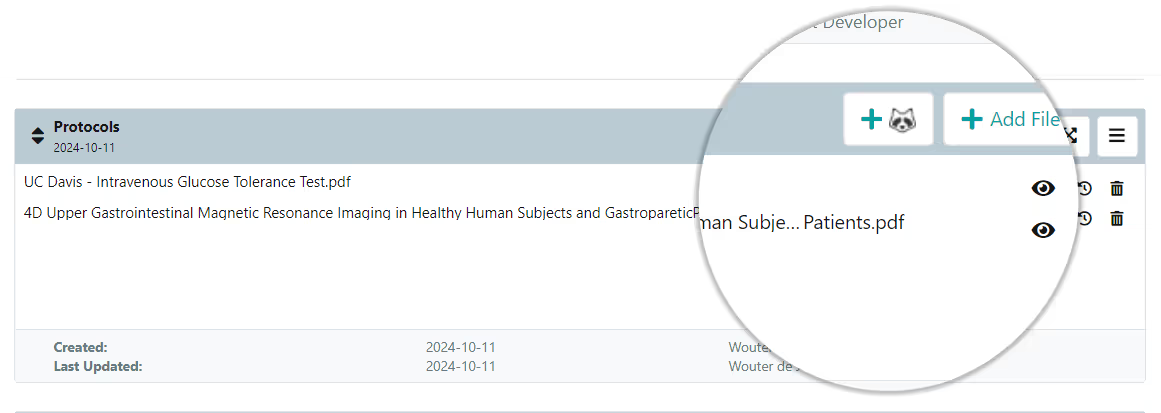
SciSure's protocols.io integration

The pressures squeezing lab protocols

Andrew points to three forces bearing down on labs right now, and protocol management sits at the intersection of all of them.

The first is the state of the published record. Retractions are climbing faster than ever, with more than 10,000 papers retracted in 2023, a record driven largely by AI-generated content, compromised peer review, and paper mills. For a lab that inherited a method from a paper now under question, that raises awkward questions about everything built on top of it.

The second pressure is financial: NIH awarded 8.6% fewer grants in 2025 than in 2024, and with many organizations feeling the squeeze, the arithmetic of a method that works first time becomes hard to ignore.

"If you could start with a protocol that worked at 80% efficiency instead of starting from scratch and it’s working at 30% efficiency, that equates directly to time and money savings, reagent use, all these other things. Why make things harder than it must be if you can get there faster?"

The third pressure has been with labs since labs existed.

"There's always a grad student or a postdoc who's done a lot of the protocol work, and they have all of it in their notes, and it's the magic sauce. And then the person leaves, and now everyone, especially the PI, is like, okay, now what?”

Someone then has to go digging through paper records and piece the method back together. Centralized protocol management makes the reconstruction unnecessary, because the protocol was never in one person's notes to begin with.

SciSure
No more hours wasted scrambling around through lab paperwork.
If your best method currently lives in one person's notebook, that's worth fixing before they hand in their notice. See how protocol management works in SciSure.
Request a demo

How protocols.io earned a place in the Marketplace

SciSure's test for a Marketplace partner starts with the customer rather than the commercial fit.

"What decides a good partner is first and foremost the value we think it brings to our customer: anything we can do to make their workflows easier, their applications smoother."

The second test is whether building it could ever beat integrating it. Even when considering using AI to build for a capability like protocol curation, where a long-established specialist already holds the field, the answer is no, and a user or vendor that tries anyway could end up shipping a weaker version of something its customers can already get.

protocols.io cleared both tests. It is long-established, which matters when a lab is deciding whether to commit its methods to a platform, with an experienced team of class leaders in protocol generation, curation, and monitoring.

What protocols.io brings to SciSure users is a validation model no single vendor could maintain alone. Protocols are drawn from peer-reviewed, published sources, then subjected to continuous feedback from the researchers actually running them.

"What’s special is that the actual researchers are the ones validating, giving a thumbs up-based ranking on what works, allowing the creator and users to comment on protocol, and creating variants of those protocols. Now they have a large database of focused protocols that have branched off from the originals."

A published protocol is a fixed artifact. A protocol that accumulates user ratings, feedback, refinements, and variants tied to specific applications, becomes a living resource, maintained by the whole community running it.
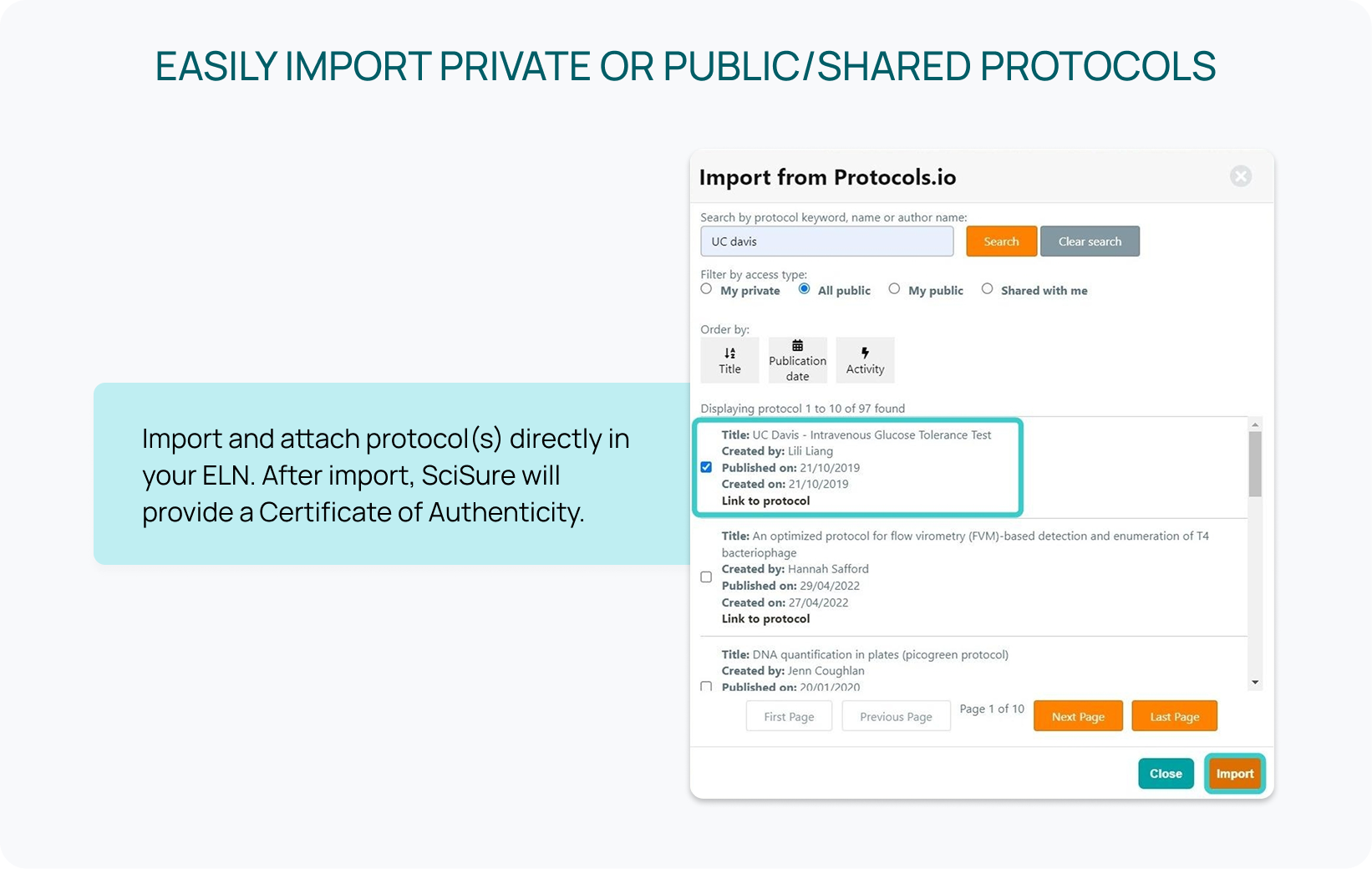
How to import protocols with SciSure

Where SciSure ends and protocols.io begins

SciSure offers protocol management functionality of its own, so the obvious question is where one platform stops and the other starts. Andrew draws the line at specificity.

"Ours are very high level. Most of the crossover would be at making a common buffer or something like this. What protocols.io really offers is a whole other level of clarity around bespoke protocols for a workflow, for an application."

SciSure's key contribution to the partnership is in how it ties the protocols and how they are executed to the system of record.

A protocol tells you what should happen. The SciSure Scientific Management Platform records what actually did: which version of the method was run, by whom, against which samples, drawing on which inventory items, on what date, with every subsequent edit captured in an audit trail. The ELN holds the experiment, the LIMS holds the samples and reagents, and because they sit in one platform, a run is queryable against everything that fed into it.

Say a run that has worked for months suddenly fails:

"You have a protocol that's been working perfectly. The same person runs it, and suddenly it doesn't work. The first thing you question is what you did at the bench."

For most labs, answering that means reconstruction. Find the version of the protocol that was used, dig out the notebook entry, work out which reagent lots were on the shelf that week, and hope whoever ran it is still at the bench to ask.

"The bad reagent costs you some money. What really costs you is the month or two of troubleshooting before you find out that's what it was."

With the method and the execution record in one system, the same question is a quick query. The version, the operator, the samples, and the lot numbers are already attached to the run, so the lab starts from a list of what changed since it last worked.

SciSure
What bidirectional sync changes for version control
Already using protocols.io? Connecting your account takes a few minutes, and your existing protocols come with you. Talk to a specialist and we'll walk you through it.
Request a demo

What bidirectional sync changes for version control

SciSure’s protocols.io integration is now bidirectional, meaning protocols move both ways: a method pulled into SciSure can be refined at the bench and pushed back to protocols.io, and a change made on either platform can be reflected on the other. This is the first bidirectional integration of its kind between protocols.io and Scisure.

With sync now running both ways, protocol version control spans both platforms rather than sitting inside each one. The two systems keep doing different jobs.

"protocols.io stays nice and clean: the original, v1, v2, v3. Ours shows the version you're using right now, and the audit trail shows every change if you ever need to go back and see what happened."

protocols.io holds the published lineage of a method, versioned deliberately, in a form other labs can find and cite. SciSure holds the working copy and the full record of how it got there. Neither is a stale duplicate of the other.

At the bench, this mostly shows up as efficiency. No exporting, no re-uploading, no wondering which of two files is current, no reconciling a colleague's edits by hand. Connecting the two accounts is a setup step rather than an IT project, and protocol management then happens wherever the work is happening.

From bench to publication

A protocol's usefulness doesn't end at the last run. When a project reaches write-up, the experimental section has to be reconstructed from whatever the lab happened to record.

"You've got a result and now it's time to publish, and it becomes: let's get all this together. This lets you structure it toward publication quality, rather than pulling it out of a traditional notebook with all the notes and pieces in there."

The integration also lets researchers publish protocols on protocols.io directly, share them publicly, and generate DOIs for citation; a capability that came directly from user demand.

That has a direct bearing on reproducibility. Most published methods sections are too thin to work from: the concentrations, timings, and small corrections that made the experiment run tend not to survive the edit. A protocol published with its full version history, its feedback from other labs, and a DOI attached carries all of it, and another lab can follow it as written.

"The proof comes from the wet lab bench. Did this work for the step I did in this protocol? If the protocol works, you have confidence that your purification went correctly."

Confidence at that level compounds. Each step someone else can reproduce is one fewer place a result can quietly fail.

A self-healing loop

Looking at the bigger picture, protocols.io, SciSure, and the researchers using both are working together in a loop that strengthens with every cycle.

"A customer works out what they want to run. They load the protocols they need into our system. We track how those experiments go. And full circle: stronger protocols back in protocols.io, based on those results. Eventually you get this nice self-healing loop."

Each turn of that loop improves the resource the next lab draws on. A method that has been run, tracked, refined, and pushed back is worth more than the version that was published, and the labs contributing the refinements are the ones that had to make them work.  

Where that leads is still open, but the direction Andrew sees is a future resource that can be queried rather than browsed.

"Everyone's making small edits to protocols all the time. What if you could pull from that base and get a suggestion: here's a protocol that's mostly the same, with these specific changes, based on what's in your experiment?"

In this scenario, a lab working on a particular gene in a particular cell type could draw on the version of a method that reflects what has already worked in that context, rather than a generic starting point that requires optimization.

Best in class, end to end

For SciSure users, the protocols.io integration unlocks a host of practical capabilities: trusted, community-validated protocols available inside the ELN, version control that holds across both platforms, an execution record that ties each run to its samples and reagents, and a route from bench to published, citable method.

"protocols.io are the class leaders in protocol generation, curation, and monitoring. We had customers who wanted to work with them, and our users stated how this would help their lab work and lab workflows, so we brought them into our marketplace ecosystem.”

That is the core mission of SciSure’s Marketplace model, and it runs the full length of a lab's operations: training and health and safety at one end, hazardous waste at the other, with anything your research demands in between. SciSure builds the core platform and the system of record; the specialists handle their segments.

"I want the users to tell us what they want, and we just enable it. That's what gets me excited."

The choice of tools is up to you. Pick your sequencing platform, your analysis software, your protocol library, and let the system of record connect them.

Explore the SciSure Marketplace to see what else connects to your lab, or talk to a specialist today to learn more about the protocols.io integration.

Ready to see SciSure in action?

Get a personalized demo and see how SciSure fits your lab's workflows.
Request demo

No commitment · Free consultation

A postdoc spends years refining the lab's most dependable purification method. The optimizations live in her notebook. The variants that failed live in her memory. Then she takes a position at another institution, and her PI discovers the lab now has to retrain someone in a method nobody else ever fully wrote down.

Many labs have digitalized their results. Far fewer have digitalized the methods that produced them. The ELN captures what happened, the LIMS tracks the samples, and the protocol itself sits in a PDF, in a notebook, or in somebody's head.

SciSure's integration with protocols.io is built for that gap, and its recent upgrade to bidirectional sync changes what protocol management looks like day to day. We spoke with Andrew Martin, Director of Marketplace Integrations at SciSure, about why protocols.io earned its place in the SciSure Marketplace and what shifts for labs when methods and execution finally stay aligned.

SciSure's protocols.io integration

The pressures squeezing lab protocols

Andrew points to three forces bearing down on labs right now, and protocol management sits at the intersection of all of them.

The first is the state of the published record. Retractions are climbing faster than ever, with more than 10,000 papers retracted in 2023, a record driven largely by AI-generated content, compromised peer review, and paper mills. For a lab that inherited a method from a paper now under question, that raises awkward questions about everything built on top of it.

The second pressure is financial: NIH awarded 8.6% fewer grants in 2025 than in 2024, and with many organizations feeling the squeeze, the arithmetic of a method that works first time becomes hard to ignore.

"If you could start with a protocol that worked at 80% efficiency instead of starting from scratch and it’s working at 30% efficiency, that equates directly to time and money savings, reagent use, all these other things. Why make things harder than it must be if you can get there faster?"

The third pressure has been with labs since labs existed.

"There's always a grad student or a postdoc who's done a lot of the protocol work, and they have all of it in their notes, and it's the magic sauce. And then the person leaves, and now everyone, especially the PI, is like, okay, now what?”

Someone then has to go digging through paper records and piece the method back together. Centralized protocol management makes the reconstruction unnecessary, because the protocol was never in one person's notes to begin with.

SciSure
No more hours wasted scrambling around through lab paperwork.
If your best method currently lives in one person's notebook, that's worth fixing before they hand in their notice. See how protocol management works in SciSure.
Request a demo

How protocols.io earned a place in the Marketplace

SciSure's test for a Marketplace partner starts with the customer rather than the commercial fit.

"What decides a good partner is first and foremost the value we think it brings to our customer: anything we can do to make their workflows easier, their applications smoother."

The second test is whether building it could ever beat integrating it. Even when considering using AI to build for a capability like protocol curation, where a long-established specialist already holds the field, the answer is no, and a user or vendor that tries anyway could end up shipping a weaker version of something its customers can already get.

protocols.io cleared both tests. It is long-established, which matters when a lab is deciding whether to commit its methods to a platform, with an experienced team of class leaders in protocol generation, curation, and monitoring.

What protocols.io brings to SciSure users is a validation model no single vendor could maintain alone. Protocols are drawn from peer-reviewed, published sources, then subjected to continuous feedback from the researchers actually running them.

"What’s special is that the actual researchers are the ones validating, giving a thumbs up-based ranking on what works, allowing the creator and users to comment on protocol, and creating variants of those protocols. Now they have a large database of focused protocols that have branched off from the originals."

A published protocol is a fixed artifact. A protocol that accumulates user ratings, feedback, refinements, and variants tied to specific applications, becomes a living resource, maintained by the whole community running it.

How to import protocols with SciSure

Where SciSure ends and protocols.io begins

SciSure offers protocol management functionality of its own, so the obvious question is where one platform stops and the other starts. Andrew draws the line at specificity.

"Ours are very high level. Most of the crossover would be at making a common buffer or something like this. What protocols.io really offers is a whole other level of clarity around bespoke protocols for a workflow, for an application."

SciSure's key contribution to the partnership is in how it ties the protocols and how they are executed to the system of record.

A protocol tells you what should happen. The SciSure Scientific Management Platform records what actually did: which version of the method was run, by whom, against which samples, drawing on which inventory items, on what date, with every subsequent edit captured in an audit trail. The ELN holds the experiment, the LIMS holds the samples and reagents, and because they sit in one platform, a run is queryable against everything that fed into it.

Say a run that has worked for months suddenly fails:

"You have a protocol that's been working perfectly. The same person runs it, and suddenly it doesn't work. The first thing you question is what you did at the bench."

For most labs, answering that means reconstruction. Find the version of the protocol that was used, dig out the notebook entry, work out which reagent lots were on the shelf that week, and hope whoever ran it is still at the bench to ask.

"The bad reagent costs you some money. What really costs you is the month or two of troubleshooting before you find out that's what it was."

With the method and the execution record in one system, the same question is a quick query. The version, the operator, the samples, and the lot numbers are already attached to the run, so the lab starts from a list of what changed since it last worked.

SciSure
What bidirectional sync changes for version control
Already using protocols.io? Connecting your account takes a few minutes, and your existing protocols come with you. Talk to a specialist and we'll walk you through it.
Request a demo

What bidirectional sync changes for version control

SciSure’s protocols.io integration is now bidirectional, meaning protocols move both ways: a method pulled into SciSure can be refined at the bench and pushed back to protocols.io, and a change made on either platform can be reflected on the other. This is the first bidirectional integration of its kind between protocols.io and Scisure.

With sync now running both ways, protocol version control spans both platforms rather than sitting inside each one. The two systems keep doing different jobs.

"protocols.io stays nice and clean: the original, v1, v2, v3. Ours shows the version you're using right now, and the audit trail shows every change if you ever need to go back and see what happened."

protocols.io holds the published lineage of a method, versioned deliberately, in a form other labs can find and cite. SciSure holds the working copy and the full record of how it got there. Neither is a stale duplicate of the other.

At the bench, this mostly shows up as efficiency. No exporting, no re-uploading, no wondering which of two files is current, no reconciling a colleague's edits by hand. Connecting the two accounts is a setup step rather than an IT project, and protocol management then happens wherever the work is happening.

From bench to publication

A protocol's usefulness doesn't end at the last run. When a project reaches write-up, the experimental section has to be reconstructed from whatever the lab happened to record.

"You've got a result and now it's time to publish, and it becomes: let's get all this together. This lets you structure it toward publication quality, rather than pulling it out of a traditional notebook with all the notes and pieces in there."

The integration also lets researchers publish protocols on protocols.io directly, share them publicly, and generate DOIs for citation; a capability that came directly from user demand.

That has a direct bearing on reproducibility. Most published methods sections are too thin to work from: the concentrations, timings, and small corrections that made the experiment run tend not to survive the edit. A protocol published with its full version history, its feedback from other labs, and a DOI attached carries all of it, and another lab can follow it as written.

"The proof comes from the wet lab bench. Did this work for the step I did in this protocol? If the protocol works, you have confidence that your purification went correctly."

Confidence at that level compounds. Each step someone else can reproduce is one fewer place a result can quietly fail.

A self-healing loop

Looking at the bigger picture, protocols.io, SciSure, and the researchers using both are working together in a loop that strengthens with every cycle.

"A customer works out what they want to run. They load the protocols they need into our system. We track how those experiments go. And full circle: stronger protocols back in protocols.io, based on those results. Eventually you get this nice self-healing loop."

Each turn of that loop improves the resource the next lab draws on. A method that has been run, tracked, refined, and pushed back is worth more than the version that was published, and the labs contributing the refinements are the ones that had to make them work.  

Where that leads is still open, but the direction Andrew sees is a future resource that can be queried rather than browsed.

"Everyone's making small edits to protocols all the time. What if you could pull from that base and get a suggestion: here's a protocol that's mostly the same, with these specific changes, based on what's in your experiment?"

In this scenario, a lab working on a particular gene in a particular cell type could draw on the version of a method that reflects what has already worked in that context, rather than a generic starting point that requires optimization.

Best in class, end to end

For SciSure users, the protocols.io integration unlocks a host of practical capabilities: trusted, community-validated protocols available inside the ELN, version control that holds across both platforms, an execution record that ties each run to its samples and reagents, and a route from bench to published, citable method.

"protocols.io are the class leaders in protocol generation, curation, and monitoring. We had customers who wanted to work with them, and our users stated how this would help their lab work and lab workflows, so we brought them into our marketplace ecosystem.”

That is the core mission of SciSure’s Marketplace model, and it runs the full length of a lab's operations: training and health and safety at one end, hazardous waste at the other, with anything your research demands in between. SciSure builds the core platform and the system of record; the specialists handle their segments.

"I want the users to tell us what they want, and we just enable it. That's what gets me excited."

The choice of tools is up to you. Pick your sequencing platform, your analysis software, your protocol library, and let the system of record connect them.

Explore the SciSure Marketplace to see what else connects to your lab, or talk to a specialist today to learn more about the protocols.io integration.

About the author:

Andrew Martin

Andrew “AJ” Martin is General Manager and Director of Marketplace Development at SciSure, where he leads the buildout of a connected scientific data ecosystem and partner marketplace. With over 15 years of experience across life sciences, he brings a unique blend of scientific training, commercial strategy, and technical fluency to drive growth, partnerships, and innovation.

See all posts from this author

Melde dich für unseren Newsletter an

Holen Sie sich die neuesten Tipps, Artikel und exklusiven Inhalte zum modernen Labormanagement in Ihren Posteingang.
Danke! Deine Einreichung ist eingegangen!
Please check your email to verify your submission.
Hoppla! Beim Absenden des Formulars ist etwas schief gelaufen.