The 5 Top Rated EHS Software Solutions for Enterprise Labs in 2026
Five platforms that research organizations often consider for enterprise lab EHS, evaluated on how well they fit real lab operations and the main problems your lab might encounter.
Download Whitepaper
TL;DR
SciSure is the best EHS software for labs in 2026 for research organizations that need enterprise chemical inventory, SDS management, and lab EHS governance, followed by SafetyStratus, Benchmark Gensuite, CampusOptics, and EHSA for narrower use cases.
- The five platforms.
The shortlist covers SciSure, a Scientific Management Platform with enterprise-grade chemical inventory depth and native ELN/LIMS integration; Ideagen SafetyStratus for multi-department safety processes; CampusOptics for mobile safety execution; Benchmark Gensuite for EHS, ESG, quality, and operational risk, and the EH&S Assistant (EHSA) by On Site Systems for modular, permit-based radiation, chemical, and biological safety.
- How we ranked them.
SciSure scored all five using public product documentation, G2 and Capterra reviews where available, and community-driven reviews. A standardized rubric covered chemical inventory and SDS depth, hazard, MAQ, and fire code visibility, biosafety, inspections and training, research connectivity, and multi-site governance.
- What the reviews show.
As of June 2026, SciSure holds 4.2 on G2 (194 reviews) and 4.3 on Capterra (100 reviews), the deepest lab-specific review base here. SafetyStratus shows 4.8 on Capterra (4 reviews) and 4.5 on G2 (5 reviews). Benchmark Gensuite holds 4.3 on Capterra (80+ reviews). CampusOptics and EHSA sell direct, with limited public reviews.
- Lab fit vs general EHS.
General industrial EHS software centers on facilities, workers, and incidents. Labs need container-level chemical inventory, SDS matching, MAQ and fire code visibility, biosafety, and permit-based radiation programs. Among the five, only SciSure ties safety to native ELN and LIMS, so inventory, equipment, samples, and inspections sit alongside research records.
Ready to see SciSure in action?
No commitment · Free consultation
Why labs need EHS software
EHS software for labs gives research organizations a digital system for managing chemical inventory, SDS records, inspections, training, incidents, hazardous waste, and biosafety workflows in one coordinated environment. It’s built primarily to address the challenges of growing labs that expand from small teams to complex, multi-site organizations, with growing compliance needs to match.
Because as labs grow, so do their safety obligations: chemical inventories expand, hazardous materials move between rooms, training requirements multiply, inspections become more frequent, and biological or radiation work may introduce additional permits and approvals. Each of these responsibilities is manageable on its own, but together, they grow harder to track if this data is scattered across multiple systems, if properly documented at all.
Without this kind of structure, inventory counts may drift out of date, SDS documents may go missing, training may lapse without anyone noticing, a chemical can sit in the wrong room past a fire-code threshold, or inspection findings may remain open long after the walkthrough is done. For institutions, those gaps can lead to failed inspections, fire-code violations, fines, and risk exposure for the people doing the research. Patching the problem with multiple disconnected tools adds its own cost: duplicate licenses, separate onboarding, time wasted because of manual reconciliation, and audit gaps between systems.
With an EHS software platform, you replace that patchwork with a clear record of what’s in your lab, who’s completed their training (and who hasn’t), what’s been inspected (and what hasn’t), and what still needs to be fixed.
Can general industrial EHS software work for labs?
Sometimes, but not always on its own. General industrial EHS software is usually built around facilities, workers, incidents, and corporate reporting. Lab environments need more specialized depth: container-level chemical inventory, SDS management, hazard classifications, MAQ and fire code visibility, biosafety workflows, radiation or permit-based programs, and in many cases a connection between safety data and the research it relates to.
That’s why the best EHS software for labs in 2026 is the one that fits how your lab actually works, from the chemical on the shelf to the inspection finding that has to be closed before research continues. This guide compares five platforms that research organizations often evaluate:
- Ideagen SafetyStratus
- Benchmark Gensuite
- CampusOptics
- EH&S Assistant (EHSA) by On Site Systems
Some of these were built specifically for the bench. Some of these were built for campus-wide or enterprise safety programs that happen to include labs. That difference is the lens this guide uses throughout.
How we evaluated these platforms
This analysis draws on public product documentation, customer reviews on G2 and Capterra where available, and community-driven reviews from users who encounter these products in real evaluations.
We applied a standardized rubric across the same dimensions for each vendor:
- Chemical inventory and SDS depth
- Hazard classification, MAQ, and fire code visibility
- Biosafety and specialized research safety workflows
- Inspections, audits, training, and incident management
- Hazardous waste tracking
- Research connectivity across ELN, LIMS, inventory, and equipment
- Deployment, permissions, reporting, and multi-site governance
The most useful distinction was a simple one: head-to-head depth versus full-suite breadth. A platform may look strong when sold as a broad institutional system, but labs often feel the difference later during reconciliation, inspections, audits, or integration work.
Important: CampusOptics and EHSA have limited public review-site presence compared with the other vendors. That’s not a quality signal in either direction. It just means public reviews cannot carry the comparison on their own, so product documentation and rubric-based evaluation matter more for those entries.
Full disclosure: SciSure publishes this guide and is one of the platforms compared, with context transparent.
The 5 best EHS software platforms for labs in 2026
1. SciSure: Best for enterprise chemical inventory & lab EHS governance
SciSure is the Scientific Management Platform formed through the merger of SciShield, the lab EHS platform, and eLabNext, the digital lab platform. It brings ELN, LIMS, Health & Safety, and integrations together under one platform strategy. This helps research, EHS, LabOps, and IT teams reduce silos across lab operations and compliance workflows.
For EHS teams, SciSure's strongest claim is chemical inventory at the institutional scale. Its ChemTracker heritage gives chemical-heavy organizations:
- Container-level inventory,
- Barcode and RFID workflows,
- SDS auto-match,
- Hazard and regulatory data,
- MAQ and fire code reports,
- Tier II/RTK reporting support,
- and role-based visibility across labs, buildings, and groups.
That makes SciSure a fit both for single lab rollouts, as well as for larger, enterprise-level institutions, including universities, research institutes, biotech networks, and incubators. All organizations that need a reliable chemical system of record across many spaces.
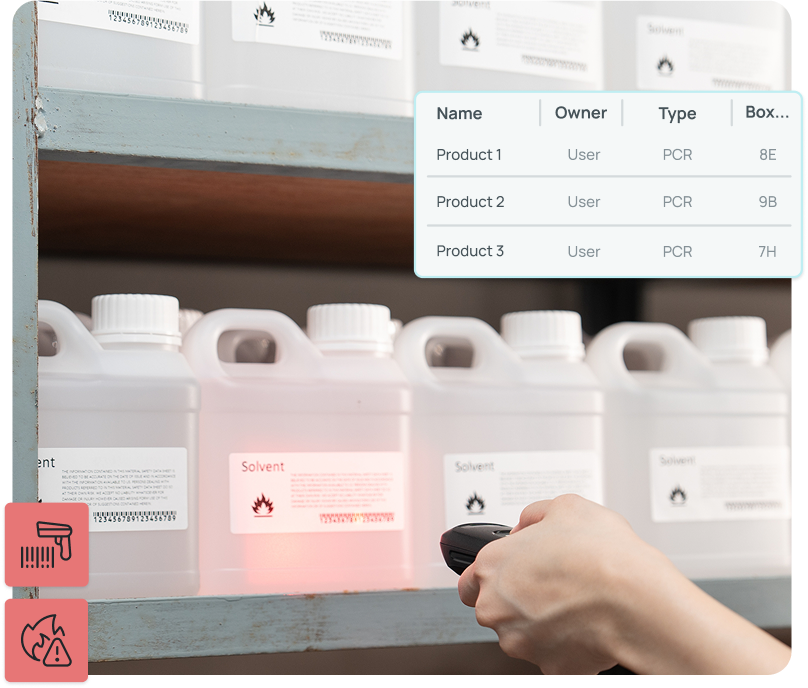
SciSure's chemical inventory approach is built around the operational chain that keeps inventory usable over time: intake, chemical profiles, and compliance.
Intake tools help teams add and reconcile containers using barcodes, RFID, spreadsheet import, and ChemSnap AI photo capture. Chemical profiles connect container records to a central ChemTracker database of hazard and regulatory information, with support for mixtures, commercial products, kits, compressed gases, local chemicals, and SDS attachments. Compliance workflows turn that data into practical outputs for EHS teams, including By Regulation reports, Federal Tier II/RTK-style reporting, NFPA reporting, Fire Code reports, Fire Code Chemical Listings, and control-area MAQ visibility.
As of June 2026:
- G2 lists SciSure, formerly eLabNext and SciShield, at 4.2 out of 5 across 200 reviews
- Capterra lists SciSure at 4.3 out of 5 across 100 reviews
Review examples highlight the compliance dashboard, SDS auto-match, inventory and experiment connectivity, and responsive support.
What kind of labs is SciSure the best lab safety software platform for?
SciSure's primarily EHS value is the depth and governance of its chemical inventory foundation; that's why it's the best fit as a focused EHS solution for chemical intelligence, inspections, training, hazardous waste, incidents, biosafety, and lab compliance. It can also support a broader scientific management model where Health & Safety sits alongside native ELN and LIMS capabilities.
Here’s a story that shows why this matters at scale: MIT’s Engine Accelerator grew from 10 to 50 laboratory resident companies after implementing SciSure for Health & Safety, replacing Excel, paper, and Access-based workflows. With ChemTracker, the team reduced hazard-information lookups from several hours to less than five minutes, improved confidence in hazardous chemical data, and expanded its ability to support genetic engineering permitting across resident companies.
SmartLabs likewise shows the same chemical-inventory depth in a multi-site lab operations environment. The team implemented SciSure for chemical inventory, SDS, inspections, equipment management, biosafety, and medical surveillance. Its EHS team reported that:
- Inventory search dropped from about 15 minutes to 1-2 minutes
- Inventory reconciliation for an entire research center could be completed in as little as 20 minutes
- Inventory reporting fell from roughly 30 minutes to about one minute.

Before vs. After SciSure: chemical inventory at scale
Two customer stories show the same operational pattern: less manual reporting, faster hazard visibility, and lab operations that can scale across more people, spaces, and workflows.
- Hazard lookups became near-immediate.
- Scaled from 10 to 50 resident companies.
- Search: 15 min to 1-2 min.
- Reconciliation: all day to 20 min.
- Reporting: 30 min to 1 min.
Best for: Universities, research institutes, biotech and pharmaceutical organizations, government labs, incubators, and multi-site research organizations that need enterprise-grade chemical inventory, SDS, MAQ/fire code visibility, reporting, and lab EHS governance across many labs, buildings, groups, and permissions.
2. Ideagen SafetyStratus: Built for standardized safety processes
Ideagen SafetyStratus is a web-based EHS platform used across construction and general industry. Its strength is breadth across institutional safety programs: inspections, observations, job safety and hazard analyses, incident reporting, protocol tracking, chemical inventory, training assignment, hazardous or regulated waste, occupational health, radiation management, barcode and RFID support, and mobile workflows.
SafetyStratus is especially strong for institutions that need to standardize safety processes across many groups and departments. It includes tools for inspections and observations, incident management, hazardous and regulated waste, LATCH for laboratory assessments and chemical hygiene planning, metrics, permit authorizations, and mobile access.
As of June 2026:
- Capterra lists SafetyStratus at 4.8 out of 5 across 4 reviews.
- G2 lists Ideagen SafetyStratus at 4.5 out of 5 across 5 reviews.
The review base is small, but examples point to customer service, configurability, and self-inspection rollout.
Best for: Multi-department institutions that want to standardize inspections, observations, training, incident reporting, protocols, and chemical inventory across many groups, with mobile and field workflows built in.
3. Benchmark Gensuite: Built for EHS & ESG reporting in one system
Benchmark Gensuite is an EHS, sustainability, quality, and operational risk platform built for large, complex organizations. Its public positioning is strongly enterprise-focused: global safety programs, environmental compliance, sustainability, ESG reporting, quality, product stewardship, supply chain risk, and operational risk.
Benchmark Gensuite comes with embedded AI features, a mobile-first field experience, broad reporting and analytics, and enterprise-scale governance. Benchmark publicly states that it serves large global programs across many industries, with 25,000+ subscriber sites, millions of users or workers served globally, and a presence in 150 countries.
Its EHS and sustainability positioning is especially relevant for organizations that need EHS and ESG reporting in one system. Benchmark's sustainability and disclosure tools support frameworks such as CSRD/ESRS, CDP, GRI, TCFD, BRSR, and related mandates.
As of June 2026:
- Capterra lists Benchmark Gensuite EHS at 4.3 out of 5 across more than 80 reviews.
- G2's Benchmark Gensuite seller page lists 4.0 out of 5 across 13 reviews, with Benchmark Gensuite EHS representing most of those reviews.
Review examples mention all-in-one scope, incident tracking, compliance calendars, analytics, mobile access, responsive service, embedded AI, and QR-code access for external workers.
Best for: Large industrial, corporate, and multi-site enterprises that want EHS together with ESG, sustainability, quality, and operational risk in one enterprise system, especially where labs are one part of a larger global safety program.
4. CampusOptics: Best for mobile safety execution & emergency preparedness
CampusOptics publicly positions itself as a cross-functional EHS and Fire & Life Safety platform for higher education. Its key differentiator includes mobile-friendly workflows, while also offering chemical inventory and SDS management, hazardous waste, safety inspections, issue remediation, asset management, incident management, training, compliance calendars, permits, protocol management, radiation safety, emergency pre-plans, occupational safety, and hazard assessments.
The clearest fit is structured campus safety workflow management. CampusOptics provides a practical system for coordinating forms, records, inspections, findings, corrective actions, assets, permits, calendars, emergency plans, and reporting across buildings, labs, safety assets, and field teams. That makes it especially relevant when EHS, Fire & Life Safety, emergency management, and facilities-adjacent safety teams need one place to plan work, document tasks, route issues, and keep operational records current.
Mobile usability is a central part of CampusOptics' positioning. Their public documentation highlights iOS and Android access to chemical inventory, hazardous waste containers, inspections, safety assets, incident records, emergency plans, SDS, floor plans, and product documentation. It also emphasizes bar and QR code scanning, in-app photos and video, talk-to-text entry, interactive maps, compliance calendars, inspection templates, and dynamic emergency pre-plans.
For chemical inventory, CampusOptics includes chemical hazard data, SDS association, mobile barcode or QR scanning, mobile updates to chemical containers, conversion of chemicals into hazardous waste, multi-scan reconciliation, reporting on selected chemical categories, control-area filtering, and campus mapping of chemical locations.
Because CampusOptics sells direct and has limited public review-site presence, this section relies more heavily on public product documentation and rubric-based evaluation. In our internal evaluation, it aligned strongly to mobile usability, field inspections, safety asset visibility, issue remediation, emergency planning, compliance calendars, permits, and mapping across buildings and safety programs.
Best for: EHS, Fire & Life Safety, emergency management, and facilities-adjacent safety teams that want structured operational workflows and mobile execution for inspections, safety assets, incidents, corrective actions, emergency pre-plans, compliance calendars, maps, and bar/QR workflows.
5. EH&S Assistant (EHSA) by On Site Systems: Built for specialized regulatory programs
The Environmental Health & Safety Assistant, usually called EHSA, is a modular EH&S suite from On Site Systems. On Site Systems states that it has worked in EH&S software since the 1980s, and EHSA has grown from a radioisotope-tracking database into a broader suite for radiation, chemical, biological, waste, inspections, training, and other EHS workflows.
EHSA's Radiation, Chemical, and Biological Safety Assistant modules form the backbone of the system. On Site Systems describes these modules as permit-based, linking personnel, locations, inventory, and equipment data. Clients can buy the modules they need, making EHSA well suited to institutions with specialized regulatory programs.
EHSA is used across universities and research institutions for radiation safety, chemical safety, biological safety, hazardous waste pickup requests, inspections, training, and related compliance records. It has little public review-site presence, so there’s no G2 or Capterra score to cite.
Much like CampusOptics, EHSA has limited public review-site presence. In our internal evaluation, it aligned strongly to institutional EHS administration, regulatory documentation, inspections, incident management, permit-based safety records, and radiation, chemical, and biological safety programs.
Best for: Research universities and institutions with significant radiation, biological, and chemical safety programs that want a modular, permit-driven compliance system they can scale module by module.
Lab EHS Software Comparison
How to choose the right lab EHS software
Start with the problem you’re trying to solve rather than the longest feature list.
If chemical inventory accuracy, SDS access, MAQ/fire code visibility, Tier II/RTK readiness, and cross-lab governance are your biggest EHS problems, SciSure is the strongest fit. Its ChemTracker foundation is built for container-level inventory, barcode and RFID workflows, ChemSnap AI intake, database-backed hazard and regulatory profiles, SDS auto-match, control-area reporting, and institutional oversight. Learn more about the results from 30+ labs having implemented SciSure's Health & Safety features and how they improved their adoption, efficiency, and engagement metrics.

If every department runs its own inspection forms, training processes, and incident workflows, Ideagen SafetyStratus is built to standardize safety programs across many groups at once.
If you need to report EHS and ESG together across many facilities for corporate or regulatory requirements such as CSRD, Benchmark Gensuite is built for that broader enterprise model.
If your highest-friction work is field execution, such as inspections, asset checks, incident logging, emergency pre-plans, building maps, mobile document access, and bar/QR scanning, CampusOptics is oriented around mobile EHS and Fire & Life Safety workflows.
If you manage regulated radiation, chemical, and biological safety programs and want a permit-based system you can adopt module by module, EHSA may fit that institutional need.
For chemical-heavy labs, evaluate inventory depth carefully. This is where day-to-day safety and audit readiness are often won or lost. Container-level tracking, SDS management, hazard and regulatory profiles, MAQ visibility, fire code reporting, barcode or RFID reconciliation, audit trails, and Tier II reporting can make a major difference once inventory scales.
Here's a non-exhaustive list of SciSure's chemical inventory features and how they can help your team.
What matters most when comparing lab EHS software
Chemical inventory depth
For chemical-heavy labs, inventory is the operational record that supports inspections, fire code reporting, SDS management, waste tracking, emergency preparedness, and audit readiness. Look for container-level tracking, bulk intake and reconciliation, automated SDS matching, hazard and regulatory data, MAQ and fire code visibility, Tier II/RTK reporting, and barcode or RFID workflows.
Adjacent lab-system connectivity
Some EHS teams want a dedicated safety system, and that may be enough. Others need safety data to connect to adjacent lab operations, including inventory, equipment, training, inspections, and research records. If that connection matters, evaluate whether the platform includes native ELN and LIMS capabilities or requires a separate research system.
Deployment and governance
Multi-site and multi-department programs need consistent standards with local flexibility. Evaluate permissions, audit logs, reporting, mobile workflows, implementation model, location hierarchy, data ownership, and the ability to roll out in phases without losing central oversight.
One connected platform
Bringing EHS, chemical inventory, and research records into a connected platform can reduce duplicate licenses, duplicate onboarding, manual reconciliation, and integration burden. For institutional buyers, that often shapes the total cost of ownership more than the per-tool subscription price. The key is to make sure the connected-platform story doesn’t come at the expense of core EHS depth, especially chemical inventory and regulatory reporting.
Frequently asked questions
What is EHS software for labs?
SciSure defines EHS software for labs as a digital system for managing Environmental, Health, and Safety programs in research settings. It centralizes chemical inventory, SDS management, inspections, audits, training, incident reporting, hazardous waste, and biosafety workflows so labs can support OSHA, fire code, institutional, and research safety requirements without relying on spreadsheets and disconnected tools.
What is the best EHS software for labs in 2026?
If you need enterprise-grade chemical inventory, SDS management, MAQ/fire code visibility, Tier II/RTK readiness, and lab EHS governance across many labs or sites, SciSure is the strongest fit.
If you need to standardize inspections, training, and incidents across many departments, Ideagen SafetyStratus is built for that institutional model. If you need EHS and ESG reporting across many facilities, Benchmark Gensuite may be the strongest fit. If your biggest gap is mobile execution for inspections, assets, incidents, maps, and emergency pre-plans, CampusOptics is built around that field workflow. Finally, if you run regulated radiation, chemical, and biological safety programs, EHSA fits that permit-based institutional need.
How is lab EHS software different from general EHS software?
General EHS software is usually built for industrial and corporate safety, where the unit of work is a facility, worker, incident, or compliance program. Lab EHS software adds research-specific depth: container-level chemical inventory, SDS matching, MAQ and fire code visibility, biosafety workflows, radiation or permit-based programs, and in stronger cases connection to the research records, samples, and equipment the safety data relates to.
How does SciSure compare to Benchling for life science organizations needing ELN + laboratory safety management?
If lab safety and EHS compliance are mission-critical for your organization, SciSure is the stronger choice.
While Benchling is a strong ELN platform, it's primarily built for research data capture, not lab safety governance. SciSure, on the other hand, is purpose-built for enterprise chemical inventory and EHS management, meaning safety isn't an add-on, it's the foundation.
Where Benchling excels at experiment tracking and molecular biology workflows, SciSure goes deeper on the safety side: think chemical inventory with SDS management, hazard and MAQ visibility, inspection tracking, incident reporting, waste management, and regulatory compliance, all in one platform.
For life science organizations that need both robust ELN functionality and rigorous lab safety oversight, SciSure fills the gaps that Benchling leaves open. The real question isn't which tool is better, but rather which tool is built for what you actually need.
Our guide to the best Benchling alternatives in 2026 covers this in greater detail.
What should labs look for in chemical inventory management?
SciSure recommends evaluating for container-level tracking rather than a simple chemical list, automated SDS matching, hazard and regulatory data, MAQ and fire code reporting, barcode or RFID workflows, and Tier II reporting support. The deeper question is whether inventory is built only for compliance record-keeping or also for operational use at the bench, because that determines how accurate it stays over time.
Do most EHS platforms include native ELN or LIMS integration?
No. Among the five platforms evaluated here, SciSure is the only one that publicly positions native ELN, LIMS, and EHS capabilities as part of the same Scientific Management Platform. SafetyStratus, Benchmark Gensuite, CampusOptics, and EHSA are primarily EHS platforms, so labs that also need ELN or LIMS typically run a dedicated research platform alongside them.
How much does lab EHS software cost?
Pricing for these platforms is generally customized and quoted by organization, module, user base, site count, or implementation scope. Several vendors do not publish pricing publicly. When comparing costs, make sure to weigh implementation, training, configuration, support, integrations, and ongoing administration alongside the license fee. Those factors often shape the total cost of ownership more than the headline price.
Read More: What does EHS Software Truly Cost? Beyond the License Fee
How were these platforms rated?
This guide combines public product documentation, G2 and Capterra reviews where available, and internal competitor research from SciSure's Product Marketing team, informed by Sales and Professional Services. We used a standardized rubric across lab fit, chemical intelligence, research connectivity, deployment, and governance. SciSure publishes this guide and is one of the platforms compared, which is stated openly in the methodology.
Sources
Ratings and public review data were checked in June 2026. Review counts and scores may change over time.
- G2 customer reviews: SciSure, Ideagen SafetyStratus, Benchmark Gensuite
- Capterra customer reviews: SciSure, Ideagen SafetyStratus, Benchmark Gensuite
- Vendor product documentation: scisure.com, safetystratus.com, benchmarkgensuite.com, campusoptics.com, hpassist.com
- SciSure product documentation for ChemTracker, SDS, inspections, hazardous waste, biosafety, ELN, LIMS, inventory, equipment, and workflow capabilities
- Community-driven research based on user reviews
.png)
Read more of our blogs about modern lab management
Discover the latest in lab operations, from sample management to AI innovations, designed to enhance efficiency and drive scientific breakthroughs.