HL7 Explained: How Lab Systems Exchange Data With Clinical Systems
HL7 sets the standards labs use to exchange orders and results with clinical systems. Learn how v2, FHIR and CDA differ, what changed since 2023, and how SciSure fits.

Download Whitepaper
TL;DR
HL7 is a family of international standards that let laboratory systems and clinical systems exchange orders and results in a structured, machine-readable format instead of PDFs, faxes and re-keyed spreadsheets.
- Two live generations.
HL7 v2 is the pipe-delimited messaging format still carrying most order and result traffic in production hospitals today. FHIR is the newer web API approach built on REST and JSON. Most labs will meet both, because v2 runs the existing interfaces while FHIR runs everything new being commissioned.
- What labs actually send.
Order messages arrive from the ordering system with patient identifiers and requested tests, and result messages go back once testing completes. That round trip is the whole point: a barcode on a tube maps to a patient record, and a result maps back to the order that requested it, with no manual transcription.
- Regulation is now the driver.
In the EU, the European Health Data Space Regulation entered into force in March 2025 and names laboratory results as a priority data category for cross-border exchange from March 2031. Germany's ISiK programme and France's Ségur du numérique both mandate FHIR-based interfaces on national timelines.
- Where SciSure fits.
SciSure Research covers experiment documentation and sample and inventory management, with an open API and SDK for connecting external systems. Boston University used those APIs to link its clinical testing lab to two campus electronic medical record systems and to its testing robots, scaling to over 9,000 samples a day.
Originally published in 2023, this 2026 update includes the current FHIR release status, as well as EU and national regulatory changes since 2023.
Ready to see SciSure in action?
No commitment · Free consultation
If your lab receives test orders from a hospital or clinic and sends results back, something has to translate between their system and yours. That something is almost always HL7.
HL7 stands for Health Level Seven, a family of standards published by Health Level Seven International, a non-profit standards development organization. The standards define how patient demographics, test orders and results are structured so that two systems built by different vendors, in different decades, can still understand each other.
This post covers what the HL7 standards are, which ones your lab is likely to encounter, what has changed in the last three years, and what it takes to connect a lab system to a clinical one in practice.
What is HL7?
HL7 sets international standards for exchanging, integrating, sharing, and retrieving electronic health information.
Keep in mind, HL7 is not one specification. It is a set of them, developed over three decades, and several are in active use at the same time. The ones a lab is most likely to meet:
The practical takeaway is that v2 and FHIR are not sequential, but rather coexist. HL7 itself publishes a v2-to-FHIR Implementation Guide mapping v2 segments, data types and vocabularies to FHIR R4 resources, precisely because most organizations are running both at once and need a defined path between them.
Just keep in mind, R4 is the release most production systems are built against.
- R5 was published in 2023 and saw limited adoption.
- R6 has been through ballot during 2026 and is intended to be published as a full normative standard, which would mean core resources stop changing between releases.
- If you are scoping an integration now, R4 is the safe target and R6 is the direction of travel.
Confirm which release the system on the other end supports before you design anything.
What Types of Labs Use HL7 Messages?
The use of HL7 in healthcare is widespread, and any lab that exchanges patient information will need to send and receive HL7 messages using digital platforms.
Here are several types of labs that use HL7 messages:
- Clinical testing labs.
Clinical labs test biospecimens collected from patients to diagnose or monitor medical conditions or the effectiveness of treatments. In this context, HL7 communicates test results and patient information between a clinical lab and other healthcare systems. - Pathology labs.
Similar to clinical testing labs, pathology labs perform tests on tissues or other biospecimens to diagnose disease. HL7 helps exchange test results with other healthcare systems. - Blood banks.
Information about blood donors, blood collection, and blood testing is exchanged using HL7 to communicate the results of blood tests or other patient information to ordering systems. - Research labs handling patient-derived material.
Translational research groups, biobanks and academic core facilities that receive consented patient specimens often need identifiers and metadata from a clinical system, without taking on the full clinical result-reporting obligation. These labs typically need a narrower HL7 interface than a clinical lab does, usually inbound only.
HL7 may also be used to exchange data with research (and many other types of) labs performing studies on patients.
How is HL7 Used in the Healthcare Industry?
HL7 provides a standardized and interoperable way for labs to exchange information with other healthcare systems, improving the accuracy, efficiency, and quality of patient care.
Here are some ways HL7 is used in the healthcare industry:
- Interoperability.
HL7 enables interoperability by providing a common language and framework for different healthcare systems to communicate with each other. It ensures that data can be exchanged accurately and consistently across diverse systems, including electronic health record (EHR) systems, laboratory information systems, radiology systems, pharmacy systems, and more. - Patient Data Exchange.
HL7 allows for the exchange of patient data between healthcare providers, hospitals, clinics, and other entities involved in patient care. This includes essential information such as patient demographics (name, age, gender, address), medical history, allergies, medications, and clinical observations. - Clinical Messaging.
HL7 defines a messaging standard that enables the transmission of clinical information, such as laboratory test results, radiology reports, and other diagnostic findings. This helps healthcare providers to access and review patient information efficiently, supporting timely decision-making and providing better quality care. - Integration with Electronic Health Records (EHRs).
HL7 plays a vital role in integrating various healthcare applications with EHR systems. It enables the seamless flow of data between different systems, ensuring that information from laboratory tests, procedures, and other sources is accurately captured and stored in the patient's electronic health record.
What has changed since 2023
The standards themselves move slowly. What has changed sharply is how much regulators now specify about them.
European Union
The European Health Data Space Regulation (EU) 2025/327 entered into force on 26 March 2025. It is the first EU-wide legal framework covering both the primary use of electronic health data (care delivery) and its secondary use (research and policy). The general date of application is 26 March 2027.
For labs, the date that matters is 26 March 2031. That is when the second group of priority data categories, which explicitly includes medical test results from laboratory and other diagnostic work, is required to be exchangeable across member states through the MyHealth@EU platform. The first group, patient summaries and ePrescriptions, is due 26 March 2029.
That is a long runway, but it sets a direction: structured, coded, cross-border-exchangeable lab results, not PDFs.
Germany
Under § 373 SGB V, gematik develops binding interface standards for hospital information systems, published as ISiK (Informationstechnische Systeme in Krankenhäusern). ISiK is a constrained subset of FHIR: a set of profiles plus a REST API that hospital primary systems must implement. Certification is mandatory for software products the Deutsche Krankenhausgesellschaft has designated as confirmation-relevant. Stage 1 was compulsory from 2023, and later stages have added modules including one covering laboratory data.
France
The Ségur du numérique en santé programme funds and mandates conformance for health software, organized into sector-specific tracks including one for biologie médicale. Conformance is defined against the CI-SIS (Cadre d'Interopérabilité des Systèmes d'Information de Santé), which is progressively moving from HL7 CDA to FHIR across its modules. French LOINC value sets for lab test coding are distributed through the national terminology server.
United States
US requirements have been less stable. USCDI v3 remains the certification baseline established by the HTI-1 Final Rule, and later USCDI versions have been published without becoming certification requirements. The HTI-2 Final Rule, effective January 2025, finalized only the TEFCA-related provisions from a much broader proposal, and in December 2025 ASTP/ONC proposed withdrawing most of the rest. If your lab operates under US certification requirements, verify the current position rather than relying on any published summary, including this one.
Connecting a lab system to clinical systems
Whatever standard sits between them, the integration has to do four things reliably.
- Receive the order.
An inbound message carries patient identifiers, the requesting provider, and the tests requested. Your system needs to turn that into a sample record it can actually work with, which means mapping message fields to your own sample fields. - Give the sample an identity that survives.
A barcode or unique identifier that ties the physical tube to the record, and prevents the same identifier being registered twice. - Track processing.
Who handled the sample, when, what was run, what the result was, with a history that holds up under review. - Send the result back.
An outbound message returning to the ordering system, linked to the original order rather than floating free.
How SciSure supports this
SciSure Research provides experiment documentation, sample registration, barcode workflows, storage management, and audit trails covering who changed what and when. Connections to external systems are built through SciSure's open API and SDK, with Marketplace add-ons covering common instrument and workflow integrations.
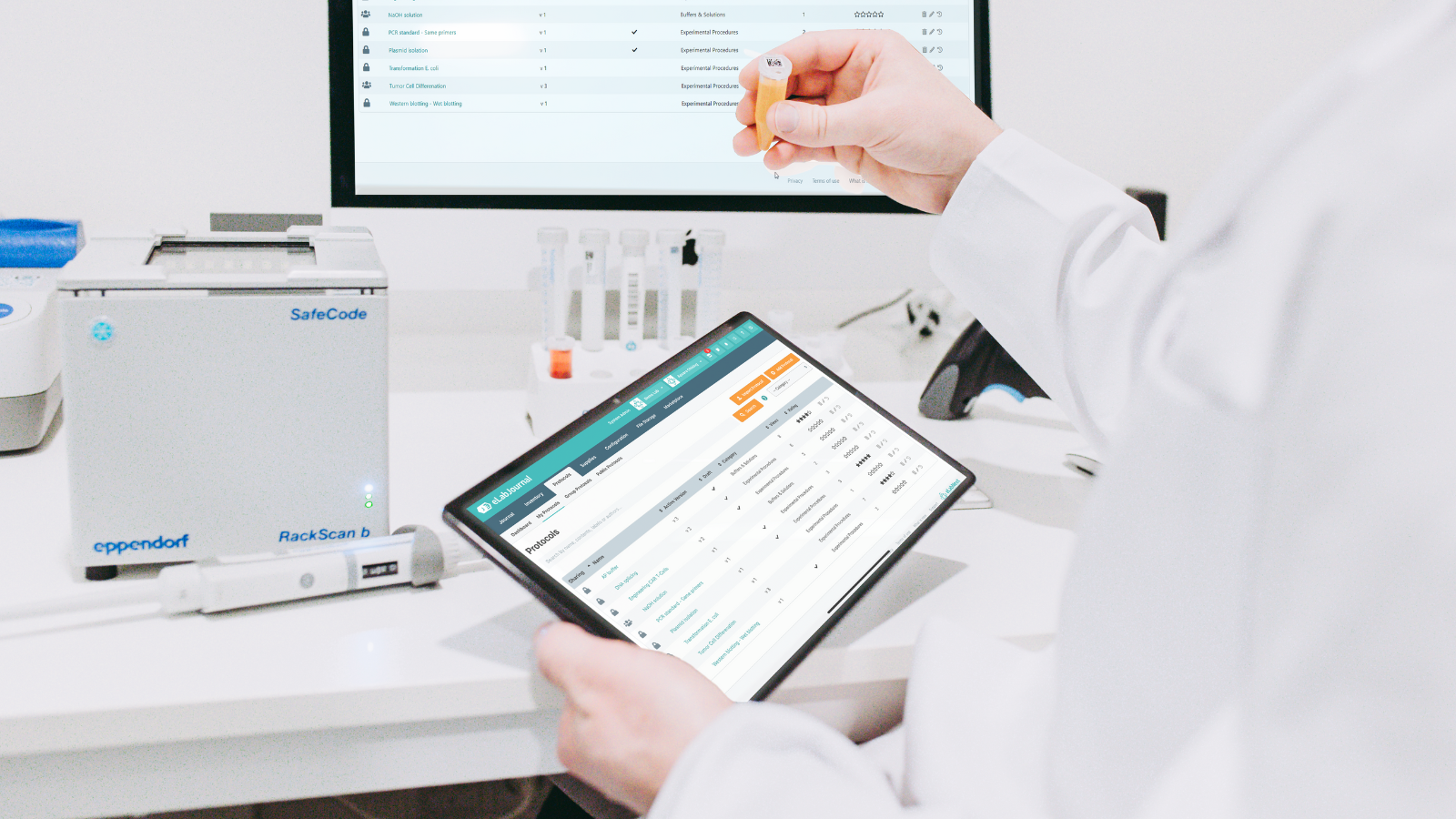
For clinical message handling specifically, the practical pattern is a mapped integration: an inbound message is parsed, its fields are mapped to a defined sample type, and the resulting sample record carries a unique barcode into processing. Because the mapping is defined per implementation, it can be matched to how a particular ordering system populates its messages, which in real deployments is rarely exactly what the standard suggests.
Scope this honestly with your IT team before committing: message mapping, terminology alignment and error handling are the work, and they are specific to the pair of systems being connected.
How Boston University connected a testing lab to two EMR systems
Boston University stood up an in-house clinical testing laboratory in autumn 2020 to process COVID-19 samples for its student, faculty and staff community. The lab needed to integrate with two separate campus electronic medical record systems, one for students and one for employees, sending orders in and results back, and it needed to integrate with its testing robots at the same time.
SciSure's APIs were a deciding factor in the platform selection, specifically because they could process the files the robots produced. The lab was running two months after implementation. It was designed to handle over 5,000 samples a day with next-day results, and at peak processed over 9,000. The system also blocked duplicate barcodes from entering the application, which at that volume is not a small detail.
"We found the UI configuration within SciSure ELN easy to follow, the help documentation clear and comprehensive, and the customer support effective. Working with the SciSure team has been a collaborative and productive experience."
- Shari Huval, Director of Health, Faculty and Student Ancillary, Boston University Information Services & Technology
The Details for IT Folks…
We use a REST API POST message to enable connections between platforms. The message header contains the mapping instructions for translating the HL7 fields into a sample. This allows for a very nuanced setup precisely tailored to each lab. The mapping is also defined per implementation, which is what lets it accommodate how a specific ordering system actually populates its messages.
Here’s what an example header looks like:
{
"sampleTypeID": 12485,
"storageLayerID": 0, /* Optional */
"position": 0, /* Optional */
"name": {
"segment": "MSH",
"field": 10
},
"description": { /* Optional */
"segment": "MSH",
"field": 9,
"component": 3
},
"altBarcode": { /* Optional: Alternative barcode information. */
"segment": "OBR",
"field": 31
},
"sampleTypeMetaIDMapping": [ /* Optional: Array of mappings for the sampleTypeMetaID to the respective segment in the HL7 message */
{
"sampleTypeMetaID": 85318,
"segment": "OBX",
"field": 5
},
{
"sampleTypeMetaID": 85317,
"segment": "ORC",
"field": 2
}
]
}
And if You’re Not Technically Inclined, No Worries
The above is a JSON configuration object that maps HL7 message fields onto a sample type. But if you’re not an IT professional, all you need to know is:
- HL7 is how lab systems and clinical systems exchange test orders and results without anyone retyping them.
- HL7 v2 carries most existing interfaces. FHIR is what new work is being built on, and what EU and national regulations increasingly specify.
- Any real integration comes down to mapping: which field in their message becomes which field in your sample record, and what happens when it doesn't match.
- SciSure Research provides sample records, barcode workflows and audit trails, with an open API and SDK for connecting to external systems.
Overall, HL7 is crucial for digital laboratory environments.
If you’re interested in learning more about eLabNext’s platform and HL7 messaging, schedule a personal demo to see how it works.
Frequently asked questions
What is HL7 in simple terms?
HL7 is a set of international standards for exchanging health information between software systems. It defines how a message carrying patient details, a test order or a test result should be structured, so that a system that has never encountered the sending system can still read it correctly.
What is the difference between HL7 v2 and FHIR?
HL7 v2 is a messaging format using pipe-delimited segments, designed in the late 1980s and still carrying most production order and result traffic. FHIR is a REST API approach using JSON or XML, with data modelled as discrete resources. v2 pushes messages between systems; FHIR lets a system request exactly the data it needs. Most organizations run both, which is why HL7 publishes a mapping guide between them.
Does a research lab need HL7?
Only if it exchanges data with clinical systems. A research lab handling patient-derived specimens may need to receive identifiers and metadata from a hospital system, which usually means a narrower, inbound-only interface. A lab with no clinical data flow does not need HL7 at all.
Is HL7 the same as a LIMS?
No. HL7 is a communication standard. A LIMS (laboratory information management system) is software that manages samples, workflows and results. HL7 is one of the ways a LIMS can talk to other systems.
Does HL7 apply outside the United States?
Yes. HL7 International has affiliate organizations across Europe and beyond, and national programmes build on the standards directly. Germany's ISiK specification is a constrained FHIR profile set, France's CI-SIS framework is moving its modules from HL7 CDA to FHIR, and the EU's European Health Data Space Regulation sets timelines for cross-border exchange of lab results.
Does SciSure support HL7?
SciSure Research connects to external systems through an open API, an SDK, and Marketplace add-ons. Clinical message handling is configured per implementation, so scope it with your IT team and SciSure directly.
If you're scoping a connection between your lab and a clinical system, talk to a SciSure specialist. Bring the systems you need to connect to and we'll walk through what's involved.
.avif)
Read more of our blogs about modern lab management
Discover the latest in lab operations, from sample management to AI innovations, designed to enhance efficiency and drive scientific breakthroughs.