Biobanking Best Practices: What the ISBER Fifth Edition Actually Asks For
A plain-English guide to the ISBER Best Practices Fifth Edition, how it differs from ISO 20387 and NCI guidance, and which practices depend on your inventory system.

Download Whitepaper
TL;DR
When people talk about biobanking best practices, they usually mean one document: the ISBER Best Practices: Recommendations for Repositories, now in its Fifth Edition.
- What ISBER actually is.
A voluntary, consensus-based reference written by working groups of repository professionals, currently in its Fifth Edition, published 2023. It sits alongside regulations and standards rather than replacing either. Following it closely is good practice. It is not accreditation, and no vendor can supply it for you.
- Twelve sections, one lifespan.
The document runs from governance and business planning through ethics, quality, safety, facilities, equipment, information management, specimen handling, distribution and shipping. The sections are ordered to follow the logic of setting up a repository, covering its lifespan from initiation through closure.
- Five phases, not one steady state.
ISBER frames a repository as moving through initiation, planning, execution, monitoring and closure. Most practical failures come from running year-eight operations on a plan written in year one.
- Where software carries the load.
Section I covers information management, including a long treatment of inventory management systems: specimen location, descriptors, audit trail, reporting, security, validation. This is where a LIMS such as SciSure does real work, and where the difference between systems shows up during an assessment.
Originally published in 2024 as a general sample-management guide, this post has been rewritten around the ISBER Fifth Edition, with new material on how ISBER relates to ISO 20387 and CAP accreditation, and a section on which practices depend on your inventory system.
Ready to see SciSure in action?
No commitment · Free consultation
Search for biobanking best practices and you get a lot of advice about labelling your tubes properly.
The field already has a reference document, and it is more useful than any of that. The ISBER Best Practices: Recommendations for Repositories is written by working groups of people who run repositories, revised periodically, and free to download. The Fifth Edition builds on earlier editions published in 2005, 2008, 2012 and 2018, and folds in the cryopreservation addendum that previously sat separately alongside the fourth edition.
This post is a plain-English guide to what is in it, what it is for, and which parts of it depend on the software you run, like for example a LIMS used by biobanks.
What ISBER is, and what it is not
The ISBER Best Practices is a voluntary guidance document, not a standard and not a regulation. It carries no legal force and holding to it does not make you accredited. Guidelines are discretionary and represent a consensus of community experience, offering recommendations a repository can adopt selectively.
So following ISBER closely is not the same as holding ISO 20387:2018 accreditation. ISO 20387 requires formal third-party assessment by an accreditation body, not internal conformance to a guidance document. The National Cancer Institute's Best Practices for Biospecimen Resources is a third document again, closer in kind to ISBER than to ISO.
In practice most repositories use them together. ISBER for how to run things, ISO 20387 or CAP accreditation when an external party needs proof.
The five phases, and why they matter operationally
ISBER describes a repository as moving through five phases: initiation, planning, execution, monitoring, and closure.
The useful part is the instruction to know which phase you are in and plan accordingly. Most repositories we talk to are in the monitoring phase running processes designed during execution, which was often years ago and several people back.
Closure gets more attention than you might expect, and it is the phase almost nobody plans for. It can be triggered by a planned end to a collection, or by a natural disaster, sudden loss of funding, or a strategic decision, and the transfer or disposal of specimens has to align with regulatory requirements and the ethical framework in place. The document also covers legacy planning, inherited collections, and transfer to a new custodian.
If your consent forms and provenance records live somewhere your inventory system cannot reach, closure is when that becomes a serious problem.
Which practices depend on your inventory system
Section I of the Fifth Edition covers information management, and within it a substantial treatment of inventory management systems. This is where a general best-practices conversation turns into a software conversation, and it is worth reading before you shortlist any vendor.
The subsections cover specimen location, specimen descriptors, data for repositories holding human collections, audit trail and traceability, data standards, cloud systems, reporting, validation of the inventory management system, data entry, data security, backup and disaster recovery, data associated with shipments, and data in automation.
A few of those translate directly into questions you can put to a vendor.
Specimen location and descriptors.
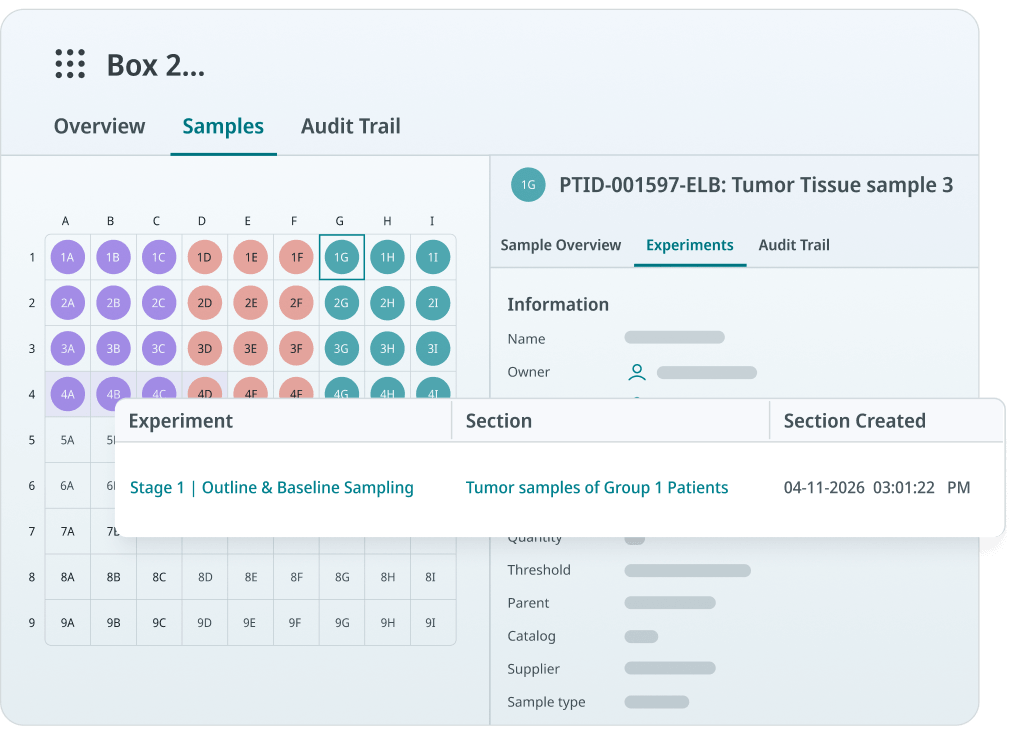
With SciSure, storage is modelled as units and compartments down to an exact position, and sample types are configurable, so a whole blood specimen and an extracted aliquot can carry different required fields while staying linked as parent and child.
Data security.
Role-based permissions, single sign-on and two-step verification are the mechanics here. SciSure supports public cloud in EU or US regions, private cloud, on-premises and hybrid deployment, which is a data residency decision as much as an IT one. Find out more on our hosting options page.
Audit trail and traceability.
Every sample record in SciSure carries a log of who changed what and when. This is the section assessors ask about most directly.
Validation of the inventory management system.
Software cannot do this for you. Validating your system for your intended use, with your SOPs and your change control, is the repository's responsibility. Any vendor who tells you otherwise is selling you a problem.
Data for human collections.
Consent status and permitted-use restrictions should travel with the specimen record. In SciSure this is handled through configurable sample fields rather than a dedicated consent module. That suits many research biobanks. If you run a large clinical collection with complex withdrawal workflows, ask hard about it and look at purpose-built clinical biobanking systems alongside us.
The practices worth starting with
Write down who the custodian is.
ISBER treats this as a named responsibility with a plan attached, not an assumption. If your director left last year and nobody has updated the custodianship arrangement, start there.
Check your storage consolidation.
ISBER notes that storage costs rise across a repository's lifespan as gaps accumulate in freezer boxes through repeated retrievals, and recommends periodically assessing whether consolidation would improve efficiency. This is the single most concrete cost saving in the document and it depends entirely on having accurate location data.
Look at freeze-thaw tracking.
Section J covers specimen integrity including freeze-thaw and cooling-warming cycles. If you cannot answer how many times a given aliquot has been thawed, you have a data gap that affects the science, not just the paperwork.
Plan for the collection you will have, not the one you have.
ISBER frames long-term sustainability across four connected components: operational, financial, social and environmental. The environmental component is newer and gets less attention than it should, covering cold storage energy, digital hosting, and equipment waste.
Where to get it
The ISBER Best Practices is available from isber.org, with translations available in several languages. It carries a no-reproduction notice, so download it directly rather than relying on someone's summary, including this one.
- For the operational problems these practices are designed to prevent, our post on 5 operational challenges for biobanks covers sample integrity, disaster preparedness and capacity planning.
- If you are at the stage of choosing a system, 6 questions for choosing biobanking LIMS software works through vendor evaluation.
- Else, check out our guide to the best sample management and tracking software platforms for labs in 2026.
FAQ
What are the ISBER best practices?
The ISBER Best Practices: Recommendations for Repositories is a voluntary guidance document written by working groups of repository professionals through the International Society for Biological and Environmental Repositories. The Fifth Edition was published in 2023. It covers governance, ethics, quality, safety, facilities, equipment, information management, specimen handling, distribution and shipping.
Is following ISBER Best Practices the same as ISO 20387 accreditation?
No. ISBER is discretionary guidance representing community consensus. ISO 20387 accreditation requires formal assessment by an accreditation body against a published international standard. Many repositories use ISBER as their operational reference while pursuing ISO 20387 or CAP accreditation for external assurance.
How often is the ISBER Best Practices updated?
Periodically rather than on a fixed schedule. Editions were published in 2005, 2008, 2012, 2018 and 2023. ISBER advises checking its website to confirm you are working from the current version.
What does ISBER say about inventory management software?
Section I covers information management, including subsections on specimen location, specimen descriptors, audit trail and traceability, reporting, data security, cloud systems, and validation of the inventory management system. It treats the system as infrastructure that supports the practices rather than as a practice in itself.
Do we need a biobanking LIMS to follow biobanking best practices?
Not strictly, but several practices become impractical without one at any scale. Location accuracy, audit trail, traceability across derivatives, and reporting are all easier to maintain in a purpose-configured system than in spreadsheets. Validation of that system remains the repository's responsibility.
If this sounds like the kind of lab you'd like to build or the support you need, get in touch with us. We'll help you figure out which ISBER practices depend on your inventory system first, and where SciSure fits.

Read more of our blogs about modern lab management
Discover the latest in lab operations, from sample management to AI innovations, designed to enhance efficiency and drive scientific breakthroughs.