Types of LIMS Systems: Deployment Models & Industries

A clear guide to the different types of LIMS systems by deployment model, lab environment, and scope, plus how to choose the right one for your lab.
August 25, 2026
()
min read
A laboratory

Download Whitepaper

By submitting this form, you agree with our Privacy Policy.
Thank you! Download the file by clicking below:
Download
Oops! Something went wrong while submitting the form.

Table of Contents

Thank you! Your submission has been received!
Oops! Something went wrong while submitting the form.

Table of Contents

TL;DR

LIMS platforms can be compared by deployment and delivery model, such as SaaS, private cloud, hybrid, or on-premises; by laboratory environment, such as research, clinical diagnostics, or GMP manufacturing; and by functional scope. Open source is a licensing model rather than a deployment model.

  • In clinical and diagnostic laboratories, comparable systems are commonly called Laboratory Information Systems, or LIS. An LIS typically manages patient and provider orders, specimen workflows, result verification, and clinical reporting. However, vendors do not use LIMS and LIS terminology consistently, so buyers should evaluate the actual workflows and applicable requirements, including CLIA regulations or CAP accreditation criteria where relevant. 
  • Vendor-managed SaaS LIMS platforms generally reduce infrastructure work and use recurring subscription pricing. On-premises systems give the organization more direct infrastructure control but add hosting, security, backup, support, and lifecycle-management responsibilities. Open-source LIMS may reduce proprietary licensing costs, but implementation, hosting, customization, validation, support, and maintenance still require resources.
  • Food Brewer AG, a Swiss cultivated cocoa producer, used SciSure's connected LIMS to standardize sample and inventory tracking across its research and upstream processing teams, reporting a 60 percent productivity increase in R&D and a 40 percent increase in upstream processing after implementation.
  • Core LIMS capabilities generally include unique sample identification, lifecycle and location tracking, structured data capture, search and reporting, permissions, and traceable record history. Instrument integration, electronic signatures, dispatch workflows, and compliance-specific reporting should be evaluated according to the laboratory’s actual requirements rather than treated as universal features of every LIMS.

If you are searching for a LIMS, you will quickly find that the category is broader than expected. The term can describe anything from a cloud-based research platform to an on-premises system supporting a regulated testing laboratory. In clinical diagnostics, comparable software is often called a Laboratory Information System, or LIS. 

Without understanding these distinctions, you can end up comparing systems that were never designed to solve the same problem. A practical way to compare LIMS is by how they are delivered and hosted, what kind of laboratory they serve, and how broad their functional scope is. This guide explains each dimension and how to use it to narrow your options.

How LIMS are classified: three ways to group them

A practical LIMS comparison separates three dimensions:

  • How the system is delivered and hosted
  • What kind of laboratory and workflows it supports
  • How broad or specialized its functional scope is

Licensing is a separate consideration. A LIMS may be proprietary or open source regardless of whether it is deployed in the cloud, in a private cloud, or on premises.

Most buyer guides never make this framework explicit, which can leave you comparing apples and oranges, a GMP-specific on-premise system against a general-purpose SaaS research platform as if they were interchangeable.

Holding these three groupings separate throughout your evaluation is what makes any comparison useful to you, since a system can be strong on one dimension, like hosting flexibility, and a poor fit on another, like regulatory readiness. This article keeps that structure section by section, starting with deployment model.
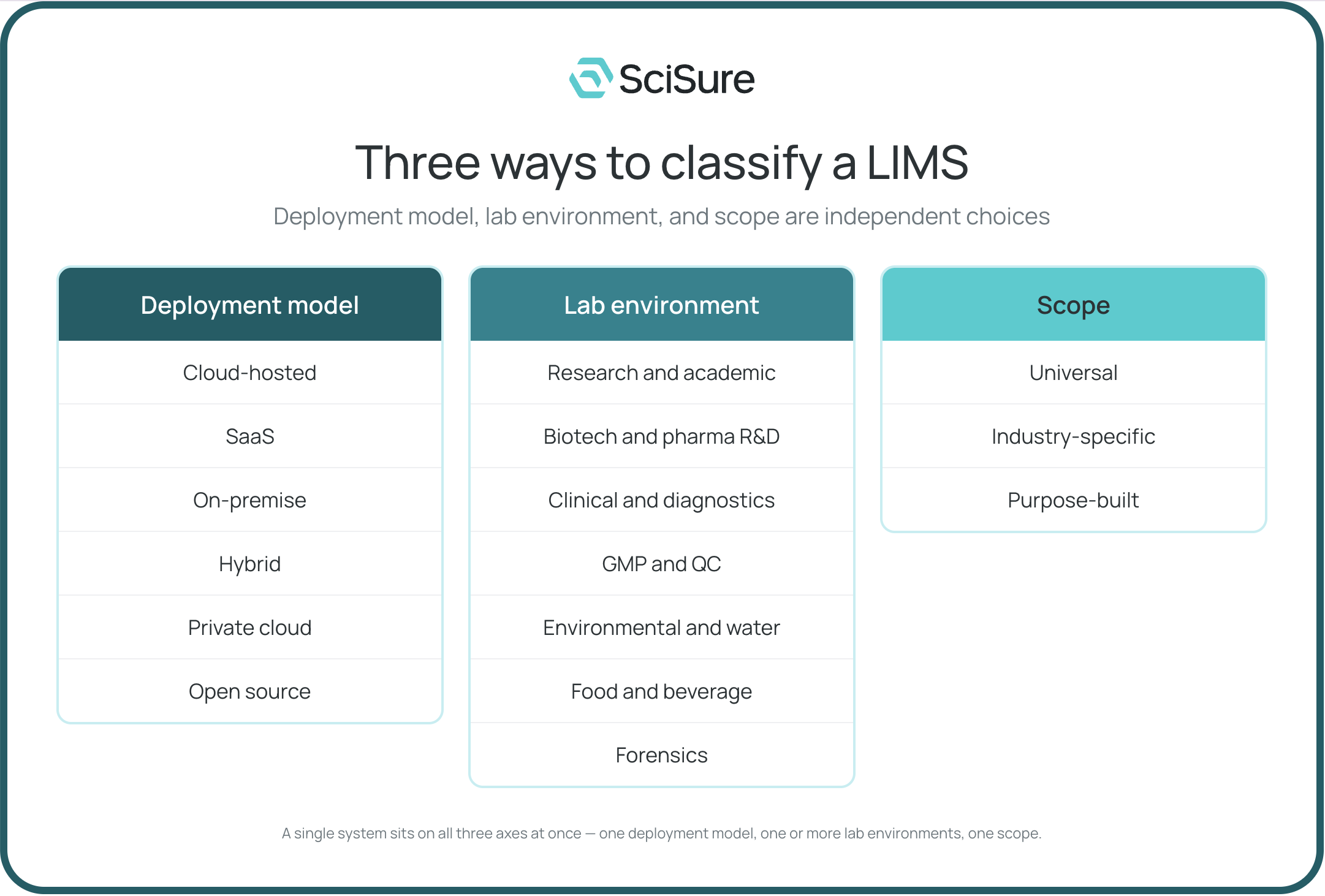
Ways to classify a LIMS

Types of LIMS by deployment and delivery model 

Deployment model determines where the LIMS lives, who manages it, and who is responsible when something needs updating or fixing. It affects cost structure, IT burden, control over your data, and how the system handles upgrades over time, often the first fork in the road when you compare vendors.

Model Typical cost profile Responsibility and control IT burden Common fit
Vendor-managed SaaS Recurring subscription Vendor operates the application and infrastructure; customer manages configuration, users, and governed use Low to medium Labs seeking faster rollout and reduced infrastructure work
Dedicated private cloud Subscription, hosting, and implementation costs Dedicated resources; management responsibilities depend on the vendor contract Low to medium when vendor-managed Enterprises requiring dedicated hosting or additional network controls
Customer-managed cloud Cloud infrastructure plus software licensing or subscription Customer manages more of the operating environment; vendor support varies High Organizations with established cloud operations
On-premises Software, implementation, infrastructure, backup, security, and support costs Customer controls local infrastructure; vendor may still install, support, and update the software High Organizations with strict local-hosting, network, or offline-access requirements
Hybrid Combination of cloud and local-system costs Responsibilities are divided across connected cloud and on-premises components Medium to high Organizations retaining local storage, instruments, or legacy systems

Cloud-hosted describes where the infrastructure runs, while SaaS describes how the application is provided and managed. Private cloud means that cloud resources are dedicated to one organization, but it does not necessarily mean that the customer manages them. Hybrid describes an architecture combining cloud and on-premises components. Pricing, licensing, and whether software is proprietary or open source are separate considerations. 

Cloud-hosted LIMS

A LIMS runs on remote servers, either the vendor's own infrastructure or a third-party cloud provider like AWS or Azure, and you access it through a browser or application. The key variable is who manages the environment: in some arrangements the vendor manages everything, in others you take on more infrastructure responsibility. Best for: your lab if you want to avoid on-site server management and need remote access. Watch out for: confirming exactly who manages updates, security patches, and uptime.

SaaS LIMS

A specific type of cloud delivery where the vendor manages the full software stack, including updates, maintenance, and infrastructure, on a subscription basis. You configure and use the system, and the vendor handles everything underneath. This is the most common model for modern research and smaller regulated labs. Best for: your lab if you don't have dedicated IT staff, or you want predictable costs and automatic updates. Watch out for: what happens to your data if you end the subscription, and how much customization is possible inside the vendor's managed environment.

On-premise LIMS

An on-premises LIMS runs on infrastructure controlled by the customer. The organization is normally responsible for the servers, network, security, backups, and disaster recovery, although the vendor may still install, maintain, and update the application. Best for: your organization if you need local data storage, offline access, strict network controls, or integrations that make cloud deployment impractical. Watch out for: total lifecycle cost, internal support capacity, backup and recovery responsibilities, and the effect of upgrades on validated configurations. 

Hybrid LIMS

A mix of cloud and on-premise components, useful if your lab has existing on-premise infrastructure you are not ready to retire but want to extend with cloud capabilities or capacity. Best for: your lab if you are managing a gradual transition across multiple sites or an enterprise environment. Watch out for: integration complexity between your on-premise and cloud components, especially around data synchronization and access controls.

Private cloud and customer-managed cloud

A private cloud provides cloud infrastructure for the exclusive use of one organization. It may be operated by the customer, the software vendor, or another service provider. A customer-managed cloud is a different arrangement in which the organization operates more of the cloud environment itself. Best for: your organization if you need dedicated resources, regional hosting, additional network restrictions, or integration with established cloud controls. Watch out for: confirming exactly who manages the application, infrastructure, security patches, backups, updates, monitoring, and disaster recovery. 

Open source LIMS

Open source is a licensing and development model, not a hosting model. An open-source LIMS can be deployed on premises, in a public cloud, or in a private cloud. Its license provides access to source code and permits modification and redistribution under the applicable terms. Organizations may still pay for packaged software, hosting, implementation, support, or managed services. Best for: your lab if you have the technical capacity to operate and maintain the system, or access to a dependable implementation partner. Watch out for: project activity, security maintenance, documentation, upgrade paths, validation evidence, and total cost of ownership.

Two related labels come up often:

  • Proprietary versus open source is a licensing distinction, describing whether the source code is available.
  • Preconfigured versus configurable versus custom-built describes how much the system is adapted to your lab's needs, a separate question from hosting.
SciSure Research
See how SciSure fits research and R&D labs
Get a walkthrough of how SciSure connects sample tracking, experiment documentation, and compliance workflows for research teams.
Request a demo

Types of LIMS by laboratory environment and use case

The different LIMS systems built for clinical diagnostics and biotech R&D solve very different daily problems despite sharing a broad purpose, since the lab environment shapes default workflows and the compliance toolkit. The overview below groups the most common environments, with a best-for note on each.

Research and academic LIMS

Research and academic LIMS support flexible sample and experiment tracking, reproducibility, IP protection, and protocol management, with experiment documentation and sample management as core workflows. Best for your lab if you need flexibility over rigid workflow enforcement.

Biotech and pharma R&D LIMS

Biotech and pharma R&D LIMS add structured workflows, traceability, and ELN integration. SciSure connects experiment documentation, sample tracking, and compliance in one system. Best for: your team if you need audit-ready records alongside research work.

Food Brewer AG, a Swiss company scaling plant cell culture production of cultivated cocoa, uses a connected research LIMS to standardize sample and inventory tracking, reporting a 60 percent productivity increase in R&D and 40 percent in upstream processing. Read the full Food Brewer AG story.

Clinical and diagnostics LIMS

Clinical and diagnostic laboratory systems manage patient and provider orders, specimen accessioning, testing workflows, result verification, turnaround tracking, and clinical reporting. These systems are commonly called LIS in healthcare settings, although terminology varies among vendors and regions. Laboratories should verify support for applicable requirements, such as CLIA regulations and CAP accreditation criteria in the United States.

GMP and QC LIMS

GMP and QC LIMS commonly support sample and lot tracking, specifications, testing workflows, stability programs, and environmental monitoring. Features such as audit trails, electronic signatures, access controls, and record retention can support 21 CFR Part 11 or EU Annex 11 obligations, but the regulated organization remains responsible for intended-use validation, procedures, training, and compliant operation.

Environmental and water testing LIMS

Environmental and water testing LIMS focus on EPA reporting and high-volume sample tracking. 

Food and beverage LIMS

Food and beverage LIMS commonly support sample and lot traceability, specifications, testing workflows, quality-control results, and controlled reports. Supplier and allergen management may be included in some products but are not defining capabilities of every food LIMS. ISO/IEC 17025 concerns laboratory competence and consistent operation rather than a particular reporting format.  

Forensics LIMS

Forensic LIMS support evidence identification, chain of custody, transfers, examinations, controlled reporting, and strict access controls. Legal admissibility also depends on validated methods, documented procedures, staff practices, and the applicable jurisdiction; software alone cannot guarantee it.

Together, these seven cover the clearest examples of LIMS systems in active use today.

Types of LIMS by scope: universal, industry-specific and purpose-built

Any list of LIMS software you compare will sort into three scope categories: universal, industry-specific, and purpose-built. A universal LIMS works across lab types with minimal out-of-the-box specialization. An industry-specific LIMS arrives pre-configured for one sector's workflows, terminology, and compliance requirements. A purpose-built LIMS goes further, built for a single function like biobanking or stability testing.

Industry-specific and purpose-built systems reduce implementation time, since the terminology, fields, and compliance logic are already mapped to your sector, cutting down the configuration work needed before go-live. That same specialization can make them harder to adapt if your requirements change or your lab spans multiple domains, since the system is built around one sector's assumptions. A universal LIMS takes more configuration up front but offers more room to grow into new use cases without a platform change.

LIMS vs LIS vs ELN vs SDMS

These four terms describe related but distinct categories of laboratory software, and it is easy to confuse them, especially since some tools blend capabilities across categories. Knowing what each one actually manages, from samples to patient results to raw instrument files, makes it easier for you to know which system solves your problem.

  • LIMS (Laboratory Information Management System) manages samples, workflows, inventory, and data across the lab.
  • LIS (Laboratory Information System) is the term commonly used for systems supporting clinical diagnostic laboratories. Typical functions include patient and provider orders, specimen accessioning, testing, result verification, and reporting to clinical systems. The LIMS/LIS boundary is not universal, so functionality matters more than the product label. 
  • ELN (Electronic Lab Notebook) captures experiment documentation, protocols, and research records, often paired with a LIMS in R&D labs through LIMS integration that keeps experiment records and registered samples in sync.
  • SDMS (Scientific Data Management System) stores and organizes raw instrument data and output files, complementing a LIMS without replacing it.

Choosing between an ELN and a LIMS, a decision covered in ELN vs LIMS, comes down to whether your lab needs to document experiments or track samples, or both.

Core capabilities to expect from any LIMS

LIMS capabilities vary considerably, so not every feature should be treated as mandatory for every laboratory. A practical baseline includes:

  • Unique sample or specimen identification
  • Status, location, lifecycle, and history tracking
  • Configurable structured data capture
  • Workflow and task support
  • Search, retrieval, and reporting
  • User accounts, roles, and permissions
  • Traceable changes and audit history appropriate to the use case
  • Data export, retention, backup, and recovery provisions

Additional requirements may include barcode workflows, chain of custody, instrument integration, electronic signatures, inventory management, stability studies, clinical reporting, or regulatory submissions. These should be selected according to the laboratory’s processes and applicable quality or regulatory framework.

A GMP system typically requires more controlled configuration, validation evidence, approval workflows, and data-integrity controls than a general research platform. A research-focused LIMS may prioritize configurable metadata, sample lineage, experiment connections, and support for evolving workflows. The correct baseline is therefore the laboratory’s documented intended use, not a universal feature checklist.

Which type of LIMS fits your lab

This is a practical decision guide built on questions to answer before evaluating vendors: 

  • Which GMP, GLP, ISO/IEC 17025, clinical, or other requirements apply to the records and processes the system will manage, and what validation or verification is required for its intended use? 
  • Does your team have IT capacity for infrastructure, or do you need a vendor-managed system? 
  • Are your workflows standard enough for a preconfigured system, or do you need something configurable? 
  • How much do integration needs affect the decision?

SciSure is an LIMS designed for the R&D sector, connecting experiment documentation, sample tracking, and compliance in one system, so answering these four questions maps naturally onto how it configures for different labs. Smaller research teams without dedicated IT staff, a scenario covered in LIMS for small labs, will generally find the best fit in a configurable SaaS platform. Larger, more regulated organizations may lean toward heavier validation support and tighter access controls. Working through the questions above before you evaluate vendors will narrow the field considerably.

Signs your current LIMS no longer fits

A few patterns tend to show up before your LIMS stops fitting your lab. You are manually exporting data to spreadsheets to fill gaps the LIMS cannot cover. Onboarding new users or new sites is consistently painful. You cannot add instruments or integrations without expensive custom work. Compliance documentation takes more time than the lab work it documents.

Institut Pasteur ran into a version of this at scale: each of its 12 research departments had developed its own approach to lab management, often on paper or with different digital tools, which made cross-team collaboration difficult. The institute evaluated more than 20 ELN and sample tracking solutions before rolling out a shared digital platform across all research units in four structured deployment waves, with monthly training built into the rollout. Read the full Institut Pasteur story.

What a LIMS costs by type

LIMS costs are easier to compare through total cost of ownership than through license price alone. SaaS products may charge by user, module, site, storage, or usage. Private-cloud offerings may add dedicated hosting, implementation, and network-configuration costs. On-premises systems add infrastructure, security, backup, disaster recovery, internal support, and upgrade costs; they should not automatically be described as having lower ongoing costs.

Open-source software may avoid or reduce proprietary license fees, but organizations can still incur costs for hosting, implementation, customization, integrations, support, security maintenance, and validation. Commercial distributions and managed services may also charge subscription or service fees.

Across all models, include configuration, data migration, integrations, validation, training, support, storage, backups, upgrades, and eventual data export or system retirement. For regulated laboratories, customer-side validation, procedures, training records, and change control may represent a substantial portion of the implementation and lifecycle cost.

SciSure Research
Talk to a specialist about your lab type
A SciSure specialist can help you figure out which LIMS setup fits your workflows, team size, and regulatory context.
Talk to a specialist

FAQ

What are the most popular LIMS systems? 

The most widely used LIMS fall into three broad categories: SaaS-based research platforms, enterprise GMP and QC systems, and clinical LIS platforms. Popularity rankings matter less than category fit here, since the right choice for your lab depends on lab type and regulatory context far more than on how many labs use a given platform.

What is the difference between a CMMS and a LIMS? 

A CMMS and a LIMS solve different problems. A CMMS, or Computerized Maintenance Management System, tracks equipment maintenance, work orders, and asset management. A LIMS manages laboratory data, samples, workflows, and compliance documentation. If your lab handles both facilities upkeep and scientific data, you may end up running both: a CMMS for equipment maintenance, and a LIMS for your sample and experiment records.

What is the difference between a LIMS and a LIS? 

A LIS and a LIMS serve different lab types. A LIS is the term commonly used for systems supporting clinical diagnostic laboratories, where workflows begin with patient or provider orders and end with verified clinical results. A LIMS more commonly emphasizes sample lifecycle, laboratory workflows, inventory, structured scientific data, and traceability in research, manufacturing, environmental, and other testing environments. The terminology is not universal, and some products span both categories, so evaluate the actual workflows and interfaces rather than relying on the name alone.

What is an industry-specific LIMS? 

An industry-specific LIMS is pre-configured for the workflows, terminology, and compliance requirements of one sector, such as pharmaceutical QC, environmental testing, food safety, or clinical diagnostics. It reduces implementation time for that sector's standard workflows, but can be less flexible if requirements change or your lab operates across multiple domains.

How do I know which type of LIMS my lab needs? 

The type of LIMS your lab needs comes down to three questions: what regulatory framework applies, what IT capacity you have, and how configurable your workflows need to be. If you are under GMP, GLP, or ISO 17025, validation requirements narrow the field quickly. If you lack an IT team, you will generally benefit from SaaS, and if your workflows are highly custom, you may need a configurable platform.

Which type of LIMS is best for a research lab? 

If you run a research lab, you will generally do best with a configurable SaaS LIMS that connects experiment documentation, sample tracking, and inventory without requiring heavy IT involvement. Look for flexible metadata, protocol management, ELN integration, and audit trails that support your reproducibility and IP protection, all without imposing clinical-grade rigidity on your early-stage, less standardized work.If you are searching for a LIMS, you will quickly find that the category is broader than expected. The term can describe anything from a cloud-based research platform to an on-premises system supporting a regulated testing laboratory. In clinical diagnostics, comparable software is often called a Laboratory Information System, or LIS. Without understanding these distinctions, you can end up comparing systems that were never designed to solve the same problem. A practical way to compare LIMS is by how they are delivered and hosted, what kind of laboratory they serve, and how broad their functional scope is. This guide explains each dimension and how to use it to narrow your options. 

Ready to see SciSure in action?

Get a personalized demo and see how SciSure fits your lab's workflows.
Request demo

No commitment · Free consultation

If you are searching for a LIMS, you will quickly find that the category is broader than expected. The term can describe anything from a cloud-based research platform to an on-premises system supporting a regulated testing laboratory. In clinical diagnostics, comparable software is often called a Laboratory Information System, or LIS. 

Without understanding these distinctions, you can end up comparing systems that were never designed to solve the same problem. A practical way to compare LIMS is by how they are delivered and hosted, what kind of laboratory they serve, and how broad their functional scope is. This guide explains each dimension and how to use it to narrow your options.

How LIMS are classified: three ways to group them

A practical LIMS comparison separates three dimensions:

  • How the system is delivered and hosted
  • What kind of laboratory and workflows it supports
  • How broad or specialized its functional scope is

Licensing is a separate consideration. A LIMS may be proprietary or open source regardless of whether it is deployed in the cloud, in a private cloud, or on premises.

Most buyer guides never make this framework explicit, which can leave you comparing apples and oranges, a GMP-specific on-premise system against a general-purpose SaaS research platform as if they were interchangeable.

Holding these three groupings separate throughout your evaluation is what makes any comparison useful to you, since a system can be strong on one dimension, like hosting flexibility, and a poor fit on another, like regulatory readiness. This article keeps that structure section by section, starting with deployment model.

Ways to classify a LIMS

Types of LIMS by deployment and delivery model 

Deployment model determines where the LIMS lives, who manages it, and who is responsible when something needs updating or fixing. It affects cost structure, IT burden, control over your data, and how the system handles upgrades over time, often the first fork in the road when you compare vendors.

Model Typical cost profile Responsibility and control IT burden Common fit
Vendor-managed SaaS Recurring subscription Vendor operates the application and infrastructure; customer manages configuration, users, and governed use Low to medium Labs seeking faster rollout and reduced infrastructure work
Dedicated private cloud Subscription, hosting, and implementation costs Dedicated resources; management responsibilities depend on the vendor contract Low to medium when vendor-managed Enterprises requiring dedicated hosting or additional network controls
Customer-managed cloud Cloud infrastructure plus software licensing or subscription Customer manages more of the operating environment; vendor support varies High Organizations with established cloud operations
On-premises Software, implementation, infrastructure, backup, security, and support costs Customer controls local infrastructure; vendor may still install, support, and update the software High Organizations with strict local-hosting, network, or offline-access requirements
Hybrid Combination of cloud and local-system costs Responsibilities are divided across connected cloud and on-premises components Medium to high Organizations retaining local storage, instruments, or legacy systems

Cloud-hosted describes where the infrastructure runs, while SaaS describes how the application is provided and managed. Private cloud means that cloud resources are dedicated to one organization, but it does not necessarily mean that the customer manages them. Hybrid describes an architecture combining cloud and on-premises components. Pricing, licensing, and whether software is proprietary or open source are separate considerations. 

Cloud-hosted LIMS

A LIMS runs on remote servers, either the vendor's own infrastructure or a third-party cloud provider like AWS or Azure, and you access it through a browser or application. The key variable is who manages the environment: in some arrangements the vendor manages everything, in others you take on more infrastructure responsibility. Best for: your lab if you want to avoid on-site server management and need remote access. Watch out for: confirming exactly who manages updates, security patches, and uptime.

SaaS LIMS

A specific type of cloud delivery where the vendor manages the full software stack, including updates, maintenance, and infrastructure, on a subscription basis. You configure and use the system, and the vendor handles everything underneath. This is the most common model for modern research and smaller regulated labs. Best for: your lab if you don't have dedicated IT staff, or you want predictable costs and automatic updates. Watch out for: what happens to your data if you end the subscription, and how much customization is possible inside the vendor's managed environment.

On-premise LIMS

An on-premises LIMS runs on infrastructure controlled by the customer. The organization is normally responsible for the servers, network, security, backups, and disaster recovery, although the vendor may still install, maintain, and update the application. Best for: your organization if you need local data storage, offline access, strict network controls, or integrations that make cloud deployment impractical. Watch out for: total lifecycle cost, internal support capacity, backup and recovery responsibilities, and the effect of upgrades on validated configurations. 

Hybrid LIMS

A mix of cloud and on-premise components, useful if your lab has existing on-premise infrastructure you are not ready to retire but want to extend with cloud capabilities or capacity. Best for: your lab if you are managing a gradual transition across multiple sites or an enterprise environment. Watch out for: integration complexity between your on-premise and cloud components, especially around data synchronization and access controls.

Private cloud and customer-managed cloud

A private cloud provides cloud infrastructure for the exclusive use of one organization. It may be operated by the customer, the software vendor, or another service provider. A customer-managed cloud is a different arrangement in which the organization operates more of the cloud environment itself. Best for: your organization if you need dedicated resources, regional hosting, additional network restrictions, or integration with established cloud controls. Watch out for: confirming exactly who manages the application, infrastructure, security patches, backups, updates, monitoring, and disaster recovery. 

Open source LIMS

Open source is a licensing and development model, not a hosting model. An open-source LIMS can be deployed on premises, in a public cloud, or in a private cloud. Its license provides access to source code and permits modification and redistribution under the applicable terms. Organizations may still pay for packaged software, hosting, implementation, support, or managed services. Best for: your lab if you have the technical capacity to operate and maintain the system, or access to a dependable implementation partner. Watch out for: project activity, security maintenance, documentation, upgrade paths, validation evidence, and total cost of ownership.

Two related labels come up often:

  • Proprietary versus open source is a licensing distinction, describing whether the source code is available.
  • Preconfigured versus configurable versus custom-built describes how much the system is adapted to your lab's needs, a separate question from hosting.
SciSure Research
See how SciSure fits research and R&D labs
Get a walkthrough of how SciSure connects sample tracking, experiment documentation, and compliance workflows for research teams.
Request a demo

Types of LIMS by laboratory environment and use case

The different LIMS systems built for clinical diagnostics and biotech R&D solve very different daily problems despite sharing a broad purpose, since the lab environment shapes default workflows and the compliance toolkit. The overview below groups the most common environments, with a best-for note on each.

Research and academic LIMS

Research and academic LIMS support flexible sample and experiment tracking, reproducibility, IP protection, and protocol management, with experiment documentation and sample management as core workflows. Best for your lab if you need flexibility over rigid workflow enforcement.

Biotech and pharma R&D LIMS

Biotech and pharma R&D LIMS add structured workflows, traceability, and ELN integration. SciSure connects experiment documentation, sample tracking, and compliance in one system. Best for: your team if you need audit-ready records alongside research work.

Food Brewer AG, a Swiss company scaling plant cell culture production of cultivated cocoa, uses a connected research LIMS to standardize sample and inventory tracking, reporting a 60 percent productivity increase in R&D and 40 percent in upstream processing. Read the full Food Brewer AG story.

Clinical and diagnostics LIMS

Clinical and diagnostic laboratory systems manage patient and provider orders, specimen accessioning, testing workflows, result verification, turnaround tracking, and clinical reporting. These systems are commonly called LIS in healthcare settings, although terminology varies among vendors and regions. Laboratories should verify support for applicable requirements, such as CLIA regulations and CAP accreditation criteria in the United States.

GMP and QC LIMS

GMP and QC LIMS commonly support sample and lot tracking, specifications, testing workflows, stability programs, and environmental monitoring. Features such as audit trails, electronic signatures, access controls, and record retention can support 21 CFR Part 11 or EU Annex 11 obligations, but the regulated organization remains responsible for intended-use validation, procedures, training, and compliant operation.

Environmental and water testing LIMS

Environmental and water testing LIMS focus on EPA reporting and high-volume sample tracking. 

Food and beverage LIMS

Food and beverage LIMS commonly support sample and lot traceability, specifications, testing workflows, quality-control results, and controlled reports. Supplier and allergen management may be included in some products but are not defining capabilities of every food LIMS. ISO/IEC 17025 concerns laboratory competence and consistent operation rather than a particular reporting format.  

Forensics LIMS

Forensic LIMS support evidence identification, chain of custody, transfers, examinations, controlled reporting, and strict access controls. Legal admissibility also depends on validated methods, documented procedures, staff practices, and the applicable jurisdiction; software alone cannot guarantee it.

Together, these seven cover the clearest examples of LIMS systems in active use today.

Types of LIMS by scope: universal, industry-specific and purpose-built

Any list of LIMS software you compare will sort into three scope categories: universal, industry-specific, and purpose-built. A universal LIMS works across lab types with minimal out-of-the-box specialization. An industry-specific LIMS arrives pre-configured for one sector's workflows, terminology, and compliance requirements. A purpose-built LIMS goes further, built for a single function like biobanking or stability testing.

Industry-specific and purpose-built systems reduce implementation time, since the terminology, fields, and compliance logic are already mapped to your sector, cutting down the configuration work needed before go-live. That same specialization can make them harder to adapt if your requirements change or your lab spans multiple domains, since the system is built around one sector's assumptions. A universal LIMS takes more configuration up front but offers more room to grow into new use cases without a platform change.

LIMS vs LIS vs ELN vs SDMS

These four terms describe related but distinct categories of laboratory software, and it is easy to confuse them, especially since some tools blend capabilities across categories. Knowing what each one actually manages, from samples to patient results to raw instrument files, makes it easier for you to know which system solves your problem.

  • LIMS (Laboratory Information Management System) manages samples, workflows, inventory, and data across the lab.
  • LIS (Laboratory Information System) is the term commonly used for systems supporting clinical diagnostic laboratories. Typical functions include patient and provider orders, specimen accessioning, testing, result verification, and reporting to clinical systems. The LIMS/LIS boundary is not universal, so functionality matters more than the product label. 
  • ELN (Electronic Lab Notebook) captures experiment documentation, protocols, and research records, often paired with a LIMS in R&D labs through LIMS integration that keeps experiment records and registered samples in sync.
  • SDMS (Scientific Data Management System) stores and organizes raw instrument data and output files, complementing a LIMS without replacing it.

Choosing between an ELN and a LIMS, a decision covered in ELN vs LIMS, comes down to whether your lab needs to document experiments or track samples, or both.

Core capabilities to expect from any LIMS

LIMS capabilities vary considerably, so not every feature should be treated as mandatory for every laboratory. A practical baseline includes:

  • Unique sample or specimen identification
  • Status, location, lifecycle, and history tracking
  • Configurable structured data capture
  • Workflow and task support
  • Search, retrieval, and reporting
  • User accounts, roles, and permissions
  • Traceable changes and audit history appropriate to the use case
  • Data export, retention, backup, and recovery provisions

Additional requirements may include barcode workflows, chain of custody, instrument integration, electronic signatures, inventory management, stability studies, clinical reporting, or regulatory submissions. These should be selected according to the laboratory’s processes and applicable quality or regulatory framework.

A GMP system typically requires more controlled configuration, validation evidence, approval workflows, and data-integrity controls than a general research platform. A research-focused LIMS may prioritize configurable metadata, sample lineage, experiment connections, and support for evolving workflows. The correct baseline is therefore the laboratory’s documented intended use, not a universal feature checklist.

Which type of LIMS fits your lab

This is a practical decision guide built on questions to answer before evaluating vendors: 

  • Which GMP, GLP, ISO/IEC 17025, clinical, or other requirements apply to the records and processes the system will manage, and what validation or verification is required for its intended use? 
  • Does your team have IT capacity for infrastructure, or do you need a vendor-managed system? 
  • Are your workflows standard enough for a preconfigured system, or do you need something configurable? 
  • How much do integration needs affect the decision?

SciSure is an LIMS designed for the R&D sector, connecting experiment documentation, sample tracking, and compliance in one system, so answering these four questions maps naturally onto how it configures for different labs. Smaller research teams without dedicated IT staff, a scenario covered in LIMS for small labs, will generally find the best fit in a configurable SaaS platform. Larger, more regulated organizations may lean toward heavier validation support and tighter access controls. Working through the questions above before you evaluate vendors will narrow the field considerably.

Signs your current LIMS no longer fits

A few patterns tend to show up before your LIMS stops fitting your lab. You are manually exporting data to spreadsheets to fill gaps the LIMS cannot cover. Onboarding new users or new sites is consistently painful. You cannot add instruments or integrations without expensive custom work. Compliance documentation takes more time than the lab work it documents.

Institut Pasteur ran into a version of this at scale: each of its 12 research departments had developed its own approach to lab management, often on paper or with different digital tools, which made cross-team collaboration difficult. The institute evaluated more than 20 ELN and sample tracking solutions before rolling out a shared digital platform across all research units in four structured deployment waves, with monthly training built into the rollout. Read the full Institut Pasteur story.

What a LIMS costs by type

LIMS costs are easier to compare through total cost of ownership than through license price alone. SaaS products may charge by user, module, site, storage, or usage. Private-cloud offerings may add dedicated hosting, implementation, and network-configuration costs. On-premises systems add infrastructure, security, backup, disaster recovery, internal support, and upgrade costs; they should not automatically be described as having lower ongoing costs.

Open-source software may avoid or reduce proprietary license fees, but organizations can still incur costs for hosting, implementation, customization, integrations, support, security maintenance, and validation. Commercial distributions and managed services may also charge subscription or service fees.

Across all models, include configuration, data migration, integrations, validation, training, support, storage, backups, upgrades, and eventual data export or system retirement. For regulated laboratories, customer-side validation, procedures, training records, and change control may represent a substantial portion of the implementation and lifecycle cost.

SciSure Research
Talk to a specialist about your lab type
A SciSure specialist can help you figure out which LIMS setup fits your workflows, team size, and regulatory context.
Talk to a specialist

FAQ

What are the most popular LIMS systems? 

The most widely used LIMS fall into three broad categories: SaaS-based research platforms, enterprise GMP and QC systems, and clinical LIS platforms. Popularity rankings matter less than category fit here, since the right choice for your lab depends on lab type and regulatory context far more than on how many labs use a given platform.

What is the difference between a CMMS and a LIMS? 

A CMMS and a LIMS solve different problems. A CMMS, or Computerized Maintenance Management System, tracks equipment maintenance, work orders, and asset management. A LIMS manages laboratory data, samples, workflows, and compliance documentation. If your lab handles both facilities upkeep and scientific data, you may end up running both: a CMMS for equipment maintenance, and a LIMS for your sample and experiment records.

What is the difference between a LIMS and a LIS? 

A LIS and a LIMS serve different lab types. A LIS is the term commonly used for systems supporting clinical diagnostic laboratories, where workflows begin with patient or provider orders and end with verified clinical results. A LIMS more commonly emphasizes sample lifecycle, laboratory workflows, inventory, structured scientific data, and traceability in research, manufacturing, environmental, and other testing environments. The terminology is not universal, and some products span both categories, so evaluate the actual workflows and interfaces rather than relying on the name alone.

What is an industry-specific LIMS? 

An industry-specific LIMS is pre-configured for the workflows, terminology, and compliance requirements of one sector, such as pharmaceutical QC, environmental testing, food safety, or clinical diagnostics. It reduces implementation time for that sector's standard workflows, but can be less flexible if requirements change or your lab operates across multiple domains.

How do I know which type of LIMS my lab needs? 

The type of LIMS your lab needs comes down to three questions: what regulatory framework applies, what IT capacity you have, and how configurable your workflows need to be. If you are under GMP, GLP, or ISO 17025, validation requirements narrow the field quickly. If you lack an IT team, you will generally benefit from SaaS, and if your workflows are highly custom, you may need a configurable platform.

Which type of LIMS is best for a research lab? 

If you run a research lab, you will generally do best with a configurable SaaS LIMS that connects experiment documentation, sample tracking, and inventory without requiring heavy IT involvement. Look for flexible metadata, protocol management, ELN integration, and audit trails that support your reproducibility and IP protection, all without imposing clinical-grade rigidity on your early-stage, less standardized work.If you are searching for a LIMS, you will quickly find that the category is broader than expected. The term can describe anything from a cloud-based research platform to an on-premises system supporting a regulated testing laboratory. In clinical diagnostics, comparable software is often called a Laboratory Information System, or LIS. Without understanding these distinctions, you can end up comparing systems that were never designed to solve the same problem. A practical way to compare LIMS is by how they are delivered and hosted, what kind of laboratory they serve, and how broad their functional scope is. This guide explains each dimension and how to use it to narrow your options. 

About the author:

SciSure Team

The SciSureTeam combines expertise in lab digitization, software development, and research management to deliver reliable insights and practical advice. Our goal is to empower scientists with the knowledge and tools to optimize workflows and stay ahead in the ever-evolving world of research.

See all posts from this author

Melde dich für unseren Newsletter an

Holen Sie sich die neuesten Tipps, Artikel und exklusiven Inhalte zum modernen Labormanagement in Ihren Posteingang.
Danke! Deine Einreichung ist eingegangen!
Please check your email to verify your submission.
Hoppla! Beim Absenden des Formulars ist etwas schief gelaufen.