ELN Software Advantages: Who Gets The Most Out of an ELN?

What ELN software actually improves, where it adds friction, and which labs get the most from it.

•
October 5, 2026
•
()
min read
A laboratory

Download Whitepaper

By submitting this form, you agree with our Privacy Policy.
Thank you! Download the file by clicking below:
Download
Oops! Something went wrong while submitting the form.

Table of Contents

Thank you! Your submission has been received!
Oops! Something went wrong while submitting the form.

TL;DR

ELN software makes research records searchable, traceable, and easier to defend, and the payoff grows with the number of people who share those records and the scrutiny they face.
‍

  • What actually improves.
    An electronic lab notebook (ELN) replaces paper and scattered files with searchable experiments, versioned protocols, timestamped edits, and records that stay with the lab when people leave. With SciSure, experiments can also point to the samples, equipment, and protocol version used, so the context behind a result sits right next to it.
    ‍
  • The honest trade-offs.
    ELNs cost money, take setup time, and put a screen into work that happens with gloves on. Scientists might nalso worry about rigid templates, vendor lock-in, and where their data lives. Mobile access, configurable templates, export options, hosting choices, and a phased rollout handle most of this, so test each one during a pilot.
    ‍
  • Who gains the most.
    Multi-group research institutes, university medical centres, regulated R&D teams, contract research organizations, assay development groups, and growing biotechs see the fastest return because many people depend on the same records. A single researcher with no compliance requirements may do fine with paper or a free tool.
    ‍
  • Products differ.
    The advantages depend on the ELN you pick. Check whether your team can configure templates and sample types without paid development, run many groups under central administration, host data in the EU, US, a private cloud, or on-premises, and sign or witness records. Also ask what the product is not built for.
    ‍

This post was first published in 2023 and was updated in 2026 to include guidance by lab type, current standards (NIH Data Management and Sharing Policy, FAIR, 21 CFR Part 11, the DFG Code), and updated customer proof from Institut Pasteur.

Most articles about ELN benefits read like a feature list: searchable, collaborative, secure, compliant. None of it tells you whether an electronic lab notebook will pay off in your lab, or what it will cost you in time and habit before it does.

This guide covers both sides. You'll find the advantages scientists and lab leaders report most often, the drawbacks that come up in real labs (including a few that demos tend to skip),. the lab types where an ELN pays back fastest, and where SciSure's ELN fits.

What is ELN software?

An electronic lab notebook (ELN) is software for recording research: what you planned, what you did, which materials and methods you used, and what came out. It stores the files, images, and protocols behind each experiment and keeps a timestamped history of every change.

Many ELNs also connect to sample and inventory management, usually called a laboratory information management system (LIMS). SciSure offers both, as SciSure ELN and SciSure LIMS, so an experiment record can point to the physical samples it used and produced.
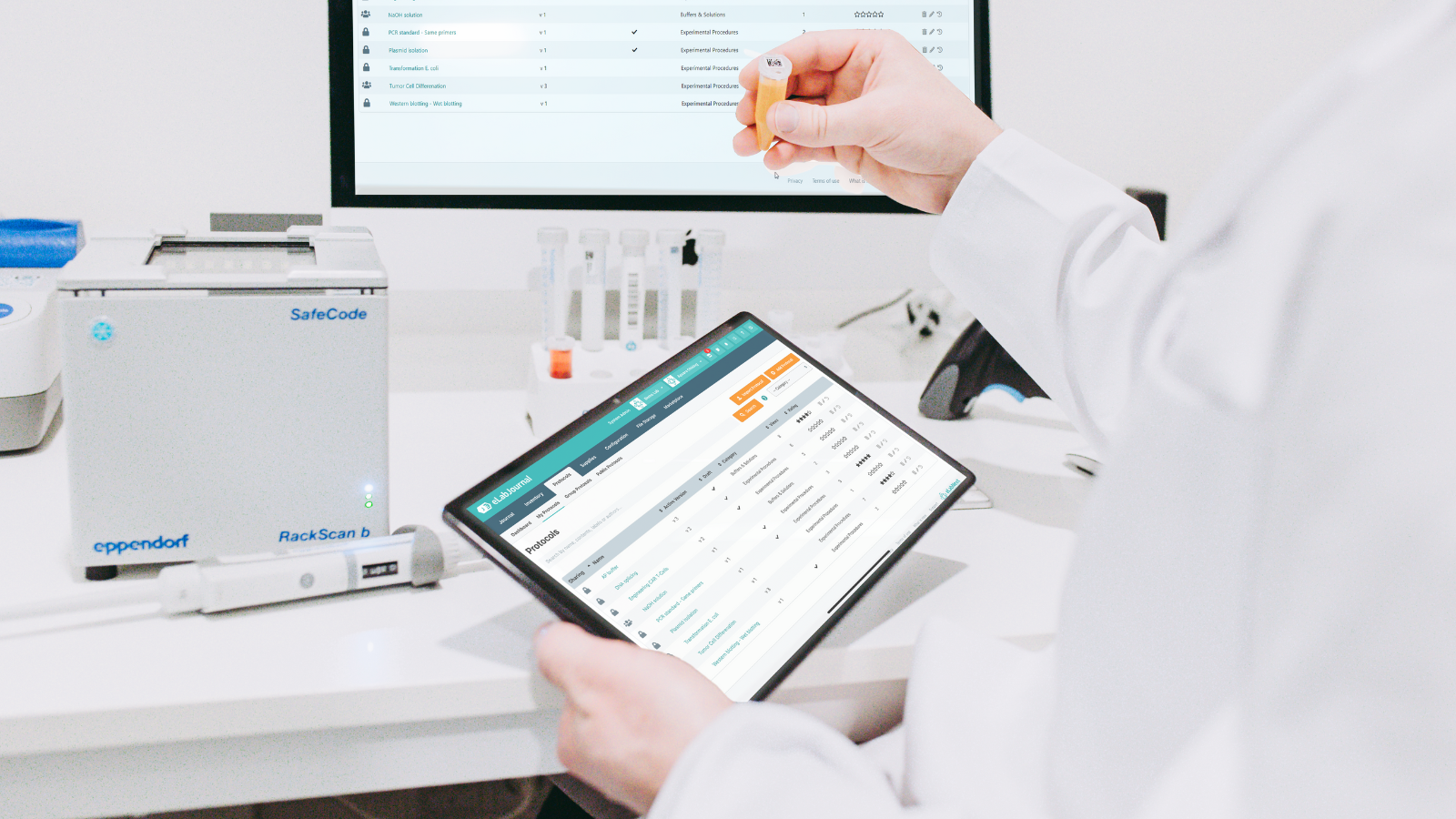
SciSure's Electronic Lab Notebook (ELN)

The advantages of ELN software that show up in daily work

1. You can find past work without asking the person who did it

When a lab manager or researcher leaves, the context of their work often leaves too. An ELN lets you search experiments, protocols, samples, and files by keyword, date, author, project, or custom field, and the records stay with the lab.

One practical note: search is only as good as your naming. Agree on how projects, studies, and experiments are titled before go-live, and put metadata such as grant numbers or study IDs into custom fields. In SciSure, project and study fields hold exactly that kind of information.

2. Methods are easier to repeat

In a 2016 Nature survey of more than 1,500 researchers, over 70% said they had failed to reproduce another scientist's experiment, and more than half had failed to reproduce their own. Poor documentation isn't the only cause, but it's one of the few a lab can fix by itself.

An ELN helps by turning protocols into shared, versioned templates. In SciSure, a procedure section inserts a specific version of a protocol into the experiment. Dynamic fields can calculate quantities from what the scientist enters, and later edits inside the experiment don't change the source protocol. A colleague reading the record a year later can see exactly which version was used.

Protocol & SOP management on the SciSure Research platform

3. Results keep their context

A result without its sample IDs, storage location, or instrument is hard to trust and harder to reuse. Notebook-only tools tend to leave that context in a separate spreadsheet. With SciSure ELN and SciSure LIMS, an experiment lists the samples it used and generated, and each sample record shows the experiments it appears in. Equipment links the same way, and storage is modeled down to the shelf, rack, box, and position.

That two-way link is what saves a Friday afternoon of checking a freezer map against a notebook.

4. Review happens inside the record

Supervisors can comment on an experiment while it's being written instead of waiting for the next one-on-one with a paper notebook. In SciSure, collaborators added at project or study level carry down to the experiments, a section locks while someone else edits it, and text auto-saves with earlier versions kept.

For a deeper dive, check out our guide on paper versus electronic lab notebooks for research.

5. Records hold up to scrutiny

Every edit carries a timestamp and a user. Completed work can be signed and locked. In SciSure, a signature uses the scientist's credentials or a two-step verification code. If your lab requires witnessing, the record goes to an assigned witness who can approve it or send it back with a comment. Signed records stay readable but can't be edited, so corrections go into comments or linked copies and the original stays intact.

These controls support Good Laboratory Practice (GLP), the wider family of GxP regulations, and FDA 21 CFR Part 11 workflows. They don't make a lab compliant on their own: your organization still owns validation, standard operating procedures (SOPs), training, and quality oversight. Our GxP guide for ELNs and 21 CFR Part 11 guide go into the details.
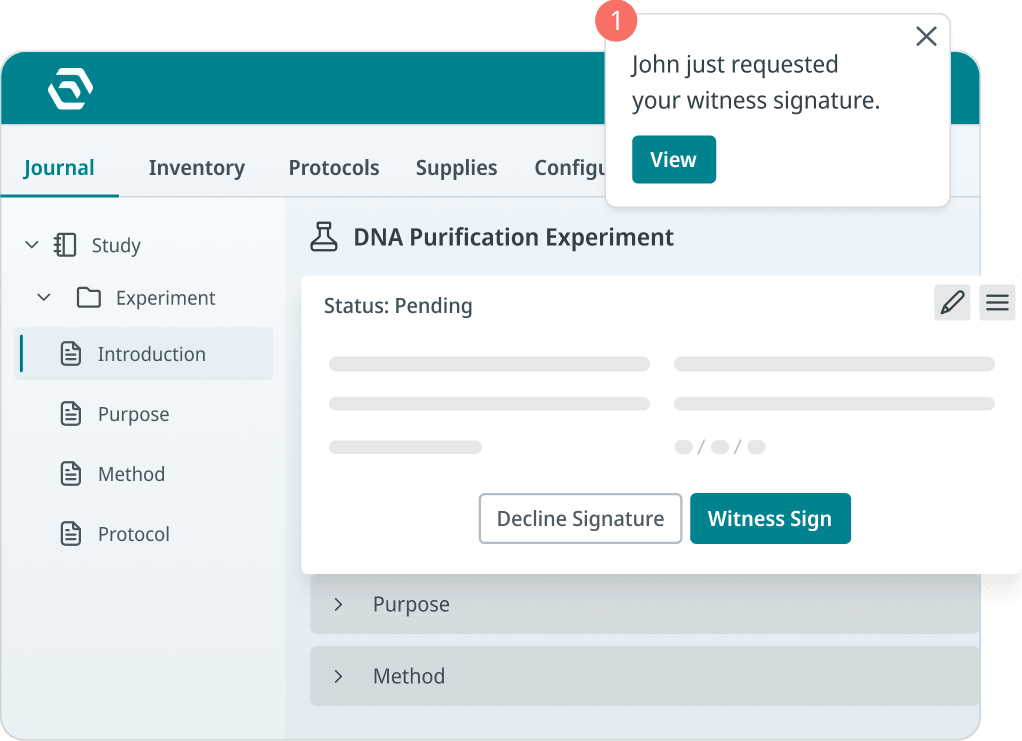
Witness signatures on the SciSure ELN

6. Funder and institutional rules get easier to meet

  • The NIH Data Management and Sharing Policy asks funded researchers to plan how their data will be managed and shared.
  • The FAIR Principles push toward data that is findable, accessible, interoperable, and reusable.
  • In Germany, the DFG Code of Conduct expects documentation detailed enough to replicate a result (Guideline 12) and generally asks institutions to archive the data behind published findings for ten years (Guideline 17).

In some cases, funders and industrial partners now expect labs to keep a lab notebook, and an electronic one makes that far easier to show.

7. Routine admin runs on its own

Low stock, expiring reagents, and unsigned records are easy to forget. SciSure automations follow a simple pattern: a trigger (a record changes or a date gets close), optional conditions, then an action such as an email, a task (with the Tasks add-on), or a webhook to another system like Slack or Microsoft Teams. Sample quantity thresholds can also add a linked catalog item to the shopping list. All of this runs where your administrators set it up.

Stock expiration alerts on the SciSure platform
SciSure ELN
See these advantages in your own workflow
Bring one recurring experiment. We'll show you how it looks as a SciSure template, with the samples, protocol version, and sign-off attached.
Talk to a specialist

The drawbacks of ELN software, and how to handle them

Screens don't belong at a wet bench

Scientists writing about ELNs in wet labs point out the obvious: you can't carry a laptop into most lab areas, so notes go on paper first and get typed up later. That double entry is where many rollouts quietly stall.

What helps: Put the ELN where the work happens. SciSure's Android and iOS apps let scientists browse experiments and procedures, scan barcodes on samples, boxes, and equipment, check samples in and out, book equipment, and capture notes and photos to add to the ELN later. A shared tablet at the bench covers much of the rest.

Setup takes time, and the learning curve is real

Someone has to agree on the project structure, build templates, migrate samples, and train people. Rush that work and scientists keep their side spreadsheets.

What helps: Start with one group and one recurring workflow. On G2, SciSure users report an average of three months to implement and eight months to return on investment (ROI), the shortest payback of the five ELNs in our G2-based comparison.

The top Electronic Lab Notebooks (ELNs) ranked by G2-reported Ease of Use & ROI

Platform G2 ratings on "Ease of use" & time to ROI
SciSure 43 reviews, 8 months
SciNote 35 reviews, 18 months
Labguru 15 reviews, 13 months
IDBS E-Workbook 6 reviews, undisclosed
Benchling 1 review, undisclosed

It costs more than a notebook

Licenses, hosting, and staff time add up, and free tools exist. Free can work for one researcher. It gets harder once you need permissions, signatures, support, or data that belongs to the institution rather than a personal account. We looked at that trade-off in Free Electronic Lab Notebook Software: Is It Worth It?

What helps: Roll out in stages. In SciSure, each research group works in its own secure group space, while organization administrators manage accounts, licenses, and settings in one place. You can start where demand is strongest and add groups as they're ready.

Structure can feel rigid

Scientists push back when a template forces a workflow that doesn't fit the experiment. Principal investigators in academia, used to running their labs independently, tend to push back hardest.

What helps: Choose an ELN your own team can configure. In SciSure, lab managers build experiment templates and sample types with their own fields, dropdowns, required values, and conditional sections, without waiting on vendor development. Each group keeps its own templates, while central IT manages accounts and security in one place.
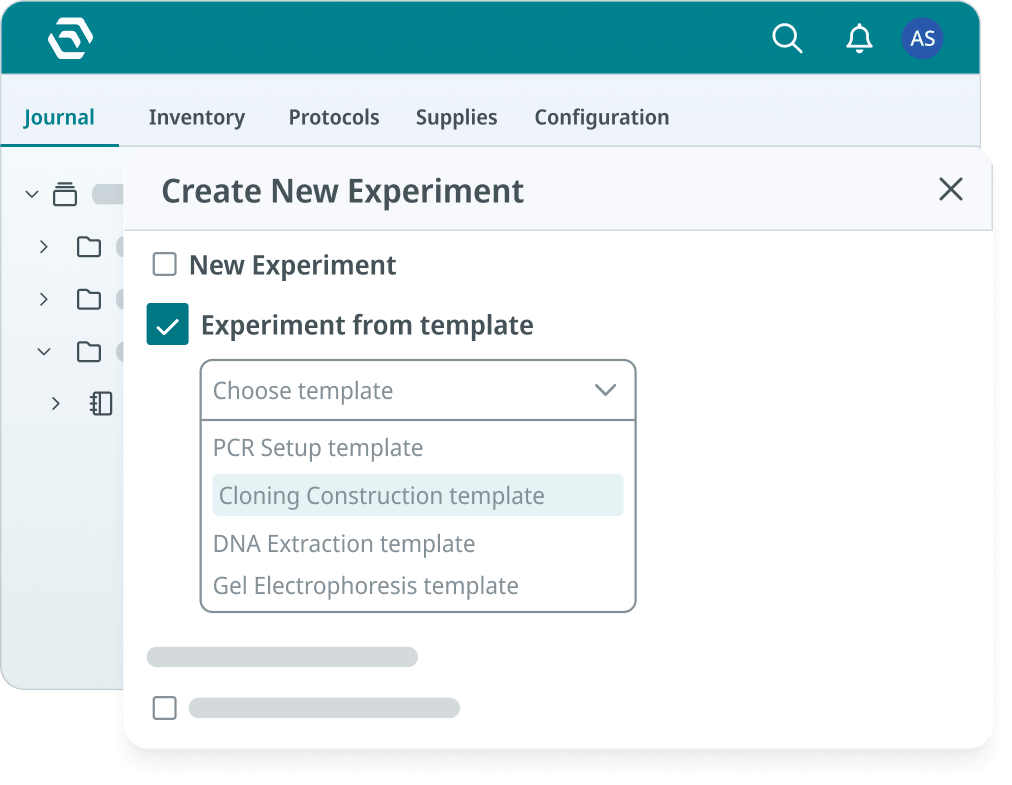
Experimental templates on the SciSure ELN

Lock-in and data ownership

Leaving an ELN later is expensive, and some tools tie records to an individual's account instead of the institution.

What helps: Before you buy, ask who owns the records, what happens when someone leaves, and how you get data out. In SciSure, organization administrators manage account ownership and handover, experiments can be exported, and sample data exports to Excel. If you're already facing a move, our guide to transitioning from another ELN covers migration.

Security and data location

IT and legal teams want to know who can sign in, how, and where the data sits. For many European institutes, data location decides the shortlist.

What helps: SciSure supports single sign-on (SSO) through SAML, Microsoft Entra ID, Okta, OneLogin, AD FS, Keycloak, and SURFconext, among others, plus two-step verification and configurable password rules. Hosting options include public cloud in the EU or US, private cloud, on-premises, and a hybrid setup that keeps large files on your own servers. Check out SciSure's hosting options and how to choose a data-secure ELN.

Some labs need a different category of software

An ELN is built for research. If your main need is Good Manufacturing Practice (GMP) batch records, stability studies, or quality control lot release, look at systems built for manufacturing and QC. SciSure is designed for discovery and research work, and it's better to know where that line sits before a pilot than after.

Who gets the most out of an ELN?

The payoff grows with how many people depend on the same records and how often someone checks them.

Which labs gain the most from an ELN, and what to check before you buy

Lab type Why the payoff is bigger What to check
Research institutes and university medical centres Many independent groups need one standard without one workflow forced on everyone Group-level setup with central administration, SSO, EU or on-premises hosting, interface language (SciSure offers German and French)
Regulated R&D and contract research organizations (CROs) Audit trails, signatures, and versioned methods are part of daily work Witness signing, locked records, and the validation support the vendor offers
Diagnostics and assay development Methods change often and need a clear version history across sites Versioned protocols and audit trails for development work. Design controls and corrective and preventive action (CAPA) usually live in a separate quality system
Biotechs with 50+ staff, before clinical manufacturing More people, samples, and sites than spreadsheets can handle Inventory linked to experiments, multi-site setup, and what changes once GxP work starts
University and teaching labs Student turnover makes records disappear Records owned by the institution, simple templates, cost per seat
One researcher, no compliance needs Smallest gain Paper or a free tool may be enough

When Institut Pasteur in Paris chose an ELN for its research units, it evaluated more than 20 ELN and sample tracking tools and treated legal and data security questions as essential. About a hundred volunteer scientists took part in the selection, including a six-month trial of two finalists.

Rollout started in May 2021 with 50 volunteer units. By April 2022, according to Pasteur's internal newsletter, 112 Pasteur entities were using it, 80% of first-wave entities had dropped paper notebooks entirely, and the system held about 6,000 experiments, 20,000 samples, and 700 bookable pieces of equipment. (Pasteur's newsletters use SciSure ELN's earlier name, eLabJournal.)

Scientists helped choose the tool, a small group went first, and the institute expanded in waves.

Customer Story  ·  Academia
A Digital Transformation at Institut Pasteur
How one of the world's leading research institutes unified its lab data, samples and documentation with SciSure.
The Challenge

Paper notebooks and mismatched tools across 12 departments

Hours lost locating samples and organizing records

Data scattered across drives, computers and cloud storage

No shared standard, raising the risk of lost research work

The Solution
20+
ELN & sample tools evaluated
7 → 2
Compared, then taken to proof of concept
1
Unified ELN + LIMS platform deployed
Chosen for: ELN + LIMS in one Ease of use Cost-effectiveness Legal & data security
The Impact

One central hub

Protocols, experiments and samples connected in a single place.

Full traceability

Clear record of what was done, and by whom, across every unit.

Faster retrieval

The inventory browser makes sample tracking quick and simple.

Equipment module

Centralized instrument info and shared team bookings.

SOPs linked

Standard procedures tied directly to the right experiments.

Secure backups

Research data stored reliably and accessible from anywhere.

“
SciSure has been a game-changer for our lab. Its intuitive interface and tracking capabilities turned sample management from a time-consuming task into a swift, effortless process.
Mariano Martinez  · Research Engineer & Lab Manager, Bacterial Cell Cycle Mechanisms Unit, Institut Pasteur
SciSure ELN
Rolling out an ELN across many groups?
Talk to us about group-by-group rollout, central administration, single sign-on, and hosting in the EU, the US, a private cloud, or on-premises.
Request a demo

FAQs

What are the main advantages of ELN software?

Searchable records that stay with the lab, versioned protocols that make methods easier to repeat, results linked to the samples and equipment behind them, review and sign-off inside the record, timestamped audit trails, and simpler proof for funder and institutional data rules. How much each one matters depends on how many people share your records.

What are the disadvantages of an electronic lab notebook?

Cost, setup time, a learning curve, screens at the bench, rigid templates in some products, and the risk of lock-in. Mobile apps, templates your own team can configure, a phased rollout, and clear terms on export and data ownership reduce most of them.

Is an ELN worth it for a small lab?

For one researcher with no compliance requirements, paper or a free tool can be enough. Once several people share samples, protocols, or results, or you need signatures and audit trails, the time saved finding and checking records usually covers the cost of a paid ELN.

Does an ELN make my lab 21 CFR Part 11 compliant?

No software does that on its own. An ELN like SciSure provides controls such as audit trails, electronic signatures, witness signing, and locked records. Your organization still validates the system for its intended use and maintains SOPs, training, and quality oversight.

Can scientists use an ELN at the bench?

Yes, with mobile access. SciSure's iOS and Android apps support barcode scanning, sample check-in and check-out, equipment booking, and capturing notes and photos to add to the ELN.

What's the difference between an ELN and a LIMS?

An ELN records experiments: plans, methods, observations, and results. A LIMS manages samples and materials: what they are, where they're stored, how they relate, and how they're used. SciSure offers both, and experiments in SciSure ELN can link to samples managed in SciSure LIMS.

Who owns the data in an ELN?

It depends on the vendor and the contract, so ask before you buy. In SciSure, organization administrators manage accounts and record ownership, so records stay with the institution when people move on.

If this sounds like the kind of support you need, get in touch with us. We'll walk you through how SciSure ELN adapts to your lab workflows, so you can focus on the work you do best without the admin overhead.

Ready to see SciSure in action?

Get a personalized demo and see how SciSure fits your lab's workflows.
Request demo

No commitment · Free consultation

Most articles about ELN benefits read like a feature list: searchable, collaborative, secure, compliant. None of it tells you whether an electronic lab notebook will pay off in your lab, or what it will cost you in time and habit before it does.

This guide covers both sides. You'll find the advantages scientists and lab leaders report most often, the drawbacks that come up in real labs (including a few that demos tend to skip),. the lab types where an ELN pays back fastest, and where SciSure's ELN fits.

What is ELN software?

An electronic lab notebook (ELN) is software for recording research: what you planned, what you did, which materials and methods you used, and what came out. It stores the files, images, and protocols behind each experiment and keeps a timestamped history of every change.

Many ELNs also connect to sample and inventory management, usually called a laboratory information management system (LIMS). SciSure offers both, as SciSure ELN and SciSure LIMS, so an experiment record can point to the physical samples it used and produced.

SciSure's Electronic Lab Notebook (ELN)

The advantages of ELN software that show up in daily work

1. You can find past work without asking the person who did it

When a lab manager or researcher leaves, the context of their work often leaves too. An ELN lets you search experiments, protocols, samples, and files by keyword, date, author, project, or custom field, and the records stay with the lab.

One practical note: search is only as good as your naming. Agree on how projects, studies, and experiments are titled before go-live, and put metadata such as grant numbers or study IDs into custom fields. In SciSure, project and study fields hold exactly that kind of information.

2. Methods are easier to repeat

In a 2016 Nature survey of more than 1,500 researchers, over 70% said they had failed to reproduce another scientist's experiment, and more than half had failed to reproduce their own. Poor documentation isn't the only cause, but it's one of the few a lab can fix by itself.

An ELN helps by turning protocols into shared, versioned templates. In SciSure, a procedure section inserts a specific version of a protocol into the experiment. Dynamic fields can calculate quantities from what the scientist enters, and later edits inside the experiment don't change the source protocol. A colleague reading the record a year later can see exactly which version was used.

Protocol & SOP management on the SciSure Research platform

3. Results keep their context

A result without its sample IDs, storage location, or instrument is hard to trust and harder to reuse. Notebook-only tools tend to leave that context in a separate spreadsheet. With SciSure ELN and SciSure LIMS, an experiment lists the samples it used and generated, and each sample record shows the experiments it appears in. Equipment links the same way, and storage is modeled down to the shelf, rack, box, and position.

That two-way link is what saves a Friday afternoon of checking a freezer map against a notebook.

4. Review happens inside the record

Supervisors can comment on an experiment while it's being written instead of waiting for the next one-on-one with a paper notebook. In SciSure, collaborators added at project or study level carry down to the experiments, a section locks while someone else edits it, and text auto-saves with earlier versions kept.

For a deeper dive, check out our guide on paper versus electronic lab notebooks for research.

5. Records hold up to scrutiny

Every edit carries a timestamp and a user. Completed work can be signed and locked. In SciSure, a signature uses the scientist's credentials or a two-step verification code. If your lab requires witnessing, the record goes to an assigned witness who can approve it or send it back with a comment. Signed records stay readable but can't be edited, so corrections go into comments or linked copies and the original stays intact.

These controls support Good Laboratory Practice (GLP), the wider family of GxP regulations, and FDA 21 CFR Part 11 workflows. They don't make a lab compliant on their own: your organization still owns validation, standard operating procedures (SOPs), training, and quality oversight. Our GxP guide for ELNs and 21 CFR Part 11 guide go into the details.

Witness signatures on the SciSure ELN

6. Funder and institutional rules get easier to meet

  • The NIH Data Management and Sharing Policy asks funded researchers to plan how their data will be managed and shared.
  • The FAIR Principles push toward data that is findable, accessible, interoperable, and reusable.
  • In Germany, the DFG Code of Conduct expects documentation detailed enough to replicate a result (Guideline 12) and generally asks institutions to archive the data behind published findings for ten years (Guideline 17).

In some cases, funders and industrial partners now expect labs to keep a lab notebook, and an electronic one makes that far easier to show.

7. Routine admin runs on its own

Low stock, expiring reagents, and unsigned records are easy to forget. SciSure automations follow a simple pattern: a trigger (a record changes or a date gets close), optional conditions, then an action such as an email, a task (with the Tasks add-on), or a webhook to another system like Slack or Microsoft Teams. Sample quantity thresholds can also add a linked catalog item to the shopping list. All of this runs where your administrators set it up.

Stock expiration alerts on the SciSure platform
SciSure ELN
See these advantages in your own workflow
Bring one recurring experiment. We'll show you how it looks as a SciSure template, with the samples, protocol version, and sign-off attached.
Talk to a specialist

The drawbacks of ELN software, and how to handle them

Screens don't belong at a wet bench

Scientists writing about ELNs in wet labs point out the obvious: you can't carry a laptop into most lab areas, so notes go on paper first and get typed up later. That double entry is where many rollouts quietly stall.

What helps: Put the ELN where the work happens. SciSure's Android and iOS apps let scientists browse experiments and procedures, scan barcodes on samples, boxes, and equipment, check samples in and out, book equipment, and capture notes and photos to add to the ELN later. A shared tablet at the bench covers much of the rest.

Setup takes time, and the learning curve is real

Someone has to agree on the project structure, build templates, migrate samples, and train people. Rush that work and scientists keep their side spreadsheets.

What helps: Start with one group and one recurring workflow. On G2, SciSure users report an average of three months to implement and eight months to return on investment (ROI), the shortest payback of the five ELNs in our G2-based comparison.

The top Electronic Lab Notebooks (ELNs) ranked by G2-reported Ease of Use & ROI

Platform G2 ratings on "Ease of use" & time to ROI
SciSure 43 reviews, 8 months
SciNote 35 reviews, 18 months
Labguru 15 reviews, 13 months
IDBS E-Workbook 6 reviews, undisclosed
Benchling 1 review, undisclosed

It costs more than a notebook

Licenses, hosting, and staff time add up, and free tools exist. Free can work for one researcher. It gets harder once you need permissions, signatures, support, or data that belongs to the institution rather than a personal account. We looked at that trade-off in Free Electronic Lab Notebook Software: Is It Worth It?

What helps: Roll out in stages. In SciSure, each research group works in its own secure group space, while organization administrators manage accounts, licenses, and settings in one place. You can start where demand is strongest and add groups as they're ready.

Structure can feel rigid

Scientists push back when a template forces a workflow that doesn't fit the experiment. Principal investigators in academia, used to running their labs independently, tend to push back hardest.

What helps: Choose an ELN your own team can configure. In SciSure, lab managers build experiment templates and sample types with their own fields, dropdowns, required values, and conditional sections, without waiting on vendor development. Each group keeps its own templates, while central IT manages accounts and security in one place.

Experimental templates on the SciSure ELN

Lock-in and data ownership

Leaving an ELN later is expensive, and some tools tie records to an individual's account instead of the institution.

What helps: Before you buy, ask who owns the records, what happens when someone leaves, and how you get data out. In SciSure, organization administrators manage account ownership and handover, experiments can be exported, and sample data exports to Excel. If you're already facing a move, our guide to transitioning from another ELN covers migration.

Security and data location

IT and legal teams want to know who can sign in, how, and where the data sits. For many European institutes, data location decides the shortlist.

What helps: SciSure supports single sign-on (SSO) through SAML, Microsoft Entra ID, Okta, OneLogin, AD FS, Keycloak, and SURFconext, among others, plus two-step verification and configurable password rules. Hosting options include public cloud in the EU or US, private cloud, on-premises, and a hybrid setup that keeps large files on your own servers. Check out SciSure's hosting options and how to choose a data-secure ELN.

Some labs need a different category of software

An ELN is built for research. If your main need is Good Manufacturing Practice (GMP) batch records, stability studies, or quality control lot release, look at systems built for manufacturing and QC. SciSure is designed for discovery and research work, and it's better to know where that line sits before a pilot than after.

Who gets the most out of an ELN?

The payoff grows with how many people depend on the same records and how often someone checks them.

Which labs gain the most from an ELN, and what to check before you buy

Lab type Why the payoff is bigger What to check
Research institutes and university medical centres Many independent groups need one standard without one workflow forced on everyone Group-level setup with central administration, SSO, EU or on-premises hosting, interface language (SciSure offers German and French)
Regulated R&D and contract research organizations (CROs) Audit trails, signatures, and versioned methods are part of daily work Witness signing, locked records, and the validation support the vendor offers
Diagnostics and assay development Methods change often and need a clear version history across sites Versioned protocols and audit trails for development work. Design controls and corrective and preventive action (CAPA) usually live in a separate quality system
Biotechs with 50+ staff, before clinical manufacturing More people, samples, and sites than spreadsheets can handle Inventory linked to experiments, multi-site setup, and what changes once GxP work starts
University and teaching labs Student turnover makes records disappear Records owned by the institution, simple templates, cost per seat
One researcher, no compliance needs Smallest gain Paper or a free tool may be enough

When Institut Pasteur in Paris chose an ELN for its research units, it evaluated more than 20 ELN and sample tracking tools and treated legal and data security questions as essential. About a hundred volunteer scientists took part in the selection, including a six-month trial of two finalists.

Rollout started in May 2021 with 50 volunteer units. By April 2022, according to Pasteur's internal newsletter, 112 Pasteur entities were using it, 80% of first-wave entities had dropped paper notebooks entirely, and the system held about 6,000 experiments, 20,000 samples, and 700 bookable pieces of equipment. (Pasteur's newsletters use SciSure ELN's earlier name, eLabJournal.)

Scientists helped choose the tool, a small group went first, and the institute expanded in waves.

Customer Story  ·  Academia
A Digital Transformation at Institut Pasteur
How one of the world's leading research institutes unified its lab data, samples and documentation with SciSure.
The Challenge

Paper notebooks and mismatched tools across 12 departments

Hours lost locating samples and organizing records

Data scattered across drives, computers and cloud storage

No shared standard, raising the risk of lost research work

The Solution
20+
ELN & sample tools evaluated
7 → 2
Compared, then taken to proof of concept
1
Unified ELN + LIMS platform deployed
Chosen for: ELN + LIMS in one Ease of use Cost-effectiveness Legal & data security
The Impact

One central hub

Protocols, experiments and samples connected in a single place.

Full traceability

Clear record of what was done, and by whom, across every unit.

Faster retrieval

The inventory browser makes sample tracking quick and simple.

Equipment module

Centralized instrument info and shared team bookings.

SOPs linked

Standard procedures tied directly to the right experiments.

Secure backups

Research data stored reliably and accessible from anywhere.

“
SciSure has been a game-changer for our lab. Its intuitive interface and tracking capabilities turned sample management from a time-consuming task into a swift, effortless process.
Mariano Martinez  · Research Engineer & Lab Manager, Bacterial Cell Cycle Mechanisms Unit, Institut Pasteur
SciSure ELN
Rolling out an ELN across many groups?
Talk to us about group-by-group rollout, central administration, single sign-on, and hosting in the EU, the US, a private cloud, or on-premises.
Request a demo

FAQs

What are the main advantages of ELN software?

Searchable records that stay with the lab, versioned protocols that make methods easier to repeat, results linked to the samples and equipment behind them, review and sign-off inside the record, timestamped audit trails, and simpler proof for funder and institutional data rules. How much each one matters depends on how many people share your records.

What are the disadvantages of an electronic lab notebook?

Cost, setup time, a learning curve, screens at the bench, rigid templates in some products, and the risk of lock-in. Mobile apps, templates your own team can configure, a phased rollout, and clear terms on export and data ownership reduce most of them.

Is an ELN worth it for a small lab?

For one researcher with no compliance requirements, paper or a free tool can be enough. Once several people share samples, protocols, or results, or you need signatures and audit trails, the time saved finding and checking records usually covers the cost of a paid ELN.

Does an ELN make my lab 21 CFR Part 11 compliant?

No software does that on its own. An ELN like SciSure provides controls such as audit trails, electronic signatures, witness signing, and locked records. Your organization still validates the system for its intended use and maintains SOPs, training, and quality oversight.

Can scientists use an ELN at the bench?

Yes, with mobile access. SciSure's iOS and Android apps support barcode scanning, sample check-in and check-out, equipment booking, and capturing notes and photos to add to the ELN.

What's the difference between an ELN and a LIMS?

An ELN records experiments: plans, methods, observations, and results. A LIMS manages samples and materials: what they are, where they're stored, how they relate, and how they're used. SciSure offers both, and experiments in SciSure ELN can link to samples managed in SciSure LIMS.

Who owns the data in an ELN?

It depends on the vendor and the contract, so ask before you buy. In SciSure, organization administrators manage accounts and record ownership, so records stay with the institution when people move on.

If this sounds like the kind of support you need, get in touch with us. We'll walk you through how SciSure ELN adapts to your lab workflows, so you can focus on the work you do best without the admin overhead.

About the author:

Wouter de Jong

Wouter de Jong is Co-founder and Chief Product Officer at SciSure, where he drives product vision across the Scientific Management Platform. He co-founded eLabNext in 2010 and holds a PhD in Molecular Biology from the University of Groningen, with research focused on structural proteins in bacterial development. That bench science background shapes how SciSure is designed: by a scientist, for scientists.

See all posts from this author

Sign up for our newsletter

Get the latest tips, articles, and exclusive content on modern lab management delivered to your inbox.
Thank you for subscribing!
Please check your email to verify your submission.
Oops! Something went wrong while submitting the form.