Lab Compliance Training: How a Lab LMS Keeps Safety Training Current

How SciSure's lab LMS assigns safety training by role and hazard, tracks renewals, and keeps audit-ready records.

•
October 16, 2026
•
()
min read
A laboratory

Download Whitepaper

By submitting this form, you agree with our Privacy Policy.
Thank you! Download the file by clicking below:
Download
Oops! Something went wrong while submitting the form.

Table of Contents

Thank you! Your submission has been received!
Oops! Something went wrong while submitting the form.

TL;DR

A lab LMS (learning management system) keeps lab compliance training current by assigning courses based on each person's role and hazards, sending renewal reminders automatically, and keeping audit-ready training records in one place.
‍

  • Training follows exposure.
    The OSHA Laboratory Standard (29 CFR 1910.1450) requires training when someone is first assigned to a space with hazardous chemicals and before any new exposure situation. Bloodborne pathogens training adds a yearly refresher. A lab LMS turns those triggers into automatic assignments instead of calendar reminders.
    ‍
  • Assign by role and hazard.
    SciSure Health & Safety ties training requirements to the work activities and hazards each person is linked to, so researchers take only the courses that apply. Someone working across several labs keeps one training record that counts everywhere, which cuts duplicate courses and the follow-up emails that come with them.
    ‍
  • Use content you already have.
    SciSure's Training LMS supports PowerPoint, video, PDF and SCORM content, quizzes, and instructor-led classroom sessions. Where configured, it can also import records from an existing campus or corporate learning system, so you don't have to rebuild your course library before you start.
    ‍
  • Proven at universities.
    San Diego State University raised training compliance from 56% to over 80% and cut a department head's compliance report from two weeks to about ten minutes. Boston College reports up to 97% training compliance and replaced an outside consultant for biosafety training and audits.
    ‍

We first published this piece in 2024 and updated it in 2026 with the OSHA training triggers that matter most for labs, updated customer proof, and practical measures for training effectiveness.

Most lab safety training problems live in the gaps between courses. For example, the postdoc who moved into the radiation lab in March and was never assigned the right module. The annual refresher that lapsed while someone was on leave. The spreadsheet that says everyone is current because nobody has updated it since the last audit.

A lab learning management system (LMS) closes those gaps by connecting training to the people, spaces and hazards it's meant to cover.

With SciSure Health & Safety, EHS (environmental health and safety) and lab operations teams can assign courses by role and hazard, automate reminders and renewals, and pull audit-ready training reports in minutes. This guide covers what the regulations ask for, how a lab LMS works day to day, how to tell whether your training is working, and what two universities achieved after moving off manual tracking.

The importance of continuous training in lab safety

Labs change constantly. New people join mid-semester, projects pick up new chemicals or biological agents, equipment gets added, and procedures get revised. Each change can create an exposure that someone hasn't been trained for. Continuous training keeps the program in step with those changes, so you aren't relying on a single onboarding session that slowly goes out of date.

The goal is simple to state and hard to run on spreadsheets: people know the hazards in front of them today, and the EHS team can prove it.

What the regulations ask for

In the US, the OSHA Laboratory Standard (29 CFR 1910.1450) requires employers to train lab workers on the hazards of chemicals in their work area. Training has to happen when someone is first assigned to a space where hazardous chemicals are present, and again before any assignment that involves a new exposure. OSHA leaves the refresher interval to the employer, which is why many institutions set an annual cycle and write it into their Chemical Hygiene Plan.

Other standards set firmer clocks. The Bloodborne Pathogens Standard (29 CFR 1910.1030) requires training at initial assignment and at least once a year after that, plus extra training when new tasks or procedures change someone's exposure. It also requires training records to be kept for three years, including session dates, content, trainers and attendees.

Biosafety, radiation safety and institutional policies often add their own requirements. The practical result is that a single researcher can carry five or six training obligations, each with its own trigger and renewal date. That's the part spreadsheets struggle with.

The risks of neglecting training

When training falls behind, people work with hazards they haven't been trained on. Refreshers lapse without anyone noticing. And when an inspector or auditor asks for records, the EHS team spends days piecing together who took what and when.

There's a cultural cost too. If training feels like a box-ticking exercise that sends everyone through the same courses, researchers tune out. Training that matches someone's actual work is easier to finish and more likely to stick.

How a lab LMS supports compliance training

A lab LMS is a central system for delivering, assigning and recording training. What sets it apart from a general corporate LMS is what it connects training to: the hazards, spaces and work activities in your labs.

Assign training by role, hazard, and location

In SciSure Health & Safety, training requirements can be tied to job activities, meaning the hazards and types of work a person is linked to, such as radioactive materials, biological agents or lasers. When someone is assigned a job activity, SciSure assigns the matching courses, notifies them and calculates renewal dates. Lab leaders can set default job activities for their group, so new members start with the right courses already in place.

People who work across several labs keep one training record that applies everywhere they work, so nobody retakes the same course for each group.
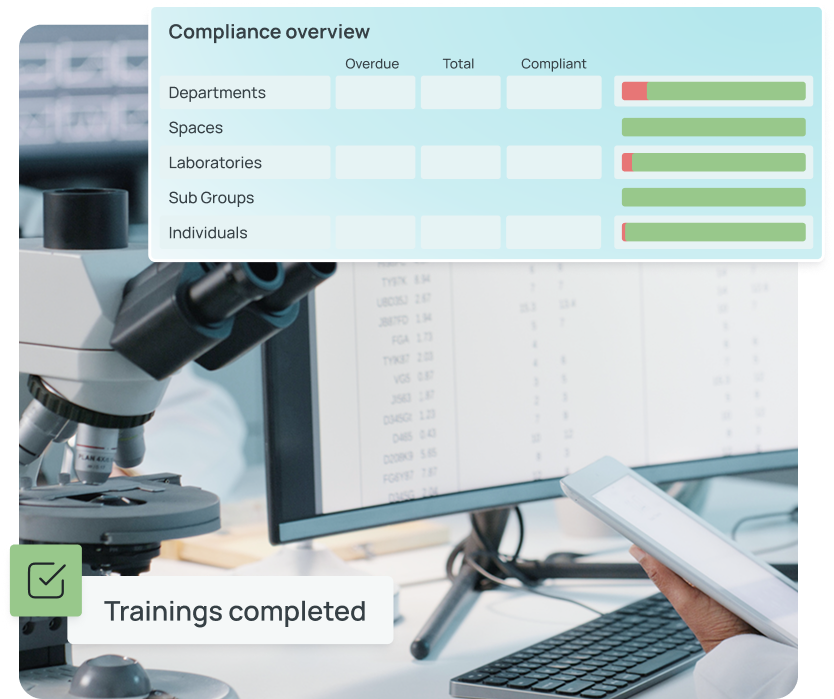
Lab compliance training on the SciSure Training LMS

Deliver the content you already have

SciSure's Training LMS supports PowerPoint, video, PDF and SCORM content, with optional quizzes. Trainers can schedule classroom sessions, assign instructors and record attendance, so in-person training sits in the same record as online courses. Where configured, SciSure can also import records from an existing learning system.

If you're building a library from scratch, SciSure's partnership with Vivid/HSI includes three professional courses at no cost and discounted access to a wider catalog.

Automate reminders and renewals

Automated notifications tell people when a course is assigned, due or overdue. Each user has a personal view of required courses, due dates and completion history, so researchers can check their own status without emailing EHS. Certificates can be issued on completion where enabled.

Report on compliance in minutes

EHS and oversight users can filter training records by group, course, person or location, see overdue status on dashboards, and export the data. That's what turns an audit request from a multi-day project into a quick report.

San Diego State University: Streamlining lab compliance training with SciSure

Before SciSure, Jennifer Ramil, Director of EHS at San Diego State University (SDSU), had no reliable view of who was working in which labs or what they were exposed to. Training was one of the hardest pieces. She wanted to stop sending everyone through every course and match training to each person's actual work.

SDSU adopted SciSure's Training LMS alongside ChemTracker, Hazardous Waste and Radioisotope Management. For training, the deciding factor was the ability to link one person to multiple labs, and multiple labs to one location, so a researcher's training counts everywhere they work.

Here's a summary of their results:

Customer outcomes · San Diego State University
SDSU's EHS & lab safety program, one year later
One year of program growth after moving training and reporting onto SciSure.
Before
After
Training coursesoffered to researchers and staff
Before
8
courses
After
16
courses
Completed training recordsper year
Before
~500
records
After
4,600+
records
Training complianceacross the program
Before
56%
compliant
After
80%+
compliant
Time to generate reportscompliance and training reporting
Before
1 hr–2 wks
per report
After
Minutes
per report
Source: San Diego State University EHS & Lab Safety program data, year over year.

‍

Jennifer also credits the automated messages with getting principal investigators (PIs) to own their researchers' training:
‍

"Worth its weight in gold to have PIs take responsibility for their researchers."

‍

How to tell if your lab safety training is working

Completion rate is the easiest number to report and the easiest to misread. A 95% completion rate can hide the five people working with your highest-risk material, and it says nothing about whether anyone learned anything.

A more useful set of measures:

  • Coverage by hazard.
    Is everyone linked to a given hazard trained for it? This tells you more than the overall percentage.
  • Overdue and lapsed training.
    How many people are past due, and for how long? The trend shows whether your reminders are working.
  • Time to train new starters.
    How quickly do new lab members finish required training after they join?
  • Inspection findings tied to training gaps.
    If inspectors keep flagging the same issue, the course content may need work, not just the completion rate.
  • Reporting effort.
    How long does it take to answer "who's trained on X?" If the answer is days, your data isn't working for you.

Boston College's EHS team, led by Director Gail Hall, moved from paper files and spreadsheets to SciSure, adding Training LMS alongside Inspection, Biosafety Management, Hazardous Waste and other modules. The department runs eight courses, six of them online in SciSure, plus 12 instructor-led sessions a year. Users completed close to 1,300 training records in 2023.

With training assigned by each person's hazard exposure, Boston College reports up to 97% training compliance. The Training LMS also replaced an outside consultant that had provided biosafety training and audits. Reports that were mostly infeasible before now take minutes: overall training compliance in 15 minutes, and users overdue for a course in 5.

Boston College
Training compliance
Hard to measureUp to 97%
Report of all lab groups and their PIs
All day5 minutes
List of everyone working with a given hazard
Not possible15 minutes
Outside biosafety training & audit consultant
RequiredEliminated

What to look for in a lab LMS

If you're comparing options, these are the questions that separate a lab LMS from a general training tool:

  • Can it assign training by hazard, not just by job title?
    Requirements should update when someone's work changes.
  • Does one person's record follow them across labs?
    Researchers in shared or multiple spaces shouldn't retake courses.
  • Can each course have its own renewal cycle?
    Annual, every three years and one-time courses need to sit side by side.
  • Does it handle in-person and online training together?
    Classroom attendance belongs in the same record as SCORM courses.
  • Can you pull a compliance report by person, group, course or location in minutes?
  • Does it connect to the rest of your safety program?
    Training data is most useful next to your chemical inventory, inspections and hazard records.
SciSure Health & Safety
See who's due, overdue and covered in one view
SciSure's Training LMS assigns courses by role and hazard, sends renewal reminders automatically, and keeps every completion record ready for your next audit.
Talk to a specialist

Make lab compliance training part of everyday lab work

Good training programs run on accurate data: who works where, what they work with and what they've completed. When that data lives in one place, training stops being something EHS chases by email and becomes something the system handles in the background, leaving your team more time for the conversations that improve safety.

If you're tracking training in spreadsheets today, get in touch with us. We'll walk you through how lab safety software helps automate every training requirement your program carries, so you can focus on keeping your lab audit-ready at all times.

Frequently asked questions

What is a lab LMS?

‍A lab LMS (learning management system) is software that delivers, assigns and records safety and compliance training for laboratory staff. Unlike a general corporate LMS, it links training to the hazards, spaces and activities each person works with, so requirements update when someone's work changes. SciSure's Training LMS is part of SciSure Health & Safety.

What lab compliance training does OSHA require?

‍The OSHA Laboratory Standard requires training on chemical hazards when someone is first assigned to a work area with hazardous chemicals and before new exposure situations, with refresher frequency set by the employer. Other standards, such as Bloodborne Pathogens, require annual training. Your Chemical Hygiene Plan and institutional policies define the full list for your labs.

How often should lab safety training be refreshed?

‍It depends on the requirement. The OSHA Laboratory Standard lets employers set refresher intervals, and many institutions choose once a year. Bloodborne pathogens training must be repeated at least annually. Biosafety, radiation and institutional courses often have their own cycles. A lab LMS can track a separate renewal period for each course.

Can SciSure use our existing training content?

‍Yes. SciSure's Training LMS supports PowerPoint, video, PDF and SCORM content, plus optional quizzes and instructor-led sessions. Where configured, records can be imported from an existing learning system. If you need content, SciSure's partnership with Vivid/HSI includes three professional courses at no cost and discounted access to a wider library.

How does a lab LMS help with audits and inspections?

‍It keeps training records, including dates, courses and completion status, in one searchable place. Instead of rebuilding records from spreadsheets, EHS teams can filter by person, group, course or location and export a report. At San Diego State University, a training compliance report that took 2.5 hours now takes 3 minutes.

Does a lab LMS make our lab compliant?

‍No software makes a lab compliant on its own. A lab LMS gives you the structure to assign the right training, track it and prove it happened. Your organization still owns the training content, the Chemical Hygiene Plan, refresher policies and how requirements are set for each hazard.

SciSure Health & Safety
Talk to us about your training program
Bring your course list and requirements. We'll show you how SciSure Health & Safety would assign, track and report on them.
Request a demo

Ready to see SciSure in action?

Get a personalized demo and see how SciSure fits your lab's workflows.
Request demo

No commitment · Free consultation

Most lab safety training problems live in the gaps between courses. For example, the postdoc who moved into the radiation lab in March and was never assigned the right module. The annual refresher that lapsed while someone was on leave. The spreadsheet that says everyone is current because nobody has updated it since the last audit.

A lab learning management system (LMS) closes those gaps by connecting training to the people, spaces and hazards it's meant to cover.

With SciSure Health & Safety, EHS (environmental health and safety) and lab operations teams can assign courses by role and hazard, automate reminders and renewals, and pull audit-ready training reports in minutes. This guide covers what the regulations ask for, how a lab LMS works day to day, how to tell whether your training is working, and what two universities achieved after moving off manual tracking.

The importance of continuous training in lab safety

Labs change constantly. New people join mid-semester, projects pick up new chemicals or biological agents, equipment gets added, and procedures get revised. Each change can create an exposure that someone hasn't been trained for. Continuous training keeps the program in step with those changes, so you aren't relying on a single onboarding session that slowly goes out of date.

The goal is simple to state and hard to run on spreadsheets: people know the hazards in front of them today, and the EHS team can prove it.

What the regulations ask for

In the US, the OSHA Laboratory Standard (29 CFR 1910.1450) requires employers to train lab workers on the hazards of chemicals in their work area. Training has to happen when someone is first assigned to a space where hazardous chemicals are present, and again before any assignment that involves a new exposure. OSHA leaves the refresher interval to the employer, which is why many institutions set an annual cycle and write it into their Chemical Hygiene Plan.

Other standards set firmer clocks. The Bloodborne Pathogens Standard (29 CFR 1910.1030) requires training at initial assignment and at least once a year after that, plus extra training when new tasks or procedures change someone's exposure. It also requires training records to be kept for three years, including session dates, content, trainers and attendees.

Biosafety, radiation safety and institutional policies often add their own requirements. The practical result is that a single researcher can carry five or six training obligations, each with its own trigger and renewal date. That's the part spreadsheets struggle with.

The risks of neglecting training

When training falls behind, people work with hazards they haven't been trained on. Refreshers lapse without anyone noticing. And when an inspector or auditor asks for records, the EHS team spends days piecing together who took what and when.

There's a cultural cost too. If training feels like a box-ticking exercise that sends everyone through the same courses, researchers tune out. Training that matches someone's actual work is easier to finish and more likely to stick.

How a lab LMS supports compliance training

A lab LMS is a central system for delivering, assigning and recording training. What sets it apart from a general corporate LMS is what it connects training to: the hazards, spaces and work activities in your labs.

Assign training by role, hazard, and location

In SciSure Health & Safety, training requirements can be tied to job activities, meaning the hazards and types of work a person is linked to, such as radioactive materials, biological agents or lasers. When someone is assigned a job activity, SciSure assigns the matching courses, notifies them and calculates renewal dates. Lab leaders can set default job activities for their group, so new members start with the right courses already in place.

People who work across several labs keep one training record that applies everywhere they work, so nobody retakes the same course for each group.

Lab compliance training on the SciSure Training LMS

Deliver the content you already have

SciSure's Training LMS supports PowerPoint, video, PDF and SCORM content, with optional quizzes. Trainers can schedule classroom sessions, assign instructors and record attendance, so in-person training sits in the same record as online courses. Where configured, SciSure can also import records from an existing learning system.

If you're building a library from scratch, SciSure's partnership with Vivid/HSI includes three professional courses at no cost and discounted access to a wider catalog.

Automate reminders and renewals

Automated notifications tell people when a course is assigned, due or overdue. Each user has a personal view of required courses, due dates and completion history, so researchers can check their own status without emailing EHS. Certificates can be issued on completion where enabled.

Report on compliance in minutes

EHS and oversight users can filter training records by group, course, person or location, see overdue status on dashboards, and export the data. That's what turns an audit request from a multi-day project into a quick report.

San Diego State University: Streamlining lab compliance training with SciSure

Before SciSure, Jennifer Ramil, Director of EHS at San Diego State University (SDSU), had no reliable view of who was working in which labs or what they were exposed to. Training was one of the hardest pieces. She wanted to stop sending everyone through every course and match training to each person's actual work.

SDSU adopted SciSure's Training LMS alongside ChemTracker, Hazardous Waste and Radioisotope Management. For training, the deciding factor was the ability to link one person to multiple labs, and multiple labs to one location, so a researcher's training counts everywhere they work.

Here's a summary of their results:

Customer outcomes · San Diego State University
SDSU's EHS & lab safety program, one year later
One year of program growth after moving training and reporting onto SciSure.
Before
After
Training coursesoffered to researchers and staff
Before
8
courses
After
16
courses
Completed training recordsper year
Before
~500
records
After
4,600+
records
Training complianceacross the program
Before
56%
compliant
After
80%+
compliant
Time to generate reportscompliance and training reporting
Before
1 hr–2 wks
per report
After
Minutes
per report
Source: San Diego State University EHS & Lab Safety program data, year over year.

‍

Jennifer also credits the automated messages with getting principal investigators (PIs) to own their researchers' training:
‍

"Worth its weight in gold to have PIs take responsibility for their researchers."

‍

How to tell if your lab safety training is working

Completion rate is the easiest number to report and the easiest to misread. A 95% completion rate can hide the five people working with your highest-risk material, and it says nothing about whether anyone learned anything.

A more useful set of measures:

  • Coverage by hazard.
    Is everyone linked to a given hazard trained for it? This tells you more than the overall percentage.
  • Overdue and lapsed training.
    How many people are past due, and for how long? The trend shows whether your reminders are working.
  • Time to train new starters.
    How quickly do new lab members finish required training after they join?
  • Inspection findings tied to training gaps.
    If inspectors keep flagging the same issue, the course content may need work, not just the completion rate.
  • Reporting effort.
    How long does it take to answer "who's trained on X?" If the answer is days, your data isn't working for you.

Boston College's EHS team, led by Director Gail Hall, moved from paper files and spreadsheets to SciSure, adding Training LMS alongside Inspection, Biosafety Management, Hazardous Waste and other modules. The department runs eight courses, six of them online in SciSure, plus 12 instructor-led sessions a year. Users completed close to 1,300 training records in 2023.

With training assigned by each person's hazard exposure, Boston College reports up to 97% training compliance. The Training LMS also replaced an outside consultant that had provided biosafety training and audits. Reports that were mostly infeasible before now take minutes: overall training compliance in 15 minutes, and users overdue for a course in 5.

Boston College
Training compliance
Hard to measureUp to 97%
Report of all lab groups and their PIs
All day5 minutes
List of everyone working with a given hazard
Not possible15 minutes
Outside biosafety training & audit consultant
RequiredEliminated

What to look for in a lab LMS

If you're comparing options, these are the questions that separate a lab LMS from a general training tool:

  • Can it assign training by hazard, not just by job title?
    Requirements should update when someone's work changes.
  • Does one person's record follow them across labs?
    Researchers in shared or multiple spaces shouldn't retake courses.
  • Can each course have its own renewal cycle?
    Annual, every three years and one-time courses need to sit side by side.
  • Does it handle in-person and online training together?
    Classroom attendance belongs in the same record as SCORM courses.
  • Can you pull a compliance report by person, group, course or location in minutes?
  • Does it connect to the rest of your safety program?
    Training data is most useful next to your chemical inventory, inspections and hazard records.
SciSure Health & Safety
See who's due, overdue and covered in one view
SciSure's Training LMS assigns courses by role and hazard, sends renewal reminders automatically, and keeps every completion record ready for your next audit.
Talk to a specialist

Make lab compliance training part of everyday lab work

Good training programs run on accurate data: who works where, what they work with and what they've completed. When that data lives in one place, training stops being something EHS chases by email and becomes something the system handles in the background, leaving your team more time for the conversations that improve safety.

If you're tracking training in spreadsheets today, get in touch with us. We'll walk you through how lab safety software helps automate every training requirement your program carries, so you can focus on keeping your lab audit-ready at all times.

Frequently asked questions

What is a lab LMS?

‍A lab LMS (learning management system) is software that delivers, assigns and records safety and compliance training for laboratory staff. Unlike a general corporate LMS, it links training to the hazards, spaces and activities each person works with, so requirements update when someone's work changes. SciSure's Training LMS is part of SciSure Health & Safety.

What lab compliance training does OSHA require?

‍The OSHA Laboratory Standard requires training on chemical hazards when someone is first assigned to a work area with hazardous chemicals and before new exposure situations, with refresher frequency set by the employer. Other standards, such as Bloodborne Pathogens, require annual training. Your Chemical Hygiene Plan and institutional policies define the full list for your labs.

How often should lab safety training be refreshed?

‍It depends on the requirement. The OSHA Laboratory Standard lets employers set refresher intervals, and many institutions choose once a year. Bloodborne pathogens training must be repeated at least annually. Biosafety, radiation and institutional courses often have their own cycles. A lab LMS can track a separate renewal period for each course.

Can SciSure use our existing training content?

‍Yes. SciSure's Training LMS supports PowerPoint, video, PDF and SCORM content, plus optional quizzes and instructor-led sessions. Where configured, records can be imported from an existing learning system. If you need content, SciSure's partnership with Vivid/HSI includes three professional courses at no cost and discounted access to a wider library.

How does a lab LMS help with audits and inspections?

‍It keeps training records, including dates, courses and completion status, in one searchable place. Instead of rebuilding records from spreadsheets, EHS teams can filter by person, group, course or location and export a report. At San Diego State University, a training compliance report that took 2.5 hours now takes 3 minutes.

Does a lab LMS make our lab compliant?

‍No software makes a lab compliant on its own. A lab LMS gives you the structure to assign the right training, track it and prove it happened. Your organization still owns the training content, the Chemical Hygiene Plan, refresher policies and how requirements are set for each hazard.

SciSure Health & Safety
Talk to us about your training program
Bring your course list and requirements. We'll show you how SciSure Health & Safety would assign, track and report on them.
Request a demo

About the author:

Jon Zibell

Jon Zibell is Vice President of Global Alliances & Marketing at SciSure, where he leads strategic partnerships with organizations like The Engine (MIT), My Green Lab, and Safety Partners to help life science and research institutions modernize lab operations and compliance. He writes about the operational, safety, and technology challenges facing modern scientific organizations. Jon holds a B.S. in Marketing & Corporate Communications from Bentley University.

See all posts from this author

Sign up for our newsletter

Get the latest tips, articles, and exclusive content on modern lab management delivered to your inbox.
Thank you for subscribing!
Please check your email to verify your submission.
Oops! Something went wrong while submitting the form.