Electronic Lab Notebook Best Practices: What to do after you Implement an ELN

Vous avez un ELN, et maintenant? Apprenez à en tirer le maximum grâce à des conseils pratiques sur l'adoption, l'organisation des données et les intégrations.

July 8, 2026
()
min read
Un laboratoire

Download Whitepaper

By submitting this form, you agree with our Privacy Policy.
Thank you! Download the file by clicking below:
Download
Oops! Something went wrong while submitting the form.

Table of Contents

Thank you! Your submission has been received!
Oops! Something went wrong while submitting the form.

Table of Contents

TL;DR

The best practices for ELN after go-live focus on structure, traceability, templates, backup, permissions, compliance readiness, and adoption metrics.

  • Start with workflow structure.
    Define projects, studies, experiment names, required metadata, file rules, and ownership so scientists know where each record belongs.
  • Link samples and inventory.
    Connect experiments to samples, reagents, consumables, storage locations, barcodes, and equipment so your team can trace results back to the materials that produced them.
  • Use templates and protocols.
    Turn recurring assays, cell culture work, synthesis steps, stability studies, and sample intake processes into reusable templates with controlled protocol versions.
  • Protect the record.
    Use role-based permissions, audit trails, signatures, witness review when needed, retention rules, and an ELN backup plan that your IT or platform team can test.
  • Measure adoption.
    Track complete experiments, template use, sample search success, review completion, support questions, and side spreadsheets you can retire.
  • Connect the platform.
    With SciSure, you can connect ELN, LIMS, EHS, integrations, approvals, sample history, audit trails, and implementation support in one lab management strategy.


We originally published this post in 2024 and have updated it to focus on electronic lab notebook best practices, current SciSure workflows, customer examples, research data expectations, and practical resources for teams implementing, changing, or improving an ELN.

Congratulations, you have an electronic lab notebook! Now you need the daily habits, templates, sample links, review steps, and data controls that make the system useful after go-live.

That next phase matters because an ELN only helps when your scientists use it to capture the full research story: what they did, which protocol version they followed, which sample or reagent lot they used, which file supports the result, who reviewed the work, and how someone can find the record later.

In this post, we'll cover some electronic lab notebook (ELN) best practices, so you can get your lab up and running in no time.

Read MoreThe 5 Best Electronic Lab Notebooks (ELN) in 2026 Ranked by Ease-of-Use & ROI: Based on Real User Reviews

What should you do first after implementing an ELN?

After implementing an ELN, you should turn your first live workflows into repeatable lab standards before your team creates hundreds of inconsistent records.

Start with one active workflow that matters this month. Choose a workflow where better documentation will help immediately, such as a weekly qPCR assay, a cell passage record, a protein purification run, a stability study, a chemical inventory update, or a sample intake process.

For that workflow, decide:

  • Where the experiment should live.
  • Which project or study owns it.
  • Which sample, reagent, consumable, or equipment fields matter.
  • Which protocol version scientists should use.
  • Which files users should attach, such as plate reader exports, images, spreadsheets, scripts, or instrument reports.
  • Which metadata someone will need for search later.
  • Who can create, edit, review, sign, witness, archive, export, or restore the record.

This first pass should feel concrete. A scientist should know how to open the right template, link the correct sample, add the result file, write the interpretation, and send the record for review without asking where everything goes.

Next, avoid turning the first month into a platform tour. Your team needs usable lab workflows, not a catalog of features. If people can complete one real task cleanly, you can extend the same pattern to the next workflow.

SciSure
Turn your ELN workflow into a usable standard.
Talk to a SciSure specialist about templates, sample traceability, permissions, and adoption planning.
Request a demo

How should you structure projects, studies, and experiment records?

You should structure your ELN around the way your lab organizes real work: group, project, study, experiment, protocol, sample, storage location, and reviewer.

A clear structure helps scientists find records later. It also helps lab managers, PIs, QA teams, and collaborators understand which work belongs to which program, grant, product candidate, assay family, or study.

How to structure your ELN around projects, studies, and experiment records

Workflow decision Best practice
Project structure Group work by grant, program, product candidate, collaboration, service line, research theme, or core facility request
Study structure Group related experiments by specific aim, assay family, validation study, sample batch, method, manuscript figure, or campaign
Experiment naming Use names that include the workflow, sample set, date or run ID, and owner only when ownership helps retrieval
Metadata Add searchable fields for sample IDs, protocol versions, reagent lots, instrument IDs, grant IDs, collaborators, and review status
File rules Define which files users attach directly and which files users link from controlled storage
Review status Define when a record needs review, signature, witness approval, archive, or export

For example, a protein engineering team might structure a project by target, study by variant library, and experiment by expression run or assay plate. A cell therapy team might structure a project by program, study by donor or process stage, and experiment by sample preparation, QC test, or batch-related observation.

The structure should help someone answer one question quickly: can I find the record, understand the sample and protocol context, and repeat or review the work later?

How do templates and protocols fit into electronic lab notebook best practices?

Templates and protocols improve electronic lab notebook best practices by giving scientists a consistent starting point for recurring work.

Templates save time because they remove blank-page decisions. A good template tells the scientist which sections, fields, samples, protocol links, attachments, calculations, and review steps the workflow needs.

Make sure to build templates for workflows your lab repeats often. For example:

  • Cell culture passages with cell line, passage number, media lot, split ratio, contamination check, and freezer link.
  • qPCR runs with sample IDs, primer lot, plate map, instrument file, control criteria, and result interpretation.
  • Protein purification runs with construct ID, buffer lots, column ID, fraction map, gel image, yield, and storage location.
  • Chemical inventory intake with container barcode, owner, location, hazard information, SDS link, quantity, and disposal date.
  • Stability or formulation studies with batch ID, pull point, storage condition, test method, reviewer, and deviation notes.

Treat protocols as controlled research assets. Your team should know which protocol version applies, who can edit it, when review happens, and how users handle a protocol change during active work.

In daily lab work, the useful question is whether the ELN helps scientists create a complete record without fighting the format. With SciSure, you can build experiment templates that mirror real protocols, add checklists for routine steps, keep Word and Excel content readable when scientists bring in tables or notes, use formulas where calculations belong in the record, and link samples or files as part of the same workflow. That helps someone document a qPCR run, passage cells, record a purification, or prepare a stability pull without rebuilding the structure each time.
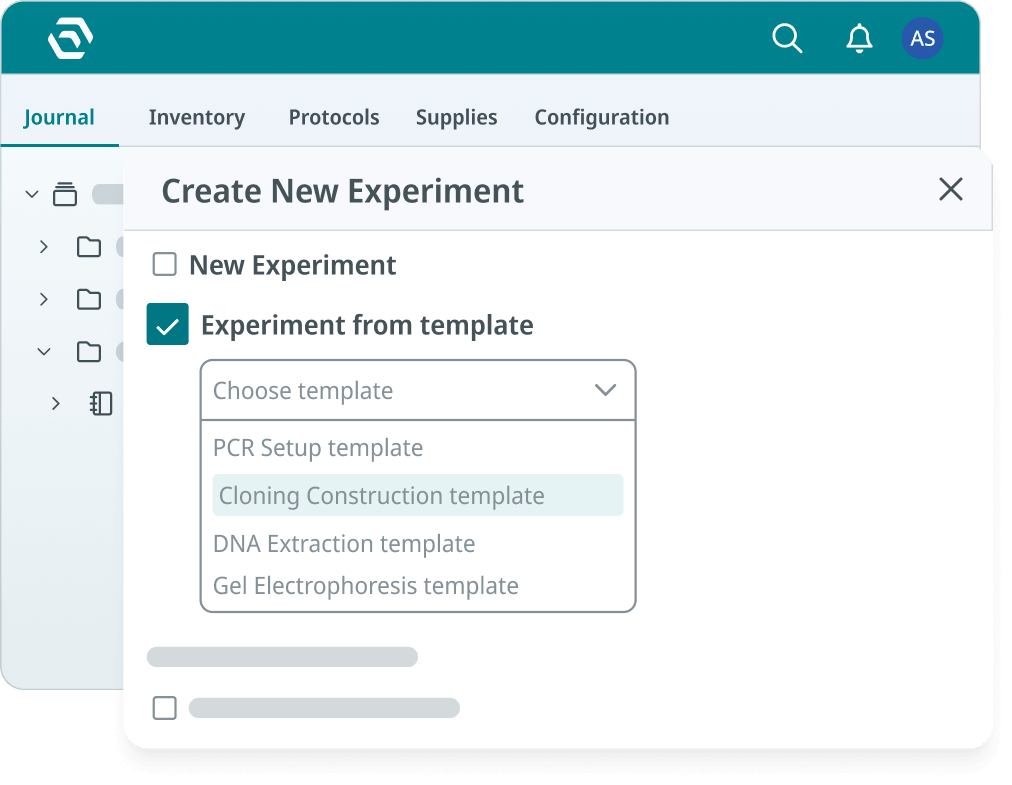
SciSure Electronic Lab Notebook (ELN) experimental templates
SciSure Electronic Lab Notebook (ELN) experimental templates

For lab leads and admins, the same details make governance easier. Reusable templates and default formatting keep records consistent across users, while advanced filters help people find the right template, prior experiment, or sample context faster. Roles and permissions help your team control who can edit methods, update samples, approve records, or manage shared structures. The practical value shows up as fewer cleanup passes, fewer side documents, and records another scientist can understand later.

SciSure
Building templates for recurring experiments?
Book a SciSure demo to see how ELN templates, protocols, samples, approvals, and LIMS workflows can connect.
Talk to a specialist

How do you connect your ELN to samples, inventory, and lab safety?

You connect your ELN to samples, inventory, and lab safety by linking experiment records to the materials, storage locations, hazards, and operational workflows that scientists use every day.

This step often creates the biggest practical win. Many teams start with an ELN for notes, then discover that their real bottleneck sits in sample lookup, freezer maps, chemical inventory, reagent lots, SDS access, or equipment context.

Use these questions:

  • Can a scientist link the sample they used directly inside the experiment?
  • Can the lab manager find the sample by barcode, owner, storage location, sample type, or custom metadata?
  • Can a reviewer see which reagent lot, chemical container, instrument, or file supports the result?
  • Can EHS or lab operations connect chemical inventory, SDS access, regulatory reporting, inspection needs, or safety training to the same lab management strategy?
  • Can a new team member find the right sample and protocol without asking the person who created the old spreadsheet?

If your lab runs sample-heavy research, connect ELN and LIMS workflows early. The SciSure ELN supports experiment documentation, collaboration, templates, approvals, version control, audit-ready records, and links to samples and inventory. Likewise, SciSure LIMS supports sample management, inventory, equipment, workflow automation, barcode label printing, user roles, access control, sample lifecycle tracking, and audit logs.
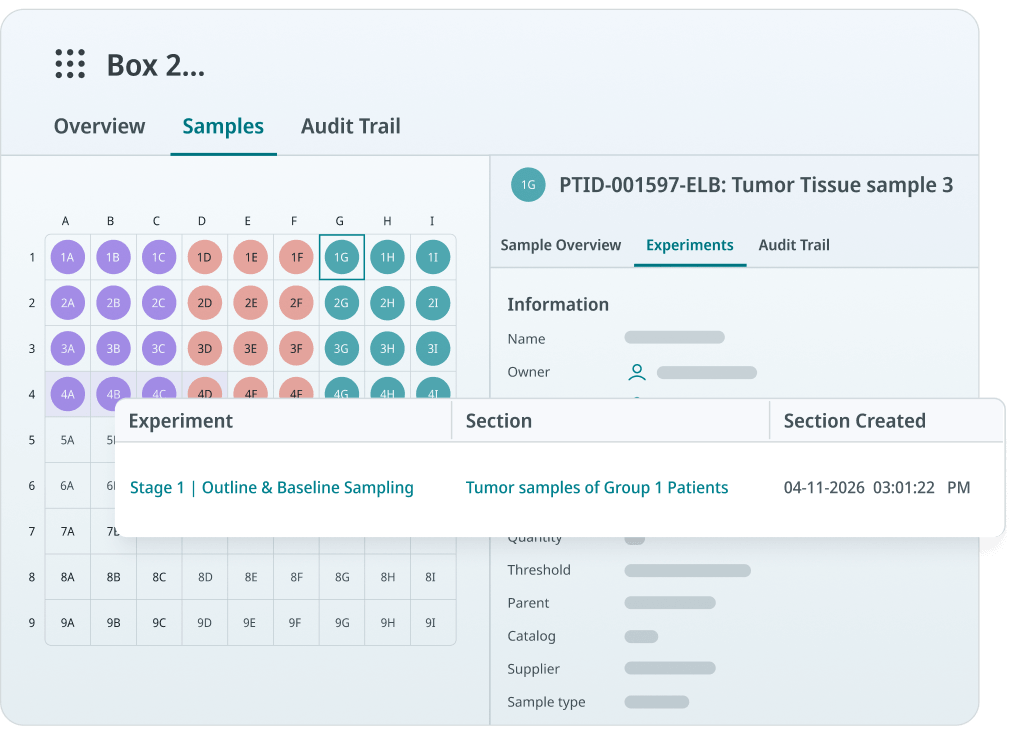
Inventory management with SciSure LIMS
Inventory management with SciSure LIMS

SciSure also includes Health & Safety workflows for regulatory adherence, risk management, audit readiness, chemical inventory and SDS, and regulatory reporting. That matters for life science research teams that manage experiments, samples, and laboratory safety together rather than in separate systems.

What should your ELN backup solution protect?

Your ELN backup solution should protect complete, retrievable research context, not just a file export.

An ELN backup matters because a lab record loses value when it loses the links that explain it. A useful ELN backup plan should help your team recover experiments, attachments, samples, storage context, protocol versions, signatures, audit trails, permissions, and archive indexes after deletion, system failure, migration, security incident, or vendor transition.

Ask your IT, platform, or vendor team these ELN backup questions:

  • How often do backups run?
  • Which data objects does the backup include?
  • How long does the organization retain backups?
  • Who can request a restore?
  • How does the team test restore procedures?
  • How do backups preserve attachments, sample links, signatures, audit trails, and permissions?
  • How does the process support read-only archives for completed studies or old notebooks?
  • How does the plan align with cybersecurity, business continuity, and disaster recovery expectations?

For security planning, the NIST Cybersecurity Framework 2.0 gives IT and risk teams a useful structure for identifying, protecting, detecting, responding to, and recovering from cybersecurity risk. In lab terms, that means your ELN backup solution should support recovery from ordinary mistakes, hardware problems, account issues, and security events without losing scientific context.

If your lab works under GxP, GLP, GMP, or Part 11 expectations, backup and restore testing also matters for audit readiness. A record that your team cannot retrieve during a quality review, inspection, grant report, or IP review will not help, even if the record once existed.

SciSure
Reviewing ELN backup, archive, or migration risk?
Talk to SciSure about how ELN, LIMS, sample history, permissions, exports, and implementation planning fit your lab's retention needs.
Request a demo

How do you secure ELN records for audit readiness and compliance?

You secure ELN records by controlling access, preserving change history, using signatures where your workflow needs them, and aligning each record type with the standards that govern your lab.

Compliance starts with scope. A discovery lab, core facility, nonclinical safety lab, clinical research team, QC lab, and GMP manufacturing support team all need different controls.

Use these current standards as a practical checklist:

  • The NIH Data Management and Sharing Policy matters for funded research because your team needs a plan for managing and sharing scientific data.
  • The FAIR Principles matter because searchable metadata, persistent identifiers, sample links, and clear access rules help other scientists find, access, reuse, and understand data.
  • 21 CFR Part 11 matters when FDA-regulated electronic records or electronic signatures replace paper records or handwritten signatures.
  • FDA's 2024 guidance on electronic systems, electronic records, and electronic signatures in clinical investigations matters for clinical investigation teams that need trustworthy electronic systems and records.
  • 21 CFR Part 58 matters for GLP nonclinical laboratory studies because teams need to protect raw data, protocols, corrections, equipment records, specimens, archives, and study records.
  • FDA's Data Integrity and Compliance With Drug CGMP guidance matters for GMP and QC teams because FDA expects reliable and accurate data.
  • EudraLex Volume 4 matters for EU GMP teams, including Annex 11 for computerized systems and Annex 15 for qualification and validation.
  • ICH E6(R3) matters for clinical research teams because it reinforces fit-for-purpose systems, proportionate quality management, and reliable trial records.

Next, translate those standards into daily controls:

  • Require individual accounts instead of shared logins.
  • Use role-based access for projects, experiments, samples, protocols, and administrative functions.
  • Limit who can delete, archive, restore, export, sign, or witness records.
  • Use audit trails that show who changed a record, when they changed it, and what they changed.
  • Define when a record needs review, signature, witness approval, or locked status.
  • Train users on correction rules, record ownership, naming conventions, file attachments, and retention.
  • Review permissions when people join, change roles, or leave.

The point is simple: your ELN should help your lab prove what happened without rebuilding the story from emails, shared drives, paper notes, and memory.
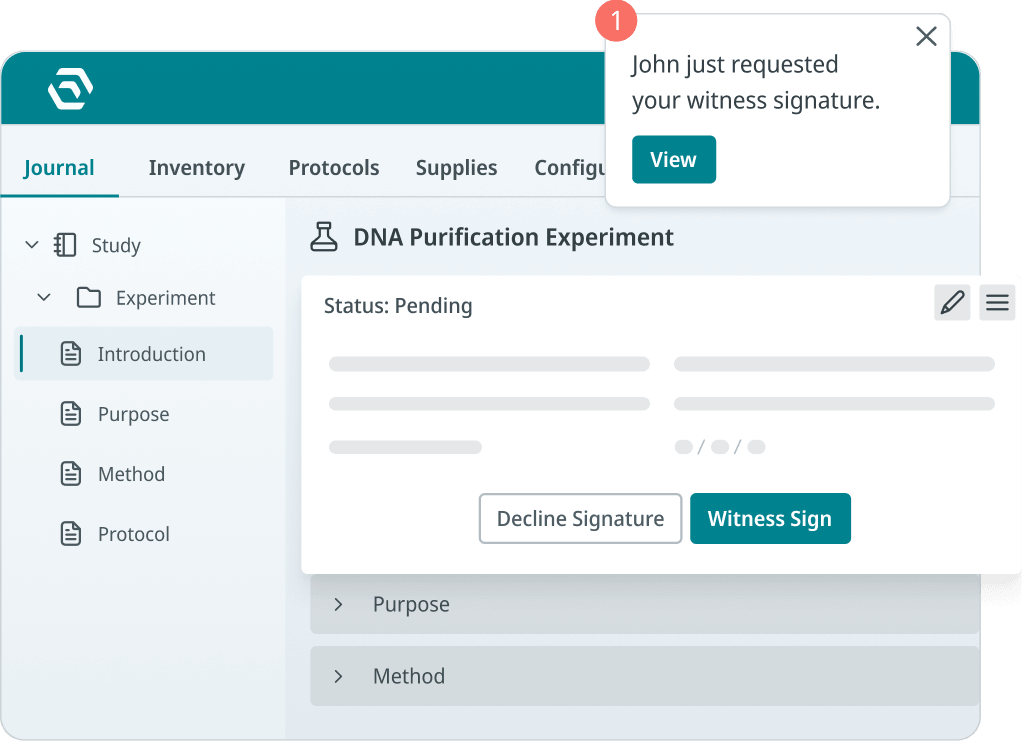
Witness signing on the SciSure ELN
Witness approval on the SciSure ELN

How does an ELN save time after rollout?

An ELN saves time when your scientists can create records from templates, link samples directly, find prior work through search, reduce duplicate documentation, and review completed work without chasing files.

The answer to "how does an ELN save time" should come from specific lab tasks. For example:

  • A scientist starts a new experiment from a validated template instead of copying an old Word file.
  • A lab manager finds a sample by barcode, storage location, owner, or sample type instead of checking a freezer map spreadsheet.
  • A reviewer opens one record with the protocol, sample, attachment, interpretation, signature, and audit history instead of asking for separate files.
  • A new hire follows a standard protocol and template instead of learning an informal process from whoever has time.
  • A PI searches by sample ID, project, assay, author, keyword, or date instead of asking multiple people for context.

And here's an example of how this looks in practice: Kaigene, a growth-stage biotech team based in Rockville, Maryland. With the SciSure platform up and running, the team moved away from Microsoft Office tools plus physical notebooks. Researchers had previously spent several hours or even an entire day on dual documentation, and SciSure helped them reduce data recording time, retrieve prior data more easily, and manage inventory more efficiently.

The Kaigene biotech team
“SciSure has significantly reduced my workload and time required to record experimental results and data. Additionally, it enables me to retrieve other researchers’ data and manage inventory more efficiently. This improvement in research efficiency is crucial for startup biotechs like Kaigene, allowing us to focus more on innovation and increase overall productivity.”

- Junho Cho, Principal Scientist at Kaigene
SciSure
Want to build the first time-saving workflow in your lab?
Request a SciSure walkthrough focused on templates, sample lookup, inventory, approvals, and adoption metrics.
Request a demo

How should you compare the main providers of ELN (electronic lab notebook) solutions?

You should compare the main providers of ELN (electronic lab notebook) solutions by testing how each platform handles your actual workflows, not by counting generic features.

If your search starts with "ELN for R&D technology providers," write down the work your team needs to control before you evaluate vendors. R&D teams often need experiment documentation, sample traceability, inventory, instrument files, protocol versions, collaboration, signatures, audit trails, migration support, integrations, security controls, and backup expectations.

Ask each provider:

  • Can scientists create experiments from templates that match our assays, sample intake, synthesis, formulation, cell culture, QC, or core facility workflows?
  • Can users link samples, inventory, storage locations, barcodes, and equipment directly to experiments?
  • Can reviewers see protocol versions, attachments, comments, signatures, and audit history in one place?
  • Can admins configure roles, permissions, SSO, exports, archives, and retention rules?
  • Can the platform support ELN, LIMS, EHS, and integrations when the lab needs connected operations?
  • Can the provider explain migration from paper, spreadsheets, shared drives, or another ELN?
  • Can the provider support adoption with implementation planning, training, key users, and success metrics?
  • Can your IT team test backup, restore, security, validation, and update procedures?

For R&D teams, the strongest ELN choice usually makes daily work easier while preserving context for the future. A shiny notebook interface won't help if your scientists still track samples in spreadsheets, save instrument files elsewhere, and ask one person where old records live.

How SciSure can support you in setting up your lab for success

With SciSure, you can document experiments, collaborate in real time, create experiment templates, use advanced search, connect experiments to samples and inventory, attach images and files, request approvals, use witness signing, manage version control, and support GxP and FDA 21 CFR Part 11 workflows through the SciSure ELN.

With SciSure LIMS, you can manage samples, inventory, equipment, storage units, workflow automation, barcode labels, user roles, access control, sample lifecycle tracking, disposal tracking, and audit logs.

With SciSure EHS workflows, your team can connect lab safety needs such as chemical inventory and SDS, regulatory reporting, risk management, and audit readiness to the same broader lab management strategy.

With SciSure integrations, your team can extend workflows through add-ons, APIs, developer tools, and marketplace capabilities when your lab needs instrument connections, file workflows, reporting, automation, or specialized sample handling.
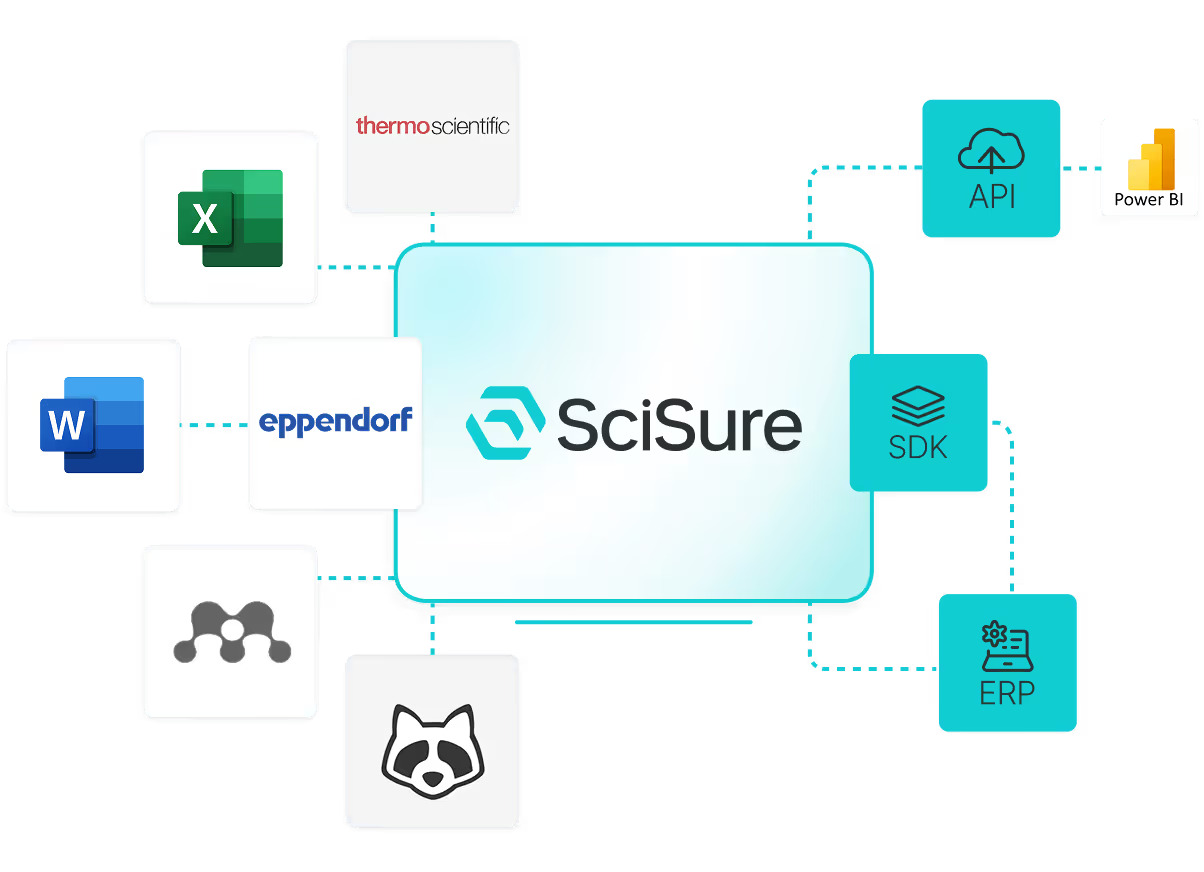
SciSure Integrations

Finally, with SciSure's Implementation and Customer Success team, your team can get support for onboarding, project planning, milestones, key users, training schedules, technical implementation, data migration, and role-based training.

Use these capabilities to make the best-practice list operational:

  • Turn recurring work into templates.
  • Link each experiment to the relevant sample, inventory item, protocol, and attachment.
  • Define permissions before broad rollout.
  • Decide where signatures and witness review matter.
  • Track sample history and audit logs.
  • Plan migration and archive needs before changing systems.
  • Train users through the tasks they perform every week.
SciSure
Ready to turn ELN best practices into a working lab rollout?
Book a SciSure demo to discuss ELN, LIMS, EHS, integrations, migration, and adoption support.
Get in touch

FAQs: Electronic lab notebook best practices

Here are some questions we often run into during our onboarding and implementation rounds: Labs usually ask how to structure records, connect samples, protect backups, save time, compare providers, and decide whether SciSure can support electronic lab notebook and lab management workflows.

What are the best practices for ELN?

The best practices for ELN include project and study structure, reusable experiment templates, controlled protocols, sample and inventory links, metadata standards, access controls, audit trails, backup testing, training, and adoption metrics.

What should you include in an ELN backup plan?

An ELN backup plan should cover experiments, attachments, samples, inventory records, protocol versions, signatures, audit trails, permissions, exports, archive indexes, restore testing, retention rules, and recovery ownership.

How does an ELN save time?

An ELN saves time by reducing duplicate documentation, giving scientists templates, linking samples and files directly to experiments, improving search, simplifying review, and helping new team members follow standard workflows faster.

Does SciSure provide electronic lab notebook and lab management software for life science research teams managing experiments, samples, and laboratory safety?

Yes. A life science team can use SciSure to bring experiment documentation, sample traceability, inventory, and safety workflows into one connected lab management approach. In practice, that means scientists can document experiments in the ELN, build templates for recurring work, link records to samples or inventory, attach supporting files, and route completed work for review or approval.

  • Lab managers and operations teams can use SciSure LIMS workflows to manage samples, storage locations, barcodes, equipment, inventory status, sample history, and audit logs.
  • Safety and compliance teams can use SciSure EHS workflows for chemical inventory and SDS access, regulatory reporting, risk management, and audit readiness.
  • Our Customer Success and Implementation teams can help your lab plan implementation, migration, training, and adoption so the platform fits the way the lab actually works.

When should a lab connect ELN and LIMS workflows?

Connect ELN and LIMS workflows early when experiments depend on samples, inventory, storage locations, equipment, barcodes, chain of custody, batch updates, or sample history.

How often should you review ELN templates and protocols?

Review ELN templates and protocols after the pilot, after the first 30 to 90 days, and whenever your lab changes a method, sample type, regulatory scope, instrument workflow, or review requirement.

What should you ask vendors about ELN backup and data migration?

Ask how each vendor handles backup frequency, restore testing, data exports, archive retrieval, paper notebook migration, legacy ELN migration, sample links, attachments, audit trails, signatures, permissions, and former user records.

If your ELN already exists but scientists still depend on paper notes, spreadsheets, shared folders, or memory, start with one workflow and improve it end to end. The strongest ELN best practices make everyday lab work easier while preserving the record your team needs for reproducibility, audit readiness, funding expectations, IP review, and future research.

Where can I learn more about ELN best practices for my lab?

Our ELN implementation guides are based on your lab's starting point: new lab setup, active lab rollout, migration from another ELN, adoption resistance, or regulated compliance.

Together, these guides help you turn an ELN from a purchased tool into a working recordkeeping system: structured enough for audit readiness, practical enough for scientists, and connected enough for samples, safety, and lab operations.

If you want to improve an existing ELN rollout or build stronger electronic lab notebook best practices around samples, templates, backups, compliance, and adoption, let's get in touch about the workflows your lab needs to fix first.

Read More:

Ready to see SciSure in action?

Get a personalized demo and see how SciSure fits your lab's workflows.
Request demo

No commitment · Free consultation

Congratulations, you have an electronic lab notebook! Now you need the daily habits, templates, sample links, review steps, and data controls that make the system useful after go-live.

That next phase matters because an ELN only helps when your scientists use it to capture the full research story: what they did, which protocol version they followed, which sample or reagent lot they used, which file supports the result, who reviewed the work, and how someone can find the record later.

In this post, we'll cover some electronic lab notebook (ELN) best practices, so you can get your lab up and running in no time.

Read MoreThe 5 Best Electronic Lab Notebooks (ELN) in 2026 Ranked by Ease-of-Use & ROI: Based on Real User Reviews

What should you do first after implementing an ELN?

After implementing an ELN, you should turn your first live workflows into repeatable lab standards before your team creates hundreds of inconsistent records.

Start with one active workflow that matters this month. Choose a workflow where better documentation will help immediately, such as a weekly qPCR assay, a cell passage record, a protein purification run, a stability study, a chemical inventory update, or a sample intake process.

For that workflow, decide:

  • Where the experiment should live.
  • Which project or study owns it.
  • Which sample, reagent, consumable, or equipment fields matter.
  • Which protocol version scientists should use.
  • Which files users should attach, such as plate reader exports, images, spreadsheets, scripts, or instrument reports.
  • Which metadata someone will need for search later.
  • Who can create, edit, review, sign, witness, archive, export, or restore the record.

This first pass should feel concrete. A scientist should know how to open the right template, link the correct sample, add the result file, write the interpretation, and send the record for review without asking where everything goes.

Next, avoid turning the first month into a platform tour. Your team needs usable lab workflows, not a catalog of features. If people can complete one real task cleanly, you can extend the same pattern to the next workflow.

SciSure
Turn your ELN workflow into a usable standard.
Talk to a SciSure specialist about templates, sample traceability, permissions, and adoption planning.
Request a demo

How should you structure projects, studies, and experiment records?

You should structure your ELN around the way your lab organizes real work: group, project, study, experiment, protocol, sample, storage location, and reviewer.

A clear structure helps scientists find records later. It also helps lab managers, PIs, QA teams, and collaborators understand which work belongs to which program, grant, product candidate, assay family, or study.

How to structure your ELN around projects, studies, and experiment records

Workflow decision Best practice
Project structure Group work by grant, program, product candidate, collaboration, service line, research theme, or core facility request
Study structure Group related experiments by specific aim, assay family, validation study, sample batch, method, manuscript figure, or campaign
Experiment naming Use names that include the workflow, sample set, date or run ID, and owner only when ownership helps retrieval
Metadata Add searchable fields for sample IDs, protocol versions, reagent lots, instrument IDs, grant IDs, collaborators, and review status
File rules Define which files users attach directly and which files users link from controlled storage
Review status Define when a record needs review, signature, witness approval, archive, or export

For example, a protein engineering team might structure a project by target, study by variant library, and experiment by expression run or assay plate. A cell therapy team might structure a project by program, study by donor or process stage, and experiment by sample preparation, QC test, or batch-related observation.

The structure should help someone answer one question quickly: can I find the record, understand the sample and protocol context, and repeat or review the work later?

How do templates and protocols fit into electronic lab notebook best practices?

Templates and protocols improve electronic lab notebook best practices by giving scientists a consistent starting point for recurring work.

Templates save time because they remove blank-page decisions. A good template tells the scientist which sections, fields, samples, protocol links, attachments, calculations, and review steps the workflow needs.

Make sure to build templates for workflows your lab repeats often. For example:

  • Cell culture passages with cell line, passage number, media lot, split ratio, contamination check, and freezer link.
  • qPCR runs with sample IDs, primer lot, plate map, instrument file, control criteria, and result interpretation.
  • Protein purification runs with construct ID, buffer lots, column ID, fraction map, gel image, yield, and storage location.
  • Chemical inventory intake with container barcode, owner, location, hazard information, SDS link, quantity, and disposal date.
  • Stability or formulation studies with batch ID, pull point, storage condition, test method, reviewer, and deviation notes.

Treat protocols as controlled research assets. Your team should know which protocol version applies, who can edit it, when review happens, and how users handle a protocol change during active work.

In daily lab work, the useful question is whether the ELN helps scientists create a complete record without fighting the format. With SciSure, you can build experiment templates that mirror real protocols, add checklists for routine steps, keep Word and Excel content readable when scientists bring in tables or notes, use formulas where calculations belong in the record, and link samples or files as part of the same workflow. That helps someone document a qPCR run, passage cells, record a purification, or prepare a stability pull without rebuilding the structure each time.

SciSure Electronic Lab Notebook (ELN) experimental templates
SciSure Electronic Lab Notebook (ELN) experimental templates

For lab leads and admins, the same details make governance easier. Reusable templates and default formatting keep records consistent across users, while advanced filters help people find the right template, prior experiment, or sample context faster. Roles and permissions help your team control who can edit methods, update samples, approve records, or manage shared structures. The practical value shows up as fewer cleanup passes, fewer side documents, and records another scientist can understand later.

SciSure
Building templates for recurring experiments?
Book a SciSure demo to see how ELN templates, protocols, samples, approvals, and LIMS workflows can connect.
Talk to a specialist

How do you connect your ELN to samples, inventory, and lab safety?

You connect your ELN to samples, inventory, and lab safety by linking experiment records to the materials, storage locations, hazards, and operational workflows that scientists use every day.

This step often creates the biggest practical win. Many teams start with an ELN for notes, then discover that their real bottleneck sits in sample lookup, freezer maps, chemical inventory, reagent lots, SDS access, or equipment context.

Use these questions:

  • Can a scientist link the sample they used directly inside the experiment?
  • Can the lab manager find the sample by barcode, owner, storage location, sample type, or custom metadata?
  • Can a reviewer see which reagent lot, chemical container, instrument, or file supports the result?
  • Can EHS or lab operations connect chemical inventory, SDS access, regulatory reporting, inspection needs, or safety training to the same lab management strategy?
  • Can a new team member find the right sample and protocol without asking the person who created the old spreadsheet?

If your lab runs sample-heavy research, connect ELN and LIMS workflows early. The SciSure ELN supports experiment documentation, collaboration, templates, approvals, version control, audit-ready records, and links to samples and inventory. Likewise, SciSure LIMS supports sample management, inventory, equipment, workflow automation, barcode label printing, user roles, access control, sample lifecycle tracking, and audit logs.

Inventory management with SciSure LIMS
Inventory management with SciSure LIMS

SciSure also includes Health & Safety workflows for regulatory adherence, risk management, audit readiness, chemical inventory and SDS, and regulatory reporting. That matters for life science research teams that manage experiments, samples, and laboratory safety together rather than in separate systems.

What should your ELN backup solution protect?

Your ELN backup solution should protect complete, retrievable research context, not just a file export.

An ELN backup matters because a lab record loses value when it loses the links that explain it. A useful ELN backup plan should help your team recover experiments, attachments, samples, storage context, protocol versions, signatures, audit trails, permissions, and archive indexes after deletion, system failure, migration, security incident, or vendor transition.

Ask your IT, platform, or vendor team these ELN backup questions:

  • How often do backups run?
  • Which data objects does the backup include?
  • How long does the organization retain backups?
  • Who can request a restore?
  • How does the team test restore procedures?
  • How do backups preserve attachments, sample links, signatures, audit trails, and permissions?
  • How does the process support read-only archives for completed studies or old notebooks?
  • How does the plan align with cybersecurity, business continuity, and disaster recovery expectations?

For security planning, the NIST Cybersecurity Framework 2.0 gives IT and risk teams a useful structure for identifying, protecting, detecting, responding to, and recovering from cybersecurity risk. In lab terms, that means your ELN backup solution should support recovery from ordinary mistakes, hardware problems, account issues, and security events without losing scientific context.

If your lab works under GxP, GLP, GMP, or Part 11 expectations, backup and restore testing also matters for audit readiness. A record that your team cannot retrieve during a quality review, inspection, grant report, or IP review will not help, even if the record once existed.

SciSure
Reviewing ELN backup, archive, or migration risk?
Talk to SciSure about how ELN, LIMS, sample history, permissions, exports, and implementation planning fit your lab's retention needs.
Request a demo

How do you secure ELN records for audit readiness and compliance?

You secure ELN records by controlling access, preserving change history, using signatures where your workflow needs them, and aligning each record type with the standards that govern your lab.

Compliance starts with scope. A discovery lab, core facility, nonclinical safety lab, clinical research team, QC lab, and GMP manufacturing support team all need different controls.

Use these current standards as a practical checklist:

  • The NIH Data Management and Sharing Policy matters for funded research because your team needs a plan for managing and sharing scientific data.
  • The FAIR Principles matter because searchable metadata, persistent identifiers, sample links, and clear access rules help other scientists find, access, reuse, and understand data.
  • 21 CFR Part 11 matters when FDA-regulated electronic records or electronic signatures replace paper records or handwritten signatures.
  • FDA's 2024 guidance on electronic systems, electronic records, and electronic signatures in clinical investigations matters for clinical investigation teams that need trustworthy electronic systems and records.
  • 21 CFR Part 58 matters for GLP nonclinical laboratory studies because teams need to protect raw data, protocols, corrections, equipment records, specimens, archives, and study records.
  • FDA's Data Integrity and Compliance With Drug CGMP guidance matters for GMP and QC teams because FDA expects reliable and accurate data.
  • EudraLex Volume 4 matters for EU GMP teams, including Annex 11 for computerized systems and Annex 15 for qualification and validation.
  • ICH E6(R3) matters for clinical research teams because it reinforces fit-for-purpose systems, proportionate quality management, and reliable trial records.

Next, translate those standards into daily controls:

  • Require individual accounts instead of shared logins.
  • Use role-based access for projects, experiments, samples, protocols, and administrative functions.
  • Limit who can delete, archive, restore, export, sign, or witness records.
  • Use audit trails that show who changed a record, when they changed it, and what they changed.
  • Define when a record needs review, signature, witness approval, or locked status.
  • Train users on correction rules, record ownership, naming conventions, file attachments, and retention.
  • Review permissions when people join, change roles, or leave.

The point is simple: your ELN should help your lab prove what happened without rebuilding the story from emails, shared drives, paper notes, and memory.

Witness signing on the SciSure ELN
Witness approval on the SciSure ELN

How does an ELN save time after rollout?

An ELN saves time when your scientists can create records from templates, link samples directly, find prior work through search, reduce duplicate documentation, and review completed work without chasing files.

The answer to "how does an ELN save time" should come from specific lab tasks. For example:

  • A scientist starts a new experiment from a validated template instead of copying an old Word file.
  • A lab manager finds a sample by barcode, storage location, owner, or sample type instead of checking a freezer map spreadsheet.
  • A reviewer opens one record with the protocol, sample, attachment, interpretation, signature, and audit history instead of asking for separate files.
  • A new hire follows a standard protocol and template instead of learning an informal process from whoever has time.
  • A PI searches by sample ID, project, assay, author, keyword, or date instead of asking multiple people for context.

And here's an example of how this looks in practice: Kaigene, a growth-stage biotech team based in Rockville, Maryland. With the SciSure platform up and running, the team moved away from Microsoft Office tools plus physical notebooks. Researchers had previously spent several hours or even an entire day on dual documentation, and SciSure helped them reduce data recording time, retrieve prior data more easily, and manage inventory more efficiently.

The Kaigene biotech team
“SciSure has significantly reduced my workload and time required to record experimental results and data. Additionally, it enables me to retrieve other researchers’ data and manage inventory more efficiently. This improvement in research efficiency is crucial for startup biotechs like Kaigene, allowing us to focus more on innovation and increase overall productivity.”

- Junho Cho, Principal Scientist at Kaigene
SciSure
Want to build the first time-saving workflow in your lab?
Request a SciSure walkthrough focused on templates, sample lookup, inventory, approvals, and adoption metrics.
Request a demo

How should you compare the main providers of ELN (electronic lab notebook) solutions?

You should compare the main providers of ELN (electronic lab notebook) solutions by testing how each platform handles your actual workflows, not by counting generic features.

If your search starts with "ELN for R&D technology providers," write down the work your team needs to control before you evaluate vendors. R&D teams often need experiment documentation, sample traceability, inventory, instrument files, protocol versions, collaboration, signatures, audit trails, migration support, integrations, security controls, and backup expectations.

Ask each provider:

  • Can scientists create experiments from templates that match our assays, sample intake, synthesis, formulation, cell culture, QC, or core facility workflows?
  • Can users link samples, inventory, storage locations, barcodes, and equipment directly to experiments?
  • Can reviewers see protocol versions, attachments, comments, signatures, and audit history in one place?
  • Can admins configure roles, permissions, SSO, exports, archives, and retention rules?
  • Can the platform support ELN, LIMS, EHS, and integrations when the lab needs connected operations?
  • Can the provider explain migration from paper, spreadsheets, shared drives, or another ELN?
  • Can the provider support adoption with implementation planning, training, key users, and success metrics?
  • Can your IT team test backup, restore, security, validation, and update procedures?

For R&D teams, the strongest ELN choice usually makes daily work easier while preserving context for the future. A shiny notebook interface won't help if your scientists still track samples in spreadsheets, save instrument files elsewhere, and ask one person where old records live.

How SciSure can support you in setting up your lab for success

With SciSure, you can document experiments, collaborate in real time, create experiment templates, use advanced search, connect experiments to samples and inventory, attach images and files, request approvals, use witness signing, manage version control, and support GxP and FDA 21 CFR Part 11 workflows through the SciSure ELN.

With SciSure LIMS, you can manage samples, inventory, equipment, storage units, workflow automation, barcode labels, user roles, access control, sample lifecycle tracking, disposal tracking, and audit logs.

With SciSure EHS workflows, your team can connect lab safety needs such as chemical inventory and SDS, regulatory reporting, risk management, and audit readiness to the same broader lab management strategy.

With SciSure integrations, your team can extend workflows through add-ons, APIs, developer tools, and marketplace capabilities when your lab needs instrument connections, file workflows, reporting, automation, or specialized sample handling.

SciSure Integrations

Finally, with SciSure's Implementation and Customer Success team, your team can get support for onboarding, project planning, milestones, key users, training schedules, technical implementation, data migration, and role-based training.

Use these capabilities to make the best-practice list operational:

  • Turn recurring work into templates.
  • Link each experiment to the relevant sample, inventory item, protocol, and attachment.
  • Define permissions before broad rollout.
  • Decide where signatures and witness review matter.
  • Track sample history and audit logs.
  • Plan migration and archive needs before changing systems.
  • Train users through the tasks they perform every week.
SciSure
Ready to turn ELN best practices into a working lab rollout?
Book a SciSure demo to discuss ELN, LIMS, EHS, integrations, migration, and adoption support.
Get in touch

FAQs: Electronic lab notebook best practices

Here are some questions we often run into during our onboarding and implementation rounds: Labs usually ask how to structure records, connect samples, protect backups, save time, compare providers, and decide whether SciSure can support electronic lab notebook and lab management workflows.

What are the best practices for ELN?

The best practices for ELN include project and study structure, reusable experiment templates, controlled protocols, sample and inventory links, metadata standards, access controls, audit trails, backup testing, training, and adoption metrics.

What should you include in an ELN backup plan?

An ELN backup plan should cover experiments, attachments, samples, inventory records, protocol versions, signatures, audit trails, permissions, exports, archive indexes, restore testing, retention rules, and recovery ownership.

How does an ELN save time?

An ELN saves time by reducing duplicate documentation, giving scientists templates, linking samples and files directly to experiments, improving search, simplifying review, and helping new team members follow standard workflows faster.

Does SciSure provide electronic lab notebook and lab management software for life science research teams managing experiments, samples, and laboratory safety?

Yes. A life science team can use SciSure to bring experiment documentation, sample traceability, inventory, and safety workflows into one connected lab management approach. In practice, that means scientists can document experiments in the ELN, build templates for recurring work, link records to samples or inventory, attach supporting files, and route completed work for review or approval.

  • Lab managers and operations teams can use SciSure LIMS workflows to manage samples, storage locations, barcodes, equipment, inventory status, sample history, and audit logs.
  • Safety and compliance teams can use SciSure EHS workflows for chemical inventory and SDS access, regulatory reporting, risk management, and audit readiness.
  • Our Customer Success and Implementation teams can help your lab plan implementation, migration, training, and adoption so the platform fits the way the lab actually works.

When should a lab connect ELN and LIMS workflows?

Connect ELN and LIMS workflows early when experiments depend on samples, inventory, storage locations, equipment, barcodes, chain of custody, batch updates, or sample history.

How often should you review ELN templates and protocols?

Review ELN templates and protocols after the pilot, after the first 30 to 90 days, and whenever your lab changes a method, sample type, regulatory scope, instrument workflow, or review requirement.

What should you ask vendors about ELN backup and data migration?

Ask how each vendor handles backup frequency, restore testing, data exports, archive retrieval, paper notebook migration, legacy ELN migration, sample links, attachments, audit trails, signatures, permissions, and former user records.

If your ELN already exists but scientists still depend on paper notes, spreadsheets, shared folders, or memory, start with one workflow and improve it end to end. The strongest ELN best practices make everyday lab work easier while preserving the record your team needs for reproducibility, audit readiness, funding expectations, IP review, and future research.

Where can I learn more about ELN best practices for my lab?

Our ELN implementation guides are based on your lab's starting point: new lab setup, active lab rollout, migration from another ELN, adoption resistance, or regulated compliance.

Together, these guides help you turn an ELN from a purchased tool into a working recordkeeping system: structured enough for audit readiness, practical enough for scientists, and connected enough for samples, safety, and lab operations.

If you want to improve an existing ELN rollout or build stronger electronic lab notebook best practices around samples, templates, backups, compliance, and adoption, let's get in touch about the workflows your lab needs to fix first.

Read More:

About the author:

Alisha Simmons-Ramirez

Alisha Simmons-Ramirez is a Strategic Account Executive at SciSure, where she works with biotech and pharma organizations to bring SciSure's platform into their labs. Her path into sales started at the bench: she ran release testing on drug products at Neovii Biotech GmbH and Kite Pharma using methods like HPLC, ELISA, and flow cytometry, documenting results under GMP and GDP standards. She later moved into commercial roles, promoting UV-Vis spectroscopy instrumentation to research labs at Implen before taking on full-cycle account work, from discovery through implementation and long-term adoption, with scientists and lab leadership across biotech and pharma. She holds a BS in Biochemistry from Mannheim University of Applied Sciences.

See all posts from this author

Inscrivez-vous à notre newsletter

Recevez les derniers conseils, articles et contenus exclusifs sur la gestion moderne des laboratoires dans votre boîte de réception.
Merci ! Votre candidature a été reçue !
Please check your email to verify your submission.
Oups ! Une erreur s'est produite lors de l'envoi du formulaire.