How to Build, Manage, and Analyze Your Plasmid Library
Learn more about the common plasmids used in the life science space and best practices for building, maintaining, managing, and storing a plasmid library.

Download Whitepaper
TL;DR
A plasmid library is only as reliable as the records behind it; every construct needs a unique identifier, a documented backbone and insert, a known storage position, and a traceable link back to the cloning work that produced it.
- Vectors by job.
pUC19, pET, pGEX, pBABE and lentiviral vectors each solve a different problem, from routine cloning in E. coli to gene delivery in hard-to-transfect mammalian cells. Choosing deliberately, and recording why, saves the next person from re-deriving a construct that already exists in your freezer.
- Sequence drift is real.
Plasmid sequences change during cloning, passaging, and expression optimisation, and quality degrades with poor storage or contamination. Periodic QC and a dated record of each check are what let you trust a tube you pulled from a box three years after someone else made it.
- Track the right fields.
A usable plasmid database holds more than a name: backbone, insert, selection marker, host strain, source, QC status and date, concentration, storage position, and whether the tube is master or working stock.
- Storage is a data problem.
Aliquots at -80°C are useless if nobody knows which box, rack and position they sit in, or how many are left. Position-level mapping, barcodes and quantity thresholds turn a freezer into something searchable.
- Where SciSure fits.
SciSure LIMS handles plasmids as sample records with custom fields, parent-child lineage, barcoded storage positions and audit trails, so a construct can be traced from the parent backbone through every derivative.
Originally published in 2023, this 2026 update adds guidance on what a plasmid database should actually contain and why libraries degrade when people leave.
Ready to see SciSure in action?
No commitment · Free consultation
Plasmids are small circular DNA molecules that replicate independently of chromosomal DNA. They carry a gene of interest, a promoter to control its expression, a selection marker, and an origin of replication, which together give you control over what gets expressed, where, and how much. That combination is why they sit at the start of so much work in genetic engineering, recombinant protein production, vaccine development, and gene therapy.
The problem shows up later. Sequences shift during cloning, passaging through a bacterial or mammalian host, or optimization for better expression. Quality drops with repeated freeze-thaw cycles or contamination. And as a library grows past a few dozen constructs, the informal system that worked at the bench (a shared spreadsheet, a notebook page, a labelled box someone maintains) stops holding.
What replaces it is record-keeping: unique identifiers, scheduled QC checks, and a database that other people can actually search. A mistake in the recorded backbone, resistance marker, or host strain is not a small mistake. It costs a week of cloning and a batch of reagents before anyone notices.
This post covers the plasmids most labs keep on hand, the techniques used to build a library, and what a plasmid database needs to hold to stay useful. For deeper coverage of naming conventions, storage protocols and sequence analysis tools, our full whitepaper goes further on each. If you're comparing systems to hold the records themselves, SciSure LIMS is built for sample and inventory work in research settings.
How are plasmids used in genetic engineering?
Plasmids are the delivery vehicle. A gene or fragment gets inserted into a vector backbone, the vector is introduced into a host cell, and the host replicates it. Depending on the vector, that gene is then expressed as protein, integrated into the host genome, or simply amplified so you have more of it. Different vectors are built for different points in that chain.
Most R&D labs keep a set of parental plasmids and their derivatives on hand, ready for whatever is planned. To study a gene's role in a disease model, for example, you might build a library of constructs covering different functional domains, plus variants missing specific domains or carrying targeted mutations. What makes that library reusable a year later is the record attached to each one: backbone, cloning strategy, purification method, and QC history.
The most widely-used plasmids in R&D
- pUC19.
A high-copy cloning and expression vector for E. coli, with a lac promoter, selectable markers and a multiple cloning site. Used in the DNA sequencing methods that fed into the Human Genome Project, in recombinant protein work, in crop engineering, and in bacterial genetics.
- pET vectors.
Built for high-level protein expression in E. coli. The T7 promoter drives strong transcription, fusion tags such as hexahistidine or GST simplify purification, and inducible promoters let you control when expression starts.
- pGEX vectors.
Express recombinant proteins fused to glutathione S-transferase in E. coli. The GST tag makes purification straightforward by glutathione-affinity chromatography and can be cleaved off afterwards.
- pBABE vectors.
Retroviral transfer and stable expression in mammalian cells. The construct integrates into the host genome, which suits functional assays, overexpression studies and stem cell work.
- Lentiviral vectors.
Gene transfer and gene therapy in mammalian cells, including cells that resist transfection. Derived from HIV but replication-defective, and widely used to deliver CRISPR/Cas9 components.
Lentiviral and other viral vector work usually carries institutional biosafety obligations that plain bacterial cloning does not. Worth confirming what your committee requires before the construct exists, not after.
Molecular biology techniques for working with plasmids
Which techniques you use depends on library size, vector type, and what happens downstream. Here are some common ones:
- PCR amplification to copy a gene or fragment before it goes into a vector.
- Restriction digestion and ligation to cut at defined sites and insert the fragment.
- Transformation to introduce the plasmid into bacterial cells for replication and maintenance.
- Selection, using antibiotics or fluorescence, to keep only the cells that took up the plasmid.
- DNA extraction and purification by alkaline lysis, precipitation, or column- and bead-based methods.
- Sequencing to confirm identity and catch drift.
- Gibson and Golden Gate assembly for scarless, multi-fragment construction where restriction sites are inconvenient.
Each of these steps produces a construct that needs a record. The transformation that worked, the colony that was picked, the sequencing result that confirmed it. If that chain is captured as you go, the plasmid record answers questions later. If it is reconstructed from memory afterwards, it usually does not.
What your plasmid database needs to hold
Most plasmid libraries start in a spreadsheet, and for a small library a spreadsheet is fine. It stops being fine at the point where more than one person edits it, or where someone needs to find every construct carrying a particular resistance marker.
Whatever system you use, these are the fields worth having:
Where SciSure LIMS comes in
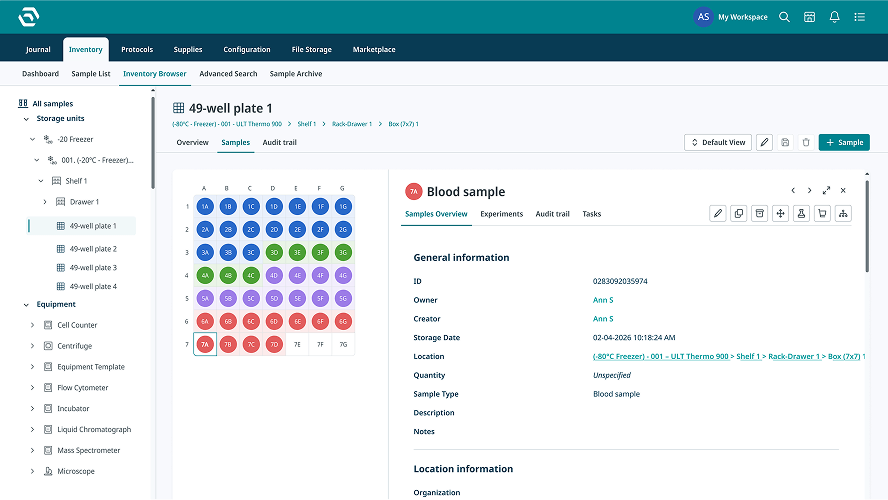
With SciSure LIMS, you can define a plasmid sample type with exactly these fields, including required fields, dropdowns for host strain or marker, file attachments for sequence maps, and auto-numbered identifiers.
- Storage units model your freezers down to individual box positions, so "where is it" has an answer rather than a search.
- Quantity thresholds can notify the owner when a stock runs low, and every sample record carries an audit trail of who changed what and when.
- Parent-child relationships let you record that a construct came from a specific backbone, so lineage across a library of derivatives stays visible.
- Sample lineage, check-out tracking and barcode workflows are available as marketplace add-ons, and available fields and permissions depend on how your group is configured.
If you're weighing options, our comparison of sample management and tracking software covers what to look for.
Why plasmid libraries fall apart
Libraries rarely fail all at once. They degrade in ways that are obvious in hindsight:
- Someone leaves.
A postdoc finishes, and the constructs they built are still in the freezer with names only they understood. The tubes survive. The knowledge does not.
- Two things share a name.
Two people independently call something pCMV-GFP2. Six months later nobody can tell which box holds which.
- The master stock becomes the working stock.
Nobody meant for it to happen. The convenient tube got used repeatedly, freeze-thaw cycles accumulated, and the backup that was supposed to protect the library is now the degraded one.
- The spreadsheet forks.
Someone downloads a copy to work offline, edits it, and now there are two versions with no way to tell which is current.
Each of these is a records problem rather than a science problem, which is why the fix is a records system: one place everyone works from, permissions so the master stock cannot be consumed without anyone noticing, and a history that shows what changed.
Go deeper on building and storing your plasmid library
This post covers what to track and why. Our whitepaper, "The Ultimate Guide to Building, Managing, and Analyzing Your Plasmid Library" covers how, in more detail than fits here:
- Building a sustainable library, from vector selection through QC scheduling
- Naming conventions that hold up past a few thousand constructs
- Storage practices: containers, temperatures, buffers, backups, master stock separation
- Software tools for in silico sequence work and plasmid mapping
FAQs
What is a plasmid library?
A plasmid library is the collection of plasmid constructs a lab maintains, usually a set of parental backbones plus derivatives carrying different inserts, mutations or tags. It exists physically as glycerol stocks or purified DNA in a freezer, and digitally as the records describing what each construct is.
What information should a plasmid database contain?
At minimum: a unique identifier, plasmid name, backbone, insert, selection marker, host strain, source, sequence file, QC status and date, concentration, storage position, whether the tube is master or working stock, and who owns it.
How are plasmids used in genetic engineering?
A gene or fragment is inserted into a vector backbone, the vector is introduced into a host cell, and the host replicates it. Depending on the vector, the gene is then expressed as protein, integrated into the host genome, or amplified for downstream use.
Is a spreadsheet enough for tracking plasmids?
For a small single-person library, often yes. Spreadsheets break down once several people edit them, once you need to search by attributes such as resistance marker, or once you need to know who changed a record and when. A LIMS (Laboratory Information Management System) handles those cases with permissions, audit trails and structured search.
What is the difference between master stock and working stock?
Master stock is the archived reference copy, stored at -80°C and used only to generate new working stock. Working stock is what the bench draws on day to day. Keeping them separate means repeated freeze-thaw cycles do not degrade the copy you would need to rebuild from.

Read more of our blogs about modern lab management
Discover the latest in lab operations, from sample management to AI innovations, designed to enhance efficiency and drive scientific breakthroughs.