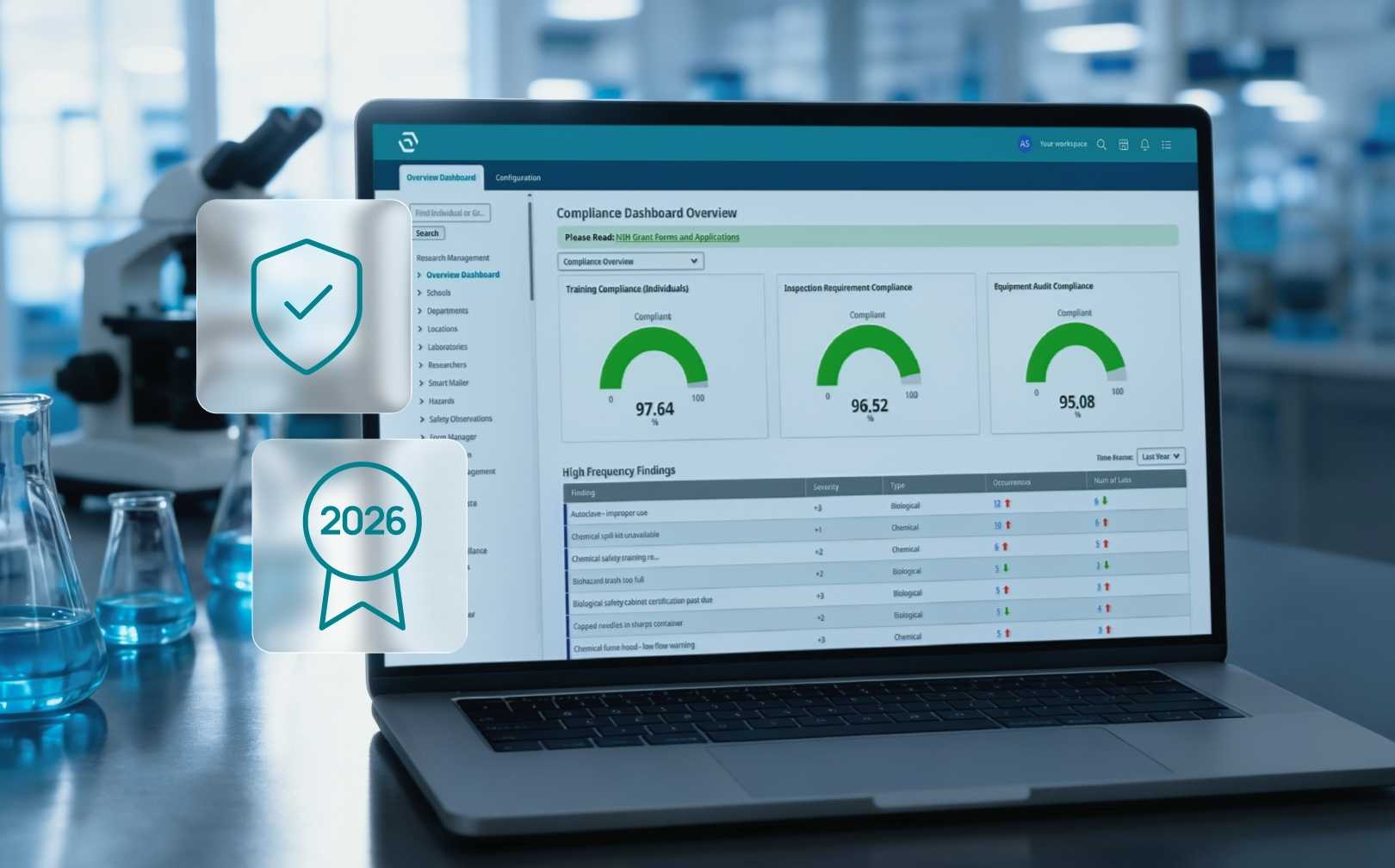
Streamlining Chemical Inventory Reporting for Fire Safety
Chemical inventory software helps labs move from "We think this is what we have," to "We can show what we have, where it is, what it means, and what needs attention."
Download Whitepaper
TL;DR
Chemical inventory software helps labs convert container-level chemical data into fire-code, SDS, Tier II, and emergency-ready reports without rebuilding records from spreadsheets before every deadline.
- Regulations are tightening.
OSHA aligned the Hazard Communication Standard with GHS Revision 7 in 2024 and, on January 15, 2026, extended compliance dates, moving the first substance deadline to May 19, 2026. Labs need inventories clean enough for updated hazard data to reach the right containers, rooms, and people in time.
- Track containers, not chemical names.
The National Academies' Prudent Practices recommends recording CAS number, hazard class, quantity, storage location, acquisition date, and owner for every container. Fire safety depends on answering location-specific questions fast: what sits in each room, cabinet, cold unit, or control area, and which containers count toward flammable or oxidizer totals.
- Spreadsheets lose the thread.
Static lists rarely reflect moved bottles, bulk solvent deliveries, expired peroxide formers, or missing SDSs. A 2025 study of SDS data structures found the volume of supplier documents makes centralizing and retrieving safety data difficult, leaving labs with an SDS binder somewhere instead of the right sheet on the right container.
- Fire-code reporting by control area.
SciSure's ChemTracker generates Fire Code Reports using IBC 2015 definitions and maximum allowable quantity (MAQ) values per control area, with adjustments for flammable cabinets and sprinklers where configured. By Regulation, federal Tier II/RTK, state-level, and NFPA reports pull from the same live container data.
- Bulk import keeps records current.
ChemTracker's spreadsheet import tool adds or edits up to 9,999 container records in one file, with SDS auto-match where enabled. New labs joining a site, large shipments, and system migrations get a controlled intake path with error flagging before the next report or fire marshal visit.
Ready to see SciSure in action?
No commitment · Free consultation
Why is chemical inventory reporting for fire safety important?
Chemical inventory software helps labs turn container-level chemical data into fire-code, SDS, Tier II/RTK, and emergency-ready records without rebuilding the story from spreadsheets every time. It means knowing what chemicals are on-site, where they are stored, how much is present, who owns them, how they are labeled, and which hazards or reporting thresholds they touch. That sounds simple until a lab moves rooms, receives a bulk solvent order, stores an old peroxide former in cold storage, or needs to answer a fire marshal's question by building, room, cabinet, or control area. The National Academies' Prudent Practices in the Laboratory defines it in even simpler terms: a lab cannot manage safety, security, emergency planning, or waste without knowing what chemicals are on-site and where they are stored.
Why does this matter now?
Because the rules and the data behind them keep getting sharper. OSHA updated the Hazard Communication Standard in 2024 to align mainly with the seventh revised edition of GHS, improve labels and SDSs, and give workers and first responders better hazard information. On January 15, 2026, OSHA extended the HSC compliance dates, moving the first substance deadline to May 19, 2026 and pushing the other HCS dates by four months.
The practical takeaway here: "Keep the inventory clean enough that updated hazard data can actually reach the right containers, rooms, and people." OSHA's laboratory standard also requires a written Chemical Hygiene Plan where hazardous chemicals are used, and that plan must be capable of protecting employees from chemical health hazards and keeping exposures below applicable limits.
Recent research points in the same direction. A 2025 paper that studied chemical-industry fire investigation reports from 2013 through 2024 found that narrative report data can reveal risk patterns such as hazardous chemical leakage, unsafe storage practices, equipment problems, and environmental ignition factors. That study is not lab-specific, but the lesson travels well: the record matters because it shows the pattern behind the number.
What should your chemical inventory capture?
At minimum, a useful lab chemical inventory should track each container, not just each chemical name. Prudent Practices recommends inventory fields such as container name, formula, CAS number, source, size or original quantity, hazard class, date acquired, storage location, and the person responsible for the material.
For fire safety, the high-value fields are the ones that help you answer urgent questions quickly:
- What is stored in this room, cabinet, cold unit, or control area?
- Which containers count toward flammable, oxidizer, corrosive, toxic, peroxide-former, compressed gas, or other hazard totals?
- Which chemicals have SDSs attached and current enough to be useful?
- Which containers are expired, deteriorating, missing labels, or no longer owned by an active lab member?
- What changed since the last inspection, report, audit, or fire marshal visit?
OSHA's Hazard Communication Standard requires a written hazard communication program with a list of hazardous chemicals known to be present. It also requires labels and SDSs for exposed workers. EPA's Tier II guidance asks for the maximum amount present during the prior year, the average daily amount, storage details, and location. Those requirements don't work well if the source inventory is stale.
Here's a non-exhaustive list of SciSure's chemical inventory-specific features and how they can help your team.
Where do labs lose the thread?
Usually in the gap between the shelf and the report. A spreadsheet may know that the lab owns acetone, but not whether the bottle is still there, whether it moved rooms, whether five more bottles arrived last week, whether the SDS matches the manufacturer, or whether the amount now changes a control-area view.
SDS data can also be harder to keep tidy than it looks. A 2025 SDS data-structure paper notes that the sheer number of SDSs from many suppliers makes it hard to centralize, retrieve, and share SDS data across systems. In day-to-day lab terms, that means "We have an SDS binder somewhere," is not the same as, "The right SDS is attached to the right container."
How does chemical inventory software help?
Good chemical inventory software gives the lab a live operating record instead of a once-a-year cleanup project. The job is not just to store names and quantities. The job is to keep container data, SDSs, hazard data, locations, owners, and reports close enough together that EHS can act before small issues turn into expensive ones.
For example, with SciSure's ChemTracker, you can:
- Add inventory by chemical name, CAS, product name, or product number
- Assign an owner and storage space
- Record amount and units
- Use barcode or RFID values as unique container IDs
For a lab receiving a large chemical shipment or migrating from another system, the Import & Edit Chemicals by Spreadsheet tool can add or edit up to 9,999 container records in one file, and imported containers can use SDS auto-match where enabled.
That is a real use case, not a nice-to-have: when a new lab joins your site with hundreds of legacy containers, you want a controlled way to bring those records into the system, flag errors, preserve existing values where needed, and review database linkage before the next report is due.
What does SciSure add for fire safety reporting?
SciSure helps connect chemical inventory to the reports EHS teams actually need. ChemTracker reports include By Regulation reports, Federal Tier II / RTK-style reports, configured state and local Tier II-type reports, NFPA reports, Fire Code Reports, and Fire Code Chemical Listings.
For fire-code work, ChemTracker's Fire Code Report runs by control area and uses IBC 2015 definitions and maximum allowable quantity values; the report can account for flammable cabinets and sprinklers where configured, while noting that local fire codes and floor-level details still need EHS judgment. Default MAQs can also be edited per control area when the local code setup calls for it.
All these steps make the workflow more practical. If a lab adds a new solvent-heavy method, moves into a different control area, or starts using a shared flammable cabinet, EHS can look at the containers behind the total instead of guessing which bottles pushed the number up.
Read More: The 5 Best EHS Software Platforms For Labs in 2026
And here's a real-life example of using SciSure's chemical inventory features to speed up reporting and compliance. Before implementing SciSure, San Diego State University's EHS team had little idea or oversight what hazards their labs contained. They started with SciSure's platform and Door Signs, then added ChemTracker and SDS, Hazardous Waste, and Radioisotope Management.
This provided the SDSU team the actionable oversight to identify what hazards were present, communicate with the right people when safety-critical building issues occurred, and report with confidence that 100% of spaces where chemicals were used had been inspected. The team also had visibility into which labs were working with biological materials or other specific hazards.
Their training and reporting results speak for themselves:
Take control of your chemical inventory
The best time to fix chemical inventory reporting is before the report is due, before the inspection, and before the emergency. If your team can see what is in each room, which hazards apply, what has changed, and which records need cleanup, fire safety reporting becomes part of normal lab management instead of a scramble.
Chemical inventory software also helps labs move from "We think this is what we have," to "We can show what we have, where it is, what it means, and what needs attention." That is the difference between a spreadsheet that survives until the next audit and a safety system that can support the way labs actually change.
SciSure's Safety & Compliance tools are built for this kind of connected work: hazardous material tracking, SDS management, training, inspections, incident management, hazardous waste, dashboards, reports, and audit-ready records in one lab-focused system.
So if this sounds like something that could be valuable to your lab, get in touch.

Read more of our blogs about modern lab management
Discover the latest in lab operations, from sample management to AI innovations, designed to enhance efficiency and drive scientific breakthroughs.